


Key Takeaways
- Bridge bearings are small components that control large forces, rotations, and thermal movements, making them frequent root causes of maintenance events.
- Demand is anchored less in new bridges and more in rehabilitation cycles where bearings and joints are replaced to restore movement and prevent damage.
- The market is likely to grow from 2026 to 2036 because bridge preservation programs are expanding and many bridge stocks are reaching replacement age for bearings.
- Corrosion, debris locking, misalignment, and loss of movement are recurring failure modes that pull spending toward higher durability designs and better access for inspection.
- Seismic isolation bearings are a focused growth pocket in high hazard regions and retrofit programs, but not the dominant volume driver everywhere.
- The biggest substitution threat is jointless design using integral and semi integral abutments that reduce or eliminate bearings in many spans.
- Innovation is shifting value toward low maintenance systems, better sliding surfaces, replaceable modules, and monitoring that detects movement loss early.
What do bridge bearings do and where does demand actually come from?
Bridge bearings sit between the superstructure and substructure and do two jobs that sound simple but are mechanically unforgiving. They transfer vertical and horizontal loads safely, and they allow the structure to move and rotate without tearing itself apart. Movement comes from temperature cycles, shrinkage and creep, traffic braking forces, wind, and in some regions earthquake demands. If a bridge is restrained when it expects to move, internal forces accumulate and the bridge starts paying a hidden tax in cracked decks, damaged joints, distorted girders, and spalled concrete at supports.
Demand for bearings is often misunderstood as a new construction story. In reality, the durable demand pool is rehabilitation. Bearings are wear components in the same way joints and waterproofing are wear components. They can lose functionality long before a bridge is structurally obsolete because they are exposed to water, deicing salts, debris, and poor drainage. A bearing that is locked by corrosion or clogged by debris stops accommodating movement. That triggers secondary damage which is more expensive than the bearing itself, and it also creates risk because a stuck bearing can shift load paths in ways designers never intended. So agencies spend on bearings to restore movement and to prevent cascading damage, not because bearings are exciting.
From 2026 to 2036, growth is more likely than decline for a simple reason: most countries are staring at ageing bridge inventories and trying to stretch service life through preservation. When you shift from build new to keep safe, components that can be inspected, maintained, and replaced become the spending priority. Bearings sit high on that list because they are critical, they fail in visible ways, and they are replaceable with targeted traffic management compared with full deck or superstructure replacement. This creates a market that behaves like maintenance capital rather than pure infrastructure expansion.
How does the bridge bearing supply chain work, and where are the weak links?
The bridge bearing supply chain is less about raw material availability and more about precision manufacturing, interface engineering, and quality assurance. The core types include elastomeric laminated bearings, pot and disc bearings, spherical and cylindrical bearings, and sliding systems using low friction interfaces such as PTFE against stainless steel. Each type comes with a different mix of materials, fabrication steps, and failure sensitivities. Elastomeric bearings lean heavily on compound quality, lamination integrity, and long-term aging performance. Mechanical bearings lean on machining precision, sealing, corrosion protection, and predictable friction behavior under load.
Quality risk concentrates at interfaces. Bearings live at the boundary between design intent and messy reality: imperfect concrete seats, construction tolerances, differential settlements, drainage failures, and thermal gradients. A bearing can be perfectly manufactured and still fail as a system if it is installed with poor alignment, improper shimming, inadequate anchorage, or insufficient maintenance access. That is why the supply chain includes more than a factory. It includes design standards, fabrication specifications, installation practices, inspection protocols, and replacement methods that can be executed under traffic.
The weak links are predictable and boring, which makes them dangerous. First is corrosion and debris management around bearings and joints. If drainage is poor, the bearing environment becomes hostile, accelerating wear and locking movement. Second is inspection access. Many legacy bridges were not designed for easy bearing inspection, making condition problems invisible until they become expensive. Third is lifecycle planning. Agencies often replace bearings only after secondary damage appears, even though early interventions can prevent major repairs. This creates a demand bias toward replacement rather than preventive maintenance, and it favors designs that are easier to access, easier to replace, and more tolerant of real-world contamination.
Which alternatives could shrink the market, and what innovations keep it growing?
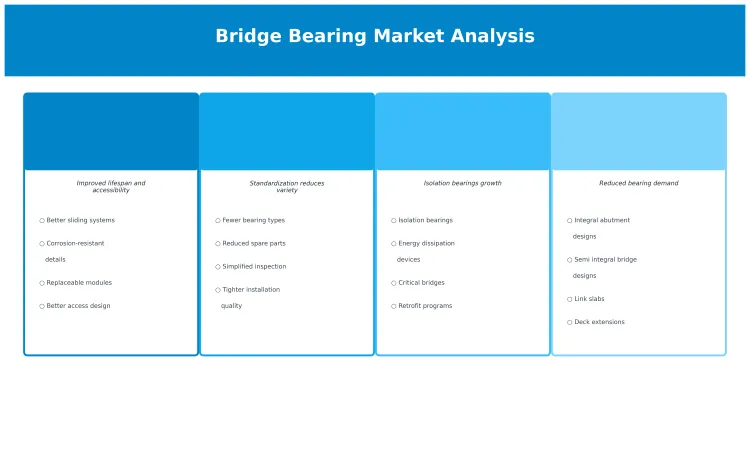
The primary alternative threat is not a new bearing technology. It is a different bridge philosophy: reduce movements, reduce joints, and reduce components that need maintenance. Integral abutment and semi integral bridge designs aim to eliminate deck joints at abutments and often reduce or remove bearings at ends. Link slabs and deck extensions are also used to reduce joints, and fewer joints usually means fewer bearing-related damage chains. When agencies adopt jointless strategies, the bearing market can lose volume on certain bridge families, especially shorter spans and bridges where thermal movements can be accommodated by abutment flexibility and soil interaction.
A second substitution trend is component simplification through standardization. Some owners shift toward fewer bearing types to reduce spare parts, simplify inspection, and tighten installation quality. This can compress variety and price dispersion, but it does not necessarily reduce unit demand because standardization often coincides with higher replacement activity and stronger preservation programs.
Innovation that supports growth is mostly about durability, maintainability, and evidence. On the mechanical side, better sliding systems and corrosion-resistant details aim to preserve movement under contamination and weather exposure. Replaceable modules and better access design reduce total lifecycle cost by making bearing swaps faster and less disruptive. In seismic regions, isolation bearings and energy dissipation devices are a growth pocket because they move the value proposition from simple movement accommodation to hazard resilience, especially for critical bridges and retrofit programs.
The biggest market tailwind is that owners increasingly treat bearings as assets that must be monitored and managed, not forgotten until they seize. Digital inspection, condition monitoring, and improved guidance on maintenance and replacement push the market toward planned interventions rather than emergency repairs. The net effect from 2026 to 2036 is likely steady growth driven by preservation cycles, with selective volume headwinds in bridge families that adopt jointless strategies at scale.
How FMI can Help
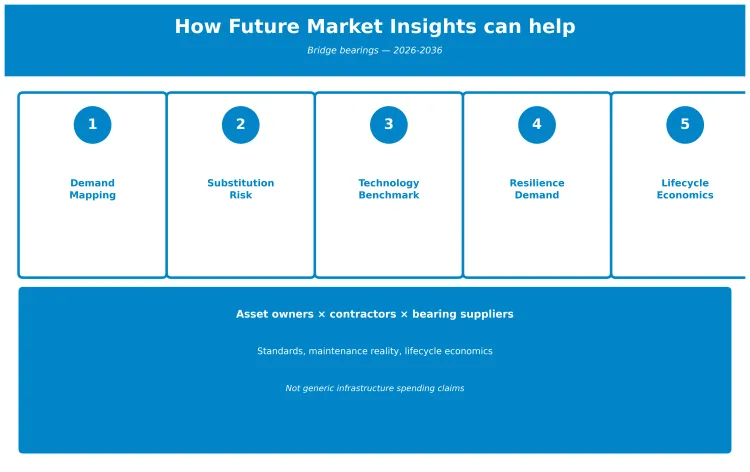
Future Market Insights can help bridge asset owners, contractors, and bearing suppliers turn a complex component market into a decision-ready view of where spending will concentrate from 2026 to 2036. We can map demand by bridge class and lifecycle stage, separating new construction from rehabilitation and preservation, then identifying which bearing types dominate each use case. FMI can also profile substitution risk from jointless design approaches such as integral and semi integral bridges and link slab strategies, clarifying where these designs are expanding and where they are constrained by span length, soil conditions, and movement demands. On the supply side, we can benchmark bearing technologies and the capabilities that influence procurement decisions, including corrosion resistance, replaceability, inspection access, and quality assurance requirements. For high hazard regions, we can quantify the resilience-driven pocket where seismic isolation bearings and retrofit programs create incremental demand. The result is a market narrative grounded in standards, maintenance reality, and lifecycle economics, not generic infrastructure spending claims.
Bibliography
- Federal Highway Administration. Jointless Bridges Volume III Summary Report. United States Department of Transportation.
- Federal Highway Administration. Comprehensive Design Example for Prestressed Concrete Bridge Superstructure. United States Department of Transportation.
- Federal Highway Administration. Case Study Eliminating Bridge Joints with Link Slabs. United States Department of Transportation.
- Federal Highway Administration. Bridge Preservation Guide. United States Department of Transportation.
- American Association of State Highway and Transportation Officials. AASHTO LRFD Bridge Design Specifications, Section 14 Joints and Bearings. AASHTO.
- American Institute of Steel Construction and National Steel Bridge Alliance. Steel Bridge Bearing Guidelines. AISC and NSBA.
- Indian Railways Research Designs and Standards Organisation. Guidelines for Inspection and Maintenance of Bridge Bearings, BS 102 Revision 1. RDSO.
- Mitoulis, S. A. Challenges and opportunities for the application of integral abutment bridges. Engineering Structures.
- Federal Highway Administration. Seismic Retrofitting Manual for Highway Structures Part 1. United States Department of Transportation.
- Federal Highway Administration. LRFD Seismic Analysis and Design of Bridges. National Highway Institute, United States Department of Transportation.
- California Department of Transportation. Seismic Design of Bridges with Isolation Bearings, Bridge Design Memo 20.33. Caltrans.
- Multidisciplinary Center for Earthquake Engineering Research. Seismic Isolation of Highway Bridges. MCEER.
- European Commission Joint Research Centre. Research and Innovation in Bridge Maintenance, Inspection and Monitoring in Europe. JRC.

