


- Food and beverage "chitosan brand share" should actually be considered supplier positioning and not consumer brand share.
- Reliable information about supplier market share is scarce; competitive capability is best understood from food-grade specifications, application expertise, regulatory documents, source reliability, and market coverage.
- FMI names KitoZyme S.A., Heppe Medical Chitosan GmbH, Primex EHF, Golden-Shell Pharmaceutical Co., Ltd., and Qingdao Yunzhou Biochemistry Co., Ltd. as some of the leading companies operating in the Chitosan Market.
- Suppliers positioning their products as premium have a significant advantage when dealing with customers that require high-purity grades, fungal chitosan, strong documentations, and application-level support.
- Suppliers positioning their products as value are well positioned to compete in cost-sensitive, volume-driven, and basic food-grade markets but vulnerable to inconsistency, traceability, and document issues.
- The main fallacy is assuming that the company producing the highest volumes or most economically priced chitosan would emerge as the winner. The real winner in this industry is the supplier minimizing buyer qualification risk.
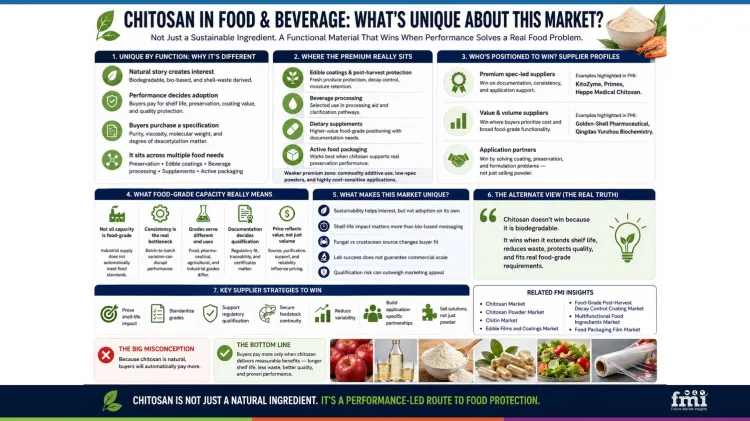
Chitosan is not a typical brand market in the food sector. Consumers do not typically shop by comparing chitosan brands in stores. Rather, the competitive issue becomes who can compete more effectively for favor among food producers, ingredient buyers, coating formula makers, beverages producers, dietary supplements makers, and food packaging innovators.
This is important as "brand share leaders" in chitosan may not necessarily be the leading branded names. The brand share leaders are those who can fulfill the precise requirements of food additives, dietary supplements, edible coatings, preservatives, and food packaging products.
FMI’s Chitosan Market lists KitoZyme S.A., Heppe Medical Chitosan GmbH, Primex EHF, Golden-Shell Pharmaceutical Co., Ltd., and Qingdao Yunzhou Biochemistry Co., Ltd. among key companies. These companies do not all compete in the same way. The chitosan market has different winner profiles by grade, application, source, and price tier.
The first winner profile is the premium specification-led supplier. These suppliers are strong where food and beverage buyers need high-quality material, consistent specifications, strong documentation, and application guidance. This is especially important in clean-label preservation, dietary supplements, edible coatings, beverage processing, and export-oriented food systems. Buyers in these applications do not only ask whether the supplier can provide chitosan. They ask whether the supplier can provide the right grade repeatedly.
KitoZyme is especially relevant in fungal chitosan. This positioning is useful for food and beverage companies that want non-crustacean sourcing, allergen-sensitive communication, or beverage processing applications. FDA GRAS Notice GRN 397 lists chitosan from Aspergillus niger for alcoholic beverage production. That gives fungal chitosan a stronger documentation story in selected use cases, especially where source and regulatory clarity matter.
Chinova Bioworks is also worth watching in food preservation, even where it is not always listed in broad chitosan supplier rankings. FDA GRAS Notice GRN 997 covers chitosan from white button mushrooms for antimicrobial use across specified food categories. This makes mushroom-derived chitosan commercially relevant for clean-label antimicrobial positioning in food and beverage. The important point is that regulatory clarity and intended-use documentation can be a competitive advantage, not just product chemistry.
Primex has a different strength. Its chitosan story is linked to North Atlantic shrimp sourcing and a premium crustacean-origin positioning. For buyers that value marine-origin chitosan, traceability, and raw material quality, this can be attractive. Primex can be relevant in dietary supplements, food-related applications, and other high-purity uses. However, food companies still need to verify the exact regulatory status, intended use, and documentation for each target market.
Heppe Medical Chitosan GmbH fits the high-purity and technical credibility profile. The company is associated with chitosan and chitosan derivatives for research, medical technology, and pharmaceutical uses. For food and beverage, this type of supplier may not always be the lowest-cost option, but it can influence premium segments where buyers value tight specification control and technical discipline.
Golden Shell Pharmaceutical, as well as Qingdao Yunzhou Biochemistry, present an alternative approach to competing. Chinese sources of chitosan are essential if there is to be any competitive advantage in terms of price efficiency, availability, and volume. The significance of the point is that not all the applications in relation to chitosan are able to afford high prices for special chitosan. Competitive prices are needed in such cases as bulk dietary supplements, food additives, and preservation uses.
The market is therefore not simply premium versus cheap. The market is defined by the requirement of applications. In the case of a company that manufactures beverages, its priorities will include being fungal source-based, easily soluble, regulatory history, and as a processing aid. A fruit coating company will consider priority for viscosity, film formation, antibacterial properties, and compatibility with coatings. A nutritional supplement company will give importance to pure, controlled heavy metals content, and particle size.
FMI’s Food-Grade Post-Harvest Decay Control Coating Market provides an important adjacent signal because it identifies chitosan and biopolymer coatings among the coating material types used to protect fruits and vegetables. Suppliers that can support coating trials, shelf-life validation, and produce-specific performance will be better positioned than suppliers that only sell powder.
FMI’s Edible Films and Coatings Market also matters because chitosan can fit into polysaccharide-based edible coating systems. This creates an opportunity for suppliers that can move beyond ingredient supply into application support. In edible coatings, the supplier who helps solve formulation, coating, and stability problems can capture more value than the supplier who only competes on price per kilogram.
The suppliers that face the greatest vulnerability are those that provide their chitosan as a generic product. The inability of such suppliers to provide specifications regarding degree of deacetylation, molecular weight, viscosity characteristics, traceability of origin, microbial requirements, contaminants control, and suitability for particular uses makes it hard to convince buyers in the food and beverages market. These suppliers might still be able to penetrate markets for low value applications but will find it difficult to penetrate premium applications such as preservatives, coating materials, and food grade chitosan.
The myth not to buy into is that successful chitosan suppliers are only the large producers. Large size counts for something, but success in the food and beverages market involves qualification and suitability of use more than anything else.
Bottom line: The winners in food-grade chitosan will not be the suppliers shouting the loudest about sustainability. They will be the suppliers that win clearly by grade tier: premium documentation and application support at the top, cost-efficient food-grade supply in the middle, and formulation partnerships where chitosan must solve a real food preservation problem.
Reference
- Chitosan Market
- Chitosan Powder Market
- Chitin Market
- Edible Films and Coatings Market
- Food-Grade Post-Harvest Decay Control Coating Market
- Multifunctional Food Ingredients Market
- Food Packaging Film Market

