


Key Takeaways
- Downstream processing remains a major contributor to cost of goods in monoclonal antibodies and other biologics, even as upstream titers increase.
- Protein A resin is priced far higher than ion-exchange or hydrophobic interaction resins, which makes utilisation per litre more important than unit price.
- Resin capacity, alkaline stability and cycle lifetime influence cost outcomes more strongly than small differences in purchase cost.
- Continuous and intensified downstream approaches improve resin utilisation, but only if the resin can withstand high cycle numbers and aggressive cleaning.
- Resin selection also affects buffer demand, water-for-injection usage and facility footprint, creating indirect costs that accumulate over time.
How much of biologics COGS actually comes from chromatography?

Most techno-economic analyses show that downstream steps can account for a major portion of total cost of goods, especially at commercial scale. The capture step, typically protein A chromatography, represents a meaningful share of these costs because of the high price and validated lifetime requirements of the resin. As upstream titers rise, the mass of product per batch increases, but the downstream load increases with it. This leaves resin performance and longevity as factors that can shift overall COGS more than labour or utilities. Protein A media costs far more per litre than standard polishing resins.
The question that matters to manufacturers is how many grams of product can be processed per litre of resin before it reaches the end of its validated cycle life. A resin that tolerates alkaline cleaning and delivers several hundred cycles spreads its initial cost across a much larger quantity of processed product. Lower-cost resins with limited stability often lead to higher total cost because of early replacement, larger columns or additional polishing steps.
Dynamic binding capacity at practical residence times determines how much resin volume is required to meet throughput targets. Higher capacities reduce column size, limit the number of trains needed for commercial output, and shorten campaign times. These choices influence labour, buffer preparation and changeover schedules. Smaller columns also reduce equilibration and wash volumes, which lowers operating costs linked to water, buffer chemicals and wastewater management.
What does the "per-gram" cost logic look like?
Increasing usable cycles through robust cleaning compatibility, improving loading strategies to increase mass per cycle, or maintaining yield through better integration with upstream titers all reduce per-gram cost more effectively than marginal reductions in resin price. This is why resin lifetime and real-world loadability are central variables in process economics. Continuous multicolumn chromatography keeps resin closer to full utilisation by cycling smaller columns more frequently.
This reduces total resin volume needed for a given annual output and can also reduce buffer and WFI consumption. These benefits only hold if the resin chemistry remains stable across high cycle numbers and repeated cleaning. If stability is limited, cost savings from intensification quickly disappear due to early resin replacement and process risk. Downstream chromatography consumes large volumes of buffer for equilibration, washing and cleaning. This drives chemical consumption, WFI generation and wastewater treatment.
Studies of intensified chromatography and buffer recycling show measurable reductions in buffer use when column volumes are smaller and compatible buffer fractions are reused. Because resin properties determine feasible column volumes, flow rates and cleaning conditions, they influence both direct and indirect operating expenditures. Manufacturers need to evaluate resins based on total cost per gram over their validated lifetime, not on list price.
Early process design and cost modelling should incorporate resin lifetime, cleaning capability and dynamic binding capacity. For suppliers, performance factors that support high-cycle stability and compatibility with intensified processes will determine long-term competitiveness. Chromatography resin becomes a structural economic lever in biologics manufacturing rather than a routine consumable.
How FMI Can Help
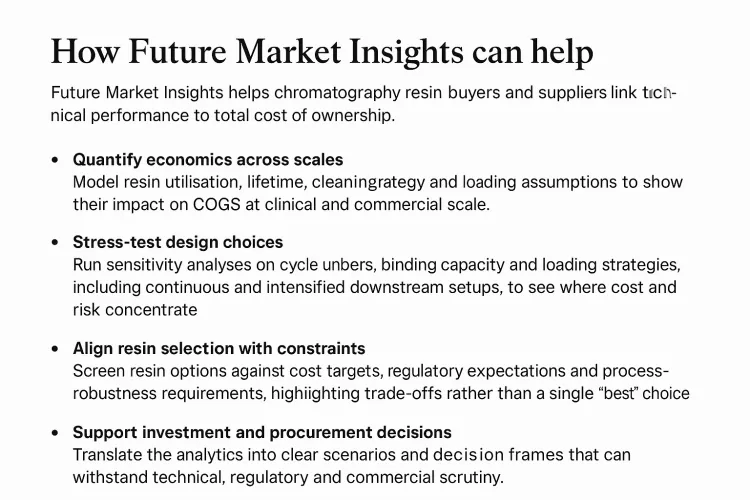
FMI can support chromatography resin stakeholders by mapping resin performance factors to realistic cost outcomes across clinical and commercial scales. This includes evaluating resin lifetime assumptions, quantifying sensitivity to cycle numbers and loading strategies, and analysing how continuous or intensified downstream designs shift demand for specific resin chemistries. Our work aligns resin selection with cost targets, regulatory constraints and process robustness requirements, helping manufacturers make evidence-based decisions that withstand commercial scrutiny.
Sources
- Farid, S.S. (2007). Process economics of industrial monoclonal antibody manufacture. Journal of Chromatography B, 848(1), 8–18.
- Farid, S.S. (2009). Economic drivers and trade-offs in antibody purification processes. BioPharm International.
- Kelley, B. (2009). Industrialization of mAb production technology: The bioprocessing industry at a crossroads. mAbs, 1(5), 443–452.
- Nandi, S. et al. (2016). Techno-economic analysis of a transient plant-based platform for monoclonal antibody production. Plant Biotechnology Journal, 14(12), 2370–2379.
- Lorek, J.K. et al. (2025). Buffer recycling in an integrated antibody downstream process. Processes, 13(11), 3563.
- (SSRN working paper, 2024). Downstream processing through buffer recycling. (Techno-economic discussion; notes downstream processing costs can reach 70–90% of overall manufacturing costs and emphasizes buffer/WFI usage.)
- Farid, S.S. (2017). Process economic drivers in industrial monoclonal antibody manufacture. In U. Gottschalk (Ed.), Process Scale Purification of Antibodies. Wiley.

