


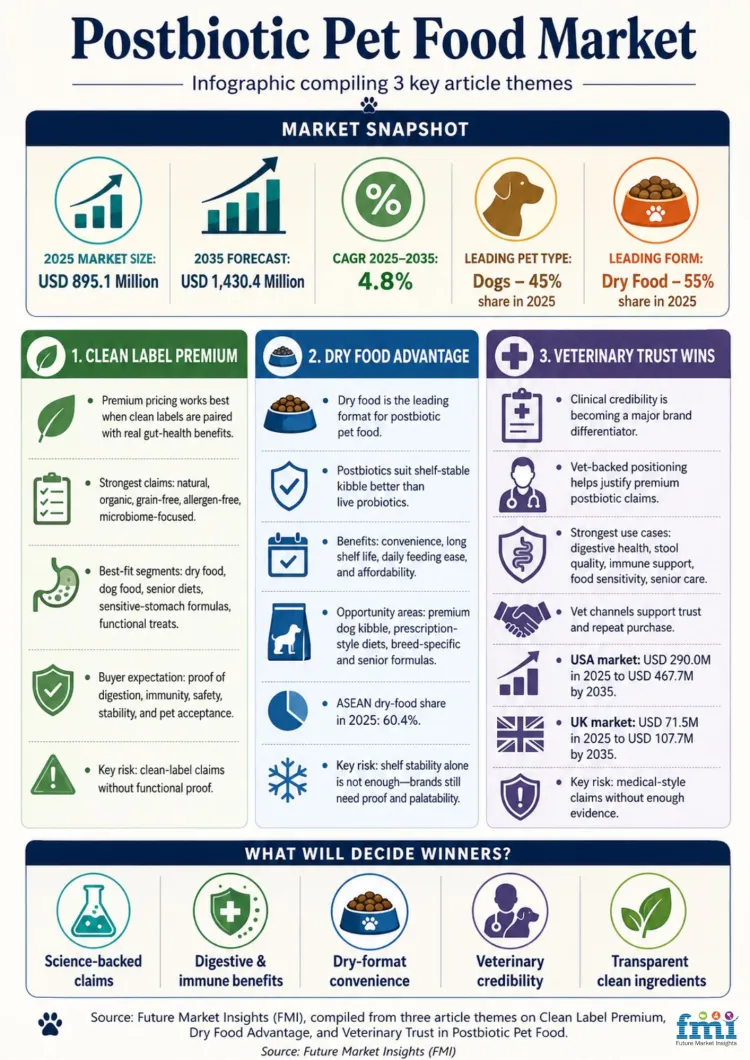
- Dry food is becoming the strongest delivery format for postbiotic pet food because it combines gut health positioning with convenience, affordability, long shelf life, and easy daily feeding.
- FMI identifies dry food as the leading form in the global postbiotic pet food market, with 55% value share in 2025.
- Postbiotics fit dry kibble better than live probiotic claims because postbiotics do not require refrigeration and can be integrated into dry extruded kibble, freeze-dried meals, dehydrated formulas, treats, and powders.
- The strongest opportunity sits in premium dry dog food, prescription-style kibble, breed-specific diets, senior pet formulas, sensitive-stomach products, and microbiome-focused dry treats.
- The biggest risk is assuming shelf stability alone will win. In postbiotic pet food, dry food brands must still prove digestive benefit, immune support, ingredient transparency, palatability, and feeding consistency.
Dry food is becoming the main commercial route for postbiotic pet food because it solves two problems at once. Pet parents want functional nutrition that supports digestion, immunity, nutrient absorption, and overall wellness. At the same time, they want formats that are easy to store, easy to feed, affordable enough for daily use, and stable on shelf. This is where dry food has a clear advantage over more fragile functional formats.
According to FMI, the global postbiotic pet food market is expected to grow from USD 895.1 million in 2025 to USD 1,430.4 million by 2035, registering a CAGR of 4.8%. FMI connects this growth with rising awareness of pet gut health, pet humanization, and the expansion of functional pet nutrition. Within this market, dry food is identified as the leading form segment, holding 55% value share in 2025.
The reason dry food is so important is that postbiotics are easier to commercialize in stable food systems than live probiotics. Live probiotic claims often depend on maintaining microbial viability through processing, storage, transport, and final consumption. Postbiotics are different because they are not live microorganisms. FMI notes that postbiotics are more stable, do not require refrigeration, and are suitable for dry extruded kibble, freeze-dried meals, dehydrated formulas, and pet treats. This makes dry food one of the most practical formats for scaling gut health claims.
Dry food also fits the everyday feeding behavior of pet owners. Kibble is already familiar, portionable, easy to store, and convenient for households with dogs and cats. A pet parent may buy a supplement occasionally, but dry food is used daily. This gives postbiotic dry food a stronger repeat-consumption advantage. Instead of asking consumers to add a separate gut health product, brands can build digestive and immune support directly into the pet’s main diet.
The dry food advantage is especially visible in dog food. FMI identifies dogs as the leading pet-type segment in the global postbiotic pet food market, with 45% value share in 2025. FMI states that dogs are driving demand because of digestive sensitivities, gut health disorders, immune-related issues, bloating, diarrhea, and food sensitivity concerns. Dry kibble and prescription-based veterinary diets with postbiotics are especially favored by pet parents seeking intestinal health solutions.
This makes premium dry dog food the strongest commercial zone for postbiotic positioning. Dog owners already buy functional formulas for sensitive stomachs, skin and coat health, stool quality, immunity, weight management, and age-specific needs. Postbiotics allow brands to strengthen these claims without depending only on live bacteria. A dry dog food formula that combines postbiotics with clean-label ingredients, protein quality, fiber systems, prebiotics, and veterinary support can justify a premium more effectively than a standard kibble.
The advantage is not only global. In ASEAN, FMI expects dry food to account for 60.4% share of the postbiotic pet food market by 2025. FMI states that dry food is widely accepted because it is shelf-stable, cost-effective, space-efficient, and convenient, while postbiotic dry food supports better digestion, nutrient uptake, and gut health. This shows that dry formats are not only a premium-market solution but also a practical format for high-growth regions where convenience and affordability matter.
The UK market shows a slightly different but still important pattern. FMI reports that dry food holds 45% share in the UK postbiotic pet food market, while wet food holds 40% and is gaining popularity due to hydration and health concerns. This means dry food leads, but it cannot be complacent. In mature markets, dry postbiotic products must compete with wet food, treats, supplements, and DTC feeding models. The winning dry food products will need a stronger value story than shelf life alone.
Dry food also gives manufacturers better room for functional product architecture. Brands can create puppy, adult, senior, breed-specific, small-breed, large-breed, sensitive-digestion, high-protein, grain-free, hypoallergenic, and veterinary-style formulas with postbiotics. FMI notes that breed-specific, size-specific, and age-specific postbiotic products are gaining relevance because pet owners want solutions that match the digestive needs of different pets. This creates a route for dry food brands to move beyond general gut health into targeted nutrition.
Another advantage is manufacturing scale. Dry pet food already has strong global production, packaging, retail, and e-commerce infrastructure. Adding postbiotics to dry food allows large manufacturers to use existing kibble platforms while creating new premium claims. FMI identifies major players such as Cargill, ADM, Diamond V, DSM-Firmenich, and Bosch Tiernahrung as companies using scientific research, premium formulations, clinical studies, and functional ingredient partnerships to strengthen market credibility.
However, the dry food opportunity also raises a formulation challenge. Heat processing, extrusion, palatability coating, storage, and packaging must be managed carefully. Postbiotics are more stable than live probiotics, but the final product still needs consistent functional positioning. If the ingredient is added only for label appeal, buyers may not repeat purchase. The brand must explain what the postbiotic does, why the dosage matters, how the formula supports digestion or immunity, and why the pet should consume it daily.
The dry food format also helps brands communicate value more clearly. A functional treat may be seen as optional. A supplement may be seen as an extra cost. A wet food may be seen as more indulgent or hydration-focused. But dry food is the core diet for many pets. This allows postbiotic dry food to be positioned as preventive daily nutrition rather than an add-on. That daily-use positioning is important because gut health benefits are easier to explain when the product becomes part of routine feeding.
Veterinary endorsement can further strengthen dry food adoption. FMI states that manufacturers are building veterinary partnerships, developing premium and veterinarian-endorsed diets, and investing in clinical validation to support postbiotic claims. This is highly relevant for dry food because prescription-style kibble is already trusted for digestive and immune concerns. Postbiotic dry food can fit naturally into this veterinary nutrition pathway if claims are supported by evidence and transparent labeling.
E-commerce also supports the dry food advantage. Dry food ships more easily than refrigerated or heavy wet formats, and subscription models fit repeat kibble purchases. FMI notes that the growth of e-commerce and DTC sales is supporting postbiotic pet food expansion, while the UK market is seeing online retail and subscription delivery improve access to premium postbiotic products. This creates a strong route for brands selling personalized, breed-specific, or sensitive-stomach dry formulas.
The premium opportunity is strongest when dry food combines multiple claims in a disciplined way. A product can be shelf-stable, clean-label, microbiome-focused, breed-specific, and veterinary supported. But the claims must not become confusing. Pet parents need a simple message: this dry food supports gut health and immunity, is convenient for daily feeding, and is made with transparent ingredients. The more technical the claim, the more important the explanation becomes.
The biggest risk is commoditization. If every dry kibble brand adds postbiotics and uses similar gut health language, the claim may lose power. Brands will then need differentiation through better clinical support, proprietary blends, visible digestive outcomes, stool quality claims, veterinary partnerships, breed or life-stage targeting, clean-label sourcing, and stronger packaging communication. Dry food gives the format advantage, but not automatic brand loyalty.
The practical conclusion is that dry food is likely to remain the leading delivery route for postbiotic pet food because it fits both the ingredient and the consumer behavior. Postbiotics are stable enough for dry systems, while kibble is familiar enough for daily feeding. The brands that win will not simply add postbiotics to dry food. They will use dry food as a platform for trusted, repeatable, affordable, and science-backed gut health nutrition.

