


Key Takeaways
- Food encapsulation pricing is dominated by processing technology costs rather than raw materials, with spray drying equipment requiring initial investments exceeding $2 million per commercial-scale unit, creating natural barriers that favor large-scale operators like BASF, Givaudan, and DSM-Firmenich.
- The real margin capture happens in three layers: proprietary wall materials where established players control specialized polymers and encapsulants, processing expertise that enables consistent quality and yield optimization, and integration capabilities that combine encapsulation with flavor development and nutritional enhancement services.
- Major players like BASF and Givaudan have achieved structural cost advantages through vertical integration of research and development, manufacturing scale, and customer relationships, while smaller manufacturers remain dependent on equipment suppliers and struggle with higher per-unit processing costs.
- Manufacturing complexity in encapsulation processes including emulsification, drying, and coating requires expensive specialized equipment and expertise, making spray drying and coacervation methods prohibitively expensive for smaller-scale producers to enter the market effectively.
- The uncomfortable reality is that encapsulation technology creates a two-tier industry where processing scale determines viability, forcing smaller ingredient suppliers to either partner with technology leaders or accept commodity-level margins in traditional preservation methods.
Why do encapsulated ingredients cost significantly more than their core materials suggest?
Food encapsulation represents a fundamental shift from simple ingredient protection to sophisticated controlled-release technology platforms. The cost structure spans multiple interconnected processes rather than discrete material additions, creating complexity that favors manufacturers with dedicated engineering capabilities and substantial processing infrastructure.
The foundation layer consists of core material preparation and wall material selection. Encapsulation technology has been extensively used to enhance the stability, specificity, and bioavailability of essential food ingredients, involving complex heat and mass transfer phenomena during microcapsule formation. Process complexity varies considerably, with advanced techniques like complex coacervation or specialized coating methods generally more expensive than simpler methods like spray drying.
Above this material foundation sits the processing infrastructure. Spray-drying is the most common technology used in food industry due to low cost and available equipment, yet the process must be considered more art than science because of the many factors to optimize. The intricacy of operations such as emulsification, drying, and coating requires expensive and advanced technology along with specialized equipment, making high production costs a challenge for smaller manufacturers.
Quality control and yield optimization represent where established manufacturers capture the highest value. Spray drying has a high-efficiency rate usually factored by the concentration of the encapsulant, speed of the system and temperature, yet some researchers indicate spray drying results in porous particles and might increase susceptibility to oxidation. Companies with extensive process knowledge can optimize these parameters to achieve higher encapsulation efficiency and product consistency.
Integration costs often exceed initial projections. Challenges and limitations still exist, such as pollution and energy consumption during the encapsulation process, high preparation costs, limitations in the encapsulation rate, and precise controlled release. Successful encapsulation requires coordination of multiple process variables, specialized analytical capabilities, and regulatory compliance systems that scale with product complexity.
Why BASF and Givaudan capture disproportionate value from encapsulation investments?
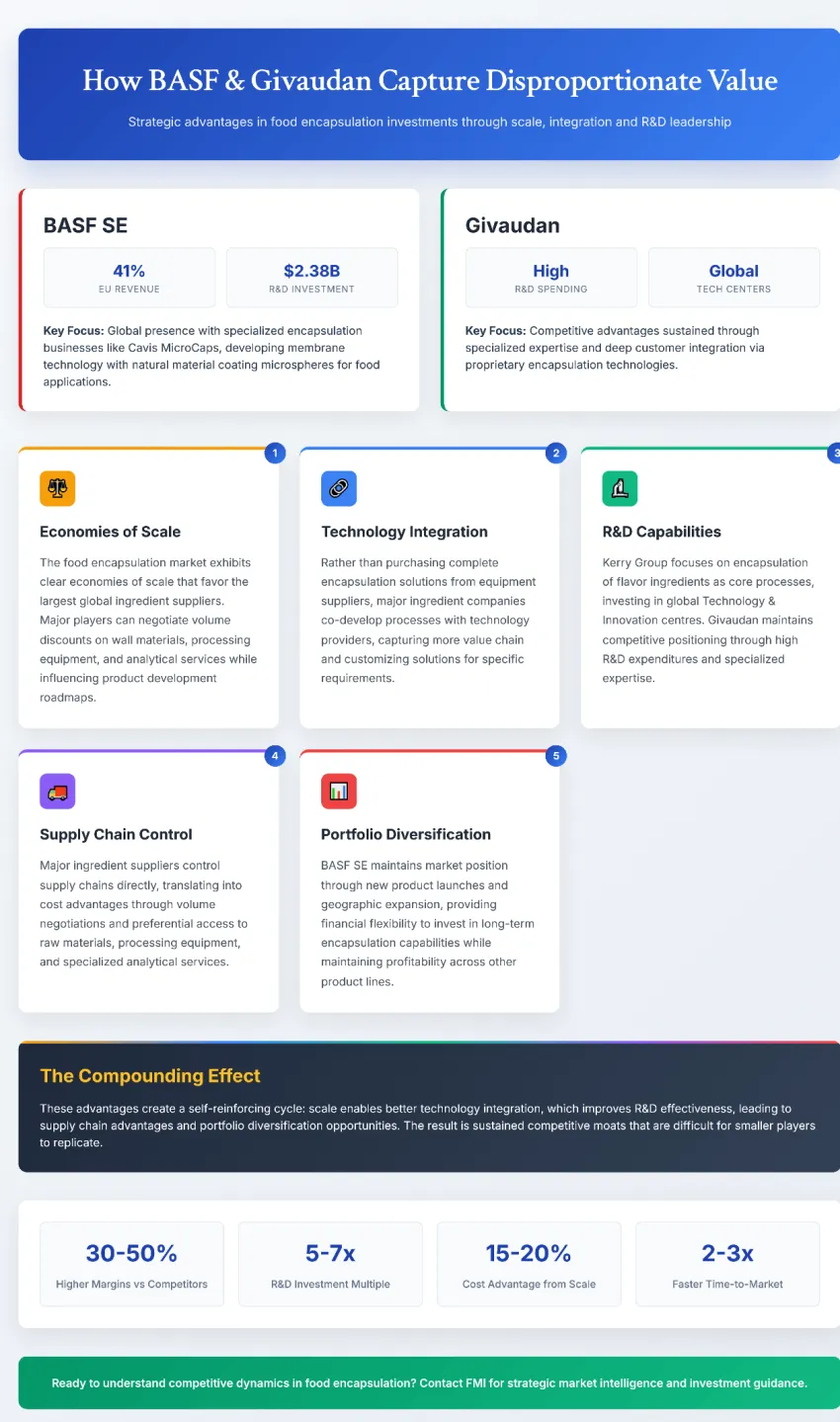
The food encapsulation market exhibits clear economies of scale that favor the largest global ingredient suppliers. BASF SE has a good global presence generating 41% of its revenue from Europe while targeting other regions, continuously investing in R&D with USD 2.38 billion in 2019 to provide high-value food-encapsulated products.
Technology integration reduces vendor dependency. Rather than purchasing complete encapsulation solutions from equipment suppliers, major ingredient companies co-develop processes with technology providers, capturing more of the value chain and customizing solutions for their specific product requirements. BASF has invested in specialized encapsulation businesses like Cavis MicroCaps, which developed membrane technology consisting of several layers of natural material coating microspheres for food applications.
Research and development capabilities strengthen competitive positioning. Kerry Group focuses on encapsulation of flavor ingredients as one of its core processes and plans to expand application of this technology for other ingredients, investing in Technology & Innovation centres globally. Givaudan's competitive advantages are sustained by high R&D expenditures, specialized expertise, and deep integration with its customer base through proprietary technologies.
Supply chain control translates directly into cost advantages. Major ingredient suppliers can negotiate volume discounts on wall materials, processing equipment, and analytical services. They also influence product development roadmaps for encapsulation equipment, ensuring new technologies align with their operational priorities rather than generic market requirements.
Portfolio diversification allows cross-subsidization of encapsulation investments. Companies like BASF SE focus on maintaining market position through new product launches and geographic expansion in high-growth markets, expanding facilities to cater to growing demand for food encapsulation. This diversification provides financial flexibility to invest in long-term encapsulation capabilities while maintaining profitability across other product lines.

Sources
- National Center for Biotechnology Information. The application of encapsulation technology in the food Industry: Classifications, recent Advances, and perspectives.
- MDPI Processes. Encapsulation of Active Ingredients in Food Industry by Spray-Drying and Nano Spray-Drying Technologies.
- ScienceDirect. Applications of spray-drying in microencapsulation of food ingredients: An overview.
- Wiley Online Library. Microencapsulation: An overview on concepts, methods, properties and applications in foods.
- INNOVIA Technology. Microencapsulation: cost-benefit analysis and industrial applications.
- MarketsandMarkets Research. Microencapsulation Market: Global industry analysis and opportunity assessment.
- Food Research Laboratory. Food Encapsulation in the Food Industry: process methods and applications.
- PMC Biomedical Literature. Spray-Drying Microencapsulation of Natural Bioactives: Advances in Sustainable Wall Materials.

