


Key Takeaways
- Automotive HUD pricing is dominated by projection unit costs and thermal management rather than optical components, with DLP technology commanding premium pricing despite higher heat generation, while TFT-LCD solutions achieve cost advantages through simpler manufacturing processes and established supply chains.
- Manufacturing complexity concentrates in three critical areas: picture generation unit assembly requiring specialized semiconductor integration, thermal dissipation systems demanding sophisticated cooling solutions, and optical calibration processes that ensure proper virtual image distance and field-of-view specifications across varying vehicle geometries.
- The real margin capture happens in three distinct layers: projection technology licensing where Texas Instruments controls DLP patents and Asian suppliers dominate LCD manufacturing, system integration capabilities where Continental and Bosch leverage automotive qualification expertise, and aftermarket positioning that creates switching costs through OEM partnerships and dealer networks.
- Established Tier-1 suppliers maintain structural advantages through automotive-grade component sourcing, extensive testing protocols, and long-term OEM relationships, while Chinese manufacturers compete primarily on hardware cost optimization rather than comprehensive system solutions.
- Supply chain vulnerabilities exposed during semiconductor shortages have fundamentally altered HUD cost structures, with specialized display controllers and processing units creating pricing pressure that flows through every vehicle segment from economy models adopting combiner HUDs to luxury cars implementing augmented reality systems.
Where does projection technology create competitive battlegrounds?
The choice between DLP and LCD projection technologies creates fundamental trade-offs that determine both cost structures and performance characteristics. DLP technology delivers superior brightness, contrast, and sunlight readability through optical efficiency advantages, but requires expensive semiconductor controllers, thermal management systems, and precise mechanical assemblies that increase both component costs and manufacturing complexity.
Texas Instruments maintains technological control through patent protection and specialized manufacturing processes that create barriers to competitive entry. The company's automotive-qualified DLP chipsets undergo extensive testing protocols and certification processes that smaller suppliers cannot easily replicate. This market position allows TI to maintain premium pricing structures while limiting alternative sourcing options for OEM customers requiring DLP performance characteristics.
LCD technology offers cost advantages through mature manufacturing processes and competitive supplier bases concentrated in Asia. TFT panels achieve automotive qualification through established testing protocols, while LED backlighting systems benefit from economies of scale across multiple applications including smartphones, tablets, and consumer displays. However, fundamental physics limitations create performance constraints that restrict LCD applications to basic information display rather than advanced augmented reality systems.
Emerging technologies including laser scanning MEMS and microLED arrays promise performance improvements with different cost structures. MEMS-based projection systems offer power efficiency advantages and compact form factors, but require specialized laser diode drivers and precise mechanical control systems. MicroLED technology eliminates backlighting requirements while providing superior brightness and contrast, yet manufacturing yields and cost structures remain challenging for automotive volume applications.
How do Tier-1 suppliers maintain pricing control despite component cost pressures?
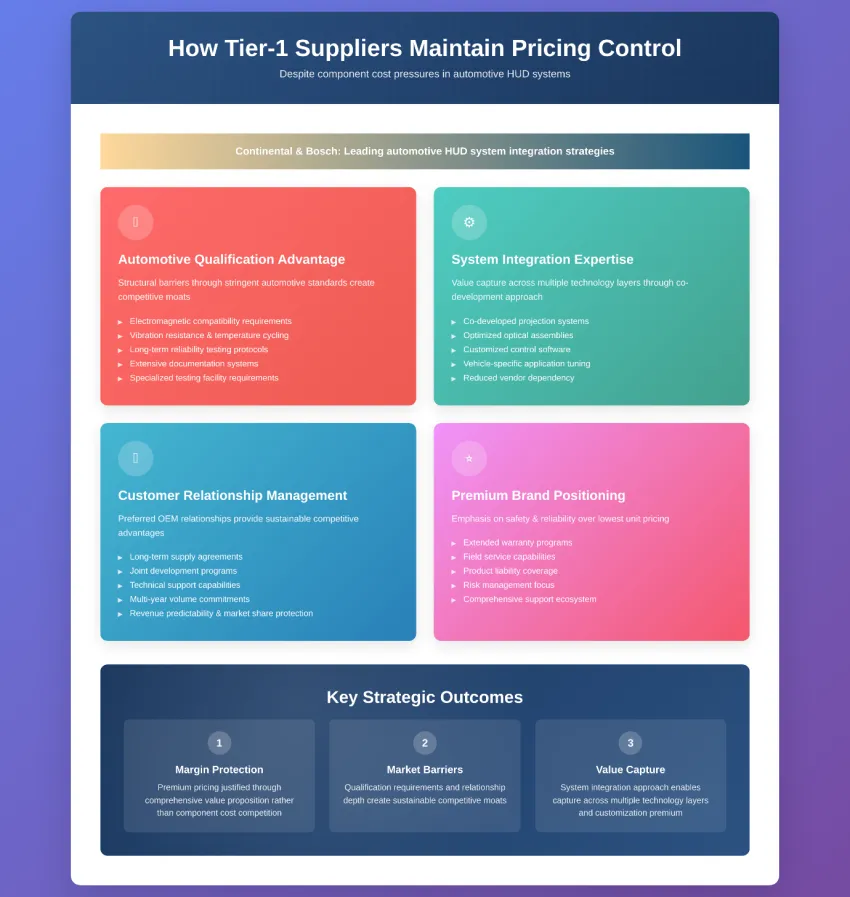
Continental and Bosch have developed sophisticated strategies to protect margins while managing the higher costs associated with automotive-grade HUD systems. Their approach centers on leveraging system integration expertise, automotive qualification capabilities, and OEM relationships rather than competing purely on component costs or technology specifications.
Automotive qualification represents a structural advantage that creates barriers to competitive entry. HUD systems must meet stringent electromagnetic compatibility, vibration resistance, temperature cycling, and long-term reliability requirements that consumer electronics manufacturers typically avoid. The qualification process involves extensive testing protocols, documentation systems, and certification procedures that can extend development timelines and require specialized testing facilities.
System integration capabilities enable Tier-1 suppliers to capture value across multiple technology layers. Rather than purchasing complete HUD modules from technology suppliers, major automotive suppliers co-develop projection systems, optical assemblies, and control software that optimize performance for specific vehicle applications. This integrated approach reduces vendor dependency while enabling customization that justifies premium pricing.
Customer relationship management provides another margin protection mechanism. Established suppliers maintain preferred relationships with major OEMs through long-term supply agreements, joint development programs, and technical support capabilities that smaller competitors cannot match. These relationships often involve multi-year contracts with volume commitments that provide revenue predictability while protecting market share.
Brand positioning strategies emphasize safety, reliability, and comprehensive support rather than lowest unit pricing. Premium suppliers typically offer extended warranty programs, field service capabilities, and product liability coverage that justify higher prices for customers prioritizing risk management over cost optimization.
Why thermal management drives hidden cost escalation in HUD systems?
Heat generation and dissipation requirements create cascading cost effects throughout HUD system architectures. High-brightness projection systems generate substantial thermal loads that must be managed to prevent component degradation, maintain image quality, and ensure long-term reliability across automotive operating conditions spanning desert environments to arctic conditions.
DLP-based systems face particular thermal challenges due to concentrated heat generation in compact projection units. The digital micromirror device, LED arrays, and control electronics generate heat that must be dissipated through heat sinks, thermal interface materials, and potentially active cooling systems. Inadequate thermal management results in reduced brightness, color shifts, and accelerated component aging that compromises system performance.
Cooling system requirements add substantial complexity and cost beyond basic component pricing. Passive thermal management relies on heat sinks, thermal pads, and vehicle airflow for heat dissipation, but active systems may require fans, liquid cooling, or thermoelectric coolers for demanding applications. Each approach creates different cost structures, power consumption requirements, and integration challenges that affect total system economics.
Environmental isolation becomes critical for thermal management effectiveness. HUD systems typically require sealed enclosures that protect sensitive optics and electronics from moisture, dust, and temperature fluctuations while maintaining thermal dissipation pathways. These protective housings must balance environmental protection against heat dissipation requirements through specialized materials and mechanical designs.
Component selection throughout HUD systems must account for thermal operating conditions that exceed consumer electronics specifications. Automotive-grade semiconductors, optical components, and mechanical assemblies typically cost significantly more than consumer equivalents due to extended temperature ranges, thermal cycling requirements, and long-term stability specifications.
Sources
- USA Department of Transportation. Advanced Driver Information Systems: Technology Assessment and Human Factors Analysis of Head-Up Display Applications.
- National Highway Traffic Safety Administration (NHTSA). Vehicle Electronics and Emerging Technologies: Safety and Performance Implications of Advanced Driver Information Systems.
- Society of Automotive Engineers (SAE International). Automotive Display Technologies: Standards, Testing Methods, and Performance Requirements for Head-Up Display Systems.
- IEEE Vehicular Technology Society. Automotive Electronics and Thermal Management: Design Considerations for Advanced Driver Information Systems.
- International Organization for Standardization (ISO). Road Vehicles - Ergonomic Aspects of Transport Information and Control Systems - Specifications and Test Procedures for In-Vehicle Visual Presentation.
- European Commission - Joint Research Centre (JRC). Automotive Electronics and Advanced Driver Assistance Systems: Technology Assessment and Market Analysis.

