


Key Takeaways
- Body armor pricing is anchored to aramids, ceramics and UHMWPE, which are concentrated supply chains.
- Export controls and licensing requirements create pricing floors for hard plates.
- Soft armor cost structure is dominated by ballistic fiber pricing, not labor.
- Military and police programs influence scale and cost spread across regions.
- Downtime and replacement cycles affect lifecycle cost more than headline unit price.
Who produces body armor and how do business models differ between soft and hard protection?
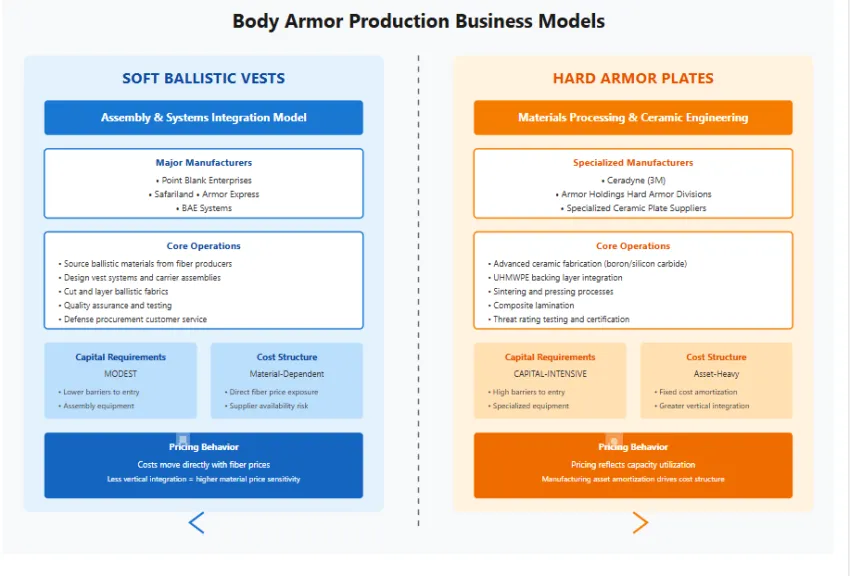
Body armor production operates through distinct business models that reflect the technical and commercial requirements of soft ballistic vests versus hard armor plates. Major defense original equipment manufacturers including Point Blank Enterprises, Safariland (formerly The Safariland Group), Armor Express and BAE Systems maintain integrated operations producing complete vest systems, carrier assemblies and soft armor panels for military and law enforcement customers. These firms typically source ballistic materials from specialized fiber producers and focus on design, assembly, quality assurance and customer service within defense procurement frameworks.
Hard armor plate manufacturers follow a different operational model centered on materials processing and ceramic engineering. Companies specializing in boron carbide, silicon carbide and alumina-based strike faces combine these advanced ceramics with UHMWPE (ultra-high molecular weight polyethylene) backing layers to create stand-alone plates meeting specific threat ratings. Examples include Ceradyne (a 3M company), Armor Holdings' hard armor divisions, and specialized ceramic plate suppliers serving military programs. These operations require capital-intensive sintering furnaces, pressing equipment and testing facilities, creating higher barriers to entry than soft armor assembly.
The business model divergence reflects material handling requirements. Soft armor producers operate as assemblers and systems integrators, cutting and layering ballistic fabrics into panel configurations specified by end users, with relatively modest capital requirements but significant dependence on material supplier pricing and availability. Hard plate manufacturers function as materials processors executing complex ceramic fabrication and composite lamination, with substantial fixed costs in production equipment but greater vertical integration of the cost structure. This distinction drives different pricing behaviors, with soft armor costs moving directly with fiber prices while hard plate pricing reflects capacity utilization and amortization of specialized manufacturing assets.
How do aramid, ceramic and UHMWPE sourcing decisions determine cost exposure?
Ballistic fiber supply for soft armor concentrates in two primary producers: DuPont with its Kevlar aramid fiber line and Teijin with Twaron and Technora aramid products. This duopoly structure limits sourcing alternatives for vest manufacturers, creating direct pricing transmission from fiber producer pricing decisions to finished armor costs. Aramid fibers represent 60 to 75% of soft armor manufacturing cost, meaning that fiber price movements translate almost immediately into vest pricing adjustments. Body armor producers maintain limited inventory buffers due to working capital constraints and quality control requirements favoring fresh material, reducing their ability to insulate customers from fiber price increases.
UHMWPE fiber supply, used in both soft armor (Dyneema from DSM, Spectra from Honeywell) and as backing layers in hard plates, follows similar concentration patterns. These producers maintain proprietary manufacturing processes protected by patents and trade secrets, limiting competitive entry and sustaining pricing power throughout the supply chain. When UHMWPE fiber prices increase, manufacturers of both soft armor and composite hard plates face simultaneous cost pressure with few substitution options that maintain required ballistic performance.
Ceramic materials for hard armor plates present different supply dynamics. Boron carbide, silicon carbide and alumina powders source from specialized chemical suppliers and ceramic material processors, with pricing influenced by purity requirements, particle size specifications and volume commitments. While ceramic supply is less concentrated than ballistic fibers, the technical specifications required for armor-grade materials limit the pool of qualified suppliers. Plate manufacturers typically qualify multiple ceramic sources to manage supply risk, but switching costs and re-certification requirements reduce practical flexibility when primary suppliers increase prices.
Export controls add complexity to international sourcing. Aramid fibers and UHMWPE materials face dual-use export restrictions under International Traffic in Arms Regulations (ITAR) in the United States and similar frameworks in other producing countries. These controls constrain cross-border material flows, limiting arbitrage opportunities and allowing regional pricing premiums to persist. Hard armor ceramics face additional export licensing requirements when processing reaches armor-grade specifications, creating compliance costs and delivery delays that feed into final pricing.
How do certification and threat-level standards create pricing tiers?
Body armor pricing stratifies according to threat protection levels defined by the National Institute of Justice (NIJ) in the United States and equivalent standards in other jurisdictions. NIJ Standard 0101.06 establishes performance requirements ranging from Level IIA (protecting against 9mm and .40 S&W handgun rounds) through Level IV (defeating armor-piercing rifle ammunition). Each level increase requires additional ballistic material, greater areal density, or advanced ceramic compositions, creating direct cost escalation.
Soft armor meeting NIJ Level IIIA specifications typically requires 20 to 30 layers of aramid or UHMWPE fabric, with exact configurations depending on material choice, threat angle requirements and trauma depth specifications. Moving from Level IIA to Level IIIA adds approximately 30 to 40% more ballistic material to achieve the required protection, translating into proportional cost increases. Manufacturers cannot reduce material quantity without failing certification testing, eliminating cost reduction opportunities through design optimization once threat level is specified.
Hard armor plates face sharper cost escalation across threat levels. Level III plates defeating standard rifle ammunition typically use alumina or silicon carbide ceramics in relatively conventional configurations. Level IV plates capable of stopping armor-piercing projectiles require boron carbide ceramics or advanced ceramic composites with superior hardness and fracture toughness, materials commanding significant price premiums. Boron carbide, the hardest ceramic practical for armor applications, costs several times more per kilogram than alumina, with this material cost difference dominating the price gap between Level III and Level IV plates.
Certification testing itself imposes costs that flow into pricing. NIJ certification requires manufacturers to submit production samples for third-party ballistic testing, with testing costs including range time, ammunition procurement, documentation and potential design iterations if initial samples fail. Maintaining certification requires ongoing quality assurance testing and periodic re-certification, creating fixed cost components that spread across production volumes. Low-volume specialty products carry higher per-unit certification costs than high-volume standard configurations, contributing to pricing premiums for uncommon threat level and size combinations.
Regional certification standards create additional complexity. European EN standards, UK CAST standards and other national specifications impose different testing protocols and acceptance criteria that may require modified designs or separate certification programs. Manufacturers serving international customers absorb these parallel certification costs, either spreading them across all production or creating region-specific pricing to reflect actual compliance expenses.
How do procurement cycles, batch sizes and logistics influence final buyer price?
Government defense and law enforcement procurement operates through formal tender processes where contract size, delivery schedules and payment terms significantly influence pricing. Large multi-year contracts for thousands of vests or plate sets allow manufacturers to commit production capacity, secure favorable material supply terms and amortize fixed costs across substantial volumes, typically yielding 20 to 35% discounts compared to small-batch or single-unit purchases. Defense ministry procurement documents from various countries reveal pricing structures where unit costs decline steeply as order quantities increase beyond minimum efficient production runs.
Procurement timing affects pricing through its interaction with material supply chains. Manufacturers receiving firm multi-year commitments can lock in ballistic fiber pricing through forward contracts with DuPont or Teijin, protecting both themselves and their customers from mid-contract material cost inflation. Buyers issuing short-term contracts or maintaining the right to adjust quantities face exposure to spot material pricing, which can vary significantly based on fiber producer capacity utilization and competitive dynamics among armor manufacturers bidding for available fiber supply.
Logistics and storage costs add layers to final delivered pricing. Body armor, particularly ceramic plates, requires careful handling to prevent damage that could compromise ballistic performance. Defense logistics systems incur costs for specialized storage facilities, inventory management systems and distribution networks that ensure product integrity from factory to end user. These logistics expenses vary by geography, with remote deployment locations or distributed law enforcement agencies facing higher per-unit delivery costs than centralized military installations.
Replacement cycle planning influences procurement pricing strategies. Organizations managing large armor inventories plan replacement cycles of 5 to 10 years based on expected service life, usage patterns and budget constraints. Buyers committing to lifecycle replacement contracts provide manufacturers with revenue visibility that supports preferential pricing, while ad-hoc replacement purchases command premium pricing reflecting lower volume and unpredictable demand.
How does warranty, wear degradation and TCO influence pricing decisions?
Body armor manufacturers offer warranty periods ranging from 5 to 10 years for soft armor and similar or shorter periods for hard plates, with warranty terms directly affecting both pricing and total cost of ownership calculations. Warranties typically cover manufacturing defects and premature ballistic performance degradation but exclude damage from improper storage, exposure to extreme environmental conditions or physical abuse. The warranty period reflects manufacturer confidence in material durability and creates a risk transfer from buyer to seller that justifies higher initial purchase prices.
Aramid fibers degrade through multiple mechanisms that affect armor service life and lifecycle cost. Ultraviolet radiation breaks down aramid molecular chains, reducing tensile strength and ballistic performance. Moisture absorption and subsequent drying cycles cause dimensional changes and fiber damage. Elevated temperatures accelerate degradation, particularly in high-humidity environments. Body armor OEMs document these degradation pathways in technical literature and design carrier systems to mitigate exposure, but field conditions often exceed controlled storage assumptions, shortening effective service life below warranty periods.
Hard armor plates face different degradation risks. Ceramic strike faces can develop micro-cracks from impact or thermal cycling, potentially compromising ballistic integrity even without visible damage. UHMWPE backing materials experience creep under sustained compression and oxidation from heat exposure. Manufacturers recommend periodic inspection protocols and retirement criteria based on observable damage or age-based replacement triggers, creating operational costs beyond initial purchase price.
Total cost of ownership analysis incorporates replacement frequency, downtime during replacement, disposal costs for expired armor and training for proper maintenance. Soft armor with 5-year service life and hard plates with 7-year life require different budget planning compared to longer-lasting alternatives, even when initial purchase prices appear similar. Organizations with rigorous armor management programs track these lifecycle costs and may prefer higher initial prices for extended warranties or superior durability, while cost-constrained buyers focus on minimizing upfront expenditure despite higher lifecycle costs.
Warranty terms also affect pricing negotiation leverage. Manufacturers offering 10-year warranties signal confidence in their material sourcing and manufacturing quality, potentially commanding premium pricing while reducing buyer lifecycle risk. Shorter warranties or extensive exclusions signal higher replacement likelihood, making lifecycle cost less favorable even if initial pricing appears competitive. Sophisticated procurement organizations evaluate warranty terms alongside unit pricing to assess true cost exposure over expected service periods.
How can Future Market Insights support pricing decisions in body armor?

Sources
- DuPont, Teijin: Aramid fiber supply and ballistic application disclosures from technical literature and product documentation
- Defense ministry procurement documents: Contract scope, pricing brackets and volume-price relationships where disclosed in public procurement records
- NIJ and regional test standards: Certification requirements affecting material usage, testing protocols and performance specifications
- Reputable business media (Reuters, Janes): Supply chain constraints, plate material sourcing and defense procurement trends
- OEM warranty and technical documentation: Lifecycle conditions, durability evidence and maintenance requirements from manufacturer publications

