


Key Takeaways
- EU Battery Regulation establishes strict carbon footprint disclosure for anode-grade materials.
- High-temperature graphite purification in China faces emissions and traceability penalties.
- Synthetic and responsibly mined natural graphite gain qualification advantage over low-visibility supply chains.
- Gigafactories tie sourcing to yield risk mitigation and compliance, not just $/kg.
- Certification and documentary governance drive pricing floors for credible suppliers.
How do EU carbon footprint and traceability rules redefine qualification for Battery Anode Materials?
The EU Battery Regulation imposes mandatory carbon footprint declarations for batteries entering European territories. Manufacturers must disclose lifecycle emissions including upstream material processing. Anode materials contribute significantly to battery carbon footprints due to energy-intensive purification and spheroidization. Scope 1 and Scope 2 emissions from graphite processing now determine whether materials qualify for European gigafactory intake. Buyers prioritize suppliers providing verifiable emissions data over those lacking documentation, regardless of material performance specifications.
Traceability requirements mandate provenance documentation from mine to battery cell. Supply chains must demonstrate custody records showing material origin, processing locations and transportation routes. This documentary burden eliminates suppliers operating through multi-tier intermediaries or opaque trading networks. Cell manufacturers face regulatory penalties and reputational damage if upstream traceability breaks down. Procurement teams now conduct ESG audits examining labor practices, environmental permits and community engagement at graphite mines and processing facilities before approving suppliers.
Compliance shifts qualification criteria beyond technical specifications. Traditional procurement evaluated purity, particle size distribution and electrochemical performance. Current frameworks add carbon intensity thresholds and traceability completeness as mandatory gates. Suppliers lacking robust documentation systems face disqualification even when offering competitive pricing or superior material properties. This regulatory reorientation fundamentally changes which producers can access European cell manufacturing supply chains, creating bifurcated qualification landscapes based on compliance infrastructure rather than purely technical merit.
Why does high-emission graphite purification struggle to maintain qualification in global supply routes?
Natural graphite purification requires heating raw flake graphite to 2,500-3,000°C in specialized furnaces to achieve battery-grade purity above 99.95 percent. This high-temperature thermal treatment consumes substantial electricity. China dominates global purification capacity, processing over 70 percent of battery-grade natural graphite. Much of this capacity relies on coal-fired electricity grids with carbon intensities exceeding 600 grams CO2 per kilowatt-hour. The combination of energy-intensive processing and high-carbon electricity generates emissions substantially above thresholds preferred by European cell manufacturers.
Emission disclosure requirements force Chinese processors to quantify and report carbon footprints that reveal these intensity levels. Buyers comparing disclosed emissions across suppliers find Chinese natural graphite carries 2 to 4 times the carbon burden of synthetic graphite produced using hydroelectric or renewable-powered processes. European gigafactories targeting low-carbon battery production cannot integrate high-emission anodes without compromising overall battery carbon declarations. This creates systematic disadvantage for Chinese natural graphite regardless of cost competitiveness or technical quality.
Scope 3 emissions tracking extends scrutiny beyond direct processing. Buyers now evaluate mining emissions, transportation carbon and even supplier electricity grid composition. Chinese processors struggle to provide comprehensive Scope 3 documentation due to complex multi-tier supply networks and limited upstream transparency. Lack of complete lifecycle data prevents qualification even when direct processing emissions improve. High-carbon energy infrastructure and fragmented supply chain visibility combine to systematically exclude significant portions of Chinese natural graphite capacity from compliance-focused procurement channels.
How do synthetic graphite and verifiable natural graphite become compliance-first alternatives?
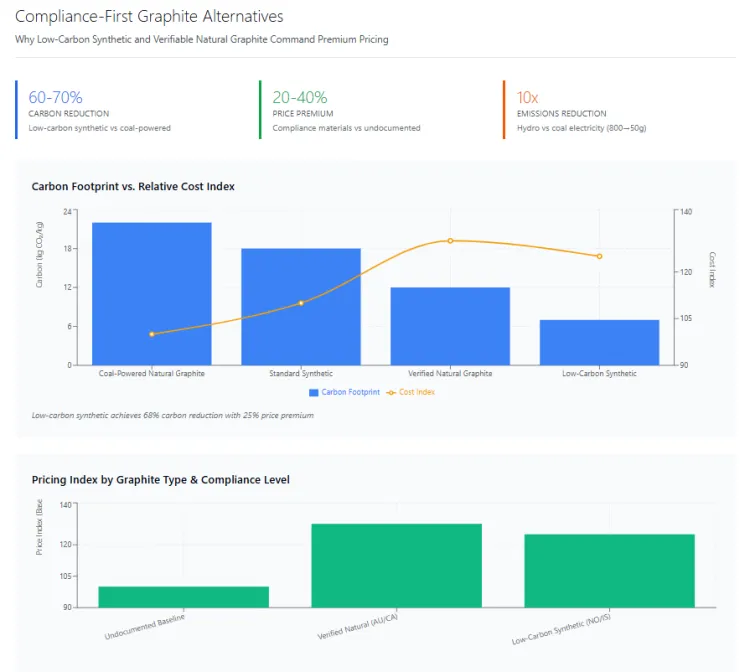
Synthetic graphite production involves petroleum coke graphitization at temperatures similar to natural graphite purification. However, synthetic producers increasingly locate facilities near low-carbon electricity sources. Plants in Norway, Canada and Iceland access hydroelectric power with carbon intensities below 50 grams CO2 per kilowatt-hour. This 10-fold reduction in electricity emissions yields synthetic graphite with lifecycle carbon footprints 60 to 70 percent lower than coal-powered natural graphite processing. European cell manufacturers accept 15 to 25 percent price premiums for synthetic graphite because lower emissions improve battery-level carbon declarations required under EU regulations.
Verifiable natural graphite from mines with strong ESG documentation provides alternative compliance pathway. Producers in Australia, Canada and select African countries implement mine-to-shipment traceability systems tracking material through processing and export. These operations maintain environmental permits, conduct third-party sustainability audits and provide complete Scope 1, 2 and 3 emissions data. Transparent documentation allows buyers to verify carbon footprints and supply chain integrity. Cell manufacturers pay premiums for this visibility, viewing it as insurance against regulatory non-compliance and reputational risk.
Cost versus qualification trade-offs favor compliant materials despite higher pricing. A gigafactory facing potential regulatory penalties, production delays or reputational damage from non-compliant anodes cannot offset these risks through modest per-kilogram savings. Procurement strategies prioritize qualification certainty over cost optimization. Synthetic graphite and documented natural graphite command pricing floors 20 to 40 percent above undocumented alternatives because buyers value compliance assurance and audit readiness. This premium reflects the economic value of regulatory access rather than intrinsic material superiority.
Why does traceability documentation influence pricing more strongly than raw-material cost?
Documentary governance determines procurement approval independent of material cost. Gigafactories operate under quality management systems requiring supplier audits, material traceability and batch-level documentation. Anode suppliers must provide certificates of origin, processing facility permits, carbon footprint calculations and chain-of-custody records. Suppliers lacking these documentation systems cannot qualify regardless of competitive pricing. The administrative infrastructure supporting traceability becomes prerequisite for commercial engagement, establishing minimum pricing thresholds that reflect documentation overhead rather than raw graphite costs.
Batch traceability reduces yield risk and liability exposure. Cell manufacturers experiencing quality issues or safety incidents must trace problems to specific material batches and upstream suppliers. Without robust traceability, manufacturers cannot isolate root causes or implement corrective actions. Regulatory authorities investigating battery failures demand supply chain documentation. Suppliers providing comprehensive batch records enable rapid problem resolution and liability attribution. This operational value justifies premium pricing because traceability infrastructure protects against costly production disruptions and legal exposure.
Origin certification addresses geopolitical and ethical sourcing concerns. European regulations increasingly restrict materials from regions with forced labor risks or environmental violations. Buyers require certified proof that graphite originates from approved jurisdictions and complies with human rights standards. Certification costs include third-party audits, blockchain tracking systems and continuous monitoring programs. These governance expenses add 10 to 20 percent to material costs but provide essential regulatory compliance. Pricing reflects the embedded value of audit-ready documentation that enables uninterrupted supply to compliance-sensitive customers.
How is regional policy shifting supply chain geography for Battery Anode Materials?
EU Battery Regulation creates economic incentive for non-Chinese graphite development. Projects in Canada, Australia and the United States position themselves as compliance-advantaged alternatives. These jurisdictions offer renewable electricity access, transparent regulatory environments and established ESG reporting frameworks. Developers highlight low-carbon energy availability and robust documentation capabilities in investor presentations and customer engagements. Regional policy support through critical minerals funding, loan guarantees and streamlined permitting accelerates project timelines. This policy-driven development aims to establish alternative supply chains aligned with European regulatory requirements.
United States Inflation Reduction Act ties battery tax credits to domestic and free-trade-agreement sourcing. Manufacturers seeking tax benefits must demonstrate anode material provenance from qualifying countries. This creates parallel qualification framework to European regulations, further incentivizing graphite projects in North America and allied nations. Developers in Canada and Australia benefit from both US and European compliance advantages, accessing multiple high-value end-user segments. Regional policy coordination amplifies commercial viability of non-Chinese graphite capacity.
Carbon border adjustment mechanisms intensify pressure on high-emission imports. Proposed EU carbon tariffs would impose costs on imported materials based on embedded emissions. High-carbon Chinese graphite would face additional duties beyond base import tariffs. This policy framework makes domestic European processing and low-carbon imports increasingly cost-competitive against traditional Chinese supply. Graphite processors evaluating facility locations prioritize regions with renewable electricity, favorable trade status and regulatory alignment with European compliance requirements. Geography becomes strategic competitive advantage as policy shapes supply chain economics beyond traditional cost factors.
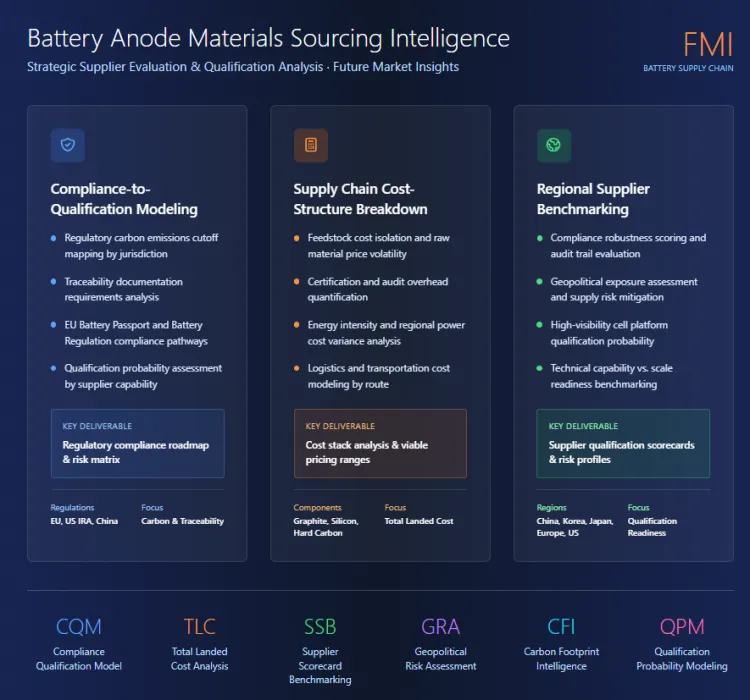
How can Future Market Insights support sourcing decisions in Battery Anode Materials?
Sources
- European Commission Battery Regulation documentation (ec.europa.eu): Carbon footprint calculation methodologies, traceability requirements, due diligence obligations and lifecycle emission thresholds for battery materials including anode graphite.
- International Energy Agency and lifecycle assessment databases: Energy intensity analysis for natural versus synthetic graphite processing, electricity grid carbon intensities by region, and comparative emission profiles across production routes.
- ASX, TSX and responsible mining initiative disclosures: ESG reporting from Australian, Canadian and emerging graphite producers detailing environmental permits, community engagement, labor practices and carbon footprint data.
- Automotive and battery manufacturer sustainability reports: Procurement criteria, supplier qualification frameworks, traceability requirements and carbon reduction targets from Tesla, Northvolt, BMW and other gigafactory operators.
- Bloomberg, Reuters and specialist battery supply chain publications: Coverage of graphite project financing, regulatory developments, tariff policies, qualification announcements and regional supply chain restructuring trends.

