


Key Takeaways
- Price in PCR is the translation of bale scarcity, contamination rates, energy intensity, and logistics constraints into a volatile margin band from recyclers to converters.
- PET bottle bales in the US averaged 11.02 cents per pound (USD 243/MT) in December 2023, with regional contracts reaching 13 to 15 cents per pound. Natural HDPE bales averaged 29.50 cents per pound (USD 650/MT). Food-grade rPET pellets FOB Southeast Asia traded at USD 1,250/MT in 2024.
- Container freight Southeast Asia to EU adds USD 80 to 150 per MT to flake costs. Energy for washing and extrusion accounts for 15 to 25% of ex-factory PCR price.
- EU Single-Use Plastics Directive mandates 25% recycled PET content in beverage bottles from 2025, escalating to 30% by 2030. California requires 50% PCR in PET beverage containers by 2030.
- Indorama Ventures targets 750,000 tonnes rPET capacity by 2025. Veolia recycled 465,000 tonnes of plastic in 2023. Plastipak operates over 150,000 tonnes rPET capacity across Europe. Bottle-to-bottle recyclers achieve 12 to 18% EBITDA margins.
What Makes Price in PCR the Translation of Bale Scarcity Into Volatile Margin Bands?
Price in PCR is the translation of bale scarcity, contamination rates, energy intensity, and logistics constraints into a volatile margin band from recyclers to converters. The battle for clean post-consumer resin feedstock has reshaped pricing dynamics across PET, HDPE, and PP value chains, with regulatory mandates forcing FMCG brands into direct competition for limited high-purity material.
In December 2023, US PET bottle bales traded between 11 cents and 15 cents per pound across regional contracts, while natural HDPE bales averaged 29.50 cents per pound. By mid-2024, food-grade rPET pellets reached USD 1,250 per metric ton FOB Southeast Asia, reflecting sustained premiums over virgin PET despite feedstock volatility. The pricing waterfall from bale to pellet embeds multiple cost drivers: bale acquisition costs represent 40 to 55 percent of ex-factory PCR price, energy for washing and extrusion adds 15 to 25 percent, logistics and freight absorb 8 to 15 percent, and contamination losses erode yield by 10 to 20 percent depending on feedstock quality.
Direct cost drivers include bale scarcity, energy for hot-washing and extrusion, and transport from collection to reclamation. Indirect drivers amplify margin pressure: EU Single-Use Plastics Directive mandates 25 percent recycled content in PET beverage bottles from 2025, escalating to 30 percent by 2030, creating structural demand that outpaces mechanical recycling capacity additions. Extended Producer Responsibility schemes in California, Oregon, and across European markets shift compliance costs upstream while tightening collection standards.
Bottle-to-bottle recyclers operating at food-grade specifications capture 12 to 18 percent EBITDA margins when utilization exceeds 80 percent, while flake producers serving non-food-grade applications operate at 8 to 12 percent. Distributor margins for PCR pellets narrow to 5 to 8 percent for bottle-grade material as brand procurement teams consolidate volume and negotiate direct contracts, compared to 10 to 15 percent for industrial-grade PCR where quality tolerances are wider.
How Does Feedstock Cost Structure Shape PCR Pricing for PET, HDPE, and PP?

Clean PET bottle bales, HDPE natural bales, and PP rigid bales represent the critical feedstock inputs for post-consumer resin production. Feedstock costs dominate the PCR cost structure, accounting for 40 to 55 percent of delivered pellet price depending on bale quality and regional collection efficiency. In the US, PET bottle bale pricing reached 11.02 cents per pound nationally in December 2023, with regional contracts in high-recovery states like Oregon commanding 13 to 15 cents per pound. Natural HDPE bales averaged 29.50 cents per pound in the same period, while polypropylene bales traded at 4.94 cents per pound.
Beverage brands, FMCG companies, pharmaceutical packaging converters, and beauty product manufacturers compete directly for high-purity feedstock. The EU's 25 percent rPET mandate for beverage bottles created immediate supply tightness, with France exceeding targets at 30 percent recycled content by 2024. Brand commitments from Coca-Cola, PepsiCo, Unilever, and Procter & Gamble further intensified competition for clear, food-grade PET bales with contamination below 50 parts per million PVC.
Substitution limits are rigid for food-grade PCR: PET bottle bales must maintain intrinsic viscosity above 0.70 to 0.80 deciliters per gram, color sorting must separate clear from light-blue and green bottles, and PVC contamination must remain below regulatory thresholds. HDPE natural bales command premiums over colored HDPE because blow-molding applications for milk jugs and detergent bottles require consistent white or translucent pellets.
Bale imports from India, Vietnam, Thailand, and Indonesia into EU and US markets have reshaped price negotiation dynamics. Southeast Asian exporters ship PET flake at FOB prices between USD 900 and 920 per metric ton for premium-grade material. Indian PET bottle scrap trades FOB at USD 410 per metric ton from ports like Nhava Sheva and Mundra. Waste import bans in China and Turkey redirected trade corridors, with Indonesia increasing PET scrap imports by 26 percent in 2022.
Where Does Energy Intensity Create Regional Cost Floors and Competitive Asymmetry?
Energy consumption in sorting, shredding, hot washing at 80 to 95 degrees Celsius, drying, extrusion at 270 to 290 degrees Celsius, and pelletization establishes a non-negotiable cost floor for PCR production. Mechanical recycling plants consume 0.8 to 1.2 megawatt-hours per metric ton of rPET pellets produced, depending on feedstock contamination levels and process efficiency. Washing stages alone account for 30 to 40 percent of total energy use.
Veolia's 2024 annual results highlighted that recycled materials pricing volatility affects EBITDA, with energy costs comprising a significant portion of processing expenses. The company's waste segment EBITDA reached EUR 2,110 million, up 11.1 percent. However, energy price spikes during 2022 to 2023 compressed margins for European recyclers. Indorama Ventures reported rPET demand growing at 16.1 percent CAGR through 2027, but noted that prolonged inflation and energy volatility forced site closures in Australia, Canada, Portugal, and the Netherlands during 2024.
Regional asymmetry in energy costs creates structural advantages. India and Southeast Asia benefit from industrial tariffs 30 to 50 percent below EU levels, enabling PET flake exports to compete on delivered cost despite freight penalties. European recyclers partially offset high grid electricity costs through renewable energy procurement. Plastipak operates on 100 percent renewable electricity across European sites, supplemented by on-site solar installations generating 1,339 megawatt-hours annually at its Toledo, Spain facility.
How Do Logistics and Plant Location Economics Impact PCR Competitiveness?
Bale transport relies on compressed bales weighing 300 to 1,000 kilograms per unit, shipped in 20-foot containers holding 20 to 22 metric tons. Freight sensitivity is acute for PET flake exports from Southeast Asia to EU ports: ocean freight from Port Klang, Bangkok, or Jakarta to Rotterdam ranges from USD 80 to 150 per metric ton, adding 9 to 15 percent to FOB flake prices.
Recyclers located near municipal waste streams capture structural cost advantages by eliminating long-haul bale transport. Clean Tech UK, Plastipak's wholly owned subsidiary in Hemswell, processes over 80,000 metric tons of post-consumer PET annually collected through kerbside systems, with minimal inbound freight costs. This co-location strategy extends to Plastipak's Luxembourg and Spain facilities, where recycling plants sit adjacent to preform manufacturing sites, eliminating pellet transport entirely.
What Compliance Requirements Create Pricing Floors and Market Access Barriers?
EU Single-Use Plastics Directive mandates 25 percent recycled PET content in beverage bottles from 2025, escalating to 30 percent for all plastic beverage bottles by 2030. Member states must collect 77 percent of plastic bottles by 2025 and 90 percent by 2029. Commission Implementing Decision 2023/2683 establishes calculation, verification, and reporting rules. France exceeded the 25 percent target by incorporating 30 percent recycled content in PET bottles in 2024.
California's recycled content law requires beverage containers to contain minimum PCR percentages, escalating to 50 percent by 2030. Oregon's extended producer responsibility framework mandates recycled content targets with non-compliance penalties of USD 1,000 per day per violation. Spain introduced a plastics tax in 2023, imposing EUR 0.45 per kilogram on non-recycled plastic packaging.
HS codes govern trade classification: HS 3915 covers waste, parings, and scrap of plastics, with sub-codes 391510 for polyethylene. Finished rPET pellets may fall under HS 3907 for polyesters. OECD monitoring reports track HS 3915 flows. Netherlands, Malaysia, and Germany remained the largest importers of plastic waste in 2022.
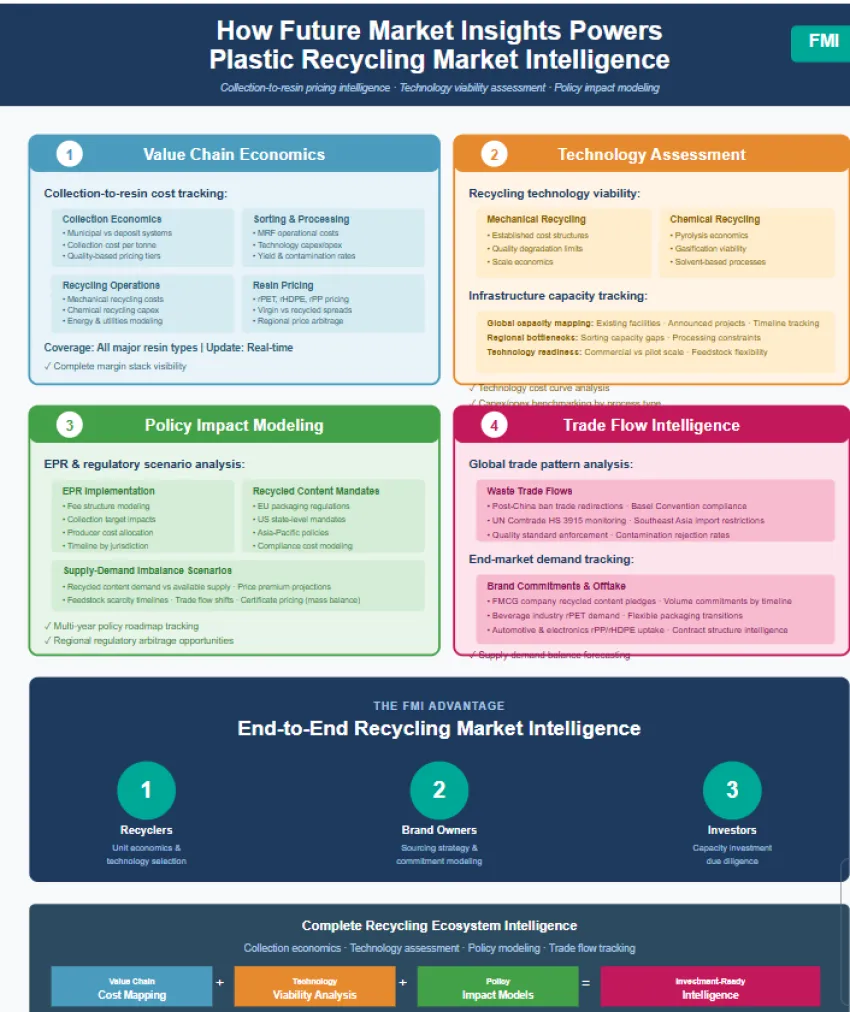
How Can Future Market Insights Help on Pricing in PCR?
Sources
- NAPCOR 2023 PET Recycling Report: US PET bottle collection rate 33 percent, rPET content in bottles 16.2 percent, bale pricing and trade data
- S&P Global Commodity Insights Asia Recycled PET Assessments: FOB Southeast Asia rPET pellets USD 1,250/MT, premium clear flakes USD 920/MT, standard flakes USD 900/MT
- Indorama Ventures 2024 Annual Report and earnings releases: 750,000 tonnes rPET capacity target, USD 1.5 billion recycling investment, 16.1 percent rPET demand CAGR
- Veolia Environnement 2024 Annual Results: 465,000 tonnes plastic recycled 2023, waste EBITDA EUR 2,110 million, operational efficiency and synergy gains
- Plastipak Packaging facility disclosures and press releases: 150,000 tonnes Europe rPET capacity, Clean Tech UK 80,000 tonnes, Toledo Spain 20,000 tonnes, renewable energy programs

