


Key Takeaways
- Virgin and recycled kraft pulp costs drive most of the variable cost structure in Paper Core production
- Recovered fiber shortages and quality swings contribute to unstable furnish blends
- Energy-intensive pulping and paper-making processes pass volatility into core pricing
- Freight and container imbalance increase delivered cost for heavy, low-value cores
- Thin producer margins amplify exposure to pulp and energy cycles during contract negotiation
Why does kraft pulp cost volatility have an outsized impact on Paper Core pricing?
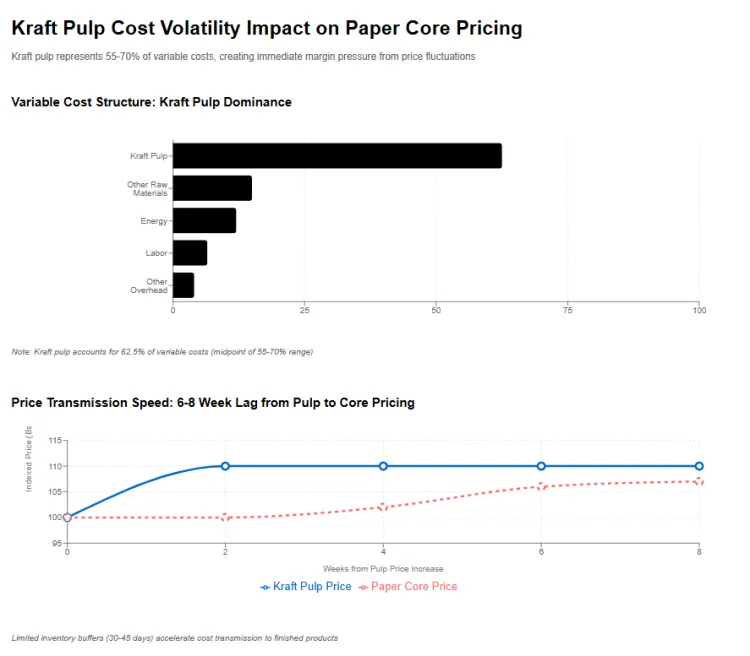
Kraft pulp represents 55 to 70 percent of the total variable cost structure in Paper Core production, making it the dominant input by far. Both virgin kraft and recycled kraft pulp follow cyclical pricing patterns driven by global supply-demand imbalances, mill capacity utilization, and regional fiber availability. When virgin kraft pulp prices rise by 10 percent, producers typically face a 6 to 8 percent increase in total manufacturing cost, which directly compresses margins when customer contracts include fixed or ceiling pricing terms.
The furnish composition determines strength properties and cost positioning. High-strength cores used in film, aluminum foil and technical tissue converting require 60 to 80 percent virgin kraft content to achieve the necessary compression resistance and dimensional stability. In contrast, cores for lighter-duty applications can incorporate higher percentages of recycled kraft or recovered fiber, but this introduces quality variability and potential performance trade-offs. Small movements in virgin kraft pricing force producers to recalculate furnish economics continuously, and a $50 per metric ton increase in virgin pulp can eliminate 15 to 25 percent of producer margin on a standard core order.
The transmission speed from pulp pricing to finished core pricing is rapid because inventory buffers are limited. Most producers maintain 30 to 45 days of pulp inventory, meaning price increases flow into production cost within six to eight weeks. When pulp prices spike suddenly due to mill outages, transportation disruptions or currency swings, producers face immediate pressure to either absorb the cost or renegotiate contracts. This dynamic creates friction in relationships with converters who expect stable pricing over quarterly or semi-annual periods.
How do recovered fiber shortages and quality variability influence core performance requirements and cost?
Recovered fiber availability depends on collection infrastructure, sorting efficiency and contamination levels, all of which fluctuate regionally and seasonally. When recovered fiber supplies tighten or contamination increases, producers must either pay premiums for cleaner grades or shift furnish composition toward virgin kraft, increasing total cost. Moisture content variability, plastic contamination and inconsistent fiber length distributions reduce the percentage of recovered fiber that can be incorporated without sacrificing compression strength or surface smoothness.
Quality variability forces producers to run more frequent furnish trials and increase quality control testing, adding operational cost and time. A core designed for high-speed film winding must maintain consistent radial crush resistance and surface friction properties, and even minor deviations can cause web breaks or slippage on the converter's winding equipment. When recovered fiber quality degrades, producers compensate by increasing virgin kraft content by 10 to 20 percentage points, which raises furnish cost by $30 to $60 per metric ton of finished cores.
Seasonal swings in recovered fiber collection compound the challenge. In regions with lower recycling rates or during periods of reduced commercial activity, recovered fiber prices rise and availability contracts. Producers in Europe and North America typically face tighter recovered fiber conditions than producers in Asia, where collection rates remain higher and contamination tolerance is managed through additional sorting. This creates regional cost disparities that influence where converters choose to source their cores.
Why do energy and steam costs in pulping and paper-making pass through directly into Paper Core pricing?
Paper Core production is energy-intensive at multiple stages. Pulping, whether mechanical or chemical, requires substantial steam and electricity input. Drying the wet paper web on heated cylinders consumes additional natural gas or heavy fuel oil, and boiler efficiency varies widely by facility age and fuel source. Energy typically represents 12 to 18 percent of total manufacturing cost, and when natural gas or electricity prices spike, producers face immediate cost pressure.
Regional energy pricing structures create cost advantages or penalties. Producers in regions with access to low-cost hydroelectric power, industrial steam co-generation or subsidized natural gas enjoy structural cost advantages over competitors dependent on expensive grid electricity or imported fuel oil. A $10 per megawatt-hour increase in electricity cost can raise core production cost by $8 to $12 per metric ton, and this differential becomes significant when freight costs are similar across regions.
Energy surcharges have become standard in many supply agreements because volatility is difficult to predict and absorb. Converters increasingly accept quarterly energy adjustments linked to published regional indices, recognizing that producers cannot hedge energy exposure over long contract periods. When energy costs rise sharply, producers pass through 70 to 90 percent of the increase within one contract cycle, and customers who resist these adjustments often face delayed shipments or contract terminations.
How does regional freight and container imbalance increase the delivered cost of Paper Core supplies?
Paper Cores are dense, heavy and have low value per cubic meter, making freight cost a disproportionately large component of delivered cost. A standard 20-foot container can carry 12 to 15 metric tons of cores, but the freight cost often equals or exceeds the manufacturing cost, particularly on long-haul routes or lanes with container imbalances. When freight rates rise due to capacity shortages, fuel surcharges or port congestion, the total delivered cost can increase by 20 to 40 percent.
Container imbalance creates asymmetric freight pricing. Routes with heavy export flows and light return flows, such as Asia to North America or Europe to Asia, face elevated backhaul costs that penalize Paper Core shipments. Converters located in import-heavy regions often find that cores sourced from distant producers become uneconomical when freight rates spike, even if manufacturing cost is lower. This dynamic drives preference for local or regional sourcing when freight volatility is high.
Inland freight adds further cost layers. Cores produced at inland mills require truck or rail transport to ports, adding $40 to $80 per metric ton before ocean freight is applied. In contrast, coastal producers with direct port access or producers located near converter facilities reduce total logistics cost substantially. This locational advantage becomes decisive when freight represents 35 to 50 percent of total delivered cost, and converters routinely re-evaluate supplier panels based on delivered cost rather than manufacturing cost alone.
How do these cost pressures influence contract negotiation, pricing corridors and supplier-switching behavior?
Contract negotiation cycles in Paper Core supply have shortened from annual to quarterly or semi-annual resets, reflecting the speed at which pulp and energy costs change. Converters demand transparency into furnish composition, pulp sourcing and energy exposure, and producers increasingly provide cost breakdowns to justify price adjustments. Pricing corridors with pulp-indexed floors and ceilings have become common, allowing automatic adjustments within agreed bands while requiring renegotiation for movements outside those thresholds.
Furnish risk-sharing clauses shift some volatility from producer to converter. In high-strength core applications, converters may agree to pay premium pricing in exchange for guaranteed virgin kraft content, while in lower-duty applications, converters accept furnish variability and associated performance trade-offs in return for cost reductions. These tiered approaches reduce friction during renegotiation but require detailed specification management and performance testing protocols.
Supplier-switching behavior accelerates when cost pressures persist. Converters maintain dual or triple sourcing strategies to preserve negotiating leverage and ensure continuity during supply disruptions. When freight costs spike, converters shift volume toward local suppliers even if per-unit manufacturing cost is higher, because delivered cost remains lower. Conversely, when pulp prices rise sharply and freight is stable, converters may import from lower-cost regions to offset furnish cost increases. This dynamic creates constant pressure on producers to balance cost competitiveness with proximity and service reliability.
How can Future Market Insights support cost-structure and sourcing decisions in Paper Core?

Sources
- Global and regional pulp price indices: Virgin kraft, recycled fiber, and pulp futures data for cost volatility
- Pulp and paper industry association reports: Data on energy use, recovered fiber availability and furnish quality trends
- Converting and packaging technical standards: Compression strength requirements, core performance benchmarks
- Freight and logistics intelligence sources: Container imbalance statistics, inland freight cost trends, export-import flows
- Reputable pulp and paper trade media: Reporting on mill outages, pulp supply disruptions, energy cost impacts and contract negotiation patterns

