


Key Takeaways
- Hillrom prices spirometers based on lifecycle value, not unit hardware cost, positioning devices as long-term clinical infrastructure rather than transactional purchases.
- Lower failure rates and longer calibration stability reduce hospital downtime, protecting patient throughput and preventing costly test cancellations that erode operational revenue.
- Service plans, sensor replacements, and software support create predictable operating costs, allowing healthcare facilities to budget with confidence while generating recurring revenue streams for Hillrom.
- Hospitals pay more upfront because reliability protects patient throughput, and procurement teams increasingly recognize that device failures disrupt scheduling and impose hidden costs that exceed initial savings.
- Procurement teams evaluate total cost of ownership as a clinical continuity investment, not a device purchase, shifting decision criteria from lowest bid to lifecycle performance and operational resilience.
How does Hillrom position its spirometers as long-horizon clinical infrastructure rather than commodity devices?
Hillrom emphasizes reliability, service continuity, and uptime in tender documentation and product positioning rather than competing solely on purchase price. Sales narratives focus on years of uninterrupted diagnostic capacity instead of technical specifications alone. Marketing materials highlight service response times, parts availability across global networks, and calibration stability that extends intervals between mandatory recertification. This framing reorients procurement conversations away from unit cost comparisons toward operational assurance.
Tender language often includes guarantees around mean time between failures, warranty terms that cover both parts and labor, and commitments to software updates that maintain regulatory compliance as standards evolve. By positioning spirometers as critical infrastructure comparable to imaging equipment or patient monitors, Hillrom justifies pricing tiers that reflect long-term performance rather than immediate hardware costs. Procurement officers in large hospital systems respond to this messaging because equipment downtime creates cascading problems: rescheduled appointments, delayed diagnoses, frustrated clinicians, and lost billable procedures. Hillrom leverages this operational anxiety to defend premium pricing as risk mitigation rather than luxury spending.
Which lifecycle factors reduce downtime and set Hillrom's pricing floor?
Spare parts availability establishes a foundational pricing floor because hospitals cannot afford extended waits for critical components. Hillrom maintains regional distribution centers and service depots that stock sensors, flow heads, calibration syringes, and circuit boards. This logistics infrastructure carries fixed costs that must be recovered through device pricing and service contracts. Competitors offering lower upfront prices often lack comparable parts networks, forcing buyers to accept longer repair cycles or source components through third-party suppliers with uncertain quality.
Calibration stability determines how often devices require verification testing to maintain regulatory compliance and diagnostic accuracy. Spirometers with superior sensor design and temperature compensation maintain calibration longer, reducing the frequency of mandatory checks and associated labor costs. Durable sensors that resist wear from repeated patient use extend replacement intervals, lowering consumables expenses over the device lifespan. Post-sale service responsiveness, including remote diagnostics, on-site technician visits, and loaner equipment during repairs, protects hospital operations from revenue loss. These factors collectively establish a pricing floor below which Hillrom cannot profitably deliver the reliability that justifies its premium positioning.
How do service contracts and consumables shift revenue from upfront sale to predictable lifecycle income?
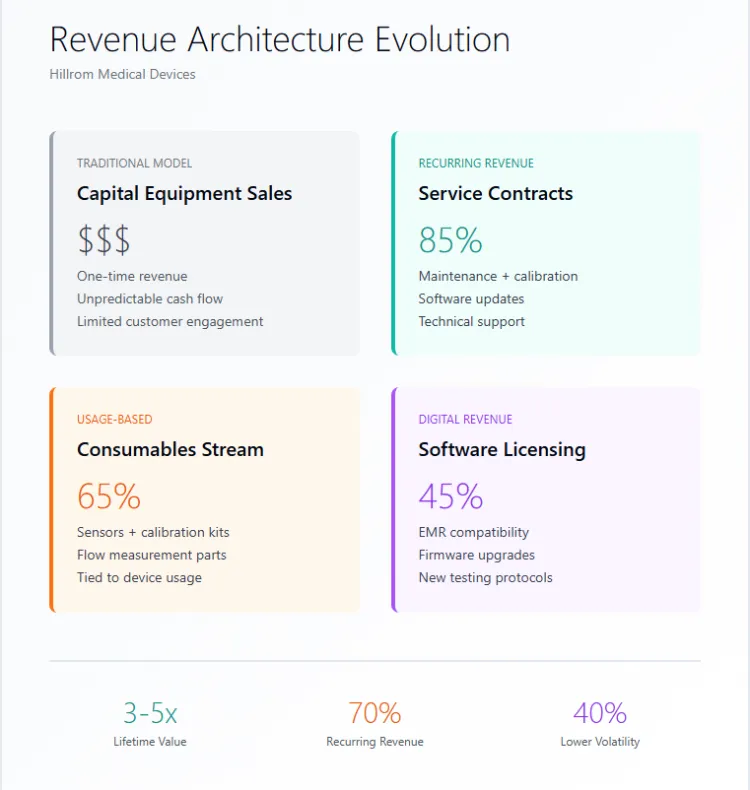
Service contracts convert one-time capital expenditures into recurring operational expenses, improving Hillrom's revenue predictability while reducing buyer cost risk. Annual maintenance agreements bundle calibration verification, preventive maintenance visits, software updates, and technical support into fixed fees. This model allows hospitals to budget with certainty rather than facing unpredictable repair costs that strain departmental finances. For Hillrom, recurring revenue smooths cash flow volatility and increases customer lifetime value beyond initial device sales.
Consumables including calibration kits, disposable sensors, and flow-measurement components create ongoing revenue streams tied directly to device usage. High-volume clinics require frequent sensor replacements, generating proportional consumables income. Software support subscriptions ensure compatibility with evolving electronic medical record systems and regulatory requirements, creating upgrade revenue opportunities as healthcare IT infrastructure advances. Firmware updates that enhance functionality or add new testing protocols justify additional licensing fees. This revenue architecture improves supplier economics by diversifying income sources and strengthening customer relationships through continuous engagement rather than transactional sales cycles.
How does downtime economics influence procurement decisions for spirometry fleets?
Clinics value uninterrupted throughput because spirometer failures impose costs that exceed device savings. When a spirometer becomes unavailable, scheduled lung-function tests must be cancelled or rescheduled, disrupting patient care pathways and delaying clinical decisions. Cancelled appointments represent lost billable procedures, reducing departmental revenue and worsening cost-recovery metrics that hospital administrators track closely. Rescheduling patients consumes administrative labor, frustrates referring physicians, and erodes patient satisfaction scores that increasingly influence hospital reimbursement rates.
For busy pulmonology departments or primary-care clinics conducting routine respiratory assessments, each day of spirometer downtime translates to dozens of missed tests. If a device failure persists for a week while awaiting parts or technician visits, the accumulated revenue loss can approach or exceed the price difference between premium and budget spirometry equipment. Procurement teams increasingly perform break-even analyses that quantify downtime risk: if a lower-cost spirometer fails twice as often as a Hillrom device, the savings disappear within the first service interruption. Hillrom leverages this economic reality to defend premium pricing, positioning reliability as the ultimate cost-control measure rather than an expensive luxury.
Which buyer segments and regions are most receptive to lifecycle-value pricing in spirometry?
Large hospital systems with complex clinical governance structures prioritize high reliability because equipment failures ripple across multiple departments and affect hundreds of patients. Integrated healthcare networks that operate under capitated payment models or value-based reimbursement contracts cannot afford operational inefficiencies that undermine care coordination and quality metrics. These organizations employ procurement specialists who conduct sophisticated total cost of ownership analyses, evaluating failure rates, service response times, and consumables costs over projected lifespans. They recognize that lifecycle value determines true cost, not purchase price alone.
Regulated facilities including teaching hospitals, research institutions, and specialized respiratory centers face stringent quality assurance requirements that demand equipment with documented calibration stability and regulatory compliance. These buyers pay premium prices willingly because non-compliant devices create accreditation risks and threaten institutional reputation. Geographic regions with mature healthcare infrastructure and established service networks, particularly North America and Western Europe, demonstrate higher receptivity to lifecycle-value pricing because buyers trust that post-sale support commitments will be honored.
Pricing flexibility varies significantly in low-resource settings where upfront capital constraints dominate procurement decisions regardless of lifecycle economics. Hospitals in emerging economies may lack budgetary mechanisms to evaluate total cost of ownership or lack confidence that service networks will remain accessible over device lifespans. In these environments, Hillrom faces pressure to offer entry-level products or flexible financing arrangements that reduce initial barriers while preserving some lifecycle revenue through consumables and service contracts.
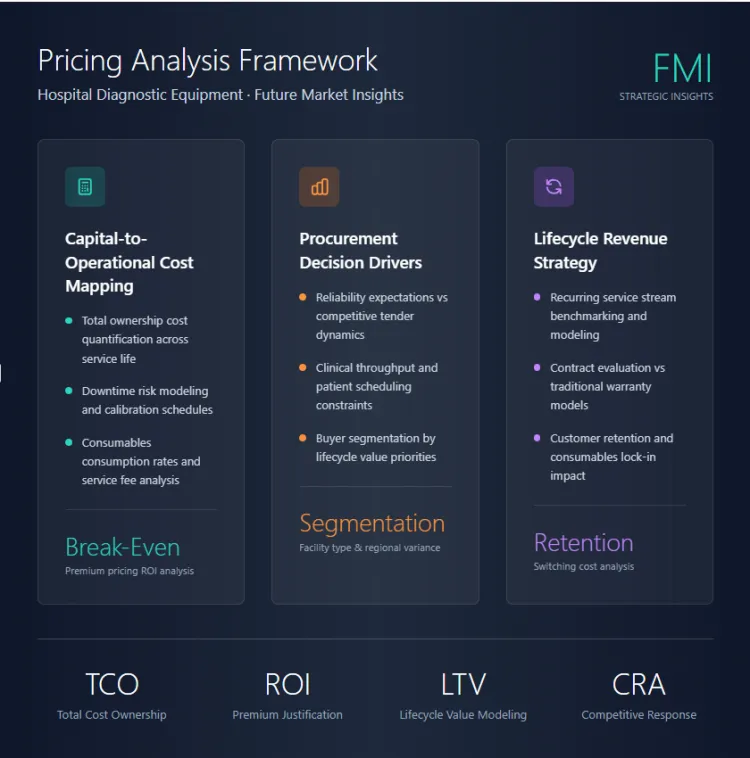
How can Future Market Insights support pricing analysis in hospital diagnostic equipment?
Sources
- Hillrom and Welch Allyn technical documentation: Lifecycle specifications, calibration intervals, EMR interoperability features and service-model details from manufacturer literature.
- Hospital procurement guidelines and tender evaluation criteria: Evidence that selection weighting includes uptime assurance, maintenance contracts, and total cost of ownership rather than unit price alone.
- Medical equipment reliability and maintenance studies (peer-reviewed): Data on how routine servicing, failure rates and calibration governance influence long-term cost in diagnostic devices.
- Healthcare financial reporting and device asset-management frameworks: Insight into downtime economics, clinical throughput loss, and depreciation cycles used by hospital administrators.

