


Key Takeaways
- Accessory products like cables, chargers, cases, Watch bands, and MagSafe parts generate more than USD 10 billion annually for Apple.
- High iPhone and wearables adoption drives consistent accessory purchases through both new device attach rates and replacement cycles.
- Production is concentrated in China and Vietnam, exposing Apple to geopolitical risks and logistics vulnerabilities.
- Proprietary components and Made for iPhone licensing create strong supplier barriers and influence cost structures.
- Strict quality, safety, and environmental compliance requirements limit supplier pools and shape accessory margins.
Who leads production and how is manufacturing distributed geographically?
Apple accessory production exhibits high geographic concentration, with China accounting for an estimated 60 to 70 percent of total output and Vietnam representing 15 to 25 percent, according to supply chain disclosures and business media reporting. Contract manufacturers including Luxshare Precision, Foxconn Technology Group and Goertek provide the majority of assembly capacity for both Apple-branded accessories and licensed third-party products. Luxshare, which reported over RMB 150 billion in revenue for 2022, manufactures cables, AirPods cases and various connectivity products across facilities in Kunshan and other Chinese manufacturing hubs. Foxconn, while better known for iPhone assembly, operates dedicated accessory production lines for power adapters and premium cases.
Vietnam has emerged as a secondary production base, particularly for cable assembly and textile-based products like Watch bands. Multiple tier-one suppliers have established Vietnamese facilities since 2018, driven by tariff mitigation strategies and capacity diversification objectives. However, Vietnam's accessory production remains constrained by limited local component ecosystems, requiring most electronic modules, chipsets and precision-molded components to be imported from China or Taiwan before final assembly.
Apple-branded accessory production operates under tighter quality controls and component specifications compared to approved third-party MFi suppliers. While Apple does not publicly disclose specific manufacturing allocations, industry analysis indicates that premium SKUs like MagSafe chargers and Braided USB-C cables are produced predominantly by tier-one suppliers with dedicated Apple capacity, whereas commodity items like basic charging cables see broader supplier participation including smaller ODMs qualifying through the MFi program.
How is the supply chain organized from component procurement to end-user delivery?
The accessory supply chain exhibits vertical integration characteristics for technology-intensive products while outsourcing commodity items more extensively. Premium accessories incorporating proprietary technology, such as MagSafe battery packs or Apple Watch magnetic charging cables, involve Apple-designed chipsets and control electronics manufactured by semiconductor partners including Broadcom and Texas Instruments, then integrated by contract manufacturers under strict technical specifications. This vertical approach allows Apple to maintain technology differentiation and pricing control.
Assembly operations cluster near component supply concentrations to minimize logistics costs and accelerate production cycles. China's Pearl River Delta and Yangtze River Delta regions provide proximity to connector manufacturers, elastomer molders, magnet suppliers and packaging producers, enabling just-in-time component delivery and rapid SKU transitions. Vietnamese facilities benefit from lower labor costs but face longer component lead times, making them more suitable for stable, high-volume products rather than frequently updated accessories tied to new device launches.
Logistics architecture depends heavily on Asia to North America and Europe routes for retail distribution. Apple accessories shipped to company-operated retail stores and authorized resellers typically move via air freight to ensure inventory availability at product launches, with ocean freight serving replenishment and third-party channel distribution. The shift toward e-commerce fulfillment during and after COVID-19 has increased direct-to-consumer distribution complexity, with regional distribution centers in the United States, Europe and Asia managing inventory across Apple's online channel and rapid delivery partnerships.
Which sourcing requirements and materials create cost sensitivity?
MFi-certified connector chipsets represent the single highest-cost electronic component in cables and audio accessories, with authentication integrated circuits adding USD 1.50 to USD 4.00 per unit depending on functionality and data transmission requirements. These chipsets, supplied exclusively through Apple's approved vendor network, enable device recognition and charging protocol negotiation while preventing unauthorized accessory proliferation. The proprietary nature of these components eliminates competitive sourcing options, creating fixed cost exposure that scales with volume but offers no price elasticity through alternative suppliers.
Rare-earth magnets used in MagSafe charging modules and magnetic Watch band clasps constitute another high-value material input. Neodymium-iron-boron magnets with precise field strength and geometry specifications are sourced predominantly from Chinese suppliers controlling over 80 percent of global rare-earth processing capacity. Pricing for rare-earth magnets fluctuates with commodity market dynamics, experiencing increases of 30 to 60 percent during 2021-2022 supply tightness before moderating. The specific magnetic array designs used in MagSafe products require custom tooling and quality validation, limiting supplier switching flexibility even when pricing pressures emerge.
Elastomer materials for Watch bands and iPhone cases demand medical-grade or skin-contact-safe certifications, restricting sourcing to qualified silicone and fluoroelastomer manufacturers. Apple specifies particular Shore hardness ranges, tensile strength requirements and colorant stability standards that exceed typical consumer goods specifications. Premium Watch bands utilize fluoroelastomer materials originally developed for aerospace applications, commanding material costs three to five times higher than standard silicone rubber. Material traceability requirements for environmental compliance further constrain supplier options, as RoHS and REACH regulations mandate documentation of substances of concern throughout the supply chain.
Which compliance and proprietary technology overheads influence pricing?
The Made for iPhone licensing program imposes both direct fees and indirect costs on accessory manufacturers. While Apple does not publicly disclose exact licensing fee structures, industry sources indicate fees ranging from USD 0.50 for basic cables to USD 4.00 per unit for complex accessories incorporating multiple MFi-certified components. These fees cover authentication chipset access, technical documentation, testing protocols and trademark usage rights. Beyond direct licensing costs, suppliers must invest in engineering resources to meet Apple's technical specifications, testing equipment for pre-submission validation, and compliance personnel to manage ongoing certification requirements.
Electrical safety and durability testing create additional qualification overhead. Accessories must pass testing protocols including over-current protection verification, temperature cycling, connector insertion-extraction endurance exceeding 10,000 cycles, and environmental exposure simulations. These tests, conducted at Apple-approved laboratories or through internal facilities meeting equivalent standards, add USD 10,000 to USD 50,000 per SKU in non-recurring engineering costs depending on product complexity. High-power accessories like 140W USB-C adapters require additional safety agency certifications from UL, TÜV or equivalent bodies, further increasing qualification investment.
Supplier qualification processes impose operational constraints beyond direct testing costs. Prospective MFi licensees must demonstrate manufacturing process controls, component traceability systems and quality management frameworks meeting Apple's Supplier Code of Conduct requirements. This includes facility audits, labor practice verification and environmental compliance assessments. The qualification timeline typically spans six to twelve months for new suppliers, creating barriers to entry that protect established participants but limit competitive pressure on pricing.
How do trade flows, freight logistics and geopolitical risks shape pricing architecture?
United States tariff policy significantly impacts accessory landed costs, particularly under Section 301 tariffs imposed on Chinese imports. Cables, chargers and cases manufactured in China face tariff rates ranging from 7.5 to 25 percent depending on product classification and trade negotiation outcomes. A USD 20 retail-price cable with a landed cost of USD 5 before tariffs faces an additional USD 1.25 cost burden under 25 percent tariff rates, directly pressuring either retail pricing or manufacturer margins. Vietnam production mitigates some tariff exposure but introduces other cost elements including higher labor rates than inland China and logistics premiums for component imports.
China Plus One diversification strategies have accelerated since 2018, with multiple suppliers establishing Vietnamese, Indian or Malaysian facilities to reduce tariff exposure and enhance supply chain resilience. However, this geographic diversification creates efficiency trade-offs. Vietnamese facilities operating below optimal scale experience per-unit costs 10 to 20 percent higher than mature Chinese operations according to industry reporting, offsetting some tariff savings. Component sourcing complexities further erode Vietnam cost advantages, as most electronic modules must still be procured from China or Taiwan and cleared through customs before assembly.
Freight rate volatility represents an increasingly significant cost variable. Ocean freight rates from Asia to North America peaked at over USD 20,000 per forty-foot container during 2021-2022 supply chain disruptions, compared to historical rates around USD 2,000 to USD 3,000, creating unprecedented logistics cost exposure. While rates have normalized somewhat, they remain elevated relative to pre-pandemic baselines. Air freight, used for time-sensitive product launches and premium accessories, commands rates 8 to 12 times higher than ocean transport, adding USD 1.00 to USD 3.00 per unit for typical accessories. These logistics costs are particularly impactful for lower-priced products where freight represents 5 to 15 percent of total landed cost.
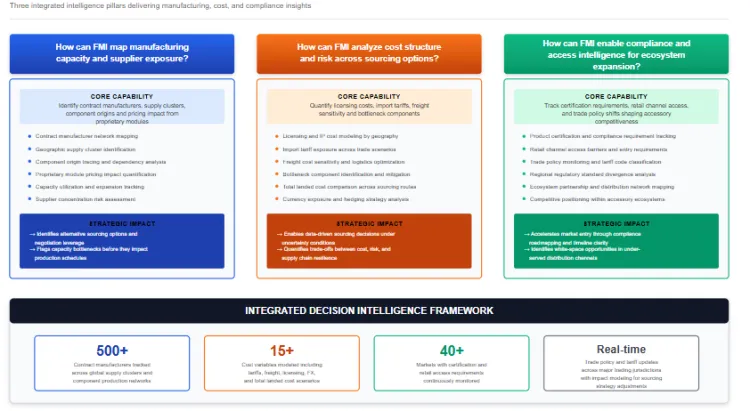
How can Future Market Insights can help?
Which sources support this analysis?
- Apple Inc annual reports and environmental progress reports: supply chain footprint disclosure, manufacturing partner references, material usage commitments
- Luxshare Precision Industry annual reports and investor presentations: revenue scale, Apple business exposure, production capacity locations
- Foxconn Technology Group corporate filings: accessory manufacturing operations, geographic facility distribution
- Goertek Inc financial disclosures: acoustic component and accessory assembly capabilities, customer concentration
- IEEE Spectrum and iFixit teardown analyses: component identification, chipset specifications, magnet configurations, material composition
- Reuters and Nikkei Asia reporting: production shifts from China to Vietnam, supplier diversification strategies, tariff impact coverage

