


Key Takeaways
- The Middle East fire safety ecosystem is anchored by regional manufacturers such as NAFFCO in Dubai and SFFECO in Saudi Arabia, which run large manufacturing campuses and export across the GCC, Asia, Africa and Europe.
- Global building technology groups including Honeywell, Siemens, Johnson Controls and Bosch overlay this hardware base with detection, control and digital service platforms targeted at complex infrastructure, oil and gas and smart buildings.
- Local champions differentiate through vertical integration and certification depth, offering full lines from extinguishers and pumps to fire doors, hydrants and complete systems that align with international standards such as UL, FM, LPCB and ISO 9001.
- Multinationals focus on digital control, cloud connectivity and analytics, treating fire systems as data platforms with remote monitoring, mobile interfaces and predictive maintenance rather than standalone panels and detectors.
- Across both groups, the strategic battlefield is shifting from single product tenders to lifecycle performance, integration into building management systems and the ability to meet tightening GCC codes with documented compliance and service capability.
Regional manufacturers as the hardware backbone
The most visible industrial footprint in Middle East fire safety comes from regional manufacturers that have grown alongside local construction booms. NAFFCO, founded in Dubai in 1991, positions itself as one of the worlds leading producers and suppliers of firefighting equipment, fire protection systems and life safety solutions, manufacturing from large facilities in the UAE and exporting to more than 100 countries.
Its catalog spans extinguishers, pumps and controllers, foam systems, fire doors, smoke management, addressable detection, emergency lighting and even custom fire trucks and ambulances, allowing the company to bid on entire system packages rather than single components. SFFECO, originally Saudi Factory for Fire Equipment, follows a similar integrated model from a Saudi base.
The company reports ISO 9001, 14001 and 45001 certifications, operates its own plants in Riyadh and Dubai, and exports a complete range of fire pumps, doors, foam equipment and related products to GCC, Middle East, Asian, African and European markets.
Alongside these two, manufacturers such as Emirates Fire Fighting Equipment Factory in Sharjah have built significant regional presence, producing firefighting equipment and systems and marketing themselves as among the large Middle Eastern manufacturers with an international footprint. Taken together, these firms give the GCC an indigenous base of certified hardware, which is important in a region where large projects and national regulators expect conformity to global standards but also value local delivery capability.
Global OEMs and the digital control layer
On top of this regional hardware base, global building technology groups compete for the control and service layer. Honeywell operates an extensive fire and gas portfolio and has documented multiple industrial and infrastructure projects in Europe, the Middle East and Africa where it supplies integrated fire and gas systems as a one stop supplier for safety and automation. In 2024 the company inaugurated a dedicated assembly line for fire alarm and building management solutions in Dhahran, Saudi Arabia, signalling a direct manufacturing and localisation commitment to the Kingdoms building automation and safety demand.
Honeywell also markets cloud connected life safety services such as CLSS that allow remote monitoring of fire systems and predictive service planning through mobile applications. Siemens positions its fire safety offering around connected protection systems, cloud enabled services and digital twins. The group highlights fire protection systems that tie panels, detectors and field devices into managed, cloud based services, and promotes fire safety digital services that combine on site and above site support to improve reliability and efficiency.
Trade coverage of Saudi projects describes Siemens fire safety digital twin being used to simulate fire spread and reduce false alarms for local operators, a sign of how advanced analytics are filtering into regional deployments. Johnson Controls brings fire suppression, detection and special hazards systems, including gaseous suppression, to the region and explicitly markets its fire protection solutions to petrochemical and oil and gas facilities. Johnson Controls Arabia operates as a regional platform offering HVAC, building automation, fire and security solutions and running a large manufacturing complex in the Middle East.
Bosch, via its building technologies division, supplies fire alarm and life safety systems globally and has introduced its Avenar series fire alarm panels specifically into the Middle East, emphasising scalability, integration and support for internet of things driven building technologies. In practice, these multinationals are not simply competing with regional manufacturers on hardware. They are fighting to become the digital nerve centre for fire detection, alarm routing, building integration and remote service across large campuses and critical infrastructure.
Shared playbook across local and global players
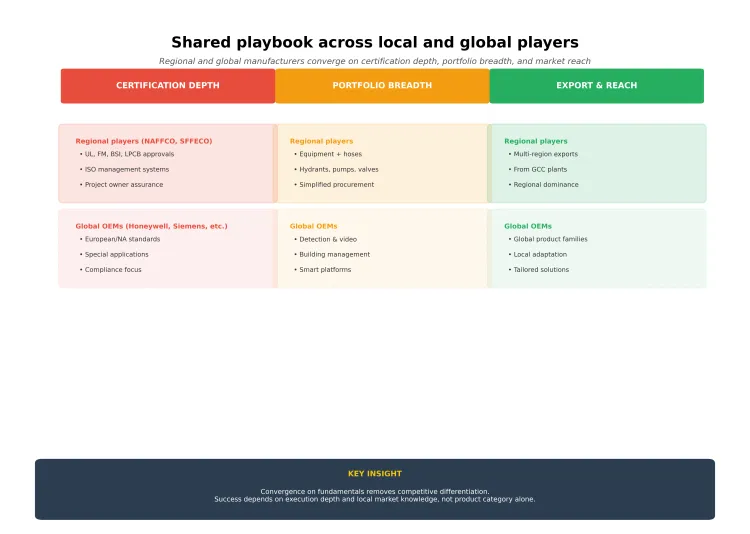
Although their origins differ, regional and global manufacturers have converged on several strategic pillars. First is certification depth. NAFFCO and SFFECO emphasise approvals from international bodies such as UL, FM, BSI and LPCB, alongside ISO management system certifications, to assure project owners that locally produced equipment aligns with global benchmarks. Global OEMs similarly stress compliance with European, North American and international standards in their case studies and product documentation, especially for special applications such as tunnels and industrial facilities. Second is breadth of portfolio.
The leading regional manufacturers aim to cover extinguishing equipment, hoses, hydrants, pumps, cabinets, valves, doors and system components so that main contractors can simplify procurement around a limited number of principal suppliers. Multinationals extend this breadth into advanced detection, video integration, building management, cyber secure connectivity and cloud services, presenting fire safety as one strand of an integrated smart building platform.
Third is export or multi country reach. NAFFCO, SFFECO and FIREX explicitly describe exports to multiple regions from their GCC plants. Honeywell, Siemens, Johnson Controls and Bosch, conversely, bring global product families into Middle Eastern projects while tailoring solutions to local regulatory regimes and client expectations.
Where strategies actually diverge
Behind this shared playbook, there are important differences in focus. Local manufacturers lean on vertical integration and project proximity. They compete on the ability to deliver certified equipment quickly into GCC projects, provide local assembly of pumps, cabinets, hydrants and special vehicles and maintain close relationships with civil defence authorities and local consultants. The strategy is to be the default specification choice for standard building types and to anchor large packages of hardware in major developments.
Global OEMs concentrate on control, software and critical applications. Their marketing emphasises remote visibility, data driven maintenance, digital twins for complex sites, and specialized suppression for data centres, industrial plants and high value assets. The Johnson Controls and Honeywell portfolios, for example, highlight gaseous systems for sensitive equipment, high integrity detection and integration into wider safety and automation architectures.
The red pill for strategy teams is that long term power is likely to sit with whoever owns the logic and data of the system rather than the metal alone. A regional manufacturer that remains purely a hardware supplier risks being locked beneath a control layer specified around the software and platforms of global players. Equally, a multinational that ignores local manufacturing economics and regulatory nuance can find itself outflanked on cost and approval timelines by GCC based producers.
What this means for positioning and partnerships
For manufacturers already inside the Middle East, the strategic questions are less about incremental product launches and more about role definition. A regional OEM can decide to double down on being the lowest friction path to compliant hardware and system delivery, or it can deliberately move up the stack toward commissioning, maintenance and remote services, potentially in partnership with digital platform providers. The existing breadth of NAFFCO and SFFECO product lines suggests they already have the scope to build more service centric offerings if they choose to invest in software and analytics capability.
Global groups face the inverse choice. They can stay focused on sophisticated detection, suppression and cloud services layered on top of any certified hardware, or they can localise more manufacturing and assembly, as Honeywell has done with its Saudi line for fire alarm and building management equipment, to capture more of the project bill of materials. Either way, the direction of travel in GCC fire safety is clear in specialist media and sector analysis. High rise density, past fire events and tighter codes are pushing the region toward higher specification, more connected systems and stronger enforcement. Manufacturers that treat fire safety as a recurring, data rich service attached to compliant hardware are better placed than those that continue to behave as commodity equipment vendors.
- How do project outcomes differ when the main contractor uses a fully local hardware stack with a global control platform compared with a single vendor global system from panel to detector to cloud service
- What is the cost and margin impact of local assembly of panels and detectors in GCC countries relative to importing finished systems under current tariff and logistics conditions
- How often do fire safety manufacturers in the region capture long term maintenance contracts versus one off equipment sales by building type and country
- Which regulatory changes in GCC building and fire codes over the past decade have most directly reshaped manufacturer product strategy and certification investments
- How are oil and gas, tunnel and data centre projects weighting digital features such as remote diagnostics or digital twins when selecting between competing fire safety suppliers
Sources
- Bosch Building Technologies. (2020, September 2). Bosch introduces next generation Avenar fire alarm panels in the Middle East. International Fire and Safety Journal. Bosch Building Technologies. (n.d.). Fire alarm systems. Bosch Security and Safety Systems.
- Energy Connects. (2024, June 5). Honeywell inaugurates first building automation assembly line in Saudi Arabia. Energy Connects.
- Honeywell. (n.d.). Case studies and brochures: Industrial fire solutions. Honeywell Building Technologies.
- Johnson Controls. (n.d.). Fire protection solutions. Johnson Controls Middle East.
- NAFFCO. (n.d.). About us. NAFFCO.
- Saudi Factory for Fire Equipment Co. (n.d.). About us. SFFECO.
- Saudi Factory for Fire Equipment Co. (n.d.). Firefighting equipment. SFFECO Global.
- Siemens AG. (n.d.). Fire protection systems. Siemens Fire Safety.
- Siemens AG. (n.d.). Fire safety services. Siemens Fire Safety.

