


Key Takeaways
- Thermal insulation pricing is dominated by manufacturing energy consumption and raw material costs rather than simple material composition, with energy-intensive processes like mineral wool melting at 1200°C creating significant cost pressures that compound through the supply chain.
- Manufacturing has shifted from basic material processing to complex integrated systems requiring specialized equipment, controlled environments, and extensive quality control, making thermal management and processing efficiency critical cost drivers beyond raw material prices.
- The real margin capture happens in three distinct layers: proprietary manufacturing technologies where established players like Owens Corning and BASF control advanced processing methods, brand positioning that justifies premium pricing over commodity alternatives, and distribution networks that determine market access and customer relationships.
- Material complexity creates exponential cost variations, with basic fiberglass insulation costing significantly less per square foot than advanced polyisocyanurate systems, while spray foam insulation requires specialized chemical mixing and application equipment that drives installation costs substantially higher.
- Supply chain vulnerabilities have fundamentally altered insulation cost structures, with petroleum-derived materials like polyurethane facing price volatility while mineral-based products depend on energy-intensive melting processes that amplify utility cost fluctuations.
Why do advanced insulation materials cost more than their raw material bills suggest?
Thermal insulation manufacturing represents a convergence of energy-intensive processing, specialized chemistry, and complex quality control systems. Unlike simple building materials that rely on commodity inputs, insulation products require sophisticated manufacturing processes that transform basic raw materials into high-performance thermal barriers through carefully controlled chemical and physical transformations.
The manufacturing foundation reveals where costs actually accumulate beyond visible material inputs. Mineral wool production requires melting basalt rock and steel slag at temperatures exceeding 1200°C, then spinning the molten material into fibers using specialized fiberizing equipment. This high-temperature process consumes substantial energy throughout continuous 24-hour operations, with energy costs representing a major portion of total production expenses according to EU emissions data.
Manufacturing complexity extends far beyond basic melting and spinning operations. Modern mineral wool facilities incorporate automated cutting systems, resin binding processes, and packaging equipment that operates in controlled environments to maintain consistent product quality. Each processing stage requires specialized equipment, technical expertise, and quality control systems that add substantial infrastructure costs beyond raw material procurement.
The integration challenge creates cascading cost effects throughout production systems. Advanced insulation materials like polyisocyanurate require precise chemical mixing of isocyanate and polyol components under controlled temperature and humidity conditions. Spray foam systems demand on-site chemical mixing equipment, specialized application training, and safety protocols that significantly increase both material and installation costs compared to traditional batt insulation.
Quality assurance and performance validation represent hidden cost layers that commodity analysis typically misses. Insulation manufacturers must conduct extensive thermal performance testing, fire resistance validation, and dimensional stability assessments to meet building code requirements. These testing protocols require specialized laboratory equipment, certified technicians, and documentation systems that scale with product complexity and regulatory requirements.
How are established manufacturers maintaining pricing control despite cost pressures?
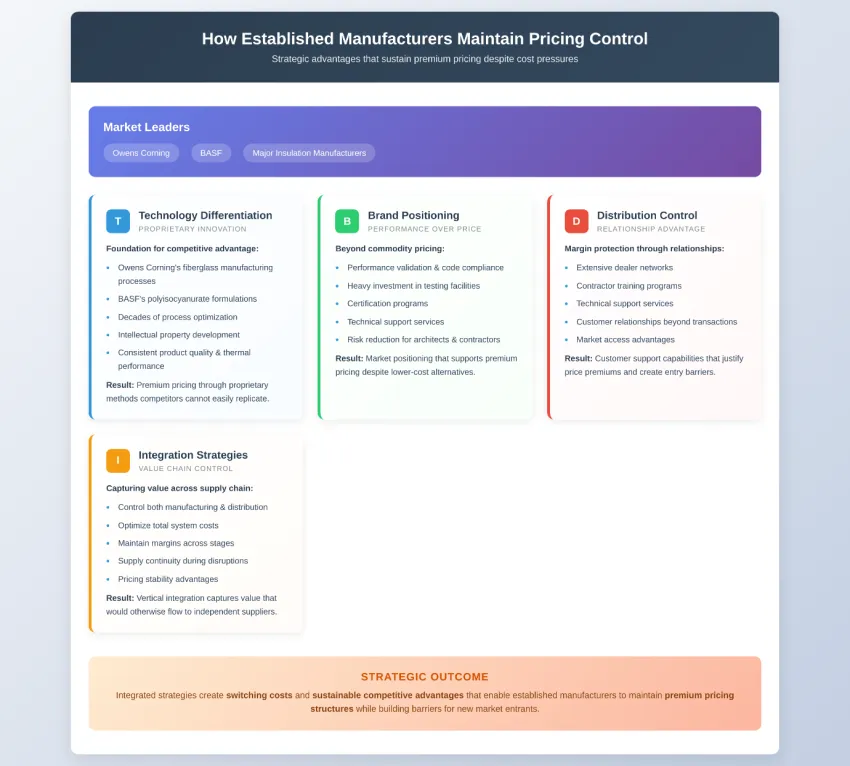
Major insulation manufacturers have developed integrated strategies that capture value beyond simple material processing. Rather than competing purely on commodity pricing, companies like Owens Corning and BASF focus on proprietary technologies, brand positioning, and customer service capabilities that create switching costs and justify premium pricing structures.
Technology differentiation provides the foundation for sustainable competitive advantages. Owens Corning's fiberglass manufacturing processes and BASF's polyisocyanurate formulations represent decades of process optimization and intellectual property development that competitors cannot easily replicate. These proprietary methods enable consistent product quality, improved thermal performance, and specialized applications that command premium pricing.
Brand positioning strategies emphasize performance validation, code compliance, and reliability rather than lowest unit cost. Established manufacturers invest heavily in testing facilities, certification programs, and technical support services that smaller competitors cannot match economically. Building architects and contractors often specify proven brands to reduce project risk, creating market positioning that supports premium pricing despite lower-cost alternatives.
Distribution control represents another margin protection mechanism. Major manufacturers maintain extensive dealer networks, contractor training programs, and technical support services that create customer relationships beyond simple product transactions. These distribution advantages ensure market access and customer support capabilities that justify price premiums while creating barriers for new market entrants.
Integration strategies allow established players to capture value across multiple supply chain stages. Companies that control both manufacturing and distribution can optimize total system costs while maintaining margins that would otherwise flow to independent suppliers. This vertical integration becomes particularly valuable during periods of supply chain disruption when integrated companies can maintain supply continuity and pricing stability.
Where does material complexity create competitive differentiation?
The thermal insulation industry exhibits clear performance tiers that correspond directly to manufacturing complexity and cost structures. Basic fiberglass batt insulation relies on relatively simple manufacturing processes and commodity raw materials, enabling competitive pricing but limiting performance differentiation opportunities. Advanced materials like closed-cell spray foam require sophisticated chemical formulations and specialized application equipment that create natural barriers to competitive entry.
Processing architecture decisions determine long-term competitive positioning. Manufacturers focused on commodity insulation products compete primarily on cost efficiency and volume scale, accepting lower margins in exchange for market share. Companies investing in advanced materials like polyisocyanurate or specialized mineral wool formulations can command premium pricing through superior thermal performance and application-specific capabilities.
Application complexity provides opportunities for value-added positioning. Standard residential insulation applications typically prioritize cost optimization and ease of installation, favoring simpler products with established installation methods. Commercial and industrial applications often require specialized performance characteristics like fire resistance, moisture barriers, or extreme temperature tolerance that justify premium pricing for engineered solutions.
The technology adoption curve creates temporary advantages for companies that successfully develop and commercialize new insulation technologies. Bio-based polyols, advanced fiber structures, and integrated smart building features represent emerging differentiation opportunities that can support premium positioning before competitors develop equivalent capabilities.
Sources
- USA Department of Energy (DOE). Building Insulation Materials: Manufacturing Processes, Energy Consumption, and Cost Analysis.
- National Institute of Standards and Technology (NIST). Thermal Performance Standards and Testing Methods for Building Insulation Materials.
- European Commission - Joint Research Centre (JRC). Energy Consumption and Emissions in Mineral Wool Production: Technical Analysis and Benchmarking Study.
- USA Bureau of Labor Statistics. Producer Price Index by Industry: Mineral Wool Manufacturing and Thermal Insulation Production.
- Massachusetts Institute of Technology (MIT). Materials Science and Engineering: Advanced Polymer Processing and Insulation Manufacturing Cost Analysis.
- University of Cambridge. Sustainable Materials Research: Life Cycle Assessment of Thermal Insulation Technologies.
- Federal Trade Commission. Insulation R-Value Standards, Consumer Protection, and Market Competition Analysis.

