Key Takeaways
- ASEAN is a feedstock and OEM powerhouse: palm, coconut and basic oleochemicals are abundant, and contract manufacturing is strong, but many high-impact actives and fragrances are still imported.
- Cost stacks in key markets show a similar pattern: base chemistry is local, performance chemistry is foreign, so a large share of ingredient margin sits outside ASEAN.
- Thailand and Vietnam act as high-volume OEM and export bases, but depend on imported actives and branded ingredient systems.
- Indonesia and Malaysia anchor oleochemicals and can theoretically move up into mid-tier functional ingredients, especially halal-certified systems, yet most players still behave as commodity suppliers.
- Singapore functions as a regulatory, HQ and trading node rather than a manufacturing centre, shaping pricing, contracts and compliance more than volumes.
- Across 2025-2035, the margin ladder favours global speciality suppliers and strong brands, not local growers or OEMs, unless ASEAN builds its own mid-tier ingredients, labs and compliance platforms.
- Real white space lies in narrow, problem-specific ingredient systems, halal/ESG compliance-as-a-service, and deeply local brands with their own IP.
Thailand - OEM backbone and imported brains
Thailand is the cleanest example of the region’s structural paradox. On the surface, it is a major beauty manufacturing base: dense clusters of OEMs, a large domestic market, strong tourism exposure and a sophisticated retail and salon network.
Inside the factory, the cost stack tells a harsher story. Base surfactants, some oils and packaging can be sourced regionally, but most performance-defining inputs brightening agents, anti-ageing actives, stabilisers, complex fragrances are imported and priced in hard currency.
For a typical mass-to-mastige skincare or haircare SKU made in Thailand, ingredient cost might represent half of ex-factory cost. Of that, a disproportionate slice is tied to those imported speciality ingredients. When exchange rates move or global prices rise, Thai OEMs and local brands are the first to feel the squeeze.
Thailand’s role between 2025 and 2035 is therefore double: an efficient assembler with deep category experience, and a margin pass-through node for foreign ingredient suppliers.
Indonesia - oleochemical spine and halal accelerator
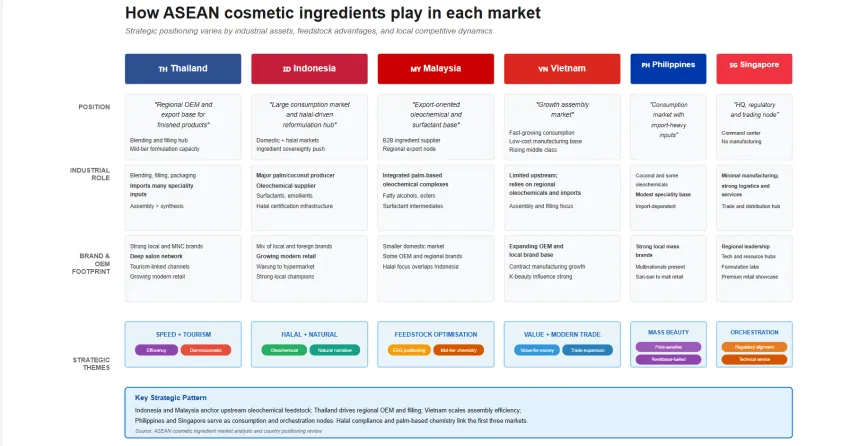
Indonesia couples vast palm and coconut resources with one of ASEAN’s most dynamic beauty markets. Large local groups and multinationals run refineries and oleochemical plants, feeding fatty acids, alcohols and surfactants into personal care.
On paper, that gives Indonesia a structural cost advantage in base chemistry. In practice, the country still imports much of its high-end actives, fragrances and polymer systems.
The twist is mandatory halal certification for cosmetics, which turns compliance into a separate cost and capability layer. Reformulation away from certain animal-derived or alcohol-based inputs, audit costs, documentation and logo licensing all sit in the cost stack. Ingredient suppliers who can offer ready-made halal-compliant systems with documentation effectively tax the category.
Indonesia can stay a cheap surfactant-and-oil supplier, or it can become the halal-functional ingredient node of ASEAN. That requires investment in application labs, regulatory expertise and mid-tier ingredients, not just more plantations.
Malaysia - integrated feedstock and export chemistry
Malaysia shares Indonesia’s palm backbone but often runs more integrated, export-focused oleochemical complexes. These plants convert palm-derived feedstock into fatty alcohols, glycerine, esters and surfactants shipped worldwide into home and personal care.
At the cost-structure level, Malaysian producers sit slightly higher up the ladder than raw growers, but they are still mostly in volume-driven, globally priced commodities. Their margins are at the mercy of palm prices, energy costs and ESG constraints.
The opportunity between now and in next five years is to move from "bulk oleochemicals" to structured ingredient systems: mild surfactant blends, sensory oils, emollient packages and preservative boosters that plug directly into beauty formulations. Without that shift, Malaysia will continue to capture limited incremental value from every extra bottle sold in ASEAN drugstores and salons.
Vietnam and the Philippines - fast-growth assembly and value squeeze
Vietnam and the Philippines are best thought of as high-growth assembly and consumption markets rather than ingredient bases. Both offer young populations, expanding modern trade, and growing middle classes trading up in skincare and haircare.
In the factory, however, the cost stack is even more skewed to imports. Base surfactants may come from regional oleochemical hubs, but virtually all branded actives, fragrances and high-spec packaging are imported. OEMs operate on tight margins, and local brands often compete on price against aggressive foreign entrants.
For these markets, the key margin question is not "can we build ingredient plants?" but "how much pricing power can local brands build around very specific needs and cultural codes?" If they cannot, they remain low-margin conduits for global ingredients and global brands.
Singapore - regulatory, HQ and trading node
Singapore does not compete on low-cost manufacturing. Its role in the ASEAN beauty ingredient system is to function as regional HQ, regulatory benchmark and trading hub.
Many global speciality suppliers base their ASEAN leadership, regulatory affairs, technical service and pricing functions in Singapore. That means decisions about list prices in Malaysia, payment terms in Vietnam or reformulation support in Indonesia are often made from this city-state.
In the margin ladder, Singapore represents the contract and IP layer of the system. Little volume is produced there, but a meaningful share of commercial and technical decisions that shape who earns what in ASEAN flow through Singapore offices rather than ASEAN factories.
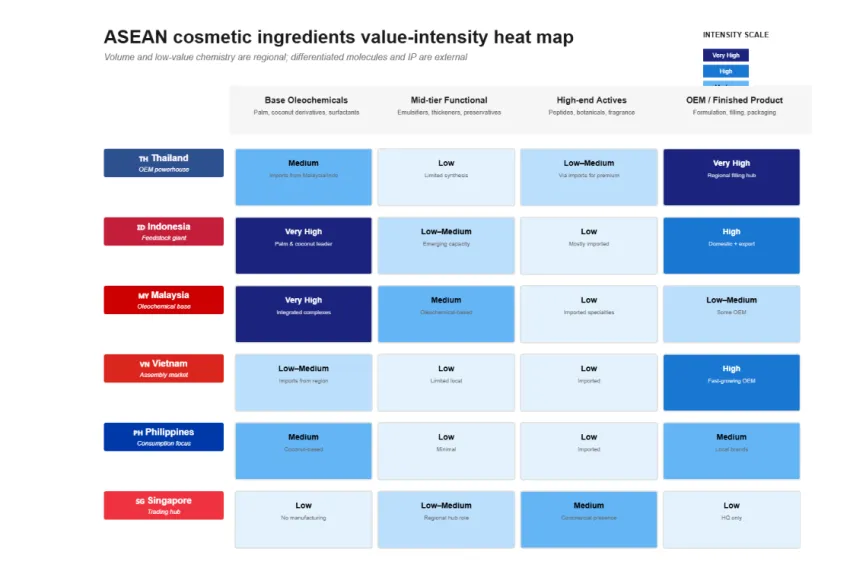
Where a challenger can still play in ASEAN cosmetic chemicals space?
Trying to replicate a full global ingredient portfolio from scratch is unrealistic. The gaps worth attacking are narrower and deeper:
- In Thailand, the system is optimised for OEM throughput. White space exists in problem-specific ingredient systems that plug directly into Thai and regional needs, backed by local testing and claims.
- In Indonesia, halal is moving from logo to architecture. A challenger can build turnkey halal-compliant ingredient kits such as surfactant, preservative, fragrance-free base, documentation, designed for speed-to-certification, not just chemistry.
- In Malaysia, strong oleochemical players can pivot into mid-tier functional ingredients that sit between commodity and prestige: mild cleansing systems, sensorial esters and emollient blends targeted at ASEAN climate and skin/hair types.
- In Vietnam and the Philippines, the more realistic play is for brands and OEMs to build tight IP around formats and local concerns (pollution, hard water, sun, texture preferences) while staying pragmatic on ingredient sourcing. The margin is in the bundle of formulation + ritual + brand, not in building plants.
- In Singapore, the white space is not production but compliance, data and formulation platforms: ingredient libraries mapped by halal/ESG/regulatory status, digital formulation tools, and regional stability/efficacy databases that others plug into.
Across the region, challengers win when they own a specific problem and the system around it, rather than just another ton of fatty alcohols or a generic "natural" story.