

- Industry Size (2026)
- USD 494.92 Mn
- Forecast (2036)
- USD 718.63 Mn
- CAGR (2026 to 2036)
- 3.8%
Cosmetic Filling Machines Market Size, Market Forecast and Outlook By FMI
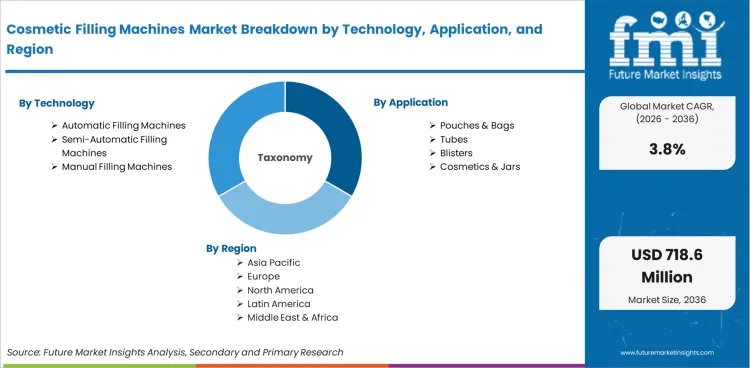
The cosmetic filling machines market was valued at USD 476.80 million in 2025. Based on Future Market Insights' analysis, demand is estimated to reach USD 494.92 million in 2026 and USD 718.63 million by 2036. FMI projects a CAGR of 3.8% during the forecast period. The incremental opportunity from 2026 to 2036 stands at USD 223.71 million. Automatic filling machines hold 41.2% of demand by technology in 2026, pouches and bags lead application-level consumption at 36.8%, and the 10K to 15K PPH operating speed range commands 44.5% of demand, as per FMI. Cosmetic filling machines are specialised packaging equipment designed to accurately dispense liquid, cream, gel, and powder cosmetic formulations into primary containers at controlled speeds.
Summary of Cosmetic Filling Machines Market
- Market valuation is expected to climb to USD 718.63 million by 2036.
- The industry is expected to expand at 3.8% annually from 2026 through 2036.
- The 2025 baseline valuation came in at USD 476.80 million.
- The ten-year outlook presents a cumulative growth opportunity of USD 223.71 million.
- Automatic Filling Machines leads by Technology with 41.2% share in 2026.
- Pouches & Bags leads by Application with 36.8% share in 2026.
- The market is a specialised packaging equipment category where demand tracks cosmetic product launch velocity, contract manufacturing capacity expansion, and the ongoing shift toward flexible packaging formats requiring rapid-changeover filling systems.
- Among key countries, India at 5.8%, China at 5.2%, USA at 3.2%, Canada at 3%, UK at 2.8%, Germany at 2.6%, Japan at 2.3% CAGR respectively.
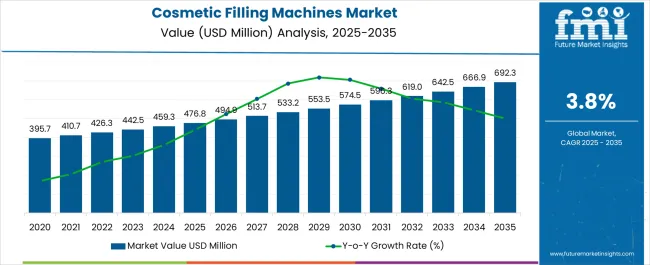
The market is structurally tied to cosmetic product launch velocity and contract manufacturing capacity expansion. FMI is of the opinion that the shift toward smaller batch sizes, limited-edition product releases, and personalised cosmetic formulations is increasing demand for filling machines with rapid changeover capability. Automatic systems dominate because mid-to-large contract manufacturers require consistent fill accuracy across multi-shift operations to meet retail delivery schedules. Pouch and bag formats lead application demand because flexible packaging adoption in the cosmetics sector is growing faster than rigid containers, driven by material cost savings, reduced shipping weight, and consumer preference for single-use travel-sized formats.
India leads at 5.8% CAGR, driven by the expansion of domestic cosmetic manufacturing capacity serving both domestic consumption and export contract packaging. China follows at 5.2%, supported by the scale of the domestic beauty market and the growing base of cosmetic contract manufacturers. The United States registers 3.2% growth, anchored by prestige beauty brand in-house production upgrades and contract manufacturer capacity expansion. Canada tracks at 3%, the United Kingdom at 2.8%, Germany at 2.6%, and Japan at 2.3%, where mature cosmetic industries sustain equipment demand through technology upgrades and compliance with updated GMP filling line requirements.
Cosmetic Filling Machines Market Key Takeaways
| Metric | Details |
|---|---|
| Industry Size (2026) | USD 494.92 million |
| Industry Value (2036) | USD 718.63 million |
| CAGR (2026-2036) | 3.8% |
Source: Future Market Insights, 2026
Cosmetic Filling Machines Market Definition
Cosmetic filling machines are specialised packaging equipment designed to dispense liquid, cream, gel, and powder cosmetic formulations into primary containers including pouches, tubes, blisters, and jars. These machines operate at controlled speeds ranging from manual single-unit filling to automatic high-speed lines exceeding 15,000 packages per hour. The equipment serves cosmetic manufacturers and contract packagers requiring accurate fill volumes, minimal product waste, and compliance with good manufacturing practice standards.
Cosmetic Filling Machines Market Inclusions
Market scope covers global and regional market sizes for cosmetic filling machines from 2026 to 2036. Segmentation spans technology (automatic, semi-automatic, manual), application (pouches & bags, tubes, blisters, cosmetics & jars), and operating speed (less than 10K PPH, 10K to 15K PPH, more than 15K PPH). The analysis includes technology trend assessments, changeover time benchmarking, and GMP compliance requirement tracking.
Cosmetic Filling Machines Market Exclusions
The scope excludes general-purpose liquid filling machines used in food, beverage, or pharmaceutical applications without cosmetic-specific configurations. Labelling machines, cartoning equipment, and secondary packaging systems are omitted. Cosmetic formulation mixing and blending equipment falls outside analytical parameters.
Cosmetic Filling Machines Market Research Methodology
- Primary Research: Analysts engaged with procurement specialists, plant operators, and technology leads to map decision gates triggering purchases and upgrades.
- Desk Research: Data collection aggregated regulatory filings, government records, industry association publications, and company financial disclosures.
- Market-Sizing and Forecasting: Baseline values derive from bottom-up aggregation of shipment and consumption records, applying region-specific adoption curves.
- Data Validation and Update Cycle: Projections are tested against publicly reported guidance and cross-referenced with government statistical data.
Why is the Cosmetic Filling Machines Market Growing?
The Cosmetic Filling Machines market is experiencing steady growth, driven by the increasing demand for efficient, high-precision packaging solutions across the cosmetics and personal care industry. The adoption of automated systems is being accelerated by the need to improve production efficiency, ensure product consistency, and maintain hygiene standards in manufacturing operations. Technological advancements, including automated filling, integrated quality control, and real-time monitoring, are enhancing operational productivity and reducing manual labor requirements.
The growing trend toward diverse packaging formats, including pouches, bags, and bottles, is further influencing market expansion. Manufacturers are increasingly focusing on scalability, energy efficiency, and adaptability of machinery to meet evolving production requirements.
Regulatory compliance, quality standards, and sustainability considerations are also driving the preference for advanced filling machines As cosmetic product lines expand and consumer demand for innovative formats grows, investments in high-speed, automated, and reliable filling systems are expected to support sustained market growth over the coming years, creating opportunities for both equipment manufacturers and end users.
Segmental Analysis
The cosmetic filling machines market is segmented by technology, application, operating speed, and geographic regions. By technology, cosmetic filling machines market is divided into Automatic Filling Machines, Semi-Automatic Filling Machines, and Manual Filling Machines. In terms of application, cosmetic filling machines market is classified into Pouches & Bags, Tubes, Blisters, and Cosmetics & Jars. Based on operating speed, cosmetic filling machines market is segmented into 10K To 15K PPH, Less Than 10K PPH, and More Than 15K PPH. Regionally, the cosmetic filling machines industry is classified into North America, Latin America, Western Europe, Eastern Europe, Balkan & Baltic Countries, Russia & Belarus, Central Asia, East Asia, South Asia & Pacific, and the Middle East & Africa.
Insights into the Automatic Filling Machines Technology Segment
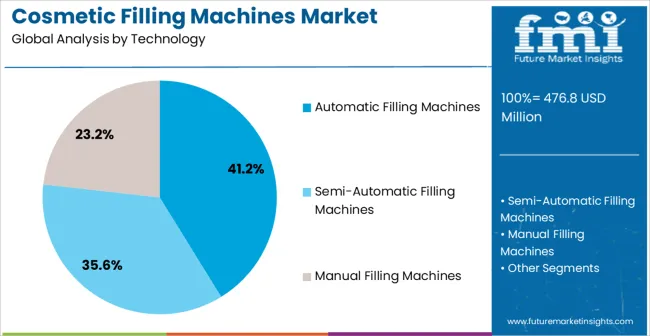
The automatic filling machines technology segment is projected to hold 41.2% of the market revenue in 2026, establishing it as the leading technology type. Its dominance is being driven by the ability to enhance production efficiency while maintaining consistent fill volumes and reducing human error.
Automation enables manufacturers to scale production rapidly and respond to fluctuating market demands without compromising on quality or hygiene standards. These machines integrate advanced control systems, sensors, and monitoring mechanisms that allow real-time performance tracking, error detection, and process optimization.
The ability to handle a wide variety of cosmetic formulations, including creams, lotions, and gels, further reinforces the appeal of automatic filling machines With growing demand for operational efficiency, product consistency, and reduced labor costs, automatic filling machines are expected to maintain their leadership in the market, supported by continuous innovation and technological upgrades in filling automation systems.
Insights into the Pouches & Bags Application Segment
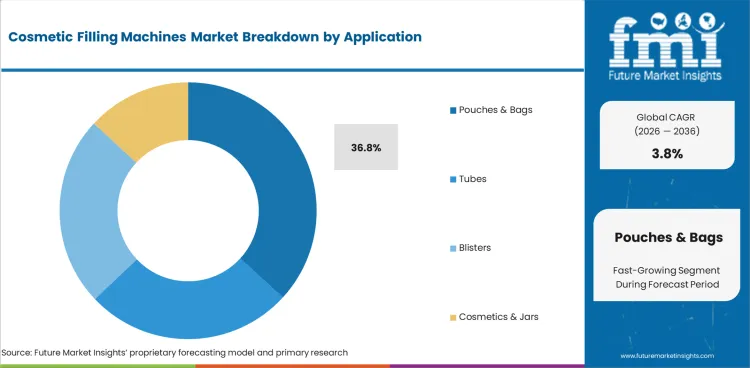
The pouches and bags application segment is expected to account for 36.8% of the market revenue in 2026, making it the leading packaging format for cosmetic filling machines. Growth is being driven by the rising consumer preference for convenient, travel-friendly, and environmentally sustainable packaging options. Pouches and bags offer flexibility in size, portability, and material usage, which allows manufacturers to meet diverse market requirements.
Cosmetic filling machines designed for pouches and bags provide high precision, minimal product waste, and faster changeover between different product lines, enhancing operational efficiency. Manufacturers are increasingly leveraging these machines to achieve cost-effective production while adhering to quality standards and regulatory requirements.
The segment’s adoption is also influenced by the expansion of retail channels, including e-commerce, which favors compact and lightweight packaging formats As market demand for customizable and efficient packaging continues to rise, the pouches and bags segment is expected to maintain its leading position in the cosmetic filling machines market.
Insights into the 10K To 15K PPH Operating Speed Segment
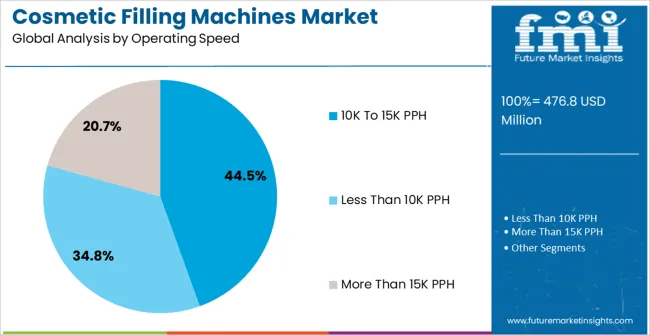
The 10K to 15K PPH operating speed segment is projected to hold 44.5% of the market revenue in 2026, establishing it as the leading speed category. Its prominence is driven by the balance it provides between high production capacity and operational efficiency, enabling manufacturers to meet increasing demand without compromising quality or precision. Machines operating within this speed range allow for rapid production cycles while maintaining consistent fill volumes and minimal downtime.
The segment is particularly suitable for medium to large-scale cosmetic manufacturing facilities seeking scalable solutions that can handle multiple product formats. Integration with automation systems, real-time monitoring, and error detection further enhances performance, reducing waste and labor costs.
The growing requirement for fast, reliable, and flexible production systems in response to expanding product portfolios, seasonal demand fluctuations, and e-commerce distribution channels has reinforced adoption As efficiency, scalability, and precision continue to be critical for cosmetic manufacturers, the 10K to 15K PPH operating speed segment is expected to maintain market leadership.
Market Overview
Cosmetic Filling Machines Market Snapshot (2026 to 2036)
Based on automation, the automatic cosmetic filling machines segment is projected to remain the leading segment among the other automation segments due to the high adoption of the latest technology and automation by the end-use industries. The target segment is estimated to grow 1.6 times the current market value from 2026 to 2036.
According to the FMI analysis, the cosmetic filling machines market reached USD 411.4 Million in 2026. With the increased adoption of automation, the global cosmetic filling machines market is projected to reach USD 619.0 Million by the end of the forecast period, expanding at a CAGR of 3.8% from 2026 to 2036.
The cosmetic filling machines market is estimated to boost during the forecast period. A new forecast by FMI anticipates that the cosmetic filling machines sale will propel during the forecast period and is projected to create an opportunity of USD 207.6 Million from 2026 to 2036.
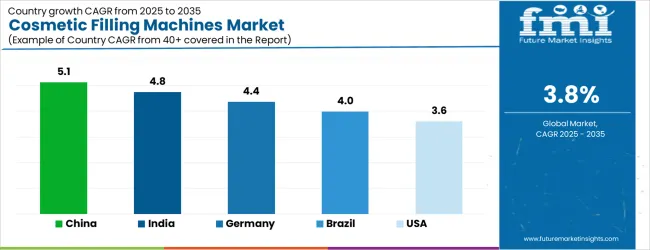
Analysis of Cosmetic Filling Machines Market By Key Countries
.webp "Top Country Growth Comparison Cosmetic Filling Machines Market Cagr (2026 2036)")
| Country | CAGR |
|---|---|
| China | 5.1% |
| India | 4.8% |
| Germany | 4.4% |
| Brazil | 4.0% |
| USA | 3.6% |
| UK | 3.2% |
| Japan | 2.9% |
Country-wise Analysis
The Cosmetic Filling Machines Market is expected to register a CAGR of 3.8% during the forecast period, exhibiting varied country level momentum. China leads with the highest CAGR of 5.1%, followed by India at 4.8%. Developed markets such as Germany, France, and the UK continue to expand steadily, while the USA is likely to grow at consistent rates. Japan posts the lowest CAGR at 2.9%, yet still underscores a broadly positive trajectory for the global Cosmetic Filling Machines Market. In 2024, Germany held a dominant revenue in the Western Europe market and is expected to grow with a CAGR of 4.4%. The USA Cosmetic Filling Machines Market is estimated to be valued at USD 170.6 million in 2026 and is anticipated to reach a valuation of USD 170.6 million by 2036. Sales are projected to rise at a CAGR of 0.0% over the forecast period between 2026 and 2036. While Japan and South Korea markets are estimated to be valued at USD 26.1 million and USD 16.6 million respectively in 2026.
Key Players in the Cosmetic Filling Machines Market
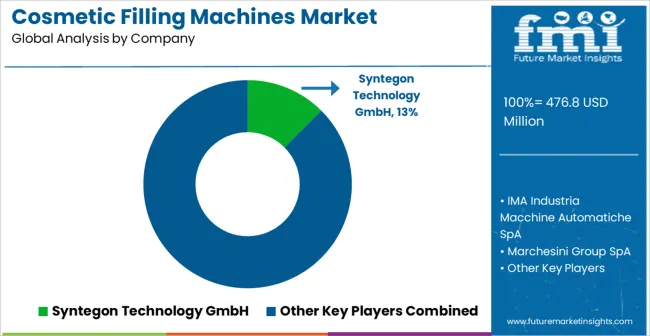
- Syntegon Technology GmbH
- IMA Industria Macchine Automatiche SpA
- Marchesini Group SpA
- Coesia S.p.A (PackSys Global etc.)
- ProMach Inc.
- Accutek Packaging Equipment Co.
- Krones AG
- Sidel Group
- Optima Packaging Group GmbH
- Norden Machinery AB
- Barry-Wehmiller (Pneumatic Scale Angelus)
- Uhlmann Packaging Systems
- ProSys Innovative Packaging Equipment
- TurboFil Packaging Machines LLC
Scope of the Report
| Metric | Value |
|---|---|
| Quantitative Units | USD 494.92 million to USD 718.63 million, at a CAGR of 3.8% |
| Market Definition | Cosmetic filling machines are specialised packaging equipment designed to dispense liquid, cream, gel, and powder cosmetic formulations into primary containers including pouches, tubes, blisters, and jars. These machines operate at controlled speeds ranging from manual single-unit filling to automatic high-speed lines exceeding 15,000 packages per hour. |
| Technology Segmentation | Automatic Filling Machines, Semi-Automatic Filling Machines, Manual Filling Machines |
| Application Segmentation | Pouches & Bags, Tubes, Blisters, Cosmetics & Jars |
| Operating Speed Segmentation | 10K to 15K PPH, Less Than 10K PPH, More Than 15K PPH |
| Regions Covered | North America, Latin America, Europe, East Asia, South Asia, Oceania, Middle East & Africa |
| Countries Covered | India, China, USA, Canada, UK, Germany, Japan, and 40 plus countries |
| Key Companies Profiled | Syntegon Technology GmbH, IMA Industria Macchine Automatiche SpA, Marchesini Group SpA, Coesia S.p.A., ProMach Inc., Accutek Packaging Equipment Co., Krones AG, Sidel Group, Optima Packaging Group GmbH, Norden Machinery AB |
| Forecast Period | 2026 to 2036 |
| Approach | Forecasting models apply a bottom-up methodology starting with installed base metrics and projecting adoption rates using region-specific demand curves. |
Cosmetic Filling Machines Market by Segments
Technology:
- Automatic Filling Machines
- Semi-Automatic Filling Machines
- Manual Filling Machines
Application:
- Pouches & Bags
- Tubes
- Blisters
- Cosmetics & Jars
Operating Speed:
- 10K To 15K PPH
- Less Than 10K PPH
- More Than 15K PPH
Region:
- North America
- USA
- Canada
- Mexico
- Latin America
- Brazil
- Chile
- Rest of Latin America
- Western Europe
- Germany
- UK
- Italy
- Spain
- France
- Nordic
- BENELUX
- Rest of Western Europe
- Eastern Europe
- Russia
- Poland
- Hungary
- Balkan & Baltic
- Rest of Eastern Europe
- East Asia
- China
- Japan
- South Korea
- South Asia and Pacific
- India
- ASEAN
- Australia & New Zealand
- Rest of South Asia and Pacific
- Middle East & Africa
- Kingdom of Saudi Arabia
- Other GCC Countries
- Turkiye
- South Africa
- Other African Union
- Rest of Middle East & Africa
Bibliography
- 1. International Society of Pharmaceutical Engineering. (2025). Good Manufacturing Practice Guide for Cosmetic Packaging Lines. ISPE.
- 2. Cosmetics Europe. (2024). Cosmetics Industry Statistical Overview 2024. Cosmetics Europe.
- 3. Ministry of Commerce and Industry, Government of India. (2025). Cosmetics Manufacturing Sector Review 2024-25. Government of India.
- 4. European Commission. (2024). EU Cosmetics Regulation: GMP Compliance Update. European Commission.
- 5. International Organization for Standardization. (2024). ISO 22716: Cosmetics, Good Manufacturing Practices. ISO.
This bibliography is provided for reader reference. The full Future Market Insights report contains the complete reference list with primary research documentation.
Frequently Asked Questions
How large is the demand for Cosmetic Filling Machines in the global market in 2026?
Demand for Cosmetic Filling Machines in the global market is estimated to be valued at USD 494.92 million in 2026.
What will be the market size of Cosmetic Filling Machines by 2036?
Market size for Cosmetic Filling Machines is projected to reach USD 718.63 million by 2036.
What is the expected demand growth between 2026 and 2036?
Demand for Cosmetic Filling Machines is expected to grow at a CAGR of 3.8% between 2026 and 2036.
Which Technology is poised to lead global sales by 2026?
Automatic Filling Machines accounts for 41.2% share in 2026.
How is Application structured in 2026?
Pouches & Bags holds 36.8% of segment share in 2026.
What is driving demand in India?
India is projected to grow at a CAGR of 5.8% during 2026 to 2036.
What is Cosmetic Filling Machines and what is it mainly used for?
Cosmetic filling machines are specialised packaging equipment designed to dispense liquid, cream, gel, and powder cosmetic formulations into primary containers including pouches, tubes, blisters, and jars. These machines operate at controlled speeds ranging from manual single-unit filling to automatic high-speed lines exceeding 15,000 packages per hour.
What is included in the scope of this report?
Market scope covers global and regional market sizes for cosmetic filling machines from 2026 to 2036. Segmentation spans technology (automatic, semi-automatic, manual), application (pouches & bags, tubes, blisters, cosmetics & jars), and operating speed (less than 10K PPH, 10K to 15K PPH, more than 15K PPH).
Preview the report firsthand - request a free sample
Get SampleGet the brochure for pricing and purchase details.
Get PDFTable of Content
- Executive Summary
- Global Market Outlook
- Demand-side Trends
- Supply-side Trends
- Technology Roadmap Analysis
- Analysis and Recommendations
- Market Overview
- Market Coverage / Taxonomy
- Market Definition / Scope / Limitations
- Research Methodology
- Chapter Orientation
- Analytical Lens and Working Hypotheses
- Market Structure, Signals, and Trend Drivers
- Benchmarking and Cross-market Comparability
- Market Sizing, Forecasting, and Opportunity Mapping
- Research Design and Evidence Framework
- Desk Research Programme (Secondary Evidence)
- Company Annual and Sustainability Reports
- Peer-reviewed Journals and Academic Literature
- Corporate Websites, Product Literature, and Technical Notes
- Earnings Decks and Investor Briefings
- Statutory Filings and Regulatory Disclosures
- Technical White Papers and Standards Notes
- Trade Journals, Industry Magazines, and Analyst Briefs
- Conference Proceedings, Webinars, and Seminar Materials
- Government Statistics Portals and Public Data Releases
- Press Releases and Reputable Media Coverage
- Specialist Newsletters and Curated Briefings
- Sector Databases and Reference Repositories
- FMI Internal Proprietary Databases and Historical Market Datasets
- Subscription Datasets and Paid Sources
- Social Channels, Communities, and Digital Listening Inputs
- Additional Desk Sources
- Expert Input and Fieldwork (Primary Evidence)
- Primary Modes
- Qualitative Interviews and Expert Elicitation
- Quantitative Surveys and Structured Data Capture
- Blended Approach
- Why Primary Evidence is Used
- Field Techniques
- Interviews
- Surveys
- Focus Groups
- Observational and In-context Research
- Social and Community Interactions
- Stakeholder Universe Engaged
- C-suite Leaders
- Board Members
- Presidents and Vice Presidents
- R&D and Innovation Heads
- Technical Specialists
- Domain Subject-matter Experts
- Scientists
- Physicians and Other Healthcare Professionals
- Governance, Ethics, and Data Stewardship
- Research Ethics
- Data Integrity and Handling
- Primary Modes
- Tooling, Models, and Reference Databases
- Desk Research Programme (Secondary Evidence)
- Data Engineering and Model Build
- Data Acquisition and Ingestion
- Cleaning, Normalisation, and Verification
- Synthesis, Triangulation, and Analysis
- Quality Assurance and Audit Trail
- Market Background
- Market Dynamics
- Drivers
- Restraints
- Opportunity
- Trends
- Scenario Forecast
- Demand in Optimistic Scenario
- Demand in Likely Scenario
- Demand in Conservative Scenario
- Opportunity Map Analysis
- Product Life Cycle Analysis
- Supply Chain Analysis
- Investment Feasibility Matrix
- Value Chain Analysis
- PESTLE and Porter’s Analysis
- Regulatory Landscape
- Regional Parent Market Outlook
- Production and Consumption Statistics
- Import and Export Statistics
- Market Dynamics
- Global Market Analysis 2021 to 2025 and Forecast, 2026 to 2036
- Historical Market Size Value (USD Million) Analysis, 2021 to 2025
- Current and Future Market Size Value (USD Million) Projections, 2026 to 2036
- Y-o-Y Growth Trend Analysis
- Absolute $ Opportunity Analysis
- Global Market Pricing Analysis 2021 to 2025 and Forecast 2026 to 2036
- Global Market Analysis 2021 to 2025 and Forecast 2026 to 2036, By Technology
- Introduction / Key Findings
- Historical Market Size Value (USD Million) Analysis By Technology , 2021 to 2025
- Current and Future Market Size Value (USD Million) Analysis and Forecast By Technology , 2026 to 2036
- Automatic Filling Machines
- Semi-Automatic Filling Machines
- Manual Filling Machines
- Automatic Filling Machines
- Y-o-Y Growth Trend Analysis By Technology , 2021 to 2025
- Absolute $ Opportunity Analysis By Technology , 2026 to 2036
- Global Market Analysis 2021 to 2025 and Forecast 2026 to 2036, By Application
- Introduction / Key Findings
- Historical Market Size Value (USD Million) Analysis By Application, 2021 to 2025
- Current and Future Market Size Value (USD Million) Analysis and Forecast By Application, 2026 to 2036
- Pouches & Bags
- Tubes
- Blisters
- Cosmetics & Jars
- Pouches & Bags
- Y-o-Y Growth Trend Analysis By Application, 2021 to 2025
- Absolute $ Opportunity Analysis By Application, 2026 to 2036
- Global Market Analysis 2021 to 2025 and Forecast 2026 to 2036, By Operating Speed
- Introduction / Key Findings
- Historical Market Size Value (USD Million) Analysis By Operating Speed, 2021 to 2025
- Current and Future Market Size Value (USD Million) Analysis and Forecast By Operating Speed, 2026 to 2036
- 10K To 15K PPH
- Less Than 10K PPH
- More Than 15K PPH
- 10K To 15K PPH
- Y-o-Y Growth Trend Analysis By Operating Speed, 2021 to 2025
- Absolute $ Opportunity Analysis By Operating Speed, 2026 to 2036
- Global Market Analysis 2021 to 2025 and Forecast 2026 to 2036, By Region
- Introduction
- Historical Market Size Value (USD Million) Analysis By Region, 2021 to 2025
- Current Market Size Value (USD Million) Analysis and Forecast By Region, 2026 to 2036
- North America
- Latin America
- Western Europe
- Eastern Europe
- East Asia
- South Asia and Pacific
- Middle East & Africa
- Market Attractiveness Analysis By Region
- North America Market Analysis 2021 to 2025 and Forecast 2026 to 2036, By Country
- Historical Market Size Value (USD Million) Trend Analysis By Market Taxonomy, 2021 to 2025
- Market Size Value (USD Million) Forecast By Market Taxonomy, 2026 to 2036
- By Country
- USA
- Canada
- Mexico
- By Technology
- By Application
- By Operating Speed
- By Country
- Market Attractiveness Analysis
- By Country
- By Technology
- By Application
- By Operating Speed
- Key Takeaways
- Latin America Market Analysis 2021 to 2025 and Forecast 2026 to 2036, By Country
- Historical Market Size Value (USD Million) Trend Analysis By Market Taxonomy, 2021 to 2025
- Market Size Value (USD Million) Forecast By Market Taxonomy, 2026 to 2036
- By Country
- Brazil
- Chile
- Rest of Latin America
- By Technology
- By Application
- By Operating Speed
- By Country
- Market Attractiveness Analysis
- By Country
- By Technology
- By Application
- By Operating Speed
- Key Takeaways
- Western Europe Market Analysis 2021 to 2025 and Forecast 2026 to 2036, By Country
- Historical Market Size Value (USD Million) Trend Analysis By Market Taxonomy, 2021 to 2025
- Market Size Value (USD Million) Forecast By Market Taxonomy, 2026 to 2036
- By Country
- Germany
- UK
- Italy
- Spain
- France
- Nordic
- BENELUX
- Rest of Western Europe
- By Technology
- By Application
- By Operating Speed
- By Country
- Market Attractiveness Analysis
- By Country
- By Technology
- By Application
- By Operating Speed
- Key Takeaways
- Eastern Europe Market Analysis 2021 to 2025 and Forecast 2026 to 2036, By Country
- Historical Market Size Value (USD Million) Trend Analysis By Market Taxonomy, 2021 to 2025
- Market Size Value (USD Million) Forecast By Market Taxonomy, 2026 to 2036
- By Country
- Russia
- Poland
- Hungary
- Balkan & Baltic
- Rest of Eastern Europe
- By Technology
- By Application
- By Operating Speed
- By Country
- Market Attractiveness Analysis
- By Country
- By Technology
- By Application
- By Operating Speed
- Key Takeaways
- East Asia Market Analysis 2021 to 2025 and Forecast 2026 to 2036, By Country
- Historical Market Size Value (USD Million) Trend Analysis By Market Taxonomy, 2021 to 2025
- Market Size Value (USD Million) Forecast By Market Taxonomy, 2026 to 2036
- By Country
- China
- Japan
- South Korea
- By Technology
- By Application
- By Operating Speed
- By Country
- Market Attractiveness Analysis
- By Country
- By Technology
- By Application
- By Operating Speed
- Key Takeaways
- South Asia and Pacific Market Analysis 2021 to 2025 and Forecast 2026 to 2036, By Country
- Historical Market Size Value (USD Million) Trend Analysis By Market Taxonomy, 2021 to 2025
- Market Size Value (USD Million) Forecast By Market Taxonomy, 2026 to 2036
- By Country
- India
- ASEAN
- Australia & New Zealand
- Rest of South Asia and Pacific
- By Technology
- By Application
- By Operating Speed
- By Country
- Market Attractiveness Analysis
- By Country
- By Technology
- By Application
- By Operating Speed
- Key Takeaways
- Middle East & Africa Market Analysis 2021 to 2025 and Forecast 2026 to 2036, By Country
- Historical Market Size Value (USD Million) Trend Analysis By Market Taxonomy, 2021 to 2025
- Market Size Value (USD Million) Forecast By Market Taxonomy, 2026 to 2036
- By Country
- Kingdom of Saudi Arabia
- Other GCC Countries
- Turkiye
- South Africa
- Other African Union
- Rest of Middle East & Africa
- By Technology
- By Application
- By Operating Speed
- By Country
- Market Attractiveness Analysis
- By Country
- By Technology
- By Application
- By Operating Speed
- Key Takeaways
- Key Countries Market Analysis
- USA
- Pricing Analysis
- Market Share Analysis, 2025
- By Technology
- By Application
- By Operating Speed
- Canada
- Pricing Analysis
- Market Share Analysis, 2025
- By Technology
- By Application
- By Operating Speed
- Mexico
- Pricing Analysis
- Market Share Analysis, 2025
- By Technology
- By Application
- By Operating Speed
- Brazil
- Pricing Analysis
- Market Share Analysis, 2025
- By Technology
- By Application
- By Operating Speed
- Chile
- Pricing Analysis
- Market Share Analysis, 2025
- By Technology
- By Application
- By Operating Speed
- Germany
- Pricing Analysis
- Market Share Analysis, 2025
- By Technology
- By Application
- By Operating Speed
- UK
- Pricing Analysis
- Market Share Analysis, 2025
- By Technology
- By Application
- By Operating Speed
- Italy
- Pricing Analysis
- Market Share Analysis, 2025
- By Technology
- By Application
- By Operating Speed
- Spain
- Pricing Analysis
- Market Share Analysis, 2025
- By Technology
- By Application
- By Operating Speed
- France
- Pricing Analysis
- Market Share Analysis, 2025
- By Technology
- By Application
- By Operating Speed
- India
- Pricing Analysis
- Market Share Analysis, 2025
- By Technology
- By Application
- By Operating Speed
- ASEAN
- Pricing Analysis
- Market Share Analysis, 2025
- By Technology
- By Application
- By Operating Speed
- Australia & New Zealand
- Pricing Analysis
- Market Share Analysis, 2025
- By Technology
- By Application
- By Operating Speed
- China
- Pricing Analysis
- Market Share Analysis, 2025
- By Technology
- By Application
- By Operating Speed
- Japan
- Pricing Analysis
- Market Share Analysis, 2025
- By Technology
- By Application
- By Operating Speed
- South Korea
- Pricing Analysis
- Market Share Analysis, 2025
- By Technology
- By Application
- By Operating Speed
- Russia
- Pricing Analysis
- Market Share Analysis, 2025
- By Technology
- By Application
- By Operating Speed
- Poland
- Pricing Analysis
- Market Share Analysis, 2025
- By Technology
- By Application
- By Operating Speed
- Hungary
- Pricing Analysis
- Market Share Analysis, 2025
- By Technology
- By Application
- By Operating Speed
- Kingdom of Saudi Arabia
- Pricing Analysis
- Market Share Analysis, 2025
- By Technology
- By Application
- By Operating Speed
- Turkiye
- Pricing Analysis
- Market Share Analysis, 2025
- By Technology
- By Application
- By Operating Speed
- South Africa
- Pricing Analysis
- Market Share Analysis, 2025
- By Technology
- By Application
- By Operating Speed
- USA
- Market Structure Analysis
- Competition Dashboard
- Competition Benchmarking
- Market Share Analysis of Top Players
- By Regional
- By Technology
- By Application
- By Operating Speed
- Competition Analysis
- Competition Deep Dive
- Syntegon Technology GmbH
- Overview
- Product Portfolio
- Profitability by Market Segments (Product/Age /Sales Channel/Region)
- Sales Footprint
- Strategy Overview
- Marketing Strategy
- Product Strategy
- Channel Strategy
- IMA Industria Macchine Automatiche SpA
- Marchesini Group SpA
- Coesia S.p.A (PackSys Global etc.)
- ProMach Inc.
- Accutek Packaging Equipment Co.
- Krones AG
- Sidel Group
- Optima Packaging Group GmbH
- Norden Machinery AB
- Barry-Wehmiller (Pneumatic Scale Angelus)
- Uhlmann Packaging Systems
- ProSys Innovative Packaging Equipment
- TurboFil Packaging Machines LLC
- Syntegon Technology GmbH
- Competition Deep Dive
- Assumptions & Acronyms Used


