


Key Takeaways
- By 2026, the Internet of Everything is less about adding more sensors and more about closing a few profitable loops where data reliably changes physical outcomes in factories, fleets, grids and buildings.
- Economic value concentrates in industrial and infrastructure settings where uptime, energy and yield matter; consumer and smart home ecosystems grow, but remain secondary in hard value creation.
- The main brake on adoption is not connectivity cost but integration debt, security exposure in operational technology, and lack of people who can model business value across IT and OT stacks.
- The practical agenda for 2026 is to pick a handful of high value use cases per sector, standardise the edge to cloud stack around them, and treat IoE as a capital project with explicit payback, not an innovation showcase.
What architectural shifts really matter in 2026
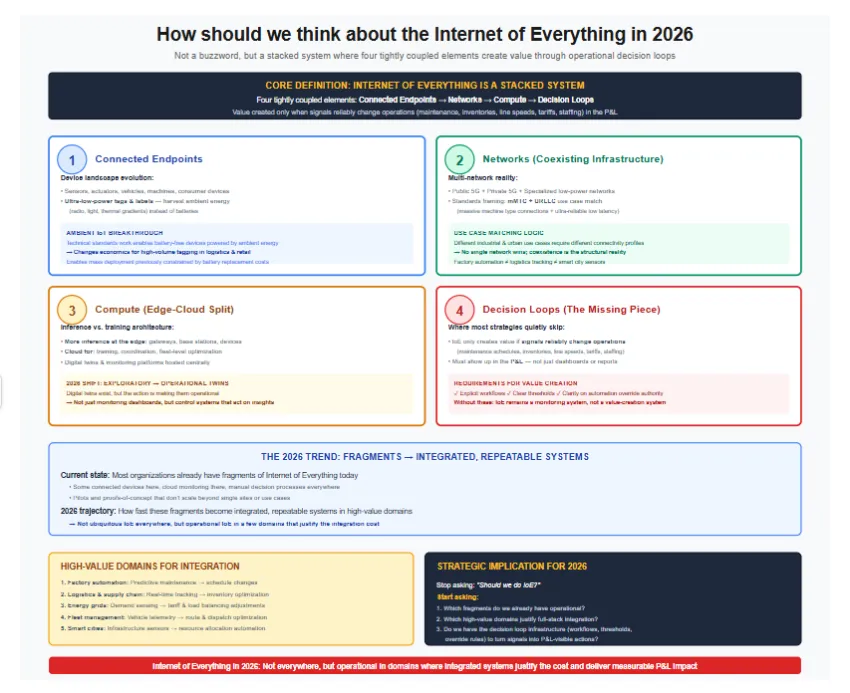
By 2026 the architecture conversation is less about whether to connect things and more about how to connect them without drowning in cost and complexity. Three trends stand out.
Rise of private and specialised 5G Industrial users increasingly deploy private 5G networks on factory sites, ports and campuses to gain predictable wireless performance and keep sensitive operational traffic under local control. Telecom and standards bodies emphasise that 5G network capabilities for massive low data rate devices and ultra reliable low latency links are designed exactly for this mix of sensors, robots and vehicles. For Internet of Everything, this means that connectivity becomes an internal design parameter rather than a given utility.
Ambient and batteryless IoT Technical work by telecom and standards organisations on ambient power enabled IoT has moved beyond theory into pilots. Devices that harvest energy from radio waves, light or heat can be made as thin tags and labels, with lifetimes much longer than battery powered counterparts. In a 2026 time frame, the realistic impact is not universal tagging of every object, but targeted deployment in high value chains such as pharmaceuticals, cold chain food and high shrink retail.
Edge first intelligence Industry and technology reports converge on the view that most IoT and IoE value will require analytics and automation close to the source of data. Latency, privacy and bandwidth constraints make continuous streaming to the cloud impractical for many real time decisions. At the same time, advances in lightweight AI models and dedicated neural hardware inside gateways and devices mean that pattern recognition, anomaly detection and control logic can run locally. By 2026, serious programmes will treat edge as the primary execution environment and the cloud as coordination and history, not the other way around.
What should a 2026 IoE agenda look like for serious enterprises
For a company treating Internet of Everything as a strategic tool rather than a slide, a pragmatic 2026 agenda would include four elements.
First, define value loops, not device counts Start from two or three measurable business outcomes, such as reduction in energy per unit, improvement in overall equipment effectiveness, or lower spoilage. Work backwards to which sensors, networks, analytics and process changes are needed. Only count an IoE deployment as real when that loop is closed and monitored.
Second, standardise an edge to cloud reference stack Pick a small number of network types, device classes, edge platforms and cloud services and commit to them for a planning cycle. Fragmentation at this level is what makes many pilots expensive and fragile. Use sector standards and telecom guidance to ensure that choices for protocols and interfaces are compatible with future ambient and low power devices.
Third, treat security and lifecycle as first class citizens Assign budget and engineering time to onboarding, identity, patching and decommissioning of devices from the start. Internet of Everything greatly increases the number of endpoints; unmanaged endpoints become liabilities in both cybersecurity and safety. Align with emerging regulatory baselines for device and system security.
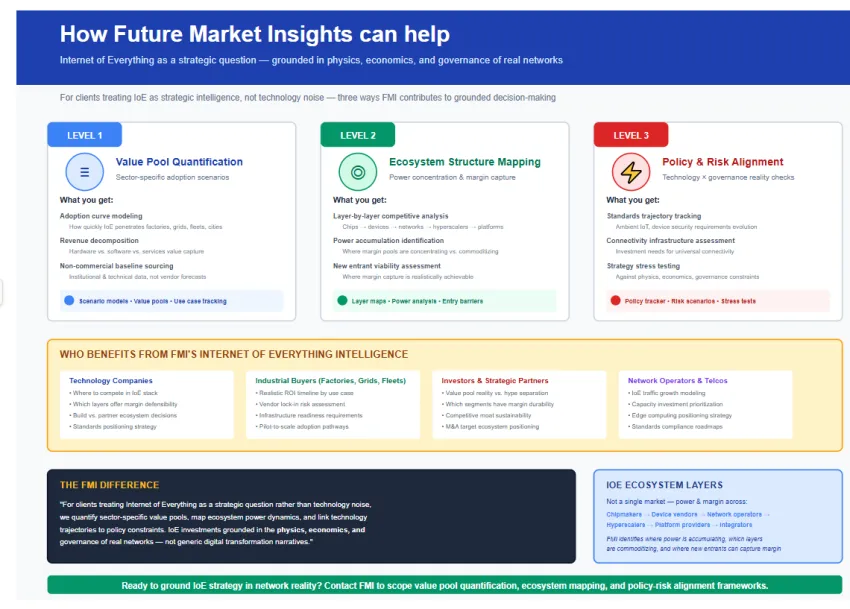
Fourth, model economics under different adoption scenarios For each major IoE initiative, build scenarios with different rates of adoption, sensor price curves, connectivity cost decline and incident avoidance. Use ranges rather than point estimates. The aim is not to produce a single precise forecast for 2030, but to understand which assumptions most strongly drive whether a programme creates or destroys value.
Sources
- Cisco Systems. (2013). The Internet of Everything: How more relevant and valuable connections will change the world. Cisco Internet Business Solutions Group.
- Cisco Systems. (2013). The Internet of Everything Value Index: How much value are private sector firms capturing from IoE. Cisco Internet Business Solutions Group.
- International Telecommunication Union. (2025). Analysis on requirements and use cases of ambient power enabled Internet of Things (Technical Report ITU T YSTR.Ambient IoT). ITU Telecommunication Standardization Sector.
- International Telecommunication Union. (2025). Statistics: Measuring digital development. ITU Development Sector.
- International Telecommunication Union and Communications, Space and Technology Commission of Saudi Arabia. (2025). Connecting Humanity Action Blueprint. ITU.
- McKinsey and Company. (2021). IoT value set to accelerate through 2030: Where and how to capture it. McKinsey Global Institute.
- McKinsey and Company. (2025). Technology trends outlook 2025. McKinsey Global Institute.
- World Economic Forum. (2020). How 5G and the Internet of Things can create a winning combination. World Economic Forum.
- World Economic Forum. (2025). Top 10 emerging technologies of 2025. World Economic Forum.
- Institute of Electrical and Electronics Engineers. (2024). Connectivity and telecom trends to watch. IEEE Standards Association.
- AIP Publishing. (2025). Integration of IoT and 5G: A comprehensive review. In AIP Conference Proceedings on advanced communication technologies.

