


Growing mobile phone ownership and proliferation of internet promise a fundamental transformation in the global payments landscape. Mobile payments, although still in their infancy, will account for a significant percentage of all transactions.
Technological innovation has already transformed the manner in which we communicate with our loved ones and acquaintances. Consumer appetite for on-demand content has made the TV industry to ponder upon the future, whereas popularity of mobile gaming has eaten into the console market.
Mobile payments are gaining traction not only in the developed world, but also in emerging markets. The success of M-Pesa in Kenya is a case study in itself, with replicating models now being tried in other emerging nations.
Millennials are at the forefront of adoption of mobile payments. From a consumer persepective, they are all too familiar with social media websites — platforms where mobile payments are expected to gain traction in the future. From a business perspective, millennials who are at climbing the corporate hierarchy are bringing new ideas and new ways of doing business to their organisations. As we move into a new era of Silicon Valley “startup” enterprise, old tools and methodologies are being increasingly replaced by new technology-oriented tools. Mobile payments represent the new era of transactions, which is consumer-driven, with lesser governmental control and regulation.
State of the Market
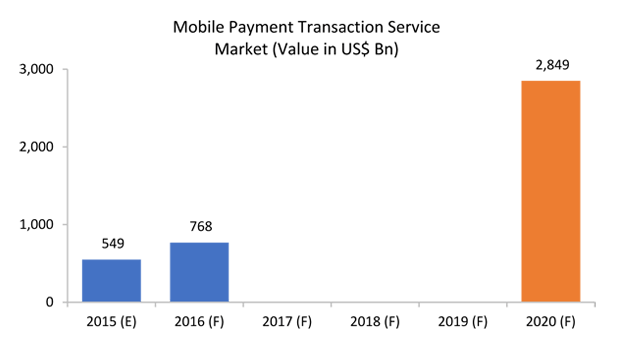
The mobile payments market is expected to reach USD 549 billion in 2015, up from USD 392 billion in 2014. Between 2014 and 2020, the market will gain an astonishing USD 2300 billion, amplifying at a compound annual growth rate (CAGR) of nearly 39%. 61 million new users are expected to be added between 2014 and 2015, and by 2020, the total user base will reach nearly three quarters to a billion.
North America
North America remains one of the most lucrative markets for mobile payments. High smartphone ownership, coupled with robust internet coverage are key factors facilitating mobile payments. In 2014, North America held a share of nearly 23% of the global mobile payments market. In the next five years, more businesses are expected to leverage the power of mobile, giving a fillip to the mobile payment market in the region.
North American mobile payment market is dominated by the US — home to companies that are expected to play a pivotal role in the widespread adoption of mobile transactions. PayPal is already scaling up efforts to shift more consumers to mobile, whereas Facebook and Twitter, are expected to join the bandwagon. The number of users in North America is expected to reach 76 million by the end of this year.
Asia Pacific
Without a doubt, the story of mobile payments in Asia Pacific is heavily influenced by adoption in China and India. While China seems to be winning the race to the top, India remains a highly lucrative market, given its burgeoning middle class and spurt in the digital businesses.
China is on course to dethrone the US to become the world’s largest economy. As urbanisation trend sweeps China, mobile ownership and internet use is gaining traction, creating the necessary infrastructure need to facilitate mobile payments.
India’s growth story has been remarkable to say the least, and as one of the key players in the multipolar economic world, the country promises a plethora of growth opportunities. Smartphone ownership is increasing at a robust pace in the country and providing internet access to people in rural areas has become a key government project. Digital India — Indian government’s ambitious plan has garnered a lot of euphoria, with Silicon Valley leaders, including Mark Zuckerberg, Satya Nadella, and Sundar Pichai pledging their support. As more Indians gain access to internet on the mobile, the scale of transactions is expected to witness an upswing.
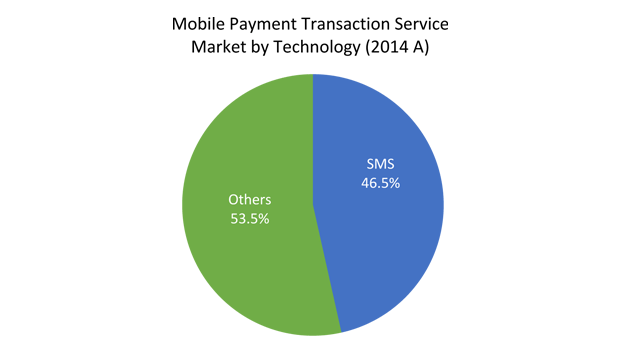
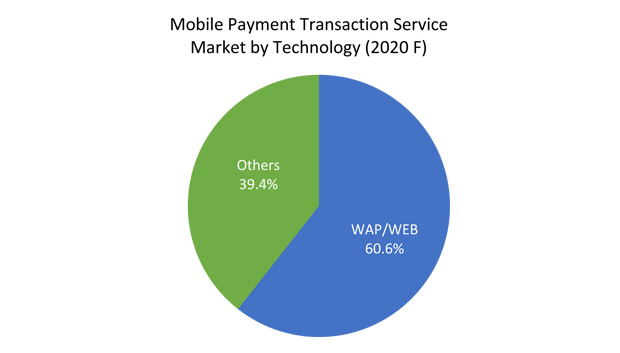
On the basis of technology, SMS dominates the mobile payments market currently. However, in the next five years, WAP/WEB based payments will gain traction, along with spurt in NFC enabled payments. The share of NFC enabled mobile payments is expected to reach 8.3% by 2020, up from 5.1% in 2014.
Related Market Research Report: Mobile Payment Transaction Market: Global Industry Analysis and Opportunity Assessment, 2014 - 2020

