

- Market Size (2026)
- USD 0.84 Bn
- Forecast (2036)
- USD 6.68 Bn
- CAGR (2026 to 2036)
- 23.0%
Permission-Aware AI Repository Gateway Market size, market forecast and outlook by FMI
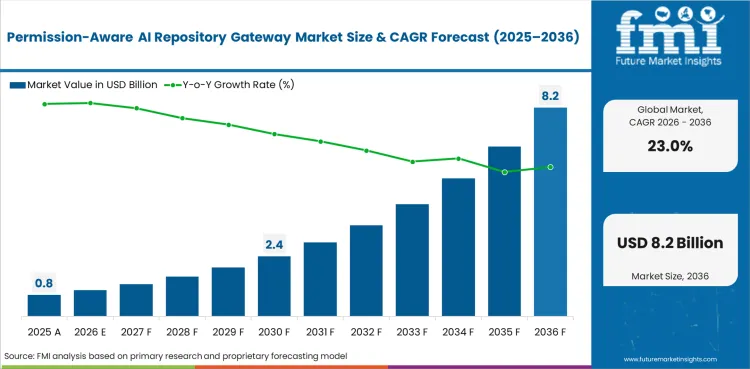
The permission-aware AI repository gateway market was valued at an estimated USD 0.68 billion in 2025, is projected to reach USD 0.84 billion in 2026, and is forecast to expand to USD 6.68 billion by 2036 at a CAGR of 23.0%. The forecast period implies an incremental opportunity of USD 5.84 billion. These figures are analyst-built estimates derived from primary-source inputs including disclosed enterprise AI connector launches, repository governance rollouts, permission-trimming requirements, seat growth in enterprise copilots, and spending signals from architecture, search, knowledge, and developer-tool vendors. Demand is being reshaped by the need to connect AI systems to enterprise repositories without breaking existing identity, entitlement, and document-level access controls.
Summary of Permission-Aware AI Repository Gateway Market
- The market is forecast to reach USD 6.68 billion by 2036.
- The market is expected to grow at a CAGR of 23.0% from 2026 to 2036.
- The market was estimated at USD 0.68 billion in 2025.
- The forecast period represents an incremental opportunity of USD 5.84 billion.
- Gateway platforms account for 47.6% of the product segment in 2026, reflecting the value of a control layer between repositories and AI runtimes.
- Repository-grounded copilots hold 44.2% of the application segment, supported by enterprise demand for grounded answers tied to live permissions.
- Large enterprises represent 69.4% of the end use segment, indicating concentration among organizations with complex content estates and tighter governance mandates.
Permission-Aware AI Repository Gateway Market key Takeaways
| Parameter | Details |
|---|---|
| Market value (2026) | USD 0.84 billion |
| Forecast value (2036) | USD 6.68 billion |
| CAGR (2026 to 2036) | 23.0% |
| Estimated market value (2025) | USD 0.68 billion |
| Incremental opportunity | USD 5.84 billion |
| Leading product | Gateway platforms, 47.6% of product revenue |
| Leading application | Repository-grounded copilots, 44.2% of application revenue |
| Leading end use | Large enterprises, 69.4% of end-use revenue |
| Key players | Microsoft, Atlassian, Box, Elastic, Glean, Coveo, Lucidworks, Sinequa |
Source: Analyst synthesis from authoritative sources, 2026.
Key Takeaways, Market Size, and Forecast
- Permission-Aware AI Repository Gateway Market is projected to grow from USD 0.84 billion in 2026 to USD 6.68 billion by 2036, at a CAGR of 23.0%.
- The permission-aware AI repository gateway market was valued at USD 0.68 billion in 2025.
- By 2036, the Permission-Aware AI Repository Gateway Market is expected to be worth USD 6.68 billion.
- From 2026 to 2036, the market is anticipated to expand at a CAGR of 23.0%.
- The market is predicted to create an incremental opportunity of USD 5.84 billion between 2026 and 2036.
- In 2026, Gateway Platforms are expected to account for 47.6% of the product segment.
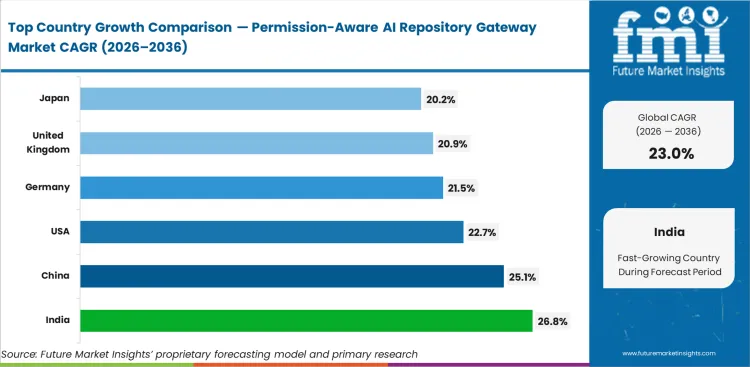
- India (26.8%) and China (25.1%) are projected to be two of the fastest growing markets.
Market growth is being shaped by the enterprise shift from generic chat layers to grounded AI systems that must respect repository entitlements at query time. Microsoft documents permission-trimmed retrieval in Microsoft 365 Copilot and Graph connectors. Atlassian documents that Rovo connectors inherit source-system permissions. Box, Elastic, Coveo, and Glean each position enterprise search and agent layers around secure retrieval, identity-aware access, and governed knowledge flows. These disclosures indicate a distinct control plane market forming around repository gatewaying for AI.
Tracked country growth ranks as follows: India, China, United States, Germany, United Kingdom, and Japan.
Permission-Aware AI Repository Gateway Market Market Definition
The permission-aware AI repository gateway market covers software platforms and control services that connect enterprise repositories to AI applications while preserving identity policies, document-level permissions, source-system entitlements, auditability, and policy enforcement. It includes gateway middleware, connector orchestration, indexing layers with access trimming, and governance tooling used to mediate retrieval between repositories and AI assistants, copilots, agents, or search interfaces.
Permission-Aware AI Repository Gateway Market Market Inclusions
The market scope includes repository gateway platforms, permission-synchronized connectors, secure retrieval orchestration layers, identity-aware indexing services, access-controlled grounding services, governance consoles, policy enforcement tools, and managed deployment services tied to these products. Covered repositories include collaboration suites, code repositories, document stores, data rooms, wikis, ticketing systems, and enterprise content platforms.
Permission-Aware AI Repository Gateway Market Market Exclusions
The market scope excludes generic LLM API revenue, standalone vector databases sold without repository permission controls, broad IAM platform revenue not tied to AI retrieval, unmanaged custom integration work, and horizontal analytics software that does not function as a repository gateway or permission-aware grounding layer.
Permission-Aware AI Repository Gateway Market Market Research Methodology
- Primary Research: FMI analysts reviewed official product documentation, company disclosures, investor commentary, standards materials, and enterprise pricing signals from vendors active in secure retrieval, connector orchestration, and enterprise AI governance.
- Desk Research: Data collection consolidated official documentation from Microsoft, Atlassian, Box, Elastic, OpenAI, GitHub, Google Cloud, and standards-related material tied to Model Context Protocol and enterprise content access controls to establish verifiable baseline parameters.
- Market Sizing and Forecasting: Baseline values were derived from enterprise AI infrastructure spending, repository connector adoption, seat growth in enterprise copilots, governed search deployments, and attached service revenue, and then cross-checked against disclosed product positioning, installed-base concentration, and procurement logic through 2036.
- Data validation and update cycle: Projections were tested against product mix, deployment mix, enterprise-size concentration, and country adoption patterns, with periodic review to keep the forecast aligned with changes in vendor capability and enterprise rollout patterns.
Why is the Permission-Aware AI Repository Gateway Market Market Growing?
Enterprise AI deployments are moving from pilot chatbots to systems connected to live repositories. That shift raises the value of secure gateway layers that can map user identity to source permissions in real time.
Copilot and agent adoption is increasing the number of retrieval events per user. Each retrieval event must be permission-trimmed to avoid leakage of restricted documents, code, tickets, or collaboration records.
Repository sprawl is widening. Large enterprises now manage content across Microsoft 365, Atlassian, GitHub, Box, SharePoint, Confluence, file stores, and sector-specific repositories, which increases demand for a unified gateway.
The core demand logic starts with grounded enterprise AI. Vendors are documenting that users expect answers backed by internal content rather than only foundation-model priors. Once retrieval becomes a core feature, entitlement synchronization becomes an operational requirement. Procurement therefore shifts from experimental connectors to controlled gateway layers that standardize ingestion, permission mapping, and query enforcement.
Growth is also linked to the economics of reuse. Enterprises do not want to rebuild content permissions repository by repository for every copilot, assistant, and agent. A reusable gateway reduces integration cost, shortens deployment time, and allows governance teams to audit a shared control layer rather than many disconnected pipelines.
Regulatory and contractual pressure add another demand signal. Sensitive sectors require clear handling of confidential records, client documents, design files, and source code. A permission-aware gateway gives procurement teams a way to authorize AI access without flattening access controls or replicating content into loosely governed stores.
The market is further supported by the rise of open connector frameworks and protocol-driven integrations. As more AI tools adopt standard ways to request repository context, buyers need an enterprise mediation layer that can expose approved context to models while blocking unauthorized retrieval paths.
Segmental Analysis
Gateway platforms lead the product segment with a 47.6% share in 2026 because enterprises prefer a central orchestration layer for retrieval, permission synchronization, and audit controls.
Repository-grounded copilots lead the application segment with a 44.2% share as internal knowledge copilots are usually the first scaled use case for secure grounding across repositories.
Large enterprises lead the end-use segment with a 69.4% share because they carry larger repository footprints, more fragmented access policies, and higher exposure to data leakage risk.
The full segmentation structure covers product, application, end use, deployment, repository type, and geography. This structure reflects how buyers evaluate control layers by functional role, use case, budget owner, operating model, content estate, and regional deployment maturity.
Insights into the Gateway platforms Segment
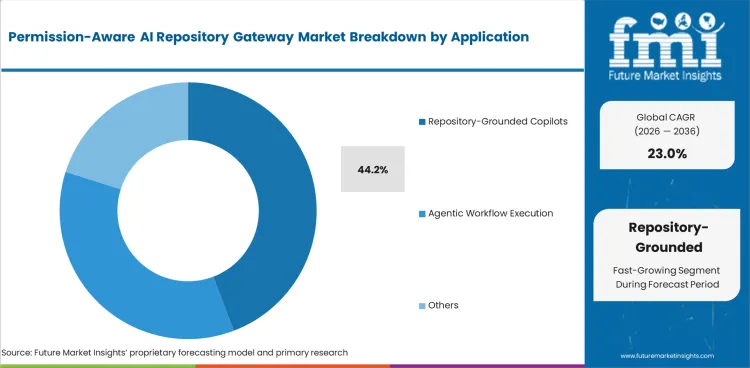
Gateway platforms hold the lead because buyers want a persistent layer that can mediate repository access across many AI endpoints. This segment combines connectors, indexing pipelines, identity mapping, audit trails, and policy controls in one operating surface. The budget advantage is strongest where several copilots or agents must share the same governed content backbone.
Insights into the Repository-grounded copilots Segment
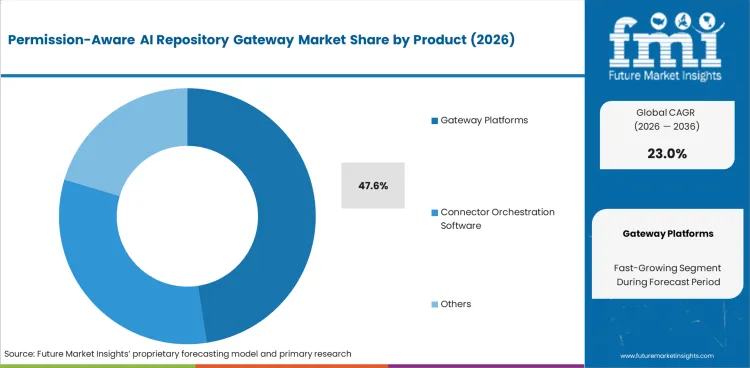
Repository-grounded copilots account for the largest application share because the earliest scaled enterprise deployments focus on employee assistance in search, drafting, summarization, and issue resolution. These workflows need current repository context and are highly sensitive to permission trimming, which favors dedicated gateway software over lighter one-off connectors.
Insights into the Large enterprises Segment
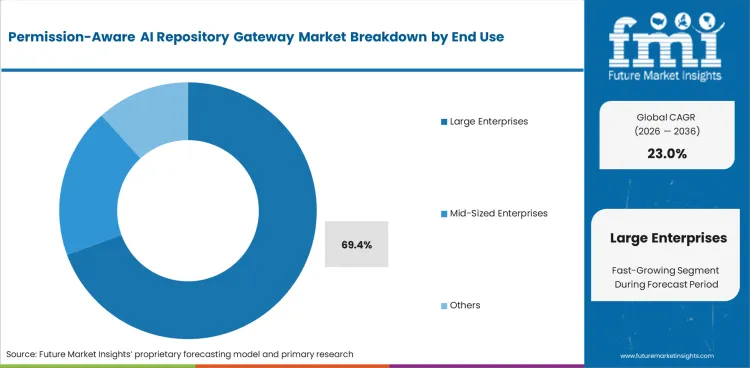
Large enterprises lead adoption because they face the highest complexity in identity governance, content fragmentation, and audit requirements. They also run more parallel AI programs across knowledge work, software engineering, service operations, and regulated functions, which increases the value of a reusable repository gateway.
What are the Drivers, Restraints, and Key Trends of the Permission-Aware AI Repository Gateway Market Market?
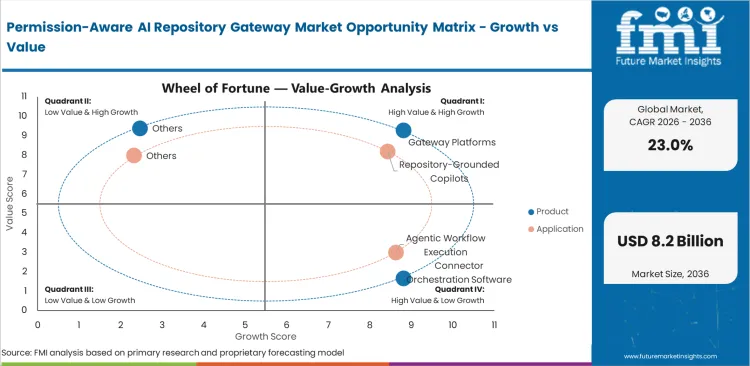
The main driver is the enterprise need to ground AI in internal content without weakening existing access controls.
Deployment complexity across heterogeneous repositories, identity stacks, and legacy permission models remains a core market constraint.
The main trend is the move toward protocol-based integration and reusable gateway layers that can serve many copilots and agents.
Overall market direction remains favorable because governance requirements are rising at the same time as enterprise AI usage expands. That combination increases the cost of unmanaged retrieval and supports spending on control layers that can scale across repositories and applications.
Driver: Permission-trimmed grounding is becoming mandatory in enterprise AI rollouts
Organizations now view permission-aware retrieval as a precondition for wider AI rollout. Official documentation from large platform vendors repeatedly describes user-scoped access, source permission inheritance, and entitlement-aware grounding. Once these capabilities become standard procurement criteria, gateway spending moves from discretionary innovation budgets into broader AI infrastructure and governance budgets.
Restraint: Integration debt slows time to value
Many enterprises hold content in repositories with inconsistent metadata, uneven connector support, and custom identity rules. Mapping these estates into a unified retrieval layer requires configuration, cleanup, and validation work. This slows deployment and can delay budgets in mid-market accounts that lack dedicated architecture and governance teams.
Trend: Gateway layers are absorbing protocol mediation and observability
Vendors are expanding beyond basic connector libraries. The current trend is to combine repository access, protocol mediation, query logging, prompt context controls, and policy observability in the same product tier. This widens average selling value and increases the strategic role of gateway platforms inside enterprise AI stacks.
Analysis of Permission-Aware AI Repository Gateway Market Market By Key Countries
.webp "Top Country Growth Comparison Permission Aware Ai Repository Gateway Market Cagr (2026 2036)")
The United States remains the largest revenue contributor because it hosts the deepest enterprise software installed base, the highest concentration of early copilot deployments, and the strongest procurement activity in governed AI infrastructure.
China and India are the fastest-growing markets in Asia because large digital platforms, IT services firms, and enterprise modernization programs are expanding internal AI use while keeping tighter control over repository access and knowledge flows.
Germany and the United Kingdom show solid demand because regulated sectors, manufacturing groups, financial institutions, and public-sector organizations require stronger controls around AI access to internal documentation.
Japan is growing from a smaller adoption base but continues to invest in enterprise productivity automation, secure knowledge systems, and repository-linked assistants for engineering and service workflows.
| Country | CAGR |
|---|---|
| India | 26.8% |
| China | 25.1% |
| United States | 22.7% |
| Germany | 21.5% |
| United Kingdom | 20.9% |
| Japan | 20.2% |
Demand Outlook for Permission-Aware AI Repository Gateway Market in the United States
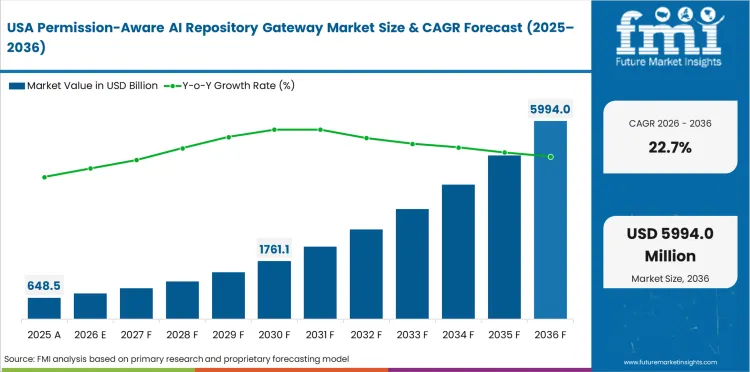
The United States leads current demand because enterprise AI adoption is broad and repository estates are large. Buyers are prioritizing permission-aware grounding for Microsoft 365, Atlassian, code repositories, and content management stacks.
- The market benefits from early spending on enterprise copilots.
- Repository sprawl raises demand for centralized access mediation.
- Vendor concentration and strong cloud adoption support faster rollouts.
Future Outlook for Permission-Aware AI Repository Gateway Market in the United Kingdom
The United Kingdom is seeing steady uptake from financial services, professional services, and public-sector organizations. These buyers emphasize auditability and entitlement controls before wider AI deployment.
- Regulated workflows favor governed retrieval.
- Cloud productivity suites accelerate connector demand.
- Service-led deployments support recurring gateway revenue.
Opportunity Analysis of Permission-Aware AI Repository Gateway Market in Germany
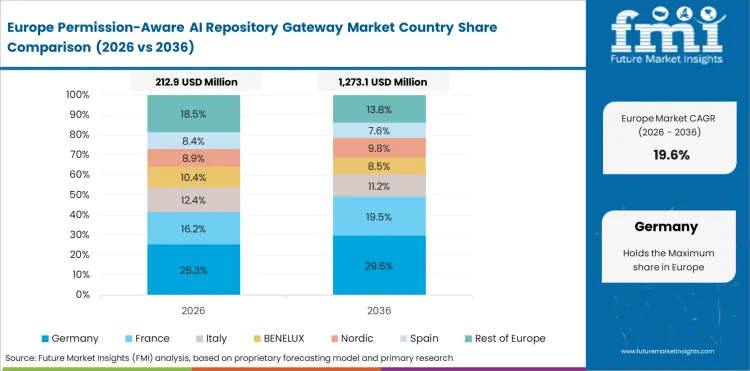
Germany offers strong medium-term opportunity because industrial enterprises and regulated organizations maintain dense documentation environments with strict access requirements. AI use in engineering and service support raises the value of repository controls.
- Manufacturing documentation creates retrieval demand.
- Data-governance discipline favors permission-aware architectures.
- Longer procurement cycles support higher-quality platform selection.
In-depth Analysis of Permission-Aware AI Repository Gateway Market in Japan
Japan is adopting repository-grounded assistants in knowledge-intensive workflows, especially where internal documentation quality is high. Demand is strongest in engineering, support, and enterprise productivity use cases.
- Structured documentation supports grounded copilots.
- Enterprise quality standards favor controlled rollout models.
- Partner-led implementation remains important.
Sales Analysis of Permission-Aware AI Repository Gateway Market in China
China is one of the fastest-growing markets as large enterprises invest in internal AI systems tied to local repositories and controlled knowledge environments. Demand is supported by digital transformation across industrial and service sectors.
- Local AI deployment supports private retrieval layers.
- Large enterprise groups have extensive document estates.
- Governance requirements favor centralized connector control.
In-depth Analysis of Permission-Aware AI Repository Gateway Market in India
India records the fastest forecast CAGR because IT services firms, digital enterprises, and large domestic groups are scaling internal copilots across dispersed knowledge repositories. Cost pressure also supports reusable gateway layers that can serve many teams.
- IT services adoption raises knowledge-governance needs.
- Large workforces increase copilot user counts.
- Reusable connectors improve deployment economics.
Competitive Landscape of Permission-Aware AI Repository Gateway Market Market
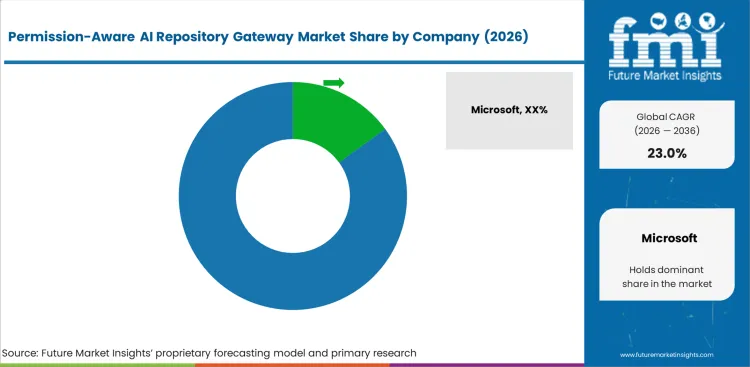
Competition centers on vendors that can connect repositories to AI systems under source-permission controls. Buyers compare connector depth, access synchronization, auditability, deployment flexibility, and support for multiple AI endpoints from one control plane.
Large platform vendors have an advantage in installed base access. Microsoft and Atlassian can embed permission-aware retrieval into environments where they already control productivity workflows, identity surfaces, or collaboration repositories.
Independent enterprise search and knowledge vendors compete by supporting broader repository coverage and cross-platform neutrality. They appeal to buyers that do not want a single-suite architecture or that operate across several content ecosystems.
Emerging vendors are differentiating through protocol mediation, developer tooling, and lightweight deployment models for agent frameworks. Their opportunity is strongest in accounts building custom agents that need tighter policy controls than raw connector libraries can provide.
Major Industry Players
Large platform vendors include Microsoft and Atlassian, both of which document permission-aware retrieval tied to their existing ecosystems.
Established search and knowledge vendors include Box, Elastic, Glean, Coveo, Lucidworks, and Sinequa. These firms compete on secure search, connector breadth, index governance, and enterprise workflow integration.
Emerging firms and adjacent players include startups focused on agent infrastructure, repository mediation, policy orchestration, and secure context delivery for custom AI applications.
Competitive Benchmarking: Permission-Aware AI Repository Gateway Market
| Company | Repository Coverage | Permission Synchronization | AI Integration Depth | Enterprise Reach |
|---|---|---|---|---|
| Microsoft | High | High | High | High |
| Atlassian | Medium | High | Medium | High |
| Box | Medium | High | Medium | High |
| Elastic | High | Medium | High | High |
| Glean | High | High | High | Medium |
| Coveo | High | Medium | High | Medium |
Source: Analyst synthesis from authoritative sources, 2026. Ratings reflect relative positioning based on disclosed capabilities and market presence.
Key Developments in Permission-Aware AI Repository Gateway Market
- In March 2024, Atlassian introduced Rovo, an enterprise AI assistant for search, chat, and agents, with documentation emphasizing that its connectors respect source‑system permissions and only surface content the user is allowed to access.
- In 2024, Microsoft expanded positioning and guidance around Microsoft 365 Copilot and Graph connectors, highlighting permission‑trimmed retrieval and grounded responses based solely on content the user has rights to view or modify.
- In November 2024, OpenAI announced further work on Model Context Protocol (MCP) support, sharpening the enterprise focus on governed context exchange between repositories, tools, and AI systems and encouraging permission‑aware workflows across AI‑gateway and connector patterns.
Key Players in the Permission-Aware AI Repository Gateway Market Market:
Major Global Players:
- Microsoft
- Atlassian
- Box
- Elastic
- Coveo
- Lucidworks
- Sinequa
- Google Cloud
Emerging Players/Startups
- Glean
- Unstructured
- Pinecone ecosystem partners with governance overlays
- Startups focused on agent policy gateways and secure connector orchestration
Scope of the report
| Metric | Value |
|---|---|
| Quantitative Units | USD 0.68 billion to USD 6.68 billion, at a CAGR of 23.0% |
| Market Definition | Software and services that connect enterprise repositories to AI systems while preserving source permissions, identity policy, and auditability |
| Segmentation | Product, application, end use, deployment, repository type, region |
| Regions Covered | North America, Latin America, Europe, East Asia, South Asia and Pacific, Middle East and Africa |
| Countries Covered | United States, United Kingdom, Germany, Japan, China, India |
| Key Companies Profiled | Microsoft, Atlassian, Box, Elastic, Glean, Coveo, Lucidworks, Sinequa |
| Forecast Period | 2026 to 2036 |
| Approach | Historical analysis, top-down spending model, bottom-up vendor and use-case triangulation, and country-level forecast validation |
| Historical Period | 2020 to 2025 |
Permission-Aware AI Repository Gateway Market Market by Segments
Market segmented as Product:
- Gateway platforms
- Connector orchestration software
- Policy and audit modules
- Managed services
Market classified by Application:
- Repository-grounded copilots
- Enterprise search and answer engines
- Agentic workflow execution
- Developer knowledge assistants
- Compliance and records discovery
Market analysed by End Use:
- Large enterprises
- Mid-sized enterprises
- Public sector and regulated institutions
Market analysed by Deployment:
- Cloud
- Hybrid
- On-premise
Market analysed by Repository Type:
- Productivity and collaboration repositories
- Code repositories
- Content management systems
- Knowledge bases and wikis
- Ticketing and workflow systems
Market by Region and Country:
- North America: United States, Canada
- Latin America: Brazil, Mexico
- Europe: United Kingdom, Germany, France
- East Asia: China, Japan, South Korea
- South Asia and Pacific: India, Australia
- Middle East and Africa: GCC Countries, South Africa
Bibliography
- Microsoft, official Microsoft 365 Copilot and Microsoft Graph connector documentation, accessed 2026.
- Atlassian, official Rovo and connector permission documentation, accessed 2026.
- Box, official Box AI and enterprise content access documentation, accessed 2026.
- Elastic, official Elastic AI Assistant and search security documentation, accessed 2026.
- Coveo, official enterprise relevance and generative answer documentation, accessed 2026.
- Glean, official product documentx`ation on enterprise search, permissions, and connectors, accessed 2026.
- OpenAI, official Model Context Protocol and enterprise product documentation, accessed 2026.
- Google Cloud, official Vertex AI Search and access control documentation, accessed 2026.
- GitHub, official GitHub Copilot for Business and enterprise repository access documentation, accessed 2026.
This Report Addresses
- Global market sizing for permission-aware AI repository gateways
- Revenue forecast from 2026 to 2036
- Segment analysis by product, application, end use, deployment, and repository type
- Country-level demand and CAGR ranking
- Competitive landscape and benchmarking
- Technology and governance trends in repository-grounded AI
- Analyst-built fact sheet for internal consistency
Frequently Asked Questions
How large is the demand for Permission-Aware AI Repository Gateway Market in the global market in 2026?
The global market is estimated at USD 0.84 billion in 2026.
What will be the market size by 2036?
The market is forecast to reach USD 6.68 billion by 2036.
What is the expected demand growth between 2026 and 2036?
The market is expected to expand at a CAGR of 23.0% between 2026 and 2036.
Which product type is poised to lead by 2026?
Gateway platforms are set to lead by 2026 with a 47.6% share.
How is large enterprises driving adoption?
Large enterprises are driving adoption because they manage broader repository estates, more complex identity rules, and more parallel AI programs than smaller buyers.
What is driving demand in the United States?
Demand in the United States is driven by early enterprise copilot adoption, heavy use of collaboration and code repositories, and stronger spending on secure AI infrastructure.
Preview the report firsthand - request a free sample
Get SampleGet the brochure for pricing and purchase details.
Get PDFTable of Content
- Executive Summary
- Global Market Outlook
- Demand-side Trends
- Supply-side Trends
- Technology Roadmap Analysis
- Analysis and Recommendations
- Market Overview
- Market Coverage / Taxonomy
- Market Definition / Scope / Limitations
- Research Methodology
- Chapter Orientation
- Analytical Lens and Working Hypotheses
- Market Structure, Signals, and Trend Drivers
- Benchmarking and Cross-market Comparability
- Market Sizing, Forecasting, and Opportunity Mapping
- Research Design and Evidence Framework
- Desk Research Programme (Secondary Evidence)
- Company Annual and Sustainability Reports
- Peer-reviewed Journals and Academic Literature
- Corporate Websites, Product Literature, and Technical Notes
- Earnings Decks and Investor Briefings
- Statutory Filings and Regulatory Disclosures
- Technical White Papers and Standards Notes
- Trade Journals, Industry Magazines, and Analyst Briefs
- Conference Proceedings, Webinars, and Seminar Materials
- Government Statistics Portals and Public Data Releases
- Press Releases and Reputable Media Coverage
- Specialist Newsletters and Curated Briefings
- Sector Databases and Reference Repositories
- FMI Internal Proprietary Databases and Historical Market Datasets
- Subscription Datasets and Paid Sources
- Social Channels, Communities, and Digital Listening Inputs
- Additional Desk Sources
- Expert Input and Fieldwork (Primary Evidence)
- Primary Modes
- Qualitative Interviews and Expert Elicitation
- Quantitative Surveys and Structured Data Capture
- Blended Approach
- Why Primary Evidence is Used
- Field Techniques
- Interviews
- Surveys
- Focus Groups
- Observational and In-context Research
- Social and Community Interactions
- Stakeholder Universe Engaged
- C-suite Leaders
- Board Members
- Presidents and Vice Presidents
- R&D and Innovation Heads
- Technical Specialists
- Domain Subject-matter Experts
- Scientists
- Physicians and Other Healthcare Professionals
- Governance, Ethics, and Data Stewardship
- Research Ethics
- Data Integrity and Handling
- Primary Modes
- Tooling, Models, and Reference Databases
- Desk Research Programme (Secondary Evidence)
- Data Engineering and Model Build
- Data Acquisition and Ingestion
- Cleaning, Normalisation, and Verification
- Synthesis, Triangulation, and Analysis
- Quality Assurance and Audit Trail
- Market Background
- Market Dynamics
- Drivers
- Restraints
- Opportunity
- Trends
- Scenario Forecast
- Demand in Optimistic Scenario
- Demand in Likely Scenario
- Demand in Conservative Scenario
- Opportunity Map Analysis
- Product Life Cycle Analysis
- Supply Chain Analysis
- Investment Feasibility Matrix
- Value Chain Analysis
- PESTLE and Porter’s Analysis
- Regulatory Landscape
- Regional Parent Market Outlook
- Production and Consumption Statistics
- Import and Export Statistics
- Market Dynamics
- Global Market Analysis 2021 to 2025 and Forecast, 2026 to 2036
- Historical Market Size Value (USD Million) Analysis, 2021 to 2025
- Current and Future Market Size Value (USD Million) Projections, 2026 to 2036
- Y-o-Y Growth Trend Analysis
- Absolute $ Opportunity Analysis
- Global Market Pricing Analysis 2021 to 2025 and Forecast 2026 to 2036
- Global Market Analysis 2021 to 2025 and Forecast 2026 to 2036, By Product
- Introduction / Key Findings
- Historical Market Size Value (USD Million) Analysis By Product , 2021 to 2025
- Current and Future Market Size Value (USD Million) Analysis and Forecast By Product , 2026 to 2036
- Gateway Platforms
- Connector Orchestration Software
- Others
- Gateway Platforms
- Y-o-Y Growth Trend Analysis By Product , 2021 to 2025
- Absolute $ Opportunity Analysis By Product , 2026 to 2036
- Global Market Analysis 2021 to 2025 and Forecast 2026 to 2036, By Application
- Introduction / Key Findings
- Historical Market Size Value (USD Million) Analysis By Application, 2021 to 2025
- Current and Future Market Size Value (USD Million) Analysis and Forecast By Application, 2026 to 2036
- Repository-Grounded Copilots
- Agentic Workflow Execution
- Others
- Repository-Grounded Copilots
- Y-o-Y Growth Trend Analysis By Application, 2021 to 2025
- Absolute $ Opportunity Analysis By Application, 2026 to 2036
- Global Market Analysis 2021 to 2025 and Forecast 2026 to 2036, By End Use
- Introduction / Key Findings
- Historical Market Size Value (USD Million) Analysis By End Use, 2021 to 2025
- Current and Future Market Size Value (USD Million) Analysis and Forecast By End Use, 2026 to 2036
- Large Enterprises
- Mid-Sized Enterprises
- Others
- Large Enterprises
- Y-o-Y Growth Trend Analysis By End Use, 2021 to 2025
- Absolute $ Opportunity Analysis By End Use, 2026 to 2036
- Global Market Analysis 2021 to 2025 and Forecast 2026 to 2036, By Region
- Introduction
- Historical Market Size Value (USD Million) Analysis By Region, 2021 to 2025
- Current Market Size Value (USD Million) Analysis and Forecast By Region, 2026 to 2036
- North America
- Latin America
- Western Europe
- Eastern Europe
- East Asia
- South Asia and Pacific
- Middle East & Africa
- Market Attractiveness Analysis By Region
- North America Market Analysis 2021 to 2025 and Forecast 2026 to 2036, By Country
- Historical Market Size Value (USD Million) Trend Analysis By Market Taxonomy, 2021 to 2025
- Market Size Value (USD Million) Forecast By Market Taxonomy, 2026 to 2036
- By Country
- USA
- Canada
- Mexico
- By Product
- By Application
- By End Use
- By Country
- Market Attractiveness Analysis
- By Country
- By Product
- By Application
- By End Use
- Key Takeaways
- Latin America Market Analysis 2021 to 2025 and Forecast 2026 to 2036, By Country
- Historical Market Size Value (USD Million) Trend Analysis By Market Taxonomy, 2021 to 2025
- Market Size Value (USD Million) Forecast By Market Taxonomy, 2026 to 2036
- By Country
- Brazil
- Chile
- Rest of Latin America
- By Product
- By Application
- By End Use
- By Country
- Market Attractiveness Analysis
- By Country
- By Product
- By Application
- By End Use
- Key Takeaways
- Western Europe Market Analysis 2021 to 2025 and Forecast 2026 to 2036, By Country
- Historical Market Size Value (USD Million) Trend Analysis By Market Taxonomy, 2021 to 2025
- Market Size Value (USD Million) Forecast By Market Taxonomy, 2026 to 2036
- By Country
- Germany
- UK
- Italy
- Spain
- France
- Nordic
- BENELUX
- Rest of Western Europe
- By Product
- By Application
- By End Use
- By Country
- Market Attractiveness Analysis
- By Country
- By Product
- By Application
- By End Use
- Key Takeaways
- Eastern Europe Market Analysis 2021 to 2025 and Forecast 2026 to 2036, By Country
- Historical Market Size Value (USD Million) Trend Analysis By Market Taxonomy, 2021 to 2025
- Market Size Value (USD Million) Forecast By Market Taxonomy, 2026 to 2036
- By Country
- Russia
- Poland
- Hungary
- Balkan & Baltic
- Rest of Eastern Europe
- By Product
- By Application
- By End Use
- By Country
- Market Attractiveness Analysis
- By Country
- By Product
- By Application
- By End Use
- Key Takeaways
- East Asia Market Analysis 2021 to 2025 and Forecast 2026 to 2036, By Country
- Historical Market Size Value (USD Million) Trend Analysis By Market Taxonomy, 2021 to 2025
- Market Size Value (USD Million) Forecast By Market Taxonomy, 2026 to 2036
- By Country
- China
- Japan
- South Korea
- By Product
- By Application
- By End Use
- By Country
- Market Attractiveness Analysis
- By Country
- By Product
- By Application
- By End Use
- Key Takeaways
- South Asia and Pacific Market Analysis 2021 to 2025 and Forecast 2026 to 2036, By Country
- Historical Market Size Value (USD Million) Trend Analysis By Market Taxonomy, 2021 to 2025
- Market Size Value (USD Million) Forecast By Market Taxonomy, 2026 to 2036
- By Country
- India
- ASEAN
- Australia & New Zealand
- Rest of South Asia and Pacific
- By Product
- By Application
- By End Use
- By Country
- Market Attractiveness Analysis
- By Country
- By Product
- By Application
- By End Use
- Key Takeaways
- Middle East & Africa Market Analysis 2021 to 2025 and Forecast 2026 to 2036, By Country
- Historical Market Size Value (USD Million) Trend Analysis By Market Taxonomy, 2021 to 2025
- Market Size Value (USD Million) Forecast By Market Taxonomy, 2026 to 2036
- By Country
- Kingdom of Saudi Arabia
- Other GCC Countries
- Turkiye
- South Africa
- Other African Union
- Rest of Middle East & Africa
- By Product
- By Application
- By End Use
- By Country
- Market Attractiveness Analysis
- By Country
- By Product
- By Application
- By End Use
- Key Takeaways
- Key Countries Market Analysis
- USA
- Pricing Analysis
- Market Share Analysis, 2025
- By Product
- By Application
- By End Use
- Canada
- Pricing Analysis
- Market Share Analysis, 2025
- By Product
- By Application
- By End Use
- Mexico
- Pricing Analysis
- Market Share Analysis, 2025
- By Product
- By Application
- By End Use
- Brazil
- Pricing Analysis
- Market Share Analysis, 2025
- By Product
- By Application
- By End Use
- Chile
- Pricing Analysis
- Market Share Analysis, 2025
- By Product
- By Application
- By End Use
- Germany
- Pricing Analysis
- Market Share Analysis, 2025
- By Product
- By Application
- By End Use
- UK
- Pricing Analysis
- Market Share Analysis, 2025
- By Product
- By Application
- By End Use
- Italy
- Pricing Analysis
- Market Share Analysis, 2025
- By Product
- By Application
- By End Use
- Spain
- Pricing Analysis
- Market Share Analysis, 2025
- By Product
- By Application
- By End Use
- France
- Pricing Analysis
- Market Share Analysis, 2025
- By Product
- By Application
- By End Use
- India
- Pricing Analysis
- Market Share Analysis, 2025
- By Product
- By Application
- By End Use
- ASEAN
- Pricing Analysis
- Market Share Analysis, 2025
- By Product
- By Application
- By End Use
- Australia & New Zealand
- Pricing Analysis
- Market Share Analysis, 2025
- By Product
- By Application
- By End Use
- China
- Pricing Analysis
- Market Share Analysis, 2025
- By Product
- By Application
- By End Use
- Japan
- Pricing Analysis
- Market Share Analysis, 2025
- By Product
- By Application
- By End Use
- South Korea
- Pricing Analysis
- Market Share Analysis, 2025
- By Product
- By Application
- By End Use
- Russia
- Pricing Analysis
- Market Share Analysis, 2025
- By Product
- By Application
- By End Use
- Poland
- Pricing Analysis
- Market Share Analysis, 2025
- By Product
- By Application
- By End Use
- Hungary
- Pricing Analysis
- Market Share Analysis, 2025
- By Product
- By Application
- By End Use
- Kingdom of Saudi Arabia
- Pricing Analysis
- Market Share Analysis, 2025
- By Product
- By Application
- By End Use
- Turkiye
- Pricing Analysis
- Market Share Analysis, 2025
- By Product
- By Application
- By End Use
- South Africa
- Pricing Analysis
- Market Share Analysis, 2025
- By Product
- By Application
- By End Use
- USA
- Market Structure Analysis
- Competition Dashboard
- Competition Benchmarking
- Market Share Analysis of Top Players
- By Regional
- By Product
- By Application
- By End Use
- Competition Analysis
- Competition Deep Dive
- Microsoft
- Overview
- Product Portfolio
- Profitability by Market Segments (Product/Age /Sales Channel/Region)
- Sales Footprint
- Strategy Overview
- Marketing Strategy
- Product Strategy
- Channel Strategy
- Atlassian
- Box
- Elastic
- Coveo
- Lucidworks
- Sinequa
- Microsoft
- Competition Deep Dive
- Assumptions & Acronyms Used


