


Key Takeaways
- Poland has become a serious IT and ICT export base: ICT service exports reached about USD 16.9 billion in 2023 and already account for roughly 15.5% of all Polish service exports, highlighting the sector’s importance in the balance of payments.
- Digital infrastructure and connectivity are strong: around 95.9% of households have internet access and very high-capacity networks already cover more households than the EU average. The weak point is not cables, it is skills and usage.
- Only about 44-49% of the population has at least basic digital skills, compared with an EU average above 55%. AI and data analytics adoption by enterprises is also well below EU levels, with only about 3.7-5.9% of firms using AI.
- Firm-level surveys show that most Polish companies still rely on relatively basic technologies even when more advanced systems are available, and over half do not invest in staff training. Many managers believe they are "digital enough" despite clear evidence of a gap with EU peers.
Where does growth really come from: exports or domestic demand?
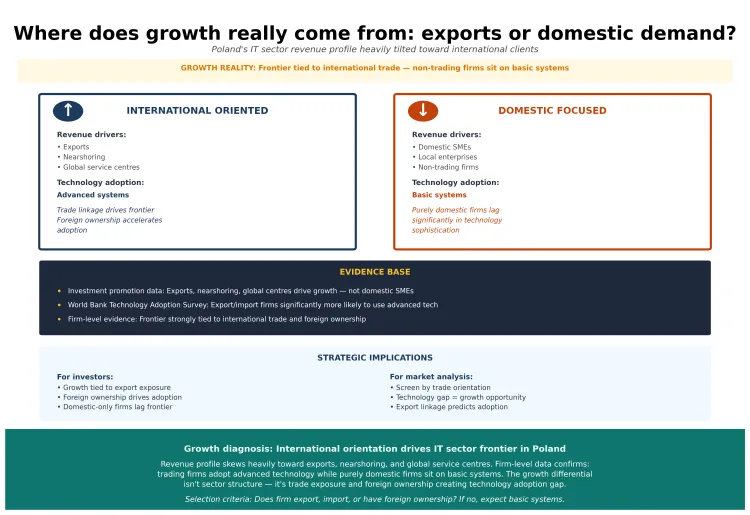
The revenue profile of Poland’s IT sector is still heavily tilted toward international clients. Investment promotion and trade agency data emphasise the role of exports, nearshoring and global service centres, not domestic SMEs.This bias is consistent with firm-level evidence from the World Bank’s Technology Adoption Survey. Firms that export or import are significantly more likely to use advanced technologies than purely domestic firms. In other words: the frontier in Poland is tied closely to international trade and foreign ownership, while non-trading firms tend to sit on much more basic systems.
How technologically sophisticated are Polish firms in practice?
The World Bank’s deep dive into Poland’s firm-level technology adoption provides the clearest diagnostic. Using a detailed Technology Adoption Survey of 1,500 firms, it finds that: The systems most frequently used for everyday business functions are relatively basic, even though more advanced tools are available. An average Polish firm has adopted more advanced technologies on paper but still relies on simpler ones in daily operations. Technology sophistication is strongly correlated with firm size, foreign ownership and participation in international trade. Management quality and education of managers (including exposure abroad) matter significantly for adoption.
Crucially, Poland ranks near the bottom of the EU on the Digital Economy and Society Index, at about 24th of 27 member states. The red-pill insight from this survey is behavioural: About half of Polish entrepreneurs surveyed believe their firms do not need further digitalisation or investment in employee skills, despite the clear gap with EU peers. Over half of firms do not offer training to workers at all. So the constraint is not only capital or technology availability. A large part of the lag comes from perception and management priorities.
Digitalisation in Poland is held back less by infrastructure and more by structural frictions inside the economy. The workforce still trails EU benchmarks on basic digital skills, and firms underinvest in continuous upskilling, which limits the payoff from affordable cloud and connectivity. The economy’s long tail of micro and small enterprises remains the weakest link: technology adoption rises sharply with scale, and the segment that employs most workers still operates with basic tools. Managerial overconfidence compounds the problem, with many owners assuming they are more advanced than they are, reducing appetite for external advice or structured digital-transition plans.
Connectivity policy has introduced its own drag: delays in allocating 5G spectrum and fully implementing EU telecoms rules have slowed the emergence of more advanced network use cases. Meanwhile, the domestic IT sector has evolved into a globally oriented enclave, with talent and capabilities concentrated in export projects, shared service centres and multinational R&D hubs. Without targeted incentives or vendor strategies that redirect this capacity toward local SMEs, diffusion into the domestic economy will continue to lag even as headline IT output remains strong. The deeper question is whether Poland can rewire its institutional and incentive structures so that digital capacity built for global clients also raises productivity at home.
What does this mean for investors, vendors and policymakers?
For investors, Poland offers a deep talent pool, a proven track record in exporting IT and digital services, and a relatively stable macro environment. The opportunity is not just more of the same outsourcing. There is a long runway in building products and platforms that help Polish and regional firms upgrade from basic tools to integrated, data-driven systems. For enterprise vendors and cloud providers, the binding constraint is not infrastructure, it is change management inside mid-sized firms: designing offers that bundle technology, training, and process redesign in ways that feel concrete and low-risk for managers who currently believe they are "digital enough."
For policymakers, the firm-level data suggest that broad subsidies deliver limited lift compared with tightly designed interventions. The priority is to correct managerial perception gaps through diagnostic audits that benchmark firms against EU peers and expose where they actually stand. Funding works better when it is tied to verifiable adoption of specific tools and processes rather than to loosely defined digital-project budgets. The evidence also points to a missing layer of managerial capability: programmes that build digital leadership and strengthen decision-making inside firms generate more durable change than schemes focused solely on buying hardware or software licences. The underlying task is to shift incentives from spending to measurable transformation.
How Future Market Insights can help
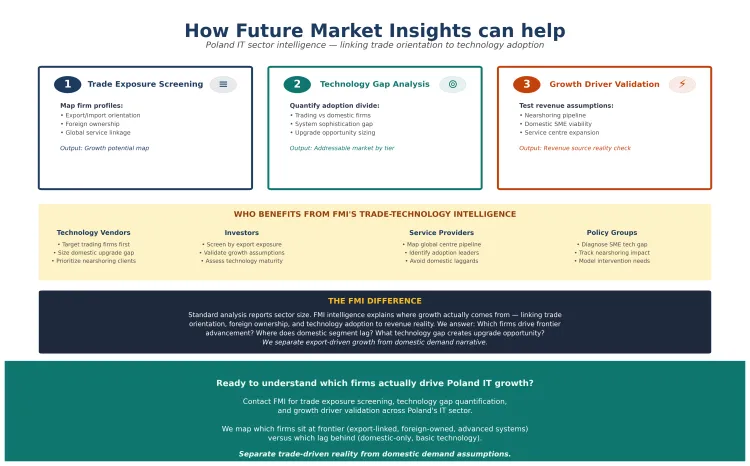
Future Market Insights can map this split between export-driven IT activity and domestic digital adoption at a granular level, down to sector, firm size and region. That includes combining official statistics, firm-level survey data and interviews with local stakeholders to identify where the true bottlenecks lie: skills, management practices, finance, or regulation.
On that evidence base, FMI can then help clients design practical strategies for Poland: which verticals to prioritise, what adoption ladders to build for SMEs, how to position IT and cloud offerings for managers who are sceptical about further digitalisation, and how to benchmark Polish operations against peers elsewhere in the EU. The goal is not simply to confirm that Poland is a strong IT export hub, but to show where the next wave of productivity-driven digital growth can realistically come from.
Sources
- European Commission. "Poland - 2025 Digital Decade Country Report." 18 June 2025. Highlights strong connectivity progress but persistent gaps in digital skills and slow adoption of advanced technologies among Polish businesses. Poland - Digital Economy: Country Commercial Guide." 20 September 2024. Discusses Poland’s fast-growing ICT sector, export opportunities, and obstacles such as low SME digital intensity and skills shortages.
- Polish Agency for Enterprise Development (PARP) / Enterprise Europe Network. "IT/ICT Sector in Poland - Report 2024/2025." Provides statistics on employment, exports, and the role of IT services in Poland’s export structure.
- Endeavor. "Mapping Poland’s Tech Sector." 2024 report on Polish startups and scale-ups, export orientation, and constraints on domestic demand and financing.
- European Commission / DESI. "Digital Economy and Society Index (DESI) - Poland Country Profile 2022." Shows Poland below EU average on human capital and integration of digital technology in firms, despite catching-up dynamics.
- BGK (Bank Gospodarstwa Krajowego). "Digital transformation - the key to the development of Polish companies." 3 June 2025. Summarises findings from "Digitization in the SME sector" and outlines barriers to technology adoption among Polish SMEs. DELab UW - University of Warsaw. "Poland’s Digital Economy: Conditions of Development." Report (earlier edition) documenting structural weaknesses in SME connectivity, broadband quality and digital adoption compared with EU15 benchmarks.
- Longitudinal survey series on Polish digital startups, export orientation, funding sources and constraints.

