Key Takeaways
- Energy efficiency regulations in Saudi Arabia and the UAE have turned LED adoption into a mandatory compliance exercise, pushing all serious manufacturers to carry SASO/ECAS labels, accredited lab reports and full technical traceability.
- A parallel grey import channel still undercuts compliant suppliers by bypassing testing, documentation and warranty obligations, creating a structural two tier market and compressing legitimate margins.
- Value in lighting is shifting rapidly from luminaires to controls, commissioning, analytics and performance guarantee contracts led by ESCOs. The "box" is no longer the main profit centre.
- Uneven standards enforcement across Gulf markets raises risk for contractors and developers. Distributors who can turn full compliance into risk reduction (fewer failures, easier inspection clearance) gain share.
- The core profitability levers in the Middle East lighting chain sit in four places: compliance cost, procurement discipline, channel strategy and participation in performance based retrofit models.
- For leadership teams, the real question is not LED vs non-LED that battle is already won. The real question is which part of the lighting stack they want to own: commodity hardware or long-term performance.
Why LED demand in the Middle East is policy driven, not preference driven
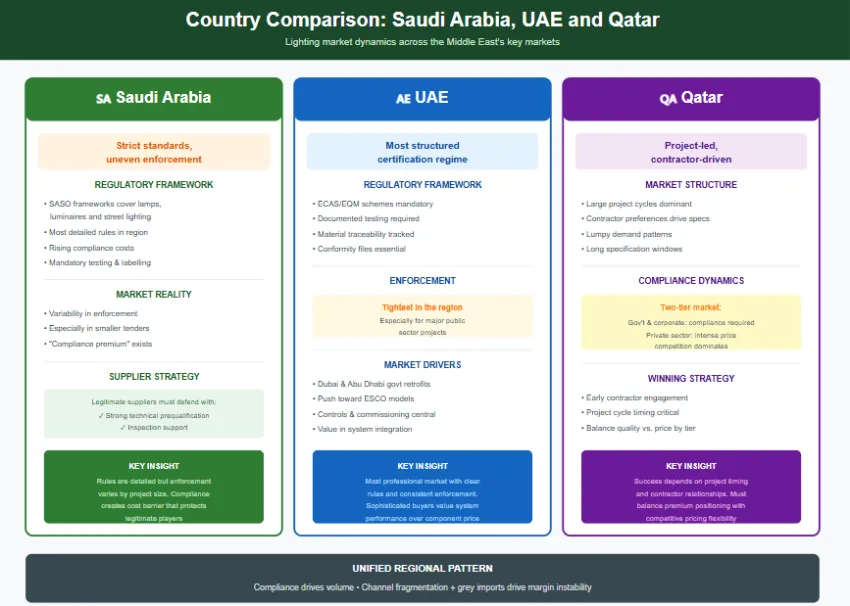
Saudi Arabia and the UAE no longer treat efficient lighting as a consumer upgrade. Regulations such as SASO 2870, SASO 2902 and SASO 2927 in Saudi Arabia, and the ECAS/EQM lighting rules in the UAE, require minimum energy performance, conformity certificates and energy labelling before products can enter the market.
Federal rules are reinforced by municipal and building code updates, especially in Dubai and Abu Dhabi, where large commercial and public buildings face tighter energy performance requirements. For many developers and government bodies, LED is now simply the compliant baseline.
This dynamic means LED volume growth is almost guaranteed but profit growth is not. Once a category becomes compliance driven, it attracts both serious manufacturers and opportunistic importers whose documentation may be partial or recycled.
The two-tier market: compliant suppliers vs grey channel traders
On paper, conformity requirements should level the playing field. In practice, buyers still receive offers at ultralow prices backed by thin or unverifiable technical files. These products typically reuse test reports, offer questionable warranties or mimic certification symbols that do not link back to valid IDs.
This creates two economic realities:
The compliant tier
Manufacturers invest in accredited testing, SASO/ECAS registrations, traceable components, documented warranties and aftersales capability. Their cost base is higher, but so is their reliability and audit readiness.
The grey tier
Traders import generic fixtures, label them locally, and supply price first tenders with incomplete documentation. Their short-term advantage is price; the long term consequences include higher failure rates, stalled inspections and reputational damage for contractors who choose low compliance options.
For responsible players, the commercial challenge is that compliance which costs money is invisible unless you tie it directly to risk mitigation. If a client sees only the price but not the avoided downtime, fewer reinstalls or smoother government inspection, compliance becomes a cost premium rather than a value proposition.
The shifting profit pool: from luminaires to controls, commissioning and analytics
Across the Gulf, the economics of lighting are slowly but decisively shifting toward services and performance.
Accredited ESCOs in Dubai, Abu Dhabi and now Saudi Arabia structure lighting retrofits around guaranteed savings. They finance and execute LED + controls + sensors + software, and are compensated based on verified energy reduction.
This model moves the value into three layers:
Controls and intelligence
Sensors, wireless systems, DALI enabled digital controls and cloud analytics deliver ongoing savings, differentiate technical proposals and defend margins.
Commissioning and integration
Correct setup of sensors, grouping, daylight harvesting and dimming curves is where performance is won or lost. This step creates a service moat competitors cannot easily replicate.
Performance contracts and data
Long term M&V (measurement and verification), fault detection and energy reporting create recurring revenue and client lock in.
For luminaire focused distributors, this trend is threatening. The performance stack captures more lifetime value than the hardware box. Without a service or ESCO partnership, they risk becoming commoditised.
The lighting cost stack: where margins are actually made (and lost)
A Middle East lighting P&L typically behaves along four buckets:
Procurement and BOM choices
LED chips, drivers, optics, heat sinks and housing materials vary widely in cost and lifetime performance. Cutting corners here triggers warranty claims that erase short lived margin gains.
Compliance and documentation cost
Testing, certification, labelling, and maintaining technical files are now recurring, not onetime, costs.
Channel and tender exposure
In price only tenders, even compliant suppliers face margin erosion. In performance based tenders, suppliers can defend higher prices by tying them to measurable energy and maintenance savings.
Services and post installation revenue
Commissioning, M&V, warranty servicing and analytics create recurring value that lasts far longer than a onetime luminaire sale.
The uncomfortable truth is that luminaire hardware alone is the weakest margin pool. The strongest lies in post installation services and in owning the performance narrative.
What leadership teams should read from this economics view
Three questions matter more than category hype:
Is the company exposed to grey imports eroding channel prices?
If the answer is yes, the business needs a compliance led differentiation model tied to risk reduction, not a price fight it cannot win.
Does the portfolio separate commodity fixtures from performance grade systems?
A single undifferentiated catalogue leaves manufacturers stuck in the middle - too expensive for commodity tenders, too weak for ESCO grade projects.
Are we participating in the rising ESCO and performance contract ecosystem?
If the business sells boxes but does not touch controls, commissioning or M&V, it is ceding the fastest growing profit pools in the Gulf.
Well run lighting companies already treat their category like an engineered energy system, not a retail SKU. Returns are written in technical compliance, BOM choice, service capability and the credibility of performance guarantees.