


Key Takeaways
- Leadership in Car Battery Chargers is segmented rather than concentrated in one global winner, with distinct leaders emerging across consumer, professional, fleet and manufacturing tiers.
- Consumer smart charger leadership is driven by branding, software algorithms and retail reach, where companies like NOCO command premium positioning through user interface design and lithium battery compatibility.
- Premium workshop chargers rely on engineering credibility and OEM approval, with brands such as CTEK establishing dominance through certification depth and diagnostic integration.
- Fleet and professional systems prioritise durability, amperage and total cost of ownership, where brands like Schumacher Electric deliver high power output and extended duty cycle performance.
- Chinese OEM manufacturers set the global price floor through volume production and white label supply, creating pricing pressure across all segments while remaining largely invisible to end buyers.
Why does the consumer smart charger segment favour branded leaders such as NOCO?
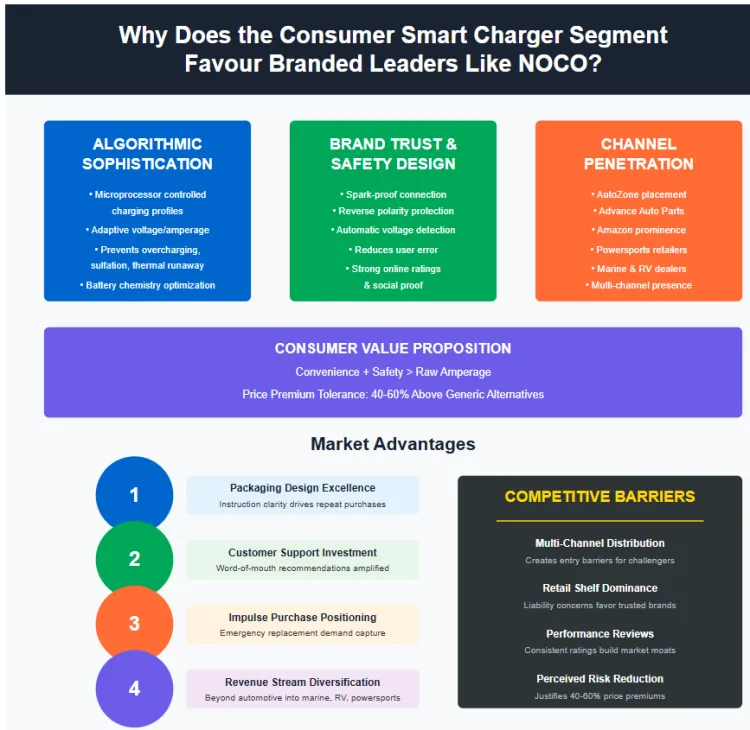
Consumer smart charger leadership depends on the intersection of algorithmic sophistication, brand trust and channel penetration. NOCO has built a dominant position in the prosumer and enthusiast segments by developing microprocessor controlled charging profiles that adjust voltage and amperage based on battery chemistry, temperature and state of charge. These adaptive algorithms prevent overcharging, sulfation and thermal runaway, which are critical concerns for lithium ion and AGM batteries now common in modern vehicles.
The consumer segment values convenience and safety above raw amperage. NOCO chargers incorporate spark proof connection technology, reverse polarity protection and automatic voltage detection, reducing user error and expanding addressable buyers beyond automotive specialists. This design philosophy aligns with retail channel requirements, where liability concerns and return rates influence shelf placement decisions.
Brand power in this segment derives from consistent performance reviews, social proof through online ratings and strategic placement in automotive retail chains and e commerce platforms. NOCO invests heavily in packaging design, instruction clarity and customer support, which drive repeat purchases and word of mouth recommendations. The consumer smart charger segment tolerates price premiums of 40 to 60 percent above generic alternatives when buyers perceive reduced risk and enhanced usability.
Distribution reach amplifies brand advantage. Companies that secure prominent placement at AutoZone, Advance Auto Parts and Amazon benefit from impulse purchases and emergency replacement demand. NOCO has also cultivated partnerships with powersports retailers, marine suppliers and RV dealers, diversifying revenue streams beyond automotive applications. This multichannel presence creates barrier effects that limit challenger entry.
How do premium engineering focused players such as CTEK establish leadership in workshops and OEM approved chargers?
CTEK has positioned itself as the engineering standard in professional automotive service environments by prioritising certification depth, diagnostic capability and OEM validation. Unlike consumer chargers that emphasise simplicity, CTEK chargers are designed for continuous operation, supporting workshop environments where multiple vehicles undergo simultaneous charging across extended duty cycles.
OEM approval represents a critical competitive moat. Mercedes Benz, Porsche, Ferrari and other premium manufacturers specify CTEK chargers in their service documentation and warranty protocols. This endorsement stems from rigorous testing of charging profiles, electromagnetic compatibility and failure mode analysis. OEM approved chargers must demonstrate that they will not damage vehicle electronics, void warranties or introduce diagnostic errors, which requires substantial investment in validation testing and certification.
Premium workshop chargers integrate diagnostic functions that consumer products omit. CTEK chargers can detect sulfation, stratification and cell imbalance, providing technicians with actionable intelligence about battery health. This diagnostic capability reduces misdiagnosis and prevents unnecessary battery replacements, creating value for service departments focused on first time fix rates and customer satisfaction.
Pricing in the professional segment reflects total cost of ownership rather than initial purchase price. A CTEK charger priced at 200 to 400 dollars may operate for a decade in a workshop environment, whereas lower cost alternatives often fail within 18 to 24 months under continuous use. Professional buyers evaluate chargers based on warranty coverage, replacement part availability and technical support responsiveness, all areas where CTEK maintains advantage through established distribution networks and service infrastructure.
Why do fleet and professional users rely on companies like Schumacher Electric for high amperage systems?
Fleet and industrial applications demand chargers that deliver sustained high amperage output, robust construction and integration with workshop power systems. Schumacher Electric has built its reputation on heavy duty chargers capable of 40 to 200 amp output, serving commercial fleets, municipal vehicle operations and industrial equipment maintenance facilities.
Durability requirements in professional environments far exceed consumer standards. Fleet chargers must withstand dropped connections, exposure to fluids, temperature extremes and continuous operation across multiple shifts. Schumacher chargers feature steel housings, industrial grade components and thermal management systems designed for abuse resistance rather than aesthetic appeal. This construction philosophy aligns with procurement officers who evaluate equipment based on mean time between failures and repair cost rather than features or brand prestige.
High amperage charging reduces vehicle downtime, which represents the primary cost driver in fleet operations. A 100 amp charger can restore a depleted commercial vehicle battery to operational status in 30 to 45 minutes, whereas a 10 amp consumer charger requires 8 to 10 hours. For fleets operating on tight schedules, this time differential justifies charger costs that exceed 1,000 dollars per unit.
Fleet procurement logic emphasises vendor consolidation, service contracts and parts commonality. Schumacher has cultivated relationships with fleet management companies, municipal purchasing departments and industrial distributors, providing centralised ordering, bulk pricing and maintenance support. These institutional relationships create switching costs that protect against commodity pricing pressure.
How do Chinese OEM manufacturers dominate volume and pricing control in Car Battery Chargers?
Chinese manufacturers such as those concentrated in Shenzhen and Guangdong provinces control global charger production volume through vertical integration, component sourcing advantages and white label manufacturing relationships. These companies produce chargers for Western brands while simultaneously selling direct through online channels under their own labels or generic branding.
Vertical integration of power electronics manufacturing in China creates cost structures that Western competitors cannot match. Chinese OEMs source transformers, rectifiers, microcontrollers and enclosures from regional suppliers with minimal logistics overhead. This proximity enables just in time inventory management and rapid design iteration, reducing working capital requirements and time to volume production.
White label manufacturing allows Chinese OEMs to serve multiple customer segments simultaneously. A single factory may produce chargers branded for a North American retailer, a European automotive chain and a direct to consumer Amazon listing, all using common platforms with differentiated feature sets and packaging. This volume aggregation drives economies of scale that reduce per unit costs by 30 to 50 percent compared to dedicated brand production.
Price leadership stems from willingness to accept lower margins. Chinese manufacturers often target 15 to 20 percent gross margins, whereas Western brands seek 40 to 50 percent margins to support R and D, warranty reserves and channel incentives. This pricing discipline sets the floor for global charger pricing, forcing branded players to justify premium positioning through engineering differentiation, warranty support or channel exclusivity.
E commerce acceleration has amplified Chinese manufacturer visibility. Brands that previously supplied components or white label products now reach consumers directly through Amazon, eBay and AliExpress, often pricing products at 40 to 60 percent below established brands. This direct access erodes the information asymmetry that previously protected premium pricing, forcing established players to defend positions through performance validation, customer service and brand reputation.
How do precision electronics companies such as Panasonic influence niche segments focused on battery protection and longevity?
Panasonic and similar precision electronics manufacturers leverage power management expertise to serve niche segments where battery protection and longevity outweigh cost considerations. These applications include luxury vehicles with complex electrical systems, auxiliary battery systems in RVs and marine applications where battery replacement costs are elevated.
Power management sophistication distinguishes precision chargers from commodity alternatives. Panasonic chargers incorporate temperature compensation algorithms, voltage ripple suppression and multi stage charging profiles that extend battery lifespan by 20 to 40 percent compared to constant voltage charging. This longevity benefit appeals to buyers who view chargers as battery protection investments rather than maintenance accessories.
Thermal control represents a critical differentiator in premium applications. Precision chargers monitor both ambient and battery temperature, adjusting charging current to prevent thermal stress that accelerates capacity degradation. This capability proves essential for vehicles equipped with start stop systems, regenerative braking and extensive auxiliary electronics, where battery demands exceed traditional charging system capacity.
Niche segment penetration allows precision manufacturers to avoid direct competition with volume producers. Panasonic targets applications where engineering credibility, reliability validation and integration support justify price premiums of 100 to 200 percent above commodity chargers. These segments value supplier stability, technical documentation and responsive customer support, all areas where established electronics companies maintain structural advantages.
How Future Market Insights Can Help

SOURCES
- Company product documentation and annual disclosures
- Used for charger specifications, target segments, positioning strategies and validation of feature claims across consumer and professional product lines.
- Automotive workshop and fleet procurement references
- Used to validate professional and fleet charger selection criteria, total cost of ownership calculations and decision frameworks that drive institutional purchasing.
- Power electronics and battery management technical literature
- Used to explain charging algorithms, safety protocols, battery protection mechanisms and thermal management approaches that differentiate premium from commodity chargers.
- E commerce and retail channel performance reporting
- Used to assess consumer charger brand dominance, distribution reach, pricing dynamics and review performance that drives purchase decisions in online and physical retail channels.
- Reputable automotive aftermarket and electronics trade media
- Used for reporting on competitive dynamics, pricing behaviour, manufacturing concentration and technological developments in battery charging systems and power electronics.

