

- Industry Size (2026)
- USD 540.0 Mn
- Forecast (2036)
- USD 980.0 Mn
- CAGR (2026 to 2036)
- 6.1%
Medical Cart Battery Market Size, Market Forecast and Outlook By FMI
In 2026, the medical cart battery market was valued at USD 540.0 million. Based on Future Market Insights analysis, demand for medical cart batteries is estimated to grow to USD 980.0 million by 2036. FMI projects a CAGR of 6.1% during the forecast period.
Absolute dollar growth of USD 440.0 million over the decade points to measured expansion rather than a one-time equipment cycle. As per FMI, demand is expected to be supported by wider use of mobile clinical carts for medication delivery, bedside documentation, and connected monitoring, while battery replacement budgets, service compatibility issues, and fleet standardization rules are expected to keep conversion gradual in cost-sensitive settings. “I was tired of seeing nurses and healthcare professionals struggle with problems that seemed to be ignored, partnering with Inpro was a natural choice given their reputation and expertise in the healthcare industry. Our collaboration aims to tackle these challenges head-on and make a significant impact on the lives of healthcare workers and their patients.” said Taggart Neal, CEO and Founder of TAGCarts. [1]
Summary of Medical Cart Battery Market
- Market Definition
- The market includes batteries that are utilized as power sources for mobile medical carts found throughout hospitals, clinics, ambulatory surgical facilities, and long-term care environments. The battery systems are utilized as power sources for medication carts, workstation on wheels/EMR carts, ultrasound carts, anesthesia carts, and telehealth/vital signs carts, where reliable runtimes and charging options are critical to safe mobility.
- Demand Drivers in the Market
- Rising digitization of bedside care and mobile documentation is increasing demand for battery-powered workstation-on-wheels and EMR carts across care settings.
- Hospitals are expanding the use of mobile medication delivery, point-of-care monitoring, and connected care carts, which is supporting repeat replacement demand for dependable battery systems.
- Preference for longer runtime, safer chemistry selection, and simplified serviceability is influencing battery purchasing decisions as providers seek fewer workflow interruptions.
- Key Segments Analyzed in the FMI Report
- By Battery Chemistry: Lithium iron phosphate (LFP) leads at 34% share in 2026, followed by lithium-ion NMC at 28% share.
- By Cart Application: Workstation-on-wheels / EMR carts lead at 34% share in 2026, followed by medication carts at 26% share.
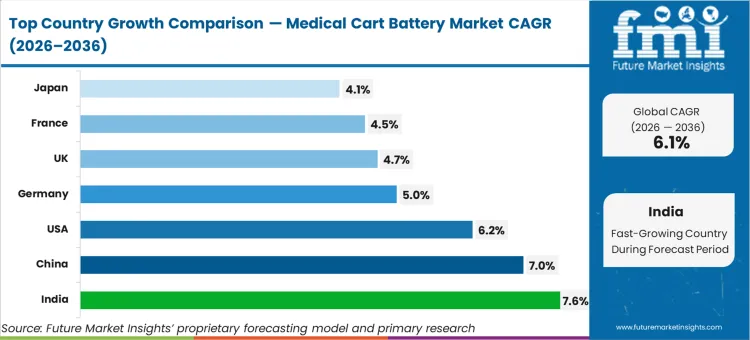
- Geography: India and China show the fastest growth at 7.6% and 7.0% CAGR, supported by improving healthcare infrastructure, rising hospital digitization, and wider deployment of mobile clinical equipment.
- Analyst Opinion at FMI
- Sabyasachi Ghosh, Principal Consultant at Future Market Insights, opines, “Buyer preference is being shaped by runtime reliability, charging convenience, and chemistry-level safety trade-offs, as healthcare providers expand mobile clinical workflows while reducing tolerance for cart downtime, battery swaps, and maintenance disruption across patient-care environments.”
- Strategic Implications and Executive Takeaways
- Build product positioning around safe chemistry, dependable cycle life, and workflow continuity, especially for hospitals running high-utilization mobile fleets.
- Prioritize solutions for workstation-on-wheels and EMR carts, where digital documentation intensity and mobility needs create sustained replacement demand.
- Strengthen growth plans in emerging healthcare systems where hospital modernization and bedside computing expansion are accelerating battery-powered cart adoption.
- Methodology
- As per FMI, sizing and splits were reconciled using company-level product mapping, installed-use assessment, and application-level demand allocation across medical cart categories.
- Segment shares were validated by linking battery requirements to cart workflow intensity, runtime expectations, charging patterns, and site-of-care deployment.
- Pricing sensitivity was stress tested under chemistry mix and application mix shifts to confirm revenue response under realistic replacement and procurement scenarios.
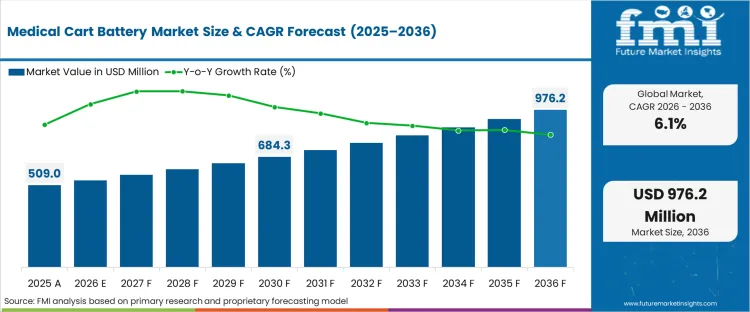
Procurement is being shaped by uptime expectations and fleet management discipline, with buyers giving weight to charge-cycle life, safe chemistry profile, and compatibility with existing cart platforms. Longer service agreements and planned replacement schedules are being used to reduce failure risk during clinical use, while hot-swappable formats are gaining preference in high-utilization hospital environments where battery downtime disrupts workflow.
India (7.6% CAGR, supported by rising hospital digitization and mobile cart deployment) and China (7.0% CAGR, driven by expanding bedside workflow infrastructure) are expected to lead growth. The USA (6.2% CAGR) is expected to remain the largest market due to broad installed cart fleets and replacement demand. Mature markets including Germany (5.0%), the UK (4.7%), France (4.5%), and Japan (4.1%) are expected to contribute more through replacement purchases, constrained by procurement review cycles and long asset refresh periods.
Medical Cart Battery Market Definition
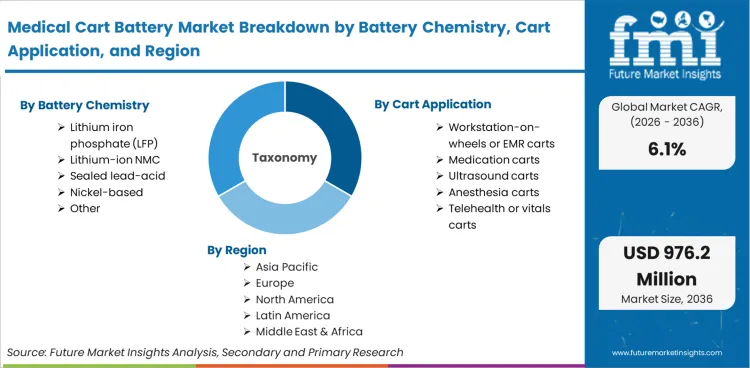
The market includes rechargeable battery systems used to power mobile medical carts in various clinical care settings. The batteries are used to power medication carts, workstation on wheels/EMR carts, ultrasound carts, anesthesia carts, and telehealth/vitals carts that need reliable mobile power in the delivery of routine patient care. The products needed are lithium iron phosphate chemistry, lithium-ion NMC chemistry, sealed lead-acid chemistry, nickel-based chemistry, and more, with varying power levels and swap configurations depending on the usage intensity of the cart. The end-users are hospitals, clinics, ambulatory surgical centers, and long-term care facilities, with the buying criteria including the reliability of the battery system, safety profile, life expectancy, and replacement considerations.
Medical Cart Battery Market Inclusions
The report includes global and regional market sizing and a 10-year forecast for 2026 to 2036. Segment-level sizing is provided by battery chemistry, cart application, power rating, swap architecture, and end user, with country-level CAGR comparisons across key markets. Coverage also includes assessment of replacement demand, fleet standardization patterns, and procurement priorities such as runtime, battery-swap design, and service life, alongside competitive positioning of major battery and cart power suppliers, based on FMI analysis.
Medical Cart Battery Market Exclusions
The scope excludes the medical carts themselves when sold without the battery system as a revenue component. It also omits general UPS systems, wall-mounted power backup units, and batteries used in non-mobile medical devices outside cart-based workflows. Consumer electronics batteries and industrial battery packs not designed for clinical cart use are excluded. Service revenue related only to cart maintenance is not included unless directly tied to battery replacement or battery management. The focus remains on battery systems aligned to the listed chemistries, applications, power classes, swap formats, and end users.
Medical Cart Battery Market Research Methodology
- Primary Research: Interviews were conducted with hospital biomedical teams, nursing workflow managers, cart fleet administrators, procurement leads, and supplier commercial teams to validate replacement cycles, runtime expectations, and buying criteria.
- Desk Research: Public information was reviewed from regulators, health system publications, standards references, and company primary disclosures to benchmark battery safety, installed workflow patterns, and supplier positioning.
- Market-Sizing and Forecasting: A hybrid model was applied using installed cart base and battery replacement logic by end user and application, then reconciled through segment shares across chemistry, power rating, and swap architecture.
- Data Validation and Update Cycle: Outputs were checked through internal consistency screening across segment totals and country growth rates, with variance review applied before finalization.
Segmental Analysis
Medical Cart Battery Market Analysis by Battery Chemistry
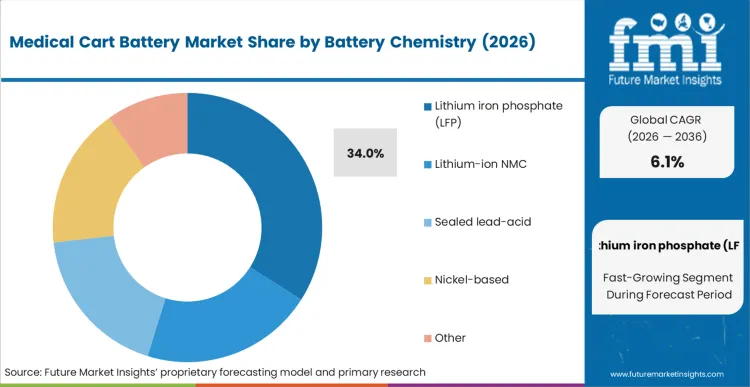
Based on FMI’s report, lithium iron phosphate (LFP) batteries are estimated to hold 34% share in 2026. This leading position is supported by their strong safety profile, dependable cycle life, and suitability for healthcare environments where reliability and reduced maintenance risk matter more than peak energy density alone. Lithium-ion NMC holds 28% share, reflecting its continued use where compact design and higher energy density remain important, while sealed lead-acid and nickel-based batteries retain narrower positions in cost-sensitive or legacy fleets.
- Longer Cycle Life and Enhanced Safety: LFP batteries are preferred in medical carts due to their longer cycle life of over 2,000 charge-discharge cycles, and superior thermal stability, ensuring safe, reliable operation in critical healthcare settings with minimal maintenance.[2]
- Cost-Effectiveness and Sustainability: LFP batteries are favored for their low-cost manufacturing, driven by abundant raw materials like iron and phosphate, making them an ideal choice for cost-sensitive applications. [3]
- Environmental and Safety Benefits: LFP batteries are increasingly adopted in medical carts due to their eco-friendly composition (cobalt-free) and inherent safety from thermal runaway, providing greater environmental sustainability and reduced health risks, which aligns with healthcare's focus on safety and compliance.
Medical Cart Battery Market Analysis by Cart Application
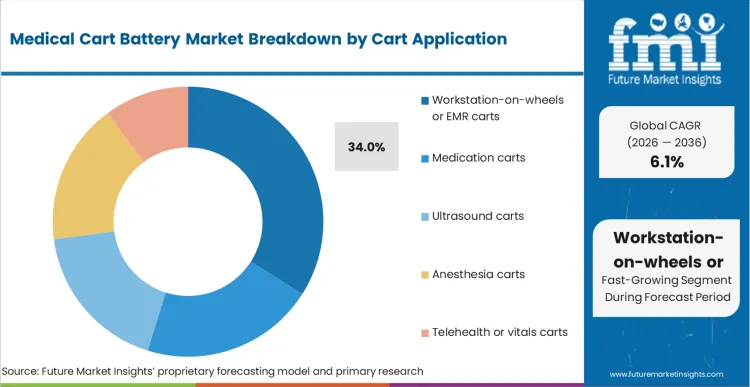
Workstation-on-wheels and EMR carts account for 34% share in 2026, based on FMI’s report, reflecting their central role in bedside documentation, electronic medical record access, and mobile clinical coordination. Their lead position is supported by higher deployment density across hospitals and clinics, along with regular battery replacement needs linked to daily use intensity. Medication carts hold 26% share as medication administration remains a major mobile workflow, while telehealth and vital signs carts, ultrasound carts, and anesthesia carts contribute smaller but relevant demand pools.
- Enhanced Mobility and Access to Real-Time Data: Workstations-on-wheels are critical for enabling real-time access to electronic health records (EHRs) and improving clinical workflow. By providing mobility, healthcare professionals can update patient records and access diagnostic information directly at the patient’s bedside, thus improving care delivery efficiency and reducing time spent away from patients. [4]
- Frequent Usage and High Battery Demand: Workstations-on-wheels (WOW) / EMR carts are used extensively throughout hospitals and clinics, requiring regular recharging due to high usage intensity. Their frequent mobility and daily deployment across various departments result in higher battery consumption, thus securing their dominant share in the Medical Cart Battery Market.
- Integration with Healthcare IT and Workflow Optimization: EMR carts are integral to modernizing clinical workflows by providing seamless integration with healthcare IT systems. Their widespread adoption for patient record management at the point of care increases their prevalence in healthcare settings, reinforcing their central role and contributing to their market dominance in battery demand.
Medical Cart Battery Market Drivers, Restraints, and Opportunities
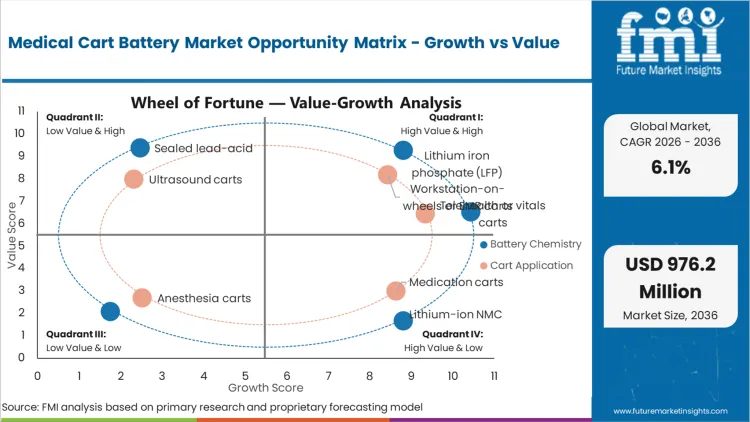
Analysis by Future Market Insights shows that the market is being formed by the continuous growth of mobile care delivery, bedside digitization, and connected clinical workflows. It is also being driven by the need to maintain cart operation over long shifts without impacting medication delivery, documentation, imaging, or point-of-care monitoring. The 2026 market value is being anchored by hospital procurement, where battery selection is becoming dependent on the consistency of the run-time, chemistry, safety, and ease of maintenance, as well as compatibility with existing cart fleets.
At the same time, growth is being moderated by budget controls, compatibility issues with legacy cart systems, and replacement cycle discipline in mature healthcare settings. Even so, forecast momentum remains supported by rising use of workstation-on-wheels, broader hospital modernization, and the gradual shift toward safer and longer-life chemistries. Based on FMI’s report, the outlook reflects a market where hospitals remain the largest end user, application demand is concentrated in digitally enabled carts, and supplier selection is increasingly influenced by serviceability, fleet uptime, and total lifecycle performance.
- Runtime Reliability: Demand is being supported as providers prioritize batteries that reduce cart downtime and maintain uninterrupted performance across clinical shifts.
- Legacy Compatibility: Replacement decisions can be slowed when older cart fleets require specific battery formats, connectors, or charging architectures.
- Digitization-led Opportunity: Demand is being supported as hospitals and clinics expand mobile documentation, bedside computing, and connected care workflows through powered cart deployments.
Regional Analysis
Based on the regional analysis, medical cart battery market is segmented into North America, Latin America, East Asia, South Asia & Pacific, Western Europe, Eastern Europe and Middle East & Africa across 40+ countries. Regional performance is interpreted through deployment of workstation-on-wheels and EMR carts, replacement cycles for hot-swappable packs, and hospital procurement standards for lithium-based chemistries, as per FMI. The full report also offers market attractiveness analysis based on regional trends.
.webp "Top Country Growth Comparison Medical Cart Battery Market Cagr (2026 2036)")
| Country | CAGR |
|---|---|
| USA | 6.2% |
| Germany | 5.0% |
| UK | 4.7% |
| France | 4.5% |
| Japan | 4.1% |
| China | 7.0% |
| India | 7.6% |
Source: Future Market Insights (FMI) analysis, based on proprietary forecasting model and primary research
North America Medical Cart Battery Market Analysis
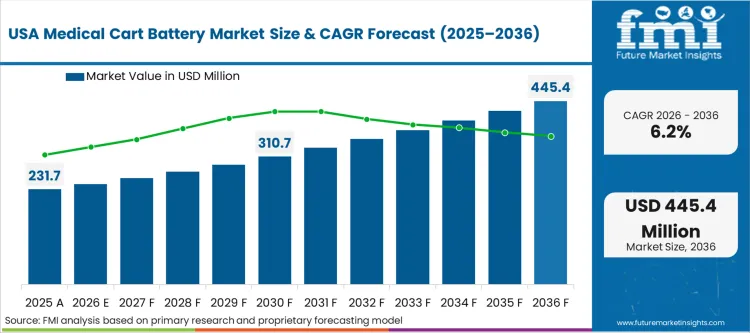
North America is defined by large installed bases of medication carts and workstation-on-wheels fleets, where uptime expectations and nursing workflow design shape battery specifications. Enovate Medical remains visible in cart ecosystems that prioritize mobility and hot-swap readiness. Capsa Healthcare and Ergotron participate through workstation and cart platforms where battery selection is tied to fleet standardisation. OmniCell influences demand where medication workflows and cart deployment connect to hospital automation. FMI analysts note that hospitals dominate purchasing, with long-term care facilities contributing smaller, steady replacement volumes.
- United States: The United States is projected to witness a growth rate of 6.2% CAGR in the medical cart battery market by the end of 2036, driven by the continued expansion of the EMR cart base and the replacement of sealed lead-acid batteries with lithium-based batteries. Lithium iron phosphate batteries are preferred in many hospitals due to the long life and safety of the batteries, but lithium-ion NMC batteries are also used where the energy density is high enough to provide long rounds between charging. Hot-swappable packs are also helping to increase adoption by reducing downtime and the need to park the cart to charge the batteries during peak shifts.
FMI’s report includes a detailed analysis of the growth in the North American region, along with a country-wise assessment that includes the USA, Canada and Mexico. Readers can also find regional trends, regulations, and market growth based on different segments and countries in the North America region.
East Asia Medical Cart Battery Market Analysis
East Asia is characterised by rapid digitisation of hospital workflows and expansion of inpatient capacity, which increases deployment of workstation-on-wheels and telehealth or vitals carts. Local system integrators and global cart manufacturers compete on service coverage and battery runtime performance, while hospitals increasingly standardise around lithium-based packs to lower maintenance burden. FMI is of the opinion that demand growth is being led by large urban hospitals upgrading EMR cart fleets.
- China: China is expected to expand at 7.0% CAGR through 2036, supported by ongoing hospital digitalisation and rising use of mobile carts across wards. Workstation-on-wheels and EMR carts contribute the largest battery demand, with mid-range power ratings common where carts operate across multiple shifts. Lithium chemistries gain share as hospitals move away from sealed lead-acid maintenance, while hot-swappable pack designs are adopted in higher utilisation departments to keep carts circulating.
- Japan: Japan’s market is projected at 4.1% CAGR through 2036, shaped by mature hospital infrastructure and steady replacement of cart fleets as nursing workflow modernisation progresses. Fixed integrated batteries remain common in some fleets, while hot-swappable packs gain traction where downtime reduction is prioritised.
FMI’s report includes a detailed analysis of the growth in the East Asia region, along with a country-wise assessment that includes China, Japan and South Korea. Readers can also find regional trends, regulations, and market growth based on different segments and countries in the East Asia region.
South Asia & Pacific Medical Cart Battery Market Analysis
South Asia & Pacific is a fast build-out market, with the digitization of care delivery services and the expansion of hospitals creating an environment conducive to the installation of EMR carts, telehealth carts, and medication carts. The selection of batteries is done with the objective of meeting the needs of the batteries while keeping costs in mind, hence the coexistence of lithium-ion batteries and old batteries in some environments, according to FMI analysis, which states that the main application driver is the workstation on wheels with the expansion of digital documentation in hospitals.
- India: India is forecast at 7.6% CAGR through 2036, supported by expansion of private hospital networks and wider adoption of mobile documentation carts in high-throughput wards. Lithium-based packs gain share as hospitals prioritise lower maintenance and better uptime, while power ratings in the 300 to 600 Wh range remain common where carts run long rounds without frequent charging.
FMI’s report includes a detailed analysis of the growth in the South Asia & Pacific region, along with a country-wise assessment that includes India, ASEAN Countries, Australia & New Zealand and Rest of South Asia. Readers can also find regional trends, regulations, and market growth based on different segments and countries in the South Asia & Pacific region.
Western Europe Medical Cart Battery Market Analysis
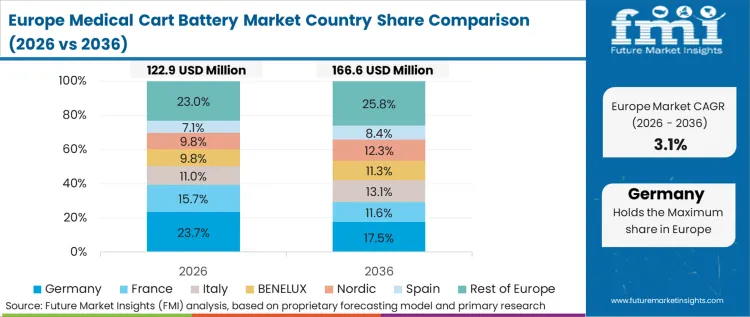
The region is characterized as replacement-led and standardization-driven, with procurement being driven by predictable runtime, safety, and total cost of ownership in multi-site hospital groups. Ergotron and Capsa have a presence in the region through cart platforms in hospital wards. JACO and other system providers are present in the region, as specialized carts require tailored battery integration. According to FMI, patterns of movement and infection control practices continue to drive demand for hot swappable battery packs.
- Germany: The region is expected to grow at a 5.0% CAGR until 2036, driven by replacement of old cart battery chemistries and continued growth of workstations on wheels in hospital environments. LFP chemistries are used in the region for increased lifespan and safety, whereas fixed integrated batteries are used in existing fleets.
- UK: The UK is projected to rise at 4.7% CAGR through 2036, shaped by hospital digitisation and ongoing replacement cycles for batteries supporting medication and EMR carts. Hot-swappable architectures gain traction where wards need carts available through long shifts, while fixed systems remain in older fleets.
- France: France is forecast at 4.5% CAGR through 2036, with growth sustained by incremental expansion of mobile cart fleets and replacement of sealed lead-acid systems in high-utilisation settings. Workstation-on-wheels continues to anchor the market, with rising use of external battery modules where facilities want flexible runtime extensions.
FMI’s analysis of medical cart battery market in Western Europe consists of country-wise assessment that includes Germany, UK, France, Italy, Spain, BENELUX, Nordic Countries and Rest of Western Europe. Readers can know various regulations and latest trends in the regional market.
Competitive aligners for market players
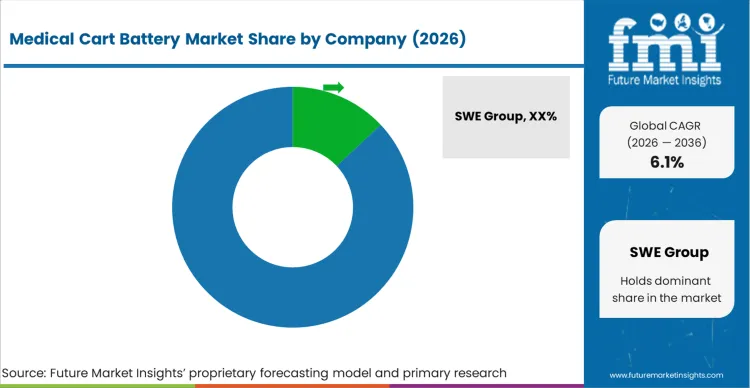
Market structure is still fragmented, although actual competition is limited to a small number of suppliers that can offer batteries with certain runtime, charging characteristics, and availability during procurement cycles. The competition is based on the cost of ownership of these services rather than actual price movements, as equipment failure equates to cart downtime. The platform also plays an important role in determining suppliers, as lithium chemistries and swap technologies must be compatible with cart fleets and chargers, and often standardized across locations for support and maintenance simplicity, as per FMI.
Companies with structural advantages typically combine battery engineering depth with field service reach and compatibility coverage across major cart families. Suppliers offering hot-swappable packs are better placed in high-utilization environments where carts cannot be taken out of service for charging, while fixed integrated designs fit fleets that prefer fewer user-handled components and more controlled charging routines. The ability to support workstation-on-wheels and EMR carts at scale strengthens account retention, since these fleets are deployed across wards and require consistent runtime and rapid replacement logistics. Firms with narrower compatibility or limited service coverage tend to rely on distributor pull-through, which can weaken their position when hospitals consolidate vendors during fleet refresh cycles, based on FMI’s report.
Customer concentration reinforces buyer leverage. Hospitals remain the primary buyers and typically manage supplier dependency through approved alternates, staged fleet rollouts, and contract terms tied to uptime, replacement lead times, and warranty response. Clinics and ASCs apply tighter budget controls and often select standard packs that minimize maintenance burden, while long-term care facilities prioritize safety, ease of handling, and predictable recharging practices for smaller fleets. This purchasing behavior limits pricing power for standard battery replacements, while measured premiums are retained mainly where a pack reduces downtime risk, improves safety compliance, and lowers labor time spent on battery management, Future Market Insights analysis.
Recent Developments
The report includes full coverage of key trends from competitive benchmarking. Some of the recent developments covered in the reports:
- In March 2026, Mount-It! Showcases Healthcare Technology Solutions and a New Battery-Powered Medical Cart, its MedHub healthcare workstation solutions and offering a sneak preview of a new battery-powered medical cart designed to support mobile clinical workflows and point-of-care computing. [5]
- In November, 2024, Green Cubes Technology, a leader in providing cutting-edge power solutions, announced the launch of its innovative Swappable Power Platform designed for mobile medical and industrial workstations. This breakthrough AC platform aims to streamline the power system design process for manufacturers, providing a cost-effective and time-saving solution for powering mobile workstations. [6]
Key players in Medical cart battery market
- SWE Group
- Amstron
- Green Cubes
- DTG
- ANTON BAUER
- ZHONGSHAN JINWO TECHNOLOGY CO.,LTD
- Bytec Healthcare
- Superpack Technology Co., Ltd
Scope of the report
| Metric | Value |
|---|---|
| Quantitative Units | USD 540.0 Mn (2026) to USD 980.0 Mn (2036), at a CAGR of 6.1% |
| Market Definition | The medical cart battery market comprises the global production and trade of rechargeable battery packs and power subsystems used to run medication carts, workstation-on-wheels or EMR carts, ultrasound carts, anesthesia carts, and telehealth or vitals carts, where demand is shaped by uptime expectations, swap-ready workflows, charging safety, and replacement cycles in hospital and clinic operations. |
| Battery Chemistry Segmentation | Lithium iron phosphate (LFP), Lithium-ion NMC, Sealed lead-acid, Nickel-based, Other |
| Cart Application Coverage | Medication carts, Workstation-on-wheels or EMR carts, Ultrasound carts, Anesthesia carts, Telehealth or vitals carts |
| Power Rating Coverage | <300 Wh, 300-600 Wh, 600-1000 Wh, >1000 Wh |
| Swap Architecture Coverage | Hot-swappable packs, Fixed integrated battery, External battery module |
| End User Coverage | Hospitals, Clinics, ASCs, Long-term care facilities |
| Regions Covered | North America, Latin America, East Asia, South Asia & Pacific, Western Europe, Eastern Europe, and Middle East & Africa. |
| Countries Covered | United States, Canada, Mexico, Brazil, Argentina, Germany, France, United Kingdom, Italy, Spain, China, India, Japan, South Korea, Indonesia, Australia and 40+ countries |
| Key Companies Profiled | SWE Group, Amstron, Green Cubes, DTG, ANTON BAUER, ZHONGSHAN JINWO TECHNOLOGY CO.,LTD, Bytec Healthcare and Superpack Technology Co., Ltd |
| Forecast Period | 2026 to 2036 |
| Approach | Hybrid top down and bottom up market modeling validated through primary interviews with hospital HTM teams, nursing operations, and cart OEMs, supported by installed base triangulation and replacement cycle benchmarking, as per FMI. |
Medical cart battery market analysis by segments
Battery chemistry:
- Lithium iron phosphate (LFP)
- Lithium-ion NMC
- Sealed lead-acid
- Nickel-based
- Other
Cart application:
- Medication carts
- Workstation-on-wheels or EMR carts
- Ultrasound carts
- Anesthesia carts
- Telehealth or vitals carts
Power rating:
- <300 Wh
- 300-600 Wh
- 600-1000 Wh
- >1000 Wh
Swap architecture:
- Hot-swappable packs
- Fixed integrated battery
- External battery module
End user:
- Hospitals
- Clinics
- ASCs
- Long-term care facilities
Region:
- North America
- USA
- Canada
- Mexico
- Latin America
- Brazil
- Argentina
- Rest of Latin America
- East Asia
- China
- Japan
- South Korea
- South Asia & Pacific
- India
- ASEAN Countries
- Australia & New Zealand
- Rest of South Asia
- Western Europe
- Germany
- UK
- France
- Italy
- Spain
- BENELUX
- Nordic Countries
- Rest of Western Europe
- Eastern Europe
- Russia
- Hungary
- Poland
- Rest of Eastern Europe
- Middle East & Africa
- Saudi Arabia
- Türkiye
- South Africa
- Other African Union
- Rest of Middle East & Africa
Bibliography
- [1] TAGCarts (2024). TAGCarts and Inpro Unveil Revolutionary Wireless Charging TAG-X Smart Rail for Enhanced Healthcare Efficiency
- [2] ScienceDirect (2024). Navigating battery choices: A comparative study of lithium iron phosphate and nickel manganese cobalt battery technologies
- [3] Springer Nature Link (2024). Status and prospects of lithium iron phosphate manufacturing in the lithium battery industry.
- [4] PubMed Central (2022). Association of Mobile Workstations and Rounding-in-Flow with Resident Efficiency: A Controlled Study at an Academic Internal Medicine Department.
- [5] Mount-It! (2026). Mount-It! Showcases Healthcare Technology Solutions and a New Battery-Powered Medical Cart.
- [6] Green Cubes Technology (2024). Green Cubes Technology Unveils Revolutionary Swappable Power Platform for Mobile Workstations
This bibliography is provided for reader reference and is not exhaustive. The full report contains the complete reference list and detailed citations.
Frequently Asked Questions
How large is the demand for Medical Cart Batteries in the global market in 2026?
Demand for medical cart batteries in the global market is estimated to be valued at USD 540.0 Mn in 2026, as per FMI.
What will be the market size of Medical Cart Batteries in the global market by 2036?
Market size for medical cart batteries is projected to reach USD 980.0 Mn by 2036.
What is the expected demand growth for Medical Cart Batteries in the global market between 2026 and 2036?
Demand for medical cart batteries in the global market is expected to grow at a CAGR of 6.1% between 2026 and 2036.
Which battery chemistry is poised to lead demand by 2026?
Lithium iron phosphate (LFP) is expected to lead with 34% share in 2026
Which swap architecture is expected to account for the largest share in 2026?
Hot-swappable packs are expected to hold the highest share at 44% in 2026.
How significant is hospital demand in the 2026 end user mix?
Hospitals are projected to account for 64% share of end user demand in 2026.
Preview the report firsthand - request a free sample
Get SampleGet the brochure for pricing and purchase details.
Get PDFTable of Content
- Executive Summary
- Global Market Outlook
- Demand-side Trends
- Supply-side Trends
- Technology Roadmap Analysis
- Analysis and Recommendations
- Market Overview
- Market Coverage / Taxonomy
- Market Definition / Scope / Limitations
- Research Methodology
- Chapter Orientation
- Analytical Lens and Working Hypotheses
- Market Structure, Signals, and Trend Drivers
- Benchmarking and Cross-market Comparability
- Market Sizing, Forecasting, and Opportunity Mapping
- Research Design and Evidence Framework
- Desk Research Programme (Secondary Evidence)
- Company Annual and Sustainability Reports
- Peer-reviewed Journals and Academic Literature
- Corporate Websites, Product Literature, and Technical Notes
- Earnings Decks and Investor Briefings
- Statutory Filings and Regulatory Disclosures
- Technical White Papers and Standards Notes
- Trade Journals, Industry Magazines, and Analyst Briefs
- Conference Proceedings, Webinars, and Seminar Materials
- Government Statistics Portals and Public Data Releases
- Press Releases and Reputable Media Coverage
- Specialist Newsletters and Curated Briefings
- Sector Databases and Reference Repositories
- FMI Internal Proprietary Databases and Historical Market Datasets
- Subscription Datasets and Paid Sources
- Social Channels, Communities, and Digital Listening Inputs
- Additional Desk Sources
- Expert Input and Fieldwork (Primary Evidence)
- Primary Modes
- Qualitative Interviews and Expert Elicitation
- Quantitative Surveys and Structured Data Capture
- Blended Approach
- Why Primary Evidence is Used
- Field Techniques
- Interviews
- Surveys
- Focus Groups
- Observational and In-context Research
- Social and Community Interactions
- Stakeholder Universe Engaged
- C-suite Leaders
- Board Members
- Presidents and Vice Presidents
- R&D and Innovation Heads
- Technical Specialists
- Domain Subject-matter Experts
- Scientists
- Physicians and Other Healthcare Professionals
- Governance, Ethics, and Data Stewardship
- Research Ethics
- Data Integrity and Handling
- Primary Modes
- Tooling, Models, and Reference Databases
- Desk Research Programme (Secondary Evidence)
- Data Engineering and Model Build
- Data Acquisition and Ingestion
- Cleaning, Normalisation, and Verification
- Synthesis, Triangulation, and Analysis
- Quality Assurance and Audit Trail
- Market Background
- Market Dynamics
- Drivers
- Restraints
- Opportunity
- Trends
- Scenario Forecast
- Demand in Optimistic Scenario
- Demand in Likely Scenario
- Demand in Conservative Scenario
- Opportunity Map Analysis
- Product Life Cycle Analysis
- Supply Chain Analysis
- Investment Feasibility Matrix
- Value Chain Analysis
- PESTLE and Porter’s Analysis
- Regulatory Landscape
- Regional Parent Market Outlook
- Production and Consumption Statistics
- Import and Export Statistics
- Market Dynamics
- Global Market Analysis 2021 to 2025 and Forecast, 2026 to 2036
- Historical Market Size Value (USD Million) Analysis, 2021 to 2025
- Current and Future Market Size Value (USD Million) Projections, 2026 to 2036
- Y-o-Y Growth Trend Analysis
- Absolute $ Opportunity Analysis
- Global Market Pricing Analysis 2021 to 2025 and Forecast 2026 to 2036
- Global Market Analysis 2021 to 2025 and Forecast 2026 to 2036, By Battery Chemistry
- Introduction / Key Findings
- Historical Market Size Value (USD Million) Analysis By Battery Chemistry , 2021 to 2025
- Current and Future Market Size Value (USD Million) Analysis and Forecast By Battery Chemistry , 2026 to 2036
- Lithium iron phosphate (LFP)
- Lithium-ion NMC
- Sealed lead-acid
- Nickel-based
- Other
- Lithium iron phosphate (LFP)
- Y-o-Y Growth Trend Analysis By Battery Chemistry , 2021 to 2025
- Absolute $ Opportunity Analysis By Battery Chemistry , 2026 to 2036
- Global Market Analysis 2021 to 2025 and Forecast 2026 to 2036, By Cart Application
- Introduction / Key Findings
- Historical Market Size Value (USD Million) Analysis By Cart Application, 2021 to 2025
- Current and Future Market Size Value (USD Million) Analysis and Forecast By Cart Application, 2026 to 2036
- Workstation-on-wheels or EMR carts
- Medication carts
- Ultrasound carts
- Anesthesia carts
- Telehealth or vitals carts
- Workstation-on-wheels or EMR carts
- Y-o-Y Growth Trend Analysis By Cart Application, 2021 to 2025
- Absolute $ Opportunity Analysis By Cart Application, 2026 to 2036
- Global Market Analysis 2021 to 2025 and Forecast 2026 to 2036, By Region
- Introduction
- Historical Market Size Value (USD Million) Analysis By Region, 2021 to 2025
- Current Market Size Value (USD Million) Analysis and Forecast By Region, 2026 to 2036
- North America
- Latin America
- Western Europe
- Eastern Europe
- East Asia
- South Asia and Pacific
- Middle East & Africa
- Market Attractiveness Analysis By Region
- North America Market Analysis 2021 to 2025 and Forecast 2026 to 2036, By Country
- Historical Market Size Value (USD Million) Trend Analysis By Market Taxonomy, 2021 to 2025
- Market Size Value (USD Million) Forecast By Market Taxonomy, 2026 to 2036
- By Country
- USA
- Canada
- Mexico
- By Battery Chemistry
- By Cart Application
- By Country
- Market Attractiveness Analysis
- By Country
- By Battery Chemistry
- By Cart Application
- Key Takeaways
- Latin America Market Analysis 2021 to 2025 and Forecast 2026 to 2036, By Country
- Historical Market Size Value (USD Million) Trend Analysis By Market Taxonomy, 2021 to 2025
- Market Size Value (USD Million) Forecast By Market Taxonomy, 2026 to 2036
- By Country
- Brazil
- Chile
- Rest of Latin America
- By Battery Chemistry
- By Cart Application
- By Country
- Market Attractiveness Analysis
- By Country
- By Battery Chemistry
- By Cart Application
- Key Takeaways
- Western Europe Market Analysis 2021 to 2025 and Forecast 2026 to 2036, By Country
- Historical Market Size Value (USD Million) Trend Analysis By Market Taxonomy, 2021 to 2025
- Market Size Value (USD Million) Forecast By Market Taxonomy, 2026 to 2036
- By Country
- Germany
- UK
- Italy
- Spain
- France
- Nordic
- BENELUX
- Rest of Western Europe
- By Battery Chemistry
- By Cart Application
- By Country
- Market Attractiveness Analysis
- By Country
- By Battery Chemistry
- By Cart Application
- Key Takeaways
- Eastern Europe Market Analysis 2021 to 2025 and Forecast 2026 to 2036, By Country
- Historical Market Size Value (USD Million) Trend Analysis By Market Taxonomy, 2021 to 2025
- Market Size Value (USD Million) Forecast By Market Taxonomy, 2026 to 2036
- By Country
- Russia
- Poland
- Hungary
- Balkan & Baltic
- Rest of Eastern Europe
- By Battery Chemistry
- By Cart Application
- By Country
- Market Attractiveness Analysis
- By Country
- By Battery Chemistry
- By Cart Application
- Key Takeaways
- East Asia Market Analysis 2021 to 2025 and Forecast 2026 to 2036, By Country
- Historical Market Size Value (USD Million) Trend Analysis By Market Taxonomy, 2021 to 2025
- Market Size Value (USD Million) Forecast By Market Taxonomy, 2026 to 2036
- By Country
- China
- Japan
- South Korea
- By Battery Chemistry
- By Cart Application
- By Country
- Market Attractiveness Analysis
- By Country
- By Battery Chemistry
- By Cart Application
- Key Takeaways
- South Asia and Pacific Market Analysis 2021 to 2025 and Forecast 2026 to 2036, By Country
- Historical Market Size Value (USD Million) Trend Analysis By Market Taxonomy, 2021 to 2025
- Market Size Value (USD Million) Forecast By Market Taxonomy, 2026 to 2036
- By Country
- India
- ASEAN
- Australia & New Zealand
- Rest of South Asia and Pacific
- By Battery Chemistry
- By Cart Application
- By Country
- Market Attractiveness Analysis
- By Country
- By Battery Chemistry
- By Cart Application
- Key Takeaways
- Middle East & Africa Market Analysis 2021 to 2025 and Forecast 2026 to 2036, By Country
- Historical Market Size Value (USD Million) Trend Analysis By Market Taxonomy, 2021 to 2025
- Market Size Value (USD Million) Forecast By Market Taxonomy, 2026 to 2036
- By Country
- Kingdom of Saudi Arabia
- Other GCC Countries
- Turkiye
- South Africa
- Other African Union
- Rest of Middle East & Africa
- By Battery Chemistry
- By Cart Application
- By Country
- Market Attractiveness Analysis
- By Country
- By Battery Chemistry
- By Cart Application
- Key Takeaways
- Key Countries Market Analysis
- USA
- Pricing Analysis
- Market Share Analysis, 2025
- By Battery Chemistry
- By Cart Application
- Canada
- Pricing Analysis
- Market Share Analysis, 2025
- By Battery Chemistry
- By Cart Application
- Mexico
- Pricing Analysis
- Market Share Analysis, 2025
- By Battery Chemistry
- By Cart Application
- Brazil
- Pricing Analysis
- Market Share Analysis, 2025
- By Battery Chemistry
- By Cart Application
- Chile
- Pricing Analysis
- Market Share Analysis, 2025
- By Battery Chemistry
- By Cart Application
- Germany
- Pricing Analysis
- Market Share Analysis, 2025
- By Battery Chemistry
- By Cart Application
- UK
- Pricing Analysis
- Market Share Analysis, 2025
- By Battery Chemistry
- By Cart Application
- Italy
- Pricing Analysis
- Market Share Analysis, 2025
- By Battery Chemistry
- By Cart Application
- Spain
- Pricing Analysis
- Market Share Analysis, 2025
- By Battery Chemistry
- By Cart Application
- France
- Pricing Analysis
- Market Share Analysis, 2025
- By Battery Chemistry
- By Cart Application
- India
- Pricing Analysis
- Market Share Analysis, 2025
- By Battery Chemistry
- By Cart Application
- ASEAN
- Pricing Analysis
- Market Share Analysis, 2025
- By Battery Chemistry
- By Cart Application
- Australia & New Zealand
- Pricing Analysis
- Market Share Analysis, 2025
- By Battery Chemistry
- By Cart Application
- China
- Pricing Analysis
- Market Share Analysis, 2025
- By Battery Chemistry
- By Cart Application
- Japan
- Pricing Analysis
- Market Share Analysis, 2025
- By Battery Chemistry
- By Cart Application
- South Korea
- Pricing Analysis
- Market Share Analysis, 2025
- By Battery Chemistry
- By Cart Application
- Russia
- Pricing Analysis
- Market Share Analysis, 2025
- By Battery Chemistry
- By Cart Application
- Poland
- Pricing Analysis
- Market Share Analysis, 2025
- By Battery Chemistry
- By Cart Application
- Hungary
- Pricing Analysis
- Market Share Analysis, 2025
- By Battery Chemistry
- By Cart Application
- Kingdom of Saudi Arabia
- Pricing Analysis
- Market Share Analysis, 2025
- By Battery Chemistry
- By Cart Application
- Turkiye
- Pricing Analysis
- Market Share Analysis, 2025
- By Battery Chemistry
- By Cart Application
- South Africa
- Pricing Analysis
- Market Share Analysis, 2025
- By Battery Chemistry
- By Cart Application
- USA
- Market Structure Analysis
- Competition Dashboard
- Competition Benchmarking
- Market Share Analysis of Top Players
- By Regional
- By Battery Chemistry
- By Cart Application
- Competition Analysis
- Competition Deep Dive
- SWE Group
- Overview
- Product Portfolio
- Profitability by Market Segments (Product/Age /Sales Channel/Region)
- Sales Footprint
- Strategy Overview
- Marketing Strategy
- Product Strategy
- Channel Strategy
- Amstron
- Green Cubes
- DTG
- ANTON BAUER
- ZHONGSHAN JINWO TECHNOLOGY CO.,LTD
- Bytec Healthcare
- Superpack Technology Co., Ltd
- SWE Group
- Competition Deep Dive
- Assumptions & Acronyms Used


