


Key Takeaways
- FMI analysis indicates that APAC automotive telematics revenues are set to more than triple between 2025 and 2035, but much of that expansion will sit in compliance, hardware and connectivity rather than in high-margin services.
- OEMs will keep control over the in-vehicle stack, yet a large share of telematics income will continue to subsidise warranty, UX and regulatory compliance rather than translating into clean profit pools.
- Insurers have the most direct path to monetisation through usage-based products and better risk selection, but their ability to price on telematics data is constrained by regulation, actuarial conservatism and consumer trust.
- Super apps and mobility platforms in parts of APAC already operate with thick behavioural data and thin hardware integration, letting them build credit, insurance and mobility pricing models without owning boxes in vehicles.
- By 2030, value capture is likely to fragment into three patterns: state-shaped ecosystems in China, alliance-driven models in Japan/Korea/Australia, and platform-led experiments in India and Southeast Asia, all sitting on top of the same basic telemetry stack.
The boom: a large market with tightly rationed economics
Telematics in APAC has moved past experiment stage. Most new passenger vehicles in key markets now ship with embedded connectivity, while commercial fleets in India, China and selected ASEAN markets are steadily adding tracking, driver-behaviour monitoring and basic analytics. Regulations such as India’s AIS-140 mandate GPS-based tracking on designated categories of commercial and public transport vehicles, which has hardened demand for compliant devices and platforms rather than leaving adoption purely to market forces.
FMI’s APAC automotive telematics outlook points to a market that more than triples between 2025 and 2035. The growth is broad-based: embedded OEM platforms in passenger cars, aftermarket devices in small commercial fleets, and platform integrations into taxis, logistics and two-wheelers. A large fraction of the revenue booked as telematics is essentially the cost of doing business in a connected, regulated automotive sector. Hardware, connectivity, cloud infrastructure, cybersecurity, data localisation and regulatory reporting consume investment and operating budgets before any participant can talk about margin from value-added services. The core strategic question for 2026-2030 is therefore not whether telematics will grow, but which players can convert their position in the stack into durable bargaining power.
OEMs: control at the edge, pressure in the middle
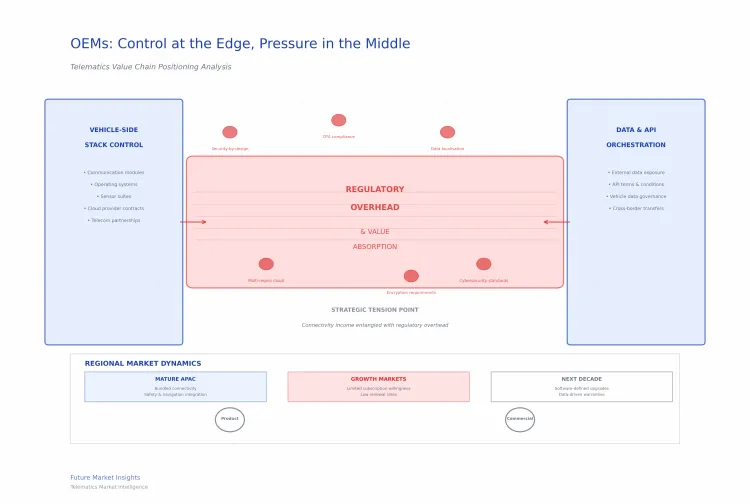
Original equipment manufacturers occupy the most visible position in the telematics hierarchy. They decide which communication modules, operating systems and sensor suites go into the vehicle. They sign contracts with cloud providers and telecom operators. They choose whether to expose vehicle data externally via APIs, and on what terms.
In mature APAC markets, many OEMs now package connectivity into the vehicle price or into multi-year service bundles. Connectivity is tied to safety features, navigation, remote diagnostics and customer apps. In parallel, regulators and standards setters are tightening expectations around cybersecurity and data protection for connected vehicles. China has issued guidelines and standards that require intelligent and connected vehicle data to be stored domestically and subject to security assessments before any cross-border transfer. Japan’s data protection framework, anchored in the Act on the Protection of Personal Information and supported by sectoral guidance, has also forced automotive players to treat in-vehicle and telematics data as personal data that must be carefully governed.
These trends mean that OEM telematics income is increasingly entangled with regulatory overhead. Security-by-design, over-the-air update compliance, encryption, data localisation and multi-region cloud architectures are now baseline requirements. They protect brand and licence to operate, but they also absorb much of the value generated by connectivity fees.
In growth markets such as India and parts of Southeast Asia, OEMs see telematics as a differentiator in mid- and high-end models. However, willingness to pay for recurring subscriptions is limited; renewal rates drop sharply once the initial free period ends. The more telematics becomes a hygiene factor in comparison tables, the less room OEMs have to charge extra for it.
Looking into the next decade, OEMs in APAC will still orchestrate the vehicle-side stack. The point of tension is whether they can move from selling connectivity as a bundled feature to monetising software-defined upgrades, data-driven warranties and cross-sell with captive finance. That requires product and commercial capabilities which many legacy OEMs in the region are still building.
Insurers: direct line to money, indirect path to adoption
In principle, insurers are the most natural telematics monetisers. They can use telematics data to refine motor risk models, price based on actual mileage and driving behaviour, detect fraud and triage claims. Usage-based products such as pay-as-you-drive and pay-how-you-drive move the industry away from blunt proxies and towards observable behaviour.
Across APAC, insurers are experimenting with these models. In India, recent commentary from regulators and market participants highlights a shift toward usage-based offerings using telematics and app-based tracking, with digital policy distribution making it easier to test and scale new structures. In Japan, Korea and Australia, telematics is folded into a broader digital modernisation of motor and multi-line portfolios.
Yet even in markets where regulators are open to telematics, constraints are real. Supervisors are cautious about fairness and discrimination. Many insist that telematics scores be one factor among several rather than the sole determinant of premium. Data from different device types, OEM platforms and apps is messy and not always consistent enough to support risk models with regulatory scrutiny.
Consumer trust adds another layer. Driving data includes location, time patterns and sometimes in-cabin information. In privacy-conscious markets, a meaningful share of customers declines monitoring even in exchange for discounts. In more price-sensitive markets, uptake can be higher, but churn and device management issues erode the economics.
For insurers, the pattern that emerges is that telematics becomes most valuable when it is embedded deeply: into underwriting rules, claims triage, fraud models and cross-sell journeys with health or life products. The financial benefit then shows up as a lower loss ratio or higher customer lifetime value, not as a neat telematics revenue line. The value is real but diffuse, which can make investment decisions harder to defend internally.
Super apps and platforms: data gravity without hardware ownership
Super apps and mobility platforms in APAC complicate the traditional telematics hierarchy. In several Southeast Asian markets, large platforms already aggregate ride-hailing, food delivery, digital payments and local commerce inside a single app. Their visibility spans routes, transaction histories, device identities and behavioural patterns across millions of users. These platforms often interact with vehicles via smartphones, lightweight SDKs and integrations with fleet operators, rather than through direct access to in-vehicle CAN buses or high-end telematics devices.
From a value-capture perspective, this can be enough. With multi-modal data, platforms can optimise driver incentives, implement dynamic pricing, segment customers, design loyalty schemes and underwrite small-ticket credit and insurance products based on observed economic behaviour. China follows a different trajectory, shaped by national security and data-sovereignty priorities. Automotive data security rules require local storage and security assessments for cross-border transfers.
New standards for confidentiality of spatio-temporal data in intelligent and connected vehicles further tighten how location and mapping data can be processed. This gives domestic OEMs, cloud providers and platforms a privileged position and limits the ability of foreign platforms to anchor telematics-based data businesses in the same way. As 2026 approaches, one can already see a divergence.
In some APAC markets, telematics value will accumulate in multi-service platforms that treat vehicle signals as one more feed into a broader customer and merchant graph. In others, especially where mapping and automotive data are treated as strategically sensitive, value will concentrate in domestic automotive and telecom ecosystems.
How FMI Can Help
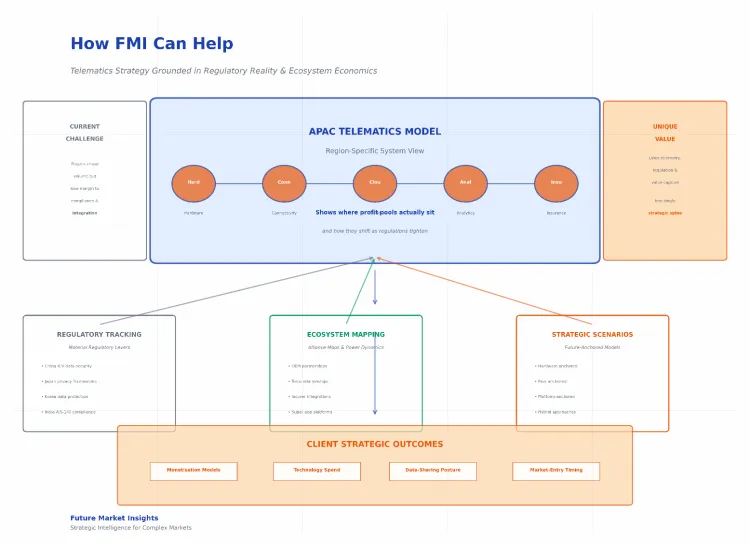
FMI helps telematics stakeholders cut through the noise by grounding strategy in regulatory reality, ecosystem economics and country-specific scenarios rather than generic TAM claims. Our internal APAC telematics model isolates where profit pools actually sit across hardware, connectivity, cloud, analytics and insurance, and shows how those pools shift as data-sovereignty rules, safety mandates and platform power tighten through the next decade.
We track the region’s most material regulatory levers-from China’s ICV data-security and localisation rules to Japan and Korea’s privacy frameworks and India’s AIS-140-driven compliance stack-and combine them with alliance maps across OEMs, telcos, insurers and super apps to show where bargaining power concentrates and where it erodes.
For clients, this translates into clear choices on monetisation models, technology spend, data-sharing posture and market-entry timing, supported by scenarios that separate hardware-anchored from risk-anchored and platform-anchored futures. In a sector where most players still chase volume but lose margin to compliance and integration, FMI provides the only region-specific system view that links telemetry, regulation and value capture into a single strategic spine.
Sources
- Ministry of Road Transport & Highways (India): AIS-140 and state-level GPS mandates
- Cyberspace Administration of China: cross-border data transfer rules and connected-vehicle data-security standards
- Ministry of Industry and Information Technology (China): intelligent & connected vehicle (ICV) data governance guidelines
- Japan’s Act on the Protection of Personal Information (APPI) and connected-vehicle data usage guidance
- Korea Personal Information Protection Commission (PIPC): telematics and mobility-data handling frameworks
- Australia Department of Infrastructure: connected-vehicle safety and data-access consultations
- UNECE WP.29 regulations on cybersecurity and software-update management for connected vehicles
- Public filings and investor disclosures from APAC OEMs (e.g., Toyota, Hyundai/Kia, BYD, Tata Motors)
- Public disclosures from insurers in Japan, Korea and Australia on telematics-enabled underwriting and claims digitisation
- Mobility platform disclosures (Grab, Gojek, Didi) on behavioural-data-based optimisation

