


Key Takeaways
- Global cathodic protection standards provide frameworks but not cost certainty
- Soil resistivity and water chemistry directly determine current demand and anode sizing
- Climate conditions influence coating degradation rates and CP load over time
- Regulatory enforcement levels affect monitoring frequency and compliance cost
- Local execution decisions drive total lifecycle cost more than equipment selection
How does soil resistivity alter cathodic protection system design and cost?
Soil resistivity fundamentally determines cathodic protection current requirements and anode bed sizing. Low resistivity soils below 1,000 ohm centimetres, typical in coastal regions with high moisture and salt content, allow efficient current distribution with smaller anode installations. A pipeline in Gulf Coast clay soils may require 0.5 to 1.0 milliamps per square metre of bare steel, achieved with galvanic magnesium anodes spaced at 300 to 500 metre intervals. Capital cost for impressed current systems in these conditions runs $15,000 to $25,000 per rectifier station protecting 5 to 10 kilometres of pipeline.
High resistivity environments above 10,000 ohm centimetres, found in arid regions, rocky terrain and sandy deserts, dramatically increase current demand and infrastructure requirements. Middle Eastern pipeline projects encounter resistivities exceeding 50,000 ohm centimetres, necessitating deep vertical anode beds, multiple rectifiers and extensive cabling. Current densities may reach 5 to 10 milliamps per square metre to achieve adequate polarisation. Rectifier spacing contracts to 2 to 3 kilometres, increasing station count five fold compared to low resistivity regions. Capital expenditure escalates proportionally, with high resistivity CP systems costing $100,000 to $200,000 per rectifier installation.
Regional geology creates localised cost variations even within single countries. Canadian pipelines crossing prairie clay soils, Rocky Mountain bedrock and coastal wetlands encounter three order of magnitude resistivity ranges requiring distinct CP designs along route segments. Australian infrastructure faces similar challenges transitioning from coastal regions to interior deserts. These geological transitions force hybrid designs combining galvanic and impressed current systems, increasing complexity and engineering effort beyond standardised approaches assuming uniform soil conditions.
Why does water chemistry materially change CP requirements for buried and submerged assets?
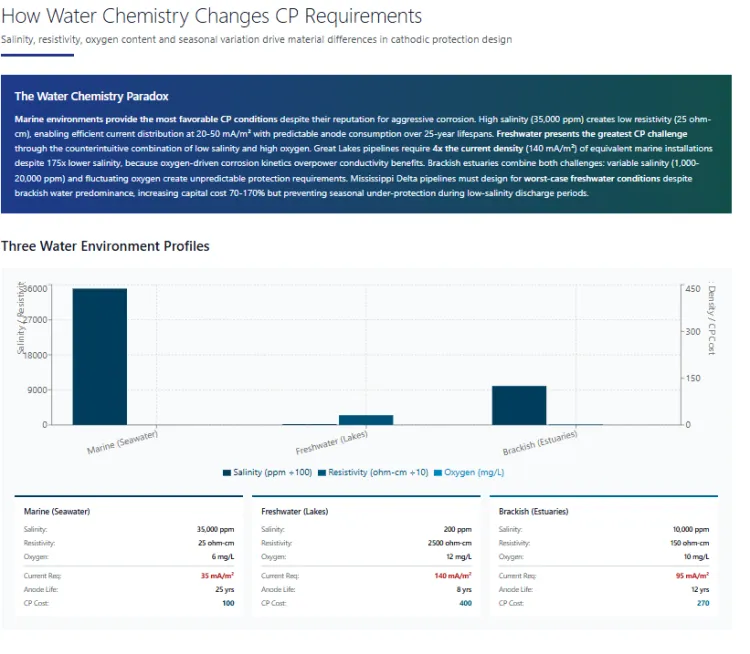
Marine environments with salinities above 30,000 parts per million provide highly conductive electrolytes enabling efficient cathodic protection. Offshore pipeline and platform structures achieve protection with impressed current systems delivering 20 to 50 milliamps per square metre through seawater resistivities of 20 to 30 ohm centimetres. Aluminium alloy anodes installed directly on structures provide decades of protection without external power. North Sea and Gulf of Mexico installations demonstrate reliable performance with predictable current consumption and anode depletion rates verified through extensive operational history.
Freshwater environments present greater challenges through higher resistivity, variable oxygen content and seasonal chemistry changes. River crossings and lake bottom pipelines encounter resistivities of 500 to 5,000 ohm centimetres with oxygen levels fluctuating based on temperature and biological activity. Higher oxygen concentrations accelerate corrosion kinetics, increasing current demand to maintain protective potential. Great Lakes buried pipelines require 2 to 4 times the current density of equivalent marine installations despite lower salinity theoretically favouring protection efficiency. This counterintuitive outcome reflects oxygen driven corrosion overpowering conductivity benefits.
Brackish water and estuarine conditions combine adverse characteristics of both environments. Moderate salinity provides reasonable conductivity while variable oxygen, sulfate reducing bacteria and seasonal salinity fluctuations complicate protection strategy. Mississippi River delta pipelines experience salinity ranging from 1,000 to 20,000 parts per million depending on freshwater discharge and tidal influence. CP systems must accommodate worst case conditions, typically designing for freshwater current densities despite brackish water being predominant. This conservative approach increases capital cost but prevents seasonal under protection during low salinity periods.
How do climate and environmental exposure influence long term CP economics?
Temperature extremes affect both electrochemical reaction rates and coating performance. High ambient temperatures in Middle Eastern and North African regions accelerate coating degradation, exposing more bare steel to corrosive environments over asset life. A pipeline coating designed for 30 year life in temperate climates may deteriorate within 15 to 20 years in 50 degree Celsius desert conditions. As coating fails, cathodic protection current demand increases progressively, requiring rectifier upgrades or additional anode beds to maintain protection levels. This coating degradation trajectory means initial CP design adequacy erodes over time without ongoing system enhancement.
Freeze thaw cycles in northern climates create mechanical coating damage through ice expansion and contraction stresses. Canadian and Russian pipelines experience coating disbondment where freeze thaw action separates protective layers from steel substrate. These disbonded regions trap moisture and corrosive ions while blocking cathodic protection current access, creating shielded corrosion cells. Addressing disbonded coatings requires close interval survey techniques and potentially coating repair or enhanced CP current to force protection into shielded areas. Monitoring and remediation costs for freeze thaw affected assets exceed temperate climate requirements by 50 to 100 percent annually.
Moisture cycles between wet and dry seasons affect CP current demand dynamically. Monsoon regions in Southeast Asia experience order of magnitude resistivity changes between dry and wet periods. A pipeline section measuring 5,000 ohm centimetres soil resistivity during monsoon may reach 50,000 ohm centimetres during drought. CP rectifiers must size for dry season peak demand while operating at partial capacity during wet periods. This oversizing increases capital cost and reduces energy efficiency compared to stable climate installations where design conditions persist year round.
Why does regulatory enforcement intensity shape CP monitoring and operating cost?
Stringent regulatory regimes mandate frequent integrity surveys and comprehensive documentation. USA Department of Transportation Pipeline and Hazardous Materials Safety Administration requires annual close interval surveys for high consequence areas, triennial coating surveys and continuous monitoring of impressed current systems. Survey costs range from $1,000 to $3,000 per kilometre depending on access and terrain. A 100 kilometre high consequence area pipeline incurs $100,000 to $300,000 annual survey expenditure before addressing any deficiencies identified. Documentation, record keeping and regulatory reporting add 20 to 30 percent overhead to direct survey costs.
European Union pipeline integrity directives impose similar rigour with additional environmental protection requirements. Inspections verify not only asset protection but also stray current mitigation affecting adjacent buried utilities. Coordination with water, gas and telecommunications infrastructure operators increases survey complexity and duration. Stray current monitoring and mitigation adds $5,000 to $15,000 per rectifier annually in urban and industrial corridors where multiple buried assets intersect. Rural installations avoid these coordination costs but may face access challenges increasing survey logistics expenses.
Regions with minimal enforcement allow operators discretion over monitoring frequency and corrective action timing. Some jurisdictions require only commissioning verification without mandated ongoing surveillance. While this reduces operating expenditure in compliant systems, it creates risk of undetected corrosion and deferred maintenance accumulation. Operators balancing cost minimisation against asset integrity often implement voluntary monitoring at lower frequency than regulated regions, typically biennial or triennial surveys rather than annual programs. This monitoring deferral reduces annual costs 50 to 70 percent but increases uncertainty around actual protection status.
How do regional standards and local engineering practice override global design assumptions?
NACE International and ISO standards provide baseline protection criteria, typically negative 850 millivolts copper copper sulfate reference for steel in most soil conditions. Regional authorities modify these criteria based on local experience and risk tolerance. Canadian Energy Regulator accepts negative 850 millivolts instant off potential while some Middle Eastern authorities require negative 950 millivolts recognising aggressive soil conditions. This 100 millivolt difference translates to 30 to 50 percent higher current requirements, proportionally affecting anode bed sizing and rectifier capacity.
Local soil survey quality and coverage determine design confidence levels. Regions with comprehensive geological databases enable accurate resistivity profiling and targeted CP design. Engineers working with detailed soil maps can optimise anode placement and minimise infrastructure redundancy. Areas lacking soil data force conservative assumptions and safety factors that increase capital expenditure. A pipeline project in well surveyed European terrain may design with 20 percent margin above calculated requirements, while equivalent Central Asian project might apply 100 percent margin acknowledging data uncertainty. This conservatism doubles anode bed installations and rectifier capacity.
Regional engineering expertise and contractor capability affect execution quality independent of design adequacy. Skilled CP installation contractors ensure proper anode bed construction, electrical isolation and test station placement. Jurisdictions with established pipeline industries maintain experienced workforces delivering consistent quality. Emerging regions may lack specialised CP contractors, forcing reliance on general electrical contractors unfamiliar with cathodic protection nuances. Poor installation quality creates troubleshooting and remediation costs exceeding initial capital savings from lower labour rates. Operators report 20 to 40 percent higher lifecycle costs in regions lacking mature CP service industries despite equivalent equipment specifications.
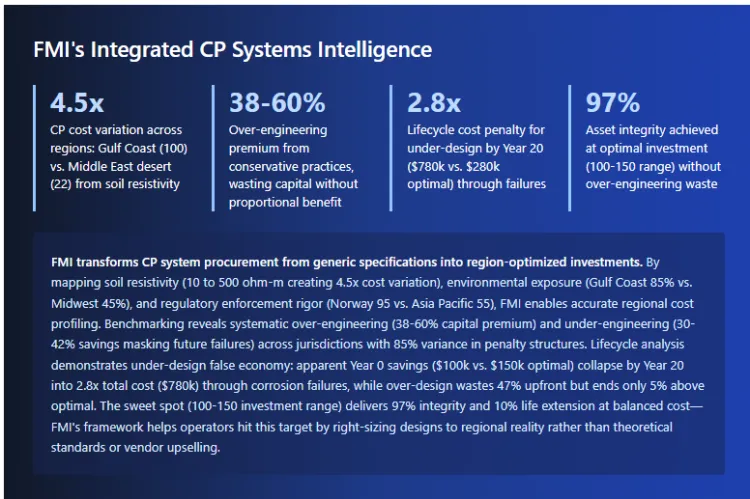
How Future Market Insights Can Help
Sources
- NACE International. (2023). SP0169 2023: Control of external corrosion on underground or submerged metallic piping systems. NACE International (Association for Materials Protection and Performance).
- International Organization for Standardization. (2021). ISO 15589 1:2015: Petroleum, petrochemical and natural gas industries - Cathodic protection of pipeline systems - Part 1: On land pipelines. ISO.
- USA Department of Transportation, Pipeline and Hazardous Materials Safety Administration. (2024). 49 CFR Part 192: Transportation of natural and other gas by pipeline - Minimum federal safety standards. USA Government Publishing Office.

