


Key Takeaways
- Smart automation reduces downtime through predictive maintenance and real-time fault detection
- Traffic management algorithms improve handling capacity without costly shaft additions
- Energy optimisation lowers operating cost over 20- to 30-year asset lifespans
- Remote monitoring shifts maintenance from reactive emergency response to planned intervention
- Lifecycle economics outweigh upfront system cost in adoption decisions for commercial building owners
Building owners and facility managers adopt smart elevator automation systems primarily to improve operational performance, reduce total cost of ownership, and extend asset life. While passenger convenience features such as touchless controls and real-time notifications generate attention, the business case for automation rests on quantifiable gains in uptime, energy efficiency, maintenance economics, and traffic handling capacity. Vertical transportation represents a critical infrastructure element in commercial and residential towers, and system failures impose immediate financial penalties through tenant dissatisfaction, service contract breaches, and lost operational productivity. Smart automation addresses these risks by shifting elevator management from reactive response to predictive, data-driven control.
This analysis examines how automation transforms elevator system economics through traffic optimisation, predictive maintenance, lifecycle cost reduction, and regulatory compliance support. It considers the adoption drivers that matter most to asset owners and the measurable performance improvements that justify capital investment in control technology.
How do smart control algorithms improve elevator traffic efficiency?
Destination control systems represent the most significant software-driven improvement in elevator traffic management. Unlike conventional systems where passengers press up or down buttons and are assigned to the next available car, destination control requires passengers to enter their target floor before boarding. The system then groups passengers by destination and assigns them to specific cars, reducing the number of stops per trip and improving handling capacity.
Traffic prediction algorithms analyse historical usage patterns, occupancy data, and time-of-day demand to pre-position cars in anticipation of peak periods. During morning arrival surges, cars are dispatched to the lobby in advance. During lunch periods or end-of-day departures, the system adjusts dispatch logic to prioritise outbound traffic. This reduces average wait times and increases the number of passengers handled per hour without adding physical infrastructure.
In buildings with multiple elevator banks, smart systems coordinate car assignments across zones to balance load and prevent bottlenecks. Machine learning models continuously refine dispatch decisions based on observed performance, adapting to changing occupancy patterns or tenant mix. For building owners, this translates to higher effective building capacity and reduced need for expensive shaft additions during renovations or tenant density increases.
Why is predictive maintenance central to smart elevator automation value?
Predictive maintenance relies on sensor networks embedded in drive systems, door mechanisms, hoist ropes, and control boards to monitor component condition in real time. Vibration sensors detect early bearing wear, temperature probes identify motor overheating, and door cycle counters track usage against expected component life. This data is transmitted to cloud-based analytics platforms that apply machine learning models to predict component failures before they occur.
By identifying degradation trends weeks or months in advance, predictive maintenance allows service teams to schedule component replacement during planned maintenance windows rather than responding to emergency breakdowns. Unplanned outages are costly not only in terms of repair labour but also in tenant disruption, potential safety incidents, and contractual penalties. Elevator downtime in a commercial office tower can trigger service-level agreement breaches that result in financial penalties or tenant lease concessions.
Predictive systems also extend component life by enabling condition-based servicing. Rather than replacing parts on fixed calendars regardless of actual wear, technicians intervene only when data indicates genuine need. This reduces unnecessary part consumption and labour while ensuring that components are replaced before failure.
How does automation reduce total maintenance and service costs?
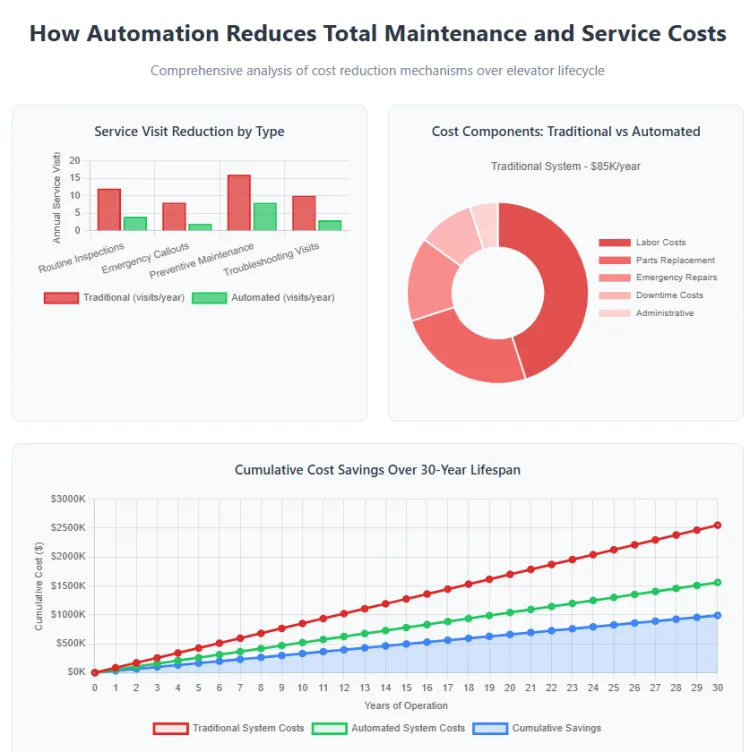
Condition-based servicing, enabled by continuous monitoring, eliminates the inefficiency of fixed-interval maintenance schedules that either replace parts prematurely or miss early signs of degradation. Smart systems provide technicians with detailed diagnostic data before they arrive on site, reducing troubleshooting time and ensuring that the correct replacement parts are available. This decreases service visit duration and minimises repeat calls.
Remote diagnostics allow many issues to be resolved through software adjustments or remote resets without dispatching a technician. Minor faults that would previously require on-site visits can be addressed immediately, improving uptime and reducing service call frequency. For service providers, this optimises technician deployment and allows a single team to manage more installations.
Automated fault reporting and digital maintenance logs improve service contract compliance and simplify regulatory inspections. Building owners gain transparency into service provider performance, enabling more accurate contract negotiations and performance-based agreements. Over a typical 20- to 30-year elevator lifespan, these incremental savings compound into substantial total cost reductions.
Why do building owners prioritise lifecycle performance over installation cost?
Elevators are long-lived assets with operational lifespans of 20 to 30 years or more. Over this period, energy consumption, maintenance costs, and downtime losses far exceed initial capital investment. A smart automation system that costs 10 to 15 percent more than a conventional installation can deliver energy savings of 20 to 40 percent, reduce maintenance costs by 15 to 25 percent, and improve uptime by 2 to 5 percentage points. These gains yield positive return on investment within three to seven years, with benefits accruing over the remaining asset life.
Downtime imposes direct and indirect costs. In commercial buildings, elevator outages reduce usable square footage, trigger tenant complaints, and can lead to lease concessions or early terminations. In residential towers, breakdowns create safety concerns and degrade resident satisfaction. For mixed-use developments, elevator reliability directly affects retail traffic and hotel guest experience. Building owners increasingly view elevator performance as a competitive differentiator in tenant attraction and retention.
Service contract structures also favour automation. Performance-based agreements, where service providers guarantee uptime levels, become economically viable only with predictive maintenance and remote monitoring. Owners benefit from predictable costs and contractual protection against prolonged outages, while service providers reduce emergency response costs and improve profitability.
How do regulatory and safety compliance requirements reinforce automation adoption?
Elevator safety regulations mandate periodic inspections, load testing, and documentation of maintenance activities. Digital monitoring systems automatically log operational data, maintenance events, and fault records, simplifying compliance reporting and reducing administrative burden. Automated safety checks verify door operation, load limits, and emergency systems continuously rather than relying on infrequent manual inspections.
Jurisdictions increasingly require digital reporting of inspection results and maintenance records. Smart systems generate these reports automatically, reducing the risk of compliance lapses and associated penalties. Real-time monitoring also improves incident response by providing detailed operational data in the event of accidents or safety investigations.
Energy efficiency regulations and building certification programs such as LEED or BREEAM award points for elevator energy performance and monitoring capabilities. Smart systems that optimise motor operation, implement regenerative braking, and provide energy consumption data help buildings achieve certification targets and comply with energy codes.
How Future Market Insights Can Help

Bibliography
- KONE Corporation. (2023). Smart elevator systems, destination control technology, and predictive maintenance models. KONE Technical and Service Documentation.
- Otis Worldwide Corporation. (2023). Digital elevator platforms, remote monitoring, and lifecycle service optimisation. Otis Engineering and Service Publications.
- Schindler Group. (2023). Elevator traffic management systems and data driven maintenance strategies for commercial buildings. Schindler Technical White Papers.
- American Society of Mechanical Engineers. (2023). Safety code for elevators and escalators and requirements for inspection, monitoring, and documentation. ASME A17 Standards Publications.
- International Organization for Standardization. (2023). Lifts and escalators safety, performance, and energy efficiency standards relevant to automated systems. ISO Standards Publications.

