


Key Takeaways
- Germany combines precision metallurgy, pressure-vessel engineering and medical-grade fabrication in its industrial base.
- European sterilisation standards and hospital safety regulations ensure steady domestic adoption and continuous quality feedback.
- High domestic demand gives German OEMs scale and reliability track record before global export.
- Innovation in automation, energy-efficient sterilisation cycles, digital compliance logging driven by local R&D differentiates German autoclaves globally.
- Strong export infrastructure and compliance documentation enable global competitiveness despite premium pricing.
Who are the leading German autoclave producers and what distinguishes them?
German autoclave manufacturing concentrates among specialized medical equipment producers with histories extending decades into industrial sterilization technology. Companies including Getinge (through its German operations), MMM Group, Melag and Belimed maintain production facilities in Germany serving hospital sterilization, laboratory applications and pharmaceutical manufacturing. These firms evolved from broader industrial equipment backgrounds, applying pressure-vessel engineering expertise developed for chemical processing and power generation to medical sterilization requirements as infection control standards tightened across European healthcare systems.
Product lines span tabletop laboratory autoclaves through large-capacity hospital sterilizers capable of processing surgical instrument sets, textiles and complex medical devices in automated cycles. Steam sterilization remains the dominant technology, with chambers designed for saturated steam at 121 to 134 degrees Celsius under pressure ranging from 1 to 3 bar above atmospheric. Water-steam hybrid systems serve heat-sensitive instruments requiring lower temperatures, while specialized configurations handle porous loads, hollow instruments and implantable devices requiring validated sterilization cycles documented for regulatory compliance.
German manufacturers differentiate through integration of chamber fabrication, control system development and validation testing within single organizations. Rather than assembling purchased components, leading producers maintain in-house capabilities for stainless steel pressure vessel construction, door seal design, steam generation systems and programmable logic controllers governing sterilization cycles. This vertical scope allows optimization of chamber geometry, heating uniformity and pressure control precision difficult to achieve through assembly of externally sourced subsystems, creating performance consistency that supports regulatory validation and long-term reliability claims.
How does Germany's industrial and materials engineering capability translate to quality and cost structure for autoclaves?
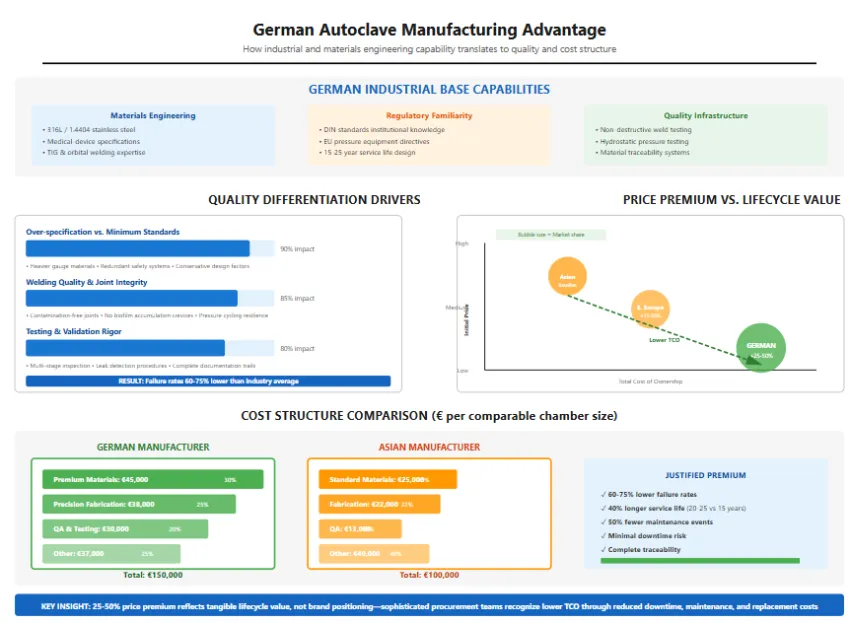
Germany's industrial base provides access to high-specification stainless steel fabrication capabilities developed across automotive, chemical processing and pharmaceutical equipment sectors. Autoclave chambers require austenitic stainless steel grades (typically 316L or 1.4404) combining corrosion resistance, pressure containment strength and weldability, materials routinely produced by German steel mills to medical-device specifications. Fabricators apply TIG (tungsten inert gas) and orbital welding techniques that produce consistent, contamination-free joints meeting pressure equipment directives and avoiding crevices where biofilm or residue could accumulate.
Pressure-vessel engineering standards established through German industrial codes (DIN standards) and European pressure equipment regulations create design requirements that German manufacturers routinely satisfy through institutional familiarity. Autoclave chambers must withstand repeated thermal cycling, pressure fluctuations and mechanical stress from door operations over service lives of 15 to 25 years. German engineering tradition emphasizes over-specification relative to minimum regulatory requirements, using heavier gauge materials, redundant safety systems and conservative design factors that reduce failure probability but increase manufacturing cost.
Quality assurance infrastructure embedded in German manufacturing operations adds cost while reducing long-term failure risk. Non-destructive testing of welds, hydrostatic pressure testing of chambers, leak detection procedures and material traceability documentation all require specialized facilities and trained personnel. These quality investments create higher per-unit production costs than manufacturers in regions with less stringent oversight, but they generate reliability track records that justify premium pricing when buyers evaluate total cost including downtime risk, maintenance frequency and replacement likelihood over equipment lifetime.
The cost structure resulting from these capabilities positions German autoclaves at price premiums of 25 to 50% compared to Asian or Eastern European alternatives for comparable chamber size and cycle specifications. However, this premium reflects tangible differences in failure rates, maintenance intervals and service life documented through installed-base performance rather than purely brand positioning, creating value propositions that sophisticated hospital procurement teams recognize when conducting lifecycle cost analysis.
How do regulatory and hospital-safety standards in Europe reinforce demand and create a feedback loop for quality improvement?
European medical device regulations including the Medical Device Regulation (MDR) 2017/745 and harmonized standards such as EN 285 for large steam sterilizers and EN 13060 for small sterilizers establish performance requirements that autoclaves must meet for CE marking and commercial sale. These standards specify chamber temperature uniformity, pressure control accuracy, air removal effectiveness and biological indicator kill requirements, creating objective performance thresholds that manufacturers must demonstrate through validated testing protocols.
Hospital accreditation systems operated by national health authorities and international bodies such as Joint Commission International impose sterilization equipment requirements as conditions for facility licensing and reimbursement eligibility. German hospitals must document sterilization cycle parameters, maintain equipment calibration records and demonstrate compliance with Robert Koch Institute recommendations for infection prevention. These requirements create continuous demand for autoclaves featuring automated cycle documentation, integrated data logging and compliance reporting capabilities that German manufacturers develop in direct response to domestic customer specifications.
The feedback loop between regulatory pressure and product development operates through multiple channels. Hospital infection control staff identify performance gaps or documentation needs, communicate requirements to equipment suppliers and validate solutions through pilot installations. Successful innovations diffuse across the German hospital base through professional networks and industry working groups, creating competitive pressure for all manufacturers to adopt similar capabilities. This iterative process, repeating over decades, progressively raises baseline equipment performance and creates installed base expectations that become de facto requirements even when not explicitly mandated.
Regular standard revisions incorporate technological advances and emerging safety evidence, compelling manufacturers to invest in redesign and revalidation cycles. German producers benefit from proximity to standards development processes through industry association participation and direct relationships with testing laboratories, allowing them to anticipate regulatory changes and incorporate compliance features before standards finalize. This regulatory foresight reduces compliance risk and time-to-market advantages compared to foreign manufacturers learning of European requirement changes only after publication.
How does domestic demand scale and support export readiness and global competitiveness?
Germany maintains approximately 1,900 hospitals alongside extensive networks of ambulatory surgery centers, dental practices, veterinary clinics and research laboratories, all requiring sterilization equipment meeting infection control standards. This installed base creates steady replacement demand as equipment reaches end-of-life, supplemented by capacity expansions and specialty procedure growth driving additional installations. The resulting production volumes allow German manufacturers to amortize tooling investments, maintain specialized workforce expertise and optimize supply chains in ways impossible for producers serving only export channels.
Domestic demand provides validation infrastructure for export competitiveness. German hospital procurement teams impose rigorous performance testing, request detailed technical documentation and conduct site inspections before purchase decisions. Successfully serving these demanding customers generates operational track records, performance data and reference installations that support export sales pitches to international buyers. Foreign hospital administrators evaluating German equipment can verify claims through facility visits, speak with peer users and review documented performance data from comparable installations, validation particularly valuable for buyers in regions lacking established autoclave quality standards.
CE marking obtained for European sale provides streamlined regulatory pathways in many export destinations. Countries including those in Middle East, Southeast Asia and Latin America accept CE certification as evidence of quality and safety, reducing or eliminating local testing requirements. German manufacturers leverage this certification transferability to reduce time and cost of entering new geographic territories, competitive advantages over manufacturers from regions whose home certifications carry less international recognition.
Export infrastructure including specialized freight forwarders, technical documentation translation services and international service networks has developed around German medical equipment exports. Manufacturers can access established logistics channels, regulatory consulting expertise and local service partners that reduce the operational burden of international sales. This ecosystem support lowers the incremental cost of serving additional export destinations, making German producers competitive even in price-sensitive segments where their equipment commands premiums over local alternatives.
How is innovation in automation, energy efficiency and compliance documentation a competitive edge rooted in Germany's ecosystem?
Automation advances in sterilization cycles reflect German expertise in industrial control systems and sensor technology. Modern autoclaves feature programmable cycles that automatically adjust steam injection, vacuum timing and drying phases based on load characteristics, eliminating operator variability and ensuring consistent sterilization outcomes. Touch-screen interfaces, barcode load tracking and automated cycle selection reduce training requirements and human error risk, particularly valuable in high-volume hospital central sterile departments processing hundreds of instrument sets daily.
Energy efficiency improvements address operating cost concerns as European energy prices fluctuate. German manufacturers developed steam recovery systems that capture and reuse condensate, reducing freshwater consumption and thermal energy requirements per cycle. Optimized door seals and insulation minimize heat loss. Variable-speed vacuum pumps adjust power consumption to actual load requirements rather than running continuously at maximum capacity. These innovations, responding initially to German hospital sustainability initiatives and energy cost pressures, create operational savings that strengthen total cost of ownership propositions for export customers facing similar economic pressures.
Digital compliance logging and remote monitoring capabilities emerged from German regulatory requirements for documented sterilization validation. Integrated data systems automatically record cycle parameters, detect deviations from validated protocols and generate compliance reports meeting regulatory requirements without manual transcription. Network connectivity enables remote troubleshooting, predictive maintenance alerts based on usage patterns and automatic software updates, reducing downtime and service call frequency. Cloud-based data storage allows hospital groups to monitor sterilization performance across multiple facilities, identifying training needs or equipment issues before they compromise patient safety.
Research and development infrastructure supporting these innovations includes collaboration between autoclave manufacturers, university engineering departments, hospital technology assessment groups and medical device testing laboratories. Publicly funded research programs and industry consortia share development costs for pre-competitive technology advances, reducing individual company risk while accelerating innovation cycles. This ecosystem approach, characteristic of German industrial sectors, creates collective capability advantages difficult for manufacturers operating in less collaborative environments to replicate.
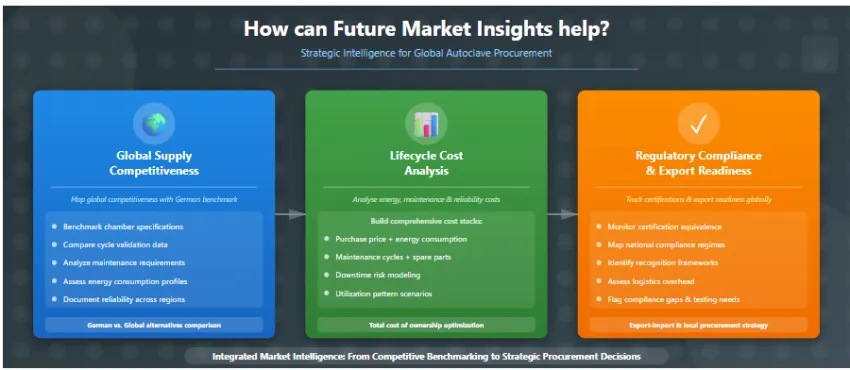
How can Future Market Insights help?
Sources
- German OEMs' annual and product specification disclosures: Capabilities, manufacturing standards and product lines from company documentation and technical literature
- European medical device and sterilization equipment standards documentation: Regulatory, safety and certification requirements from EN standards and MDR directives
- German hospital procurement and health-system statistics: Domestic adoption density and demand scale from health ministry data and hospital association publications
- Industry engineering publications on pressure-vessel fabrication and stainless-steel welding in Europe: Material and quality engineering context from technical journals and standards bodies
- Business and trade media reports on export volumes and global supply chains of European sterilization equipment: Export-readiness and global competitiveness evidence from Reuters, specialized medical equipment trade publications

