


Key Takeaways
- Floral Extract leadership is defined by extraction and formulation capability, not farm origin
- Scale in concretes and absolutes processing determines cost and consistency
- Global sourcing networks stabilise supply of volatile floral raw materials
- Integration with fragrance and personal care formulation creates pricing power
- Regulatory and quality assurance systems act as barriers to entry
The global floral extracts industry represents a concentrated segment within the broader flavors and fragrances sector, which reached approximately 40 billion euros in 2023. Despite widespread cultivation of roses, jasmine, tuberose, and other aromatic flowers across dozens of countries, value capture in floral extracts remains dominated by a small group of global fragrance houses. Givaudan, Symrise, Firmenich, and IFF collectively control an estimated 40 to 45 percent of the floral extract segment, a concentration that persists despite low barriers to flower cultivation and the availability of basic extraction equipment.
This concentration reveals a fundamental characteristic of the floral extracts business: leadership derives not from proximity to flower fields but from mastery of extraction technology, management of complex global sourcing networks, and integration with downstream fragrance formulation platforms. Companies such as Givaudan maintain leadership through capital-intensive processing facilities, multi-decade relationships with consumer brands, and proprietary fragrance bases that embed floral extracts into formulations with high switching costs. Understanding why regional flower producers struggle to capture comparable value requires examining the technical, commercial, and strategic factors that separate flower cultivation from profitable floral extract operations.
Why is leadership in Floral Extracts concentrated among global fragrance houses?
Leadership in floral extracts concentrates among global fragrance companies because the business requires capital intensity, quality consistency, regulatory compliance capability, and long-term customer relationships that smaller producers cannot replicate. The extraction of commercial-grade absolutes and concretes from flowers demands specialized equipment, process control systems, and quality assurance protocols that represent capital investments of USD 5 million to USD 50 million per facility depending on scale and automation level.
Solvent extraction facilities require explosion-proof construction, solvent recovery systems, vacuum processing equipment, and environmental controls that meet stringent safety and environmental regulations across multiple jurisdictions. Givaudan operates extraction facilities in France, Switzerland, India, and other locations with full regulatory compliance, traceability systems, and quality certifications including ISO 9001, ISO 14001, and regional fragrance industry standards. These facilities process hundreds of metric tons of floral material annually with batch-to-batch consistency requirements measured in parts per million for key aroma compounds.
Quality consistency represents a non-negotiable requirement for consumer brand customers who demand identical fragrance profiles across millions of product units manufactured over multiple years. Rose absolute used in a prestige perfume must deliver the same aroma intensity and character whether extracted from Bulgarian roses in June 2023 or Turkish roses in May 2024. Achieving this consistency requires analytical capabilities including gas chromatography-mass spectrometry, sensory evaluation panels, and statistical process control that most regional producers lack.
Long-term customer relationships create additional barriers. Major consumer brands in personal care, fine fragrance, and household products work with fragrance houses on multi-year product development cycles. A new prestige fragrance may require 18 to 36 months from concept to launch, with fragrance formulation, stability testing, regulatory approval, and scale-up manufacturing. Switching fragrance suppliers mid-development or post-launch risks reformulation costs, regulatory re-approval, and consumer rejection. These relationships, often spanning decades, provide global fragrance houses with predictable demand and justify ongoing investment in extraction capacity and innovation.
How does extraction technology differentiate leaders such as Givaudan from smaller producers?
Extraction technology differentiates industry leaders through yield optimization, aroma preservation, batch consistency, and process efficiency that directly impact cost competitiveness and product quality. The production of floral absolutes follows a two-stage process: initial solvent extraction produces concrete, followed by ethanol extraction and vacuum distillation to yield the final absolute. Each stage presents technical challenges where advanced equipment and process control deliver measurable advantages.
Solvent extraction using hexane or other organic solvents must maximize yield while minimizing degradation of heat-sensitive aroma compounds. Industrial extraction systems employ temperature-controlled vessels, automated solvent addition, and optimized extraction times calibrated for specific flower types and harvest conditions. Rose concrete extraction yields typically range from 0.2 to 0.4 percent of fresh flower weight. A facility processing 100 metric tons of roses annually that achieves 0.35 percent yield versus 0.25 percent yield captures an additional 100 kilograms of concrete worth USD 50,000 to USD 100,000 at wholesale pricing.
Supercritical CO2 extraction represents an advanced alternative gaining adoption among leading producers. This technology uses carbon dioxide at temperatures around 31 degrees Celsius and pressures above 73 bar, where CO2 exhibits both liquid and gas properties enabling selective extraction of aromatic compounds. The November 2024 acquisition of Phasex by Robertet, a leading natural ingredient supplier, demonstrates industry investment in supercritical technology. Supercritical CO2 extraction eliminates solvent residues, preserves heat-sensitive compounds, and produces extracts that command premium pricing in natural and clean-label applications. However, capital costs for supercritical systems reach USD 2 million to USD 10 million per unit, limiting adoption to companies with scale and technical expertise.
Aroma preservation during processing determines final product quality and pricing. Traditional steam distillation, while suitable for essential oil production from robust materials like lavender, destroys delicate floral compounds through heat exposure. Vacuum distillation at reduced pressures and temperatures preserves volatile top notes and maintains the full aroma profile of jasmine, tuberose, and other delicate flowers. Leaders invest in multi-stage vacuum systems with precise temperature control and inert atmosphere processing that regional producers using simpler equipment cannot match.
Batch consistency across varying raw material quality represents another critical differentiator. Flower composition varies by variety, growing conditions, harvest timing, and post-harvest handling. A batch of jasmine harvested during optimal morning hours in southern India contains different concentrations of key aroma compounds than flowers picked in afternoon heat. Advanced producers employ real-time analytical monitoring, blending protocols, and standardization techniques to deliver consistent absolutes despite raw material variation. This capability justifies premium pricing and maintains customer loyalty.
Why does global sourcing control matter more than proximity to flower cultivation?
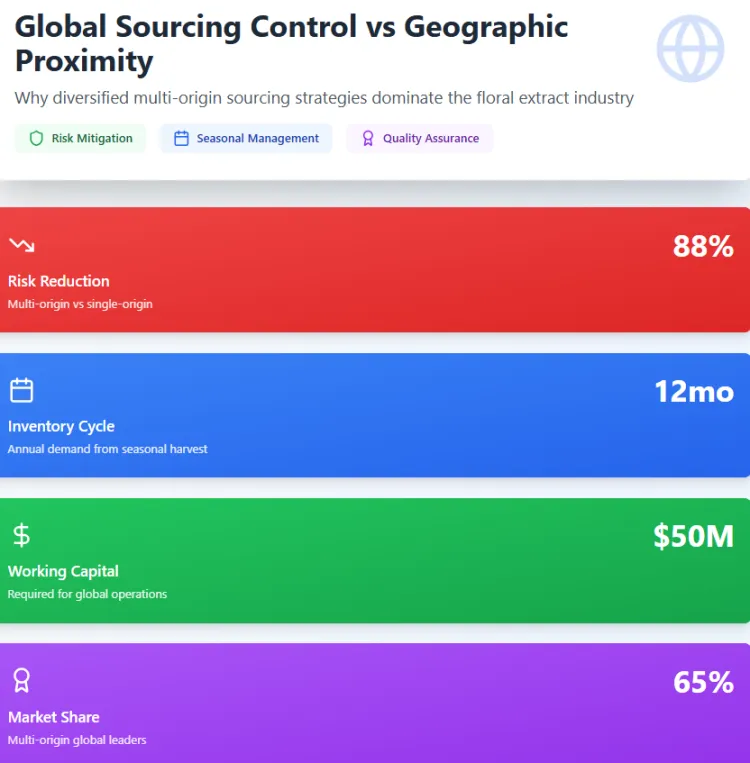
Global sourcing control matters more than geographic proximity because floral raw materials face seasonality, weather risk, political instability, and quality variation that require diversified multi-origin sourcing strategies. Rose cultivation occurs across Bulgaria, Turkey, Morocco, India, and other regions with harvest windows spanning April through June depending on location and climate. A fragrance house relying on single-origin sourcing faces supply disruption if weather, political events, or crop failures affect that region.
Givaudan, Symrise, and other leaders maintain sourcing relationships across multiple continents with qualification systems that assess grower practices, post-harvest handling, and quality metrics. These networks enable supply continuity when individual origins face disruptions. When drought reduced Bulgarian rose yields in certain years, diversified sourcing from Turkish and Moroccan growers maintained supply continuity. This geographic risk management capability justifies the premium pricing and customer loyalty that global producers command.
Seasonality in floral raw materials creates inventory management challenges that favor companies with capital resources and storage infrastructure. Jasmine grandiflorum harvested in India during August through October must supply global demand for twelve months. Proper storage of floral concretes and absolutes requires temperature control, inert atmosphere, and quality monitoring to prevent oxidation and aroma degradation. A company maintaining USD 10 million to USD 50 million in floral extract inventory requires working capital and storage facilities that regional producers struggle to finance.
Supplier qualification and relationship management represents another dimension of sourcing control. Leading fragrance houses employ agricultural specialists who work with grower cooperatives on cultivation practices, harvest timing, and post-harvest handling that optimize aroma quality. These relationships, developed over decades, provide access to premium flower lots and priority allocation during shortage periods. A regional producer entering the supply chain lacks these relationships and receives lower-quality material at higher prices.
Traceability and sustainability certification increasingly influence sourcing decisions as consumer brands demand transparency. Givaudan implements responsible sourcing programs that track flower origins, assess environmental and social practices, and provide certification for marketing claims. The company partners with grower communities on sustainable agriculture, fair labor practices, and biodiversity protection. These programs require investment in auditing systems, community development, and supply chain documentation that smaller competitors cannot replicate but that major customers increasingly require.
How does formulation integration reinforce leadership in Floral Extracts?
Formulation integration reinforces leadership by embedding floral extracts into proprietary fragrance bases, cosmetic actives, and flavor systems that create customer switching costs and capture value beyond ingredient pricing. When Givaudan develops a rose-based fragrance accord for a prestige perfume, the specific combination of rose absolute, synthetic rose compounds, and supporting ingredients becomes proprietary intellectual property. Reformulating this accord with different rose absolute from an alternative supplier risks altering the fragrance profile, requiring re-evaluation by perfumers, stability testing, regulatory review, and potential consumer rejection.
Fragrance bases represent pre-formulated ingredient combinations that perfumers use as building blocks for finished fragrances. A floral base might combine jasmine absolute, rose absolute, orange flower absolute, and supporting synthetic compounds in a proprietary blend optimized for specific applications. These bases carry trade names, maintain consistent quality across production lots, and become specified in fragrance formulations by name. A customer using a specific floral base across multiple product lines faces significant reformulation costs and risks if switching to alternative suppliers.
The integration extends into cosmetic actives and functional ingredients. Givaudan develops floral extracts not merely for aroma but for claimed skin benefits, mood enhancement, and other functional properties. The [N.A.S.]™ Vibrant Collection launched in 2024 exemplifies this approach, offering botanical extracts including gardenia and curcuma with documented antioxidant properties and skin benefits for hybrid makeup formulations. Similarly, Symrise develops Actimood® technology incorporating floral extracts that claim neurocosmetic effects. These value-added formulations command premium pricing and create dependencies where the extract becomes secondary to the functional claim and supporting documentation.
Brand partnerships and co-development agreements further reinforce integration advantages. When a fragrance house develops a signature scent for a luxury brand through multi-year collaboration, the relationship encompasses not just ingredient supply but creative direction, regulatory support, supply chain management, and marketing collaboration. The floral extracts used become embedded in a broader service relationship with switching costs far exceeding ingredient pricing considerations.
Technical service and application support represent additional integration elements. Fragrance houses employ application specialists who assist customers with fragrance incorporation, stability optimization, and regulatory compliance. This technical support creates ongoing touchpoints and relationships that independent ingredient suppliers cannot provide. A formulary chemist developing a new body lotion receives not just rose absolute but guidance on optimal usage levels, compatibility with other ingredients, stability under various conditions, and regulatory documentation for submissions to authorities.
Why do regional extract producers struggle to capture the same value as global leaders?
Regional extract producers struggle to capture comparable value because they lack downstream integration, face customer concentration risk, suffer pricing pressure, and shoulder disproportionate regulatory burdens. A regional producer extracting rose absolute in Bulgaria or jasmine concrete in India typically operates as a raw material supplier to global fragrance houses or independent perfumery houses. This positioning captures margins of 10 to 30 percent on ingredient sales but foregoes the 40 to 60 percent margins available in formulated fragrances and finished consumer products.
Customer concentration creates pricing pressure and negotiating disadvantage. A regional producer selling 70 to 90 percent of output to two or three major fragrance houses faces limited pricing power. The buyers possess market knowledge, alternative suppliers, and purchasing volumes that enable aggressive price negotiations. When raw material costs increase, regional producers struggle to pass costs through, compressing margins. Conversely, when raw material costs decline, buyers demand immediate price reductions while producers carry inventory purchased at higher costs.
Limited product diversification increases exposure to commodity pricing dynamics. Regional producers focus on one or two floral extracts reflecting local cultivation. A Bulgarian producer specializing in rose absolute faces full exposure to rose market dynamics without the diversification across multiple florals, synthetics, and formulated products that global houses maintain. Poor rose harvests or demand shifts for rose-based fragrances directly impact revenue without offsetting growth in other product lines.
Regulatory compliance costs represent disproportionate burdens for smaller operations. Food and cosmetic regulations in the European Union, United States, and other major consumer regions require extensive documentation, testing, and registration. The costs of maintaining REACH registration in the EU, TSCA compliance in the US, or cosmetic ingredient approvals spread across larger sales volumes deliver per-unit cost advantages to global producers. A regional producer selling USD 5 million annually in floral extracts faces the same regulatory documentation requirements as a global house selling USD 500 million, creating a 100-fold disadvantage in compliance cost per sales dollar.
Quality assurance and analytical capabilities present additional scaling challenges. Consumer brand customers require certificate of analysis documentation, batch testing, and traceability for every ingredient lot. Maintaining gas chromatography-mass spectrometry equipment, training analytical chemists, and operating quality management systems conforming to ISO standards requires ongoing investment that becomes economically viable only at significant scale. Regional producers often lack in-house analytical capabilities and depend on external laboratories, increasing costs and lead times while reducing responsiveness.
Market access and customer relationship development favor established global players. Entering supply chains of major consumer brands requires extensive qualification processes, trial periods, and relationship building that span months or years. Even after qualification, regional producers compete on price rather than value-added services, technical support, or co-development capabilities. The inability to offer integrated solutions limits growth opportunities and relegates regional producers to commodity supplier status.
How Future Market Insights Can Help
Sources
- Givaudan SA. (2023-2024). Annual Reports, Financial Disclosures, and Product Innovation Documentation. Corporate reporting on CHF 6.9 billion sales, Fragrance & Beauty division performance, botanical extraction acquisitions, natural ingredient portfolio expansion including [N.A.S.]™ Vibrant Collection, and biodegradable floral molecules launches.
- Robertet Group. (November 2024). Acquisition of Phasex Corporation: Supercritical CO₂ Extraction Technology. Strategic acquisition announcement for Massachusetts-based supercritical fluid extraction pioneer enabling high-purity aromatic compound extraction and sustainable natural ingredient production.
- Symrise AG. (2023-2024). Annual Financial Reports and Natural Raw Material Expansion. EUR 4.7 billion sales reporting, organic growth performance, natural floral extract portfolio expansion including Flowerconcentrole® range, Actimood® functional fragrance technology, and captive molecule launches including Salyssia for floral applications.

