


Key Takeaways
- Heat sealing value is defined by seal integrity, not machine price
- Material seal windows dictate process stability and scrap rates
- Higher line speeds narrow tolerance margins for seal consistency
- Seal failure creates downstream recall and compliance risk
- Process control capability drives total cost of ownership
How does material selection determine heat sealing performance?
Heat sealing performance begins with polymer behavior under thermal and mechanical stress. Different polymers exhibit distinct crystallinity levels and melting characteristics that define their sealing response. Polyethylene variants, polypropylene films, and polyester structures each present unique melting points, viscosity curves, and adhesion properties when subjected to heat and pressure.
Polymer crystallinity directly influences seal formation. Highly crystalline materials require higher temperatures to achieve molecular mobility, while amorphous regions soften at lower thresholds. This creates a temperature range within which effective sealing occurs without material degradation or incomplete fusion. Materials with sharp melting transitions offer narrower process windows compared to those with gradual softening behavior.
Multilayer film structures add complexity to sealing dynamics. Coextruded films combine barrier layers, structural layers, and sealant layers in a single construction. The sealant layer composition governs seal formation, but heat must transfer through outer layers without compromising their function. Adhesive-laminated structures present additional variables, as adhesive thermal stability and layer separation risks must be managed during sealing.
Dwell time, the duration heat and pressure are applied, interacts with material properties to determine seal quality. Thicker films require longer dwell times to achieve adequate heat penetration and molecular diffusion across seal interfaces. Pressure distribution affects contact uniformity, influencing how effectively heat transfers and how consistently polymer chains intermingle to form cohesive bonds.
Material selection establishes the foundation for sealing success. Films with wide seal windows and forgiving thermal behavior enable stable production, while materials with narrow operating ranges demand precise control and create vulnerability to process variation.
Why is seal window width critical to line efficiency and scrap control?

The seal window defines the temperature range within which acceptable seals form consistently. Wide seal windows provide operational flexibility, allowing temperature variation without immediate quality degradation. Narrow seal windows create fragility, where small deviations produce weak seals, incomplete fusion, or thermal damage.
Temperature sensitivity varies among polymer families and film constructions. Some sealant formulations tolerate 15 to 20 degree Celsius ranges while maintaining strength and hermetic integrity. Others exhibit acceptable performance across only 5 to 10 degree spans. This difference becomes critical when ambient conditions fluctuate, when material lots vary, or when equipment exhibits temperature drift.
Narrow seal windows amplify scrap rates during production transitions. Start-up periods, material changeovers, and equipment adjustments increase the likelihood of operating outside optimal parameters. Each rejected package represents material waste, labor cost, and throughput loss. In high-volume operations, even modest scrap percentages translate into substantial annual costs.
Process variability compounds seal window challenges. Heating element aging, cooling system performance, and mechanical wear introduce temperature inconsistencies across seal bars or rotary tooling. Material thickness variation, moisture content differences, and surface contamination further narrow effective operating ranges. Operations relying on materials with inherently narrow seal windows face constant risk of quality excursions.
Line efficiency depends on maintaining consistent output within specification. Wide seal windows buffer against normal process variation, reducing operator intervention and adjustment frequency. Narrow seal windows demand continuous monitoring, frequent validation checks, and rapid response to deviations, increasing labor requirements and reducing sustainable line speeds.
How do line speed and throughput requirements constrain heat sealing design?
Line speed directly determines available dwell time for seal formation. As throughput increases, the time each seal spends in contact with heating elements decreases proportionally. Rotary sealing systems on form-fill-seal equipment or flow wrappers must complete heat transfer and cooling within milliseconds at modern production rates.
Reduced dwell time demands higher heat flux to achieve adequate seal temperature within available contact duration. However, aggressive heating risks surface scorching, sealant layer degradation, or heat penetration beyond intended zones. Balancing rapid heat delivery with material integrity becomes increasingly difficult as speeds escalate.
Pressure uniformity challenges intensify at high speeds. Dynamic sealing systems must maintain consistent jaw force or roller pressure while components move continuously. Mechanical deflection, vibration, and alignment variation introduce pressure inconsistencies that compromise seal quality when combined with minimal dwell time.
Small process deviations magnify at elevated speeds. A temperature variation that produces minimal effect at 30 cycles per minute may cause systematic seal failure at 120 cycles per minute. The reduced thermal margin available during brief contact periods leaves no buffer for fluctuation. Equipment precision requirements increase exponentially with speed targets.
Throughput demands often conflict with process capability. Operations seeking maximum output may push equipment beyond the speed where reliable sealing occurs for specific material combinations. The resulting quality issues, unplanned downtime for adjustment, and increased reject rates can negate theoretical capacity gains.
Why does seal integrity carry regulatory and liability implications?
Seal integrity serves as the primary barrier protecting package contents from contamination, moisture ingress, and oxygen exposure. In food packaging, seal failure enables microbial contamination, accelerated spoilage, and potential foodborne illness. A compromised seal on a shelf-stable product can allow pathogen growth in supposedly safe food.
Medical device and pharmaceutical packaging face stringent validation requirements. Sterile barrier systems must maintain sterility throughout distribution and storage until point of use. Seal strength testing, dye penetration studies, and accelerated aging protocols verify that seals withstand handling stresses and environmental exposure. Validation documentation must demonstrate consistent seal performance across production lots.
Regulatory frameworks impose specific seal integrity standards. FDA guidance for medical device packaging, EU regulations for food contact materials, and industry standards like ASTM F88 establish testing methodologies and acceptance criteria. Non-compliance creates approval delays, product holds, and enforcement actions.
Seal failure downstream triggers recall exposure. A single batch of defective seals can necessitate removing thousands or millions of units from distribution. Recall costs include product retrieval, customer notification, disposal, investigation, and reputation damage. For low-margin products, a significant recall can eliminate years of profit.
Liability extends beyond immediate recall costs. If seal failure causes consumer harm, manufacturers face legal action, regulatory scrutiny, and long-term credibility loss. The cost differential between reliable sealing systems and marginal equipment pales against potential liability exposure.
How do process control and validation differentiate heat sealing capability?
Temperature control precision separates functional sealing equipment from systems capable of validated, repeatable performance. Basic sealing devices use simple thermostats with wide dead bands and slow response times. Advanced systems employ PID controllers, multiple temperature zones, and real-time monitoring with sub-degree accuracy.
Pressure monitoring and verification ensure consistent seal formation. Force transducers, pneumatic pressure sensors, or hydraulic pressure gauges provide feedback confirming that specified compression is achieved during each cycle. Systems lacking pressure verification cannot detect worn tooling, air pressure loss, or mechanical drift that compromises sealing effectiveness.
Data logging capabilities support validation and troubleshooting. Recording temperature, pressure, dwell time, and cycle count for each seal or production run creates traceable documentation. When quality issues emerge, logged data enables root cause analysis and corrective action verification. Regulated industries require this documentation to demonstrate process control.
Validation protocols establish baseline performance and detect process drift. Initial qualification studies characterize seal strength across the operating range and define control limits. Ongoing validation verifies continued capability through periodic testing and statistical process control. Equipment must provide the stability and repeatability necessary to maintain validated status.
Alarm systems and interlocks prevent operation outside established parameters. Temperature excursions, pressure loss, or speed variations should trigger automatic responses that halt production or flag affected units. Without these safeguards, defective product may enter distribution undetected.
Process control capabilities determine whether sealing operations achieve consistent quality or generate sporadic failures. The investment in control systems, monitoring instrumentation, and validation support delivers reliability that protects product integrity and minimizes total operational cost.
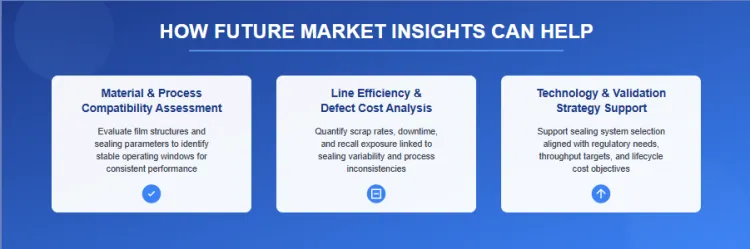
How Future Market Insights Can Help?
Sources
- European Committee for Standardization. EN ISO 11607-1:2020 - Packaging for Terminally Sterilized Medical Devices - Part 1: Requirements for Materials, Sterile Barrier Systems and Packaging Systems. Brussels: CEN.
- Flexible Packaging Association. Guidelines for Heat Seal Validation and Testing. Annapolis, MD: FPA Technical Committee Publications.

