


Key Takeaways
- On paper, more than 95 percent of Indian households now have access to improved drinking water sources, but access to any form of household water treatment is far more uneven and strongly correlated with wealth and urban residence. This gap between infrastructure and perceived safety is the space where point of use purifiers sit.
- Survey work using NFHS data and follow up studies shows that education, housing quality and non-poor status significantly raise the odds that a household treats its water, which means POU devices naturally skew toward the middle and upper middle class, not just the very rich.
- For most buyers, the trigger is not a laboratory test but a cluster of fear signals: repeated stomach infections in the family, worrying news about contamination, doctors telling patients to avoid local tap or borewell water, and visible monsoon time turbidity. Academic work on domestic purifier choice in India consistently finds health concern as the primary stated driver, with taste and odour as secondary factors.
- Trust substitutes for direct knowledge of water chemistry. Households lean on brand reputation, perceived alignment with standards such as BIS norms, neighbour and doctor recommendations, and expectations about after sales service. In studies of domestic purifier choice, brand trust and service quality routinely rank alongside price as key decision attributes.
How safe does drinking water look on paper, and why are households still anxious?
National survey data makes India’s water access story look far more reassuring than the lived experience of many urban families. NFHS 5 shows that roughly 96 percent of households report using an improved drinking water source, and a large majority can reach that source within five minutes. Yet the same work also notes that access to any kind of water treatment remains patchy, with several large states reporting that fewer than half of households treat water before drinking it. Two gaps keep anxiety alive even when taps are technically improved. First, improved is not the same as safely managed.
Intermittent supply, leaky distribution networks, cross contamination with sewage and poorly maintained overhead tanks all undermine trust in the last few metres before the kitchen tap. Evaluations around Jal Jeevan Mission investments have repeatedly highlighted that quality, reliability and pressure still vary sharply by state and district, even where infrastructure roll out is on track. Second, risk is not experienced as average national probability. It is filtered through stories.
A neighbour’s child with repeated diarrhoea, a relative in another city dealing with fluoride or arsenic issues, or local media reporting on contamination incidents anchor the way people think about their own water, even where local test reports are acceptable. In that mental landscape, a purifier is not just an appliance; it is a way to resolve a nagging dissonance between what official data says and what anecdote and experience suggest.
What does fear actually look like in the POU purifier buying journey?
In household interviews and consumer studies, the journey to buying a purifier rarely begins with a spreadsheet. It usually begins with discomfort or fear. Typical triggers include a run of gastrointestinal illnesses in the family, a doctor who casually advises patients to avoid tap water, a new baby in the house, a move from one city to another with an unfamiliar supply, or visible deterioration in taste and smell during summer and monsoon. Studies of domestic purifier buyers in Indian cities and small towns consistently report health protection as the first named motive, especially protection of children and elderly members. Fear here is less about known contaminants and more about unknown ones.
Most buyers cannot meaningfully distinguish between microbial risk, nitrate contamination, pesticide residue and TDS. They tend to over bundle these into a single idea of bad water and reach for the most comprehensive seeming solution. Marketing around RO and multi stage systems has amplified that tendency by framing visible technology complexity as equivalent to safety, even where simpler technologies would be sufficient for the actual water quality profile.
Independent commentators and environmental groups have argued that this has helped normalise unnecessary RO use in low TDS areas, with wasted water and demineralisation as side effects. The important point is that fear is sticky. Once a household has internalised that their source is unsafe, it is difficult for them to walk back from that belief even if municipal upgrades improve quality. The purifier becomes part of the household’s mental model of what a responsible family does.
How does trust shape technology and brand choices?
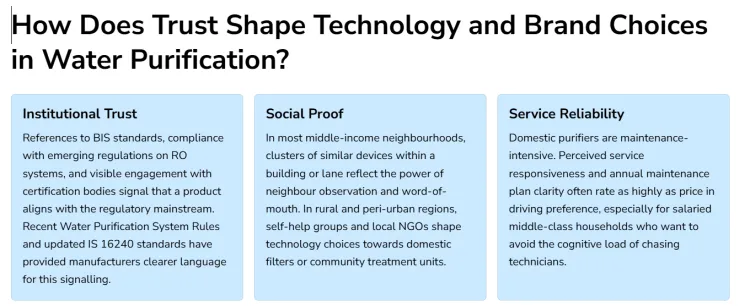
Because households cannot personally verify microbiological safety every day, they rely on proxies. Academic work on domestic purifier choice in India highlights three clusters of trust proxies. First is institutional trust. References to BIS standards, mentions of compliance with emerging rules on RO systems, and visible engagement with certification bodies all function as signals that a product is aligned with the regulatory mainstream. The recent Water Purification System (Regulation of Use) Rules and the updated IS 16240 standard for reverse osmosis based point of use systems have given manufacturers a clearer language for this signalling, and households increasingly encounter these references in product literature.
In most middle income neighbourhoods, it is common to see clusters of similar devices within a building or lane, reflecting the power of neighbour observation and word of mouth. In some rural and peri urban regions, studies point to the role of self help groups and local NGOs in shaping technology choices, whether toward domestic filters or community treatment units. Domestic purifiers are maintenance intensive. Filters need replacement, RO membranes have finite life, and faults can quickly undermine perceived safety.
In research on consumer attributes, perceived service responsiveness and annual maintenance plan clarity often rate as highly as price in driving preference, especially for salaried middle class households who do not want the cognitive load of chasing technicians. This combination makes the market structurally conservative. Once a brand has established itself as the safe choice in a given social circle, shifting households toward alternative technologies such as UV, UF or community kiosks is hard even if the objective water profile would support it.
How does EMI math turn fear into a mass middle class product?
List prices for branded multi stage POU purifiers typically sit in the ten to twenty thousand rupee range, higher for premium models. For many urban and lower tier city households, that is a non trivial capital outlay. What brings this into reach is not just income growth but the reframing of ownership into monthly commitments. Non bank finance companies, banks and retailer finance schemes have normalised no cost or low cost EMIs for durables. Water purifiers sit inside the same mental bucket as televisions and refrigerators.
For a salaried household already servicing EMIs on a two wheeler, smartphone and sometimes education, adding another few hundred or a thousand rupees per month is easier to process than writing a single large cheque. The decision is rarely done with a formal net present value calculation. It is done with what could be called EMI math. Families compare the monthly outgo to other recurring expenses that feel less negotiable, such as school tuition, mobile data, gas cylinders or streaming subscriptions.
In that comparison, the combination of health risk framing and low per month headline makes a purifier look like a prudent trade off, especially after a health scare. For lower middle income households, the same EMI logic can backfire. Missed payments risk default, and ongoing cartridge replacement costs can feel like a second hidden EMI. In those segments, cheaper gravity based filters, boiling and sachet water often remain the default, and the POU market penetrates more slowly.
How does demand really split by income and risk profile?
Bringing these drivers together, the market does not split neatly into rich users and poor non users. It is more granular. At the top end, affluent urban households often layer multiple solutions. They may live in gated communities with treated centralized supply and still use under sink RO units and bottled water for guests. For them, the purifier is a near automatic purchase, part of a broader basket of comfort and status goods. The broad urban middle class, especially salaried families in formal housing, is the real engine of the domestic POU market. This group is large enough to matter, sensitive to both health risk narratives and EMI offers, and capable of paying for annual maintenance when framed as protection for children and parents.
Their dwellings usually have stable electricity and space under the sink or on a wall, which lowers installation friction. Lower middle income households, in dense rental housing or informal settlements, may face worse objective water risk but lack the ability or willingness to commit to device plus maintenance. Where they adopt POU devices, it is often after local NGOs, microfinance groups or government schemes lower the upfront cost or provide community level units.
In rural areas, evidence shows a mix of approaches. Some better off households adopt domestic filters or RO units, particularly in regions with high salinity or fluoride. Many others rely on handpumps, boiling or simple filtration. Here, fear and trust still matter, but constraints are physical and institutional: power reliability, product availability, service reach and competing investment priorities in agriculture or housing.
How Future Market Insights can help
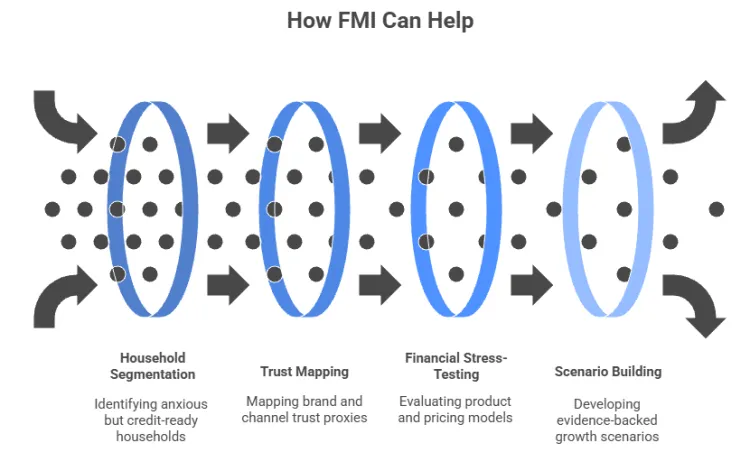
Future Market Insights can help companies, investors and policymakers get past generic narratives about unsafe water and focus on the actual structure of Indian POU demand. This includes:
Building income, geography and housing based demand maps that link NFHS, census and programme data on water access with consumer research on purifier ownership and usage.
Segmenting households not only by income but by fear triggers, trust anchors and credit behaviour to distinguish high fear high ability to pay segments from households that need different models such as community systems or pay per use kiosks.
Analysing how emerging rules on RO usage, reject water management and labelling will reshape product portfolios, price points and channel strategies across states and city tiers.
Quantifying the long run economics of different technology mixes under realistic service and maintenance patterns, rather than idealised laboratory performance, and linking this to lifetime ownership cost for different household cohorts.
Supporting regulators and development partners with evidence on where subsidies, microfinance or community models are more appropriate than individual device finance, given the distribution of risk and ability to pay.
The aim is to treat water purifiers not as a generic consumer durable, but as a risk management instrument whose adoption depends on a specific combination of anxiety, social proof and monthly affordability in each micro market.
Sources
- Progress and determinants of household access to improved drinking water in India using a Water Access Index, analysis of NFHS 1 to NFHS 5, BMJ Open, 2024.
- National Family Health Survey 5, India, 2019 to 2021, Ministry of Health and Family Welfare and IIPS.
- Jal Jeevan Mission health and economic gains of safely managed drinking water, Government of India and partner institutions.
- Future of domestic water purifiers in the Indian market and related studies on consumer behaviour attributes for domestic water purifiers in West Bengal, 2024 and 2025, peer reviewed articles accessible via ResearchGate.
- Point of use water purification for rural households in India, Applied Water Science and related journals on technology selection in low resource settings.
- Ban on RO water purifiers and Water Purification System Regulation of Use Rules 2023, Ministry of Environment, Forest and Climate Change, Government of India, including BIS standard IS 16240 2023 for reverse osmosis based point of use systems.

