

- Industry Size (2026)
- USD 48.76 Bn
- Forecast (2036)
- USD 304.44 Bn
- CAGR (2026 to 2036)
- 20.1%
3D Printing Market Size, Market Forecast and Outlook By FMI
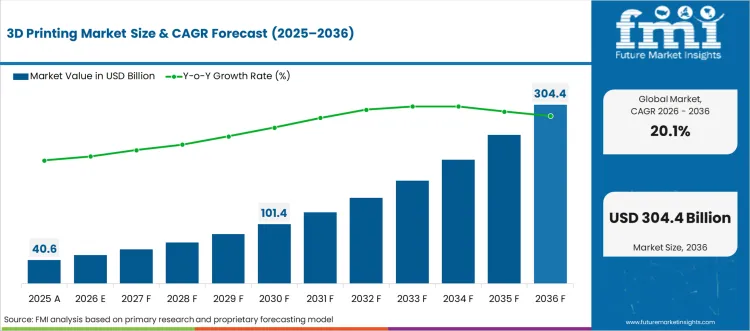
3D printing market is expected to expand from USD 48.76 billion in 2026 to USD 304.44 billion by 2036. The market is anticipated to register a 20.1% CAGR during the forecast period. 3D printers are likely to lead with a 47.1% component share, while production parts are projected to account for 47.8% of application demand in 2026.
Summary of the 3D Printing Market
- Demand and Growth Drivers
- Production-grade adoption is rising across aerospace and medical device manufacturing.
- Manufacturers are using additive methods for complex and customized components.
- Wider material availability is opening new use cases for regulated industries.
- Software integration is helping companies move from prototypes to repeat production.
- Product and Segment View
- 3D printers lead as manufacturers build internal additive capacity.
- Digital Light Processing gains from speed and high-resolution polymer production.
- Production parts now represent the strongest application area.
- Services remain important for companies without full in-house printing capacity.
- Geography and Competitive Outlook
- China leads growth through state-backed manufacturing modernization.
- India is gaining traction through automotive and healthcare adoption.
- Germany benefits from industrial equipment expertise and automotive demand.
- Competition depends on printer platforms, material validation, and workflow software.
- Analyst Opinion
- Sudip saha,Principal Consultant for Technology at Future Market Insights, opines, “3D printing has moved beyond prototype use and is becoming part of production planning. Manufacturers now assess quality monitoring, material validation, and workflow integration before scaling additive systems. Vendors that offer complete production support will gain stronger enterprise adoption than suppliers focused only on printer sales.”
- 3D Printing Market Value Analysis
- 3D printing is moving from design testing into production-grade manufacturing.
- Demand is likely to rise as regulated sectors qualify more end-use parts.
- Adoption is supported by better materials and stronger quality assurance systems.
- Spending is backed by hardware expansion, software integration, and contract printing services.
Key Takeaways, Market Size, and Forecast
- 3D printing market is valued at USD 48.76 billion in 2026.
- Market revenue is forecast to attain USD 304.44 billion by 2036.
- Demand is anticipated to rise at 20.1% CAGR during 2026 to 2036.
- 3D printers are likely to lead the component segment with 47.1% share in 2026.
- Digital Light Processing is expected to hold 32.6% share by technology in 2026.
- Production parts are projected to account for 47.8% of application demand in 2026.
- China is forecast to post the fastest country-level growth at 27.1% CAGR through 2036.
- India follows with 25.1% CAGR, supported by manufacturing modernization.
3D Printing Market Definition
The 3D printing market covers the full additive manufacturing ecosystem including hardware (printers and accessories), software (design, simulation, and production management), services (contract printing, consulting, and support), and associated materials. Additive manufacturing builds three-dimensional objects layer by layer from digital models, using technologies such as fused deposition modelling, stereolithography, selective laser sintering, and direct metal laser sintering. The market serves aerospace, automotive, healthcare, consumer goods, and industrial manufacturing sectors.
3D Printing Market Inclusions
Market scope includes industrial and professional-grade 3D printers across all technology platforms, printing materials, design and production software, and contract manufacturing services. All application categories including production parts, prototypes, and tools and fixtures are covered. Regional and country-level market sizes and forecast projections from 2026 to 2036 are included.
3D Printing Market Exclusions
The scope excludes consumer-grade desktop 3D printers for personal use, conventional subtractive manufacturing equipment including CNC machines and lathes, traditional injection moulding tooling, and casting equipment. Raw material mining and primary material processing are excluded from the valuation.
3D Printing Market Research Methodology
- Primary Research: Analysts conducted interviews with manufacturing technology directors, additive production managers, equipment procurement leads, and materials engineers across aerospace, automotive, healthcare, and industrial sectors in seven countries.
- Desk Research: Data collection aggregated equipment shipment registries, published patent filing trends, regulatory clearance databases for 3D-printed parts, and industry association production volume statistics.
- Market-Sizing and Forecasting: Baseline values derive from a bottom-up aggregation of equipment revenues, material consumption volumes, software licence values, and service contract spend, applying sector-specific adoption curves to project market value through 2036.
- Data Validation and Update Cycle: Projections are cross-verified against publicly reported quarterly revenues from leading 3D printing companies and equipment shipment data published by industry trade associations.
What is the Future of the Global 3D Printing Market?
Global exports of 3D printers were figured out to 40.6 million units in the year 2025, and by 2035, it is anticipated to reach 25 million.
Mixed-material printers are becoming widespread and strengthening the 3D printing business, for their applicability in several end-use verticals.
Modeling, prototyping, and forging are some of the popular industrial applications that are driving the 3D printing market opportunities across various industry verticals. Moreover, technical training and studies academic institutions, and research centers are also adopting flash forge 3D printers, which are propelling the market.
What are the Existing Challenges for the 3D Printing Market's Future Trends?
The installation and maintenance cost of the prototypes is the key challenge for the 3D printing market growth as pointed out by many industry experts. Instead of attempting to comprehend the cost expenditure benefits of prototypes, businesses engaged in the design, particularly small and medium-sized businesses, are hesitating for investing in 3D printers for sale.
The adoption of 3D printing is being hampered by the widespread assumptions that small and medium-sized firms have about additive manufacturing procedures. In addition, a lack of technical expertise and know-how and an impending lack of standardized quality control measures, are anticipated to restrain the 3D printing industry expansion.
Category-wise Insights for the 3D Printing Market
Which is the Leading Selling Product Type in the Global 3D Printing Market?
By occupying more than 52% of the worldwide revenue in 2026, the hardware segment dominates the global 3D printing market. This segment, which is worth around USD 40.6 billion in the current year 2026, has been further divided into industrial and desktop 3D printers based on the kind of printer.
The widespread use of industrial printers in heavy sectors including automobile components, electronic items, engineering, and military is the primary cause of the industrial 3D printer market's sizeable share.
Research Scholars and small businesses were the only ones that use to employ desktop 3D printers at first. They are currently being utilized hugely for personal and domestic tasks making them emerging as a notable segment for the 3D printing market players across the world.
Interestingly, 3D printing services are the second large segment of the market based on components. The net worth of this segment stands at USD 9 billion for the year 2026.
The growing trend of establishing small-scale businesses for such services is anticipated to drive the growth of this segment at a rate of 22.7% during the forecast years. On the other hand, the contribution of 3D printing software, consulting, and support services segments has remained marginal in the overall market. With the growing popularity and sales of 3D printers, these segments are expected to gain momentum in the coming years.
Which are the Most Preferred Technology Segments of the Global 3D Printing Market?
As evident from the 3D printing market survey report in 2026, Direct Metal Laser Sintering or DMLS was the most preferred technology type for the industry players. This segment generated a revenue of USD 40.6 billion in the year 2026 which was estimated to be around 25% of the overall market 3D printing market share.
Selective Laser Sintering (SLS) technology is the second best-performing segment type with a current valuation of USD 4.2 billion in 2026. Possibilities for the implementation of these 3D printing technologies might be facilitated by the rising demand from the aerospace and military, healthcare, and automotive sectors.
Regional Analysis of the 3D Printing Market
What is the Performance of the 3D Printing Market in North America Region?
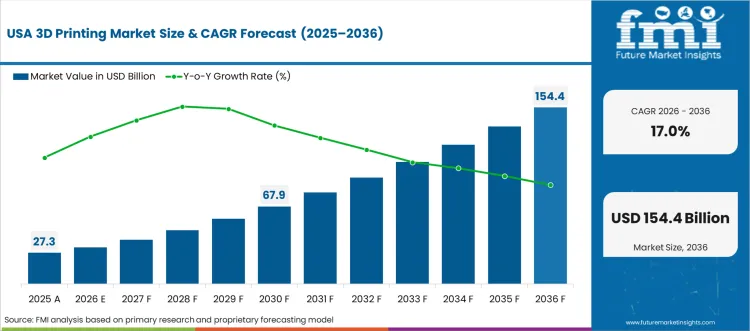
In the year 2026, North America is dominating the global 3D printing market and generated more than 40% of worldwide revenue. This is a result of additive manufacturing being widely adopted by industries in the United States and Canada in a variety of manufacturing processes.
Given its size in terms of geography, the United States is the dominating region for the target market. Due to the presence of several industry participants in additive manufacturing that have extensive technical knowledge of the procedures, the net worth of the 3D printing market size is figured out to be around USD 40.6 billion in the United States in 2026.
How the 3D Printing Market Share is Performing in Asia Pacific Region?
With a CAGR of 22% anticipated for the Asia Pacific area over the projection period, it is figured out to be significantly growing among all the broad geographical regions.
As per the 3D printing market analysis report of FMI, the Asia Pacific region is divided into East Asia and South Asia & Pacific geographical regions, with a net worth of USD 40.40.6 billion and USD 2.2 billion respectively for the year 2026. The advancements made in the region's industrial sector have contributed to the fast adoption of 3D printing in Asia Pacific countries.
Developing as a manufacturing powerhouse for the healthcare and automotive sectors, Asia Pacific’s 3D printing market is strengthening further. Rapid urbanization and the dominance of electronics and electrical manufacturing are remarkable factors boosting the 3D printing market opportunities in the area as well.
Competitive Landscape for the 3D Printing Market
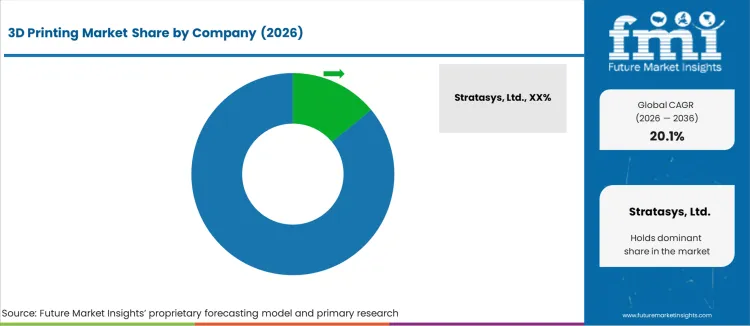
The global 3d printing market size is growing with a continual supply of new competitors. Industry 4.0 is the union of cutting-edge manufacturing and production methods with clever digital technology. It has inflected the emerging trends in the 3D printing market as a crucial element in this movement creating sufficient demand prospects for global and regional market players.
- PostProcess Technologies and EOS have established a distribution partnership as of October 2025 to provide EOS clients with an entirely automated and long-lasting depowering solution. Based on PostProcess, the Variable Acoustic Displacement (VAD) technology system is going to automate bulk depowering for 3D printed items and augment the EOS printer product line.
- In conjunction with 3D printing behemoth Ultimaker, Imaginarium, one of the world's leading providers of 3D printing systems and sophisticated manufacturing technologies, announced the release of its line of desktop and industrial 3D printers in February 2025.
How is the Start-up Ecosystem in the Global 3D Printing Market?
Metal and resin printers have also succeeded in occupying a notable chunk of the said market in recent years though plastic might probably continue predominate,
Several start-ups have also emerged grasping recent developments in the 3D printing market. With the technology being at a developing stage, the new 3D printing market players might have to invest significant capital in research and development activities.
Scope of the Report
| Metric | Value |
|---|---|
| Quantitative Units | USD 48.76 billion to USD 304.44 billion, at a CAGR of 20.1% |
| Market Definition | The 3D printing market covers the full additive manufacturing ecosystem including printers, software, services, and materials used to build three-dimensional objects layer by layer for production, prototyping, and tooling applications across regulated and industrial sectors. |
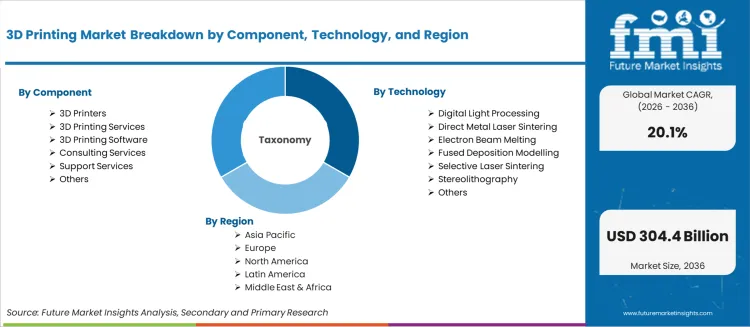
| Component Segmentation | 3D Printers, 3D Printing Services, 3D Printing Software, Consulting Services, Support Services, Others |
| Technology Segmentation | Digital Light Processing, Direct Metal Laser Sintering, Electron Beam Melting, Fused Deposition Modelling, Selective Laser Sintering, Stereolithography, Others |
| Application Segmentation | Production Parts, Prototypes, Tools & Fixtures |
| Industry Segmentation | Aerospace & Aeronautics, Automotive, Consumer Goods, Healthcare & Medical Devices, Industrial, Others |
| Regions Covered | North America, Latin America, Europe, East Asia, South Asia, Oceania, Middle East & Africa |
| Countries Covered | China, India, Germany, Brazil, UK, USA, Japan, and 40 plus countries |
| Key Companies Profiled | Stratasys, Ltd., Materialise, EnvisionTec, Inc., 3D Systems, Inc., GE Additive, Autodesk Inc., Canon Inc., Voxeljet AG, SLM Solutions |
| Forecast Period | 2026 to 2036 |
| Approach | Forecasting models apply a bottom-up methodology starting with equipment shipment volumes, material consumption, and service contract values, projecting adoption using sector-specific penetration curves and regulatory qualification timelines. |
3D Printing Market by Segmentation
By Component:
- 3D Printers
- 3D Printing Services
- 3D Printing Software
- Consulting Services
- Support Services
- Others
By Technology:
- Digital Light Processing (DLP)
- Direct Metal Laser Sintering (DMLS)
- Electron Beam Melting (EBM)
- Fused Deposition Modelling (FDM)
- Selective Laser Sintering (SLS)
- Stereolithography
- Others
By Application:
- Production Parts
- Prototypes
- Tools & Fixtures
By Industry:
- Aerospace & Aeronautics
- Automotive
- Consumer Goods
- Healthcare & Medical Devices
- Industrial
- Others
By Region:
- North America
- Latin America
- Western Europe
- Eastern Europe
- South Asia and Pacific
- East Asia
- The Middle East and Africa
Bibliography
- ASTM International. (2024). ASTM F2792-24: Standard terminology for additive manufacturing technologies. ASTM.
- USA Food and Drug Administration. (2024). Technical considerations for additive manufactured medical devices: Guidance for industry. FDA.
- European Aviation Safety Agency. (2024). Certification specifications for additive manufactured aircraft parts. EASA.
- International Organization for Standardization. (2024). ISO/ASTM 52900: Additive manufacturing general principles. ISO.
- GE Additive. (2024). Annual technology and market review 2024. GE Additive.
- World Economic Forum. (2024). Technology pioneers: Additive manufacturing industrial impact assessment. WEF.
This bibliography is provided for reader reference. The full Future Market Insights report contains the complete reference list with primary research documentation.
Frequently Asked Questions
How large is the global 3D printing market in 2026?
The global 3D printing market is estimated to be valued at USD 48.76 billion in 2026.
What will be the market size by 2036?
The global 3D printing market is projected to reach USD 304.44 billion by 2036.
What is the expected CAGR between 2026 and 2036?
The market is expected to grow at a CAGR of 20.1% between 2026 and 2036.
Which Component leads global sales by 2026?
3D Printers account for 47.1% share in 2026, reflecting the ongoing hardware buildout phase across industrial and professional sectors globally.
Which Technology is poised to lead in 2026?
Digital Light Processing leads with 32.6% share in 2026, driven by its speed advantages and resolution capabilities for production-grade polymer and ceramic parts.
What is driving demand in China?
State-backed manufacturing modernization programmes and a large domestic industrial base transitioning to additive methods are propelling China to a 27.1% CAGR through 2036.
Which Application leads in 2026?
Production Parts account for 47.8% of application share in 2026, confirming the structural transition of 3D printing from prototyping tool to production manufacturing platform.
Does the report cover Germany in its regional analysis?
Yes, Germany is included within Europe, tracking at a 23.1% CAGR driven by its position as a global hub for industrial 3D printing equipment development and automotive sector adoption.
Preview the report firsthand - request a free sample
Get SampleGet the brochure for pricing and purchase details.
Get PDFTable of Content
- Executive Summary
- Global Market Outlook
- Demand-side Trends
- Supply-side Trends
- Technology Roadmap Analysis
- Analysis and Recommendations
- Market Overview
- Market Coverage / Taxonomy
- Market Definition / Scope / Limitations
- Research Methodology
- Chapter Orientation
- Analytical Lens and Working Hypotheses
- Market Structure, Signals, and Trend Drivers
- Benchmarking and Cross-market Comparability
- Market Sizing, Forecasting, and Opportunity Mapping
- Research Design and Evidence Framework
- Desk Research Programme (Secondary Evidence)
- Company Annual and Sustainability Reports
- Peer-reviewed Journals and Academic Literature
- Corporate Websites, Product Literature, and Technical Notes
- Earnings Decks and Investor Briefings
- Statutory Filings and Regulatory Disclosures
- Technical White Papers and Standards Notes
- Trade Journals, Industry Magazines, and Analyst Briefs
- Conference Proceedings, Webinars, and Seminar Materials
- Government Statistics Portals and Public Data Releases
- Press Releases and Reputable Media Coverage
- Specialist Newsletters and Curated Briefings
- Sector Databases and Reference Repositories
- FMI Internal Proprietary Databases and Historical Market Datasets
- Subscription Datasets and Paid Sources
- Social Channels, Communities, and Digital Listening Inputs
- Additional Desk Sources
- Expert Input and Fieldwork (Primary Evidence)
- Primary Modes
- Qualitative Interviews and Expert Elicitation
- Quantitative Surveys and Structured Data Capture
- Blended Approach
- Why Primary Evidence is Used
- Field Techniques
- Interviews
- Surveys
- Focus Groups
- Observational and In-context Research
- Social and Community Interactions
- Stakeholder Universe Engaged
- C-suite Leaders
- Board Members
- Presidents and Vice Presidents
- R&D and Innovation Heads
- Technical Specialists
- Domain Subject-matter Experts
- Scientists
- Physicians and Other Healthcare Professionals
- Governance, Ethics, and Data Stewardship
- Research Ethics
- Data Integrity and Handling
- Primary Modes
- Tooling, Models, and Reference Databases
- Desk Research Programme (Secondary Evidence)
- Data Engineering and Model Build
- Data Acquisition and Ingestion
- Cleaning, Normalisation, and Verification
- Synthesis, Triangulation, and Analysis
- Quality Assurance and Audit Trail
- Market Background
- Market Dynamics
- Drivers
- Restraints
- Opportunity
- Trends
- Scenario Forecast
- Demand in Optimistic Scenario
- Demand in Likely Scenario
- Demand in Conservative Scenario
- Opportunity Map Analysis
- Product Life Cycle Analysis
- Supply Chain Analysis
- Investment Feasibility Matrix
- Value Chain Analysis
- PESTLE and Porter’s Analysis
- Regulatory Landscape
- Regional Parent Market Outlook
- Production and Consumption Statistics
- Import and Export Statistics
- Market Dynamics
- Global Market Analysis 2021 to 2025 and Forecast, 2026 to 2036
- Historical Market Size Value (USD Billion) Analysis, 2021 to 2025
- Current and Future Market Size Value (USD Billion) Projections, 2026 to 2036
- Y-o-Y Growth Trend Analysis
- Absolute $ Opportunity Analysis
- Global Market Pricing Analysis 2021 to 2025 and Forecast 2026 to 2036
- Global Market Analysis 2021 to 2025 and Forecast 2026 to 2036, By Component
- Introduction / Key Findings
- Historical Market Size Value (USD Billion) Analysis By Component , 2021 to 2025
- Current and Future Market Size Value (USD Billion) Analysis and Forecast By Component , 2026 to 2036
- 3D Printers
- 3D Printing Services
- 3D Printing Software
- Consulting Services
- Support Services
- Others
- 3D Printers
- Y-o-Y Growth Trend Analysis By Component , 2021 to 2025
- Absolute $ Opportunity Analysis By Component , 2026 to 2036
- Global Market Analysis 2021 to 2025 and Forecast 2026 to 2036, By Technology
- Introduction / Key Findings
- Historical Market Size Value (USD Billion) Analysis By Technology, 2021 to 2025
- Current and Future Market Size Value (USD Billion) Analysis and Forecast By Technology, 2026 to 2036
- Digital Light Processing
- Direct Metal Laser Sintering
- Electron Beam Melting
- Fused Deposition Modelling
- Selective Laser Sintering
- Stereolithography
- Others
- Digital Light Processing
- Y-o-Y Growth Trend Analysis By Technology, 2021 to 2025
- Absolute $ Opportunity Analysis By Technology, 2026 to 2036
- Global Market Analysis 2021 to 2025 and Forecast 2026 to 2036, By Application
- Introduction / Key Findings
- Historical Market Size Value (USD Billion) Analysis By Application, 2021 to 2025
- Current and Future Market Size Value (USD Billion) Analysis and Forecast By Application, 2026 to 2036
- Production Parts
- Prototypes
- Tools & Fixtures
- Production Parts
- Y-o-Y Growth Trend Analysis By Application, 2021 to 2025
- Absolute $ Opportunity Analysis By Application, 2026 to 2036
- Global Market Analysis 2021 to 2025 and Forecast 2026 to 2036, By Industry
- Introduction / Key Findings
- Historical Market Size Value (USD Billion) Analysis By Industry, 2021 to 2025
- Current and Future Market Size Value (USD Billion) Analysis and Forecast By Industry, 2026 to 2036
- Aerospace & Aeronautics
- Automotive
- Consumer Goods
- Healthcare & Medical Devices
- Industrial
- Others
- Aerospace & Aeronautics
- Y-o-Y Growth Trend Analysis By Industry, 2021 to 2025
- Absolute $ Opportunity Analysis By Industry, 2026 to 2036
- Global Market Analysis 2021 to 2025 and Forecast 2026 to 2036, By Region
- Introduction
- Historical Market Size Value (USD Billion) Analysis By Region, 2021 to 2025
- Current Market Size Value (USD Billion) Analysis and Forecast By Region, 2026 to 2036
- North America
- Latin America
- Western Europe
- Eastern Europe
- East Asia
- South Asia and Pacific
- Middle East & Africa
- Market Attractiveness Analysis By Region
- North America Market Analysis 2021 to 2025 and Forecast 2026 to 2036, By Country
- Historical Market Size Value (USD Billion) Trend Analysis By Market Taxonomy, 2021 to 2025
- Market Size Value (USD Billion) Forecast By Market Taxonomy, 2026 to 2036
- By Country
- USA
- Canada
- Mexico
- By Component
- By Technology
- By Application
- By Industry
- By Country
- Market Attractiveness Analysis
- By Country
- By Component
- By Technology
- By Application
- By Industry
- Key Takeaways
- Latin America Market Analysis 2021 to 2025 and Forecast 2026 to 2036, By Country
- Historical Market Size Value (USD Billion) Trend Analysis By Market Taxonomy, 2021 to 2025
- Market Size Value (USD Billion) Forecast By Market Taxonomy, 2026 to 2036
- By Country
- Brazil
- Chile
- Rest of Latin America
- By Component
- By Technology
- By Application
- By Industry
- By Country
- Market Attractiveness Analysis
- By Country
- By Component
- By Technology
- By Application
- By Industry
- Key Takeaways
- Western Europe Market Analysis 2021 to 2025 and Forecast 2026 to 2036, By Country
- Historical Market Size Value (USD Billion) Trend Analysis By Market Taxonomy, 2021 to 2025
- Market Size Value (USD Billion) Forecast By Market Taxonomy, 2026 to 2036
- By Country
- Germany
- UK
- Italy
- Spain
- France
- Nordic
- BENELUX
- Rest of Western Europe
- By Component
- By Technology
- By Application
- By Industry
- By Country
- Market Attractiveness Analysis
- By Country
- By Component
- By Technology
- By Application
- By Industry
- Key Takeaways
- Eastern Europe Market Analysis 2021 to 2025 and Forecast 2026 to 2036, By Country
- Historical Market Size Value (USD Billion) Trend Analysis By Market Taxonomy, 2021 to 2025
- Market Size Value (USD Billion) Forecast By Market Taxonomy, 2026 to 2036
- By Country
- Russia
- Poland
- Hungary
- Balkan & Baltic
- Rest of Eastern Europe
- By Component
- By Technology
- By Application
- By Industry
- By Country
- Market Attractiveness Analysis
- By Country
- By Component
- By Technology
- By Application
- By Industry
- Key Takeaways
- East Asia Market Analysis 2021 to 2025 and Forecast 2026 to 2036, By Country
- Historical Market Size Value (USD Billion) Trend Analysis By Market Taxonomy, 2021 to 2025
- Market Size Value (USD Billion) Forecast By Market Taxonomy, 2026 to 2036
- By Country
- China
- Japan
- South Korea
- By Component
- By Technology
- By Application
- By Industry
- By Country
- Market Attractiveness Analysis
- By Country
- By Component
- By Technology
- By Application
- By Industry
- Key Takeaways
- South Asia and Pacific Market Analysis 2021 to 2025 and Forecast 2026 to 2036, By Country
- Historical Market Size Value (USD Billion) Trend Analysis By Market Taxonomy, 2021 to 2025
- Market Size Value (USD Billion) Forecast By Market Taxonomy, 2026 to 2036
- By Country
- India
- ASEAN
- Australia & New Zealand
- Rest of South Asia and Pacific
- By Component
- By Technology
- By Application
- By Industry
- By Country
- Market Attractiveness Analysis
- By Country
- By Component
- By Technology
- By Application
- By Industry
- Key Takeaways
- Middle East & Africa Market Analysis 2021 to 2025 and Forecast 2026 to 2036, By Country
- Historical Market Size Value (USD Billion) Trend Analysis By Market Taxonomy, 2021 to 2025
- Market Size Value (USD Billion) Forecast By Market Taxonomy, 2026 to 2036
- By Country
- Kingdom of Saudi Arabia
- Other GCC Countries
- Turkiye
- South Africa
- Other African Union
- Rest of Middle East & Africa
- By Component
- By Technology
- By Application
- By Industry
- By Country
- Market Attractiveness Analysis
- By Country
- By Component
- By Technology
- By Application
- By Industry
- Key Takeaways
- Key Countries Market Analysis
- USA
- Pricing Analysis
- Market Share Analysis, 2025
- By Component
- By Technology
- By Application
- By Industry
- Canada
- Pricing Analysis
- Market Share Analysis, 2025
- By Component
- By Technology
- By Application
- By Industry
- Mexico
- Pricing Analysis
- Market Share Analysis, 2025
- By Component
- By Technology
- By Application
- By Industry
- Brazil
- Pricing Analysis
- Market Share Analysis, 2025
- By Component
- By Technology
- By Application
- By Industry
- Chile
- Pricing Analysis
- Market Share Analysis, 2025
- By Component
- By Technology
- By Application
- By Industry
- Germany
- Pricing Analysis
- Market Share Analysis, 2025
- By Component
- By Technology
- By Application
- By Industry
- UK
- Pricing Analysis
- Market Share Analysis, 2025
- By Component
- By Technology
- By Application
- By Industry
- Italy
- Pricing Analysis
- Market Share Analysis, 2025
- By Component
- By Technology
- By Application
- By Industry
- Spain
- Pricing Analysis
- Market Share Analysis, 2025
- By Component
- By Technology
- By Application
- By Industry
- France
- Pricing Analysis
- Market Share Analysis, 2025
- By Component
- By Technology
- By Application
- By Industry
- India
- Pricing Analysis
- Market Share Analysis, 2025
- By Component
- By Technology
- By Application
- By Industry
- ASEAN
- Pricing Analysis
- Market Share Analysis, 2025
- By Component
- By Technology
- By Application
- By Industry
- Australia & New Zealand
- Pricing Analysis
- Market Share Analysis, 2025
- By Component
- By Technology
- By Application
- By Industry
- China
- Pricing Analysis
- Market Share Analysis, 2025
- By Component
- By Technology
- By Application
- By Industry
- Japan
- Pricing Analysis
- Market Share Analysis, 2025
- By Component
- By Technology
- By Application
- By Industry
- South Korea
- Pricing Analysis
- Market Share Analysis, 2025
- By Component
- By Technology
- By Application
- By Industry
- Russia
- Pricing Analysis
- Market Share Analysis, 2025
- By Component
- By Technology
- By Application
- By Industry
- Poland
- Pricing Analysis
- Market Share Analysis, 2025
- By Component
- By Technology
- By Application
- By Industry
- Hungary
- Pricing Analysis
- Market Share Analysis, 2025
- By Component
- By Technology
- By Application
- By Industry
- Kingdom of Saudi Arabia
- Pricing Analysis
- Market Share Analysis, 2025
- By Component
- By Technology
- By Application
- By Industry
- Turkiye
- Pricing Analysis
- Market Share Analysis, 2025
- By Component
- By Technology
- By Application
- By Industry
- South Africa
- Pricing Analysis
- Market Share Analysis, 2025
- By Component
- By Technology
- By Application
- By Industry
- USA
- Market Structure Analysis
- Competition Dashboard
- Competition Benchmarking
- Market Share Analysis of Top Players
- By Regional
- By Component
- By Technology
- By Application
- By Industry
- Competition Analysis
- Competition Deep Dive
- Stratasys, Ltd.
- Overview
- Product Portfolio
- Profitability by Market Segments (Product/Age /Sales Channel/Region)
- Sales Footprint
- Strategy Overview
- Marketing Strategy
- Product Strategy
- Channel Strategy
- Materialise
- EnvisionTec, Inc.
- 3D Systems, Inc.
- GE Additive
- Autodesk Inc.
- Made In Space
- Canon Inc.
- Voxeljet AG
- SLM Solutions
- Stratasys, Ltd.
- Competition Deep Dive
- Assumptions & Acronyms Used


