

- Industry Size (2026)
- USD 2.0 Bn
- Forecast (2036)
- USD 5.4 Bn
- CAGR (2026 to 2036)
- 10.4%
4K Laparoscopic Camera Market Forecast and Outlook 2026 to 2036
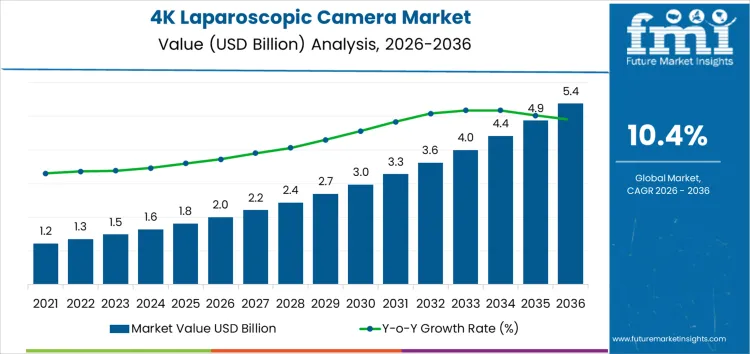
The 4K Laparoscopic Camera market is projected at USD 2 billion in 2026 and is expected to grow to USD 5.4 billion by 2036, registering a CAGR of 10.4%. The market comprises 4K camera systems, camera heads, and associated upgrades and accessories, serving general surgery, gynecology, urology, and other applications. Hospitals dominate adoption, followed by ambulatory surgery centers and OEM channels. Leading players include Olympus, Stryker, Karl Storz, Smith & Nephew, and Richard Wolf. Expansion is driven by increasing minimally invasive procedures and demand for higher-resolution imaging.
Market growth is supported by technological enhancements that improve image clarity, depth perception, and procedural accuracy. Rising investments in operating room upgrades, training programs for surgeons, and expanding surgical volumes further stimulate demand. Integration with advanced laparoscopic instruments, digital recording systems, and AI-assisted imaging ensures continued adoption across hospitals and surgical centers, creating a sustained growth trajectory through 2036.
Quick Stats for 4K Laparoscopic Camera Market
- 4K Laparoscopic Camera Market Value (2026): USD 2.0 billion
- 4K Laparoscopic Camera Market Forecast Value (2036): USD 5.4 billion
- 4K Laparoscopic Camera Market Forecast CAGR: 10.4%
- Leading Type in 4K Laparoscopic Camera Market: 4K Camera Systems
- Key Growth Regions in 4K Laparoscopic Camera Market: North America, Europe, and Asia Pacific
- Top Players in 4K Laparoscopic Camera Market: Olympus, Stryker, Karl Storz, Smith & Nephew, Richard Wolf
What is the Growth Forecast for the 4K Laparoscopic Camera Market through 2036?
From 2026 to 2031, the 4K laparoscopic camera market grows from USD 2.0 billion to approximately USD 3.0 billion, representing the early adoption phase. Annual increments increase from USD 0.15 billion in 2026 to USD 0.28 billion in 2031. Growth is driven by adoption in hospitals, surgical centers, and minimally invasive procedure facilities, where 4K imaging improves visualization, surgical precision, and procedural outcomes. Early adoption is concentrated in North America and Europe, accounting for roughly 65% of total market value, with uptake influenced by regulatory approvals, integration with robotic-assisted platforms, and demonstration of clinical efficacy in high-volume surgeries.
Between 2031 and 2036, the market expands from roughly USD 3.0 billion to USD 5.4 billion, illustrating the late adoption phase characterized by broader commercialization and multi-site deployment. Annual increments rise from USD 0.28 billion to USD 0.5 billion, driven by portfolio-wide adoption, repeat procurement, and expansion into emerging markets in Asia Pacific and Latin America. Growth is reinforced by increasing minimally invasive surgical procedures, integration with advanced imaging platforms, and normalized adoption across global surgical networks. Early-stage growth relied on selective high-volume hospitals, whereas later expansion reflects full-scale deployment and standardized use in operating rooms worldwide.
4K Laparoscopic Camera Market Key Takeaways
| Metric | Value |
|---|---|
| Market Value (2026) | USD 2.0 billion |
| Forecast Value (2036) | USD 5.4 billion |
| Forecast CAGR (2026 to 2036) | 10.4% |
What Is Driving Growth in the 4K Laparoscopic Camera Market?
Growth in the 4K laparoscopic camera market stems from clinical limitations in conventional imaging that impacted surgical precision and outcomes. Standard definition and high definition systems provided useful views but lacked the spatial resolution, contrast, and detail necessary for complex minimally invasive procedures. Surgeons faced challenges in identifying fine anatomy, small vessels, and subtle tissue boundaries, increasing reliance on tactile feedback or conversion to open surgery. The adoption of 4K imaging improved visualisation by offering four times the pixel counts of standard high definition, enabling greater detail, depth perception, and confidence during dissection. Early demand was strongest in advanced laparoscopic centres and specialist procedures where enhanced vision directly influenced performance rather than across all operating environments.
Future growth in the 4K laparoscopic camera market will be shaped by procedural standards, integration with surgical guidance technologies, and evidence linking imaging quality to clinical outcomes rather than incremental display upgrades alone. Hospitals and surgical suites are increasingly specifying imaging systems that support advanced minimally invasive techniques, including robotic assistance, fluorescence imaging, and augmented reality overlays. Regulatory and payer frameworks are placing emphasis on documentation of improved surgical efficiency, reduced complications, and reduced operative times as part of technology assessment. Integration with hospital information systems and operating room video management supports training, quality assurance, and tele-mentoring, enhancing adoption.
What Factors Are Affecting the Demand for 4K Laparoscopic Camera Market in Terms of Product Type and Application?
The 4K laparoscopic camera market is driven by demand for improved visualization, surgical precision, and standardized imaging across minimally invasive procedures. Hospitals prioritize systems that integrate reliably into operating rooms and support multiple specialties. Purchasing decisions emphasize image consistency, workflow compatibility, and long equipment life cycles. Growth reflects procedural complexity rather than volume expansion, with adoption strongest in facilities upgrading core surgical infrastructure to enhance outcomes and reduce intraoperative risk while maintaining training continuity and capital discipline across hospitals globally.
What Is Driving Leadership by Product Type in the 4K Laparoscopic Camera Market?
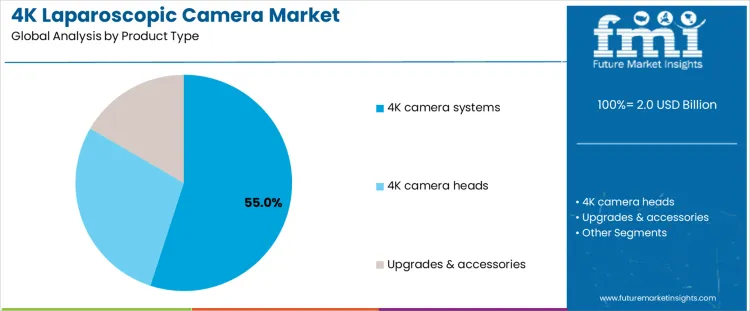
4K camera systems account for about 55% of demand because hospitals increasingly prioritize integrated imaging platforms rather than component level upgrades. These systems combine camera heads, processors, light sources, and monitors, ensuring consistent definition output across procedures. Surgeons favor complete systems to avoid compatibility issues and calibration variability during minimally invasive surgery. Procurement teams also prefer bundled systems for simplified validation, service contracts, and regulatory documentation. Adoption is strongest in operating rooms performing high procedure volumes, where image clarity directly supports precision, safety, and workflow efficiency during complex laparoscopic interventions.
4K camera heads and upgrade accessories serve facilities seeking incremental improvement without replacing full imaging stacks. Camera heads allow reuse of existing processors, lowering capital burden for smaller hospitals. Accessories support integration with legacy monitors and light systems. These options appeal where budgets are constrained or procedure mix is limited. However, reliance on partial upgrades can introduce compatibility limits and uneven image performance. As surgical expectations shift toward standardized visualization, these subsegments remain supportive rather than dominant, reinforcing system level solutions as preferred investments across advanced laparoscopic environments globally today.
What Is Driving Leadership by Application in the 4K Laparoscopic Camera Market?
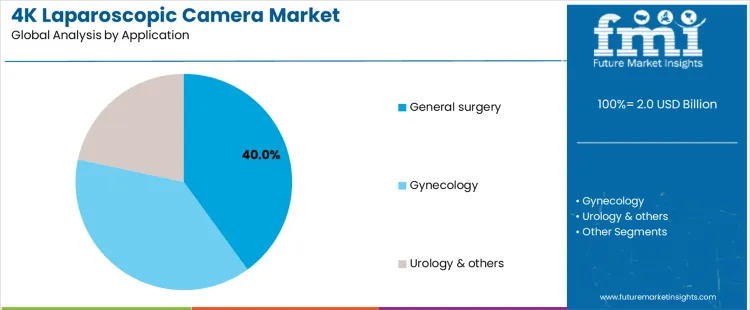
General surgery represents about 40% of demand because laparoscopy is widely used across abdominal procedures. Hernia repair, cholecystectomy, and colorectal surgeries rely on clear visualization to identify anatomy and reduce complications. 4K imaging enhances depth perception and tissue differentiation, supporting surgical precision. High procedure volumes make general surgery departments primary adopters of system upgrades. Hospitals prioritize imaging quality here because improvements benefit a broad case mix, reinforcing general surgery as the leading application shaping purchasing decisions across public and private hospitals worldwide today with consistent outcomes and training familiarity benefits.
Gynecology and urology represent secondary applications where minimally invasive procedures also benefit from higher resolution imaging. In gynecology, laparoscopic hysterectomy and endometriosis management rely on visualization of fine structures. Urology procedures apply 4K imaging selectively for complex cases. However, lower procedure volumes compared with general surgery limit overall share. Adoption often follows system availability rather than dedicated purchases. These applications therefore expand utilization of installed systems without independently driving procurement volumes across healthcare providers in tertiary centers and specialty hospitals globally today with selective budgets and case mix variability constraints.
How Is the 4K Laparoscopic Camera Market Being Applied Across Minimally Invasive Surgery?
Use appears in hospitals, surgical centers, and specialty clinics where high-definition visualization enhances precision during laparoscopic procedures. Surgeons adopt 4K cameras for gastrointestinal, gynecological, urological, and bariatric surgeries to improve tissue differentiation, margin detection, and instrument guidance. Integration with laparoscopes, robotic platforms, and imaging displays allows real-time monitoring and documentation. These applications reflect operational and clinical priorities rather than decorative objectives, with adoption driven by image clarity, procedural accuracy, and patient safety.
What Operational and Material Conditions Support Adoption of 4K Laparoscopic Cameras?
Selection aligns with endoscopic systems requiring compact, sterilizable camera heads and high-resolution imaging sensors. Surgical teams depend on stable lighting, consistent white balance, and minimal latency for accurate visualization. Integration with display monitors, recording systems, and robotic platforms is essential for workflow efficiency. Maintenance protocols include lens sterilization, cable management, and sensor calibration to ensure consistent performance. These conditions emerge from operational reliability, procedural precision, and integration efficiency priorities in structured surgical workflows.
Which Practical Considerations Limit Wider Use of 4K Laparoscopic Cameras?
High acquisition and maintenance costs can restrict adoption to advanced surgical centers. Compatibility with existing laparoscopic and robotic systems must be verified. High-resolution video data increases storage and IT infrastructure requirements. Staff training is necessary to optimize camera handling and image interpretation. These factors result in selective deployment where enhanced visualization, surgical precision, and workflow efficiency justify incremental cost and operational management.
What is the Demand for 4K Laparoscopic Cameras by Country?
| Country | CAGR (%) |
|---|---|
| USA | 11.5% |
| Brazil | 12.0% |
| China | 12.5% |
| India | 12.7% |
| UK | 9.9% |
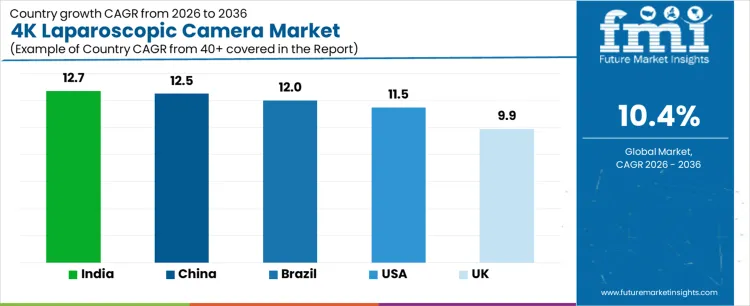
The demand for 4K laparoscopic cameras varies across countries, driven by minimally invasive surgical adoption, hospital infrastructure growth, and demand for high precision imaging. India leads with a 12.7% CAGR, supported by rising laparoscopic procedures, hospital expansion, and increasing adoption of advanced imaging technologies. China follows at 12.5%, driven by large healthcare facilities, growing surgical volumes, and investments in high resolution laparoscopic systems. Brazil records 12.0%, shaped by expanding healthcare access and adoption of minimally invasive procedures. The USA grows at 11.5%, reflecting established hospitals and surgical centers integrating advanced imaging tools. The UK posts 9.9%, supported by mature healthcare infrastructure and steady adoption of 4K laparoscopic systems.
How Is the 4K Laparoscopic Camera Market Expanding in the United States?
In the United States, the 4K Laparoscopic Camera Market is growing at a CAGR of 11.5% through 2036, driven by increasing adoption of high-resolution imaging systems in minimally invasive surgeries. Hospitals, surgical centers, and academic medical facilities are integrating 4K cameras to enhance visualization, improve procedural precision, and reduce operative complications. Demand is concentrated in laparoscopic surgery units, specialty surgical centers, and teaching hospitals. Domestic suppliers are providing high-performance, compatible cameras that integrate with existing surgical platforms and imaging systems. Rising surgical volumes, regulatory approvals, and recurring technology upgrades are sustaining predictable adoption nationwide.
- Hospitals, surgical centers, and teaching hospitals drive adoption
- 4K cameras improve visualization and procedural precision
- Domestic suppliers provide high-performance, platform-compatible cameras
- Recurring technology upgrades sustain predictable adoption
How Are Minimally Invasive Surgical Programs Driving Growth in Brazil?
In Brazil, revenue is expanding at a CAGR of 12% through 2036, supported by rapid growth in minimally invasive surgeries and hospital infrastructure development. Hospitals and specialty surgical centers are adopting 4K laparoscopic cameras to improve intraoperative visualization, reduce complications, and enhance patient outcomes. Demand is concentrated in urban hospitals, private surgical centers, and academic medical facilities. Local suppliers provide high-resolution cameras compatible with laparoscopic towers and imaging platforms. Expansion of laparoscopic procedures, training programs, and recurring technology upgrades are sustaining adoption across hospitals nationwide.
- Urban hospitals, private surgical centers, and academic facilities drive adoption
- Cameras enhance intraoperative visualization and reduce complications
- Local suppliers provide laparoscopic-compatible high-resolution cameras
- Recurring upgrades sustain adoption
How Is Surgical Imaging Infrastructure Accelerating Adoption in China?
China is witnessing growth at a CAGR of 12.5% through 2036, driven by increasing adoption of advanced laparoscopic procedures and hospital modernization. Hospitals and specialty surgical centers are integrating 4K laparoscopic cameras to improve procedural accuracy, patient safety, and surgical outcomes. Demand is concentrated in tertiary hospitals, specialty surgical units, and teaching hospitals. Domestic suppliers are scaling production of high-resolution, high-performance cameras compatible with multiple laparoscopic platforms. Expanding hospital infrastructure, rising surgical volumes, and recurring technology updates are sustaining rapid adoption nationwide.
- Tertiary hospitals, surgical units, and teaching hospitals drive adoption
- 4K cameras improve procedural accuracy and patient safety
- Domestic suppliers scale high-performance, platform-compatible cameras
- Recurring technology updates sustain rapid adoption
How Is Laparoscopic Surgery Expansion Driving Camera Use in India?
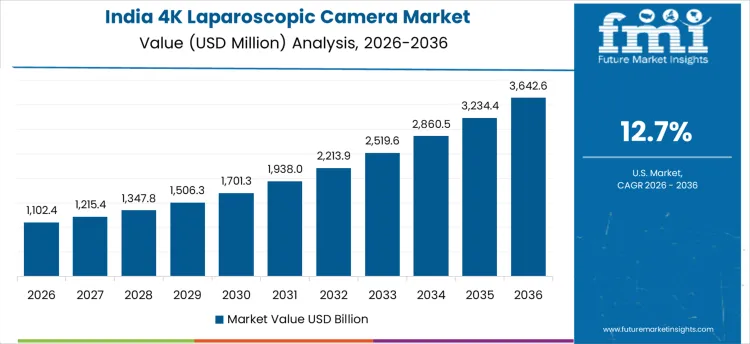
In India, revenue is growing at a CAGR of 12.7% through 2036, supported by increased adoption of minimally invasive surgeries, specialty surgical centers, and hospital infrastructure expansion. Hospitals and teaching facilities are adopting 4K laparoscopic cameras to enhance visualization, reduce operative complications, and improve outcomes. Demand is concentrated in urban hospitals, specialty surgical centers, and high-volume teaching hospitals. Domestic suppliers provide high-resolution cameras compatible with existing laparoscopic and imaging systems. Rising procedural volumes, regulatory compliance, and recurring technology upgrades are sustaining robust adoption nationwide.
- Urban hospitals, specialty centers, and teaching hospitals drive adoption
- Cameras enhance visualization and reduce operative complications
- Domestic suppliers provide high-resolution, laparoscopic-compatible cameras
- Recurring technology upgrades sustain robust adoption
How Are Surgical Standards and Imaging Integration Supporting Growth in the United Kingdom?
In the United Kingdom, the market is expanding at a CAGR of 9.9% through 2036, driven by adoption of 4K laparoscopic cameras in hospitals, teaching centers, and specialty surgical facilities. Surgeons are integrating high-resolution imaging to improve procedural precision, reduce complications, and enhance patient outcomes. Demand is concentrated in academic hospitals, laparoscopic surgery units, and private surgical centers. Domestic suppliers provide high-performance cameras compatible with laparoscopic towers and surgical platforms. Compliance with clinical standards, increasing surgical volumes, and recurring technology upgrades are sustaining consistent adoption nationwide.
- Academic hospitals, laparoscopic units, and surgical centers drive adoption
- Cameras improve procedural precision and patient outcomes
- Domestic suppliers provide high-performance, laparoscopic-compatible cameras
- Recurring technology upgrades sustain consistent adoption
Which Strategic Approaches Are Companies Using to Compete in The 4K Laparoscopic Camera Market Within Operating Room Ecosystems?
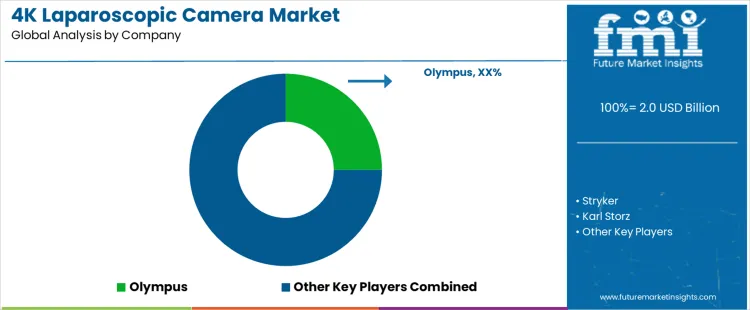
Competition in the 4K Laparoscopic Camera Market is shaped by how imaging systems are embedded into broader operating room setups rather than by resolution alone. Olympus, Stryker, and Karl Storz compete by anchoring cameras within integrated visualization platforms that include light sources, scopes, monitors, and data management systems. Their strategies emphasize color consistency, depth perception, and latency control during long procedures, where surgeon comfort and visual reliability matter more than headline specifications. Smith and Nephew positions its systems around ease of use and compatibility with minimally invasive workflows, particularly in orthopedics and general surgery. Purchasing decisions are influenced by installed base continuity, image stability under smoke or bleeding, and seamless integration with existing OR infrastructure.
Strategic differentiation increasingly centers on workflow alignment and capital planning. Leading suppliers prioritize backward compatibility, allowing hospitals to upgrade cameras without replacing entire towers. Training support, service responsiveness, and standardized user interfaces are used to reinforce surgeon preference and reduce learning curves. Richard Wolf competes through modular camera systems tailored to specific procedural needs, appealing to facilities seeking flexibility without full platform lock in. Smaller participants typically enter through niche imaging enhancements or regional tenders rather than displacing established ecosystems. Across the market, competitive advantage depends on long term reliability, surgeon trust, and alignment with hospital procurement cycles rather than rapid feature turnover or aggressive pricing.
Key Players in the 4K Laparoscopic Camera Market
- Olympus
- Stryker
- Karl Storz
- Smith & Nephew
- Richard Wolf
- Others
Scope of the Report
| Items | Values |
|---|---|
| Quantitative Units (2026) | USD billion |
| Product Type | 4K camera systems, 4K camera heads, Upgrades & accessories |
| Application | General surgery, Gynecology, Urology & others |
| End-Use Industry | Hospitals, ASCs, OEM channels |
| Region | Asia Pacific (China, Japan, South Korea, India, Australia & New Zealand, ASEAN, Rest of Asia Pacific), Europe (Germany, UK, France, Italy, Spain, Nordic, BENELUX, Rest of Europe), North America (United States, Canada, Mexico), Latin America (Brazil, Chile, Rest of Latin America), Middle East & Africa (KSA, Other GCC, Turkey, South Africa, Other African Union, Rest of MEA) |
| Key Companies Profiled | Olympus, Stryker, Karl Storz, Smith & Nephew, Richard Wolf, Others |
| Additional Attributes | Dollar by sales by product type, Dollar by sales by application, Dollar by sales by end-user, Dollar by sales by region, Annual procurement cycles, Procedural volume coverage, Integration with robotic-assisted surgery, Imaging clarity and depth perception, Real-time recording and video management, Surgeon training and handling programs, Repeat procurement frequency, Equipment life cycles, Compatibility with existing OR systems, Regulatory compliance (FDA, CE, ISO), Operational efficiency and workflow integration, Domestic vs. imported system distribution, Maintenance and service contracts |
4K Laparoscopic Camera Market Segmentation
Product Type:
- 4K camera systems
- 4K camera heads
- Upgrades & accessories
Application:
- General surgery
- Gynecology
- Urology & others
End User:
- Hospitals
- ASCs
- OEM channels
Region
- Asia Pacific
- China
- Japan
- South Korea
- India
- Australia & New Zealand
- ASEAN
- Rest of Asia Pacific
- Europe
- Germany
- United Kingdom
- France
- Italy
- Spain
- Nordic
- BENELUX
- Rest of Europe
- North America
- United States
- Canada
- Mexico
- Latin America
- Brazil
- Chile
- Rest of Latin America
- Middle East & Africa
- Kingdom of Saudi Arabia
- Other GCC Countries
- Turkey
- South Africa
- Other African Union
- Rest of Middle East & Africa
Bibliography
- Harada, H., Kanaji, S., Yamamoto, M., Oshikiri, T., Yamashita, K., Matsuda, Y., Nakamura, T., Suzuki, S., & Kakeji, Y. (2017). The impact of ultra-high-definition 4K endoscopic imaging on laparoscopic surgery. Surgical Endoscopy, 31(12), 5244-5251.
- Viereck, V., Weiss, C., Welter, J., Oehler, M. K., & Wallwiener, D. (2016). Evaluation of ultra-high-definition (4K) versus high-definition (HD) imaging in laparoscopic surgery. Journal of Minimally Invasive Gynecology, 23(4), 556-561.
Frequently Asked Questions
How big is the 4k laparoscopic camera market in 2026?
The global 4k laparoscopic camera market is estimated to be valued at USD 2.0 billion in 2026.
What will be the size of 4k laparoscopic camera market in 2036?
The market size for the 4k laparoscopic camera market is projected to reach USD 5.4 billion by 2036.
How much will be the 4k laparoscopic camera market growth between 2026 and 2036?
The 4k laparoscopic camera market is expected to grow at a 10.4% CAGR between 2026 and 2036.
What are the key product types in the 4k laparoscopic camera market?
The key product types in 4k laparoscopic camera market are 4k camera systems, 4k camera heads and upgrades & accessories.
Which application segment to contribute significant share in the 4k laparoscopic camera market in 2026?
In terms of application, general surgery segment to command 40.0% share in the 4k laparoscopic camera market in 2026.
Preview the report firsthand - request a free sample
Get SampleGet the brochure for pricing and purchase details.
Get PDFTable of Content
- Executive Summary
- Global Market Outlook
- Demand-side Trends
- Supply-side Trends
- Technology Roadmap Analysis
- Analysis and Recommendations
- Market Overview
- Market Coverage / Taxonomy
- Market Definition / Scope / Limitations
- Market Background
- Market Dynamics
- Drivers
- Restraints
- Opportunity
- Trends
- Scenario Forecast
- Demand in Optimistic Scenario
- Demand in Likely Scenario
- Demand in Conservative Scenario
- Opportunity Map Analysis
- Product Life Cycle Analysis
- Supply Chain Analysis
- Investment Feasibility Matrix
- Value Chain Analysis
- PESTLE and Porter’s Analysis
- Regulatory Landscape
- Regional Parent Market Outlook
- Production and Consumption Statistics
- Import and Export Statistics
- Market Dynamics
- Global Market Analysis 2021 to 2025 and Forecast, 2026 to 2036
- Historical Market Size Value (USD Million) Analysis, 2021 to 2025
- Current and Future Market Size Value (USD Million) Projections, 2026 to 2036
- Y-o-Y Growth Trend Analysis
- Absolute $ Opportunity Analysis
- Global Market Pricing Analysis 2021 to 2025 and Forecast 2026 to 2036
- Global Market Analysis 2021 to 2025 and Forecast 2026 to 2036, By Product Type
- Introduction / Key Findings
- Historical Market Size Value (USD Million) Analysis By Product Type , 2021 to 2025
- Current and Future Market Size Value (USD Million) Analysis and Forecast By Product Type , 2026 to 2036
- 4K camera systems
- 4K camera heads
- Upgrades & accessories
- 4K camera systems
- Y-o-Y Growth Trend Analysis By Product Type , 2021 to 2025
- Absolute $ Opportunity Analysis By Product Type , 2026 to 2036
- Global Market Analysis 2021 to 2025 and Forecast 2026 to 2036, By Application
- Introduction / Key Findings
- Historical Market Size Value (USD Million) Analysis By Application, 2021 to 2025
- Current and Future Market Size Value (USD Million) Analysis and Forecast By Application, 2026 to 2036
- General surgery
- Gynecology
- Urology & others
- General surgery
- Y-o-Y Growth Trend Analysis By Application, 2021 to 2025
- Absolute $ Opportunity Analysis By Application, 2026 to 2036
- Global Market Analysis 2021 to 2025 and Forecast 2026 to 2036, By End User
- Introduction / Key Findings
- Historical Market Size Value (USD Million) Analysis By End User, 2021 to 2025
- Current and Future Market Size Value (USD Million) Analysis and Forecast By End User, 2026 to 2036
- Hospitals
- ASCs
- OEM channels
- Hospitals
- Y-o-Y Growth Trend Analysis By End User, 2021 to 2025
- Absolute $ Opportunity Analysis By End User, 2026 to 2036
- Global Market Analysis 2021 to 2025 and Forecast 2026 to 2036, By Region
- Introduction
- Historical Market Size Value (USD Million) Analysis By Region, 2021 to 2025
- Current Market Size Value (USD Million) Analysis and Forecast By Region, 2026 to 2036
- North America
- Latin America
- Western Europe
- Eastern Europe
- East Asia
- South Asia and Pacific
- Middle East & Africa
- Market Attractiveness Analysis By Region
- North America Market Analysis 2021 to 2025 and Forecast 2026 to 2036, By Country
- Historical Market Size Value (USD Million) Trend Analysis By Market Taxonomy, 2021 to 2025
- Market Size Value (USD Million) Forecast By Market Taxonomy, 2026 to 2036
- By Country
- USA
- Canada
- Mexico
- By Product Type
- By Application
- By End User
- By Country
- Market Attractiveness Analysis
- By Country
- By Product Type
- By Application
- By End User
- Key Takeaways
- Latin America Market Analysis 2021 to 2025 and Forecast 2026 to 2036, By Country
- Historical Market Size Value (USD Million) Trend Analysis By Market Taxonomy, 2021 to 2025
- Market Size Value (USD Million) Forecast By Market Taxonomy, 2026 to 2036
- By Country
- Brazil
- Chile
- Rest of Latin America
- By Product Type
- By Application
- By End User
- By Country
- Market Attractiveness Analysis
- By Country
- By Product Type
- By Application
- By End User
- Key Takeaways
- Western Europe Market Analysis 2021 to 2025 and Forecast 2026 to 2036, By Country
- Historical Market Size Value (USD Million) Trend Analysis By Market Taxonomy, 2021 to 2025
- Market Size Value (USD Million) Forecast By Market Taxonomy, 2026 to 2036
- By Country
- Germany
- UK
- Italy
- Spain
- France
- Nordic
- BENELUX
- Rest of Western Europe
- By Product Type
- By Application
- By End User
- By Country
- Market Attractiveness Analysis
- By Country
- By Product Type
- By Application
- By End User
- Key Takeaways
- Eastern Europe Market Analysis 2021 to 2025 and Forecast 2026 to 2036, By Country
- Historical Market Size Value (USD Million) Trend Analysis By Market Taxonomy, 2021 to 2025
- Market Size Value (USD Million) Forecast By Market Taxonomy, 2026 to 2036
- By Country
- Russia
- Poland
- Hungary
- Balkan & Baltic
- Rest of Eastern Europe
- By Product Type
- By Application
- By End User
- By Country
- Market Attractiveness Analysis
- By Country
- By Product Type
- By Application
- By End User
- Key Takeaways
- East Asia Market Analysis 2021 to 2025 and Forecast 2026 to 2036, By Country
- Historical Market Size Value (USD Million) Trend Analysis By Market Taxonomy, 2021 to 2025
- Market Size Value (USD Million) Forecast By Market Taxonomy, 2026 to 2036
- By Country
- China
- Japan
- South Korea
- By Product Type
- By Application
- By End User
- By Country
- Market Attractiveness Analysis
- By Country
- By Product Type
- By Application
- By End User
- Key Takeaways
- South Asia and Pacific Market Analysis 2021 to 2025 and Forecast 2026 to 2036, By Country
- Historical Market Size Value (USD Million) Trend Analysis By Market Taxonomy, 2021 to 2025
- Market Size Value (USD Million) Forecast By Market Taxonomy, 2026 to 2036
- By Country
- India
- ASEAN
- Australia & New Zealand
- Rest of South Asia and Pacific
- By Product Type
- By Application
- By End User
- By Country
- Market Attractiveness Analysis
- By Country
- By Product Type
- By Application
- By End User
- Key Takeaways
- Middle East & Africa Market Analysis 2021 to 2025 and Forecast 2026 to 2036, By Country
- Historical Market Size Value (USD Million) Trend Analysis By Market Taxonomy, 2021 to 2025
- Market Size Value (USD Million) Forecast By Market Taxonomy, 2026 to 2036
- By Country
- Kingdom of Saudi Arabia
- Other GCC Countries
- Turkiye
- South Africa
- Other African Union
- Rest of Middle East & Africa
- By Product Type
- By Application
- By End User
- By Country
- Market Attractiveness Analysis
- By Country
- By Product Type
- By Application
- By End User
- Key Takeaways
- Key Countries Market Analysis
- USA
- Pricing Analysis
- Market Share Analysis, 2025
- By Product Type
- By Application
- By End User
- Canada
- Pricing Analysis
- Market Share Analysis, 2025
- By Product Type
- By Application
- By End User
- Mexico
- Pricing Analysis
- Market Share Analysis, 2025
- By Product Type
- By Application
- By End User
- Brazil
- Pricing Analysis
- Market Share Analysis, 2025
- By Product Type
- By Application
- By End User
- Chile
- Pricing Analysis
- Market Share Analysis, 2025
- By Product Type
- By Application
- By End User
- Germany
- Pricing Analysis
- Market Share Analysis, 2025
- By Product Type
- By Application
- By End User
- UK
- Pricing Analysis
- Market Share Analysis, 2025
- By Product Type
- By Application
- By End User
- Italy
- Pricing Analysis
- Market Share Analysis, 2025
- By Product Type
- By Application
- By End User
- Spain
- Pricing Analysis
- Market Share Analysis, 2025
- By Product Type
- By Application
- By End User
- France
- Pricing Analysis
- Market Share Analysis, 2025
- By Product Type
- By Application
- By End User
- India
- Pricing Analysis
- Market Share Analysis, 2025
- By Product Type
- By Application
- By End User
- ASEAN
- Pricing Analysis
- Market Share Analysis, 2025
- By Product Type
- By Application
- By End User
- Australia & New Zealand
- Pricing Analysis
- Market Share Analysis, 2025
- By Product Type
- By Application
- By End User
- China
- Pricing Analysis
- Market Share Analysis, 2025
- By Product Type
- By Application
- By End User
- Japan
- Pricing Analysis
- Market Share Analysis, 2025
- By Product Type
- By Application
- By End User
- South Korea
- Pricing Analysis
- Market Share Analysis, 2025
- By Product Type
- By Application
- By End User
- Russia
- Pricing Analysis
- Market Share Analysis, 2025
- By Product Type
- By Application
- By End User
- Poland
- Pricing Analysis
- Market Share Analysis, 2025
- By Product Type
- By Application
- By End User
- Hungary
- Pricing Analysis
- Market Share Analysis, 2025
- By Product Type
- By Application
- By End User
- Kingdom of Saudi Arabia
- Pricing Analysis
- Market Share Analysis, 2025
- By Product Type
- By Application
- By End User
- Turkiye
- Pricing Analysis
- Market Share Analysis, 2025
- By Product Type
- By Application
- By End User
- South Africa
- Pricing Analysis
- Market Share Analysis, 2025
- By Product Type
- By Application
- By End User
- USA
- Market Structure Analysis
- Competition Dashboard
- Competition Benchmarking
- Market Share Analysis of Top Players
- By Regional
- By Product Type
- By Application
- By End User
- Competition Analysis
- Competition Deep Dive
- Olympus
- Overview
- Product Portfolio
- Profitability by Market Segments (Product/Age /Sales Channel/Region)
- Sales Footprint
- Strategy Overview
- Marketing Strategy
- Product Strategy
- Channel Strategy
- Stryker
- Karl Storz
- Smith & Nephew
- Richard Wolf
- Others
- Olympus
- Competition Deep Dive
- Assumptions & Acronyms Used
- Research Methodology


