

- Market Size (2026)
- USD 6.6 Bn
- Forecast (2036)
- USD 12.2 Bn
- CAGR (2026 to 2036)
- 6.3%
Micro Flute Paper Market Size, Market Forecast and Outlook By FMI
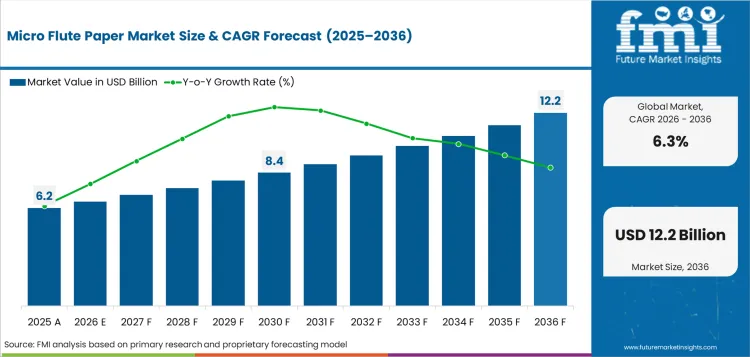
The micro flute paper market value stood at USD 6.2 billion in 2025. Industry revenue is estimated at USD 6.6 billion in 2026 and reach USD 12.2 billion by 2036 at 6.3% CAGR. By material grade recycled paper is expected to represent 57.0% share in 2026. By application packaging is estimated to account for 52.0% share in 2026.
Key Takeaways, Market Size, and Forecast
| Metric | Value |
|---|---|
| Market Size (2025) | USD 6.2 Billion |
| Market Size (2036) | USD 12.2 Billion |
| CAGR (2026–2036) | 6.3% |
| Incremental Opportunity (2026–2036) | USD 5.6 Billion |
| Leading Material Grade (2026) | Recycled Paper |
| Recycled Paper Share (2026) | 57.0% |
| Leading Application (2026) | Packaging |
| Packaging Share (2026) | 52.0% |
| Fastest-Growing Country | China |
| China CAGR | 7.6% |
Summary of Micro Flute Paper Market
- Demand and Growth Drivers
- Online retail is expected to keep micro flute paper active in small parcels and premium shipping cartons.
- Retail brands need compact corrugated formats protecting products and carry clear printed graphics.
- Recyclable paper formats are expected to gain buyer attention as plastic packaging faces stricter review.
- Product and Segment View
- Recycled paper is expected to hold 57.0% share in 2026, driven by brands asking for fiber proof in board sourcing.
- Packaging is expected to account for 52.0% share in 2026, led by shipping and retail packs needing lightweight protection.
- Single wall board is expected to represent 49.0% share in 2026 as e-commerce sellers prefer compact cartons protecting lightweight goods and limit freight volume.
- Geography and Competitive Outlook
- China is likely to record 7.6% CAGR by 2036, helped by online retail scale and local converting depth.
- India is expected to expand at 7.3% CAGR by 2036, shaped by paper packaging growth and branded retail packs.
- Smurfit Westrock, International Paper and Mondi anchor competition through corrugated capacity and design support.
- Analyst Opinion
- Ismail Sutaria, Principal Consultant for Packaging at FMI, opines, “Suppliers combining lightweight strength with high-quality print surfaces are better placed as micro flute paper moves into brand packaging. I see the next profit pool in converters able to run thin board with clean print results and stable folding behavior. E-commerce sellers and retail brands are expected to reward suppliers reducing pack weight while keeping the box visually reliable.”
- Micro Flute Paper Market Value Analysis
- Market value in micro flute paper is tied to board flatness and print surface quality before a brand approves a pack change.
- Supplier pricing reflects fiber grade and converting yield before repeat carton orders move to volume runs.
- Revenue rises above basic corrugated value as printed retail packs and ship-ready cartons carry more design work.
- Converter relationships create higher-value orders as suppliers match micro flute board with paper boxes and premium product packs.
Micro flute paper suppliers now need to prove two things clearly. Buyers want paper cartons meeting fiber traceability rules and support fast packaging runs. Regulation (EU) 2024/3234 moved the EU Deforestation Regulation dates by 12 months. Paper packaging suppliers now have more time to prepare fiber sourcing records before customer checks become stricter. FEFCO’s 2024 Activity Report said cardboard boxes received an exemption from certain reuse targets under the Packaging and Packaging Waste Regulation. This supports micro flute cartons in secondary packaging as long as suppliers can show recyclability and material origin. Speed is becoming another buying factor. BOBST stated in April 2024, packit! can make e-commerce boxes from paper web to pallet-ready form within 36 hours. Faster box production gives converters a clearer route to serve online sellers requiring short runs and clean printed packs.
Micro Flute Paper Market Definition
Micro flute paper covers thin corrugated paperboard made with fine flute profiles used in lightweight protective and display packaging. Scope includes E-flute and F-flute sheets sold to converters and pack makers. G-flute and N-flute sheets are counted when they carry a defined protective or display role. Paper packaging applications are counted when micro flute board is the main protective or presentation layer. Printed cartons and shelf-ready trays are counted through the board and converted pack value. Small parcel packs are counted when micro flute board forms the main pack material. Rigid and solid board cartons without a flute layer are excluded from direct sizing.
Micro Flute Paper Market Inclusions
Scope includes micro flute sheets, converted cartons and printed display packs sold for commercial packaging. Corrugated board packaging made with fine flute profiles is counted across food, electronics and cosmetics applications. E-commerce shippers and retail display formats are included when thin corrugated board provides protection. Recycled and virgin fiber grades are included. Direct converter sales and distributor sales are counted through verified transaction value.
Micro Flute Paper Market Exclusions
Scope excludes plain folding carton board without flute structure. Heavy triple wall cases and bulk industrial bins are counted in heavy duty corrugated packaging and not in this scope. Molded fiber trays and plastic mailers are outside direct sizing. Wood crates are outside direct sizing unless a micro flute liner is sold separately. Printing inks and adhesives are excluded unless sold as part of a micro flute board supply contract. Paper bags are excluded unless micro flute board forms the sold box component. Corrugated box machines are excluded as equipment revenue unless sold inside a board supply contract.
Micro Flute Paper Market Research Methodology
- Primary Research: FMI analysts reviewed board specification needs across converters and consumer goods pack teams.
- Desk Research: Public e-commerce data, packaging rules and company capacity announcements supported demand checks and scope mapping.
- Market Sizing and Forecasting: Forecast values used corrugated packaging value and application mix assumptions.
- Data Validation: Checks compared 2026 value with 2036 value and tested CAGR consistency across seven country rates.
Why is the Micro Flute Paper Market Growing?
- Online sellers are shifting toward compact paper cartons reducing void fill and keeping parcel protection practical.
- Brand owners prefer fine flute board combining shelf-ready print quality with strength for direct shipping.
- Converters are placing recycled and recyclable fiber formats earlier in pack design as buyer checks become stricter.
Pack owners are moving micro flute paper from a carton choice to an early design decision. Amazon stated in June 2024, it had replaced 95% of plastic air pillows in North America with paper filler and expected the shift to avoid nearly 15 billion plastic air pillows each year. Such a shift strengthens the case for compact corrugated boxes working with paper fill and reduce empty space in parcel packs. European Paper Recycling Council reported in July 2025, Europe’s paper recycling rate reached 75.1% in 2024. Recycling performance keeps recycled fiber and end-of-life proof central to board selection. American Forest & Paper Association reported in January 2026, total containerboard production fell 4% in 2025 compared with 2024 and operating rates stayed above 91%. Tighter supply discipline favors converters offering stable micro flute grades with reliable print surfaces and repeat delivery.
Market Segmentation Analysis
- Recycled paper is projected to account for 57.0% share in 2026 as brands request fiber recovery proof and lower virgin fiber exposure.
- Packaging is expected to represent 52.0% share in 2026, influenced by parcel cartons and shelf-ready packs using thin corrugated board.
- Single wall board is projected to hold 49.0% share in 2026 since most micro flute packs need one compact strength layer.
- Direct supply is expected to account for 46.0% share in 2026 due to large converters preferring agreed board specifications and repeat deliveries.
- E-flute is projected to hold 44.0% share in 2026, led by its profile supporting print detail and basic product protection.
- Litho print is expected to account for 38.0% share in 2026, reflected by premium retail packs requiring smoother graphics on micro flute surfaces.
Segmentation is divided into six parent groups built around how buyers specify micro flute performance. Flute type defines the paper profile and board thickness. Board structure shows how many layers carry strength during handling. Material grade explains fiber choice and sourcing expectations. Print type reflects how brands want the pack to look. Application identifies the product role. Sales channel explains how converters and pack users buy repeated supply.
Insights into Micro Flute Paper Market by Flute Type
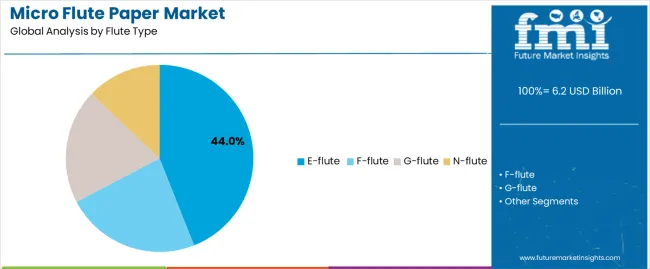
- E-flute is expected to account for 44.0% share in 2026, driven by branded product boxes needing a fine profile with useful compression strength.
- F-flute gains value in compact retail packs as brands seek thinner caliper board for cosmetics and small consumer goods displays.
Insights into Micro Flute Paper Market by Board Structure
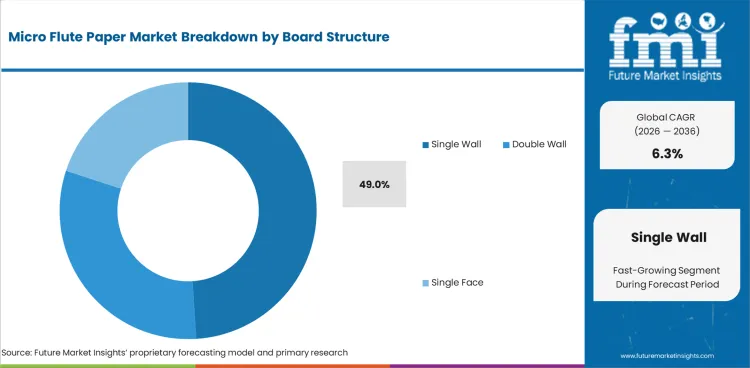
- Single wall board is expected to represent 49.0% share in 2026, influenced by converters balancing board weight with carton stiffness.
- Single face formats serve wraps and inside supports requiring cushioning without forming a full box structure.
Insights into Micro Flute Paper Market by Material Grade
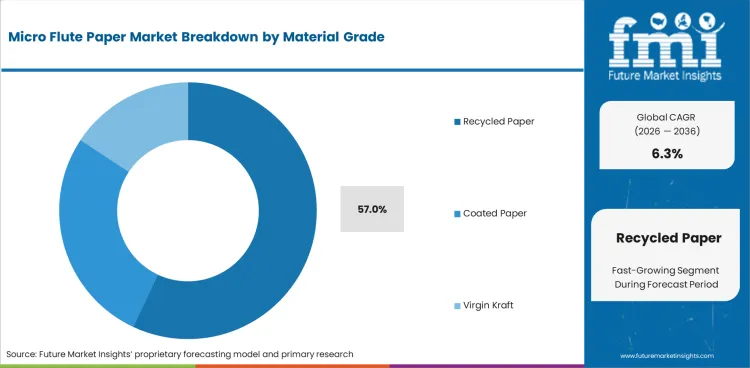
- Recycled paper is projected to hold 57.0% share in 2026 as packaging teams check recycled fiber content before approving carton programs.
- Virgin kraft retains value in high-print and food-contact packs needing cleaner fiber quality and stable board strength.
Insights into Micro Flute Paper Market by Print Type
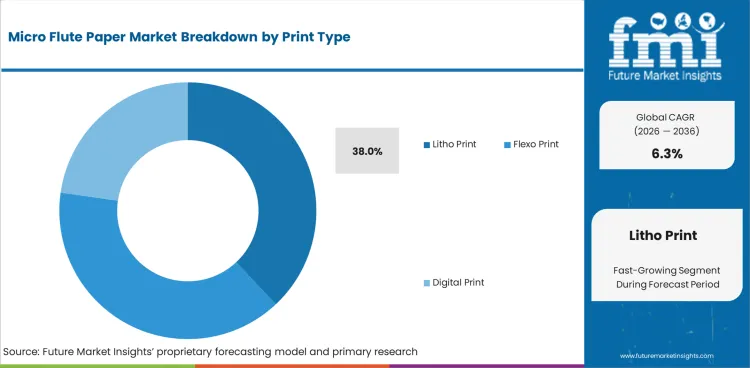
- Litho print is expected to account for 38.0% share in 2026 due to premium packs needing smooth graphics and sharper brand color control.
- sustainable packaging is rising in short runs as direct brands change designs faster and reduce plate costs.
Insights into Micro Flute Paper Market by Application
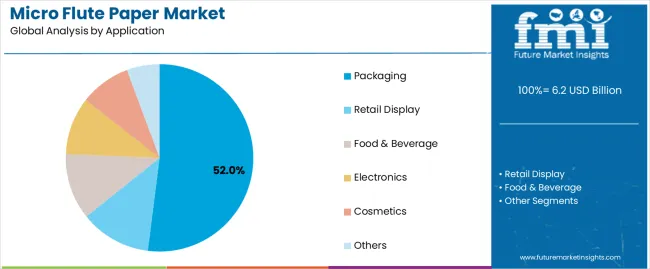
- Packaging is projected to capture 52.0% share in 2026, led by retail e-commerce packaging needing lightweight presentation boxes.
- Retail display use creates value through shelf-ready trays and counter packs needing print appeal with structural support.
Insights into Micro Flute Paper Market by Sales Channel
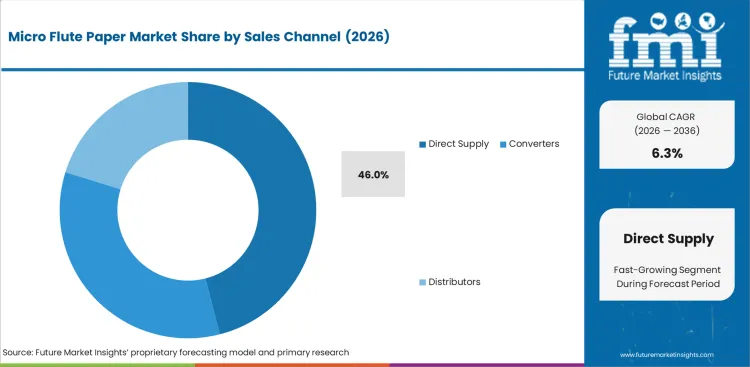
- Direct supply is expected to account for 46.0% share in 2026 due to major converters preferring fixed board grades and planned supply windows.
- Distributors serve smaller pack makers needing stocked sheets and quick access to standard paper and paperboard packaging grades.
Micro Flute Paper Market Drivers, Restraints and Opportunities
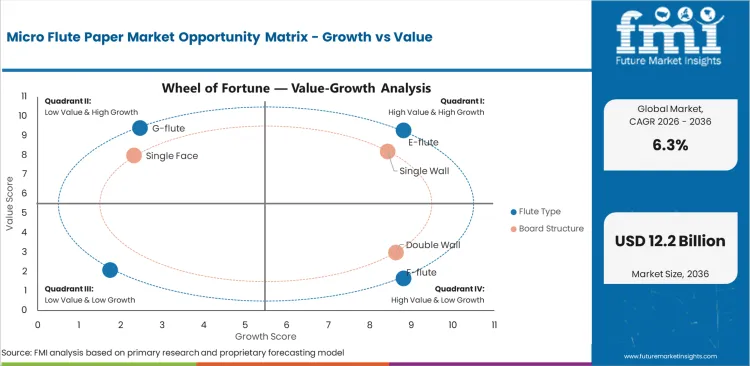
- Direct-to-consumer brands are bringing micro flute board into earlier pack design reviews as protection and presentation are checked together.
- Thin flute packs face slower uptake when plants lack scoring control and repeat folding accuracy.
- Recyclability-based fee pressure gives paper-based cartons a clearer route to replace plastic-heavy secondary packs.
Parcel packaging is moving toward lighter formats still working across high-volume delivery networks. United Parcel Service reported average daily package volume of 20.8 million pieces in 2025 across global small package operations, reflecting the scale of parcel handling carton suppliers are required to support. Cost discipline is a second factor for converters. United Kingdom PackUK listed 2025 to 2026 packaging EPR base fees at £196 per tonne for paper and card compared with £423 per tonne for plastic. Such fee gap supports recyclable paper board formats when pack performance is acceptable. Operating limits remain important since fine flute board needs accurate scoring and controlled folding to avoid waste in printed cartons. PackUK also stated, the red modulation factor can rise to 2.0 times the disposal fee over the modulation period. This gives micro flute suppliers a stronger case on proving recyclability and consistent converting output.
Material Switching and Replacement Analysis
Material switching in micro flute paper is expected to move through tested replacement of plastic-heavy and solid board packs in applications requiring print appeal with reliable handling. A September 2025 peer-reviewed paper in Food Packaging and Shelf Life found, paperboard packaging samples from 4 European countries showed good repulpability. It also noted, recycled fiber affects moisture interaction and material performance. Such findings support micro flute paper as a practical replacement route only when converters can prove moisture response and board strength during trial runs.
Regulatory Compliance Impact Analysis
Regulatory compliance is expected to make paper and paperboard packaging selection more evidence-based as brands check material claims before approval. Regulation (EU) 2025/40 states, packaging placed on the EU market must meet sustainability and recyclability requirements. This gives micro flute paper suppliers a stronger route into secondary packaging when coatings and inks do not weaken recycling claims. Converters selling printed board structures need clear material records and recycling evidence before buyers accept new pack designs.
Analysis of Micro Flute Paper Market by Key Countries
.webp "Top Country Growth Comparison Micro Flute Paper Market Cagr (2026 2036)")
| Country | CAGR |
|---|---|
| China | 7.6% |
| India | 7.3% |
| United States | 7.0% |
| Germany | 6.1% |
| Japan | 5.9% |
| United Kingdom | 5.7% |
| Brazil | 5.4% |
Source: Future Market Insights, 2026.
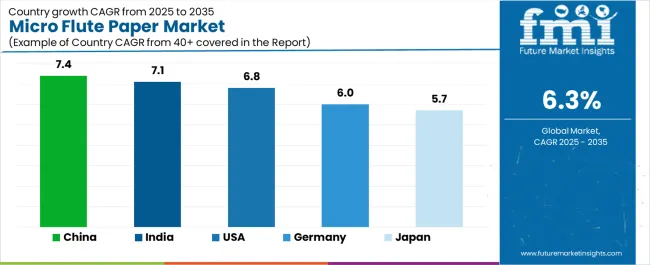
Micro Flute Paper Market CAGR Analysis by Country
- China is projected to record 7.6% CAGR by 2036, influenced by online retail scale and local carton conversion capacity.
- India is expected to expand at 7.3% CAGR by 2036, led by paper packaging growth and branded consumer goods packs.
- United States is forecast to grow at 7.0% CAGR by 2036 through online retail sales and premium shipping boxes.
- Germany is expected to advance at 6.1% CAGR by 2036 as recycling rules and high-quality packaging needs guide suppliers.
- Japan is projected to rise at 5.9% CAGR by 2036, reflecting precision packaging and electronics pack requirements.
- United Kingdom is forecast at 5.7% CAGR by 2036 with online retail supporting small parcel pack use.
- Brazil is expected to post 5.4% CAGR by 2036 as food processing and consumer goods packaging expand.
Country performance differs by online retail depth and converter capability. China and India track above the global pace as retail scale and packaging investment both support new micro flute use. United States remains above established European rates due to direct-to-consumer shipping and premium brand cartons. Germany and Japan expand at measured rates through established users. United Kingdom and Brazil gain from selective pack changes in retail goods.
Demand Outlook for Micro Flute Paper in China
Demand in China is projected to record 7.6% CAGR by 2036, influenced by online retail keeping carton use active across consumer goods. National Bureau of Statistics of China reported in January 2026, online retail sales of physical goods reached 13,092.3 billion yuan in 2025. Such scale gives micro flute paper a direct route into small parcel cartons and display-ready product boxes. Local converters can supply thin corrugated board close to major retail and export pack users.
- Online retail scale supports micro flute use in small cartons needing low weight and print clarity.
- Food and daily goods sellers need paper packs handling repeat parcel movement and shelf display.
- Local converter depth improves access to E-flute and F-flute sheets for high-volume branded packs.
Demand Analysis of Micro Flute Paper in India
The market in India is expected to expand at 7.3% CAGR by 2036, reflected by branded retail and packaging investment moving together. India Brand Equity Foundation reported, India paper packaging reached USD 19.07 billion as of August 2025. A larger paper packaging pool supports micro flute cartons for food, beauty and quick-commerce shipments. Domestic converters are expected to gain as pack users seek recyclable board with affordable print results.
- Snack and personal care brands use compact cartons needing lower board weight and clear shelf graphics.
- Quick-commerce orders support small parcel formats required to protect products during dense delivery cycles.
- Recycled paper grades gain interest as brands ask suppliers for fiber recovery proof in tender reviews.
Growth Outlook for Micro Flute Paper in the United States
Sector in the United States is forecast to grow at 7.0% CAGR by 2036, led by online sales continuing to shape shipping packs. United States Census Bureau data placed first quarter 2026 retail e-commerce sales at USD 326.7 billion after seasonal adjustment. Micro flute board benefits as brands seek presentation cartons travelling through parcel networks. Large converters can pair paper box design with testing support for drop and compression performance.
- Direct-to-consumer brands value printed cartons protecting goods and improve unboxing presentation.
- Electronics and cosmetics sellers need compact corrugated packs with cleaner graphics and better corner protection.
- National converter networks support repeat programs for subscription boxes and specialty retail shipments.
Sales Analysis of Micro Flute Paper in Germany
Sales in Germany are projected to rise at 6.1% CAGR by 2036 due to recycling expectations and premium packaging remaining linked. Eurostat reported in October 2025, Germany generated 215.2 kilograms of packaging waste per inhabitant in 2023. High recovery pressure makes paper based pack choices more visible during material approval. German converters are expected to favor micro flute formats combining clean scoring with documented recyclability.
- Premium goods producers use micro flute board for printed packs requiring a rigid feel without heavy board.
- Recycling proof is becoming a stronger filter as pack owners compare coating and ink choices.
- Europe corrugated packaging expertise supports micro flute adoption in retail display and specialty boxes.
Sales Outlook for Micro Flute Paper in Japan
The market in Japan is expected to post 5.9% CAGR by 2036 as pack quality and compact form factors guide material choice. Ministry of Economy, Trade and Industry reported in August 2025, Japan business-to-consumer e-commerce reached 26.1 trillion yen in 2024. Presentation quality is important for compact goods such as electronics and cosmetics. Micro flute paper suppliers can profit when board thickness stays stable during printing and folding.
- Electronics packaging uses fine flute board to protect compact products without adding bulky cartons.
- Cosmetics packs need smooth print surfaces and clean folds for premium shelf presentation.
- Automation-friendly sheets support repeat converting runs with fewer scoring defects and lower waste.
Demand Outlook for Micro Flute Paper in the United Kingdom
Demand in the United Kingdom is forecast at 5.7% CAGR by 2036, reflected by online retail keeping small carton use active. International Trade Administration guidance published in February 2026 said retail e-commerce sales were predicted to represent 38.1% of United Kingdom total retail sales in 2025. Such a high online share supports micro flute use in lightweight shipping and branded delivery packs. Local brands are expected to favor print-ready board working for both parcels and shelf display.
- Fashion and beauty sellers need compact boxes with brand graphics and reliable parcel protection.
- Smaller online brands value stock micro flute formats reducing minimum order risk.
- Retailers using contract packaging seek formats running well across outsourced packing lines.
Demand Outlook for Micro Flute Paper in Brazil
Sector in Brazil is forecast at 5.4% CAGR by 2036 since processed food and consumer goods packs form the main use channel. United States Department of Agriculture Foreign Agricultural Service reported in March 2026, Brazil food processing revenue reached about USD 248.0 billion in 2025. Large processed food output supports printed cartons for snacks and specialty retail goods. Micro flute paper suppliers must balance strength and price for mass retail distribution.
- Food brands use micro flute cartons for retail presentation and protection across long domestic logistics routes.
- Export-oriented consumer goods need stronger print surfaces and lower pack weight for regional shipments.
- Distributor sales remains important as smaller pack makers buy standard sheets for short production runs.
Competitive Landscape and Strategic Positioning
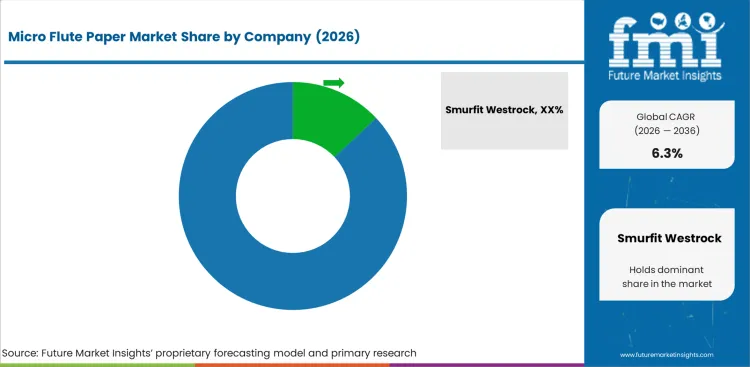
- Large corrugated groups hold an advantage led by controlling board supply and supporting design testing at scale.
- Integrated paper groups compete by linking liner supply with converting reach across retail and e-commerce packaging accounts.
- Regional converters gain attention on providing quick production run and print support for established brand packaging.
Competition in the micro flute paper market is shaped by large global corrugated groups and regional sheet converters. Suppliers compete on consistent flute quality and clean print surfaces. Dependable delivery strengthens their position in retail and e-commerce packaging. Smurfit Westrock operates across 40 countries with over 500 packaging converting operations after its 2024 combination. International Paper gained DS Smith in January 2025 and widened its reach across North America and Europe. Mondi strengthened Western Europe corrugated capacity in April 2025 through the Schumacher Packaging asset acquisition. Consumer electronics packaging creates a higher specification route for micro flute formats needing fine print and controlled product protection.
Supplier selection starts with proof stating a carton can protect products and keep graphics clean after folding. Price remains important, but brand owners increasingly expect testing data and sample support before approving repeat orders. Corrugated automotive packaging and retail display packs continue to influence design expectations for strength and presentation. Suppliers with reliable board quality and fast sample making are best placed to win. Global groups hold an edge in scale and supply security. Responsive regional converters can win specialized programs requiring short runs and close print support.
Key Companies in the Micro Flute Paper Market
Competitive structure is grouped by integrated corrugated groups, print-ready packaging suppliers and Asian paper groups.
- Integrated Corrugated Groups: Smurfit Westrock and International Paper support large micro flute programs through paper supply. Mondi plc and Packaging Corporation of America support the same programs through converting reach.
- Print-Ready Packaging Suppliers: Stora Enso and Mondi support retail and premium display packs needing clean surface quality and structural precision.
- Asian Paper Groups: Rengo Co., Ltd. and Oji Holdings Corporation support fine flute demand due to corrugated operations and regional packaging networks.
Competitive Benchmarking: Micro Flute Paper Market
| Company | Microflute Converting Depth | Print Surface Support | E-Commerce Pack Reach | Geographic Footprint |
|---|---|---|---|---|
| Smurfit Westrock | Very Strong | Strong | Very Strong | Global |
| International Paper | Very Strong | Strong | Very Strong | Global |
| Mondi plc | Strong | Very Strong | Strong | Global |
| Packaging Corporation of America | Strong | Moderate | Strong | North America |
| Stora Enso | Strong | Very Strong | Moderate | Europe |
| Rengo Co., Ltd. | Strong | Moderate | Strong | Asia Pacific |
| Oji Holdings Corporation | Strong | Moderate | Moderate | Asia Pacific |
Source: Future Market Insights competitive analysis 2026. Ratings reflect relative positioning by micro flute converting depth, print surface support and e-commerce pack reach.
Key Developments in Micro Flute Paper Market
- In January 2025, Victory Packaging became Smurfit Westrock Packaging Solutions, strengthening Smurfit Westrock’s packaging distribution and customer support reach.
- In January 2025, International Paper completed the acquisition of DS Smith, expanding its paper packaging footprint across North America and EMEA.
- In April 2025, Mondi completed the acquisition of Schumacher Packaging’s Western Europe operations, adding over 1 billion square metres of packaging capacity.
Key Players in the Micro Flute Paper Market
Major Global Players:
- Smurfit Westrock
- International Paper
- Mondi plc
- Packaging Corporation of America
- Stora Enso
Specialist and Regional Players:
- Rengo Co., Ltd.
- Oji Holdings Corporation
-
Market Report Scope
Report Scope
| Parameter | Details |
|---|---|
| Quantitative units | USD 6.6 billion to USD 12.2 billion at 6.3% CAGR |
| Market definition | Thin corrugated paperboard with fine flute profiles used for protective and display packaging |
| By flute type | E-flute, F-flute, G-flute, N-flute |
| By board structure | Single face, single wall, double wall |
| By material grade | Virgin kraft, recycled paper, coated paper |
| By print type | Litho print, flexo print, digital print |
| By application | Packaging, retail display, food packaging, electronics, cosmetics, others |
| By sales channel | Direct supply, converters, distributors |
| Regions covered | North America, Latin America, Europe, East Asia, South Asia and Pacific, Middle East and Africa |
| Countries covered | China, India, United States, Germany, Japan, United Kingdom, Brazil |
| Key companies profiled | Smurfit Westrock, International Paper, Mondi plc, Packaging Corporation of America, Stora Enso, Rengo Co., Ltd., Oji Holdings Corporation |
| Forecast period | 2026 to 2036 |
| Approach | Hybrid top-down and bottom-up sizing with converter and application checks |
Source: Future Market Insights, 2026.
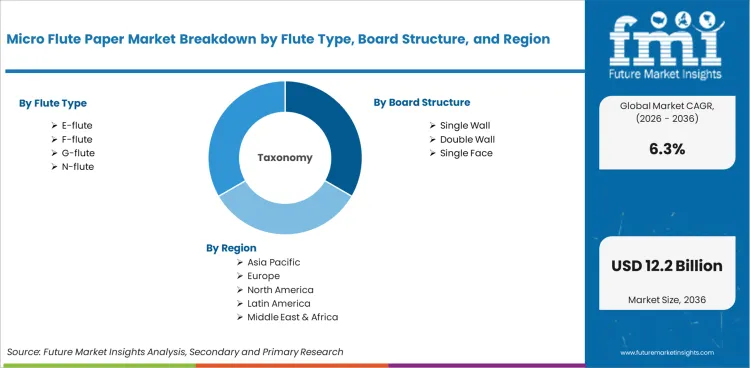
Micro Flute Paper Market Breakdown by Flute Type, Board Structure, Material Grade, Print Type, Application, Sales Channel, and Region
By Flute Type
- E-flute
- F-flute
- G-flute
- N-flute
By Board Structure
- Single Face
- Single Wall
- Double Wall
By Material Grade
- Virgin Kraft
- Recycled Paper
- Coated Paper
By Print Type
- Litho Print
- Flexo Print
- Digital Print
By Application
- Packaging
- Retail Display
- Food Packaging
- Electronics
- Cosmetics
- Others
By Sales Channel
- Direct Supply
- Converters
- Distributors
By Region
- North America
- Latin America
- Europe
- East Asia
- South Asia and Pacific
- Middle East and Africa
Research Sources and Bibliography
- United Parcel Service, Inc. (2026, February 17). 2025 annual report on Form 10-K. USA Securities and Exchange Commission.
- Department for Environment, Food & Rural Affairs. (2025, June 30). Extended Producer Responsibility for Packaging: 2025 base fees. GOV.UK.
- PackUK. (2026, February 17). PackUK extended producer responsibility (EPR) for packaging: producer disposal fees modulation statement. GOV.UK.
- European Parliament and Council of the European Union. (2025, January 22). Regulation (EU) 2025/40 on packaging and packaging waste. Official Journal of the European Union.
- Singh, S., Sögut, E., Uysal-Unalan, I., Karlovits, I., Coma, V., Corredig, M., & Poças, F. (2025). Current usage of paperboard packaging: A case study of the European landscape on tomato packaging. Food Packaging and Shelf Life, 51, Article 101572.
- European Parliament and Council of the European Union. (2024, December 23). Regulation (EU) 2024/3234 amending Regulation (EU) 2023/1115 as regards provisions relating to the date of application.
- BOBST. (2024, April 26). E-commerce packaging from paper to box in 36 hours.
- European Federation of Corrugated Board Manufacturers. (2025, October 27). FEFCO Activity Report 2024.
- Amazon Staff. (2024, June 20). Amazon announces its largest reduction in plastic packaging in North America to date. Amazon.
- European Paper Recycling Council. (2025, July 11). European Paper Recycling Council reports strong recycling rates for 2024. Confederation of European Paper Industries.
- American Forest & Paper Association. (2026, January 30). AF&PA releases Q4 2025 containerboard quarterly report.
- European Commission. (2025, February 11). Packaging waste.
- Eurostat. (2025, October 10). Packaging waste statistics.
- India Brand Equity Foundation. (2025, August). India’s thriving paper and packaging industry.
- National Bureau of Statistics of China. (2026, January 20). Total retail sales of consumer goods in December 2025.
- United States Census Bureau. (2026, May 18). Quarterly retail e-commerce sales.
- Ministry of Economy, Trade and Industry. (2025, August 26). Results of FY2024 e-commerce market survey compiled.
- International Trade Administration. (2026, February 3). United Kingdom - eCommerce.
- United States Department of Agriculture Foreign Agricultural Service. (2026, March 31). Brazil: Food processing ingredients annual.
- Mondi. (2025, April 1). Mondi expands packaging portfolio and capacity by completing acquisition of Schumacher Packaging’s Western Europe operations.
- Smurfit Westrock. (2025, January 13). Victory Packaging becomes Smurfit Westrock Packaging Solutions.
- International Paper Company. (2025, April 30). Quarterly report on Form 10-Q for the quarter ended March 31, 2025. USA Securities and Exchange Commission.
This Report Answers
- What is the current and forecast value of the micro flute paper market?
- Which material grade is projected to hold a leading share in 2026?
- How does packaging use shape demand for micro flute paper structures?
- Which countries lead in the market for micro flute paper?
- How do print quality and recyclability affect supplier positioning?
- Which companies compete in micro flute paper?
Frequently Asked Questions
What is the micro flute paper market value in 2026?
The micro flute paper market value is expected to cross USD 6.6 billion in 2026 and scale to USD 12.2 billion by 2036.
What CAGR is projected for the micro flute paper market?
The micro flute paper sector is projected to expand at 6.3% CAGR from 2026 to 2036 as lightweight paper packaging use widens.
Which material grade leads the micro flute paper market?
Recycled paper is set to account for 57.0% share in 2026 as brands seek fiber recovery proof and lower virgin content.
Which application is important for micro flute paper?
Packaging is expected to hold 52.0% share in 2026, led by parcel cartons and retail packs needing lightweight protection.
Which country leads in the micro flute paper market?
China is likely to record 7.6% CAGR by 2036, driven by online retail scale and strong local converting depth.
Who are key players in the micro flute paper market?
Smurfit Westrock and International Paper are active suppliers. Mondi, Packaging Corporation of America and Stora Enso compete with Rengo and Oji.
Preview the report firsthand - request a free sample
Get SampleGet the brochure for pricing and purchase details.
Get PDFTable of Content
- Executive Summary
- Global Market Outlook
- Demand-side Trends
- Supply-side Trends
- Technology Roadmap Analysis
- Analysis and Recommendations
- Market Overview
- Market Coverage / Taxonomy
- Market Definition / Scope / Limitations
- Research Methodology
- Chapter Orientation
- Analytical Lens and Working Hypotheses
- Market Structure, Signals, and Trend Drivers
- Benchmarking and Cross-market Comparability
- Market Sizing, Forecasting, and Opportunity Mapping
- Research Design and Evidence Framework
- Desk Research Programme (Secondary Evidence)
- Company Annual and Sustainability Reports
- Peer-reviewed Journals and Academic Literature
- Corporate Websites, Product Literature, and Technical Notes
- Earnings Decks and Investor Briefings
- Statutory Filings and Regulatory Disclosures
- Technical White Papers and Standards Notes
- Trade Journals, Industry Magazines, and Analyst Briefs
- Conference Proceedings, Webinars, and Seminar Materials
- Government Statistics Portals and Public Data Releases
- Press Releases and Reputable Media Coverage
- Specialist Newsletters and Curated Briefings
- Sector Databases and Reference Repositories
- FMI Internal Proprietary Databases and Historical Market Datasets
- Subscription Datasets and Paid Sources
- Social Channels, Communities, and Digital Listening Inputs
- Additional Desk Sources
- Expert Input and Fieldwork (Primary Evidence)
- Primary Modes
- Qualitative Interviews and Expert Elicitation
- Quantitative Surveys and Structured Data Capture
- Blended Approach
- Why Primary Evidence is Used
- Field Techniques
- Interviews
- Surveys
- Focus Groups
- Observational and In-context Research
- Social and Community Interactions
- Stakeholder Universe Engaged
- C-suite Leaders
- Board Members
- Presidents and Vice Presidents
- R&D and Innovation Heads
- Technical Specialists
- Domain Subject-matter Experts
- Scientists
- Physicians and Other Healthcare Professionals
- Governance, Ethics, and Data Stewardship
- Research Ethics
- Data Integrity and Handling
- Primary Modes
- Tooling, Models, and Reference Databases
- Desk Research Programme (Secondary Evidence)
- Data Engineering and Model Build
- Data Acquisition and Ingestion
- Cleaning, Normalisation, and Verification
- Synthesis, Triangulation, and Analysis
- Quality Assurance and Audit Trail
- Market Background
- Market Dynamics
- Drivers
- Restraints
- Opportunity
- Trends
- Scenario Forecast
- Demand in Optimistic Scenario
- Demand in Likely Scenario
- Demand in Conservative Scenario
- Opportunity Map Analysis
- Product Life Cycle Analysis
- Supply Chain Analysis
- Investment Feasibility Matrix
- Value Chain Analysis
- PESTLE and Porter’s Analysis
- Regulatory Landscape
- Regional Parent Market Outlook
- Production and Consumption Statistics
- Import and Export Statistics
- Market Dynamics
- Global Market Analysis 2021 to 2025 and Forecast, 2026 to 2036
- Historical Market Size Value (USD Million) Analysis, 2021 to 2025
- Current and Future Market Size Value (USD Million) Projections, 2026 to 2036
- Y-o-Y Growth Trend Analysis
- Absolute $ Opportunity Analysis
- Global Market Pricing Analysis 2021 to 2025 and Forecast 2026 to 2036
- Global Market Analysis 2021 to 2025 and Forecast 2026 to 2036, By Flute Type
- Introduction / Key Findings
- Historical Market Size Value (USD Million) Analysis By Flute Type , 2021 to 2025
- Current and Future Market Size Value (USD Million) Analysis and Forecast By Flute Type , 2026 to 2036
- E-flute
- F-flute
- G-flute
- N-flute
- E-flute
- Y-o-Y Growth Trend Analysis By Flute Type , 2021 to 2025
- Absolute $ Opportunity Analysis By Flute Type , 2026 to 2036
- Global Market Analysis 2021 to 2025 and Forecast 2026 to 2036, By Board Structure
- Introduction / Key Findings
- Historical Market Size Value (USD Million) Analysis By Board Structure, 2021 to 2025
- Current and Future Market Size Value (USD Million) Analysis and Forecast By Board Structure, 2026 to 2036
- Single Wall
- Double Wall
- Single Face
- Single Wall
- Y-o-Y Growth Trend Analysis By Board Structure, 2021 to 2025
- Absolute $ Opportunity Analysis By Board Structure, 2026 to 2036
- Global Market Analysis 2021 to 2025 and Forecast 2026 to 2036, By Material Grade
- Introduction / Key Findings
- Historical Market Size Value (USD Million) Analysis By Material Grade, 2021 to 2025
- Current and Future Market Size Value (USD Million) Analysis and Forecast By Material Grade, 2026 to 2036
- Recycled Paper
- Coated Paper
- Virgin Kraft
- Recycled Paper
- Y-o-Y Growth Trend Analysis By Material Grade, 2021 to 2025
- Absolute $ Opportunity Analysis By Material Grade, 2026 to 2036
- Global Market Analysis 2021 to 2025 and Forecast 2026 to 2036, By Print Type
- Introduction / Key Findings
- Historical Market Size Value (USD Million) Analysis By Print Type, 2021 to 2025
- Current and Future Market Size Value (USD Million) Analysis and Forecast By Print Type, 2026 to 2036
- Litho Print
- Flexo Print
- Digital Print
- Litho Print
- Y-o-Y Growth Trend Analysis By Print Type, 2021 to 2025
- Absolute $ Opportunity Analysis By Print Type, 2026 to 2036
- Global Market Analysis 2021 to 2025 and Forecast 2026 to 2036, By Application
- Introduction / Key Findings
- Historical Market Size Value (USD Million) Analysis By Application, 2021 to 2025
- Current and Future Market Size Value (USD Million) Analysis and Forecast By Application, 2026 to 2036
- Packaging
- Retail Display
- Food Packaging
- Electronics
- Cosmetics
- Others
- Packaging
- Y-o-Y Growth Trend Analysis By Application, 2021 to 2025
- Absolute $ Opportunity Analysis By Application, 2026 to 2036
- Global Market Analysis 2021 to 2025 and Forecast 2026 to 2036, By Sales Channel
- Introduction / Key Findings
- Historical Market Size Value (USD Million) Analysis By Sales Channel, 2021 to 2025
- Current and Future Market Size Value (USD Million) Analysis and Forecast By Sales Channel, 2026 to 2036
- Direct Supply
- Converters
- Distributors
- Direct Supply
- Y-o-Y Growth Trend Analysis By Sales Channel, 2021 to 2025
- Absolute $ Opportunity Analysis By Sales Channel, 2026 to 2036
- Global Market Analysis 2021 to 2025 and Forecast 2026 to 2036, By Region
- Introduction
- Historical Market Size Value (USD Million) Analysis By Region, 2021 to 2025
- Current Market Size Value (USD Million) Analysis and Forecast By Region, 2026 to 2036
- North America
- Latin America
- Western Europe
- Eastern Europe
- East Asia
- South Asia and Pacific
- Middle East & Africa
- Market Attractiveness Analysis By Region
- North America Market Analysis 2021 to 2025 and Forecast 2026 to 2036, By Country
- Historical Market Size Value (USD Million) Trend Analysis By Market Taxonomy, 2021 to 2025
- Market Size Value (USD Million) Forecast By Market Taxonomy, 2026 to 2036
- By Country
- USA
- Canada
- Mexico
- By Flute Type
- By Board Structure
- By Material Grade
- By Print Type
- By Application
- By Sales Channel
- By Country
- Market Attractiveness Analysis
- By Country
- By Flute Type
- By Board Structure
- By Material Grade
- By Print Type
- By Application
- By Sales Channel
- Key Takeaways
- Latin America Market Analysis 2021 to 2025 and Forecast 2026 to 2036, By Country
- Historical Market Size Value (USD Million) Trend Analysis By Market Taxonomy, 2021 to 2025
- Market Size Value (USD Million) Forecast By Market Taxonomy, 2026 to 2036
- By Country
- Brazil
- Chile
- Rest of Latin America
- By Flute Type
- By Board Structure
- By Material Grade
- By Print Type
- By Application
- By Sales Channel
- By Country
- Market Attractiveness Analysis
- By Country
- By Flute Type
- By Board Structure
- By Material Grade
- By Print Type
- By Application
- By Sales Channel
- Key Takeaways
- Western Europe Market Analysis 2021 to 2025 and Forecast 2026 to 2036, By Country
- Historical Market Size Value (USD Million) Trend Analysis By Market Taxonomy, 2021 to 2025
- Market Size Value (USD Million) Forecast By Market Taxonomy, 2026 to 2036
- By Country
- Germany
- UK
- Italy
- Spain
- France
- Nordic
- BENELUX
- Rest of Western Europe
- By Flute Type
- By Board Structure
- By Material Grade
- By Print Type
- By Application
- By Sales Channel
- By Country
- Market Attractiveness Analysis
- By Country
- By Flute Type
- By Board Structure
- By Material Grade
- By Print Type
- By Application
- By Sales Channel
- Key Takeaways
- Eastern Europe Market Analysis 2021 to 2025 and Forecast 2026 to 2036, By Country
- Historical Market Size Value (USD Million) Trend Analysis By Market Taxonomy, 2021 to 2025
- Market Size Value (USD Million) Forecast By Market Taxonomy, 2026 to 2036
- By Country
- Russia
- Poland
- Hungary
- Balkan & Baltic
- Rest of Eastern Europe
- By Flute Type
- By Board Structure
- By Material Grade
- By Print Type
- By Application
- By Sales Channel
- By Country
- Market Attractiveness Analysis
- By Country
- By Flute Type
- By Board Structure
- By Material Grade
- By Print Type
- By Application
- By Sales Channel
- Key Takeaways
- East Asia Market Analysis 2021 to 2025 and Forecast 2026 to 2036, By Country
- Historical Market Size Value (USD Million) Trend Analysis By Market Taxonomy, 2021 to 2025
- Market Size Value (USD Million) Forecast By Market Taxonomy, 2026 to 2036
- By Country
- China
- Japan
- South Korea
- By Flute Type
- By Board Structure
- By Material Grade
- By Print Type
- By Application
- By Sales Channel
- By Country
- Market Attractiveness Analysis
- By Country
- By Flute Type
- By Board Structure
- By Material Grade
- By Print Type
- By Application
- By Sales Channel
- Key Takeaways
- South Asia and Pacific Market Analysis 2021 to 2025 and Forecast 2026 to 2036, By Country
- Historical Market Size Value (USD Million) Trend Analysis By Market Taxonomy, 2021 to 2025
- Market Size Value (USD Million) Forecast By Market Taxonomy, 2026 to 2036
- By Country
- India
- ASEAN
- Australia & New Zealand
- Rest of South Asia and Pacific
- By Flute Type
- By Board Structure
- By Material Grade
- By Print Type
- By Application
- By Sales Channel
- By Country
- Market Attractiveness Analysis
- By Country
- By Flute Type
- By Board Structure
- By Material Grade
- By Print Type
- By Application
- By Sales Channel
- Key Takeaways
- Middle East & Africa Market Analysis 2021 to 2025 and Forecast 2026 to 2036, By Country
- Historical Market Size Value (USD Million) Trend Analysis By Market Taxonomy, 2021 to 2025
- Market Size Value (USD Million) Forecast By Market Taxonomy, 2026 to 2036
- By Country
- Kingdom of Saudi Arabia
- Other GCC Countries
- Turkiye
- South Africa
- Other African Union
- Rest of Middle East & Africa
- By Flute Type
- By Board Structure
- By Material Grade
- By Print Type
- By Application
- By Sales Channel
- By Country
- Market Attractiveness Analysis
- By Country
- By Flute Type
- By Board Structure
- By Material Grade
- By Print Type
- By Application
- By Sales Channel
- Key Takeaways
- Key Countries Market Analysis
- USA
- Pricing Analysis
- Market Share Analysis, 2025
- By Flute Type
- By Board Structure
- By Material Grade
- By Print Type
- By Application
- By Sales Channel
- Canada
- Pricing Analysis
- Market Share Analysis, 2025
- By Flute Type
- By Board Structure
- By Material Grade
- By Print Type
- By Application
- By Sales Channel
- Mexico
- Pricing Analysis
- Market Share Analysis, 2025
- By Flute Type
- By Board Structure
- By Material Grade
- By Print Type
- By Application
- By Sales Channel
- Brazil
- Pricing Analysis
- Market Share Analysis, 2025
- By Flute Type
- By Board Structure
- By Material Grade
- By Print Type
- By Application
- By Sales Channel
- Chile
- Pricing Analysis
- Market Share Analysis, 2025
- By Flute Type
- By Board Structure
- By Material Grade
- By Print Type
- By Application
- By Sales Channel
- Germany
- Pricing Analysis
- Market Share Analysis, 2025
- By Flute Type
- By Board Structure
- By Material Grade
- By Print Type
- By Application
- By Sales Channel
- UK
- Pricing Analysis
- Market Share Analysis, 2025
- By Flute Type
- By Board Structure
- By Material Grade
- By Print Type
- By Application
- By Sales Channel
- Italy
- Pricing Analysis
- Market Share Analysis, 2025
- By Flute Type
- By Board Structure
- By Material Grade
- By Print Type
- By Application
- By Sales Channel
- Spain
- Pricing Analysis
- Market Share Analysis, 2025
- By Flute Type
- By Board Structure
- By Material Grade
- By Print Type
- By Application
- By Sales Channel
- France
- Pricing Analysis
- Market Share Analysis, 2025
- By Flute Type
- By Board Structure
- By Material Grade
- By Print Type
- By Application
- By Sales Channel
- India
- Pricing Analysis
- Market Share Analysis, 2025
- By Flute Type
- By Board Structure
- By Material Grade
- By Print Type
- By Application
- By Sales Channel
- ASEAN
- Pricing Analysis
- Market Share Analysis, 2025
- By Flute Type
- By Board Structure
- By Material Grade
- By Print Type
- By Application
- By Sales Channel
- Australia & New Zealand
- Pricing Analysis
- Market Share Analysis, 2025
- By Flute Type
- By Board Structure
- By Material Grade
- By Print Type
- By Application
- By Sales Channel
- China
- Pricing Analysis
- Market Share Analysis, 2025
- By Flute Type
- By Board Structure
- By Material Grade
- By Print Type
- By Application
- By Sales Channel
- Japan
- Pricing Analysis
- Market Share Analysis, 2025
- By Flute Type
- By Board Structure
- By Material Grade
- By Print Type
- By Application
- By Sales Channel
- South Korea
- Pricing Analysis
- Market Share Analysis, 2025
- By Flute Type
- By Board Structure
- By Material Grade
- By Print Type
- By Application
- By Sales Channel
- Russia
- Pricing Analysis
- Market Share Analysis, 2025
- By Flute Type
- By Board Structure
- By Material Grade
- By Print Type
- By Application
- By Sales Channel
- Poland
- Pricing Analysis
- Market Share Analysis, 2025
- By Flute Type
- By Board Structure
- By Material Grade
- By Print Type
- By Application
- By Sales Channel
- Hungary
- Pricing Analysis
- Market Share Analysis, 2025
- By Flute Type
- By Board Structure
- By Material Grade
- By Print Type
- By Application
- By Sales Channel
- Kingdom of Saudi Arabia
- Pricing Analysis
- Market Share Analysis, 2025
- By Flute Type
- By Board Structure
- By Material Grade
- By Print Type
- By Application
- By Sales Channel
- Turkiye
- Pricing Analysis
- Market Share Analysis, 2025
- By Flute Type
- By Board Structure
- By Material Grade
- By Print Type
- By Application
- By Sales Channel
- South Africa
- Pricing Analysis
- Market Share Analysis, 2025
- By Flute Type
- By Board Structure
- By Material Grade
- By Print Type
- By Application
- By Sales Channel
- USA
- Market Structure Analysis
- Competition Dashboard
- Competition Benchmarking
- Market Share Analysis of Top Players
- By Regional
- By Flute Type
- By Board Structure
- By Material Grade
- By Print Type
- By Application
- By Sales Channel
- Competition Analysis
- Competition Deep Dive
- Smurfit Westrock
- Overview
- Product Portfolio
- Profitability by Market Segments (Product/Age /Sales Channel/Region)
- Sales Footprint
- Strategy Overview
- Marketing Strategy
- Product Strategy
- Channel Strategy
- International Paper
- Mondi plc
- Packaging Corporation of America
- Stora Enso
- Rengo Co., Ltd.
- Oji Holdings Corporation
- Smurfit Westrock
- Competition Deep Dive
- Assumptions & Acronyms Used


