

- Market Size (2026)
- USD 3.9 Bn
- Forecast (2036)
- USD 6.95 Bn
- CAGR (2026 to 2036)
- 5.9%
Tire Pressure Monitoring System Market Size, Market Forecast and Outlook By FMI
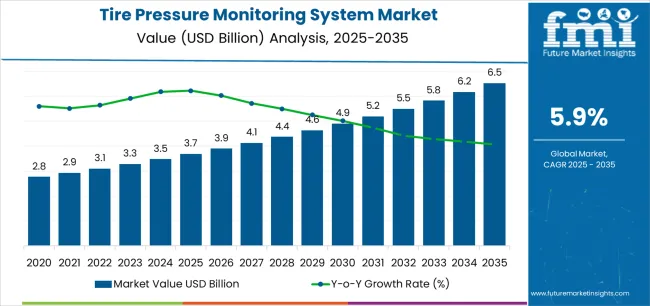
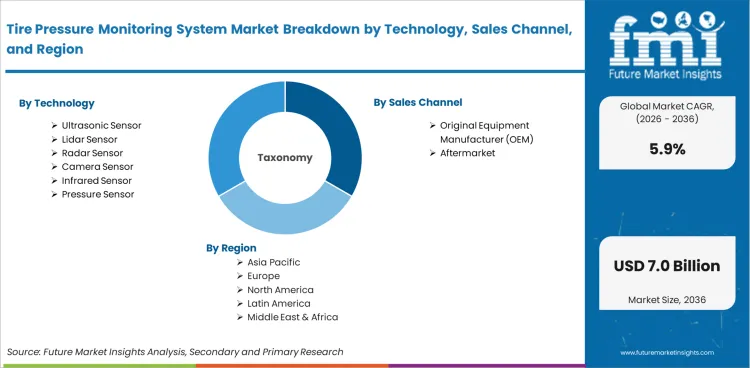
The tire pressure monitoring system market was valued at USD 3.7 billion in 2025. The market is set to reach USD 3.9 billion by 2026-end and grow at a CAGR of 5.9% between 2026–2036 to reach USD 7.0 billion by 2036.
Summary of the Tire Pressure Monitoring System Market
- Demand and Growth Drivers
- Mandatory TPMS installation regulations in the USA, EU, China, India, and other markets are creating non-discretionary OEM demand that grows proportionally with vehicle production volumes.
- Growing vehicle safety awareness and regulatory expansion into commercial vehicle segments are broadening the addressable market for tire pressure monitoring across heavy and light commercial fleets.
- Electric vehicle adoption is driving demand for advanced TPMS that optimize tire pressure for range efficiency and integrate with vehicle energy management systems.
- Product and Segment View
- Ultrasonic sensors are expected to hold a leading position in the technology segment in 2026, reflecting their accuracy and compatibility with ADAS integration requirements.
- OEM channel dominates as mandatory regulations require factory installed TPMS on all new vehicles in major markets, with aftermarket serving older vehicle upgrades and replacement.
- Direct pressure sensors are gaining share over indirect systems as automakers seek more accurate, reliable monitoring that supports advanced tire health diagnostics.
- Geography and Competitive Outlook
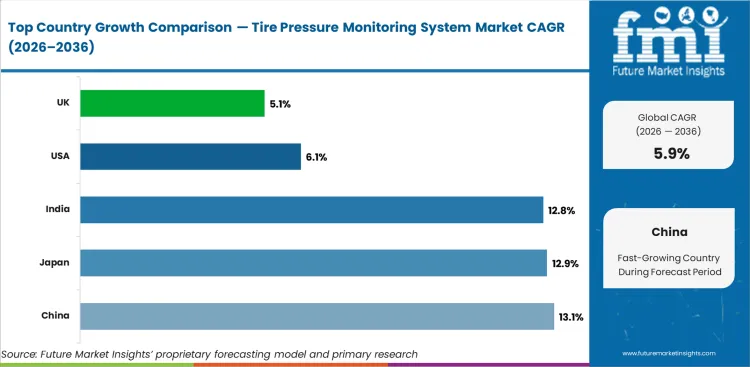
- China is expected to lead growth at 13.1%, reflecting mandatory TPMS implementation, massive vehicle production volumes, and growing domestic sensor manufacturing capability.
- Japan at 12.9% reflects its automotive technology leadership and sensor manufacturing excellence, while India at 12.8% reflects new regulatory mandates and rapid vehicle production growth.
- Companies combining sensor technology, ADAS integration capability, and established OEM partnerships are positioned to capture the largest share of TPMS procurement.
- Analyst Opinion
- The TPMS market is experiencing accelerated growth as regulatory mandates expand geographically and across vehicle categories, creating compounding non-discretionary demand linked to vehicle production volumes.
- Adoption reflects the convergence of vehicle safety regulation, fuel efficiency optimization, and the integration of tire monitoring with broader vehicle sensor and ADAS architectures.
- Growth at 5.9% CAGR reflects regulatory expansion into emerging markets and commercial vehicle segments combined with technology evolution toward direct sensing and integrated tire health diagnostics.
- Companies investing in direct sensor technology, EV specific tire monitoring, and integration with autonomous driving platforms are positioned to lead market development.
Key Takeaways, Market Size, and Forecast
- The tire pressure monitoring system market was valued at USD 3.7 billion in 2025.
- By 2036, the Tire Pressure Monitoring System Market is expected to be worth USD 6.95 billion.
- From 2026 to 2036, the market is projected to expand at a CAGR of 5.9%.
- The market is projected to create an incremental opportunity of USD 3.03 billion between 2026 and 2036.
- In 2026, ultrasonic sensor is expected to account for 21.0% of the technology segment, driven by ultrasonic sensors' accuracy in detecting tire pressure variations and their integration capability with advanced driver assistance systems across passenger and commercial vehicles.
- China (13.1%) and Japan (12.9%) are two of the fastest growing markets in the world.
Tire Pressure Monitoring System Market Definition
The tire pressure monitoring system market covers electronic sensor systems that monitor tire air pressure in real time across passenger vehicles, light commercial vehicles, and heavy commercial vehicles. Technologies include ultrasonic, lidar, radar, camera, infrared, and direct pressure sensors distributed through OEM installation and aftermarket channels.
Tire Pressure Monitoring System Market Inclusions
Market scope includes all commercially traded TPMS products categorized by technology (ultrasonic, lidar, radar, camera, infrared, pressure sensor), sales channel (OEM, aftermarket), and vehicle type (passenger vehicle, heavy commercial vehicle, light commercial vehicle). Revenue coverage spans 2026 to 2036.
Tire Pressure Monitoring System Market Exclusions
The scope does not include general automotive sensors not designed for tire pressure monitoring, tire inflation systems, or standalone tire temperature gauges without pressure monitoring capability.
Tire Pressure Monitoring System Market Research Methodology
- Primary Research: FMI analysts conducted interviews with manufacturers, technology specialists, and procurement professionals across key markets.
- Desk Research: Combined data from industry associations, regulatory bodies, and manufacturer disclosures.
- Market Sizing and Forecasting: Bottom up methodology aggregating segment and regional data with adoption velocity projections.
- Data Validation: Cross checked quarterly against production data, trade statistics, and manufacturer reporting.
Why is the Tire Pressure Monitoring System Market Growing?
- Regulatory mandates requiring TPMS on all new vehicles in the USA, EU, China, South Korea, and India create non-discretionary demand that scales with vehicle production volumes.
- Electric vehicle adoption drives demand for advanced TPMS that optimizes tire pressure for range efficiency, as underinflated tires increase rolling resistance and reduce EV driving range.
- Commercial vehicle fleet operators are adopting TPMS to reduce tire related breakdowns, improve fuel efficiency, and comply with evolving commercial vehicle safety regulations.
Demand for tire pressure monitoring systems is driven by regulatory mandates that require TPMS installation on new vehicles. The USA mandated TPMS for all passenger vehicles from 2007, the EU followed in 2014, and China, South Korea, and India have implemented or are implementing similar requirements. These regulations create non-discretionary OEM demand that grows proportionally with vehicle production, establishing a stable demand foundation.
The technology landscape is evolving from indirect TPMS that estimate pressure from wheel speed data to direct systems that use physical pressure sensors in each tire. Direct TPMS provides more accurate readings, faster response to pressure changes, and the ability to display individual tire pressures. Advanced direct systems now incorporate temperature monitoring, tread depth estimation, and tire health diagnostics that support predictive maintenance.
Electric vehicles represent a growing influence on TPMS development. Proper tire pressure is more critical for EVs because underinflation increases rolling resistance that directly reduces driving range. EV specific TPMS designs integrate with vehicle energy management systems to optimize tire pressure for range, load, and driving conditions. The premium content per vehicle in EV TPMS applications drives value growth beyond volume expansion.
Market Segmentation Analysis
- Ultrasonic sensors hold a leading share reflecting their accuracy and ADAS integration compatibility across vehicle platforms.
- OEM channel dominates as regulatory mandates require factory installed TPMS on all new vehicles in major global markets.
- Aftermarket channel serves older vehicle upgrades and replacement sensor demand for vehicles with pre-installed TPMS systems.
The TPMS market segments by technology, sales channel, and vehicle type. By technology, the market covers ultrasonic, lidar, radar, camera, infrared, and pressure sensors. By sales channel, the market includes OEM and aftermarket.
Insights into the Ultrasonic Sensor Technology Segment
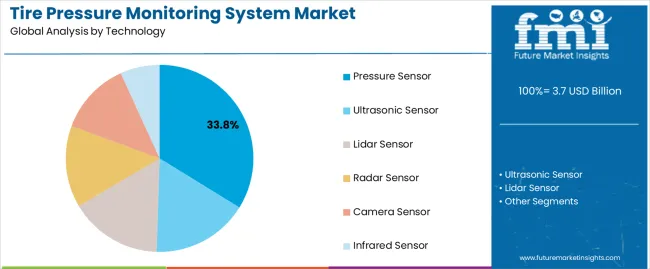
Ultrasonic sensors provide accurate pressure detection through non-contact measurement that avoids tire contact wear issues. Their integration capability with ADAS platforms enables data sharing across vehicle sensor networks, supporting comprehensive vehicle dynamics monitoring beyond basic pressure alerting.
Insights into the OEM Sales Channel Segment
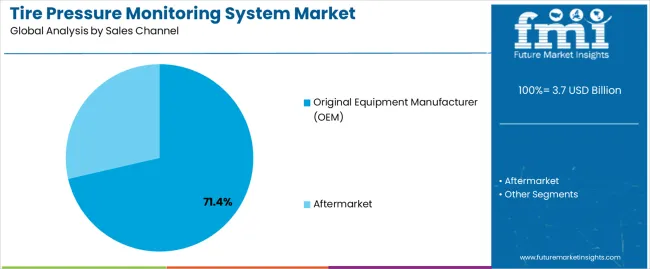
OEM installation represents the dominant channel as regulatory mandates in the USA, EU, China, and India require factory installed TPMS on all new vehicles. This creates captive demand linked to vehicle production volumes, with automakers specifying TPMS suppliers through multi-year platform contracts that provide revenue visibility.
Tire Pressure Monitoring System Market Drivers, Restraints, and Opportunities
- Regulatory mandates create non-discretionary demand that scales with vehicle production, providing a stable growth foundation for TPMS manufacturers.
- Price pressure from automaker cost reduction programs and competition among sensor suppliers constrains per-unit margins despite growing volumes.
- EV adoption and commercial vehicle regulatory expansion create incremental demand with higher content per vehicle and premium technology requirements.
The TPMS market is expanding at 5.9% CAGR driven by regulatory mandates, vehicle production growth, and EV adoption. Pricing pressure constrains margins, while EV integration and commercial vehicle expansion provide premium growth opportunities.
Regulatory Mandate Expansion
Geographic expansion of mandatory TPMS regulations into India, Southeast Asia, and Latin America creates new market demand linked to vehicle production in these high growth regions.
OEM Price Pressure
Automaker cost reduction programs and multi-supplier competition create pricing pressure on TPMS components, requiring manufacturers to offset margin compression through volume growth and technology differentiation.
Electric Vehicle Integration
EV specific TPMS designs that optimize tire pressure for range and integrate with vehicle energy management systems create premium content per vehicle opportunities.
Commercial Vehicle Expansion
Regulatory expansion into commercial vehicle TPMS requirements and fleet operator adoption of tire monitoring for safety and fuel efficiency create incremental demand in heavy and light commercial segments.
Analysis of Tire Pressure Monitoring System Market By Key Countries
.webp "Top Country Growth Comparison Tire Pressure Monitoring System Market Cagr (2026 2036)")
| Country | CAGR |
|---|---|
| China | 13.1% |
| Japan | 12.9% |
| India | 12.8% |
| USA | 6.1% |
| UK | 5.1% |
- China leads at 13.1% CAGR through 2036.
- Japan leads at 12.9% CAGR through 2036.
- India leads at 12.8% CAGR through 2036.
- USA leads at 6.1% CAGR through 2036.
The global tire pressure monitoring system market is projected to grow at a CAGR of 5.9% from 2026 to 2036. The analysis covers more than 30 countries, with the leading markets detailed below.
Demand Outlook for Tire Pressure Monitoring System Market in China
China is expected to lead growth at 13.1% through 2036, reflecting mandatory TPMS regulation implementation, massive vehicle production volumes, and growing domestic sensor manufacturing.
- Mandatory regulation creates non-discretionary OEM demand.
- Vehicle production scale drives high volume sensor procurement.
- Domestic sensor manufacturing capability reduces import dependency.
Future Outlook for Tire Pressure Monitoring System Market in Japan
Japan is expected to grow at 12.9% through 2036, reflecting its automotive sensor technology leadership and established OEM supply chains.
- Sensor technology leadership drives innovation and premium positioning.
- Established OEM relationships support stable procurement.
- EV development creates advanced TPMS integration demand.
Opportunity Analysis of Tire Pressure Monitoring System Market in India
India is expected to grow at 12.8% through 2036, driven by new TPMS regulatory mandates and rapidly growing vehicle production volumes.
- New regulatory mandates create emerging market TPMS demand.
- Vehicle production growth drives proportional sensor procurement.
- Domestic manufacturing development supports local supply capability.
In-depth Analysis of Tire Pressure Monitoring System Market in the United States
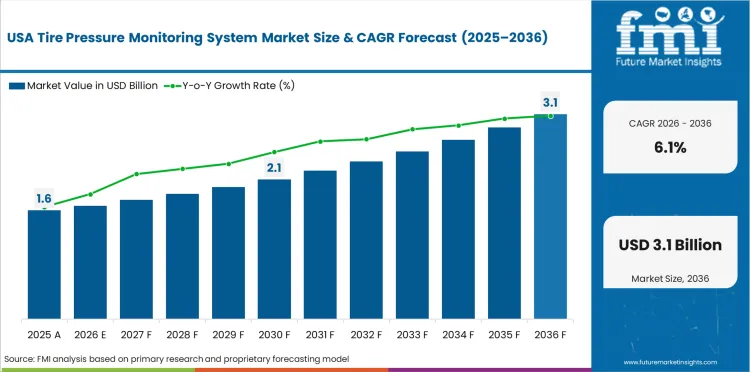
The USA is expected to grow at 6.1% through 2036, reflecting a mature TPMS market with demand driven by vehicle production, EV adoption, and aftermarket replacement.
- Mature regulation creates stable OEM demand linked to production.
- EV adoption drives advanced TPMS technology demand.
- Aftermarket replacement supports installed base service demand.
Sales Analysis of Tire Pressure Monitoring System Market in the United Kingdom
The UK is expected to grow at 5.1% through 2036, reflecting its automotive industry and regulatory alignment with EU TPMS standards.
- Regulatory alignment supports consistent TPMS requirements.
- Automotive industry drives OEM sensor demand.
- Commercial vehicle adoption creates incremental market growth.
Competitive Landscape and Strategic Positioning
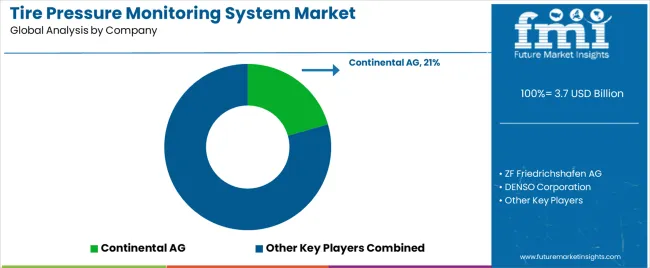
- Continental AG leads the market with comprehensive product and service capabilities and established customer relationships.
- Multiple global and regional players compete on technology capability, certification credentials, and geographic reach.
- Emerging players are targeting specialized applications and next generation technology development.
Continental AG leads the global TPMS market with comprehensive sensor technology, established OEM relationships across major automakers, and integrated ADAS platform development. ZF Friedrichshafen holds a strong position through automotive sensor expertise and global manufacturing scale.
DENSO Corporation serves Asian and global markets with precision sensor technology. Mobileye and Aptiv provide sensor solutions integrated with autonomous driving platforms. Veoneer and Autoliv focus on safety sensor systems.
Valeo, Magna International, and Aisin Seiki provide TPMS as part of broader automotive systems portfolios. Semiconductor companies including NXP, Texas Instruments, and NVIDIA supply the electronic components underpinning TPMS functionality.
Key Companies in the Tire Pressure Monitoring System Market
Key global companies leading the tire pressure monitoring system market include:
- Continental AG (Germany), ZF Friedrichshafen AG (Germany), DENSO Corporation (Japan), Mobileye (Israel), Aptiv Plc (Ireland) hold strong positions through manufacturing scale, certification credentials, and established customer relationships.
- Veoneer Inc. (Sweden), Autoliv Inc. (Sweden), Valeo SA (France), Magna International (Canada) are expanding presence through regional focus and specialized product development.
- Aisin Seiki Co., Ltd. (Japan), Panasonic Corporation (Japan), Texas Instruments Incorporated (USA), NVIDIA Corporation (USA), NXP Semiconductors N.V. (Netherlands) represent emerging participants targeting niche applications.
Competitive Benchmarking: Tire Pressure Monitoring System Market
| Company | Sensor Technology | ADAS Integration | OEM Partnerships | Geographic Reach |
|---|---|---|---|---|
| Continental AG | High | High | Strong | Global |
| ZF Friedrichshafen | High | High | Strong | Global |
| DENSO Corporation | High | High | Strong | Asia, Global |
| Mobileye | High | High | Strong | Global |
| Aptiv Plc | High | High | Strong | Global |
| Veoneer Inc. | High | High | Moderate | Europe, Global |
| Autoliv Inc. | High | High | Strong | Global |
| Valeo SA | High | High | Strong | Europe, Global |
| Magna International | High | High | Strong | North America, Global |
| NXP Semiconductors | High | High | Strong | Global |
Source: Future Market Insights competitive analysis, 2026.
Key Players in the Tire Pressure Monitoring System Market
Major Global Players
- Continental AG (Germany)
- ZF Friedrichshafen AG (Germany)
- DENSO Corporation (Japan)
- Mobileye (Israel)
- Aptiv Plc (Ireland)
Emerging Players/Startups
- Veoneer Inc. (Sweden)
- Autoliv Inc. (Sweden)
- Valeo SA (France)
- Magna International (Canada)
- Aisin Seiki Co., Ltd. (Japan)
- Panasonic Corporation (Japan)
- Texas Instruments Incorporated (USA)
- NVIDIA Corporation (USA)
- NXP Semiconductors N.V. (Netherlands)
Report Scope and Coverage
| Parameter | Details |
|---|---|
| Quantitative Units | USD Billion 3.9 to USD Billion 6.95, at a CAGR of 5.9% |
| Market Definition | The tire pressure monitoring system market covers electronic sensor systems that monitor tire air pressure in real time across passenger vehicles, light commercial vehicles, and heavy commercial vehicles. Technologies include ultrasonic, lidar, radar, camera, infrared, and direct pressure sensors distributed through OEM installation and aftermarket channels. |
| Regions Covered | North America, Latin America, Europe, East Asia, South Asia and Pacific, Middle East and Africa |
| Countries Covered | China, Japan, India, USA, UK, and 30 plus countries |
| Key Companies Profiled | Continental AG, ZF Friedrichshafen AG, DENSO Corporation, Mobileye, Aptiv Plc, Veoneer Inc., Autoliv Inc., Valeo SA |
| Forecast Period | 2026 to 2036 |
| Approach | Hybrid bottom up and top down methodology starting with verified transaction data, projecting adoption velocity across segments and regions. |
Segmentation
Tire Pressure Monitoring System Market Segmented by Technology:
- Ultrasonic Sensor
- Lidar Sensor
- Radar Sensor
- Camera Sensor
- Infrared Sensor
- Pressure Sensor
Tire Pressure Monitoring System Market Segmented by Sales Channel:
- Original Equipment Manufacturer (OEM)
- Aftermarket
Tire Pressure Monitoring System Market Segmented by Vehicle Type:
- Passenger Vehicle
- Heavy Commercial Vehicle
- Light Commercial Vehicle
Tire Pressure Monitoring System Market by Region:
- North America
- USA
- Canada
- Mexico
- Latin America
- Brazil
- Chile
- Rest of Latin America
- Western Europe
- Germany
- UK
- Italy
- Spain
- France
- Nordic
- BENELUX
- Rest of Western Europe
- Eastern Europe
- Russia
- Poland
- Hungary
- Balkan & Baltic
- Rest of Eastern Europe
- East Asia
- China
- Japan
- South Korea
- South Asia and Pacific
- India
- ASEAN
- Australia & New Zealand
- Rest of South Asia and Pacific
- Middle East & Africa
- Kingdom of Saudi Arabia
- Other GCC Countries
- Turkiye
- South Africa
- Other African Union
- Rest of Middle East & Africa
Research Sources and Bibliography
- 1. National Highway Traffic Safety Administration. (2025). NHTSA FMVSS 138: Tire Pressure Monitoring System Requirements. NHTSA.
- 2. European Commission. (2024). EU Regulation 661/2009: TPMS Requirements for Motor Vehicles. EC.
- 3. Society of Automotive Engineers. (2025). SAE J2657: TPMS Standards and Performance Requirements. SAE.
- 4. International Organization for Standardization. (2024). ISO 21750: Tire Pressure Monitoring Systems for Road Vehicles. ISO.
- 5. World Forum for Harmonization of Vehicle Regulations. (2025). UNECE Regulation 141: Tire Pressure Monitoring. UNECE.
This bibliography is provided for reader reference. The full Future Market Insights report contains the complete reference list.
This Report Answers
- Estimating the size of the market and projected revenue from 2026 to 2036.
- Segmentation by technology, sales channel, vehicle type, and region.
- Insights across more than 30 country markets.
- Analysis of sensor technology, EV integration, and ADAS platform trends.
- Assessment of the competitive landscape and supplier positioning.
- Identification of investment opportunities in direct sensing, commercial vehicles, and emerging market regulatory expansion.
- Tracking regulatory developments in vehicle safety standards.
- Delivery of data in PDF and Excel formats.
Frequently Asked Questions
What is the global market demand for Tire Pressure Monitoring System in 2026?
In 2026, the global tire pressure monitoring system market is expected to be worth USD Billion 3.92 billion.
How big will the Tire Pressure Monitoring System Market be in 2036?
By 2036, the tire pressure monitoring system market is expected to be worth USD Billion 6.95 billion.
How much is demand for Tire Pressure Monitoring System expected to grow between 2026 and 2036?
Between 2026 and 2036, demand is expected to grow at a CAGR of 5.9%.
Which technology segment is expected to lead in 2026?
Ultrasonic Sensor is expected to account for 21.0% of the technology segment in 2026, driven by ultrasonic sensors' accuracy in detecting tire pressure variations and their integration capability with advanced driver assistance systems across passenger and commercial vehicles.
What is causing demand to rise in China?
China is expected to grow at 13.1% CAGR through 2036. Mandatory regulation creates non-discretionary OEM demand.
What is causing demand to rise in Japan?
Japan is expected to grow at 12.9% CAGR through 2036. Sensor technology leadership drives innovation and premium positioning.
What does this report mean by 'Tire Pressure Monitoring System Market definition'?
The tire pressure monitoring system market covers electronic sensor systems that monitor tire air pressure in real time across passenger vehicles, light commercial vehicles, and heavy commercial vehicles. Technologies include ultrasonic, lidar, radar, camera, infrared, and direct pressure sensors distributed through OEM installation and aftermarket channels.
How does FMI make the Tire Pressure Monitoring System forecast and validate it?
Forecasting models use a hybrid bottom up and top down approach, starting with verified transaction data and validating against industry production statistics and manufacturer disclosures.
Preview the report firsthand - request a free sample
Get SampleGet the brochure for pricing and purchase details.
Get PDFTable of Content
- Executive Summary
- Global Market Outlook
- Demand-side Trends
- Supply-side Trends
- Technology Roadmap Analysis
- Analysis and Recommendations
- Market Overview
- Market Coverage / Taxonomy
- Market Definition / Scope / Limitations
- Research Methodology
- Chapter Orientation
- Analytical Lens and Working Hypotheses
- Market Structure, Signals, and Trend Drivers
- Benchmarking and Cross-market Comparability
- Market Sizing, Forecasting, and Opportunity Mapping
- Research Design and Evidence Framework
- Desk Research Programme (Secondary Evidence)
- Company Annual and Sustainability Reports
- Peer-reviewed Journals and Academic Literature
- Corporate Websites, Product Literature, and Technical Notes
- Earnings Decks and Investor Briefings
- Statutory Filings and Regulatory Disclosures
- Technical White Papers and Standards Notes
- Trade Journals, Industry Magazines, and Analyst Briefs
- Conference Proceedings, Webinars, and Seminar Materials
- Government Statistics Portals and Public Data Releases
- Press Releases and Reputable Media Coverage
- Specialist Newsletters and Curated Briefings
- Sector Databases and Reference Repositories
- FMI Internal Proprietary Databases and Historical Market Datasets
- Subscription Datasets and Paid Sources
- Social Channels, Communities, and Digital Listening Inputs
- Additional Desk Sources
- Expert Input and Fieldwork (Primary Evidence)
- Primary Modes
- Qualitative Interviews and Expert Elicitation
- Quantitative Surveys and Structured Data Capture
- Blended Approach
- Why Primary Evidence is Used
- Field Techniques
- Interviews
- Surveys
- Focus Groups
- Observational and In-context Research
- Social and Community Interactions
- Stakeholder Universe Engaged
- C-suite Leaders
- Board Members
- Presidents and Vice Presidents
- R&D and Innovation Heads
- Technical Specialists
- Domain Subject-matter Experts
- Scientists
- Physicians and Other Healthcare Professionals
- Governance, Ethics, and Data Stewardship
- Research Ethics
- Data Integrity and Handling
- Primary Modes
- Tooling, Models, and Reference Databases
- Desk Research Programme (Secondary Evidence)
- Data Engineering and Model Build
- Data Acquisition and Ingestion
- Cleaning, Normalisation, and Verification
- Synthesis, Triangulation, and Analysis
- Quality Assurance and Audit Trail
- Market Background
- Market Dynamics
- Drivers
- Restraints
- Opportunity
- Trends
- Scenario Forecast
- Demand in Optimistic Scenario
- Demand in Likely Scenario
- Demand in Conservative Scenario
- Opportunity Map Analysis
- Product Life Cycle Analysis
- Supply Chain Analysis
- Investment Feasibility Matrix
- Value Chain Analysis
- PESTLE and Porter’s Analysis
- Regulatory Landscape
- Regional Parent Market Outlook
- Production and Consumption Statistics
- Import and Export Statistics
- Market Dynamics
- Global Market Analysis 2021 to 2025 and Forecast, 2026 to 2036
- Historical Market Size Value (USD Billion) Analysis, 2021 to 2025
- Current and Future Market Size Value (USD Billion) Projections, 2026 to 2036
- Y-o-Y Growth Trend Analysis
- Absolute $ Opportunity Analysis
- Global Market Pricing Analysis 2021 to 2025 and Forecast 2026 to 2036
- Global Market Analysis 2021 to 2025 and Forecast 2026 to 2036, By Technology
- Introduction / Key Findings
- Historical Market Size Value (USD Billion) Analysis By Technology , 2021 to 2025
- Current and Future Market Size Value (USD Billion) Analysis and Forecast By Technology , 2026 to 2036
- Ultrasonic Sensor
- Lidar Sensor
- Radar Sensor
- Camera Sensor
- Infrared Sensor
- Pressure Sensor
- Ultrasonic Sensor
- Y-o-Y Growth Trend Analysis By Technology , 2021 to 2025
- Absolute $ Opportunity Analysis By Technology , 2026 to 2036
- Global Market Analysis 2021 to 2025 and Forecast 2026 to 2036, By Sales Channel
- Introduction / Key Findings
- Historical Market Size Value (USD Billion) Analysis By Sales Channel, 2021 to 2025
- Current and Future Market Size Value (USD Billion) Analysis and Forecast By Sales Channel, 2026 to 2036
- Original Equipment Manufacturer (OEM)
- Aftermarket
- Original Equipment Manufacturer (OEM)
- Y-o-Y Growth Trend Analysis By Sales Channel, 2021 to 2025
- Absolute $ Opportunity Analysis By Sales Channel, 2026 to 2036
- Global Market Analysis 2021 to 2025 and Forecast 2026 to 2036, By Vehicle Type
- Introduction / Key Findings
- Historical Market Size Value (USD Billion) Analysis By Vehicle Type, 2021 to 2025
- Current and Future Market Size Value (USD Billion) Analysis and Forecast By Vehicle Type, 2026 to 2036
- Passenger Vehicle
- Heavy Commercial Vehicle
- Light Commercial Vehicle
- Passenger Vehicle
- Y-o-Y Growth Trend Analysis By Vehicle Type, 2021 to 2025
- Absolute $ Opportunity Analysis By Vehicle Type, 2026 to 2036
- Global Market Analysis 2021 to 2025 and Forecast 2026 to 2036, By Region
- Introduction
- Historical Market Size Value (USD Billion) Analysis By Region, 2021 to 2025
- Current Market Size Value (USD Billion) Analysis and Forecast By Region, 2026 to 2036
- North America
- Latin America
- Western Europe
- Eastern Europe
- East Asia
- South Asia and Pacific
- Middle East & Africa
- Market Attractiveness Analysis By Region
- North America Market Analysis 2021 to 2025 and Forecast 2026 to 2036, By Country
- Historical Market Size Value (USD Billion) Trend Analysis By Market Taxonomy, 2021 to 2025
- Market Size Value (USD Billion) Forecast By Market Taxonomy, 2026 to 2036
- By Country
- USA
- Canada
- Mexico
- By Technology
- By Sales Channel
- By Vehicle Type
- By Country
- Market Attractiveness Analysis
- By Country
- By Technology
- By Sales Channel
- By Vehicle Type
- Key Takeaways
- Latin America Market Analysis 2021 to 2025 and Forecast 2026 to 2036, By Country
- Historical Market Size Value (USD Billion) Trend Analysis By Market Taxonomy, 2021 to 2025
- Market Size Value (USD Billion) Forecast By Market Taxonomy, 2026 to 2036
- By Country
- Brazil
- Chile
- Rest of Latin America
- By Technology
- By Sales Channel
- By Vehicle Type
- By Country
- Market Attractiveness Analysis
- By Country
- By Technology
- By Sales Channel
- By Vehicle Type
- Key Takeaways
- Western Europe Market Analysis 2021 to 2025 and Forecast 2026 to 2036, By Country
- Historical Market Size Value (USD Billion) Trend Analysis By Market Taxonomy, 2021 to 2025
- Market Size Value (USD Billion) Forecast By Market Taxonomy, 2026 to 2036
- By Country
- Germany
- UK
- Italy
- Spain
- France
- Nordic
- BENELUX
- Rest of Western Europe
- By Technology
- By Sales Channel
- By Vehicle Type
- By Country
- Market Attractiveness Analysis
- By Country
- By Technology
- By Sales Channel
- By Vehicle Type
- Key Takeaways
- Eastern Europe Market Analysis 2021 to 2025 and Forecast 2026 to 2036, By Country
- Historical Market Size Value (USD Billion) Trend Analysis By Market Taxonomy, 2021 to 2025
- Market Size Value (USD Billion) Forecast By Market Taxonomy, 2026 to 2036
- By Country
- Russia
- Poland
- Hungary
- Balkan & Baltic
- Rest of Eastern Europe
- By Technology
- By Sales Channel
- By Vehicle Type
- By Country
- Market Attractiveness Analysis
- By Country
- By Technology
- By Sales Channel
- By Vehicle Type
- Key Takeaways
- East Asia Market Analysis 2021 to 2025 and Forecast 2026 to 2036, By Country
- Historical Market Size Value (USD Billion) Trend Analysis By Market Taxonomy, 2021 to 2025
- Market Size Value (USD Billion) Forecast By Market Taxonomy, 2026 to 2036
- By Country
- China
- Japan
- South Korea
- By Technology
- By Sales Channel
- By Vehicle Type
- By Country
- Market Attractiveness Analysis
- By Country
- By Technology
- By Sales Channel
- By Vehicle Type
- Key Takeaways
- South Asia and Pacific Market Analysis 2021 to 2025 and Forecast 2026 to 2036, By Country
- Historical Market Size Value (USD Billion) Trend Analysis By Market Taxonomy, 2021 to 2025
- Market Size Value (USD Billion) Forecast By Market Taxonomy, 2026 to 2036
- By Country
- India
- ASEAN
- Australia & New Zealand
- Rest of South Asia and Pacific
- By Technology
- By Sales Channel
- By Vehicle Type
- By Country
- Market Attractiveness Analysis
- By Country
- By Technology
- By Sales Channel
- By Vehicle Type
- Key Takeaways
- Middle East & Africa Market Analysis 2021 to 2025 and Forecast 2026 to 2036, By Country
- Historical Market Size Value (USD Billion) Trend Analysis By Market Taxonomy, 2021 to 2025
- Market Size Value (USD Billion) Forecast By Market Taxonomy, 2026 to 2036
- By Country
- Kingdom of Saudi Arabia
- Other GCC Countries
- Turkiye
- South Africa
- Other African Union
- Rest of Middle East & Africa
- By Technology
- By Sales Channel
- By Vehicle Type
- By Country
- Market Attractiveness Analysis
- By Country
- By Technology
- By Sales Channel
- By Vehicle Type
- Key Takeaways
- Key Countries Market Analysis
- USA
- Pricing Analysis
- Market Share Analysis, 2025
- By Technology
- By Sales Channel
- By Vehicle Type
- Canada
- Pricing Analysis
- Market Share Analysis, 2025
- By Technology
- By Sales Channel
- By Vehicle Type
- Mexico
- Pricing Analysis
- Market Share Analysis, 2025
- By Technology
- By Sales Channel
- By Vehicle Type
- Brazil
- Pricing Analysis
- Market Share Analysis, 2025
- By Technology
- By Sales Channel
- By Vehicle Type
- Chile
- Pricing Analysis
- Market Share Analysis, 2025
- By Technology
- By Sales Channel
- By Vehicle Type
- Germany
- Pricing Analysis
- Market Share Analysis, 2025
- By Technology
- By Sales Channel
- By Vehicle Type
- UK
- Pricing Analysis
- Market Share Analysis, 2025
- By Technology
- By Sales Channel
- By Vehicle Type
- Italy
- Pricing Analysis
- Market Share Analysis, 2025
- By Technology
- By Sales Channel
- By Vehicle Type
- Spain
- Pricing Analysis
- Market Share Analysis, 2025
- By Technology
- By Sales Channel
- By Vehicle Type
- France
- Pricing Analysis
- Market Share Analysis, 2025
- By Technology
- By Sales Channel
- By Vehicle Type
- India
- Pricing Analysis
- Market Share Analysis, 2025
- By Technology
- By Sales Channel
- By Vehicle Type
- ASEAN
- Pricing Analysis
- Market Share Analysis, 2025
- By Technology
- By Sales Channel
- By Vehicle Type
- Australia & New Zealand
- Pricing Analysis
- Market Share Analysis, 2025
- By Technology
- By Sales Channel
- By Vehicle Type
- China
- Pricing Analysis
- Market Share Analysis, 2025
- By Technology
- By Sales Channel
- By Vehicle Type
- Japan
- Pricing Analysis
- Market Share Analysis, 2025
- By Technology
- By Sales Channel
- By Vehicle Type
- South Korea
- Pricing Analysis
- Market Share Analysis, 2025
- By Technology
- By Sales Channel
- By Vehicle Type
- Russia
- Pricing Analysis
- Market Share Analysis, 2025
- By Technology
- By Sales Channel
- By Vehicle Type
- Poland
- Pricing Analysis
- Market Share Analysis, 2025
- By Technology
- By Sales Channel
- By Vehicle Type
- Hungary
- Pricing Analysis
- Market Share Analysis, 2025
- By Technology
- By Sales Channel
- By Vehicle Type
- Kingdom of Saudi Arabia
- Pricing Analysis
- Market Share Analysis, 2025
- By Technology
- By Sales Channel
- By Vehicle Type
- Turkiye
- Pricing Analysis
- Market Share Analysis, 2025
- By Technology
- By Sales Channel
- By Vehicle Type
- South Africa
- Pricing Analysis
- Market Share Analysis, 2025
- By Technology
- By Sales Channel
- By Vehicle Type
- USA
- Market Structure Analysis
- Competition Dashboard
- Competition Benchmarking
- Market Share Analysis of Top Players
- By Regional
- By Technology
- By Sales Channel
- By Vehicle Type
- Competition Analysis
- Competition Deep Dive
- Continental AG
- Overview
- Product Portfolio
- Profitability by Market Segments (Product/Age /Sales Channel/Region)
- Sales Footprint
- Strategy Overview
- Marketing Strategy
- Product Strategy
- Channel Strategy
- ZF Friedrichshafen AG
- DENSO Corporation
- Mobileye
- Aptiv Plc
- Veoneer Inc.
- Autoliv Inc.
- Valeo SA
- Magna International
- Aisin Seiki Co., Ltd.
- Panasonic Corporation
- Texas Instruments Incorporated
- NVIDIA Corporation
- NXP Semiconductors N.V.
- Renesas Electronics Corporation
- Intel Corporation
- Hitachi, Ltd
- Harman International Industries, Inc.
- Continental AG
- Competition Deep Dive
- Assumptions & Acronyms Used


