

- Market Size (2026)
- USD 2460.6 Mn
- Forecast (2036)
- USD 4885.8 Mn
- CAGR (2026 to 2036)
- 7.1%
How big is the Tire Masterbatch Materials Market in 2026?
USD 2,460.6 million in 2026 and USD 4,885.8 million by 2036 at a 7.1% CAGR.
Demand for tire masterbatch materials is projected to rise at a CAGR of 7.1% by 2036, driving industry valuation from USD 2,460.6 million in 2026 to USD 4,885.8 million during the forecast period. Tire masterbatch materials are integrating from routine compound inputs into formulation tools used to protect tire quality and batch consistency. Tire plants evaluate dispersion behavior and carrier response before masterbatch materials enter commercial recipes. International Organization of Motor Vehicle Manufacturers reported global vehicle production at 96.4 million units in 2025, up from 92.7 million units in 2024, providing material suppliers a wider tire-production base for repeatable product use.
South Korea tire accounts are anticipated to assess dispersion control for export-focused compound programs. India accounts are forecasted to seek masterbatch supply response for localized tire material demand. Tire producers and compounders need masterbatch materials connecting reinforcement and processing control with measurable plant outcomes. USA Tire Manufacturers Association projected total USA tire shipments at 337.4 million units in 2025, influencing demand for materials used across original equipment and replacement tire channels. Higher tire shipment activity gives compound teams stronger reasons to assess tire materials led by trial evidence and quality documentation.
Buyers compare tire masterbatch materials based on raw-material traceability and service support across tire plants and rubber compounders. Association of Natural Rubber Producing Countries projected global natural rubber production at 15.324 million tons in 2026, alongside demand near 15.602 million tons. Commercial decisions rest on masterbatch proof holding due to rubber-input movement and tire performance reviews.
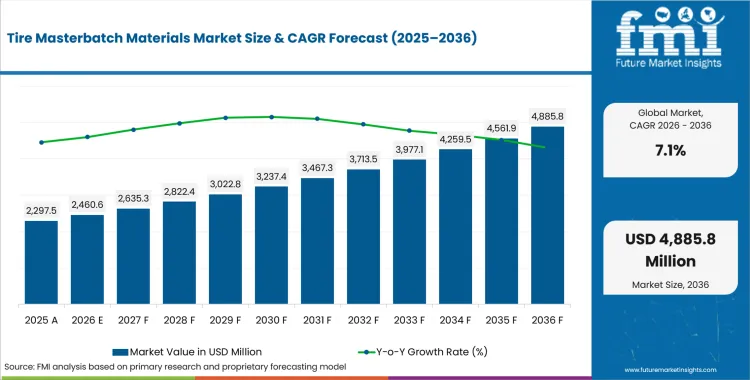
| Metric | Value |
|---|---|
| 2025 Market Size | USD 2,297.5 million |
| 2026 Market Size | USD 2,460.6 million |
| 2036 Market Size | USD 4,885.8 million |
| Forecast CAGR (2026-2036) | 7.1% |
| Sales Channel Focus | Direct to Tire OEM |
| Direct to Tire OEM Share (2026) | 59.5% |
| Tire Type Focus | Passenger Tires |
| Passenger Tires Share (2026) | 44.2% |
| Masterbatch Type Focus | Carbon Black Masterbatch |
| Carbon Black Masterbatch Share (2026) | 38.0% |
Summary of the Tire Masterbatch Materials Market
| Market Signal | Commercial Impact |
|---|---|
| Demand and Growth Drivers | Demand for tire masterbatch materials is increasing as tire plants connect masterbatch use with compound control and production quality.
|
| Product and Segment View | Segment demand is led by direct sales support and passenger tire programs requiring validated plant handling.
|
| Geography and Growth Outlook | Country demand is stronger across automotive systems with tire output scale and compound quality needs.
|
| Competitive Landscape | Competition focuses on material depth and plant-ready additive support.
|
| Analyst Perspective | Tire masterbatch materials are developing into a performance-validation segment linked to tire quality and compounding efficiency.
|
How is the tire masterbatch materials market segmented?
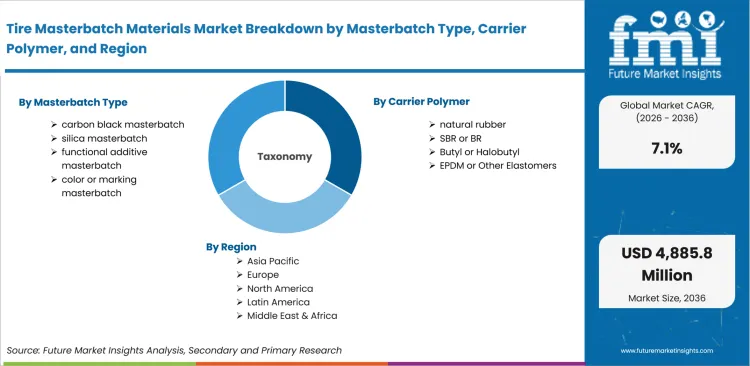
The tire masterbatch materials industry is segmented by masterbatch type, carrier polymer, application, tire type, sales channel, and region.
The tire masterbatch materials market is segmented by masterbatch type, carrier polymer, application, tire type, sales channel and region. By masterbatch type, coverage includes carbon black masterbatch, silica masterbatch, functional additive masterbatch and color or marking masterbatch. By carrier polymer, coverage includes natural rubber, SBR or BR, butyl or halobutyl and EPDM or other elastomers. By application, coverage includes tread compounds, sidewall compounds, innerliner compounds and bead or belt compounds. By tire type, coverage includes passenger tires, truck and bus tires, OTR tires and EV or specialty tires. By sales channel, coverage includes direct to tire OEM, rubber compounders and distributors, with regional coverage across North America, Latin America, Western Europe, Eastern Europe, East Asia, South Asia and Pacific and Middle East and Africa.
How does direct to tire OEM influence buying within sales channel?
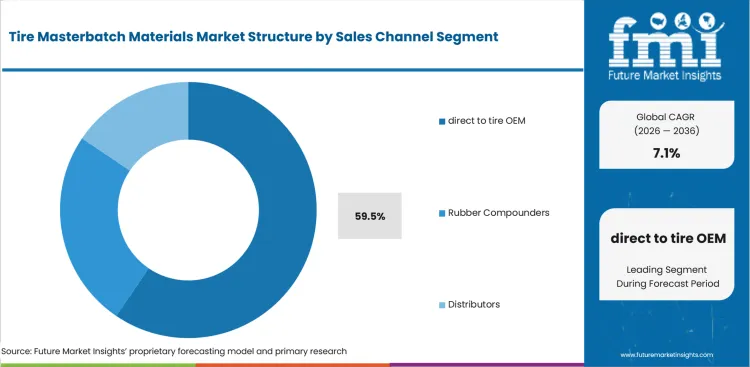
Direct to tire OEM is central to tire masterbatch material buying as technical files and trial plans attach to approved tire programs. Buyers want supplier accountability during formulation review and plant performance tracking. USA Tire Manufacturers Association projected replacement truck tire shipments to increase by 7.9% in 2025, attracting direct supplier attention across tire programs needing higher channel readiness.
- Direct to tire OEM is expected to capture 59.5% share in 2026, driven by product approval work completed before commercial tire production. Suppliers gain strength by supporting compound and plant teams through qualification.
- Rubber compounders remain useful for custom batches and specialty tire programs. Larger tire plants move toward direct supply once material performance and documentation are accepted by technical decision teams.
Where do passenger tires create value within tire type?
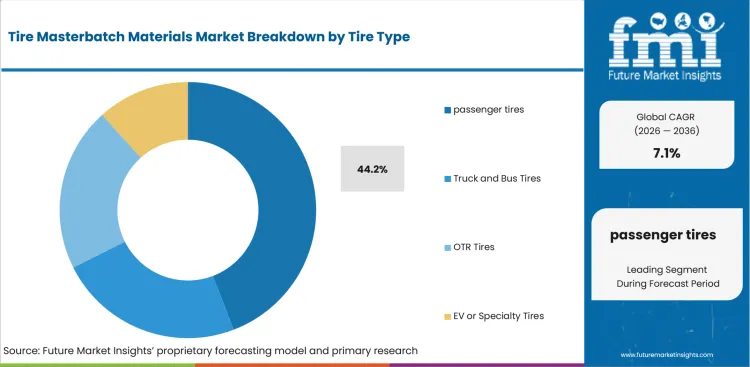
Passenger tires generate the main demand pool for tire masterbatch materials as production cycles are frequent and quality records are closely monitored. Compound teams use masterbatch inputs in passenger tire recipes requiring repeatable dispersion and color control. European Automobile Manufacturers’ Association reported EU new car registrations at 10.6 million units in 2025, supporting tire material demand across replacement and original equipment channels.
- Passenger Tires are expected to represent 44.2% share in 2026, influenced by repeated compound use and replacement tire activity. Masterbatch suppliers gain commercial access once trials connect product use with tire quality records and plant consistency.
- Truck and bus tire programs use more targeted masterbatch strategies. Passenger tire operations often need tighter support as compound variation can affect yield and warranty exposure.
What keeps carbon black masterbatch important within masterbatch type?
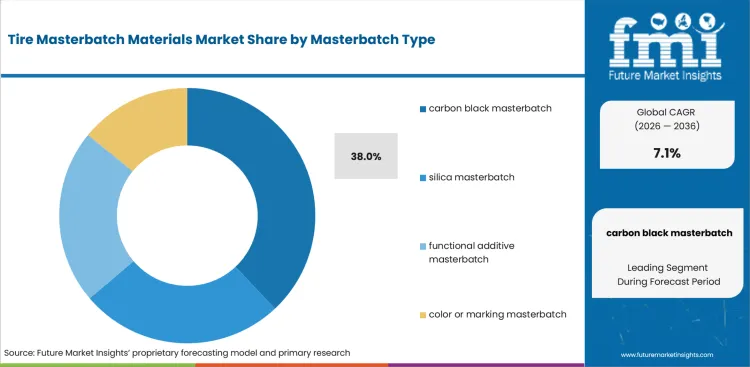
Carbon black masterbatch is a direct commercial measure for tire compounding. UV protection and process stability make carbon black systems central to tire material selection. Cabot reported Reinforcement Materials sales of USD 2,341 million in fiscal 2025, reflecting how reinforcing carbon platforms remain commercially important across tire and industrial rubber programs.
- Carbon black masterbatch is projected to capture 38.0% share in 2026, guided by tire plants needing consistent filler dispersion and black compound performance. Buyers assess carbon black masterbatch programs based on formulation trials and service follow-up.
- Silica and functional additive masterbatches remain close evaluation areas. Carbon black masterbatch gains attention once compound teams link material use with reinforcement quality and lower avoidable batch variation.
How should buyers read natural rubber demand within carrier polymer?
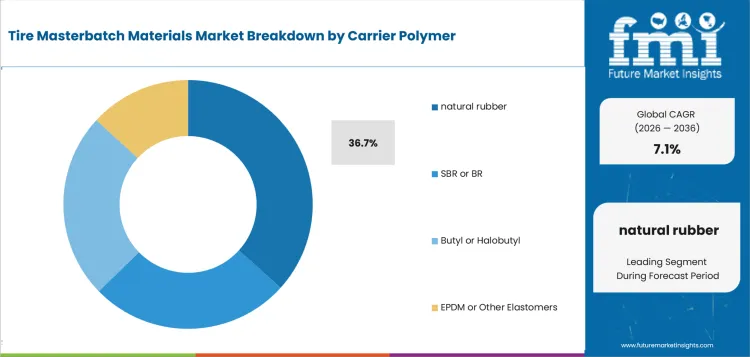
Natural rubber supports tire masterbatch programs needing elastomer compatibility and practical mixing behavior. Compound teams use carrier polymers in masterbatch systems requiring stable dispersion without formulation disruption. Rubber Board of India reported natural rubber production at 857,000 tonnes during 2024-25, reinforcing carrier-polymer planning across tire-linked material systems.
- Natural Rubber is anticipated to hold 36.7% share in 2026, led by compounding programs requiring elastomer compatibility and batch stability. Suppliers gain approval once carrier identity and formulation behavior are clear.
- SBR or BR and butyl or halobutyl carriers remain useful in targeted programs. Natural Rubber options gain attention as buyers connect carrier selection with measurable processing and compound outcomes.
Why do tread compounds guide application decisions?
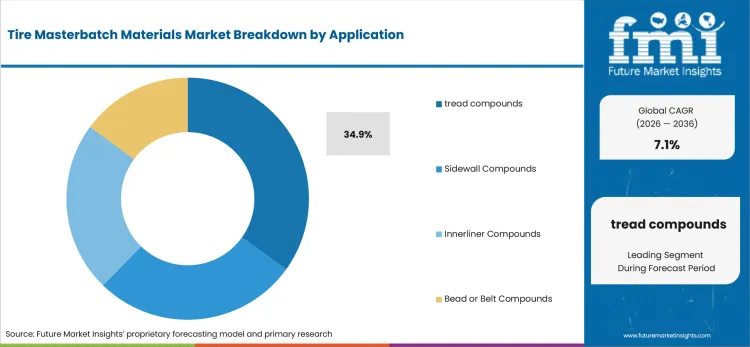
Tread Compounds are direct performance areas for tire producers. Abrasion resistance and reinforcement quality require material suppliers to connect masterbatch use with measurable tire outcomes. Evonik reported that ULTRASIL active filler combined with Si 363 are expected to lower rolling resistance by up to 35.0%, maintaining tread formulations focused on energy efficiency and grip retention.
- Tread compounds are projected to capture 34.9% share in 2026, guided by tire plants needing repeatable performance across high-contact tire surfaces. Buyers assess masterbatch programs based on formulation trials and production follow-up.
- Sidewall and innerliner compounds remain close evaluation areas. Tread compounds gain attention once technical teams link low rolling resistance (LLR) tires with filler dispersion and controlled compound behavior.
What are the drivers, restraints, and opportunities in the tire masterbatch materials market?
Near-term purchases are shaped by material validation and tire-specific support outlined below.
- Driver: Vehicle production and tire replacement demand increase demand for masterbatch materials improving compound predictability. Tire producers need systems connecting reinforcement and processing support with repeatable plant outcomes.
- Restraint: Adoption can slow if suppliers lack product characterization and application evidence. Buyers delay material changes once internal trials cannot prove carrier compatibility or service response.
- Opportunity: EV tires and circular compound reformulation create room for application-specific masterbatch and technical service packages. Suppliers with circular carbon and processing additive evidence supporting tire programs requiring stronger documentation.
Tire masterbatch material demand rises as buyers treat masterbatch systems as operating tools. Tire programs are required to protect compound performance and support quality documentation. International Energy Agency reported electric car sales exceeded 20.0 million units in 2025, meaning one-quarter of new cars sold were electric and raising pressure for tire compounds supporting range and wear control.
Buyer pressure is higher in tire systems are required to handle variable rubber inputs and maintain predictable production records. Association of Natural Rubber Producing Countries projected global natural rubber demand to grow 1.4% in 2026, reaching around 15.602 million tons. Supplier files need product characterization and formulation evidence before buyers accept wider masterbatch inclusion.
Circular tire material systems create opportunity as end-of-life tire recovery moves deeper into compound value chains. European tire-sector organizations reported in 2025, 3.9 million tons of end-of-life tires were collected in Europe in 2024. Material recovery flows support tire masterbatch suppliers being able to connect recycled carbon and circular material evidence with application needs.
Which country CAGRs are profiled in the tire masterbatch materials market?
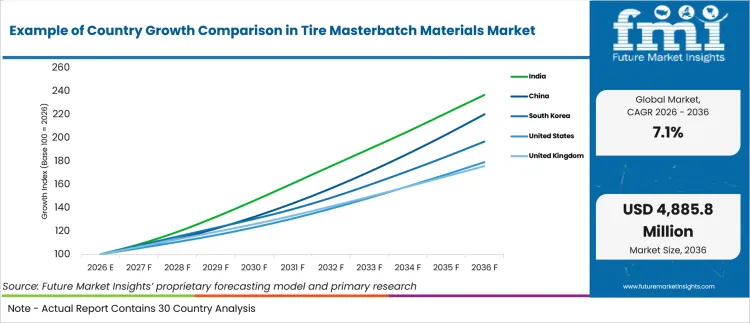
| Country | CAGR |
|---|---|
| India | 9.0% |
| China | 8.2% |
| South Korea | 7.0% |
| United States | 6.0% |
| United Kingdom | 5.8% |
| Japan | 5.6% |
| Germany | 5.5% |
Source: Future Market Insights analysis, 2026.
How do country-level CAGRs compare in the tire masterbatch materials market?
Country demand in tire masterbatch materials is expected to be led by automotive production intensity and tire manufacturing depth. India and China connect masterbatch demand with large vehicle systems and expanding tire quality needs. South Korea, United States, United Kingdom, Japan and Germany connect adoption with documentation and tighter formulation control. Senior buyers assess which countries are able to connect supplier evidence with repeatable compound outcomes.
- India is projected to post 9.0% CAGR by 2036, driven by expanding vehicle output and tire production support. Society of Indian Automobile Manufacturers reported total vehicle production of 33,191,967 units during calendar 2025, providing masterbatch suppliers a large base for compound-control and tire-material support.
- China is forecast to grow at 8.2% CAGR from 2026 to 2036, influenced by automotive scale and tire manufacturing depth. China’s official state information service reported auto output of 34.531 million units in 2025, up 10.4% from 2024, supporting a dense tire input base.
- South Korea is projected to record 7.0% CAGR through 2036, reflected by export-linked automotive systems and compact tire supply chains. Korea’s industry ministry reported automobile export volume at 247,000 units in January 2026, up 23.4% year-on-year, giving tire material suppliers a measurable output-linked base.
- United States is expected to expand at 6.0% CAGR during the forecast period, backed by replacement tire activity and strong tire service networks. USA Tire Manufacturers Association projected total tire shipments of 338.9 million units in 2026, supporting masterbatch trial activity across tire material programs.
- United Kingdom is forecast to register 5.8% CAGR by 2036, shaped by service-led supply and tire material import reliability. Society of Motor Manufacturers and Traders reported 717,371 cars and 47,344 commercial vehicles built in the United Kingdom in 2025, reinforcing buyer focus on timely supply and production continuity.
- Japan is expected to post 5.6% CAGR through 2036, aided by quality expectations and controlled tire production programs. International Trade Administration reported Japan’s automotive industry employed 5.58 million people in 2025, up to 8.3% of the national workforce, giving tire material suppliers a practical base for service-led programs.
- Germany is anticipated to grow at 5.5% CAGR during the study period, underpinned by tire quality expectations and EV tire material needs. German Association of the Automotive Industry reported battery-electric passenger car production reached 1.22 million vehicles in 2025, up 15.0%, supporting demand for advanced tire materials.
Who are the notable companies in the tire masterbatch materials market?
Cabot Corporation, Orion S.A., Birla Carbon, PCBL Chemical Limited, LANXESS, Evonik Industries, Ampacet Corporation and Avient Corporation are the notable companies influencing tire masterbatch materials and tire compounding support pathways.
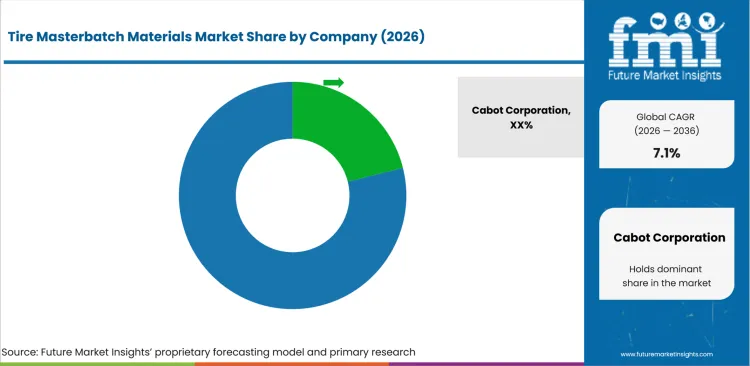
Competition in tire masterbatch materials is grouped by how buyers want material proof to work. Cabot Corporation, Orion S.A., Birla Carbon and PCBL Chemical Limited are stronger in carbon black and reinforcing material pathways. LANXESS and Evonik Industries are important for rubber additives or silane systems and tire performance pathways. Ampacet Corporation and Avient Corporation strengthen competition led by polymer masterbatch and compound handling support.
- Cabot Corporation has an advantage led by reinforcing carbon and masterbatch capabilities. Buyers can connect supplier support with tire compounding trials and carbon black performance review.
- Orion S.A. supports buyer review based on circular carbon black and tire pyrolysis oil activity. Its 2025 Contec supply agreement gives tire material teams a clearer route for circular carbon black sourcing.
- Birla Carbon and PCBL Chemical Limited strengthen competition due to carbon black scale and tire material positioning. Tire programs use such capabilities as compound performance and batch consistency affect commercial outcomes.
- LANXESS, Evonik Industries, Ampacet Corporation and Avient Corporation compete based on additive reach and technical support. Buyers compare these companies driven by formulation evidence and regional service continuity.
Competitive Benchmarking: Tire Masterbatch Materials Market
| Company | Material Coverage | Technical Service Alignment | Tire Compound Integration | Geographic Reach |
|---|---|---|---|---|
| Cabot Corporation | High | High | High | Global |
| Orion S.A. | High | Strong | High | Global |
| Birla Carbon | High | Strong | Strong | Global |
| PCBL Chemical Limited | Strong | Medium | Strong | Regional |
| LANXESS | Strong | High | High | Global |
| Evonik Industries | High | High | Strong | Global |
| Ampacet Corporation | Medium | Medium | Medium | Global |
| Avient Corporation | Medium | Strong | Medium | Global |
Source: Future Market Insights competitive analysis, 2026.
Key Developments in the Tire Masterbatch Materials Market
- In February 2025, Orion S.A. signed a long-term supply agreement with Contec S.A. for tire pyrolysis oil. Agreement completion supports circular carbon black production for tire and rubber goods customers requiring lower fossil feedstock exposure.
- In August 2025, Birla Carbon launched Continua 8030 Sustainable Carbonaceous Material for the Indian subcontinent and Asia. Product expansion supports circular carbon solutions for tire and compound applications requiring local supply and quality consistency.
- In September 2025, LANXESS announced Continental as the first tire manufacturer to use Vulkanox HS Scopeblue rubber additive in tire production. Product use supports tire programs requiring rubber compound protection during vulcanization and lower carbon footprint documentation.
Key Players in the Tire Masterbatch Materials Market
Carbon Black and Reinforcing Material Suppliers
- Cabot Corporation
- Orion S.A.
- Birla Carbon
- PCBL Chemical Limited
Rubber Additive and Silica System Suppliers
- LANXESS
- Evonik Industries
Masterbatch and Polymer Compound Suppliers
- Ampacet Corporation
- Avient Corporation
Tire Masterbatch Materials Market - Report Scope
| Coverage field | Report scope |
|---|---|
| Market breakdown | Tire masterbatch materials market breakdown by masterbatch type, carrier polymer, application, tire type, sales channel and region |
| Market Definition | Commercial masterbatch inputs and related material solutions used in tire compound programs to support reinforcement, dispersion, marking, processing, carrier compatibility and functional performance |
| Regions Covered | North America, Latin America, Western Europe, Eastern Europe, East Asia, South Asia and Pacific, Middle East and Africa |
| Countries Covered | United States, China, India, Germany, United Kingdom, Japan, South Korea and 30+ countries |
| Key Companies Profiled | Cabot Corporation, Orion S.A., Birla Carbon, PCBL Chemical Limited, LANXESS, Evonik Industries, Ampacet Corporation, Avient Corporation |
| Forecast Period | 2026 to 2036 |
| Approach | Hybrid bottom-up and top-down methodology using tire compound demand, material inclusion, vehicle output, supplier portfolios, sales-channel structure and country-level indicators |
Source: Future Market Insights analysis, 2026.
Tire Masterbatch Materials Market - Research Methodology
| Method | Approach |
|---|---|
| Primary Research | FMI analysts reviewed inputs from tire compounders, tire producers, material suppliers, masterbatch distributors, formulators and plant technical teams. Discussions focused on product use, adoption barriers, formulation support and measurable operating value. |
| Desk Research | Desk research covered official automotive sources, tire industry bodies, natural rubber data, company releases, product information, tire material datasets and public tire-safety guidance. Product coverage was checked against masterbatch type, carrier polymer, application, tire type, sales-channel route and commercial use. |
| Market Sizing and Forecasting | Model inputs combined 2026 baseline value, masterbatch inclusion intensity, tire type adoption, supplier reach, channel structure and country CAGR assumptions. Forecast logic was adjusted for tire output, compound use and technical service needs. |
| Data Validation | Forecasts were checked against vehicle production signals, tire shipment indicators, company portfolio activity and supplier qualification patterns. Company portfolios were reviewed to avoid counting adjacent products without direct tire masterbatch material use. |
Tire Masterbatch Materials Market by Segments
Tire Masterbatch Materials Market segmented by Masterbatch Type:
- Carbon Black Masterbatch
- Silica Masterbatch
- Functional Additive Masterbatch
- Color or Marking Masterbatch
Tire Masterbatch Materials Market segmented by Carrier Polymer:
- Natural Rubber
- SBR or BR
- Butyl or Halobutyl
- EPDM or Other Elastomers
Tire Masterbatch Materials Market segmented by Application:
- Tread Compounds
- Sidewall Compounds
- Innerliner Compounds
- Bead or Belt Compounds
Tire Masterbatch Materials Market segmented by Tire Type:
- Passenger Tires
- Truck and Bus Tires
- OTR Tires
- EV or Specialty Tires
Tire Masterbatch Materials Market segmented by Sales Channel:
- Direct to Tire OEM
- Rubber Compounders
- Distributors
Tire Masterbatch Materials Market by Region:
- North America
- United States
- Canada
- Mexico
- Latin America
- Brazil
- Chile
- Rest of Latin America
- Western Europe
- Germany
- United Kingdom
- Italy
- Spain
- France
- Nordic
- BENELUX
- Rest of Western Europe
- Eastern Europe
- Poland
- Hungary
- Balkan and Baltic
- Rest of Eastern Europe
- East Asia
- China
- Japan
- South Korea
- South Asia and Pacific
- India
- ASEAN
- Australia and New Zealand
- Rest of South Asia and Pacific
- Middle East and Africa
- Kingdom of Saudi Arabia
- Other GCC Countries
- Turkiye
- South Africa
- Other African Union
- Rest of Middle East and Africa
Research Sources and Bibliography
- Association of Natural Rubber Producing Countries. (2026, January). Monthly natural rubber statistical report, January 2026. Association of Natural Rubber Producing Countries.
- Birla Carbon. (2025, August 22). Launch of Continua 8030 Sustainable Carbonaceous Material. Birla Carbon.
- Cabot Corporation. (2025, November 24). Annual report 2025. Cabot Corporation.
- European Automobile Manufacturers’ Association. (2026, January). New car registrations in 2025. European Automobile Manufacturers’ Association.
- European Tyre and Rubber Manufacturers’ Association. (2025, July). End-of-life tire management update. European Tyre and Rubber Manufacturers’ Association.
- Evonik Industries. (2026, March). Low rolling resistance tires for sustainable mobility. Evonik Industries.
- German Association of the Automotive Industry. (2026, February). Car production in Germany in January 2026. German Association of the Automotive Industry.
- International Energy Agency. (2026, May). Global EV Outlook 2026. International Energy Agency.
- International Organization of Motor Vehicle Manufacturers. (2026, April 23). Auto industry growth shifted east in 2025 amid global repositioning. International Organization of Motor Vehicle Manufacturers.
- International Trade Administration. (2025, November). Japan automotive country commercial guide. International Trade Administration.
- LANXESS. (2025, September 9). Continental is the first tire manufacturer to use new sustainable rubber additive from LANXESS. LANXESS.
- Orion S.A. (2025, February 4). Orion S.A. signs supply agreement for tire pyrolysis oil with Contec S.A. Orion S.A.
- Rubber Board of India. (2025, April). Natural rubber production and consumption statistics 2024-25. Rubber Board of India.
- Society of Indian Automobile Manufacturers. (2026, January). Auto industry performance of December 2025 and third quarter October to December 2025. Society of Indian Automobile Manufacturers.
- Society of Motor Manufacturers and Traders. (2026, January 29). Tough year for auto but new models and industrial strategy can deliver growth. Society of Motor Manufacturers and Traders.
- State Council Information Office of the People’s Republic of China. (2026, January 14). China’s auto output and sales reach new highs in 2025. State Council Information Office of the People’s Republic of China.
- USA Tire Manufacturers Association. (2025, December 2). USTMA November 2025 forecast. USA Tire Manufacturers Association.
- USA Tire Manufacturers Association. (2026, March 4). USTMA February 2026 forecast predicts slightly higher 2026 tire shipments for USA tire market. USA Tire Manufacturers Association.
This bibliography is provided for reader reference and is not exhaustive. The full report contains the complete reference list and detailed citations.
This Report Answers
- What is the expected global value of the tire masterbatch materials market in 2026 and 2036?
- What CAGR is forecast for the tire masterbatch materials market during the 2026 to 2036 period?
- Which masterbatch type segment is used to assess carbon black masterbatch demand in 2026?
- Why do tire OEMs and compounders buy controlled tire masterbatch systems?
- How do natural rubber carriers and tread compounds shape tire material choices?
- Which countries are compared in the tire masterbatch materials forecast?
- Which companies compete across carbon black and masterbatch support pathways?
- What material systems and applications are included within the tire masterbatch materials definition?
- How does FMI size and forecast tire masterbatch material demand across segments and countries?
- What implementation and supplier-selection factors should executives assess?
Frequently Asked Questions
What is driving growth in the tire masterbatch materials market?
Demand is driven by compound consistency needs and the need to maintain tire quality across commercial production programs. Buyers are also giving more attention to masterbatch systems reducing uncertainty during formulation and plant-level performance review.
Why should executives track the tire masterbatch materials market?
Executives are expected to track this segment since material approval affects plant productivity and supplier accountability. Supplier selection can influence tire program reliability and commercial performance across compounding operations.
What business problem does the tire masterbatch materials market address?
Tire masterbatch materials help tire producers and compounders reduce uncertainty around filler dispersion and repeatable use in commercial operations. It also supports buyers that need clearer links between masterbatch use and operating control.
What should sourcing leaders evaluate before selecting suppliers?
Sourcing leaders are likely to compare documentation quality and supply reliability before supplier approval. Technical service and tire-specific evidence should also guide supplier review.
What can limit return on investment for buyers?
Return on investment is expected to be delayed if trial evidence is weak or masterbatch handling requires plant changes. Buyers can reduce such risk by phasing trials before wider use.
How can suppliers build executive confidence?
Suppliers build confidence through verified product data and accountable support during commercial tire compound roll-out. Clear trial protocols and consistent batch documentation can strengthen buyer approval.
Which companies lead tire masterbatch materials market?
Supplier strength is based on Cabot Corporation and Orion S.A., due to carbon black supply and tire material support. Birla Carbon, PCBL Chemical Limited and LANXESS add material depth driven by reinforcing applications.
What opportunity supports tire masterbatch materials market?
Tire plants create opportunity for masterbatch materials improving dispersion control. Supplier gains depend on traceability packs and plant trial performance across commercial recipes.
Preview the report firsthand - request a free sample
Get SampleGet the brochure for pricing and purchase details.
Get PDFTable of Content
- Key Takeaways
- Market Size and CAGR
- Top Growth Driver
- Fastest Growing Segment
- Leading Region
- Key Companies
- Emerging Opportunities
- Executive Summary
- Global Market Outlook
- Demand-side Trends
- Supply-side Trends
- Technology Roadmap Analysis
- Analysis and Recommendations
- Analyst Perspective (What is happening? Why now? What should investors know?)
- Key Questions Answered
- How large is the market?
- What is the CAGR?
- What are key trends?
- Which region dominates?
- Who are the leaders?
- Market Overview
- Market Coverage / Taxonomy
- Market Definition / Scope / Limitations
- Research Methodology
- Chapter Orientation
- Analytical Lens and Working Hypotheses
- Market Structure, Signals, and Trend Drivers
- Benchmarking and Cross-market Comparability
- Market Sizing, Forecasting, and Opportunity Mapping
- Research Design and Evidence Framework
- Desk Research Programme (Secondary Evidence)
- Expert Input and Fieldwork (Primary Evidence)
- Tooling, Models, and Reference Databases
- Data Engineering and Model Build
- Quality Assurance and Audit Trail
- Market Background
- Market Dynamics (Drivers, Restraints, Opportunity, Trends)
- Scenario Forecast (Optimistic, Likely, Conservative)
- Impact Analysis
- AI Impact
- Sustainability Impact
- Regulatory Impact
- Technology Impact
- Consumer / Buyer Analysis
- Purchase Drivers
- Adoption Barriers
- Buyer Journey
- Opportunity Map Analysis
- Product Life Cycle Analysis
- Supply Chain Analysis
- Investment Feasibility Matrix
- Value Chain Analysis
- PESTLE and Porter's Analysis
- Regulatory Landscape
- Regional Parent Market Outlook
- Production and Consumption Statistics
- Import and Export Statistics
- Global Market Analysis and Forecast, 2021 to 2036
- Historical Market Size Value (USD Mn) Analysis, 2021 to 2025
- Current and Future Market Size Value (USD Mn) Projections, 2026 to 2036
- Y-o-Y Growth Trend Analysis
- Absolute $ Opportunity Analysis
- Global Market Pricing Analysis, 2021 to 2036
- Global Market Analysis and Forecast, By Masterbatch Type, 2021 to 2036
- Introduction / Key Findings
- Historical Market Size Value (USD Mn) Analysis By Masterbatch Type, 2021 to 2025
- Current and Future Market Size Value (USD Mn) Analysis and Forecast By Masterbatch Type, 2026 to 2036
- carbon black masterbatch
- silica masterbatch
- functional additive masterbatch
- color or marking masterbatch
- carbon black masterbatch
- Y-o-Y Growth Trend Analysis By Masterbatch Type, 2021 to 2025
- Absolute $ Opportunity Analysis By Masterbatch Type, 2026 to 2036
- Global Market Analysis and Forecast, By Carrier Polymer, 2021 to 2036
- Introduction / Key Findings
- Historical Market Size Value (USD Mn) Analysis By Carrier Polymer, 2021 to 2025
- Current and Future Market Size Value (USD Mn) Analysis and Forecast By Carrier Polymer, 2026 to 2036
- natural rubber
- SBR or BR
- Butyl or Halobutyl
- EPDM or Other Elastomers
- natural rubber
- Y-o-Y Growth Trend Analysis By Carrier Polymer, 2021 to 2025
- Absolute $ Opportunity Analysis By Carrier Polymer, 2026 to 2036
- Global Market Analysis and Forecast, By Application, 2021 to 2036
- Introduction / Key Findings
- Historical Market Size Value (USD Mn) Analysis By Application, 2021 to 2025
- Current and Future Market Size Value (USD Mn) Analysis and Forecast By Application, 2026 to 2036
- tread compounds
- Sidewall Compounds
- Innerliner Compounds
- Bead or Belt Compounds
- tread compounds
- Y-o-Y Growth Trend Analysis By Application, 2021 to 2025
- Absolute $ Opportunity Analysis By Application, 2026 to 2036
- Global Market Analysis and Forecast, By Tire Type, 2021 to 2036
- Introduction / Key Findings
- Historical Market Size Value (USD Mn) Analysis By Tire Type, 2021 to 2025
- Current and Future Market Size Value (USD Mn) Analysis and Forecast By Tire Type, 2026 to 2036
- passenger tires
- Truck and Bus Tires
- OTR Tires
- EV or Specialty Tires
- passenger tires
- Y-o-Y Growth Trend Analysis By Tire Type, 2021 to 2025
- Absolute $ Opportunity Analysis By Tire Type, 2026 to 2036
- Global Market Analysis and Forecast, By Sales Channel, 2021 to 2036
- Introduction / Key Findings
- Historical Market Size Value (USD Mn) Analysis By Sales Channel, 2021 to 2025
- Current and Future Market Size Value (USD Mn) Analysis and Forecast By Sales Channel, 2026 to 2036
- direct to tire OEM
- Rubber Compounders
- Distributors
- direct to tire OEM
- Y-o-Y Growth Trend Analysis By Sales Channel, 2021 to 2025
- Absolute $ Opportunity Analysis By Sales Channel, 2026 to 2036
- Global Market Analysis and Forecast, By Region, 2021 to 2036
- Introduction
- Historical Market Size Value (USD Mn) Analysis By Region, 2021 to 2025
- Current Market Size Value (USD Mn) Analysis and Forecast By Region, 2026 to 2036
- North America
- Latin America
- Western Europe
- Eastern Europe
- East Asia
- South Asia and Pacific
- Middle East & Africa
- Market Attractiveness Analysis By Region
- North America Market Analysis and Forecast, By Country, 2021 to 2036
- Historical Market Size Value (USD Mn) Trend Analysis By Market Taxonomy, 2021 to 2025
- Market Size Value (USD Mn) Forecast By Market Taxonomy, 2026 to 2036
- By Country
- USA
- Canada
- By Masterbatch Type
- By Carrier Polymer
- By Application
- By Tire Type
- By Sales Channel
- By Country
- Market Attractiveness Analysis
- By Country
- By Masterbatch Type
- By Carrier Polymer
- By Application
- By Tire Type
- By Sales Channel
- Key Takeaways
- Latin America Market Analysis and Forecast, By Country
- Historical Market Size Value (USD Mn) Trend Analysis By Market Taxonomy, 2021 to 2025
- Market Size Value (USD Mn) Forecast By Market Taxonomy, 2026 to 2036
- By Country
- Brazil
- Mexico
- Chile
- Rest of Latin America
- By Masterbatch Type
- By Carrier Polymer
- By Application
- By Tire Type
- By Sales Channel
- By Country
- Market Attractiveness Analysis
- By Country
- By Masterbatch Type
- By Carrier Polymer
- By Application
- By Tire Type
- By Sales Channel
- Key Takeaways
- Western Europe Market Analysis and Forecast, By Country
- Historical Market Size Value (USD Mn) Trend Analysis By Market Taxonomy, 2021 to 2025
- Market Size Value (USD Mn) Forecast By Market Taxonomy, 2026 to 2036
- By Country
- Germany
- UK
- Italy
- Spain
- France
- Nordic
- BENELUX
- Rest of Western Europe
- By Masterbatch Type
- By Carrier Polymer
- By Application
- By Tire Type
- By Sales Channel
- By Country
- Market Attractiveness Analysis
- By Country
- By Masterbatch Type
- By Carrier Polymer
- By Application
- By Tire Type
- By Sales Channel
- Key Takeaways
- Eastern Europe Market Analysis and Forecast, By Country
- Historical Market Size Value (USD Mn) Trend Analysis By Market Taxonomy, 2021 to 2025
- Market Size Value (USD Mn) Forecast By Market Taxonomy, 2026 to 2036
- By Country
- Russia
- Poland
- Hungary
- Balkan & Baltic
- Rest of Eastern Europe
- By Masterbatch Type
- By Carrier Polymer
- By Application
- By Tire Type
- By Sales Channel
- By Country
- Market Attractiveness Analysis
- By Country
- By Masterbatch Type
- By Carrier Polymer
- By Application
- By Tire Type
- By Sales Channel
- Key Takeaways
- East Asia Market Analysis and Forecast, By Country
- Historical Market Size Value (USD Mn) Trend Analysis By Market Taxonomy, 2021 to 2025
- Market Size Value (USD Mn) Forecast By Market Taxonomy, 2026 to 2036
- By Country
- China
- Japan
- South Korea
- By Masterbatch Type
- By Carrier Polymer
- By Application
- By Tire Type
- By Sales Channel
- By Country
- Market Attractiveness Analysis
- By Country
- By Masterbatch Type
- By Carrier Polymer
- By Application
- By Tire Type
- By Sales Channel
- Key Takeaways
- South Asia and Pacific Market Analysis and Forecast, By Country
- Historical Market Size Value (USD Mn) Trend Analysis By Market Taxonomy, 2021 to 2025
- Market Size Value (USD Mn) Forecast By Market Taxonomy, 2026 to 2036
- By Country
- India
- ASEAN
- Australia & New Zealand
- Rest of South Asia and Pacific
- By Masterbatch Type
- By Carrier Polymer
- By Application
- By Tire Type
- By Sales Channel
- By Country
- Market Attractiveness Analysis
- By Country
- By Masterbatch Type
- By Carrier Polymer
- By Application
- By Tire Type
- By Sales Channel
- Key Takeaways
- Middle East & Africa Market Analysis and Forecast, By Country
- Historical Market Size Value (USD Mn) Trend Analysis By Market Taxonomy, 2021 to 2025
- Market Size Value (USD Mn) Forecast By Market Taxonomy, 2026 to 2036
- By Country
- Kingdom of Saudi Arabia
- Other GCC Countries
- Türkiye
- South Africa
- Other African Union
- Rest of Middle East & Africa
- By Masterbatch Type
- By Carrier Polymer
- By Application
- By Tire Type
- By Sales Channel
- By Country
- Market Attractiveness Analysis
- By Country
- By Masterbatch Type
- By Carrier Polymer
- By Application
- By Tire Type
- By Sales Channel
- Key Takeaways
- Key Countries Market Analysis
- USA
- Pricing Analysis
- Market Share Analysis, 2025
- By Masterbatch Type
- By Carrier Polymer
- By Application
- By Tire Type
- By Sales Channel
- Canada
- Pricing Analysis
- Market Share Analysis, 2025
- By Masterbatch Type
- By Carrier Polymer
- By Application
- By Tire Type
- By Sales Channel
- Mexico
- Pricing Analysis
- Market Share Analysis, 2025
- By Masterbatch Type
- By Carrier Polymer
- By Application
- By Tire Type
- By Sales Channel
- Brazil
- Pricing Analysis
- Market Share Analysis, 2025
- By Masterbatch Type
- By Carrier Polymer
- By Application
- By Tire Type
- By Sales Channel
- Chile
- Pricing Analysis
- Market Share Analysis, 2025
- By Masterbatch Type
- By Carrier Polymer
- By Application
- By Tire Type
- By Sales Channel
- Germany
- Pricing Analysis
- Market Share Analysis, 2025
- By Masterbatch Type
- By Carrier Polymer
- By Application
- By Tire Type
- By Sales Channel
- UK
- Pricing Analysis
- Market Share Analysis, 2025
- By Masterbatch Type
- By Carrier Polymer
- By Application
- By Tire Type
- By Sales Channel
- Italy
- Pricing Analysis
- Market Share Analysis, 2025
- By Masterbatch Type
- By Carrier Polymer
- By Application
- By Tire Type
- By Sales Channel
- Spain
- Pricing Analysis
- Market Share Analysis, 2025
- By Masterbatch Type
- By Carrier Polymer
- By Application
- By Tire Type
- By Sales Channel
- France
- Pricing Analysis
- Market Share Analysis, 2025
- By Masterbatch Type
- By Carrier Polymer
- By Application
- By Tire Type
- By Sales Channel
- India
- Pricing Analysis
- Market Share Analysis, 2025
- By Masterbatch Type
- By Carrier Polymer
- By Application
- By Tire Type
- By Sales Channel
- ASEAN
- Pricing Analysis
- Market Share Analysis, 2025
- By Masterbatch Type
- By Carrier Polymer
- By Application
- By Tire Type
- By Sales Channel
- Australia & New Zealand
- Pricing Analysis
- Market Share Analysis, 2025
- By Masterbatch Type
- By Carrier Polymer
- By Application
- By Tire Type
- By Sales Channel
- China
- Pricing Analysis
- Market Share Analysis, 2025
- By Masterbatch Type
- By Carrier Polymer
- By Application
- By Tire Type
- By Sales Channel
- Japan
- Pricing Analysis
- Market Share Analysis, 2025
- By Masterbatch Type
- By Carrier Polymer
- By Application
- By Tire Type
- By Sales Channel
- South Korea
- Pricing Analysis
- Market Share Analysis, 2025
- By Masterbatch Type
- By Carrier Polymer
- By Application
- By Tire Type
- By Sales Channel
- Russia
- Pricing Analysis
- Market Share Analysis, 2025
- By Masterbatch Type
- By Carrier Polymer
- By Application
- By Tire Type
- By Sales Channel
- Poland
- Pricing Analysis
- Market Share Analysis, 2025
- By Masterbatch Type
- By Carrier Polymer
- By Application
- By Tire Type
- By Sales Channel
- Hungary
- Pricing Analysis
- Market Share Analysis, 2025
- By Masterbatch Type
- By Carrier Polymer
- By Application
- By Tire Type
- By Sales Channel
- Kingdom of Saudi Arabia
- Pricing Analysis
- Market Share Analysis, 2025
- By Masterbatch Type
- By Carrier Polymer
- By Application
- By Tire Type
- By Sales Channel
- Türkiye
- Pricing Analysis
- Market Share Analysis, 2025
- By Masterbatch Type
- By Carrier Polymer
- By Application
- By Tire Type
- By Sales Channel
- South Africa
- Pricing Analysis
- Market Share Analysis, 2025
- By Masterbatch Type
- By Carrier Polymer
- By Application
- By Tire Type
- By Sales Channel
- USA
- Market Structure Analysis
- Competition Dashboard
- Competition Benchmarking
- Market Share Analysis of Top Players
- By Regional
- By Masterbatch Type
- By Carrier Polymer
- By Application
- By Tire Type
- By Sales Channel
- Emerging Startups
- Innovation Benchmarking
- Competition Analysis
- Competition Deep Dive
- Cabot Corporation
- Overview
- Product Portfolio
- Profitability by Market Segments
- Sales Footprint
- Strategy Overview
- Marketing Strategy
- Product Strategy
- Channel Strategy
- Orion S.A
- Birla Carbon
- PCBL Chemical Limited
- LANXESS
- Evonik Industries
- Ampacet Corporation
- Avient Corporation
- Cabot Corporation
- Case Studies
- Success Stories
- Recent Developments
- Competition Deep Dive
- Assumptions & Acronyms Used


