

- Market Size (2026)
- USD 1240.7 Mn
- Forecast (2036)
- USD 2373.1 Mn
- CAGR (2026 to 2036)
- 6.7%
How big is the Tire Cord Adhesives Market in 2026?
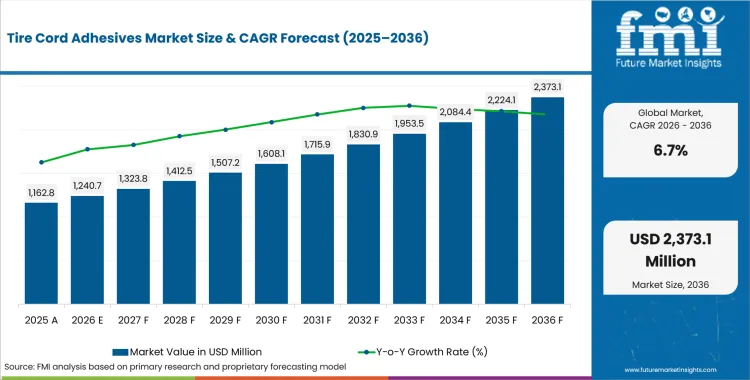
USD 1,240.7 million in 2026 and USD 2,373.1 million by 2036 at a 6.7% CAGR.
Demand for tire cord adhesives is projected to expand at 6.7% CAGR between 2026 and 2036, increasing valuation from USD 1,240.7 million in 2026 to USD 2,373.1 million by 2036. Tire cord adhesives are moving from routine tire-plant inputs into formulation tools used to protect bonding reliability and production consistency. Tire producers evaluate adhesive behavior across rubber compatibility and curing conditions before products enter approved production lines. OICA reported global vehicle production at 96.4 million units in 2025, giving adhesive suppliers a large manufacturing base for repeatable product qualification.
Germany tire accounts are projected to review cord-rubber adhesion proof before formula approval. India accounts are anticipated to expand, driven by localized tire inputs and supplier service access. Passenger tire and commercial tire operations need adhesives connecting cord-rubber bonding with measurable durability and process outcomes. USA Tire Manufacturers Association forecast replacement passenger tire shipments at 224.2 million units in 2025, influencing continued material demand through tire service cycles. Larger replacement activity gives tire material teams stronger reasons to assess rubber bonding systems determined by trial evidence and quality documentation.
Buyers compare tire cord adhesives driven by chemistry clarity and plant-level technical support. Federal Reserve data showed total USA industrial production at 102.6% of its 2017 average in May 2026, while capacity utilization stood at 76.2%. Commercial decisions rest on adhesive proof being able to hold led by production raw-material variation and customer performance reviews.
| Metric | Value |
|---|---|
| 2025 Market Size | USD 1,162.8 million |
| 2026 Market Size | USD 1,240.7 million |
| 2036 Market Size | USD 2,373.1 million |
| Forecast CAGR (2026-2036) | 6.7% |
| Sales Model Focus | Direct Chemical Supply |
| Direct Chemical Supply Share (2026) | 59.5% |
| Tire Type Focus | Passenger Car Tires |
| Passenger Car Tires Share (2026) | 44.5% |
| Adhesive Type Focus | RFL Adhesives |
| RFL Adhesives Share (2026) | 38.0% |
Summary of the Tire Cord Adhesives Market
| Market Signal | Commercial Impact |
|---|---|
| Demand and Growth Drivers | Demand for tire cord adhesives is increasing as tire producers connect bonding quality with cord durability and process control.
|
| Product and Segment View | Segment demand is led by direct chemical support and passenger tire applications requiring validated adhesion performance.
|
| Geography and Growth Outlook | Country demand is stronger across tire manufacturing systems with automotive production depth and local material qualification needs.
|
| Competitive Landscape | Competition focuses on adhesion chemistry depth and tire-plant support.
|
| Analyst Perspective | Tire cord adhesives are developing into a qualification-led materials segment linked to tire durability and process efficiency.
|
How is the tire cord adhesives market segmented?
The tire cord adhesives industry is segmented by adhesive type, cord material, tire type, process, sales model and region.
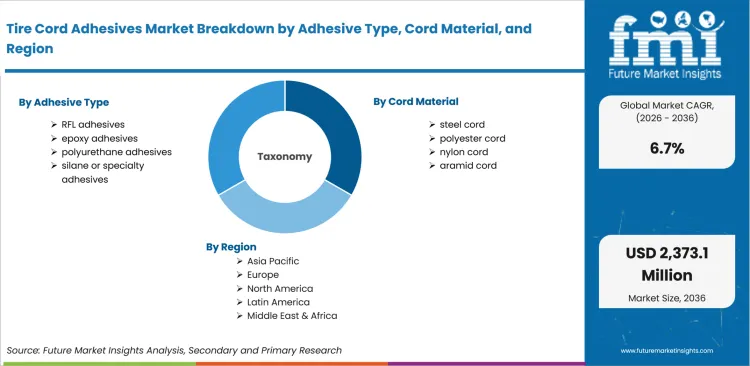
The tire cord adhesives market is segmented by adhesive type, cord material, tire type, process, sales model and region. By adhesive type, coverage includes RFL adhesives, epoxy adhesives, polyurethane adhesives and silane or specialty adhesives. By cord material, coverage includes steel cord, polyester cord, nylon cord and aramid cord. By tire type, coverage includes passenger car tires, truck and bus tires, OTR tires and two-wheeler tires. By process, coverage includes dip coating, surface treatment, compound integration and hybrid adhesion systems. By sales model, coverage includes direct chemical supply, technical service bundle and distributors, with regional coverage across North America, Latin America, Europe, East Asia, South Asia and Pacific and the Middle East and Africa.
How does direct chemical supply influence buying within the sales model segment?
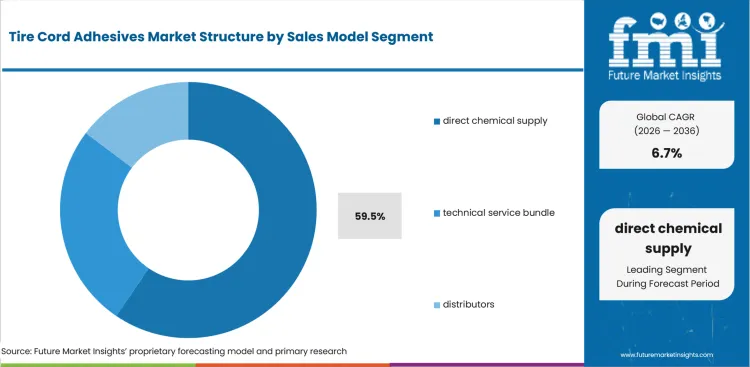
Direct chemical supply is central to tire cord adhesive buying as technical files and plant trial plans attach to approval decisions. Buyers want supplier accountability during line qualification and production performance tracking. LANXESS expanded and upgraded its Rhein Chemie production site in Qingdao in November 2025, increasing capacity by 50% for processing promoters and polymer-bound rubber chemicals used in tire and rubber production.
- Direct chemical supply is expected to capture 59.5% share in 2026, driven by product approval work completed before commercial tire-line use. Segment revenue is estimated at USD 738.2 million in 2026, as buyers prefer supplier routes able to support technical response and batch documentation.
- Distributor-led supply remains useful for replenishment and smaller buyer accounts. Larger tire programs move toward direct supply once adhesive performance and documentation are accepted by plant engineering and sourcing teams.
Where does passenger car tires create value within tire type?
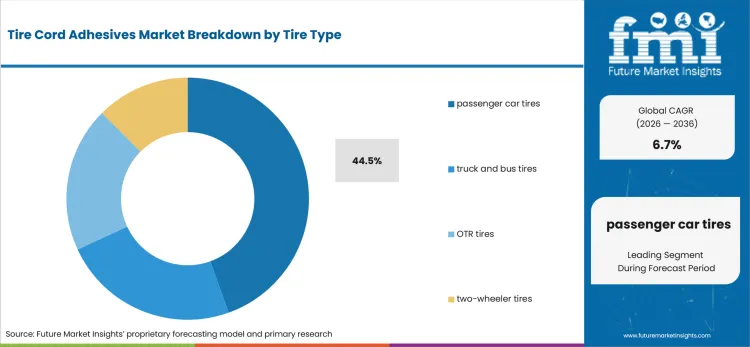
Passenger car tires generate the main demand pool for tire cord adhesives as production volumes are high and performance records are closely monitored. IEA reported nearly 22 million electric cars were produced globally in 2025, increasing more than 25% from 2024. Higher EV output gives tire producers stronger reasons to qualify bonding systems suited to heavier and torque-intensive vehicle platforms.
- Passenger car tires are expected to represent 44.5% share in 2026, influenced by passenger vehicle production and replacement tire programs needing repeatable reinforcement performance. Segment revenue is placed at USD 552.1 million in 2026, as adhesive suppliers gain commercial access once trials connect product use with cord adhesion records and tire durability outcomes.
- Truck and OTR tire programs use more targeted adhesive strategies. Passenger car tire production often needs tighter support as speed ratings and EV requirements affect tire-material approval.
What keeps RFL adhesives important within adhesive type?
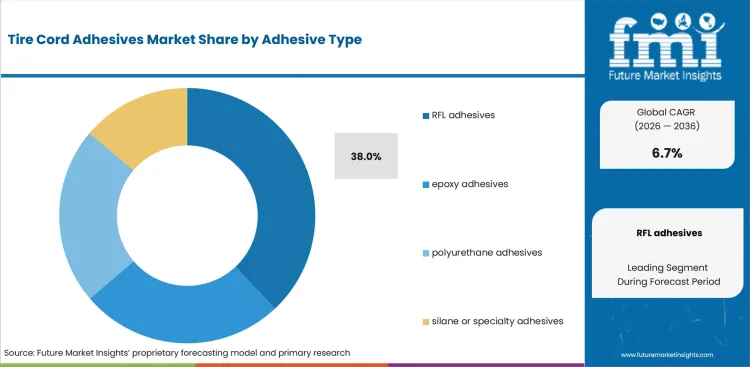
RFL adhesives guide adhesive type decisions due to established use in textile cord-rubber bonding. Tire producers rely on proven adhesion chemistry before approving materials for high-volume cord treatment. Synthomer lists 3 chemistry families for tire cord adhesion, including styrene butadiene vinyl pyridine polymers and cold-polymerized non-carboxylated chemistries.
- RFL adhesives are projected to capture 38.0% share in 2026, guided by tire plants needing tested bonding systems for fabric reinforcement. Segment revenue is forecast at USD 471.5 million in 2026, as buyers assess adhesive programs based on formulation trials and service follow-up.
- Polyurethane and silane or specialty systems remain close evaluation areas. RFL adhesives gain attention once tire teams link adhesive use with stable cord coating and lower avoidable bonding defects.
How should buyers read steel cord demand within cord material?
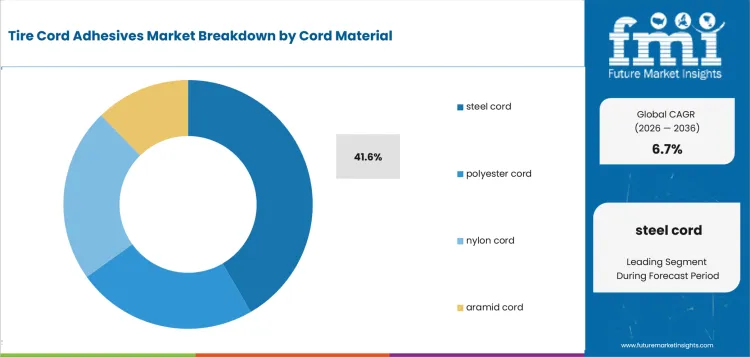
Steel cord demand is tied to tire strength and supplier coordination across tire plants. Bekaert stated that it reinforces 1 in 4 tires worldwide and supplies all top 30 tire makers, showing the scale attached to steel tire reinforcement. Adhesive suppliers serving steel cord programs need technical evidence supporting stable bonding under repeated stress.
- Steel cord is expected to account for 41.6% share in 2026, backed by demand for bonding systems aligned with reinforced tire structures. Segment revenue is projected at USD 516.1 million in 2026, as buyers prefer adhesives being able to support fatigue resistance and controlled production behavior.
- Polyester and aramid cord materials remain useful in lighter tire structures and specialized tire designs. Steel cord gains selection attention once tire producers compare bonding conditions and supplier technical depth during qualification.
Why is dip coating important within process demand?
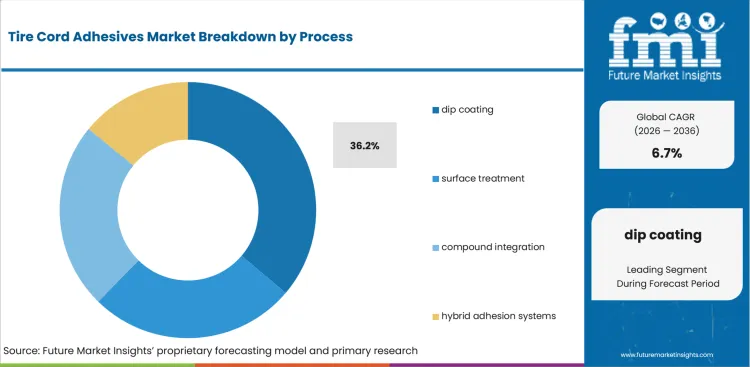
Dip coating remains important as treated cord must bond predictably with rubber compounds after adhesive application. Tire plants use dip coating as a controlled process step linking adhesive formulation with cord coverage and curing behavior. LANXESS highlighted resorcinol-free coupling agent systems for bonding rubber and reinforcing materials at Tire Technology Expo 2026, reflecting supplier work around adhesion alternatives and processing efficiency.
- Dip coating is projected to capture 36.2% share in 2026, backed by established cord treatment workflows in tire manufacturing. Segment revenue is estimated at USD 449.1 million in 2026, as tire producers need coating methods supporting adhesion control and repeatable production outcomes.
- Surface treatment and hybrid adhesion systems remain useful for reformulation programs. Dip coating keeps buyer attention once plant teams compare line compatibility and tire performance records during approval.
What are the drivers, restraints, and opportunities in the tire cord adhesives market?
Near-term purchases are shaped by adhesive validation and tire production support outlined below.
- Driver: Vehicle production and replacement tire activity increase demand for adhesives improving cord-rubber bonding. Tire producers need bonding systems supporting durability and production consistency after material approval.
- Restraint: Adoption can slow if suppliers lack adhesive characterization and efficacy evidence. Tire plants may delay supplier switching if plant trials or service ownership are unclear before rollout.
- Opportunity: EV tire development and resorcinol-free bonding systems create room for stronger technical service packages. Adhesive producers can gain buyer access by impacting safer processing and documented performance.
Tire cord adhesive demand rises as buyers treat bonding chemistry as a production-control tool. Tire programs are required to protect adhesion performance and support quality documentation. OICA reported global vehicle production of 96.4 million units in 2025, up 3.9% from 2024, explaining how vehicle manufacturing activity can affect tire material demand.
Buyer pressure is higher in tire systems required to handle changing vehicle torque and durability expectations. IEA reported China produced 16 million electric cars in 2025, keeping tire design teams focused on materials suited to EV platforms. Supplier files need adhesive characterization and tire-line evidence before buyers accept wider use.
Implementation risk remains a practical constraint for adhesive programs. Tire engineering and plant operations teams need shared success measures before wider adoption. Federal Reserve data recorded unchanged USA manufacturing output in May 2026 after a 0.7% increase in April 2026, reflecting why supplier qualification must account for cost discipline and plant reliability.
Which country CAGRs are profiled in the tire cord adhesives market?
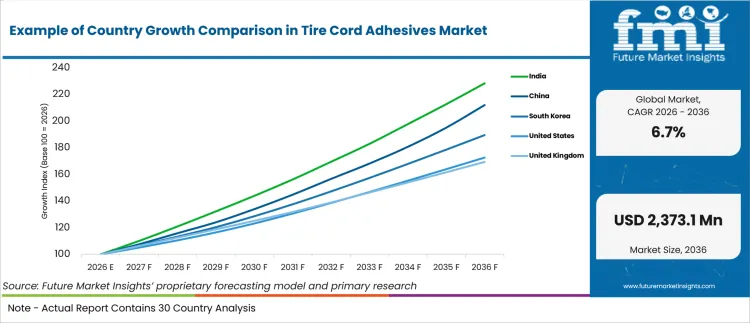
| Country | CAGR |
|---|---|
| India | 8.6% |
| China | 7.8% |
| South Korea | 6.6% |
| United States | 5.6% |
| United Kingdom | 5.4% |
| Germany | 5.2% |
| Japan | 5.1% |
Source: Future Market Insights analysis, 2026.
How do country-level CAGRs compare in the tire cord adhesives market?
Country demand in tire cord adhesives is expected to be led by tire production depth and supplier qualification discipline. India and China connect adhesive demand with manufacturing expansion and local material supply. South Korea, United States, United Kingdom, Germany and Japan connect adoption with plant discipline and export-linked tire production. Senior buyers assess which countries are able to connect supplier evidence with repeatable tire production outcomes.
- India is projected to post 8.6% CAGR by 2036, driven by auto manufacturing scale and tire input localization. Press Information Bureau reported India’s automotive industry turnover at about USD 240 billion, with around 30 million direct and indirect jobs supported by the sector. Tire cord adhesive suppliers benefit as local tire plants need approved bonding systems being able to support two-wheeler and commercial vehicle tire programs.
- China is forecast to grow at 7.8% CAGR by 2036, influenced by vehicle output scale and domestic tire material production. State Council Information Office reported China’s automobile output reached 34.531 million units in 2025, up 10.4% from the previous year. Local adhesive qualification is expected to stay important as tire producers balance high-volume production and reinforcement material requirements.
- South Korea is projected to record 6.6% CAGR through 2036, supported by compact automotive supply chains and export-facing tire production. Ministry of Trade, Industry and Resources reported first-quarter automobile production of 1.026 million units in 2026, marking the fourth consecutive year above 1 million units for first-quarter output. Adhesive suppliers are likely to gain approval by supporting tire makers with batch discipline and reinforcement compatibility across export programs.
- United States is forecast to expand at 5.6% CAGR through 2036, backed by technical review and replacement tire activity. USA Tire Manufacturers Association forecast replacement passenger tire shipments at 224.2 million units in 2025, supporting continued material demand through tire service cycles. Buyer evaluation is expected to remain strict as tire producers compare adhesive consistency and qualification evidence before changing approved suppliers.
- United Kingdom is anticipated to grow at 5.4% CAGR by 2036, shaped by vehicle production pressure and service-led supplier selection. SMMT reported UK factories produced 208,088 vehicles in the first quarter of 2026, down 13.0% from the same period in 2025. Tire cord adhesive suppliers need a clearer reliability case as lower vehicle output can make tire material buyers more selective during approval cycles.
- Germany is expected to post 5.2% CAGR through 2036, supported by tire engineering standards and EU automotive production depth. ACEA reported EU car production reached just under 11.5 million units in 2025, with Germany accounting for 35.2% of EU output and exceeding 4 million cars. Adhesive suppliers serving German tire programs need processing evidence and local technical support being bale to satisfy demanding production standards.
- Japan is projected to grow at 5.1% CAGR by 2036, aided by quality requirements and supplier approval discipline. OICA reported Japan produced 8.41 million vehicles in 2025, keeping tire cord adhesive demand tied to high-specification manufacturing programs. Suppliers are expected to support cautious buyer review with proven cord-rubber adhesion data and dependable plant-level service.
Who are the notable companies in the tire cord adhesives market?
Synthomer, Apcotex Industries, LANXESS, Parker LORD, Henkel, Bekaert, Kordsa and SRF are the notable companies influencing rubber bonding systems and tire reinforcement support pathways.
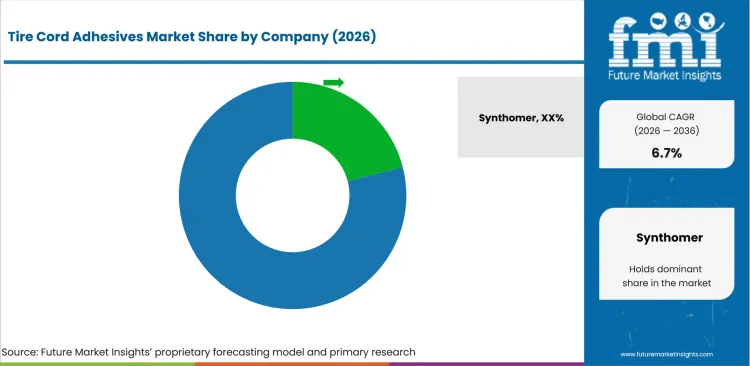
Competition in tire cord adhesives is grouped by how buyers want adhesive proof to work. Synthomer and Apcotex Industries are stronger in latex and fiber-to-rubber adhesion chemistry. LANXESS and Parker LORD are important for rubber chemical and bonding systems. Henkel strengthens competition led by automotive adhesive depth. Bekaert, Kordsa and SRF support tire reinforcement pathways influencing adhesive qualification.
- Synthomer has an advantage driven by water-based latex systems and tire cord adhesion products. Buyers can connect supplier support with cord treatment trials and tire reinforcement performance review.
- LANXESS supports buyer review based on processing promoters and coupling systems. Its 2026 tire additive portfolio gives tire makers a clearer route for rubber-to-reinforcement bonding evaluation.
- Bekaert, Kordsa and SRF strengthen competition due to tire reinforcement and cord fabric positioning. Tire programs use such capabilities as cord material selection and adhesive performance affect commercial outcomes.
- Henkel, Parker LORD and Apcotex Industries compete based on adhesive depth and regional service continuity. Buyers compare these companies through formulation evidence and batch consistency.
Competitive Benchmarking: Tire Cord Adhesives Market
| Company | Adhesion Chemistry Fit | Tire Reinforcement Link | Technical Service Alignment | Geographic Reach |
|---|---|---|---|---|
| Synthomer | High | High | High | Global |
| Apcotex Industries | High | Medium | Medium | Regional |
| LANXESS | Strong | Medium | Strong | Global |
| Parker LORD | Strong | Medium | Strong | Global |
| Henkel | Medium | Medium | High | Global |
| Bekaert | Medium | High | High | Global |
| Kordsa | Medium | High | Medium | Global |
| SRF | Medium | Strong | Medium | Regional |
Source: Future Market Insights competitive analysis, 2026.
Key Developments in the Tire Cord Adhesives Market
- In November 2025, LANXESS expanded and upgraded its Rhein Chemie production site in Qingdao, China. The project included a 50% capacity increase and technical upgrade for processing promoters and polymer-bound rubber chemicals used in tire and rubber production.
- In March 2026, LANXESS presented new tire industry additives at Tire Technology Expo 2026 in Hannover. Portfolio items included resorcinol-free coupling agent systems designed to improve bonding between rubber and reinforcing materials.
- In April 2026, Kordsa reported first-quarter 2026 financial results. Tire reinforcement segment revenue decreased 15% year-on-year to USD 139 million, reflecting pricing and volume pressure in tire reinforcement markets.
Key Players in the Tire Cord Adhesives Market
Latex and Adhesion Chemistry Suppliers
- Synthomer
- Apcotex Industries
Rubber Chemical and Bonding System Suppliers
- LANXESS
- Parker LORD
- Henkel
Tire Reinforcement Suppliers
- Bekaert
- Kordsa
- SRF
Tire Cord Adhesives Market - Report Scope
| Coverage field | Report scope |
|---|---|
| Market breakdown | Tire cord adhesives market breakdown by adhesive type, cord material, tire type, process, sales model and region |
| Market Definition | Adhesive systems, latex chemistries, bonding agents and related technical support used to improve adhesion between tire cords and rubber compounds in tire manufacturing |
| Regions Covered | North America, Latin America, Europe, East Asia, South Asia and Pacific, Middle East and Africa |
| Countries Covered | United States, China, India, Germany, United Kingdom, Japan, South Korea and 30+ countries |
| Key Companies Profiled | Synthomer, Apcotex Industries, LANXESS, Parker LORD, Henkel, Bekaert, Kordsa, SRF |
| Forecast Period | 2026 to 2036 |
| Approach | Hybrid bottom-up and top-down methodology using adhesive inclusion, tire production intensity, cord material demand, supplier portfolios, sales model structure and country-level indicators |
Source: Future Market Insights analysis, 2026.
Tire Cord Adhesives Market - Research Methodology
| Method | Approach |
|---|---|
| Primary Research | FMI analysts reviewed inputs from tire manufacturers, cord fabric suppliers, adhesive producers, rubber chemical suppliers, technical service teams and sourcing leaders. Discussions focused on adhesive use, adoption barriers, formulation support and measurable operating value. |
| Desk Research | Desk research covered official automotive data, tire industry associations, company releases, product information, rubber chemical portfolios and public manufacturing indicators. Product coverage was checked against adhesive type, cord material, tire type, process, sales model and commercial use. |
| Market Sizing and Forecasting | Model inputs combined 2026 baseline value, adhesive inclusion intensity, tire type demand, cord material adoption, supplier reach, channel structure and country CAGR assumptions. Forecast logic was adjusted for tire output, replacement flows, EV tire requirements and technical service needs. |
| Data Validation | Forecasts were checked against automotive output signals, tire shipment indicators, company portfolio activity and supplier qualification patterns. Company portfolios were reviewed to avoid counting adjacent products without direct tire cord adhesive or reinforcement use. |
Tire Cord Adhesives Market by Segments
Tire Cord Adhesives Market segmented by Adhesive Type:
- RFL Adhesives
- Epoxy Adhesives
- Polyurethane Adhesives
- Silane / Specialty Adhesives
Tire Cord Adhesives Market segmented by Cord Material:
- Steel Cord
- Polyester Cord
- Nylon Cord
- Aramid Cord
Tire Cord Adhesives Market segmented by Tire Type:
- Passenger Car Tires
- Truck and Bus Tires
- OTR Tires
- Two-wheeler Tires
Tire Cord Adhesives Market segmented by Process:
- Dip Coating
- Surface Treatment
- Compound Integration
- Hybrid Adhesion Systems
Tire Cord Adhesives Market segmented by Sales Model:
- Direct Chemical Supply
- Technical Service Bundle
- Distributors
Tire Cord Adhesives Market by Region:
- North America
- United States
- Canada
- Mexico
- Latin America
- Brazil
- Chile
- Rest of Latin America
- Western Europe
- Germany
- United Kingdom
- Italy
- Spain
- France
- Nordic
- BENELUX
- Rest of Western Europe
- Eastern Europe
- Poland
- Hungary
- Balkan and Baltic
- Rest of Eastern Europe
- East Asia
- China
- Japan
- South Korea
- South Asia and Pacific
- India
- ASEAN
- Australia and New Zealand
- Rest of South Asia and Pacific
- Middle East and Africa
- Kingdom of Saudi Arabia
- Other GCC Countries
- Turkiye
- South Africa
- Other African Union
- Rest of Middle East and Africa
Research Sources and Bibliography
- ACEA. (2026, April). Economic and market report: Global and EU auto industry, full year 2025. European Automobile Manufacturers’ Association.
- Bekaert. (2026, May). Business news: Bekaert completes acquisition of tire cord business from Bridgestone in China and Thailand. Bekaert.
- Federal Reserve Board. (2026, June). Industrial production and capacity utilization: G.17. Board of Governors of the Federal Reserve System.
- Henkel. (2026, March). Henkel delivers organic growth in 2025 and increases profitability through innovation and more efficiency. Henkel.
- International Energy Agency. (2026, May). Global EV Outlook 2026: Manufacturing and trade. International Energy Agency.
- International Organization of Motor Vehicle Manufacturers. (2026, April). Auto industry growth shifted east in 2025 amid global repositioning. International Organization of Motor Vehicle Manufacturers.
- Kordsa. (2026, April). 1Q’26 financial results earnings release. Kordsa.
- LANXESS. (2025, November). LANXESS expanded capacity at Rhein Chemie Qingdao site on growing market demand. LANXESS.
- LANXESS. (2026, March). LANXESS at the Tire Technology Expo: New high-performance additives for the tire industry. LANXESS.
- Ministry of Trade, Industry and Resources. (2026, March). March 2026 automobile exports reach USD 6.4 billion. Republic of Korea.
- Press Information Bureau. (2025, March). Revolutionizing mobility: The Make in India auto story. Government of India.
- Society of Motor Manufacturers and Traders. (2026, April). Car production stabilises but outlook still challenging. Society of Motor Manufacturers and Traders.
- State Council Information Office. (2026, January). China’s auto output, sales reach new highs in 2025. State Council Information Office of the People’s Republic of China.
- Synthomer. (2026). Tyre cord: Market-leading fibre-to-rubber adhesion for tyres. Synthomer.
- USA Tire Manufacturers Association. (2025, July). USTMA July 2025 forecast. USA Tire Manufacturers Association.
This bibliography is provided for reader reference and is not exhaustive. The full report contains the complete reference list and detailed citations.
This Report Answers
- What value is forecast for the tire cord adhesives market in 2026 and by 2036?
- What CAGR is forecast for the tire cord adhesives market during the 2026 to 2036 period?
- Which adhesive type, cord material, tire type, process and sales model segments are assessed?
- Why do tire producers need controlled adhesive systems for cord-rubber bonding?
- How do RFL adhesives and dip coating shape tire cord adhesive demand?
- Which countries are compared in the tire cord adhesives forecast?
- Which companies compete across adhesive chemistry and tire reinforcement pathways?
- What adhesive systems and applications are included within the tire cord adhesives definition?
- How does FMI size and forecast tire cord adhesive demand across segments and countries?
- What supplier-selection and qualification factors should executives assess?
Frequently Asked Questions
What is driving growth in the tire cord adhesives market?
Demand is driven by replacement tire flows and the need to maintain cord-rubber bonding quality across tire production. Buyers are also giving more attention to adhesives reducing uncertainty during plant qualification and repeated batch review.
Why should executivesi track the tire cord adhesives market?
Executives are expected to track this segment since adhesive approval affects tire durability and supplier accountability. Supplier selection can influence production reliability and commercial performance across tire manufacturing programs.
What business problem does the tire cord adhesives market address?
Tire cord adhesives help tire producers reduce uncertainty around cord-rubber adhesion and repeated use in commercial production. The segment also supports buyers requiring clearer links between adhesive choice and operating control.
What should sourcing leaders evaluate before selecting suppliers?
Sourcing leaders are likely to compare formulation evidence, technical documentation and supply reliability before supplier approval. Plant support and cord-material experience should also guide supplier review.
What can limit return on investment for buyers?
Return on investment is expected to be delayed if trial evidence is weak or adhesive handling requires plant changes. Buyers can reduce such risk by phasing trials before wider use.
How can suppliers build executive confidence?
Suppliers build confidence through verified product data and accountable support during tire production rollout. Clear qualification protocols and consistent batch documentation can strengthen buyer approval.
Which companies lead tire cord adhesives market?
Supplier leadership is led by Synthomer and Apcotex Industries, due to latex systems and adhesion chemistry. LANXESS, Parker LORD and Kordsa add depth based on tire reinforcement and bonding-system support.
What challenge affects tire cord adhesives market?
Adhesive approval faces pressure from cord material variation and curing conditions. Tire producers require adhesion proof before formula approval across commercial tire lines.
Preview the report firsthand - request a free sample
Get SampleGet the brochure for pricing and purchase details.
Get PDFTable of Content
- Key Takeaways
- Market Size and CAGR
- Top Growth Driver
- Fastest Growing Segment
- Leading Region
- Key Companies
- Emerging Opportunities
- Executive Summary
- Global Market Outlook
- Demand-side Trends
- Supply-side Trends
- Technology Roadmap Analysis
- Analysis and Recommendations
- Analyst Perspective (What is happening? Why now? What should investors know?)
- Key Questions Answered
- How large is the market?
- What is the CAGR?
- What are key trends?
- Which region dominates?
- Who are the leaders?
- Market Overview
- Market Coverage / Taxonomy
- Market Definition / Scope / Limitations
- Research Methodology
- Chapter Orientation
- Analytical Lens and Working Hypotheses
- Market Structure, Signals, and Trend Drivers
- Benchmarking and Cross-market Comparability
- Market Sizing, Forecasting, and Opportunity Mapping
- Research Design and Evidence Framework
- Desk Research Programme (Secondary Evidence)
- Expert Input and Fieldwork (Primary Evidence)
- Tooling, Models, and Reference Databases
- Data Engineering and Model Build
- Quality Assurance and Audit Trail
- Market Background
- Market Dynamics (Drivers, Restraints, Opportunity, Trends)
- Scenario Forecast (Optimistic, Likely, Conservative)
- Impact Analysis
- AI Impact
- Sustainability Impact
- Regulatory Impact
- Technology Impact
- Consumer / Buyer Analysis
- Purchase Drivers
- Adoption Barriers
- Buyer Journey
- Opportunity Map Analysis
- Product Life Cycle Analysis
- Supply Chain Analysis
- Investment Feasibility Matrix
- Value Chain Analysis
- PESTLE and Porter's Analysis
- Regulatory Landscape
- Regional Parent Market Outlook
- Production and Consumption Statistics
- Import and Export Statistics
- Global Market Analysis and Forecast, 2021 to 2036
- Historical Market Size Value (USD Mn) Analysis, 2021 to 2025
- Current and Future Market Size Value (USD Mn) Projections, 2026 to 2036
- Y-o-Y Growth Trend Analysis
- Absolute $ Opportunity Analysis
- Global Market Pricing Analysis, 2021 to 2036
- Global Market Analysis and Forecast, By Adhesive Type, 2021 to 2036
- Introduction / Key Findings
- Historical Market Size Value (USD Mn) Analysis By Adhesive Type, 2021 to 2025
- Current and Future Market Size Value (USD Mn) Analysis and Forecast By Adhesive Type, 2026 to 2036
- RFL adhesives
- epoxy adhesives
- polyurethane adhesives
- silane or specialty adhesives
- RFL adhesives
- Y-o-Y Growth Trend Analysis By Adhesive Type, 2021 to 2025
- Absolute $ Opportunity Analysis By Adhesive Type, 2026 to 2036
- Global Market Analysis and Forecast, By Cord Material, 2021 to 2036
- Introduction / Key Findings
- Historical Market Size Value (USD Mn) Analysis By Cord Material, 2021 to 2025
- Current and Future Market Size Value (USD Mn) Analysis and Forecast By Cord Material, 2026 to 2036
- steel cord
- polyester cord
- nylon cord
- aramid cord
- steel cord
- Y-o-Y Growth Trend Analysis By Cord Material, 2021 to 2025
- Absolute $ Opportunity Analysis By Cord Material, 2026 to 2036
- Global Market Analysis and Forecast, By Tire Type, 2021 to 2036
- Introduction / Key Findings
- Historical Market Size Value (USD Mn) Analysis By Tire Type, 2021 to 2025
- Current and Future Market Size Value (USD Mn) Analysis and Forecast By Tire Type, 2026 to 2036
- passenger car tires
- truck and bus tires
- OTR tires
- two-wheeler tires
- passenger car tires
- Y-o-Y Growth Trend Analysis By Tire Type, 2021 to 2025
- Absolute $ Opportunity Analysis By Tire Type, 2026 to 2036
- Global Market Analysis and Forecast, By Process, 2021 to 2036
- Introduction / Key Findings
- Historical Market Size Value (USD Mn) Analysis By Process, 2021 to 2025
- Current and Future Market Size Value (USD Mn) Analysis and Forecast By Process, 2026 to 2036
- dip coating
- surface treatment
- compound integration
- hybrid adhesion systems
- dip coating
- Y-o-Y Growth Trend Analysis By Process, 2021 to 2025
- Absolute $ Opportunity Analysis By Process, 2026 to 2036
- Global Market Analysis and Forecast, By Sales Model, 2021 to 2036
- Introduction / Key Findings
- Historical Market Size Value (USD Mn) Analysis By Sales Model, 2021 to 2025
- Current and Future Market Size Value (USD Mn) Analysis and Forecast By Sales Model, 2026 to 2036
- direct chemical supply
- technical service bundle
- distributors
- direct chemical supply
- Y-o-Y Growth Trend Analysis By Sales Model, 2021 to 2025
- Absolute $ Opportunity Analysis By Sales Model, 2026 to 2036
- Global Market Analysis and Forecast, By Region, 2021 to 2036
- Introduction
- Historical Market Size Value (USD Mn) Analysis By Region, 2021 to 2025
- Current Market Size Value (USD Mn) Analysis and Forecast By Region, 2026 to 2036
- North America
- Latin America
- Western Europe
- Eastern Europe
- East Asia
- South Asia and Pacific
- Middle East & Africa
- Market Attractiveness Analysis By Region
- North America Market Analysis and Forecast, By Country, 2021 to 2036
- Historical Market Size Value (USD Mn) Trend Analysis By Market Taxonomy, 2021 to 2025
- Market Size Value (USD Mn) Forecast By Market Taxonomy, 2026 to 2036
- By Country
- USA
- Canada
- By Adhesive Type
- By Cord Material
- By Tire Type
- By Process
- By Sales Model
- By Country
- Market Attractiveness Analysis
- By Country
- By Adhesive Type
- By Cord Material
- By Tire Type
- By Process
- By Sales Model
- Key Takeaways
- Latin America Market Analysis and Forecast, By Country
- Historical Market Size Value (USD Mn) Trend Analysis By Market Taxonomy, 2021 to 2025
- Market Size Value (USD Mn) Forecast By Market Taxonomy, 2026 to 2036
- By Country
- Brazil
- Mexico
- Chile
- Rest of Latin America
- By Adhesive Type
- By Cord Material
- By Tire Type
- By Process
- By Sales Model
- By Country
- Market Attractiveness Analysis
- By Country
- By Adhesive Type
- By Cord Material
- By Tire Type
- By Process
- By Sales Model
- Key Takeaways
- Western Europe Market Analysis and Forecast, By Country
- Historical Market Size Value (USD Mn) Trend Analysis By Market Taxonomy, 2021 to 2025
- Market Size Value (USD Mn) Forecast By Market Taxonomy, 2026 to 2036
- By Country
- Germany
- UK
- Italy
- Spain
- France
- Nordic
- BENELUX
- Rest of Western Europe
- By Adhesive Type
- By Cord Material
- By Tire Type
- By Process
- By Sales Model
- By Country
- Market Attractiveness Analysis
- By Country
- By Adhesive Type
- By Cord Material
- By Tire Type
- By Process
- By Sales Model
- Key Takeaways
- Eastern Europe Market Analysis and Forecast, By Country
- Historical Market Size Value (USD Mn) Trend Analysis By Market Taxonomy, 2021 to 2025
- Market Size Value (USD Mn) Forecast By Market Taxonomy, 2026 to 2036
- By Country
- Russia
- Poland
- Hungary
- Balkan & Baltic
- Rest of Eastern Europe
- By Adhesive Type
- By Cord Material
- By Tire Type
- By Process
- By Sales Model
- By Country
- Market Attractiveness Analysis
- By Country
- By Adhesive Type
- By Cord Material
- By Tire Type
- By Process
- By Sales Model
- Key Takeaways
- East Asia Market Analysis and Forecast, By Country
- Historical Market Size Value (USD Mn) Trend Analysis By Market Taxonomy, 2021 to 2025
- Market Size Value (USD Mn) Forecast By Market Taxonomy, 2026 to 2036
- By Country
- China
- Japan
- South Korea
- By Adhesive Type
- By Cord Material
- By Tire Type
- By Process
- By Sales Model
- By Country
- Market Attractiveness Analysis
- By Country
- By Adhesive Type
- By Cord Material
- By Tire Type
- By Process
- By Sales Model
- Key Takeaways
- South Asia and Pacific Market Analysis and Forecast, By Country
- Historical Market Size Value (USD Mn) Trend Analysis By Market Taxonomy, 2021 to 2025
- Market Size Value (USD Mn) Forecast By Market Taxonomy, 2026 to 2036
- By Country
- India
- ASEAN
- Australia & New Zealand
- Rest of South Asia and Pacific
- By Adhesive Type
- By Cord Material
- By Tire Type
- By Process
- By Sales Model
- By Country
- Market Attractiveness Analysis
- By Country
- By Adhesive Type
- By Cord Material
- By Tire Type
- By Process
- By Sales Model
- Key Takeaways
- Middle East & Africa Market Analysis and Forecast, By Country
- Historical Market Size Value (USD Mn) Trend Analysis By Market Taxonomy, 2021 to 2025
- Market Size Value (USD Mn) Forecast By Market Taxonomy, 2026 to 2036
- By Country
- Kingdom of Saudi Arabia
- Other GCC Countries
- Türkiye
- South Africa
- Other African Union
- Rest of Middle East & Africa
- By Adhesive Type
- By Cord Material
- By Tire Type
- By Process
- By Sales Model
- By Country
- Market Attractiveness Analysis
- By Country
- By Adhesive Type
- By Cord Material
- By Tire Type
- By Process
- By Sales Model
- Key Takeaways
- Key Countries Market Analysis
- USA
- Pricing Analysis
- Market Share Analysis, 2025
- By Adhesive Type
- By Cord Material
- By Tire Type
- By Process
- By Sales Model
- Canada
- Pricing Analysis
- Market Share Analysis, 2025
- By Adhesive Type
- By Cord Material
- By Tire Type
- By Process
- By Sales Model
- Mexico
- Pricing Analysis
- Market Share Analysis, 2025
- By Adhesive Type
- By Cord Material
- By Tire Type
- By Process
- By Sales Model
- Brazil
- Pricing Analysis
- Market Share Analysis, 2025
- By Adhesive Type
- By Cord Material
- By Tire Type
- By Process
- By Sales Model
- Chile
- Pricing Analysis
- Market Share Analysis, 2025
- By Adhesive Type
- By Cord Material
- By Tire Type
- By Process
- By Sales Model
- Germany
- Pricing Analysis
- Market Share Analysis, 2025
- By Adhesive Type
- By Cord Material
- By Tire Type
- By Process
- By Sales Model
- UK
- Pricing Analysis
- Market Share Analysis, 2025
- By Adhesive Type
- By Cord Material
- By Tire Type
- By Process
- By Sales Model
- Italy
- Pricing Analysis
- Market Share Analysis, 2025
- By Adhesive Type
- By Cord Material
- By Tire Type
- By Process
- By Sales Model
- Spain
- Pricing Analysis
- Market Share Analysis, 2025
- By Adhesive Type
- By Cord Material
- By Tire Type
- By Process
- By Sales Model
- France
- Pricing Analysis
- Market Share Analysis, 2025
- By Adhesive Type
- By Cord Material
- By Tire Type
- By Process
- By Sales Model
- India
- Pricing Analysis
- Market Share Analysis, 2025
- By Adhesive Type
- By Cord Material
- By Tire Type
- By Process
- By Sales Model
- ASEAN
- Pricing Analysis
- Market Share Analysis, 2025
- By Adhesive Type
- By Cord Material
- By Tire Type
- By Process
- By Sales Model
- Australia & New Zealand
- Pricing Analysis
- Market Share Analysis, 2025
- By Adhesive Type
- By Cord Material
- By Tire Type
- By Process
- By Sales Model
- China
- Pricing Analysis
- Market Share Analysis, 2025
- By Adhesive Type
- By Cord Material
- By Tire Type
- By Process
- By Sales Model
- Japan
- Pricing Analysis
- Market Share Analysis, 2025
- By Adhesive Type
- By Cord Material
- By Tire Type
- By Process
- By Sales Model
- South Korea
- Pricing Analysis
- Market Share Analysis, 2025
- By Adhesive Type
- By Cord Material
- By Tire Type
- By Process
- By Sales Model
- Russia
- Pricing Analysis
- Market Share Analysis, 2025
- By Adhesive Type
- By Cord Material
- By Tire Type
- By Process
- By Sales Model
- Poland
- Pricing Analysis
- Market Share Analysis, 2025
- By Adhesive Type
- By Cord Material
- By Tire Type
- By Process
- By Sales Model
- Hungary
- Pricing Analysis
- Market Share Analysis, 2025
- By Adhesive Type
- By Cord Material
- By Tire Type
- By Process
- By Sales Model
- Kingdom of Saudi Arabia
- Pricing Analysis
- Market Share Analysis, 2025
- By Adhesive Type
- By Cord Material
- By Tire Type
- By Process
- By Sales Model
- Türkiye
- Pricing Analysis
- Market Share Analysis, 2025
- By Adhesive Type
- By Cord Material
- By Tire Type
- By Process
- By Sales Model
- South Africa
- Pricing Analysis
- Market Share Analysis, 2025
- By Adhesive Type
- By Cord Material
- By Tire Type
- By Process
- By Sales Model
- USA
- Market Structure Analysis
- Competition Dashboard
- Competition Benchmarking
- Market Share Analysis of Top Players
- By Regional
- By Adhesive Type
- By Cord Material
- By Tire Type
- By Process
- By Sales Model
- Emerging Startups
- Innovation Benchmarking
- Competition Analysis
- Competition Deep Dive
- Synthomer
- Overview
- Product Portfolio
- Profitability by Market Segments
- Sales Footprint
- Strategy Overview
- Marketing Strategy
- Product Strategy
- Channel Strategy
- Apcotex Industries
- LANXESS
- Parker LORD
- Henkel
- Bekaert
- Kordsa
- SRF
- Synthomer
- Case Studies
- Success Stories
- Recent Developments
- Competition Deep Dive
- Assumptions & Acronyms Used


