

- Market Size (2026)
- USD 0.82 Bn
- Forecast (2036)
- USD 1.58 Bn
- CAGR (2026 to 2036)
- 6.8%
How big is the adaptive torque control smart power tools market in 2026?
USD 0.82 billion in 2026 and USD 1.58 billion by 2036 at a 6.8% CAGR.
The adaptive torque control smart power tools market was valued at USD 0.76 billion in 2025. The market is expected to reach USD 0.82 billion in 2026 and USD 1.58 billion by 2036. Sales are projected to expand at a 6.8% CAGR from 2026 to 2036. Closed Loop Torque is projected to account for 42.0% of 2026 revenue. Bluetooth tools are expected to hold 46.0% share as fleets prefer mobile setup and fast inspection records.
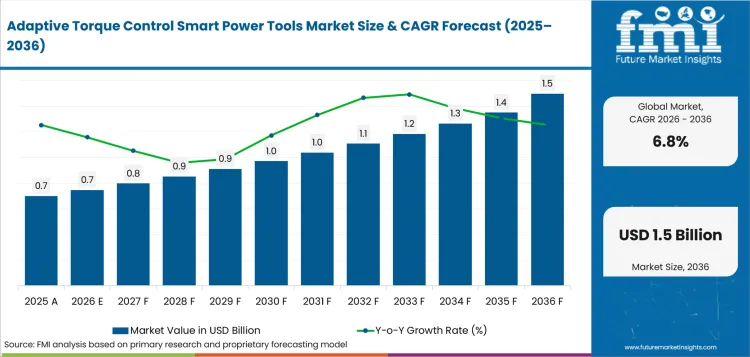
Adaptive Torque Control Smart Power Tools Market Overview: Size and Forecast
- 2026 Market Size: USD 0.82 billion
- 2036 Market Size: USD 1.58 billion
- Forecast CAGR: 6.8% from 2026 to 2036
- Leading Control Architecture: Closed Loop Torque
- Closed Loop Torque Share in 2026: 42.0%
- Leading Connectivity: Bluetooth
- Bluetooth Share in 2026: 46.0%
- Fastest-growing Country: India
- India CAGR: 8.5% by 2036
What are the key takeaways for the adaptive torque control smart power tools market?
Closed Loop Torque leads at 42.0% with Bluetooth at 46.0% and India fastest at 8.5%.
- Demand and Growth Drivers
- Structural bolting workflows are expected to push construction fastening demand, with the segment projected to hold 31.0% end-use share in 2026.
- Factory quality checks are expected to support industrial assembly demand, which is projected to account for 39.0% end-use share in 2026.
- Automotive service demand is expected to hold 17.0% share in 2026, as shops use torque presets to reduce rework on wheels and chassis parts.
- India is projected to grow at 8.5% CAGR through 2036, with infrastructure spending creating a larger pool of professional cordless tool buyers.
- Product and Segment View
- Closed Loop Torque is projected to lead control architecture with 42.0% share as buyers need automatic shutoff and recorded fastening results.
- Impact Wrenches are expected to lead tool type with 36.0% share, given their use in anchors and heavy service work.
- Industrial Assembly is projected to lead end use with 39.0% share as factories treat torque data as part of quality control.
- Direct Enterprise is expected to hold 41.0% share in sales channels, since large buyers need demos and calibration support.
- Geography and Competitive Outlook
- India is projected to grow at 8.5% CAGR through 2036, while China is expected to follow at 8.2% CAGR with factory automation demand.
- The United States is projected to record a 7.0% CAGR, with jobsite safety and fleet tracking shaping professional tool upgrades.
- Germany is forecast at 6.6% CAGR, as automotive and industrial buyers already understand controlled assembly requirements.
- Atlas Copco, Hilti, Bosch, Ingersoll Rand, Milwaukee, Apex Tool Group, and Stanley Black & Decker form the verified competitive set.
- Analyst Opinion
- Nikhil Kaitwade, Associate Vice President at FMI, says, “I see this market less as a tool upgrade and more as a proof upgrade. Buyers are no longer paying only for torque. They are paying for a fastening event that a supervisor, inspector, or quality engineer can trust later. The first demand route comes from factories, where a missed torque event can create warranty cost. The second route comes from construction, where anchors and metal supports need proof during inspection. The third route comes from fleet managers, who want fewer injuries and fewer missing tools. Suppliers with calibrated shutoff and exportable fastening records will have the clearest edge.
Adaptive torque control smart power tools are shifting buyer attention from raw tool power toward fastening proof and repeatable jobsite control. In June 2026, the U.S. Census Bureau estimated April 2026 construction spending at a seasonally adjusted annual rate of USD 2,172.4 billion. That scale matters because contractors, inspectors and factory quality teams need fastening records that can survive handoffs after the operator leaves the work area. Hilti’s SI-AT-22 module shows the premium direction through barcode fastener selection, targeted pre-tension delivery and report-ready documentation for anchors, metal bolting and MEP support structures. Bosch’s June 2025 cordless tool additions point to the adjacent safety route because switchable KickBack Control and torque settings reduce bind-up risk and help crews standardize repeat tasks. Verified torque records are therefore becoming a selection factor where rework cost, inspection exposure and fleet accountability matter more than peak torque alone.
What supports value in the adaptive torque control smart power tools market?
Digital torque records and calibration support lift value across factory and construction fastening use cases.
- Market value is rising as buyers shift from manual torque confirmation toward digital torque tools that store fastening records for audits.
- Industrial assembly spending supports higher average selling prices, since assembly fastening tools need controller links and plant software.
- Construction users are paying for reduced inspection time, as Hilti states its adaptive torque module can work up to 30% faster than a torque wrench.
- Automotive service fleets prefer preset torque tools where repeated wheel and chassis fastening creates liability risk after the vehicle leaves the bay.
- The main value risk is proof quality, since buyers reject connected features when the tool cannot show calibration status or usable export records.
Why is the adaptive torque control smart power tools market growing?
Factory quality teams and contractors are shifting toward tools that record the fastening event after each job.
Factory assembly is the first major growth route for adaptive torque control tools. Automotive and electronics plants need fastening records that connect a tool event to a batch, part, or work cell. In September 2025, the International Federation of Robotics reported 542,000 industrial robots installed in factories during 2024. That automation level raises the value of automotive torque tools that integrate with quality systems. Once production lines measure every step, manual torque notes become weak proof.
Construction is another major route for growth. Contractors want a faster way to show that anchors, T-bolts, and support systems were installed correctly. In June 2026, the U.S. Census Bureau reported private nonresidential construction spending at a seasonally adjusted annual rate of USD 729.8 billion for April 2026. This spending pool supports professional tools that reduce repeat inspection work. The buyer decision is not only tool price. It is the avoided cost of callbacks and disputed fastening quality.
How is the adaptive torque control smart power tools market segmented?
The adaptive torque control smart power tools market is segmented by control architecture, tool type, end use, connectivity, and sales channel.
- Closed Loop Torque is expected to lead control architecture with a projected 42.0% share in 2026, as automatic shutoff gives buyers clear pass-fail fastening proof.
- Impact Wrenches are expected to account for 36.0% of tool type revenue in 2026, with heavy bolting and anchor work supporting premium pricing.
- Industrial Assembly buyers are projected to direct 39.0% of end-use demand toward controlled fastening, as traceability is tied to quality records.
- Bluetooth is estimated to hold 46.0% of connectivity revenue in 2026, with mobile setup fitting jobsite and service fleet workflows.
- Direct Enterprise is projected to represent 41.0% of sales channel revenue in 2026, since calibration and software onboarding require vendor support.
Segmentation reflects how buyers specify proof, not only tool shape. Closed-loop tools win in audited fastening work, while sensor kickback tools win where safety teams need lower reaction risk. In March 2024, NIOSH listed hand-arm vibration syndrome as a risk tied to vibrational tools with levels of 5 to 36 m/s². This keeps safety sensing relevant even when buyers do not need full torque records.
Why does closed loop torque lead the adaptive torque control smart power tools market?
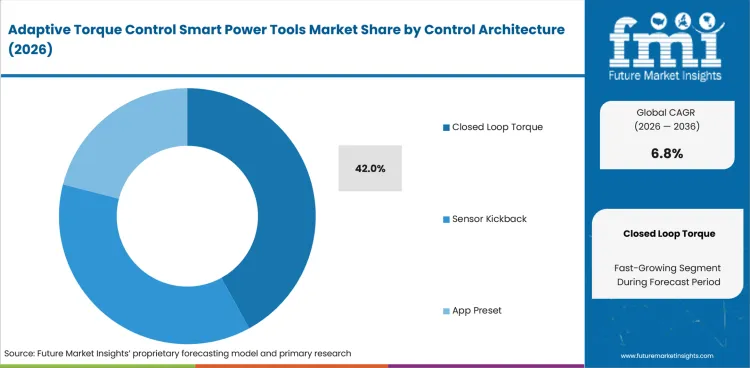
- Closed Loop Torque is projected to account for 42.0% share in 2026 as automatic shutoff, barcode setup, and stored records answer the inspector’s core question.
- Sensor Kickback tools serve a different buyer need. Bosch connected-ready drills show how sudden rotational torque reaction control extends connected-tool value beyond fastening records.
Which tool type leads the adaptive torque control smart power tools market?
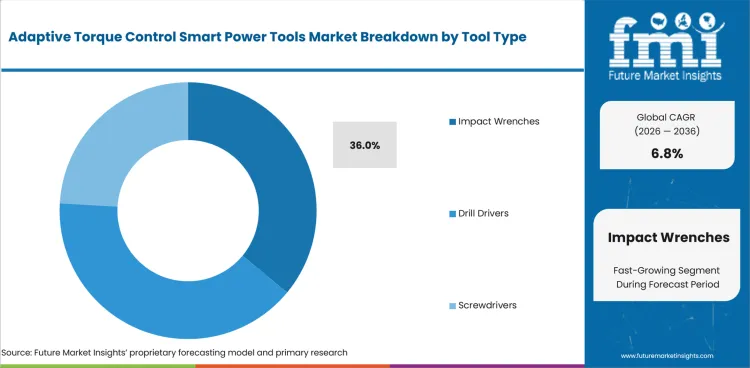
- Impact Wrenches are expected to hold 36.0% share in 2026 as anchor installers, bridge crews, and heavy service shops need high torque with fewer manual checks.
- Milwaukee’s ONE-KEY high torque impact wrench lists up to 1,500 ft-lbs fastening torque, which shows why wrenches are the natural host for premium control electronics.
Which end use leads the adaptive torque control smart power tools market?
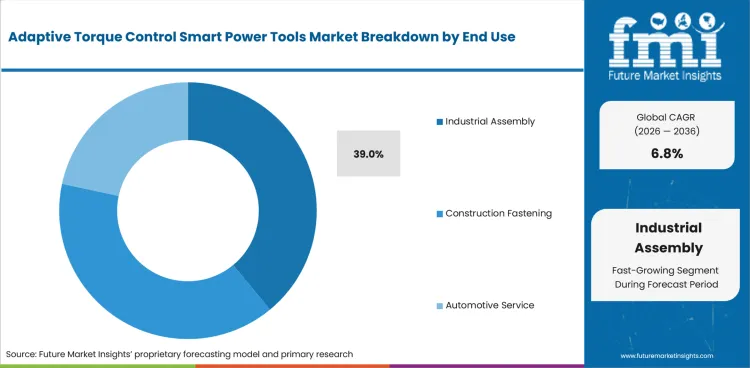
- Industrial Assembly is anticipated to account for 39.0% share in 2026 as automotive and electronics plants need torque proof inside quality systems.
- Atlas Copco’s smart assembly tools use torque software for data collection and process control, which separates factory-grade tools from standard cordless fastening products.
Which connectivity type leads the adaptive torque control smart power tools market?
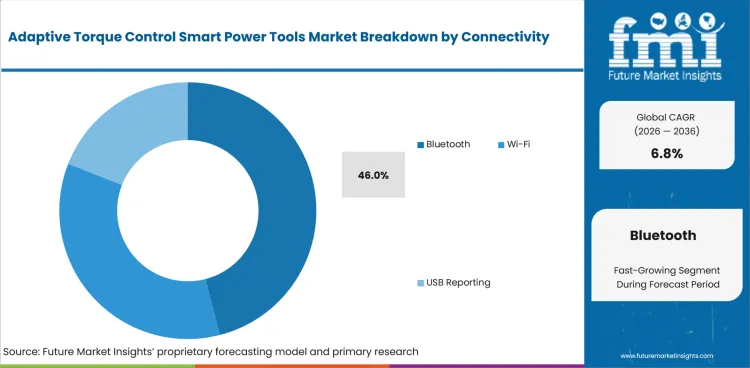
- Bluetooth is projected to hold 46.0% share in 2026 as field crews need simple setup without plant networks or fixed controllers.
- Wi-Fi tools gain ground in factories where controllers link several tools and bring smart fastening closer to plant oversight systems.
Which sales channel leads the adaptive torque control smart power tools market?
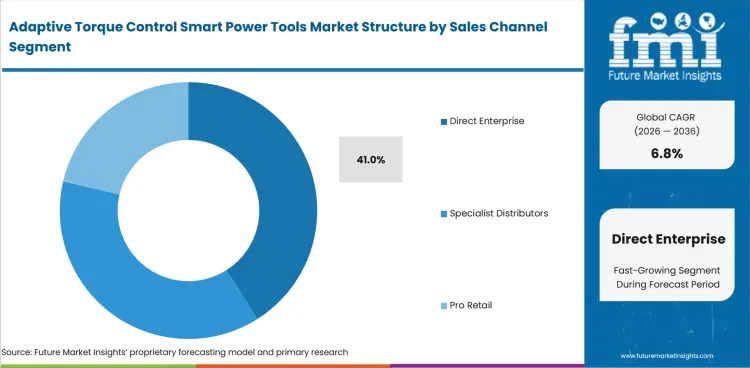
- Direct Enterprise is estimated to account for 41.0% share in 2026 as buyers need demos, software setup and application matching.
- Specialist distributors win when they train buyers on accessories and replacement pathways for air wrenches.
What are the drivers, restraints, and opportunities in the adaptive torque control smart power tools market?
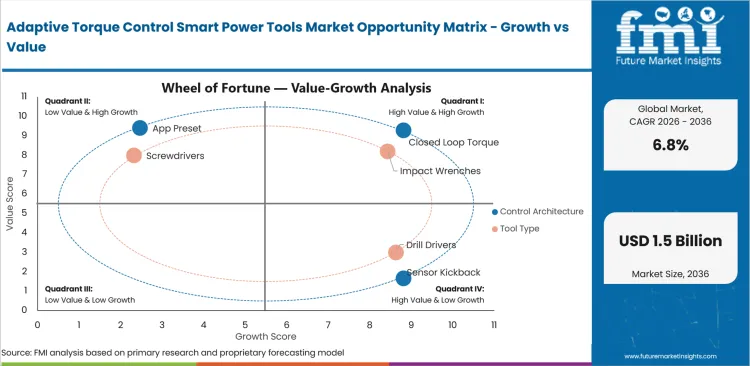
Torque documentation and kickback sensing support demand while calibration cost and battery lock-in limit adoption.
- Driver: Torque documentation demand is the main driver, as buyers need proof that each critical fastener reached the required setting.
- Driver: Kickback sensing is a safety driver, since sudden torque reaction creates injury and tool-damage risk in drilling and cutting jobs.
- Opportunity: Software setup creates an opportunity, as suppliers can sell tool records and calibration workflows with the physical product.
- Restraint: Calibration cost is a restraint, since smaller contractors often delay purchase when service support is not local.
- Restraint: Battery platform lock-in is a channel restraint, as buyers avoid smart tools that do not fit existing chargers and packs.
Fastening Record Liability
Liability is changing how buyers judge torque tools. A standard wrench may tighten a fastener, but it cannot prove the event later without manual notes. Hilti states that its adaptive torque module scans fastener packaging and converts executed fastening data into reports through documentation software. This gives construction buyers a practical audit trail. The effect is strongest in anchors, cast-in channels, and metal support systems. Suppliers that combine tool shutoff with readable records gain an edge over tool-only brands.
Kickback Sensor Safety
Safety sensing is a separate growth route from full torque traceability. Bosch describes KickBack Control as a feature that reduces sudden rotational torque reaction in bind-up scenarios. That control matters in drills and grinders, where tool jam events can injure wrists or shoulders. The benefit is not a documented fastening record. It is safer tool control during high-force work.
Calibration and Battery Lock-in
Calibration remains the main barrier for smaller contractors. Buyers hesitate when service is distant or when software training adds cost after the tool purchase. Battery platform lock-in is another restraint. Contractors with existing chargers and packs need a clear reason to add another tool ecosystem.
Which countries are growing fastest in the adaptive torque control smart power tools market?
India reaches 8.5% CAGR followed by China at 8.2% and South Korea at 7.4% through 2036.
.webp "Top Country Growth Comparison Adaptive Torque Control Smart Power Tools Market Cagr (2026 2036)")
| Country | CAGR |
|---|---|
| India | 8.5% |
| China | 8.2% |
| South Korea | 7.4% |
| United States | 7.0% |
| United Kingdom | 6.8% |
| Germany | 6.6% |
| Japan | 6.1% |
| France | 5.8% |
Source: Future Market Insights, 2026.
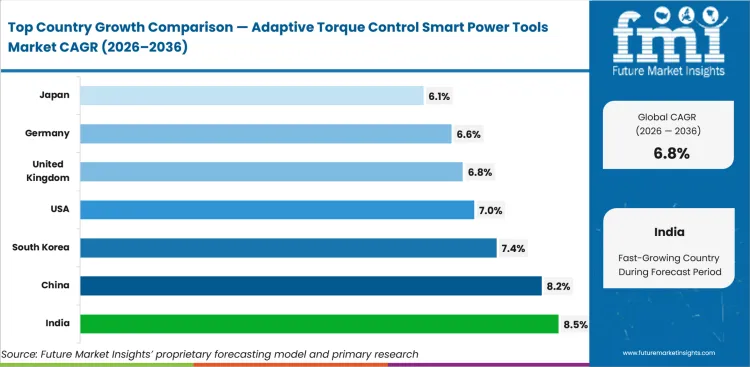
How do country-level CAGRs compare in the adaptive torque control smart power tools market?
India leads country growth while France records the most measured expansion outlook among profiled markets.
- India is projected to record 8.5% CAGR by 2036 as infrastructure capex and factory automation widen the professional cordless tool base.
- China is forecast to expand at 8.2% CAGR from 2026 to 2036 due to equipment investment and smart manufacturing depth.
- South Korea is expected to grow at 7.4% CAGR through 2036 as electronics assembly and shipbuilding service work support controlled fastening.
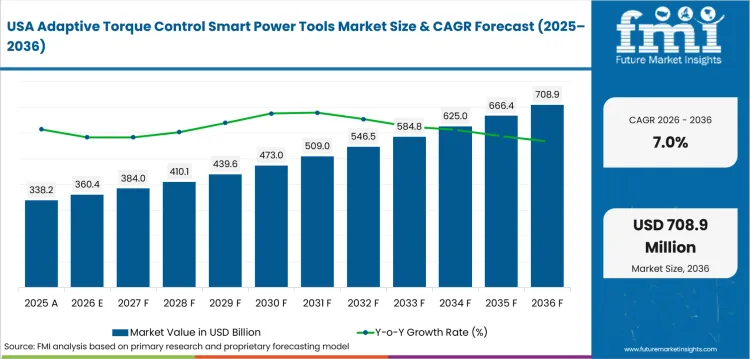
- The United States is projected to rise at 7.0% CAGR by 2036 through nonresidential construction and safety-led fleet upgrades.
- The United Kingdom is forecast to grow at 6.8% CAGR through 2036 as infrastructure work and repair activity support documented fastening demand.
- Germany is expected to post 6.6% CAGR by 2036 because automotive and industrial buyers already use controlled assembly methods.
- Japan is projected to record 6.1% CAGR through 2036 as factory discipline and maintenance quality support preset torque tools.
- France is forecast to expand at 5.8% CAGR by 2036 as manufacturing recovery supports selective tool upgrades.
How fast is the adaptive torque control smart power tools market growing in India?
A 8.5% CAGR through 2036 reflects infrastructure capex and faster professional cordless tool penetration.
Country Market Snapshot Table
| Parameter | Value |
|---|---|
| Market Size in 2025 (Value) | USD 57.1 million |
| Market Size in 2026 (Value) | USD 62.0 million |
| Market Forecast in 2036 (Value) | USD 140.3 million |
| CAGR (2026 to 2036) | 8.5% |
| Years Considered | 2021 to 2036 |
| Base Year | 2025 |
| Forecast Period | 2026 to 2036 |
| Units Considered | Value (USD million) |
| Leading Sub-Region | National infrastructure and metro construction corridors |
India Adaptive Torque Control Smart Power Tools Market Outlook
India demand is shaped by public infrastructure spending and wider use of professional cordless tools. Large construction contractors need fastening records where anchors, steel supports, and rail systems require inspection proof.
Factory buyers are also expected to use adaptive torque tools for assembly checks and rework reduction. Suppliers with local service support and battery-platform compatibility should gain better enterprise access.
Key Growth Drivers
- Public infrastructure spending gives tool suppliers a larger construction base. India proposed public capital expenditure of INR 12.2 lakh crore for FY2026 to FY2027.
- Manufacturing activity supports controlled fastening in equipment plants. MoSPI reported April 2026 manufacturing growth at 6.2% and electrical equipment growth at 19.2%.
- Metro, rail, and airport contractors can use adaptive torque modules to reduce rework during anchor and support installation.
- Local service networks can help enterprise buyers accept premium tools by improving calibration access and operator training.
Key Restraints
- Industrial activity is still uneven outside large factories. MoSPI reported mining and quarrying output declined 5.1% in April 2026.
- Smaller contractors may delay adaptive torque tools when battery packs and software setup add upfront cost.
- Calibration support can remain thin outside large cities and organized industrial clusters.
What makes India unique
India is unique due to fast public capex growth and a large professional tool buyer pool moving from corded and basic cordless tools.
Key Companies
- Bosch India
- Hilti India
- Milwaukee Tool
- Atlas Copco India
- Ingersoll Rand India
- Apex Tool Group
Sales & Marketing Channels
- Direct enterprise sales
- Specialist tool distributors
- Construction supply dealers
- Industrial MRO distributors
- Pro retail counters
- E-commerce platforms
Country Segment Breakdown Table
| Segment | Sub-Segments |
|---|---|
| By Control Architecture | Closed Loop Torque · Sensor Kickback · App Preset · Trigger Control |
| By Tool Type | Impact Wrenches · Drill Drivers · Screwdrivers · Angle Grinders · Rotary Tools |
| By End Use | Industrial Assembly · Construction Fastening · Automotive Service · Renewable Structures · MRO Fleets |
| By Connectivity | Bluetooth · Wi-Fi · USB Reporting · Offline Preset |
| By Sales Channel | Direct Enterprise · Specialist Distributors · Pro Retail · E-Commerce |
| Key Sub-Regions Covered, Infrastructure and Industrial Corridors | Maharashtra · Gujarat · Tamil Nadu · Karnataka · Delhi NCR · Telangana |
Frequently Asked Questions
How fast is India adaptive torque control smart power tools market growing?
India is projected to expand at 8.5% CAGR from 2026 to 2036 through infrastructure capex and professional cordless tool upgrades.
Who leads India adaptive torque control smart power tools market?
Bosch India, Hilti India, Atlas Copco India, Milwaukee Tool, and Ingersoll Rand India compete through industrial and construction tool channels.
What is driving adoption in India adaptive torque control smart power tools market?
Infrastructure spending and manufacturing growth are moving buyers toward documented fastening and safer torque control tools.
How is the adaptive torque control smart power tools market performing in China?
A 8.2% CAGR through 2036 reflects smart manufacturing depth and high equipment-investment activity.
Country Market Snapshot Table
| Parameter | Value |
|---|---|
| Market Size in 2025 (Value) | USD 124.8 million |
| Market Size in 2026 (Value) | USD 135.0 million |
| Market Forecast in 2036 (Value) | USD 296.8 million |
| CAGR (2026 to 2036) | 8.2% |
| Years Considered | 2021 to 2036 |
| Base Year | 2025 |
| Forecast Period | 2026 to 2036 |
| Units Considered | Value (USD million) |
| Leading Sub-Region | Yangtze River Delta and Greater Bay Area |
China Adaptive Torque Control Smart Power Tools Market Outlook
China demand is shaped by factory automation and infrastructure investment. Adaptive torque tools can fit plants that already use connected production data and quality-control systems.
Construction demand remains selective because property-related weakness affects some project types. Industrial buyers should remain the stronger route for connected fastening and torque documentation.
Key Growth Drivers
- Factory automation supports tool data integration. China reported equipment manufacturing output growth of 8.7% and high-tech manufacturing growth of 12.6% during January to April 2026.
- Equipment purchases support smart tool adoption. China reported equipment and instrument purchase investment growth of 11.5% during January to April 2026.
- Electronics and machinery plants can use torque records to link fastening events with batch-level inspection data.
- Large contractors can use app preset and USB reporting tools where project documentation requirements become stricter.
Key Restraints
- Property-linked weakness can restrict construction tool upgrades. China reported real estate development investment declined 13.7% during January to April 2026.
- Local tool competition can pressure prices for imported adaptive torque products.
- Smaller subcontractors may prefer basic impact tools when inspection records are not contractually required.
What makes China unique
China is unique due to its deep factory automation base and large equipment-manufacturing scale.
Key Companies
- Atlas Copco China
- Bosch China
- Hilti China
- Ingersoll Rand China
- Stanley Black & Decker China
- Milwaukee Tool
- Apex Tool Group
Sales & Marketing Channels
- Direct enterprise sales
- Factory automation distributors
- Specialist tool dealers
- Construction supply channels
- Pro retail stores
- E-commerce platforms
Country Segment Breakdown Table
| Segment | Sub-Segments |
|---|---|
| By Control Architecture | Closed Loop Torque · Sensor Kickback · App Preset · Trigger Control |
| By Tool Type | Impact Wrenches · Drill Drivers · Screwdrivers · Angle Grinders · Rotary Tools |
| By End Use | Industrial Assembly · Construction Fastening · Automotive Service · Renewable Structures · MRO Fleets |
| By Connectivity | Bluetooth · Wi-Fi · USB Reporting · Offline Preset |
| By Sales Channel | Direct Enterprise · Specialist Distributors · Pro Retail · E-Commerce |
| Key Sub-Regions Covered, Manufacturing and Construction Clusters | Yangtze River Delta · Greater Bay Area · Beijing-Tianjin-Hebei · Chengdu-Chongqing · Shandong · Hubei |
Frequently Asked Questions
How fast is China adaptive torque control smart power tools market growing?
China is forecast to expand at 8.2% CAGR from 2026 to 2036 as factory automation supports connected fastening systems.
Who leads China adaptive torque control smart power tools market?
Atlas Copco, Bosch, Hilti, Ingersoll Rand, Stanley Black & Decker, and Apex Tool Group compete through enterprise tool channels.
What is driving adoption in China adaptive torque control smart power tools market?
Equipment investment and smart manufacturing are supporting wider use of adaptive torque and reporting-enabled fastening tools.
What is the adaptive torque control smart power tools market outlook in South Korea?
A 7.4% CAGR through 2036 reflects electronics assembly depth and industrial service demand.
Country Market Snapshot Table
| Parameter | Value |
|---|---|
| Market Size in 2025 (Value) | USD 44.7 million |
| Market Size in 2026 (Value) | USD 48.0 million |
| Market Forecast in 2036 (Value) | USD 98.0 million |
| CAGR (2026 to 2036) | 7.4% |
| Years Considered | 2021 to 2036 |
| Base Year | 2025 |
| Forecast Period | 2026 to 2036 |
| Units Considered | Value (USD million) |
| Leading Sub-Region | Seoul Capital Area and industrial technology corridors |
South Korea Adaptive Torque Control Smart Power Tools Market Outlook
South Korea demand is supported by electronics, shipbuilding, and precision industrial service work. Buyers need torque consistency where assembly defects can create warranty and quality costs.
Construction weakness may slow jobsite adoption in the near term. Factory and MRO accounts should remain the more reliable path for adaptive torque tool suppliers.
Key Growth Drivers
- Capital equipment demand supports factory tool upgrades. South Korea reported facilities investment growth of 8.1% year over year in April 2026.
- Export-facing industries create demand for quality records. South Korea reported May 2026 exports increased 53.2% year over year.
- Electronics assembly teams can use closed-loop torque tools to reduce fastening rework and warranty exposure.
- Shipbuilding and industrial maintenance crews can use impact wrenches with presets for repeated bolting work.
Key Restraints
- Construction weakness can slow jobsite tool upgrades. South Korea reported construction output declined 5.5% year over year in April 2026.
- Imported premium tools can face price resistance from smaller service contractors.
- Buyer training remains necessary where operators are used to basic cordless tools and manual checks.
What makes South Korea unique
South Korea is unique due to electronics assembly depth and strong industrial maintenance demand across compact manufacturing clusters.
Key Companies
- Atlas Copco Korea
- Bosch Korea
- Hilti Korea
- Ingersoll Rand Korea
- Milwaukee Tool
- Apex Tool Group
Sales & Marketing Channels
- Direct enterprise sales
- Industrial distributors
- Electronics assembly suppliers
- Shipyard MRO channels
- Construction tool dealers
- E-commerce platforms
Country Segment Breakdown Table
| Segment | Sub-Segments |
|---|---|
| By Control Architecture | Closed Loop Torque · Sensor Kickback · App Preset · Trigger Control |
| By Tool Type | Impact Wrenches · Drill Drivers · Screwdrivers · Angle Grinders · Rotary Tools |
| By End Use | Industrial Assembly · Construction Fastening · Automotive Service · Renewable Structures · MRO Fleets |
| By Connectivity | Bluetooth · Wi-Fi · USB Reporting · Offline Preset |
| By Sales Channel | Direct Enterprise · Specialist Distributors · Pro Retail · E-Commerce |
| Key Sub-Regions Covered, Electronics and Industrial Service Areas | Seoul Capital Area · Gyeonggi · Chungcheong · Ulsan · Busan · Daegu-Gyeongbuk |
Frequently Asked Questions
How fast is South Korea adaptive torque control smart power tools market growing?
South Korea is expected to grow at 7.4% CAGR from 2026 to 2036 through electronics assembly and MRO tool upgrades.
Who leads South Korea adaptive torque control smart power tools market?
Atlas Copco Korea, Bosch Korea, Hilti Korea, Ingersoll Rand Korea, and Milwaukee Tool compete through industrial and service channels.
What is driving adoption in South Korea adaptive torque control smart power tools market?
Factory investment and export-oriented production are supporting demand for torque records and controlled fastening tools.
What is the adaptive torque control smart power tools market outlook in the United States?
A 7.0% CAGR through 2036 reflects nonresidential construction activity and safety-led fleet upgrades.
Country Market Snapshot Table
| Parameter | Value |
|---|---|
| Market Size in 2025 (Value) | USD 163.6 million |
| Market Size in 2026 (Value) | USD 175.0 million |
| Market Forecast in 2036 (Value) | USD 344.3 million |
| CAGR (2026 to 2036) | 7.0% |
| Years Considered | 2021 to 2036 |
| Base Year | 2025 |
| Forecast Period | 2026 to 2036 |
| Units Considered | Value (USD million) |
| Leading Sub-Region | South Atlantic and national pro-tool networks |
United States Adaptive Torque Control Smart Power Tools Market Outlook
United States demand is shaped by large nonresidential construction work and enterprise tool fleets. Contractors can justify adaptive torque tools when inspection records reduce rework and liability disputes.
Industrial buyers are also expected to use torque presets in assembly and maintenance work. Suppliers with calibration support and fleet software should gain stronger direct enterprise placement.
Key Growth Drivers
- Nonresidential construction supports professional tool demand. The U.S. Census Bureau reported April 2026 private nonresidential construction spending at USD 729.8 billion.
- Safety and injury control support kickback features. BLS reported 2.5 million nonfatal workplace injuries and illnesses in private industry during 2024.
- Fleet managers can use connected tool data to monitor tool status, user assignment, and maintenance timing.
- Automotive service networks can use preset torque tools to reduce rework on wheels and chassis components.
Key Restraints
- Construction spending softness can delay premium upgrades. The U.S. Census Bureau reported private nonresidential construction spending fell 0.2% from March to April 2026.
- Battery-platform lock-in can slow switching when buyers already own large cordless tool fleets.
- Small contractors may avoid software-linked tools when inspection records are not required by contract.
What makes the United States unique
The United States is unique due to large contractor fleets and broad direct-enterprise channels for connected professional tools.
Key Companies
- Milwaukee Tool
- Bosch Power Tools
- Hilti North America
- Ingersoll Rand
- Stanley Black & Decker
- Atlas Copco
- Apex Tool Group
Sales & Marketing Channels
- Direct enterprise sales
- Specialist distributors
- Pro retail stores
- Construction supply houses
- Automotive service channels
- E-commerce platforms
Country Segment Breakdown Table
| Segment | Sub-Segments |
|---|---|
| By Control Architecture | Closed Loop Torque · Sensor Kickback · App Preset · Trigger Control |
| By Tool Type | Impact Wrenches · Drill Drivers · Screwdrivers · Angle Grinders · Rotary Tools |
| By End Use | Industrial Assembly · Construction Fastening · Automotive Service · Renewable Structures · MRO Fleets |
| By Connectivity | Bluetooth · Wi-Fi · USB Reporting · Offline Preset |
| By Sales Channel | Direct Enterprise · Specialist Distributors · Pro Retail · E-Commerce |
| Key Sub-Regions Covered, Construction and Industrial Tool Networks | South Atlantic · Midwest · Texas · California · Northeast · Pacific Northwest |
Frequently Asked Questions
How fast is United States adaptive torque control smart power tools market growing?
The United States is projected to grow at 7.0% CAGR from 2026 to 2036 through construction fastening and fleet upgrades.
Who leads United States adaptive torque control smart power tools market?
Milwaukee Tool, Bosch, Hilti, Ingersoll Rand, Stanley Black & Decker, and Atlas Copco compete through professional tool channels.
What is driving adoption in United States adaptive torque control smart power tools market?
Nonresidential construction and workplace safety needs are moving buyers toward connected torque and kickback-control tools.
How is the adaptive torque control smart power tools market performing in the United Kingdom?
A 6.8% CAGR through 2036 reflects infrastructure pipelines and repair-led construction demand.
Country Market Snapshot Table
| Parameter | Value |
|---|---|
| Market Size in 2025 (Value) | USD 46.8 million |
| Market Size in 2026 (Value) | USD 50.0 million |
| Market Forecast in 2036 (Value) | USD 96.6 million |
| CAGR (2026 to 2036) | 6.8% |
| Years Considered | 2021 to 2036 |
| Base Year | 2025 |
| Forecast Period | 2026 to 2036 |
| Units Considered | Value (USD million) |
| Leading Sub-Region | London, Midlands, and rail maintenance corridors |
United Kingdom Adaptive Torque Control Smart Power Tools Market Outlook
United Kingdom demand is supported by infrastructure renewal and repair-heavy construction work. Contractors can use adaptive torque tools where inspection records matter for rail, utilities, and structural support installation.
Tool suppliers face a measured growth path because new construction remains uneven. Direct support through calibration and training should decide enterprise adoption.
Key Growth Drivers
- Repair and maintenance work supports controlled fastening demand. ONS reported construction output grew 1.6% in the three months to April 2026.
- Infrastructure planning supports long-cycle tool demand. The UK pipeline includes 734 projects with £718 billion of planned investment over the next decade.
- Rail, utilities, and public-asset maintenance can use torque records to reduce inspection delays.
- Specialist distributors can support adoption by training contractors on presets, calibration, and reporting workflows.
Key Restraints
- New work remains softer than repair activity. ONS reported construction output was 1.3% lower year over year in the first quarter of 2026.
- Contractor margins can limit adoption when tools need subscription software and periodic calibration.
- Fragmented subcontractor networks can slow consistent use of barcode setup and exportable fastening records.
What makes the United Kingdom unique
The United Kingdom is unique due to repair-led construction demand and a large planned infrastructure pipeline.
Key Companies
- Bosch UK
- Hilti Great Britain
- Atlas Copco UK
- Ingersoll Rand UK
- Milwaukee Tool UK
- Apex Tool Group
Sales & Marketing Channels
- Direct enterprise sales
- Specialist tool distributors
- Pro retail counters
- Rail maintenance suppliers
- Construction supply chains
- E-commerce platforms
Country Segment Breakdown Table
| Segment | Sub-Segments |
|---|---|
| By Control Architecture | Closed Loop Torque · Sensor Kickback · App Preset · Trigger Control |
| By Tool Type | Impact Wrenches · Drill Drivers · Screwdrivers · Angle Grinders · Rotary Tools |
| By End Use | Industrial Assembly · Construction Fastening · Automotive Service · Renewable Structures · MRO Fleets |
| By Connectivity | Bluetooth · Wi-Fi · USB Reporting · Offline Preset |
| By Sales Channel | Direct Enterprise · Specialist Distributors · Pro Retail · E-Commerce |
| Key Sub-Regions Covered, Infrastructure and Maintenance Areas | London · Midlands · North West England · Scotland · Wales · Northern England |
Frequently Asked Questions
How fast is United Kingdom adaptive torque control smart power tools market growing?
The United Kingdom is forecast to expand at 6.8% CAGR from 2026 to 2036 through infrastructure and maintenance demand.
Who leads United Kingdom adaptive torque control smart power tools market?
Bosch UK, Hilti Great Britain, Atlas Copco UK, Milwaukee Tool UK, and Ingersoll Rand UK compete through pro channels.
What is driving adoption in United Kingdom adaptive torque control smart power tools market?
Infrastructure planning and repair-led construction are supporting demand for documented torque and safer tool control.
How is the adaptive torque control smart power tools market performing in Germany?
A 6.6% CAGR through 2036 reflects industrial assembly discipline and automotive service depth.
Country Market Snapshot Table
| Parameter | Value |
|---|---|
| Market Size in 2025 (Value) | USD 67.5 million |
| Market Size in 2026 (Value) | USD 72.0 million |
| Market Forecast in 2036 (Value) | USD 136.8 million |
| CAGR (2026 to 2036) | 6.6% |
| Years Considered | 2021 to 2036 |
| Base Year | 2025 |
| Forecast Period | 2026 to 2036 |
| Units Considered | Value (USD million) |
| Leading Sub-Region | Bavaria and Baden-Württemberg industrial corridors |
Germany Adaptive Torque Control Smart Power Tools Market Outlook
Germany demand is shaped by controlled assembly habits across automotive and machinery buyers. Industrial users already understand the value of torque accuracy and process documentation.
Construction and capital-equipment caution can slow broader tool upgrades. Suppliers with factory-grade software and calibration support should keep the strongest position.
Key Growth Drivers
- Manufacturing recovery supports factory tool upgrades. Destatis reported industrial production increased 0.4% month over month in April 2026.
- Selected industrial categories support fastening demand. Destatis reported December 2025 construction production rose 3.0% and fabricated metal production increased 3.2%.
- Automotive plants can use closed-loop torque tools where fastening records support quality checks and warranty control.
- Specialist distributors can sell adaptive tools through calibration, application advice, and enterprise installation support.
Key Restraints
- Machinery and vehicle weakness can delay premium tool purchases. Destatis reported 2025 machinery and equipment production fell 2.6%.
- Buyers may extend existing torque-tool fleets when plant investment budgets remain cautious.
- Software onboarding can slow adoption among smaller workshops that prefer offline preset tools.
What makes Germany unique
Germany is unique due to its controlled assembly culture and strong industrial buyer understanding of torque proof.
Key Companies
- Bosch Professional
- Atlas Copco Germany
- Hilti Germany
- Apex Tool Group
- Ingersoll Rand Germany
- Milwaukee Tool
Sales & Marketing Channels
- Direct enterprise sales
- Industrial distributors
- Automotive service channels
- Construction supply houses
- Pro retail stores
- E-commerce platforms
Country Segment Breakdown Table
| Segment | Sub-Segments |
|---|---|
| By Control Architecture | Closed Loop Torque · Sensor Kickback · App Preset · Trigger Control |
| By Tool Type | Impact Wrenches · Drill Drivers · Screwdrivers · Angle Grinders · Rotary Tools |
| By End Use | Industrial Assembly · Construction Fastening · Automotive Service · Renewable Structures · MRO Fleets |
| By Connectivity | Bluetooth · Wi-Fi · USB Reporting · Offline Preset |
| By Sales Channel | Direct Enterprise · Specialist Distributors · Pro Retail · E-Commerce |
| Key Sub-Regions Covered, Industrial Assembly and Automotive Areas | Bavaria · Baden-Württemberg · North Rhine-Westphalia · Lower Saxony · Hesse · Saxony |
Frequently Asked Questions
How fast is Germany adaptive torque control smart power tools market growing?
Germany is expected to post 6.6% CAGR from 2026 to 2036 through automotive assembly and industrial maintenance demand.
Who leads Germany adaptive torque control smart power tools market?
Bosch, Atlas Copco, Hilti, Apex Tool Group, Ingersoll Rand, and Milwaukee Tool compete through industrial and pro channels.
What is driving adoption in Germany adaptive torque control smart power tools market?
Controlled assembly requirements and automotive service depth are supporting demand for torque records and calibrated fastening tools.
What is the adaptive torque control smart power tools market forecast for Japan?
A 6.1% CAGR through 2036 reflects factory quality discipline and selective maintenance use.
Country Market Snapshot Table
| Parameter | Value |
|---|---|
| Market Size in 2025 (Value) | USD 51.8 million |
| Market Size in 2026 (Value) | USD 55.0 million |
| Market Forecast in 2036 (Value) | USD 99.4 million |
| CAGR (2026 to 2036) | 6.1% |
| Years Considered | 2021 to 2036 |
| Base Year | 2025 |
| Forecast Period | 2026 to 2036 |
| Units Considered | Value (USD million) |
| Leading Sub-Region | Tokyo, Nagoya, and Kansai manufacturing corridors |
Japan Adaptive Torque Control Smart Power Tools Market Outlook
Japan demand is shaped by disciplined manufacturing and high expectations for process reliability. Adaptive torque tools can gain in plants where repeatability matters more than tool speed alone.
Adoption is expected to stay selective because many buyers already use established assembly systems. Field service and maintenance channels should favor compact Bluetooth and offline preset tools.
Key Growth Drivers
- Industrial output supports selective tool upgrades. METI reported April 2026 production increased 0.5% month over month and 2.0% year over year.
- Shipment activity supports industrial tool replacement. METI reported April 2026 shipments increased 1.3% month over month.
- Automotive and electronics plants can use torque documentation to support quality checks and operator accountability.
- Maintenance teams can use preset tools where compact service workflows do not justify full controller systems.
Key Restraints
- Capacity use remains under pressure in some plants. METI reported the production capacity index fell 1.0% year over year in April 2026.
- Long replacement cycles can slow switching from established controlled assembly tools to newer smart power tools.
- Buyer caution can limit adoption when app setup adds work without clear audit requirements.
What makes Japan unique
Japan is unique due to factory quality discipline and selective acceptance of compact professional tool upgrades.
Key Companies
- Bosch Japan
- Hilti Japan
- Atlas Copco Japan
- Milwaukee Tool
- Apex Tool Group
- Ingersoll Rand Japan
Sales & Marketing Channels
- Direct enterprise sales
- Industrial distributors
- Factory maintenance suppliers
- Automotive service channels
- Pro retail stores
- E-commerce platforms
Country Segment Breakdown Table
| Segment | Sub-Segments |
|---|---|
| By Control Architecture | Closed Loop Torque · Sensor Kickback · App Preset · Trigger Control |
| By Tool Type | Impact Wrenches · Drill Drivers · Screwdrivers · Angle Grinders · Rotary Tools |
| By End Use | Industrial Assembly · Construction Fastening · Automotive Service · Renewable Structures · MRO Fleets |
| By Connectivity | Bluetooth · Wi-Fi · USB Reporting · Offline Preset |
| By Sales Channel | Direct Enterprise · Specialist Distributors · Pro Retail · E-Commerce |
| Key Sub-Regions Covered, Factory and Service Tool Areas | Tokyo · Nagoya · Kansai · Kyushu · Tohoku · Hokkaido |
Frequently Asked Questions
How fast is Japan adaptive torque control smart power tools market growing?
Japan is projected to record 6.1% CAGR from 2026 to 2036 through factory quality and maintenance tool demand.
Who leads Japan adaptive torque control smart power tools market?
Bosch Japan, Hilti Japan, Atlas Copco Japan, Milwaukee Tool, and Apex Tool Group compete through enterprise and pro channels.
What is driving adoption in Japan adaptive torque control smart power tools market?
Industrial output recovery and quality-control discipline are supporting selective use of torque reporting and preset tools.
How is the adaptive torque control smart power tools market performing in France?
A 5.8% CAGR through 2036 reflects selective manufacturing recovery and construction maintenance demand.
Country Market Snapshot Table
| Parameter | Value |
|---|---|
| Market Size in 2025 (Value) | USD 38.8 million |
| Market Size in 2026 (Value) | USD 41.0 million |
| Market Forecast in 2036 (Value) | USD 72.1 million |
| CAGR (2026 to 2036) | 5.8% |
| Years Considered | 2021 to 2036 |
| Base Year | 2025 |
| Forecast Period | 2026 to 2036 |
| Units Considered | Value (USD million) |
| Leading Sub-Region | Paris region and industrial maintenance corridors |
France Adaptive Torque Control Smart Power Tools Market Outlook
France demand is expected to remain selective because construction output has been uneven. Manufacturing and maintenance accounts should provide the clearer route for adaptive torque control tools.
Professional buyers are expected to value tools that reduce inspection time and improve fastening consistency. Direct enterprise sales should remain important where buyers need training and software setup.
Key Growth Drivers
- Manufacturing recovery supports factory and maintenance tool demand. INSEE reported manufacturing output increased 1.2% month over month in March 2026.
- Civil engineering work can support structural fastening demand. INSEE reported civil engineering output increased 2.9% month over month in March 2026.
- Industrial maintenance teams can use preset torque tools to reduce rework during scheduled shutdowns.
- Construction contractors can use reporting tools where public infrastructure work needs stronger documentation.
Key Restraints
- Construction weakness can restrict faster adoption. INSEE reported construction output over the first quarter of 2026 was 2.8% lower year over year.
- Smaller contractors may avoid premium connected tools when manual checks remain accepted on lower-risk jobs.
- Distribution training needs can slow adoption when buyers do not understand the difference between smart tools and adaptive torque control.
What makes France unique
France is unique due to its mix of industrial maintenance demand and cautious construction-sector recovery.
Key Companies
- Bosch France
- Hilti France
- Atlas Copco France
- Ingersoll Rand France
- Milwaukee Tool
- Apex Tool Group
Sales & Marketing Channels
- Direct enterprise sales
- Industrial distributors
- Construction supply dealers
- Automotive service channels
- Pro retail stores
- E-commerce platforms
Country Segment Breakdown Table
| Segment | Sub-Segments |
|---|---|
| By Control Architecture | Closed Loop Torque · Sensor Kickback · App Preset · Trigger Control |
| By Tool Type | Impact Wrenches · Drill Drivers · Screwdrivers · Angle Grinders · Rotary Tools |
| By End Use | Industrial Assembly · Construction Fastening · Automotive Service · Renewable Structures · MRO Fleets |
| By Connectivity | Bluetooth · Wi-Fi · USB Reporting · Offline Preset |
| By Sales Channel | Direct Enterprise · Specialist Distributors · Pro Retail · E-Commerce |
| Key Sub-Regions Covered, Manufacturing and Construction Service Areas | Île-de-France · Auvergne-Rhône-Alpes · Hauts-de-France · Grand Est · Occitanie · Provence-Alpes-Côte d’Azur |
Frequently Asked Questions
How fast is France adaptive torque control smart power tools market growing?
France is forecast to expand at 5.8% CAGR from 2026 to 2036 through manufacturing and maintenance tool upgrades.
Who leads France adaptive torque control smart power tools market?
Bosch France, Hilti France, Atlas Copco France, Ingersoll Rand France, and Milwaukee Tool compete through industrial channels.
What is driving adoption in France adaptive torque control smart power tools market?
Manufacturing recovery and civil engineering work are supporting selective demand for documented torque and preset fastening tools.
Who are the leading companies in the adaptive torque control smart power tools market?
Factory tightening specialists and construction-focused tool brands compete on torque traceability, sensor safety, software usability, and channel support.
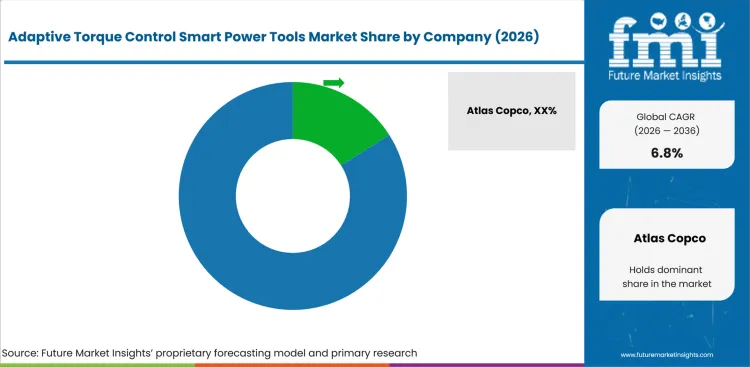
Competition is shaped by proof depth rather than tool power alone. Atlas Copco stands out in factory tightening because its smart assembly systems include torque controllers and software. That creates an advantage in automotive and electronics plants that already use structured work instructions.
Hilti is strongest in construction fastening proof because its adaptive torque module links compatible anchors, barcode setup, and documentation software. Bosch and Milwaukee compete through connected cordless platforms, safety sensing, and wide professional tool ecosystems. Ingersoll Rand and Apex Tool Group hold strength in assembly tools and controlled fastening applications.
Smaller and channel-led competitors can win where service coverage, calibration, and local training matter more than global product breadth. The best-positioned suppliers are those that connect shutoff accuracy, readable records, and dependable service support.
How do top adaptive torque control smart power tools companies compare?
| Company | Torque Traceability Depth | Sensor Safety Control | Platform Integration | Geographic Footprint | Primary Strength |
|---|---|---|---|---|---|
| Atlas Copco | High | Strong | High | Global | Factory tightening systems |
| Hilti | High | Strong | Strong | Global | Construction anchor proof |
| Bosch | Medium | High | Strong | Global | Kickback control and connected drills |
| Milwaukee | Medium | Strong | Strong | Global | ONE-KEY cordless ecosystem |
| Ingersoll Rand | High | Medium | Medium | Global | Assembly fastening platforms |
| Apex Tool Group | High | Medium | Medium | Global | Controlled assembly tools |
| Stanley Black & Decker | Medium | Medium | Strong | Global | Professional tool reach |
Source: Future Market Insights competitive analysis, 2026.
Key Developments in Adaptive Torque Control Smart Power Tools Market
- In March 2024, Milwaukee Tool and Columbus McKinnon introduced the M18 Compact 1-Ton Chain Hoist with One-Key. The launch shows how connected control is expanding beyond drills and impact tools.
- In June 2024, Milwaukee introduced next generation M12 FUEL Stubby Impact Wrenches with up to 550 ft-lbs of nut-busting torque. The product strengthens cordless heavy fastening reach.
- In October 2024, Ingersoll Rand previewed QX Limitless with Wi-Fi 6 and cordless accessories. The update supports factory fastening projects that need stronger wireless data movement.
- In October 2024, Hilti documented use of SIW 4 AT impact wrenches and SI-AT-22 adaptive torque modules at Red Bull Dual Ascent. The case shows adaptive torque use in safety-critical anchor installation.
- In January 2024, Bosch launched connected-ready drill and hammer drill models with KickBack Control and 565 in-lbs of torque. The launch links power, safety sensing, and connected readiness.
Key Players in the Adaptive Torque Control Smart Power Tools Market
Factory Tightening Specialists
- Atlas Copco
- Apex Tool Group
- Ingersoll Rand
- Stanley Black & Decker
Construction and Jobsite Specialists
- Hilti
- Bosch
- Milwaukee
Hybrid Platform Players
- Bosch
- Milwaukee
- Ingersoll Rand
- Stanley Black & Decker
Adaptive Torque Control Smart Power Tools Market - Report Scope
| Item | Value |
|---|---|
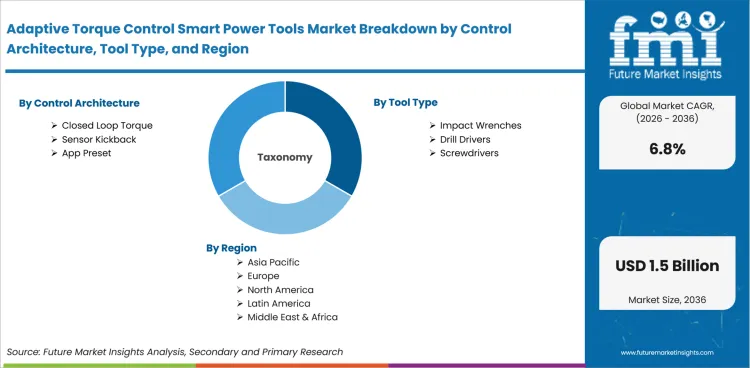
| Market size by 2036 | USD 1.58 billion |
| Growth rate | 6.8% CAGR from 2026 to 2036 |
| Forecast period | 2026 to 2036 |
| Base year value (2025) | USD 0.76 billion |
| By control architecture | Closed Loop Torque, Sensor Kickback, App Preset, Trigger Control |
| By tool type | Impact Wrenches, Drill Drivers, Screwdrivers, Angle Grinders, Rotary Tools |
| By end use | Industrial Assembly, Construction Fastening, Automotive Service, Renewable Structures, MRO Fleets |
| By connectivity | Bluetooth, Wi-Fi, USB Reporting, Offline Preset |
| By sales channel | Direct Enterprise, Specialist Distributors, Pro Retail, E-Commerce |
| Regions covered | North America, Latin America, Europe, East Asia, South Asia and Pacific, Middle East and Africa |
| Key companies | Hilti, Atlas Copco, Bosch, Ingersoll Rand, Milwaukee, Apex Tool Group, Stanley Black & Decker |
Source: Future Market Insights, 2026.
Adaptive Torque Control Smart Power Tools Market Breakdown by Control Architecture, Tool Type, End Use, Connectivity, Sales Channel, and Region
Adaptive Torque Control Smart Power Tools Market Segmented by Control Architecture:
- Closed Loop Torque
- Sensor Kickback
- App Preset
- Trigger Control
Adaptive Torque Control Smart Power Tools Market Segmented by Tool Type:
- Impact Wrenches
- Drill Drivers
- Screwdrivers
- Angle Grinders
- Rotary Tools
Adaptive Torque Control Smart Power Tools Market Segmented by End Use:
- Industrial Assembly
- Construction Fastening
- Automotive Service
- Renewable Structures
- MRO Fleets
Adaptive Torque Control Smart Power Tools Market Segmented by Connectivity:
- Bluetooth
- Wi-Fi
- USB Reporting
- Offline Preset
Adaptive Torque Control Smart Power Tools Market Segmented by Sales Channel:
- Direct Enterprise
- Specialist Distributors
- Pro Retail
- E-Commerce
Adaptive Torque Control Smart Power Tools Market by Region:
- North America
- United States
- Canada
- Mexico
- Latin America
- Brazil
- Chile
- Rest of Latin America
- Western Europe
- Germany
- United Kingdom
- France
- Italy
- Spain
- Nordic
- BENELUX
- Rest of Western Europe
- Eastern Europe
- Russia
- Poland
- Hungary
- Balkan & Baltic
- Rest of Eastern Europe
- East Asia
- China
- Japan
- South Korea
- South Asia and Pacific
- India
- ASEAN
- Australia & New Zealand
- Rest of South Asia and Pacific
- Middle East & Africa
- Kingdom of Saudi Arabia
- Other GCC Countries
- Turkiye
- South Africa
- Other African Union
- Rest of Middle East & Africa
This Report Answers
- What is the 2026 value and 2036 forecast for adaptive torque control smart power tools market?
- What CAGR is expected for adaptive torque control smart power tools from 2026 to 2036?
- Which control architecture is expected to lead adaptive torque control smart power tool revenue?
- Which tool type is expected to carry the strongest demand in smart torque control applications?
- Why are construction and factory buyers paying for torque documentation and adaptive shutoff?
- How do safety sensing, kickback control, and inspection records affect supplier selection?
- Which countries are forecast to grow fastest in adaptive torque control smart power tools?
- Which companies are most relevant in factory tightening and construction smart fastening?
- What products are included and excluded from adaptive torque control smart power tools?
- How were market values and country CAGRs derived for this forecast?
Research Sources and Bibliography
- U.S. Census Bureau. (2026, June 1). Monthly construction spending, April 2026. U.S. Department of Commerce.
- Office for National Statistics. (2026, June 12). Construction output in Great Britain: April 2026. Office for National Statistics.
- Institut national de la statistique et des études économiques. (2026, April 3). In February 2026, manufacturing output was stable. INSEE.
- International Federation of Robotics. (2025, September 25). Global robot demand in factories doubles over 10 years. IFR.
- International Federation of Robotics. (2024, November 20). Global robot density in factories doubled in seven years. IFR.
- National Institute for Occupational Safety and Health. (2024, March 1). Step 1: Identify risk factors. Centers for Disease Control and Prevention.
- Ministry of Finance, Government of India. (2026, February 3). Union Budget FY 2026-27: Strengthening capital goods sector. Press Information Bureau.
- Hilti. (2026). SI-AT-22 Adaptive Torque Module. Hilti.
- Robert Bosch Tool Corporation. (2024, January 23). Bosch continues commitment to cordless. Bosch Press.
- Milwaukee Tool. (2024, June 26). Milwaukee delivers the next generation of M12 FUEL Stubby Impact Wrenches. Milwaukee Tool.
- Ingersoll Rand. (2024, October 15). Leading innovations in assembly operations. Ingersoll Rand Power Tools.
- Atlas Copco. (2026). Assembly tools and solutions. Atlas Copco.
- Milwaukee Tool. (2026). M18 FUEL 1 in. High Torque Impact Wrench with ONE-KEY. Milwaukee Tool.
Adaptive Torque Control Smart Power Tools Market - Scope & Definition
| Attribute | Detail |
|---|---|
| Market Definition | Powered tools that adjust, limit, stop, or record torque through sensors, controllers, embedded electronics, or connected software. |
| Functions Covered | Torque adjustment, automatic shutoff, kickback sensing, preset control, fastening documentation, calibration workflow support |
| Applications Covered | Construction anchoring, industrial assembly, automotive service, renewable structure installation, and MRO fastening |
| End-Use Industries | Construction, automotive, electronics, manufacturing, renewable energy, and maintenance services |
| Products Included | Smart impact wrenches, torque screwdrivers, drill drivers, controlled nutrunners, adaptive torque modules, and documentation software |
| Products Excluded | Manual torque wrenches, basic impact tools without torque control, standard drills without smart sensing, standalone asset tags, and non-powered hand tools |
Adaptive Torque Control Smart Power Tools Market - Research Methodology
| Method | Description |
|---|---|
| Primary Research | FMI analyst interviews with construction contractors, factory assembly teams, automotive service operators, tool distributors, and fleet managers. |
| Desk Research | Review of government construction data, official robotics statistics, safety guidance, company product documents, and official product launch material. |
| Market Sizing & Forecasting | Hybrid bottom-up and top-down model using parent power tool revenue, smart tool penetration, controlled fastening share, and country adoption differences. |
| Data Validation | Forecasts were checked against construction output, industrial automation demand, company product portfolios, and official safety guidance. |
Frequently Asked Questions
What is the adaptive torque control smart power tools market size in 2026?
The market is expected to be worth USD 0.82 billion in 2026, supported by documented fastening demand.
What is the adaptive torque control smart power tools market forecast for 2036?
The market is forecast to reach USD 1.58 billion by 2036 as torque records become more common in factory and construction work.
What is the adaptive torque control smart power tools market CAGR?
The market is projected to expand at a 6.8% CAGR from 2026 to 2036 across smart fastening and safety-control applications.
What segment leads the adaptive torque control smart power tools market?
Closed Loop Torque is projected to lead with 42.0% share in 2026 because buyers need automatic shutoff and usable fastening proof.
What country grows fastest in the adaptive torque control smart power tools market?
India is projected to grow fastest at 8.5% CAGR through 2036, supported by infrastructure spending and professional cordless tool adoption.
What does the adaptive torque control smart power tools market include?
The market includes powered tools that adjust, stop, limit, or record torque through sensors, controllers, electronics, or connected software.
How was the forecast calculated?
The forecast used parent power tool revenue, smart tool penetration, controlled fastening share, country adoption rates, and verified supplier activity.
What are the disadvantages of adaptive torque smart power tools?
The main disadvantages are higher upfront cost, calibration needs, software setup, battery platform lock-in, and training.
Preview the report firsthand - request a free sample
Get SampleGet the brochure for pricing and purchase details.
Get PDFTable of Content
- Key Takeaways
- Market Size and CAGR
- Top Growth Driver
- Fastest Growing Segment
- Leading Region
- Key Companies
- Emerging Opportunities
- Executive Summary
- Global Market Outlook
- Demand-side Trends
- Supply-side Trends
- Technology Roadmap Analysis
- Analysis and Recommendations
- Analyst Perspective (What is happening? Why now? What should investors know?)
- Key Questions Answered
- How large is the market?
- What is the CAGR?
- What are key trends?
- Which region dominates?
- Who are the leaders?
- Market Overview
- Market Coverage / Taxonomy
- Market Definition / Scope / Limitations
- Research Methodology
- Chapter Orientation
- Analytical Lens and Working Hypotheses
- Market Structure, Signals, and Trend Drivers
- Benchmarking and Cross-market Comparability
- Market Sizing, Forecasting, and Opportunity Mapping
- Research Design and Evidence Framework
- Desk Research Programme (Secondary Evidence)
- Expert Input and Fieldwork (Primary Evidence)
- Tooling, Models, and Reference Databases
- Data Engineering and Model Build
- Quality Assurance and Audit Trail
- Market Background
- Market Dynamics (Drivers, Restraints, Opportunity, Trends)
- Scenario Forecast (Optimistic, Likely, Conservative)
- Impact Analysis
- AI Impact
- Sustainability Impact
- Regulatory Impact
- Technology Impact
- Consumer / Buyer Analysis
- Purchase Drivers
- Adoption Barriers
- Buyer Journey
- Opportunity Map Analysis
- Product Life Cycle Analysis
- Supply Chain Analysis
- Investment Feasibility Matrix
- Value Chain Analysis
- PESTLE and Porter's Analysis
- Regulatory Landscape
- Regional Parent Market Outlook
- Production and Consumption Statistics
- Import and Export Statistics
- Global Market Analysis and Forecast, 2021 to 2036
- Historical Market Size Value (USD Billion) & Volume (Unit) Analysis, 2021 to 2025
- Current and Future Market Size Value (USD Billion) & Volume (Unit) Projections, 2026 to 2036
- Y-o-Y Growth Trend Analysis
- Absolute $ Opportunity Analysis
- Global Market Pricing Analysis, 2021 to 2036
- Global Market Analysis and Forecast, By Control Architecture, 2021 to 2036
- Introduction / Key Findings
- Historical Market Size Value (USD Billion) & Volume (Unit) Analysis By Control Architecture, 2021 to 2025
- Current and Future Market Size Value (USD Billion) & Volume (Unit) Analysis and Forecast By Control Architecture, 2026 to 2036
- Closed Loop Torque
- Sensor Kickback
- App Preset
- Trigger Control
- Closed Loop Torque
- Y-o-Y Growth Trend Analysis By Control Architecture, 2021 to 2025
- Absolute $ Opportunity Analysis By Control Architecture, 2026 to 2036
- Global Market Analysis and Forecast, By Tool Type, 2021 to 2036
- Introduction / Key Findings
- Historical Market Size Value (USD Billion) & Volume (Unit) Analysis By Tool Type, 2021 to 2025
- Current and Future Market Size Value (USD Billion) & Volume (Unit) Analysis and Forecast By Tool Type, 2026 to 2036
- Impact Wrenches
- Drill Drivers
- Screwdrivers
- Angle Grinders
- Rotary Tools
- Impact Wrenches
- Y-o-Y Growth Trend Analysis By Tool Type, 2021 to 2025
- Absolute $ Opportunity Analysis By Tool Type, 2026 to 2036
- Global Market Analysis and Forecast, By End Use, 2021 to 2036
- Introduction / Key Findings
- Historical Market Size Value (USD Billion) & Volume (Unit) Analysis By End Use, 2021 to 2025
- Current and Future Market Size Value (USD Billion) & Volume (Unit) Analysis and Forecast By End Use, 2026 to 2036
- Industrial Assembly
- Construction Fastening
- Automotive Service
- Renewable Structures
- MRO Fleets
- Industrial Assembly
- Y-o-Y Growth Trend Analysis By End Use, 2021 to 2025
- Absolute $ Opportunity Analysis By End Use, 2026 to 2036
- Global Market Analysis and Forecast, By Connectivity, 2021 to 2036
- Introduction / Key Findings
- Historical Market Size Value (USD Billion) & Volume (Unit) Analysis By Connectivity, 2021 to 2025
- Current and Future Market Size Value (USD Billion) & Volume (Unit) Analysis and Forecast By Connectivity, 2026 to 2036
- Bluetooth
- Wi-Fi
- USB Reporting
- Offline Preset
- Bluetooth
- Y-o-Y Growth Trend Analysis By Connectivity, 2021 to 2025
- Absolute $ Opportunity Analysis By Connectivity, 2026 to 2036
- Global Market Analysis and Forecast, By Sales Channel, 2021 to 2036
- Introduction / Key Findings
- Historical Market Size Value (USD Billion) & Volume (Unit) Analysis By Sales Channel, 2021 to 2025
- Current and Future Market Size Value (USD Billion) & Volume (Unit) Analysis and Forecast By Sales Channel, 2026 to 2036
- Direct Enterprise
- Specialist Distributors
- Pro Retail
- E-Commerce
- Direct Enterprise
- Y-o-Y Growth Trend Analysis By Sales Channel, 2021 to 2025
- Absolute $ Opportunity Analysis By Sales Channel, 2026 to 2036
- Global Market Analysis and Forecast, By Region, 2021 to 2036
- Introduction
- Historical Market Size Value (USD Billion) & Volume (Unit) Analysis By Region, 2021 to 2025
- Current Market Size Value (USD Billion) & Volume (Unit) Analysis and Forecast By Region, 2026 to 2036
- North America
- Latin America
- Western Europe
- Eastern Europe
- East Asia
- South Asia and Pacific
- Middle East & Africa
- Market Attractiveness Analysis By Region
- North America Market Analysis and Forecast, By Country, 2021 to 2036
- Historical Market Size Value (USD Billion) & Volume (Unit) Trend Analysis By Market Taxonomy, 2021 to 2025
- Market Size Value (USD Billion) & Volume (Unit) Forecast By Market Taxonomy, 2026 to 2036
- By Country
- USA
- Canada
- Mexico
- By Control Architecture
- By Tool Type
- By End Use
- By Connectivity
- By Sales Channel
- By Country
- Market Attractiveness Analysis
- By Country
- By Control Architecture
- By Tool Type
- By End Use
- By Connectivity
- By Sales Channel
- Key Takeaways
- Latin America Market Analysis and Forecast, By Country
- Historical Market Size Value (USD Billion) & Volume (Unit) Trend Analysis By Market Taxonomy, 2021 to 2025
- Market Size Value (USD Billion) & Volume (Unit) Forecast By Market Taxonomy, 2026 to 2036
- By Country
- Brazil
- Chile
- Rest of Latin America
- By Control Architecture
- By Tool Type
- By End Use
- By Connectivity
- By Sales Channel
- By Country
- Market Attractiveness Analysis
- By Country
- By Control Architecture
- By Tool Type
- By End Use
- By Connectivity
- By Sales Channel
- Key Takeaways
- Western Europe Market Analysis and Forecast, By Country
- Historical Market Size Value (USD Billion) & Volume (Unit) Trend Analysis By Market Taxonomy, 2021 to 2025
- Market Size Value (USD Billion) & Volume (Unit) Forecast By Market Taxonomy, 2026 to 2036
- By Country
- Germany
- UK
- Italy
- Spain
- France
- Nordic
- BENELUX
- Rest of Western Europe
- By Control Architecture
- By Tool Type
- By End Use
- By Connectivity
- By Sales Channel
- By Country
- Market Attractiveness Analysis
- By Country
- By Control Architecture
- By Tool Type
- By End Use
- By Connectivity
- By Sales Channel
- Key Takeaways
- Eastern Europe Market Analysis and Forecast, By Country
- Historical Market Size Value (USD Billion) & Volume (Unit) Trend Analysis By Market Taxonomy, 2021 to 2025
- Market Size Value (USD Billion) & Volume (Unit) Forecast By Market Taxonomy, 2026 to 2036
- By Country
- Russia
- Poland
- Hungary
- Balkan & Baltic
- Rest of Eastern Europe
- By Control Architecture
- By Tool Type
- By End Use
- By Connectivity
- By Sales Channel
- By Country
- Market Attractiveness Analysis
- By Country
- By Control Architecture
- By Tool Type
- By End Use
- By Connectivity
- By Sales Channel
- Key Takeaways
- East Asia Market Analysis and Forecast, By Country
- Historical Market Size Value (USD Billion) & Volume (Unit) Trend Analysis By Market Taxonomy, 2021 to 2025
- Market Size Value (USD Billion) & Volume (Unit) Forecast By Market Taxonomy, 2026 to 2036
- By Country
- China
- Japan
- South Korea
- By Control Architecture
- By Tool Type
- By End Use
- By Connectivity
- By Sales Channel
- By Country
- Market Attractiveness Analysis
- By Country
- By Control Architecture
- By Tool Type
- By End Use
- By Connectivity
- By Sales Channel
- Key Takeaways
- South Asia and Pacific Market Analysis and Forecast, By Country
- Historical Market Size Value (USD Billion) & Volume (Unit) Trend Analysis By Market Taxonomy, 2021 to 2025
- Market Size Value (USD Billion) & Volume (Unit) Forecast By Market Taxonomy, 2026 to 2036
- By Country
- India
- ASEAN
- Australia & New Zealand
- Rest of South Asia and Pacific
- By Control Architecture
- By Tool Type
- By End Use
- By Connectivity
- By Sales Channel
- By Country
- Market Attractiveness Analysis
- By Country
- By Control Architecture
- By Tool Type
- By End Use
- By Connectivity
- By Sales Channel
- Key Takeaways
- Middle East & Africa Market Analysis and Forecast, By Country
- Historical Market Size Value (USD Billion) & Volume (Unit) Trend Analysis By Market Taxonomy, 2021 to 2025
- Market Size Value (USD Billion) & Volume (Unit) Forecast By Market Taxonomy, 2026 to 2036
- By Country
- Kingdom of Saudi Arabia
- Other GCC Countries
- Türkiye
- South Africa
- Other African Union
- Rest of Middle East & Africa
- By Control Architecture
- By Tool Type
- By End Use
- By Connectivity
- By Sales Channel
- By Country
- Market Attractiveness Analysis
- By Country
- By Control Architecture
- By Tool Type
- By End Use
- By Connectivity
- By Sales Channel
- Key Takeaways
- Key Countries Market Analysis
- USA
- Pricing Analysis
- Market Share Analysis, 2025
- By Control Architecture
- By Tool Type
- By End Use
- By Connectivity
- By Sales Channel
- Canada
- Pricing Analysis
- Market Share Analysis, 2025
- By Control Architecture
- By Tool Type
- By End Use
- By Connectivity
- By Sales Channel
- Mexico
- Pricing Analysis
- Market Share Analysis, 2025
- By Control Architecture
- By Tool Type
- By End Use
- By Connectivity
- By Sales Channel
- Brazil
- Pricing Analysis
- Market Share Analysis, 2025
- By Control Architecture
- By Tool Type
- By End Use
- By Connectivity
- By Sales Channel
- Chile
- Pricing Analysis
- Market Share Analysis, 2025
- By Control Architecture
- By Tool Type
- By End Use
- By Connectivity
- By Sales Channel
- Germany
- Pricing Analysis
- Market Share Analysis, 2025
- By Control Architecture
- By Tool Type
- By End Use
- By Connectivity
- By Sales Channel
- UK
- Pricing Analysis
- Market Share Analysis, 2025
- By Control Architecture
- By Tool Type
- By End Use
- By Connectivity
- By Sales Channel
- Italy
- Pricing Analysis
- Market Share Analysis, 2025
- By Control Architecture
- By Tool Type
- By End Use
- By Connectivity
- By Sales Channel
- Spain
- Pricing Analysis
- Market Share Analysis, 2025
- By Control Architecture
- By Tool Type
- By End Use
- By Connectivity
- By Sales Channel
- France
- Pricing Analysis
- Market Share Analysis, 2025
- By Control Architecture
- By Tool Type
- By End Use
- By Connectivity
- By Sales Channel
- India
- Pricing Analysis
- Market Share Analysis, 2025
- By Control Architecture
- By Tool Type
- By End Use
- By Connectivity
- By Sales Channel
- ASEAN
- Pricing Analysis
- Market Share Analysis, 2025
- By Control Architecture
- By Tool Type
- By End Use
- By Connectivity
- By Sales Channel
- Australia & New Zealand
- Pricing Analysis
- Market Share Analysis, 2025
- By Control Architecture
- By Tool Type
- By End Use
- By Connectivity
- By Sales Channel
- China
- Pricing Analysis
- Market Share Analysis, 2025
- By Control Architecture
- By Tool Type
- By End Use
- By Connectivity
- By Sales Channel
- Japan
- Pricing Analysis
- Market Share Analysis, 2025
- By Control Architecture
- By Tool Type
- By End Use
- By Connectivity
- By Sales Channel
- South Korea
- Pricing Analysis
- Market Share Analysis, 2025
- By Control Architecture
- By Tool Type
- By End Use
- By Connectivity
- By Sales Channel
- Russia
- Pricing Analysis
- Market Share Analysis, 2025
- By Control Architecture
- By Tool Type
- By End Use
- By Connectivity
- By Sales Channel
- Poland
- Pricing Analysis
- Market Share Analysis, 2025
- By Control Architecture
- By Tool Type
- By End Use
- By Connectivity
- By Sales Channel
- Hungary
- Pricing Analysis
- Market Share Analysis, 2025
- By Control Architecture
- By Tool Type
- By End Use
- By Connectivity
- By Sales Channel
- Kingdom of Saudi Arabia
- Pricing Analysis
- Market Share Analysis, 2025
- By Control Architecture
- By Tool Type
- By End Use
- By Connectivity
- By Sales Channel
- Türkiye
- Pricing Analysis
- Market Share Analysis, 2025
- By Control Architecture
- By Tool Type
- By End Use
- By Connectivity
- By Sales Channel
- South Africa
- Pricing Analysis
- Market Share Analysis, 2025
- By Control Architecture
- By Tool Type
- By End Use
- By Connectivity
- By Sales Channel
- USA
- Market Structure Analysis
- Competition Dashboard
- Competition Benchmarking
- Market Share Analysis of Top Players
- By Regional
- By Control Architecture
- By Tool Type
- By End Use
- By Connectivity
- By Sales Channel
- Emerging Startups
- Innovation Benchmarking
- Competition Analysis
- Competition Deep Dive
- Atlas Copco China
- Overview
- Product Portfolio
- Profitability by Market Segments (Product/Region/Sales Channel)
- Sales Footprint
- Strategy Overview
- Marketing Strategy
- Product Strategy
- Channel Strategy
- Bosch China
- Hilti China
- Ingersoll Rand China
- Stanley Black & Decker China
- Milwaukee Tool
- Apex Tool Group
- Atlas Copco China
- Case Studies
- Success Stories
- Recent Developments
- Competition Deep Dive
- Assumptions & Acronyms Used


