

- Industry Size (2026)
- USD 160.0 Mn
- Forecast (2036)
- USD 289.3 Mn
- CAGR (2026 to 2036)
- 6.1%
Aerodynamic Wheel Covers Market Forecast and Outlook 2026 to 2036
The aerodynamic wheel covers market is likely to be valued at USD 160.0 million in 2026, and reach USD 289.3 million by 2036, at 6.1% CAGR. Value expansion reflects incremental efficiency capture rather than transformational vehicle redesign. Demand is anchored in applications where small drag reductions translate into measurable operating cost or range outcomes. OEM specification dominates early adoption because validated airflow performance and durability testing reduce risk during certification cycles. Battery electric vehicles account for a disproportionate share of value as highway-speed efficiency directly affects certified range metrics. Procurement emphasis centers on fit precision, surface stability, and retention reliability under rotational stress, since detachment risk and brake cooling interference carry safety implications.
Quick Stats for Aerodynamic Wheel Covers Market
- Aerodynamic Wheel Covers Market Value (2026): USD 160.0 million
- Aerodynamic Wheel Covers Market Forecast Value (2036): USD 289.3 million
- Aerodynamic Wheel Covers Market Forecast CAGR 2026 to 2036: 6.1%
- Leading Vehicle Type by Demand Share: Battery Electric Vehicles
- Fastest-Growing Countries: China, India, South Korea, USA, Germany
- Top Players in Global Demand: Tesla, Hyundai Mobis, Volkswagen Group Original Parts, Stellantis Mopar, BMW Group Genuine Parts
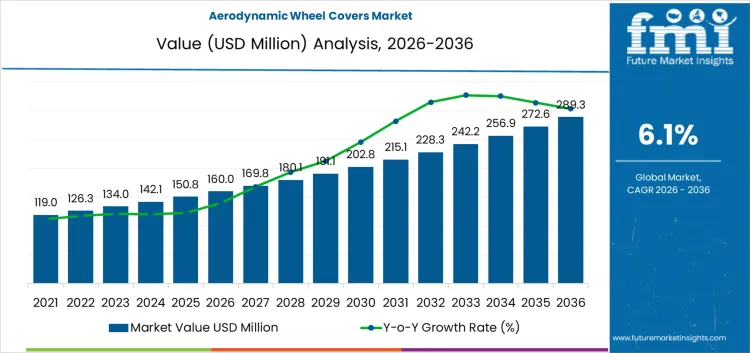
Volume scaling remains structurally constrained by wheel-size fragmentation and platform-specific brake architectures that limit universal designs. Cost sensitivity persists outside fleet and electric segments, moderating penetration in price-driven passenger vehicles. Aesthetic acceptance varies by region, capping aftermarket uptake where visual modification is discouraged. Material durability under debris impact and thermal cycling influences replacement frequency and lifecycle cost. Competitive differentiation relies on validated drag reduction rather than branding leverage. Growth tracks regulatory efficiency pressure, fleet operating economics, and electric vehicle mix evolution rather than discretionary accessory spending or styling-led upgrades across the broader vehicle parc.
Aerodynamic Wheel Covers Market Key Takeaways
| Metric | Value |
|---|---|
| Market Value (2026) | USD 160.0 million |
| Market Forecast Value (2036) | USD 289.3 million |
| Forecast CAGR (2026 to 2036) | 6.1% |
Why is the Demand for Aerodynamic Wheel Covers Growing?
Demand for aerodynamic wheel covers is increasing as vehicle manufacturers and fleet operators pursue improvements in fuel efficiency and reduced energy consumption across commercial and passenger vehicle segments. Aerodynamic wheel covers smooth airflow around rotating wheels, which reduces drag and contributes to lower rolling resistance at highway speeds. Engineers specify covers with optimized surface profiles and tight tolerances to ensure compatibility with specific wheel diameters and brake cooling requirements, and procurement teams evaluate material stiffness, finish durability, and weight impact to support both performance and longevity. Regulatory emphasis on fuel economy standards and emissions reduction targets encourages integration of aerodynamic enhancements into vehicle design packages that span light trucks, vans, and delivery fleets. Vehicle designers also consider aesthetic integration because wheel covers must align with exterior styling while delivering measurable aerodynamic benefits that improve operational efficiency.
Growth in electric vehicle adoption reinforces uptake of aerodynamic wheel covers because reduced drag has a proportional effect on extending driving range and improving energy utilization. Commercial operators of urban delivery and long haul fleets are specifying wheel covers that can be easily fitted and removed during service cycles without specialized tools to support flexible operation and maintenance planning. Technical developments in composite materials and injection molded finishes improve surface smoothness and impact resistance, which supports performance under varied road conditions. Retail and aftermarket channels maintain inventories that align with popular wheel sizes and vehicle models to support fleet upgrades and replacements during scheduled service intervals. These performance-specific and operational needs are contributing to sustained demand growth in the aerodynamic wheel covers market.
How Are the Segments Classified in the Aerodynamic Wheel Covers Market?
Demand for aerodynamic wheel covers is shaped by vehicle efficiency optimization, range enhancement objectives, and exterior airflow management requirements. Manufacturers and vehicle owners adopt these components to reduce aerodynamic drag and improve energy utilization during driving. Adoption aligns with growth in electrified vehicles and increasing regulatory focus on efficiency performance. Product selection emphasizes fit accuracy, durability, and compatibility with wheel designs. Segment classification reflects differentiation by vehicle propulsion category, installation pathway, and material composition influencing performance contribution, adoption timing, and lifecycle durability.
Which Vehicle Type Represents the Largest Share of Demand?
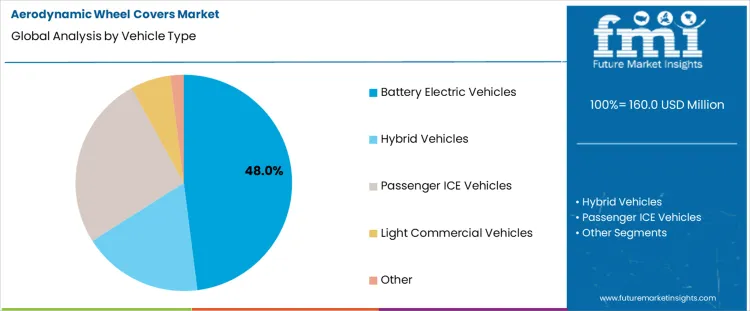
Battery electric vehicles hold 48.0%, representing the largest share among vehicle types due to sensitivity to aerodynamic efficiency. Range performance in electric vehicles is directly influenced by drag reduction measures. Wheel covers contribute measurable efficiency gains during highway operation. Standardized wheel designs support integration of aerodynamic components. Hybrid vehicles adopt covers to supplement efficiency improvements with lower penetration. Passenger ICE vehicles apply covers selectively for styling and efficiency balance. Light commercial vehicles contribute limited volume. Vehicle type segmentation reflects concentration where energy efficiency directly impacts user value and vehicle performance metrics.
Key Points
- Electric vehicles prioritize aerodynamic efficiency for range extension.
- Wheel covers support drag reduction at cruising speeds.
- Other vehicle types apply covers with lower efficiency dependence.
Which Fitment Type Accounts for the Highest Share of Demand?
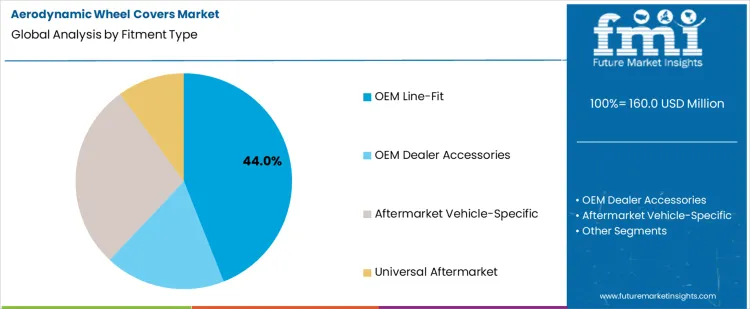
OEM line-fit installations hold 44.0%, representing the largest share among fitment types due to early-stage integration. Factory installation ensures precise fit, validated airflow performance, and durability testing alignment. Design integration supports consistent appearance and retention under operating conditions. OEM specification enables large-scale deployment across vehicle programs. Aftermarket vehicle-specific products address retrofit demand with tailored designs. Dealer accessories provide optional upgrades at point of sale. Universal aftermarket solutions prioritize broad compatibility with reduced optimization. Fitment segmentation reflects preference for factory-integrated solutions ensuring performance predictability and quality assurance.
Key Points
- Line-fit integration ensures validated aerodynamic performance.
- Factory installation supports consistent quality and fit.
- Other fitments address retrofit or optional upgrade needs.
Which Material Accounts for the Highest Share of Demand?
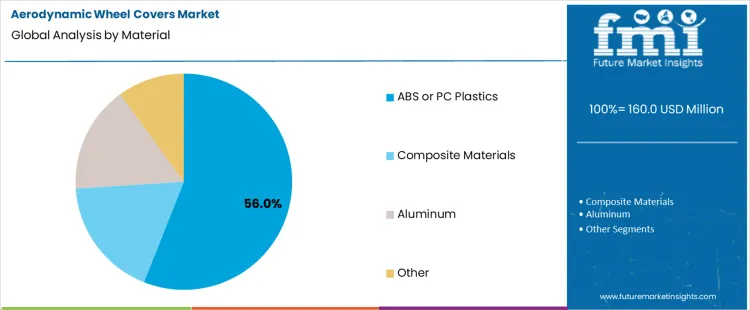
ABS or polycarbonate plastics hold 56.0%, representing the largest share among materials due to lightweight and moldability. These plastics enable complex aerodynamic shapes with consistent surface finish. Impact resistance supports durability under road debris exposure. Cost efficiency supports large-volume production. Composite materials offer stiffness advantages with higher manufacturing complexity. Aluminum provides structural rigidity with added weight considerations. Other materials address niche design or cost requirements. Material segmentation reflects preference for lightweight, formable plastics balancing performance contribution, durability, and production scalability.
Key Points
- Plastics enable lightweight aerodynamic shaping.
- Moldability supports consistent high-volume production.
- Other materials trade weight, stiffness, or cost attributes.
What are the Key Dynamics in the Aerodynamic Wheel Covers Market?
Demand for aerodynamic wheel covers reflects efficiency-driven requirements to reduce rotational drag and improve vehicle energy performance. Adoption concentrates in passenger vehicles, electric vehicles, and commercial fleets operating under fuel or range optimization targets. Global scope aligns with tightening efficiency standards and cost-effective drag reduction measures. Usage centers on removable or integrated wheel covers engineered to smooth airflow around rotating wheel assemblies.
How do efficiency optimization and vehicle operating profiles shape adoption?
Vehicle wheels contribute measurable aerodynamic drag due to turbulence around spokes and rotating cavities. Demand increases as manufacturers seek incremental efficiency gains without major body redesign. Electric vehicles adopt aerodynamic wheel covers to extend driving range under highway conditions where aerodynamic losses dominate. Fleet operators value covers as low-cost efficiency enhancements that improve fuel economy across high-mileage duty cycles. Lightweight materials support minimal impact on unsprung mass and ride quality. Design compatibility with brake cooling requirements influences acceptance in heavier vehicles. OEM adoption depends on validated drag reduction under standardized test cycles. Adoption reflects practical focus on energy efficiency improvements achievable through exterior airflow management.
How do durability exposure, aesthetic acceptance, and cost sensitivity influence market scalability?
Wheel covers operate in harsh environments with exposure to impact, debris, moisture, and thermal cycling. Demand sensitivity rises where durability concerns increase replacement frequency and maintenance cost. Attachment mechanisms must resist detachment at speed while allowing service access, increasing design complexity. Aesthetic acceptance varies across consumer segments, limiting adoption beyond efficiency-focused buyers. Brake heat management constraints restrict use on performance-oriented vehicles. Material selection affects resistance to cracking and discoloration over time. Aftermarket pricing pressure influences quality consistency. Platform-specific wheel sizes limit universal fit, constraining scalable deployment across diverse vehicle lineups.
How Is Demand for Aerodynamic Wheel Covers Evolving Globally?
Demand for aerodynamic wheel covers is expanding globally due to efficiency optimization needs, emission compliance pressure, and electric vehicle range improvement priorities. Adoption aligns with passenger vehicles and commercial fleets seeking incremental aerodynamic gains without drivetrain modification. Regulatory testing cycles and OEM efficiency targets reinforce specification at design and aftermarket levels. Replacement demand follows vehicle refresh cycles and accessory upgrades. Growth rates in China at 7.6%, India at 7.1%, South Korea at 6.5%, USA at 5.2%, and Germany at 4.8% indicate steady expansion driven by efficiency-led procurement, fleet operating cost control, and compliance alignment rather than styling-focused customization.
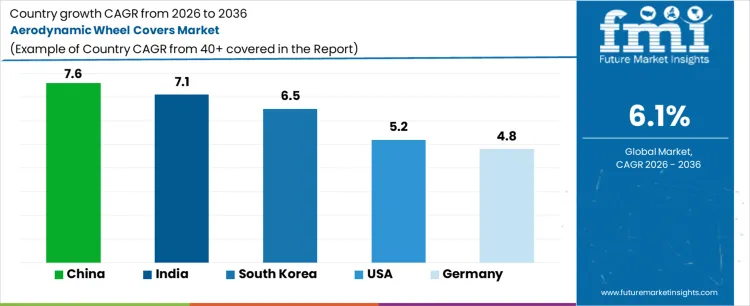
| Country | CAGR (%) |
|---|---|
| China | 7.6% |
| India | 7.1% |
| South Korea | 6.5% |
| USA | 5.2% |
| Germany | 4.8% |
What Is Driving Expansion of Aerodynamic Wheel Cover Demand in China?
Demand for aerodynamic wheel covers in China is growing at a CAGR of 7.6%, supported by efficiency standards and rapid electric vehicle penetration. OEMs specify covers to reduce drag and improve certified range outcomes. Urban delivery fleets adopt covers to lower energy consumption under stop-start conditions. Domestic manufacturing enables scale production with vehicle-specific fitment. Regulatory testing incentives favor measurable aerodynamic improvements. Demand growth reflects compliance optimization and fleet efficiency focus rather than consumer-led aesthetic preferences.
- Electric vehicle range optimization requirements
- OEM specification for regulatory efficiency testing
- Urban delivery fleet energy cost reduction
- Large-scale domestic manufacturing capability
Why Is India Seeing Strong Uptake of Aerodynamic Wheel Covers?
Aerodynamic wheel cover demand in India is expanding at a CAGR of 7.1%, driven by fuel economy sensitivity and expanding electric vehicle adoption. Fleet operators seek low-cost efficiency improvements for high-mileage operations. Two-wheeler and passenger vehicle platforms increasingly consider aero accessories for marginal gains. Heat and dust conditions increase preference for protective wheel coverage. Aftermarket channels promote covers aligned with efficiency claims. Growth reflects operating cost control and efficiency awareness rather than premium vehicle styling trends.
- Fuel economy sensitivity among fleet operators
- Growing electric passenger vehicle adoption
- Protective benefits under harsh road conditions
- Aftermarket promotion of efficiency accessories
How Is South Korea Supporting Growth of Aerodynamic Wheel Cover Sales?
Sales of aerodynamic wheel covers in South Korea are growing at a CAGR of 6.5%, shaped by advanced OEM engineering and electrified vehicle programs. Manufacturers integrate covers within holistic aerodynamic packages. Consumer acceptance improves where efficiency gains translate into range visibility. Supplier collaboration supports lightweight materials and precise fitment. Regulatory emphasis on emission reduction reinforces adoption. Growth reflects OEM-led integration and technology alignment rather than standalone aftermarket demand acceleration.
- OEM-integrated aerodynamic design strategies
- Focus on electric vehicle efficiency gains
- Lightweight material and fitment precision
- Emission reduction policy alignment
What Factors Are Influencing Aerodynamic Wheel Cover Demand in United States?
Demand for aerodynamic wheel covers in the United States is growing at a CAGR of 5.2%, supported by fleet efficiency programs and electric vehicle range optimization. Logistics and delivery fleets deploy covers to reduce operating costs. Consumer adoption concentrates within electric and hybrid segments. Replacement demand follows wheel and tire changeovers. Regulatory pressure remains moderate, shaping selective uptake. Growth reflects fleet-led efficiency initiatives and EV usage patterns rather than broad consumer styling adoption.
- Fleet fuel and energy efficiency initiatives
- Electric and hybrid vehicle segment uptake
- Replacement during wheel and tire service
- Moderate regulatory efficiency pressure
Why Is Germany Experiencing Measured Growth in Aerodynamic Wheel Covers?
Aerodynamic wheel cover demand in Germany is expanding at a CAGR of 4.8%, driven by engineering standards and efficiency-focused vehicle design. OEMs prioritize integrated aerodynamic solutions across body and wheel systems. Consumer emphasis on performance balance moderates accessory adoption pace. Regulatory compliance supports incremental efficiency improvements. Mature vehicle parc limits rapid growth. Expansion remains measured, reflecting OEM-led specification and regulatory alignment rather than aggressive aftermarket penetration.
- OEM emphasis on integrated aerodynamic engineering
- Performance and efficiency balance priorities
- Regulatory compliance supporting incremental gains
- Mature vehicle parc limiting rapid adoption
What is the competitive landscape of demand for the aerodynamic wheel covers market globally?
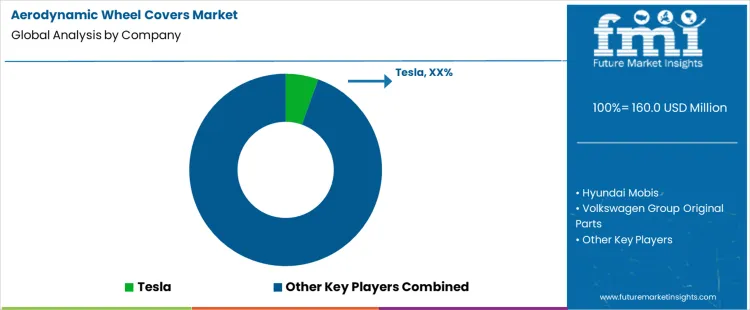
Demand for aerodynamic wheel covers is driven by the growing focus on improving vehicle fuel efficiency, enhancing aesthetics, and the increasing adoption of electric vehicles (EVs). Buyers evaluate the impact of wheel covers on drag reduction, durability, ease of installation, and compatibility with various vehicle models. Procurement behavior emphasizes suppliers offering aerodynamic solutions that improve fuel economy and provide a balance between design, performance, and environmental impact. Purchasing decisions prioritize companies with established relationships with automakers, innovative designs, and products that meet or exceed performance standards. Trend in the market reflects the integration of aerodynamic wheel covers in electric and hybrid vehicles to optimize energy efficiency and increase range.
Tesla leads the competitive positioning with its emphasis on innovation in electric vehicle performance, including aerodynamic enhancements such as wheel covers designed to maximize energy efficiency. Hyundai Mobis competes by offering lightweight, aerodynamic solutions tailored for a wide range of vehicles, focusing on both function and design. Volkswagen Group Original Parts offers high-quality, performance-driven aerodynamic wheel covers that align with its vehicle design philosophy and fuel efficiency goals. Stellantis Mopar provides aerodynamic accessories for various vehicles, including a strong offering of wheel covers optimized for fuel savings. BMW Group Genuine Parts supports demand with high-performance aerodynamic covers designed to fit seamlessly with luxury and electric vehicle platforms, contributing to improved range and efficiency.
Key Players in the Aerodynamic Wheel Covers Market
- Tesla
- Hyundai Mobis
- Volkswagen Group Original Parts
- Stellantis Mopar
- BMW Group Genuine Parts
- Mercedes-Benz Genuine Parts
- Toyota Genuine Parts
- Ford Accessories
- General Motors Accessories
Scope of the Report
| Items | Values |
|---|---|
| Quantitative Units | USD million |
| Vehicle Type | Battery Electric Vehicles; Hybrid Vehicles; Passenger ICE Vehicles; Light Commercial Vehicles; Other |
| Fitment Type | OEM Line-Fit; OEM Dealer Accessories; Aftermarket Vehicle-Specific; Universal Aftermarket |
| Material | ABS or PC Plastics; Composite Materials; Aluminum; Other |
| Sales Channel | OEM or Dealer; Online Retail; Auto Parts Retail; Other |
| Regions Covered | Asia Pacific, Europe, North America, Latin America, Middle East & Africa |
| Countries Covered | China, India, South Korea, USA, Germany, and 40+ countries |
| Key Companies Profiled | Tesla; Hyundai Mobis; Volkswagen Group Original Parts; Stellantis Mopar; BMW Group Genuine Parts; Mercedes-Benz Genuine Parts; Toyota Genuine Parts; Ford Accessories; General Motors Accessories |
| Additional Attributes | Dollar sales by vehicle type, fitment type, material, and sales channel; aerodynamic performance, weight reduction, and durability across ABS, composite materials, and aluminum covers; market trends driven by BEVs, hybrid vehicles, and passenger ICE vehicle adoption; fitment type dynamics influenced by OEM dealer supply, aftermarket vehicle-specific demands, and universal aftermarket applications. |
Aerodynamic Wheel Covers Market by Segment
Vehicle Type:
- Battery Electric Vehicles
- Hybrid Vehicles
- Passenger ICE Vehicles
- Light Commercial Vehicles
- Other
Fitment Type:
- OEM Line-Fit
- OEM Dealer Accessories
- Aftermarket Vehicle-Specific
- Universal Aftermarket
Material:
- ABS or PC Plastics
- Composite Materials
- Aluminum
- Other
Sales Channel:
- OEM or Dealer
- Online Retail
- Auto Parts Retail
- Other
Region:
- Asia Pacific
- China
- Japan
- South Korea
- India
- Australia & New Zealand
- ASEAN
- Rest of Asia Pacific
- Europe
- Germany
- United Kingdom
- France
- Italy
- Spain
- Nordic
- BENELUX
- Rest of Europe
- North America
- United States
- Canada
- Mexico
- Latin America
- Brazil
- Chile
- Rest of Latin America
- Middle East & Africa
- Kingdom of Saudi Arabia
- Other GCC Countries
- Turkey
- South Africa
- Other African Union
- Rest of Middle East & Africa
Bibliography
- United Nations Economic Commission for Europe. (2023). UNECE Regulation No. 101-Measurement of fuel consumption and electric range: Amendments impacting aerodynamic efficiency assessment. United Nations.
- European Commission. (2023). Regulation (EU) 2019/631-CO₂ emission performance standards for passenger cars and light commercial vehicles: Phased implementation influencing aerodynamic component adoption. Official Journal of the European Union.
- European Commission. (2024). Vehicle type-approval framework-Aerodynamic efficiency considerations under WLTP testing procedures. Official Journal of the European Union.
- Organisation for Economic Co-operation and Development. (2023). Vehicle energy efficiency improvements through aerodynamic optimization and exterior component design. OECD Publishing.
- International Organization for Standardization. (2023). Passenger cars-Wheels and rims-Test methods relevant to airflow, cooling, and external attachments (ISO 3006:2023). ISO.
Frequently Asked Questions
How big is the aerodynamic wheel covers market in 2026?
The global aerodynamic wheel covers market is estimated to be valued at USD 160.0 million in 2026.
What will be the size of aerodynamic wheel covers market in 2036?
The market size for the aerodynamic wheel covers market is projected to reach USD 289.3 million by 2036.
How much will be the aerodynamic wheel covers market growth between 2026 and 2036?
The aerodynamic wheel covers market is expected to grow at a 6.1% CAGR between 2026 and 2036.
What are the key product types in the aerodynamic wheel covers market?
The key product types in aerodynamic wheel covers market are battery electric vehicles, hybrid vehicles, passenger ice vehicles, light commercial vehicles and other.
Which fitment type segment to contribute significant share in the aerodynamic wheel covers market in 2026?
In terms of fitment type, oem line-fit segment to command 44.0% share in the aerodynamic wheel covers market in 2026.
Preview the report firsthand - request a free sample
Get SampleGet the brochure for pricing and purchase details.
Get PDFTable of Content
- Executive Summary
- Global Market Outlook
- Demand-side Trends
- Supply-side Trends
- Technology Roadmap Analysis
- Analysis and Recommendations
- Market Overview
- Market Coverage / Taxonomy
- Market Definition / Scope / Limitations
- Market Background
- Market Dynamics
- Drivers
- Restraints
- Opportunity
- Trends
- Scenario Forecast
- Demand in Optimistic Scenario
- Demand in Likely Scenario
- Demand in Conservative Scenario
- Opportunity Map Analysis
- Product Life Cycle Analysis
- Supply Chain Analysis
- Investment Feasibility Matrix
- Value Chain Analysis
- PESTLE and Porter’s Analysis
- Regulatory Landscape
- Regional Parent Market Outlook
- Production and Consumption Statistics
- Import and Export Statistics
- Market Dynamics
- Global Market Analysis 2021 to 2025 and Forecast, 2026 to 2036
- Historical Market Size Value (USD Million) Analysis, 2021 to 2025
- Current and Future Market Size Value (USD Million) Projections, 2026 to 2036
- Y-o-Y Growth Trend Analysis
- Absolute $ Opportunity Analysis
- Global Market Pricing Analysis 2021 to 2025 and Forecast 2026 to 2036
- Global Market Analysis 2021 to 2025 and Forecast 2026 to 2036, By Vehicle Type
- Introduction / Key Findings
- Historical Market Size Value (USD Million) Analysis By Vehicle Type , 2021 to 2025
- Current and Future Market Size Value (USD Million) Analysis and Forecast By Vehicle Type , 2026 to 2036
- Battery Electric Vehicles
- Hybrid Vehicles
- Passenger ICE Vehicles
- Light Commercial Vehicles
- Other
- Battery Electric Vehicles
- Y-o-Y Growth Trend Analysis By Vehicle Type , 2021 to 2025
- Absolute $ Opportunity Analysis By Vehicle Type , 2026 to 2036
- Global Market Analysis 2021 to 2025 and Forecast 2026 to 2036, By Fitment Type
- Introduction / Key Findings
- Historical Market Size Value (USD Million) Analysis By Fitment Type, 2021 to 2025
- Current and Future Market Size Value (USD Million) Analysis and Forecast By Fitment Type, 2026 to 2036
- OEM Line-Fit
- OEM Dealer Accessories
- Aftermarket Vehicle-Specific
- Universal Aftermarket
- OEM Line-Fit
- Y-o-Y Growth Trend Analysis By Fitment Type, 2021 to 2025
- Absolute $ Opportunity Analysis By Fitment Type, 2026 to 2036
- Global Market Analysis 2021 to 2025 and Forecast 2026 to 2036, By Material
- Introduction / Key Findings
- Historical Market Size Value (USD Million) Analysis By Material, 2021 to 2025
- Current and Future Market Size Value (USD Million) Analysis and Forecast By Material, 2026 to 2036
- ABS or PC Plastics
- Composite Materials
- Aluminum
- Other
- ABS or PC Plastics
- Y-o-Y Growth Trend Analysis By Material, 2021 to 2025
- Absolute $ Opportunity Analysis By Material, 2026 to 2036
- Global Market Analysis 2021 to 2025 and Forecast 2026 to 2036, By Sales Channel
- Introduction / Key Findings
- Historical Market Size Value (USD Million) Analysis By Sales Channel, 2021 to 2025
- Current and Future Market Size Value (USD Million) Analysis and Forecast By Sales Channel, 2026 to 2036
- OEM or Dealer
- Online Retail
- Auto Parts Retail
- Other
- OEM or Dealer
- Y-o-Y Growth Trend Analysis By Sales Channel, 2021 to 2025
- Absolute $ Opportunity Analysis By Sales Channel, 2026 to 2036
- Global Market Analysis 2021 to 2025 and Forecast 2026 to 2036, By Region
- Introduction
- Historical Market Size Value (USD Million) Analysis By Region, 2021 to 2025
- Current Market Size Value (USD Million) Analysis and Forecast By Region, 2026 to 2036
- North America
- Latin America
- Western Europe
- Eastern Europe
- East Asia
- South Asia and Pacific
- Middle East & Africa
- Market Attractiveness Analysis By Region
- North America Market Analysis 2021 to 2025 and Forecast 2026 to 2036, By Country
- Historical Market Size Value (USD Million) Trend Analysis By Market Taxonomy, 2021 to 2025
- Market Size Value (USD Million) Forecast By Market Taxonomy, 2026 to 2036
- By Country
- USA
- Canada
- Mexico
- By Vehicle Type
- By Fitment Type
- By Material
- By Sales Channel
- By Country
- Market Attractiveness Analysis
- By Country
- By Vehicle Type
- By Fitment Type
- By Material
- By Sales Channel
- Key Takeaways
- Latin America Market Analysis 2021 to 2025 and Forecast 2026 to 2036, By Country
- Historical Market Size Value (USD Million) Trend Analysis By Market Taxonomy, 2021 to 2025
- Market Size Value (USD Million) Forecast By Market Taxonomy, 2026 to 2036
- By Country
- Brazil
- Chile
- Rest of Latin America
- By Vehicle Type
- By Fitment Type
- By Material
- By Sales Channel
- By Country
- Market Attractiveness Analysis
- By Country
- By Vehicle Type
- By Fitment Type
- By Material
- By Sales Channel
- Key Takeaways
- Western Europe Market Analysis 2021 to 2025 and Forecast 2026 to 2036, By Country
- Historical Market Size Value (USD Million) Trend Analysis By Market Taxonomy, 2021 to 2025
- Market Size Value (USD Million) Forecast By Market Taxonomy, 2026 to 2036
- By Country
- Germany
- UK
- Italy
- Spain
- France
- Nordic
- BENELUX
- Rest of Western Europe
- By Vehicle Type
- By Fitment Type
- By Material
- By Sales Channel
- By Country
- Market Attractiveness Analysis
- By Country
- By Vehicle Type
- By Fitment Type
- By Material
- By Sales Channel
- Key Takeaways
- Eastern Europe Market Analysis 2021 to 2025 and Forecast 2026 to 2036, By Country
- Historical Market Size Value (USD Million) Trend Analysis By Market Taxonomy, 2021 to 2025
- Market Size Value (USD Million) Forecast By Market Taxonomy, 2026 to 2036
- By Country
- Russia
- Poland
- Hungary
- Balkan & Baltic
- Rest of Eastern Europe
- By Vehicle Type
- By Fitment Type
- By Material
- By Sales Channel
- By Country
- Market Attractiveness Analysis
- By Country
- By Vehicle Type
- By Fitment Type
- By Material
- By Sales Channel
- Key Takeaways
- East Asia Market Analysis 2021 to 2025 and Forecast 2026 to 2036, By Country
- Historical Market Size Value (USD Million) Trend Analysis By Market Taxonomy, 2021 to 2025
- Market Size Value (USD Million) Forecast By Market Taxonomy, 2026 to 2036
- By Country
- China
- Japan
- South Korea
- By Vehicle Type
- By Fitment Type
- By Material
- By Sales Channel
- By Country
- Market Attractiveness Analysis
- By Country
- By Vehicle Type
- By Fitment Type
- By Material
- By Sales Channel
- Key Takeaways
- South Asia and Pacific Market Analysis 2021 to 2025 and Forecast 2026 to 2036, By Country
- Historical Market Size Value (USD Million) Trend Analysis By Market Taxonomy, 2021 to 2025
- Market Size Value (USD Million) Forecast By Market Taxonomy, 2026 to 2036
- By Country
- India
- ASEAN
- Australia & New Zealand
- Rest of South Asia and Pacific
- By Vehicle Type
- By Fitment Type
- By Material
- By Sales Channel
- By Country
- Market Attractiveness Analysis
- By Country
- By Vehicle Type
- By Fitment Type
- By Material
- By Sales Channel
- Key Takeaways
- Middle East & Africa Market Analysis 2021 to 2025 and Forecast 2026 to 2036, By Country
- Historical Market Size Value (USD Million) Trend Analysis By Market Taxonomy, 2021 to 2025
- Market Size Value (USD Million) Forecast By Market Taxonomy, 2026 to 2036
- By Country
- Kingdom of Saudi Arabia
- Other GCC Countries
- Turkiye
- South Africa
- Other African Union
- Rest of Middle East & Africa
- By Vehicle Type
- By Fitment Type
- By Material
- By Sales Channel
- By Country
- Market Attractiveness Analysis
- By Country
- By Vehicle Type
- By Fitment Type
- By Material
- By Sales Channel
- Key Takeaways
- Key Countries Market Analysis
- USA
- Pricing Analysis
- Market Share Analysis, 2025
- By Vehicle Type
- By Fitment Type
- By Material
- By Sales Channel
- Canada
- Pricing Analysis
- Market Share Analysis, 2025
- By Vehicle Type
- By Fitment Type
- By Material
- By Sales Channel
- Mexico
- Pricing Analysis
- Market Share Analysis, 2025
- By Vehicle Type
- By Fitment Type
- By Material
- By Sales Channel
- Brazil
- Pricing Analysis
- Market Share Analysis, 2025
- By Vehicle Type
- By Fitment Type
- By Material
- By Sales Channel
- Chile
- Pricing Analysis
- Market Share Analysis, 2025
- By Vehicle Type
- By Fitment Type
- By Material
- By Sales Channel
- Germany
- Pricing Analysis
- Market Share Analysis, 2025
- By Vehicle Type
- By Fitment Type
- By Material
- By Sales Channel
- UK
- Pricing Analysis
- Market Share Analysis, 2025
- By Vehicle Type
- By Fitment Type
- By Material
- By Sales Channel
- Italy
- Pricing Analysis
- Market Share Analysis, 2025
- By Vehicle Type
- By Fitment Type
- By Material
- By Sales Channel
- Spain
- Pricing Analysis
- Market Share Analysis, 2025
- By Vehicle Type
- By Fitment Type
- By Material
- By Sales Channel
- France
- Pricing Analysis
- Market Share Analysis, 2025
- By Vehicle Type
- By Fitment Type
- By Material
- By Sales Channel
- India
- Pricing Analysis
- Market Share Analysis, 2025
- By Vehicle Type
- By Fitment Type
- By Material
- By Sales Channel
- ASEAN
- Pricing Analysis
- Market Share Analysis, 2025
- By Vehicle Type
- By Fitment Type
- By Material
- By Sales Channel
- Australia & New Zealand
- Pricing Analysis
- Market Share Analysis, 2025
- By Vehicle Type
- By Fitment Type
- By Material
- By Sales Channel
- China
- Pricing Analysis
- Market Share Analysis, 2025
- By Vehicle Type
- By Fitment Type
- By Material
- By Sales Channel
- Japan
- Pricing Analysis
- Market Share Analysis, 2025
- By Vehicle Type
- By Fitment Type
- By Material
- By Sales Channel
- South Korea
- Pricing Analysis
- Market Share Analysis, 2025
- By Vehicle Type
- By Fitment Type
- By Material
- By Sales Channel
- Russia
- Pricing Analysis
- Market Share Analysis, 2025
- By Vehicle Type
- By Fitment Type
- By Material
- By Sales Channel
- Poland
- Pricing Analysis
- Market Share Analysis, 2025
- By Vehicle Type
- By Fitment Type
- By Material
- By Sales Channel
- Hungary
- Pricing Analysis
- Market Share Analysis, 2025
- By Vehicle Type
- By Fitment Type
- By Material
- By Sales Channel
- Kingdom of Saudi Arabia
- Pricing Analysis
- Market Share Analysis, 2025
- By Vehicle Type
- By Fitment Type
- By Material
- By Sales Channel
- Turkiye
- Pricing Analysis
- Market Share Analysis, 2025
- By Vehicle Type
- By Fitment Type
- By Material
- By Sales Channel
- South Africa
- Pricing Analysis
- Market Share Analysis, 2025
- By Vehicle Type
- By Fitment Type
- By Material
- By Sales Channel
- USA
- Market Structure Analysis
- Competition Dashboard
- Competition Benchmarking
- Market Share Analysis of Top Players
- By Regional
- By Vehicle Type
- By Fitment Type
- By Material
- By Sales Channel
- Competition Analysis
- Competition Deep Dive
- Tesla
- Overview
- Product Portfolio
- Profitability by Market Segments (Product/Age /Sales Channel/Region)
- Sales Footprint
- Strategy Overview
- Marketing Strategy
- Product Strategy
- Channel Strategy
- Hyundai Mobis
- Volkswagen Group Original Parts
- Stellantis Mopar
- BMW Group Genuine Parts
- Mercedes-Benz Genuine Parts
- Toyota Genuine Parts
- Ford Accessories
- General Motors Accessories
- Tesla
- Competition Deep Dive
- Assumptions & Acronyms Used
- Research Methodology


