

- Market Size (2026)
- USD 265.4 Mn
- Forecast (2036)
- USD 690.6 Mn
- CAGR (2026 to 2036)
- 10.0%
How big is the algal DHA gummies market in 2026?
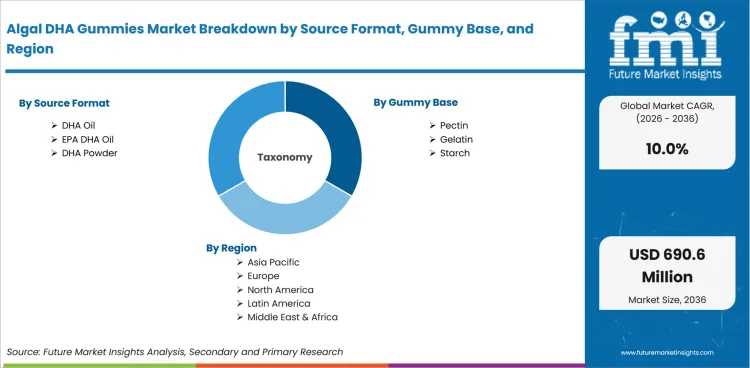
USD 265.4 million in 2026 and USD 690.6 million by 2036 at a 10.0% CAGR.
The global Algal DHA Gummies Market was valued at USD 240.0 million in 2025 and is estimated to reach USD 265.4 million in 2026. Demand is projected to reach USD 690.6 million by 2036 at a 10.0% CAGR during the forecast period. DHA oil is expected to account for 52.0% of source format revenue in 2026. Pectin gummies are projected to represent 64.0% of gummy base demand in 2026 as vegan positioning shifts omega-3 formats away from fish oil softgels.
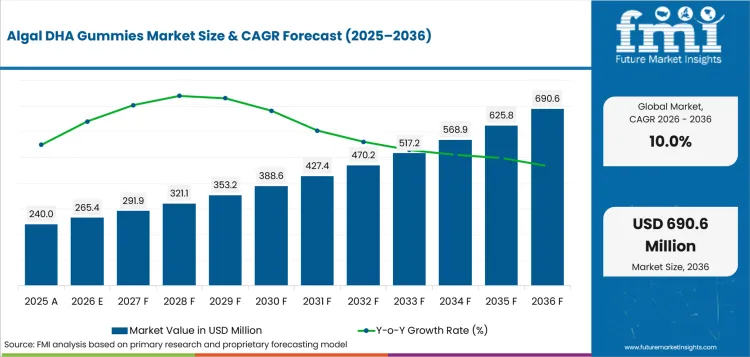
Algal DHA Gummies Market Overview: Size and Forecast
- 2026 Market Size: USD 265.4 million
- 2036 Market Size: USD 690.6 million
- Forecast CAGR: 10.0% from 2026 to 2036
- Leading Source Format: DHA Oil
- DHA Oil Share in 2026: 52.0%
- Leading Gummy Base: Pectin
- Pectin Share in 2026: 64.0%
- Leading Sales Channel: Online Retail
- Online Retail Share in 2026: 38.0%
- Fastest-growing Country: China
- China CAGR: 12.4% by 2036
Summary of algal DHA gummies market
- Demand and Growth Drivers
- High-load gummy technology is expected to raise the addressable pool as DHA gummies move closer to softgel dose levels.
- Prenatal nutrition is projected to support standard dose gummies with 31.0% dosage strength share in 2026.
- Children are expected to represent 46.0% of consumer group demand in 2026 as taste and chewability affect daily use.
- China’s 12.4% CAGR is projected to exceed the global pace due to filings for DHA algae oil health foods.
- India’s 11.8% CAGR reflects urban nutraceutical buying and stronger use of online wellness retail.
- Product and Segment View
- DHA oil is projected to lead source format demand with 52.0% share as brands use DHA as the main label claim.
- Pectin leads the gummy base segment with an estimated 64.0% share in 2026 since it supports vegan positioning.
- Children are expected to lead the consumer group segment with 46.0% share due to parent-led repeat purchase behavior.
- Low dose gummies are projected to hold 48.0% share in 2026 as taste limits oil loading in mass retail products.
- Online retail is expected to lead sales channels with 38.0% share as brands use subscriptions and bundled family packs.
- Geography and Competitive Outlook
- The United States is projected to grow at 9.2% CAGR due to mature supplement retail and direct-to-consumer brands.
- China is projected to grow at 12.4% CAGR due to health food filings and local interest in algae-based nutrients.
- DSM-firmenich and SCN BestCo hold an early advantage in high-load algal omega-3 gummy development.
- Corbion provides upstream algae lipid strength but public evidence for finished DHA gummy sales is limited.
- SIRIO Pharma and TopGum Industries compete as gummy CMOs with dosage form and pectin matrix know-how.
- Analyst Opinion
- Anurag Sharma, Principal Consultant at FMI says, “I see algal DHA gummies as a format battle more than an ingredient battle. The first path is children’s nutrition where taste decides repeat use. The second path is prenatal nutrition where buyers want DHA without fish odor or large capsules. The third path is vegan wellness where brands need a source story that avoids marine contaminant concerns. Suppliers gain a commercial edge when they protect DHA during cooking and storage.”
Algal DHA gummies are moving from a children’s novelty format into a higher-load supplement format for families and prenatal buyers. dsm-firmenich and SCN BestCo stated in March 2024 that traditional omega-3 gummies usually contain less than 100 mg EPA plus DHA per two-piece serving. Their algal omega-3 powder platform is designed for gummy applications above 400 mg EPA plus DHA per two-piece serving. This changes the category from taste-led convenience to dose-led compliance for brands comparing gummies with softgels.
What supports value in the algal DHA gummies market?
High-load DHA powder and pectin bases support premium pricing where brands need taste control and dose proof.
- Algal DHA gummies gain value as brands convert part of the algae omega pool into chewable daily formats.
- Premium pricing is supported by pectin bases and microencapsulated DHA powders that reduce fishy taste in gummies.
- The forecast depends on whether high-load formulations can hold sensory quality during shelf-life testing.
- Children’s nutrition drives volume while prenatal DHA drives value through higher dose expectations.
- Private label gummies are expected to create the highest profit pool where CMOs combine formulation and finished-pack service.
Why is the algal DHA gummies market growing?
Parents and prenatal buyers are shifting toward chewable DHA formats where taste and source clarity support repeat use.
Daily use is the main commercial test for this market. The United States Food and Drug Administration received a 2024 structure and function claim notification for a vegan DHA product using algal oil as the dietary ingredient. The claim covered heart, brain and eye health for Naturelo Vegan DHA. That filing signals active label work around algal DHA in the U.S. supplement channel.
Dose density is the second growth lever because traditional omega-3 gummies have struggled to carry enough EPA and DHA without taste defects or texture failure. dsm-firmenich’s March 2024 partnership with SCN BestCo targeted gummy doses exceeding 400 mg EPA plus DHA per two-piece serving. That level changes how brands compare gummies with softgels. It means high-load algal formats can serve adults and prenatal buyers instead of only children.
How is the algal DHA gummies market segmented?
The algal DHA gummies industry is segmented by source format, gummy base, consumer group, dosage strength and sales channel.
- DHA oil is expected to lead source format demand with an estimated 52.0% share in 2026 due to direct label clarity.
- Pectin gummies are anticipated to hold 64.0% of gummy base demand in 2026 with vegan positioning shaping briefs.
- Children are projected to account for 46.0% of consumer group demand in 2026 as taste drives parent purchase.
- Low dose products are expected to represent 48.0% of dosage strength in 2026 since mass retail gummies prioritize flavor.
- Online retail is projected to direct 38.0% of sales in 2026 through subscription packs and targeted search demand.
Which source format leads the algal DHA gummies market?
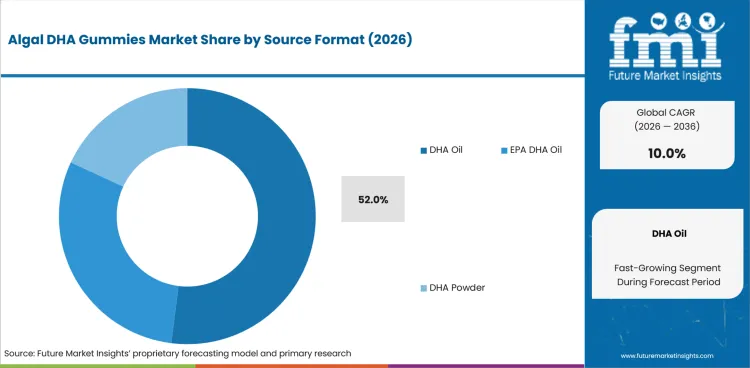
- DHA oil is projected to account for 52.0% of source format demand in 2026 as brands use a clean single-benefit claim tied to brain and eye support.
- DHA powder gains where gummy makers need better heat tolerance and easier dosing. It also reduces oil bleed risk during pectin cooking and storage.
Which gummy base leads the algal DHA gummies market?
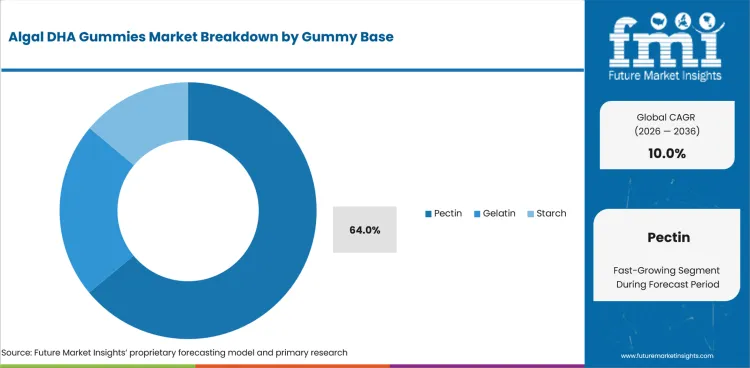
- Pectin is estimated to represent 64.0% of gummy base demand in 2026 as vegan gummies match algal DHA sourcing and avoid gelatin conflicts.
- Gelatin keeps use in lower-cost formats where texture bounce is preferred. It loses vegan shelf space when retailers group plant-based supplements together.
Which consumer group leads the algal DHA gummies market?
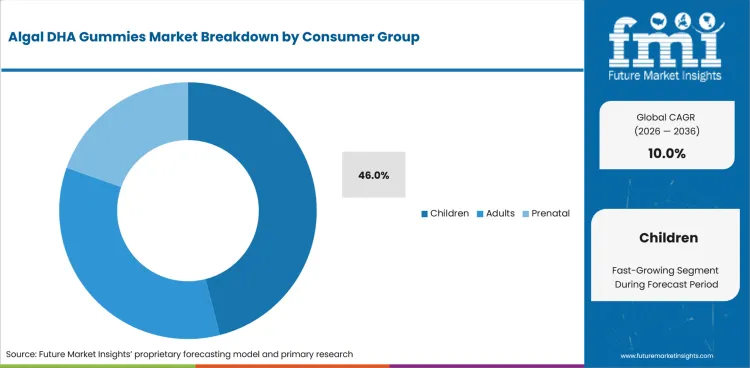
- Children are anticipated to account for 46.0% of consumer group demand in 2026 since parents prioritize chewability over capsule strength.
- Pediatric gummy buyers compare sugar content and fishy aftertaste before dose strength. This makes flavor systems as important as DHA purity.
Which dosage strength leads the algal DHA gummies market?
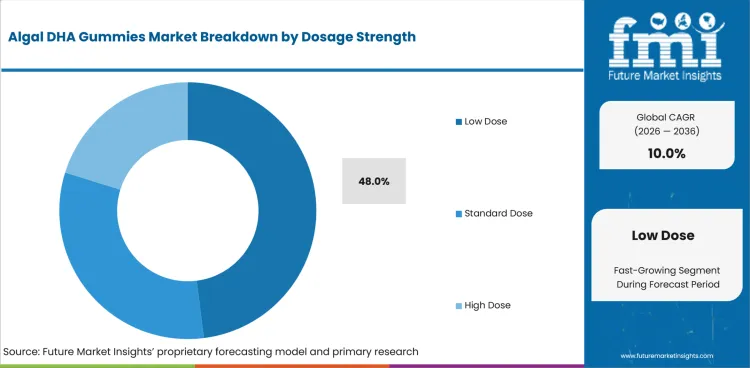
- Low dose gummies are expected to hold 48.0% of dosage strength demand in 2026 as mass brands balance taste with oil loading.
- High dose gummies are gaining technical interest where powder systems can exceed legacy gummy limits. The trade-off is higher ingredient cost per serving.
Which sales channel leads the algal DHA gummies market?
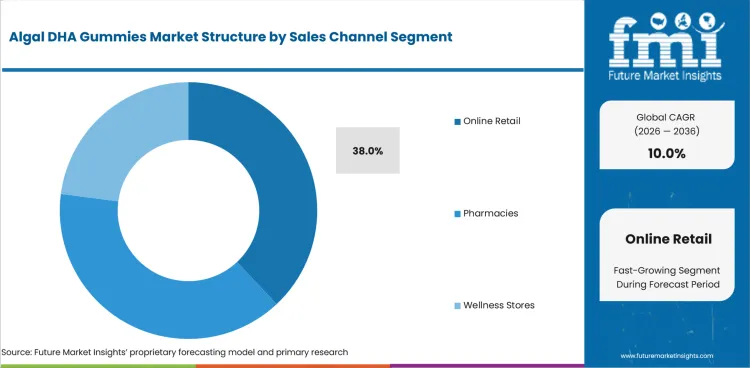
- Online retail is projected to account for 38.0% of sales in 2026 as brand education works better in product pages than shelf tags.
- Pharmacies stay important for prenatal DHA since buyers want trust and pharmacist guidance. Online channels win on subscriptions and flavor variety.
What are the drivers, restraints, and opportunities in the algal DHA gummies market?
High-load powder systems and pectin bases support growth while oxidation risk limits broader dose claims.
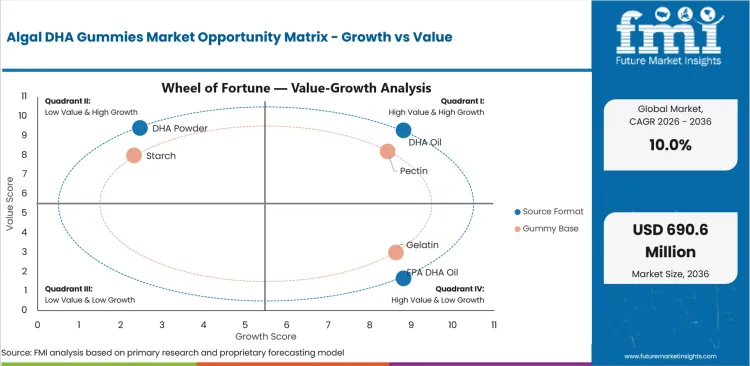
- Driver: High-load microencapsulation is expected to raise adult use cases by closing the gap with softgels.
- Opportunity: Pectin systems support vegan claims that align with algae-derived DHA.
- Opportunity: Prenatal DHA demand opens a premium channel where dose proof matters more than candy-like appeal.
- Restraint: Oxidation risk can raise formulation and shelf-life testing costs during gummy processing and storage.
- Opportunity: Private label launch speed is expected to improve through specialist gummy CMOs.
DHA dose compression is the practical driver for algal DHA gummies. France’s food safety agency reviewed claim conditions in 2024 and noted that normal heart function claims need 250 mg EPA plus DHA daily. That threshold creates a product design target for gummies. Suppliers able to protect DHA in powder form can bring gummy claims closer to softgel expectations. Pectin and algal DHA fit together in a way fish oil and gelatin do not. The buyer sees a consistent plant-based story across active ingredient and gummy base. Oxidation remains the main formulation restraint because DHA is sensitive to oxygen, heat and flavor carryover during gummy cooking. Gummies must prove acceptable taste and shelf-life stability before larger retail programs.
Who is the primary consumer of algal DHA gummies?
Parents, prenatal buyers and vegan adults form the main switching pool for algae-based DHA gummies.
Consumer segmentation centers on shoppers who want DHA without fish odor, large capsules or animal-derived inputs. Children’s products create the largest volume pool because taste and chewability affect daily use. Prenatal buyers create higher value because DHA dose proof matters more during pregnancy. Vegan adults add repeat demand where source transparency and marine contaminant avoidance shape the purchase decision.
What influences algal DHA gummies purchase decisions?
Dose per serving, taste control and vegan label clarity shape repeat purchase across online and pharmacy channels.
Purchase decisions depend on whether the gummy can deliver a visible DHA benefit without fishy taste or excessive sugar. Product pages matter because online retail gives brands space to explain algal source, serving size and shelf-life claims.
CMO capability also influences brand choice behind the shelf. Buyers compare pectin texture, DHA recovery and oxidation control before scaling a gummy launch.
Which countries are growing fastest in the algal DHA gummies market?
.webp "Top Country Growth Comparison Algal Dha Gummies Market Cagr (2026 2036)")
| Country | CAGR |
|---|---|
| China | 12.4% |
| India | 11.8% |
| South Korea | 10.8% |
| United States | 9.2% |
| United Kingdom | 8.8% |
| France | 8.6% |
| Germany | 8.4% |
| Japan | 7.9% |
Source: Future Market Insights, 2026.
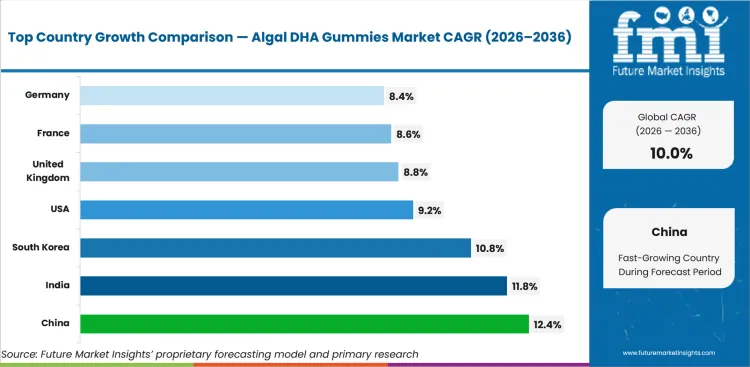
How do country-level CAGRs compare in the algal DHA gummies market?
- China leads country growth while Japan records the most cautious expansion outlook among profiled markets.
- China is projected to record 12.4% CAGR by 2036 as health food filings and parent-led DHA demand support launch activity.
- India is expected to expand at 11.8% CAGR through 2036 with vegetarian positioning and online nutraceutical sales supporting adoption.
- South Korea is forecast to advance at 10.8% CAGR by 2036 due to functional food literacy and online supplement use.
- The United States is projected to grow at 9.2% CAGR through 2036 as CMOs and direct-to-consumer brands support format trials.
- The United Kingdom is estimated to rise at 8.8% CAGR by 2036 as vegan supplement positioning and pharmacy trust shape uptake.
- France is expected to post 8.6% CAGR through 2036 with pharmacy trust and dose-linked claims supporting premium use.
- Germany is forecast to grow at 8.4% CAGR by 2036 as drugstore retail and claim discipline shape launch planning.
- Japan is projected to expand at 7.9% CAGR by 2036 as DHA familiarity supports targeted gummy testing.
How fast is the algal DHA gummies market growing in China?
A 12.4% CAGR through 2036 reflects health food filing activity and strong online supplement access.
Country Market Snapshot Table
| Parameter | Value |
|---|---|
| Market Size in 2025 (Value) | USD 37.4 million |
| Market Size in 2026 (Value) | USD 42.0 million |
| Market Forecast in 2036 (Value) | USD 135.2 million |
| CAGR (2026 to 2036) | 12.4% |
| Years Considered | 2021 to 2036 |
| Base Year | 2025 |
| Forecast Period | 2026 to 2036 |
| Units Considered | Value (USD million) |
| Leading Sub-Region | Guangdong, Shanghai and cross-border e-commerce hubs |
China Algal DHA Gummies Market Outlook
China algal DHA gummies demand is shaped by parent-led nutrition buying and strong e-commerce access. Health food filing rules give brands a clearer route for algae-based DHA positioning.
Local supplement brands can use gummies to extend DHA beyond capsules and infant nutrition. Imported brands face stronger documentation work when they use cross-border and health food channels.
Key Growth Drivers
- Online retail gives algal DHA gummies a wide launch route. National Bureau of Statistics reported online retail sales of physical goods at CNY 13,092.3 billion in 2025.
- Parent-led DHA demand has a large child nutrition base. The State Council reported 9.54 million newborns in China in 2024.
- Domestic health food filing supports algae-based DHA launches by giving supplement brands a clearer basis for approved source and claim planning.
- Cross-border platforms help imported gummy brands test premium DHA formats before wider offline retail expansion.
Key Restraints
- Import competition can pressure pricing and filing discipline. The State Council reported cross-border e-commerce retail imports at CNY 141.77 billion in 2023.
- Health food claim review can slow launch timing when brands lack China-ready evidence files and Chinese-language label support.
- Parents may compare gummies against infant nutrition and softgel products before accepting higher prices for algal DHA formats.
What makes China unique
China is unique due to health food filing depth and large e-commerce channels that support fast supplement testing.
Key Companies
- BYHEALTH
- WonderLab
- Swisse China
- Sirio Pharma China
- Amway China
- H&H Group
Sales & Marketing Channels
- Cross-border e-commerce
- Tmall and JD storefronts
- Pharmacy chains
- Mother and baby stores
- Supermarket wellness aisles
- Livestream commerce
Country Segment Breakdown Table
| Segment | Sub-Segments |
|---|---|
| By Source Format | DHA Oil · EPA DHA Oil · DHA Powder · Nutrient Blends |
| By Gummy Base | Pectin · Gelatin · Starch · Other Bases |
| By Consumer Group | Children · Adults · Prenatal · Seniors |
| By Dosage Strength | Low Dose · Standard Dose · High Dose |
| By Sales Channel | Online Retail · Pharmacies · Wellness Stores · Supermarkets · Practitioner Sales |
| Key Sub-Regions Covered, Wellness Retail Areas | Guangdong · Shanghai · Beijing · Zhejiang · Jiangsu · Sichuan |
Frequently Asked Questions
How fast is China algal DHA gummies market growing?
The China algal DHA gummies market is projected to expand at 12.4% CAGR from 2026 to 2036.
Who leads China algal DHA gummies market?
BYHEALTH, WonderLab, Swisse China, compete through local supplement channels and documented DHA positioning.
What is driving adoption in China algal DHA gummies market?
Source clarity and dose-led supplement positioning are moving buyers toward algae-based DHA gummies.
How fast is the algal DHA gummies market growing in India?
An 11.8% CAGR through 2036 is supported by vegetarian positioning and metro nutraceutical retail growth.
Country Market Snapshot Table
| Parameter | Value |
|---|---|
| Market Size in 2025 (Value) | USD 12.5 million |
| Market Size in 2026 (Value) | USD 14.0 million |
| Market Forecast in 2036 (Value) | USD 42.7 million |
| CAGR (2026 to 2036) | 11.8% |
| Years Considered | 2021 to 2036 |
| Base Year | 2025 |
| Forecast Period | 2026 to 2036 |
| Units Considered | Value (USD million) |
| Leading Sub-Region | Mumbai, Bengaluru and metro pharmacy-app corridors |
India Algal DHA Gummies Market Outlook
India algal DHA gummies demand is supported by vegetarian source preference and online nutraceutical access. Parents and prenatal buyers can accept algae-based DHA when fish oil positioning is less suitable.
Metro pharmacy apps give brands a practical path for education around dose and source. Price sensitivity remains high because gummies compete with tablets and syrups.
Key Growth Drivers
- Vegetarian source positioning has regulatory support in infant nutrition. FSSAI allows algal and fungal oils as DHA and ARA sources in infant nutrition rules.
- Packaged wellness demand benefits from a larger processing base. USDA FAS reported India's food processing sector at USD 355.0 billion in 2024.
- Pharmacy apps and wellness marketplaces can explain algae-based DHA better than short shelf labels in traditional retail.
- Urban prenatal buyers use plant-based DHA gummies when capsule size and fish odor reduce repeat use.
Key Restraints
Price pressure can restrict repeat purchase in premium gummies. MoSPI reported April 2026 food inflation at 4.20% year on year.
Dose claims need careful label work because FSSAI rules separate infant nutrition and nutraceutical product categories.
Mass retail acceptance can remain slower outside metro cities where softgels and syrups are more familiar.
What makes India unique
India is unique due to vegetarian DHA positioning and pharmacy-app retail that supports supplement education.
Key Companies
- Tata 1mg
- HealthKart
- Amway India
- Himalaya Wellness
- Carbamide Forte
- Nutrabay
- Kapiva
Sales & Marketing Channels
- Pharmacy apps
- Nutraceutical marketplaces
- Modern pharmacies
- Pediatrician referrals
- Prenatal clinics
- Amazon India
Country Segment Breakdown Table
| Segment | Sub-Segments |
|---|---|
| By Source Format | DHA Oil · EPA DHA Oil · DHA Powder · Nutrient Blends |
| By Gummy Base | Pectin · Gelatin · Starch · Other Bases |
| By Consumer Group | Children · Adults · Prenatal · Seniors |
| By Dosage Strength | Low Dose · Standard Dose · High Dose |
| By Sales Channel | Online Retail · Pharmacies · Wellness Stores · Supermarkets · Practitioner Sales |
| Key Sub-Regions Covered, Wellness Retail Areas | Maharashtra · Delhi NCR · Karnataka · Tamil Nadu · Telangana · Gujarat |
Frequently Asked Questions
How fast is India algal DHA gummies market growing?
The India algal DHA gummies market is projected to expand at 11.8% CAGR from 2026 to 2036.
Who leads India algal DHA gummies market?
Tata 1mg, HealthKart, Amway India, Himalaya Wellness compete through local supplement channels and documented DHA positioning.
What is driving adoption in India algal DHA gummies market?
Source clarity and dose-led supplement positioning are moving buyers toward algae-based DHA gummies.
How fast is the algal DHA gummies market growing in South Korea?
A 10.8% CAGR through 2036 reflects health functional food literacy and online supplement buying.
Country Market Snapshot Table
| Parameter | Value |
|---|---|
| Market Size in 2025 (Value) | USD 14.4 million |
| Market Size in 2026 (Value) | USD 16.0 million |
| Market Forecast in 2036 (Value) | USD 44.6 million |
| CAGR (2026 to 2036) | 10.8% |
| Years Considered | 2021 to 2036 |
| Base Year | 2025 |
| Forecast Period | 2026 to 2036 |
| Units Considered | Value (USD million) |
| Leading Sub-Region | Seoul and national home-shopping wellness channels |
South Korea Algal DHA Gummies Market Outlook
South Korea algal DHA gummies demand is shaped by a large health functional food market and strong consumer trust in documented functionality. Gummies can work when brands control taste and label proof.
Imported and local brands both compete on safety and credibility. Claims must fit health functional food rules before suppliers scale family and children’s products.
Key Growth Drivers
- Health functional food scale supports DHA gummy launches. USDA FAS reported the Korean health functional food industry reached KRW 5.07 trillion in 2024.
- Family nutrition demand has a measurable new-parent pool. Statistics Korea reported 238.3 thousand live births in 2024.
- Home-shopping and online channels help gummy brands explain algae source and dosage in more detail than store shelves.
- Local supplement buyers value brand credibility and safety files when choosing omega-3 products for children.
Key Restraints
- Low fertility can narrow long-term child-focused demand. Statistics Korea projected the total fertility rate at 1.02 in 2036 under its medium scenario.
- Imported products face approval and documentation steps before health functional food claims can be used at scale.
- Flavor and sugar control are important because parents compare gummies against liquid and capsule supplement formats.
What makes South Korea unique
South Korea is unique due to health functional food literacy and online channels that reward documented claims.
Key Companies
- Korea Eundan
- KGC
- CJ Wellcare
- Hugel Wellness
- DSM Korea
- Amway Korea
- Ildong Foodis
Sales & Marketing Channels
- Home-shopping networks
- Online supplement stores
- Pharmacy chains
- Department store wellness floors
- Pediatric retail channels
- Marketplace subscriptions
Country Segment Breakdown Table
| Segment | Sub-Segments |
|---|---|
| By Source Format | DHA Oil · EPA DHA Oil · DHA Powder · Nutrient Blends |
| By Gummy Base | Pectin · Gelatin · Starch · Other Bases |
| By Consumer Group | Children · Adults · Prenatal · Seniors |
| By Dosage Strength | Low Dose · Standard Dose · High Dose |
| By Sales Channel | Online Retail · Pharmacies · Wellness Stores · Supermarkets · Practitioner Sales |
| Key Sub-Regions Covered, Wellness Retail Areas | Seoul · Gyeonggi · Busan · Incheon · Daegu · Daejeon |
Frequently Asked Questions
How fast is South Korea algal DHA gummies market growing?
The South Korea algal DHA gummies market is projected to expand at 10.8% CAGR from 2026 to 2036.
Who leads South Korea algal DHA gummies market?
Korea Eundan, KGC, CJ Wellcare, Hugel Wellness compete through local supplement channels and documented DHA positioning.
What is driving adoption in South Korea algal DHA gummies market?
Source clarity and dose-led supplement positioning are moving buyers toward algae-based DHA gummies.
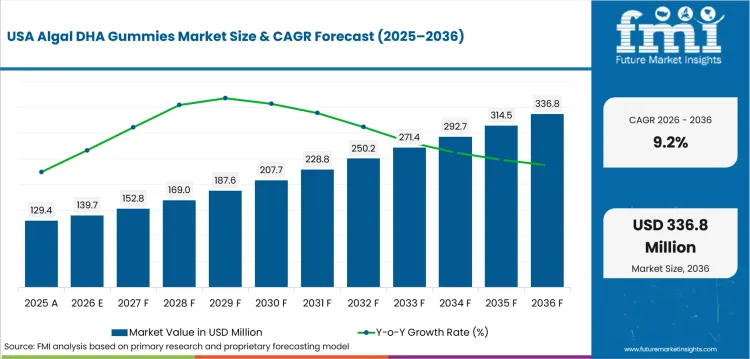
What is the algal DHA gummies market outlook in the United States?
A 9.2% CAGR through 2036 reflects large gummy CMOs and direct-to-consumer supplement retail.
Country Market Snapshot Table
| Parameter | Value |
|---|---|
| Market Size in 2025 (Value) | USD 71.4 million |
| Market Size in 2026 (Value) | USD 78.0 million |
| Market Forecast in 2036 (Value) | USD 188.1 million |
| CAGR (2026 to 2036) | 9.2% |
| Years Considered | 2021 to 2036 |
| Base Year | 2025 |
| Forecast Period | 2026 to 2036 |
| Units Considered | Value (USD million) |
| Leading Sub-Region | California and national online supplement corridors |
United States Algal DHA Gummies Market Outlook
United States algal DHA gummies demand behaves like a format replacement market because shoppers already know omega-3 but often avoid fishy softgels. Gummies give brands a route to reach children and prenatal buyers with clearer source language.
FDA structure and function rules keep claim language disciplined. Local gummy CMOs shorten trial cycles for products that need taste masking and active recovery checks.
Key Growth Drivers
Prenatal and family DHA demand has a large addressable base. CDC reported 3,622,673 births in the United States in 2024.
Low dietary DHA and EPA intake supports supplement positioning. NIH reports children and teens consume about 40 mg per day from foods.
Direct-to-consumer brands can explain vegan DHA source and dose per serving better on product pages than on short shelf tags.
Domestic gummy CMOs support faster pilot batches for brands testing high-load algal DHA concepts.
Key Restraints
High-dose positioning needs safety discipline. NIH notes FDA recommends no more than 5 g per day of EPA and DHA combined from supplements.
Sugar content concerns can limit adult wellness repeat purchase when gummies are compared with softgels.
Structure and function claims must stay within dietary supplement boundaries before national retail expansion.
What makes United States unique
The United States is unique because high-load gummy development and direct-to-consumer testing both happen at commercial scale.
Key Companies
- dsm-firmenich
- SCN BestCo
- Naturelo
- Nordic Naturals
- MaryRuth Organics
- Life Extension
- SmartyPants Vitamins
Sales & Marketing Channels
- Direct-to-consumer websites
- Amazon storefronts
- Pharmacy chains
- Private label retail programs
- Prenatal practitioner referrals
- Club store wellness aisles
Country Segment Breakdown Table
| Segment | Sub-Segments |
|---|---|
| By Source Format | DHA Oil · EPA DHA Oil · DHA Powder · Nutrient Blends |
| By Gummy Base | Pectin · Gelatin · Starch · Other Bases |
| By Consumer Group | Children · Adults · Prenatal · Seniors |
| By Dosage Strength | Low Dose · Standard Dose · High Dose |
| By Sales Channel | Online Retail · Pharmacies · Wellness Stores · Supermarkets · Practitioner Sales |
| Key Sub-Regions Covered, Wellness Retail Areas | California · New York · Texas · Florida · Illinois · Washington |
Frequently Asked Questions
How fast is United States algal DHA gummies market growing?
The United States algal DHA gummies market is projected to expand at 9.2% CAGR from 2026 to 2036.
Who leads United States algal DHA gummies market?
dsm-firmenich, SCN BestCo, Naturelo, Nordic Naturals compete through local supplement channels and documented DHA positioning.
What is driving adoption in United States algal DHA gummies market?
Source clarity and dose-led supplement positioning are moving buyers toward algae-based DHA gummies.
How is the algal DHA gummies market performing in the United Kingdom?
An 8.8% CAGR through 2036 is supported by vegan supplement positioning and pharmacy trust.
Country Market Snapshot Table
| Parameter | Value |
|---|---|
| Market Size in 2025 (Value) | USD 18.4 million |
| Market Size in 2026 (Value) | USD 20.0 million |
| Market Forecast in 2036 (Value) | USD 46.5 million |
| CAGR (2026 to 2036) | 8.8% |
| Years Considered | 2021 to 2036 |
| Base Year | 2025 |
| Forecast Period | 2026 to 2036 |
| Units Considered | Value (USD million) |
| Leading Sub-Region | London and national pharmacy-led wellness retail |
United Kingdom Algal DHA Gummies Market Outlook
United Kingdom algal DHA gummies demand is supported by vegan supplement positioning and high pharmacy trust. Parents can use gummies when children reject capsules or fishy liquids.
Brands must manage novel food evidence and health claim language carefully. Products with clearer dose and sugar information should gain better acceptance.
Key Growth Drivers
- Prenatal and child nutrition channels have a measurable base. ONS reported 594,677 live births in England and Wales in 2024.
- Algal oil use has a regulatory route. The UK FSA assessment dated April 2024 covered Schizochytrium sp. oil rich in DHA and EPA.
- Vegan supplement shelves create a practical fit for pectin gummies using algae-derived DHA.
- Pharmacy and online channels support better education around dose per serving and fish-free sourcing.
Key Restraints
- Low oily fish intake creates education work for omega-3 claims. The UK Food Security Report 2024 stated oily fish intake fell below the recommended minimum.
- Sugar and additive scrutiny can slow children’s gummy launches when brands target parent-led repeat purchase.
- Novel food and health claim checks can increase documentation work before wider retail placement.
What makes United Kingdom unique
The United Kingdom is unique due to vegan wellness demand and pharmacy-led supplement retail with strict claim discipline.
Key Companies
- Vitabiotics
- Holland & Barrett
- Boots UK
- Together Health
- Healthspan
- Nature’s Aid
- NaturesPlus UK
Sales & Marketing Channels
- Pharmacy chains
- Online wellness stores
- Supermarket supplement aisles
- Vegan retail platforms
- Practitioner channels
- Marketplace subscriptions
Country Segment Breakdown Table
| Segment | Sub-Segments |
|---|---|
| By Source Format | DHA Oil · EPA DHA Oil · DHA Powder · Nutrient Blends |
| By Gummy Base | Pectin · Gelatin · Starch · Other Bases |
| By Consumer Group | Children · Adults · Prenatal · Seniors |
| By Dosage Strength | Low Dose · Standard Dose · High Dose |
| By Sales Channel | Online Retail · Pharmacies · Wellness Stores · Supermarkets · Practitioner Sales |
| Key Sub-Regions Covered, Wellness Retail Areas | London · Manchester · Birmingham · Leeds · Glasgow · Bristol |
Frequently Asked Questions
How fast is United Kingdom algal DHA gummies market growing?
The United Kingdom algal DHA gummies market is projected to expand at 8.8% CAGR from 2026 to 2036.
Who leads United Kingdom algal DHA gummies market?
Vitabiotics, Holland & Barrett, Boots UK, Together Health compete through local supplement channels and documented DHA positioning.
What is driving adoption in United Kingdom algal DHA gummies market?
Source clarity and dose-led supplement positioning are moving buyers toward algae-based DHA gummies.
What is driving algal DHA gummies growth in France?
An 8.6% CAGR through 2036 reflects pharmacy trust and dose-linked omega-3 claim discipline.
Country Market Snapshot Table
| Parameter | Value |
|---|---|
| Market Size in 2025 (Value) | USD 16.6 million |
| Market Size in 2026 (Value) | USD 18.0 million |
| Market Forecast in 2036 (Value) | USD 41.1 million |
| CAGR (2026 to 2036) | 8.6% |
| Years Considered | 2021 to 2036 |
| Base Year | 2025 |
| Forecast Period | 2026 to 2036 |
| Units Considered | Value (USD million) |
| Leading Sub-Region | Île-de-France and pharmacy-led wellness corridors |
France Algal DHA Gummies Market Outlook
France algal DHA gummies demand is shaped by pharmacy trust and ingredient scrutiny. Vegan and vegetarian consumers create a source-based opening for algae-derived DHA.
Supplement brands need careful health claim language and dose evidence. Gummies should remain more credible when they avoid candy-like positioning.
Key Growth Drivers
- Prenatal DHA demand has a measurable consumer base. INSEE reported 663,000 babies were born in France in 2024.
- Dose-linked omega-3 claims support stronger product design. ANSES lists 250 mg for DHA and 250 mg for EPA in lipid guidance.
- Pharmacy channels can support premium DHA gummies when brands explain algae source and dose per serving.
- Vegetarian and vegan dietary patterns create a source-driven opening for algae DHA instead of fish oil.
Key Restraints
- High-dose claim discipline limits exaggerated positioning. ANSES noted supplemental EPA and DHA combined should not exceed 5 g per day.
- French pharmacy buyers may reject gummy products that read more like confectionery than supplements.
- Labeling and health claim review can slow new pectin gummy launches without precise dose evidence.
What makes France unique
France is unique due to pharmacy-led supplement buying and stronger scrutiny of health claims around nutrients.
Key Companies
- Arkopharma
- PiLeJe
- Nutrisanté
- Laboratoire Lescuyer
- Laboratoires Forté Pharma
- EA Pharma
- Naturactive
Sales & Marketing Channels
- Pharmacies
- Parapharmacies
- Online supplement stores
- Organic retail chains
- Prenatal practitioner channels
- Marketplace wellness shops
Country Segment Breakdown Table
| Segment | Sub-Segments |
|---|---|
| By Source Format | DHA Oil · EPA DHA Oil · DHA Powder · Nutrient Blends |
| By Gummy Base | Pectin · Gelatin · Starch · Other Bases |
| By Consumer Group | Children · Adults · Prenatal · Seniors |
| By Dosage Strength | Low Dose · Standard Dose · High Dose |
| By Sales Channel | Online Retail · Pharmacies · Wellness Stores · Supermarkets · Practitioner Sales |
| Key Sub-Regions Covered, Wellness Retail Areas | Île-de-France · Auvergne-Rhône-Alpes · Provence-Alpes-Côte d’Azur · Occitanie · Nouvelle-Aquitaine · Hauts-de-France |
Frequently Asked Questions
How fast is France algal DHA gummies market growing?
The France algal DHA gummies market is projected to expand at 8.6% CAGR from 2026 to 2036.
Who leads France algal DHA gummies market?
Arkopharma, PiLeJe, Nutrisanté, Laboratoire Lescuyer compete through local supplement channels and documented DHA positioning.
What is driving adoption in France algal DHA gummies market?
Source clarity and dose-led supplement positioning are moving buyers toward algae-based DHA gummies.
How is the algal DHA gummies market performing in Germany?
An 8.4% CAGR through 2036 reflects drugstore retail strength and stricter omega-3 claim discipline.
Country Market Snapshot Table
| Parameter | Value |
|---|---|
| Market Size in 2025 (Value) | USD 19.4 million |
| Market Size in 2026 (Value) | USD 21.0 million |
| Market Forecast in 2036 (Value) | USD 47.0 million |
| CAGR (2026 to 2036) | 8.4% |
| Years Considered | 2021 to 2036 |
| Base Year | 2025 |
| Forecast Period | 2026 to 2036 |
| Units Considered | Value (USD million) |
| Leading Sub-Region | North Rhine-Westphalia and national drugstore chains |
Germany Algal DHA Gummies Market Outlook
Germany algal DHA gummies demand is shaped by drugstore retail and careful omega-3 messaging. Buyers compare gummies with capsules based on dose proof and additive control.
Adult wellness and senior nutrition can support broader use beyond children. Brands must avoid overpromising because omega-3 intake is already tracked by public health agencies.
Key Growth Drivers
- Adult omega-3 familiarity supports supplement comparison. BfR reported German adults take in 127 mg to 295 mg DHA and EPA per day through normal nutrition.
- Senior wellness gives DHA gummies another consumer route. Destatis stated one person in five was aged 67 or older in Germany in 2024.
- Drugstore chains can scale compliant pectin gummies when products show dose evidence and clean labeling.
- Vegan supplement positioning fits algae-derived DHA where consumers avoid fish oil and gelatin capsules.
Key Restraints
- High background intake can weaken high-dose claims. BfR reported the 95th percentile intake ranged from 369 mg to 827 mg DHA and EPA per day.
- Drugstore buyers may limit gummies with high sugar loads or unclear oxidation testing.
- German claim discipline can slow launches that lack shelf-life data or precise DHA recovery evidence.
What makes Germany unique
Germany is unique due to strong drugstore retail and careful consumer review of supplement evidence.
Key Companies
- Doppelherz
- Abtei
- Orthomol
- Bayer Vital
- Queisser Pharma
- dmBio
- Denk Pharma
Sales & Marketing Channels
- Drugstores
- Pharmacies
- Online supplement retailers
- Organic supermarkets
- Practitioner channels
- Amazon Germany
Country Segment Breakdown Table
| Segment | Sub-Segments |
|---|---|
| By Source Format | DHA Oil · EPA DHA Oil · DHA Powder · Nutrient Blends |
| By Gummy Base | Pectin · Gelatin · Starch · Other Bases |
| By Consumer Group | Children · Adults · Prenatal · Seniors |
| By Dosage Strength | Low Dose · Standard Dose · High Dose |
| By Sales Channel | Online Retail · Pharmacies · Wellness Stores · Supermarkets · Practitioner Sales |
| Key Sub-Regions Covered, Wellness Retail Areas | North Rhine-Westphalia · Bavaria · Baden-Württemberg · Berlin · Hamburg · Hesse |
Frequently Asked Questions
How fast is Germany algal DHA gummies market growing?
The Germany algal DHA gummies market is projected to expand at 8.4% CAGR from 2026 to 2036.
Who leads Germany algal DHA gummies market?
Doppelherz, Abtei, Orthomol, Bayer Vital compete through local supplement channels and documented DHA positioning.
What is driving adoption in Germany algal DHA gummies market?
Source clarity and dose-led supplement positioning are moving buyers toward algae-based DHA gummies.
What is the algal DHA gummies market forecast for Japan?
A 7.9% CAGR through 2036 reflects DHA familiarity and cautious testing in drugstore wellness channels.
Country Market Snapshot Table
| Parameter | Value |
|---|---|
| Market Size in 2025 (Value) | USD 22.2 million |
| Market Size in 2026 (Value) | USD 24.0 million |
| Market Forecast in 2036 (Value) | USD 51.3 million |
| CAGR (2026 to 2036) | 7.9% |
| Years Considered | 2021 to 2036 |
| Base Year | 2025 |
| Forecast Period | 2026 to 2036 |
| Units Considered | Value (USD million) |
| Leading Sub-Region | Tokyo and national drugstore wellness corridors |
Japan Algal DHA Gummies Market Outlook
Japan algal DHA gummies demand is shaped by DHA familiarity and high trust in function-led products. Gummies can serve adults and children when brands keep dose messages simple.
Fish consumption remains culturally familiar but has declined over time. That creates room for convenient DHA formats but keeps consumers sensitive to credible claims.
Key Growth Drivers
- Prenatal and child nutrition demand has a measurable base. MHLW reported 686,061 births in Japan in 2024.
- Convenience-led DHA formats gain room as fish intake declines. MAFF estimated fish and shellfish consumption at 21.4 kg per person in FY2023.
- Drugstore wellness shelves can test smaller DHA gummy packs before broader supermarket rollout.
- Functional food familiarity helps brands explain algae-derived DHA through focused brain and eye support language.
Key Restraints
- Claim evidence review can limit weak DHA positioning. Japan’s Consumer Affairs Agency identified 88 related functional food filings for additional evidence checks.
- Gummies must compete with softgels and drinks that already carry familiar DHA messaging.
- Older consumers may prefer tablets or capsules when gummies appear too close to confectionery.
What makes Japan unique
Japan is unique due to DHA familiarity and disciplined functional food review across health-oriented channels.
Key Companies
- DHC
- Fancl
- Orihiro
- Asahi Group Foods
- Morinaga Milk Industry
- Suntory Wellness
- Kobayashi Pharmaceutical
Sales & Marketing Channels
- Drugstores
- Convenience stores
- Online wellness stores
- Pharmacy counters
- Supermarket supplement aisles
- Subscription retail
Country Segment Breakdown Table
| Segment | Sub-Segments |
|---|---|
| By Source Format | DHA Oil · EPA DHA Oil · DHA Powder · Nutrient Blends |
| By Gummy Base | Pectin · Gelatin · Starch · Other Bases |
| By Consumer Group | Children · Adults · Prenatal · Seniors |
| By Dosage Strength | Low Dose · Standard Dose · High Dose |
| By Sales Channel | Online Retail · Pharmacies · Wellness Stores · Supermarkets · Practitioner Sales |
| Key Sub-Regions Covered, Wellness Retail Areas | Tokyo · Osaka · Yokohama · Nagoya · Fukuoka · Sapporo |
Frequently Asked Questions
How fast is Japan algal DHA gummies market growing?
The Japan algal DHA gummies market is projected to expand at 7.9% CAGR from 2026 to 2036.
Who leads Japan algal DHA gummies market?
DHC, Fancl, Orihiro, Asahi Group Foods compete through local supplement channels and documented DHA positioning.
What is driving adoption in Japan algal DHA gummies market?
Source clarity and dose-led supplement positioning are moving buyers toward algae-based DHA gummies.
Who are the leading companies in the algal DHA gummies market?
DSM-firmenich, SCN BestCo, Corbion, SIRIO Pharma and TopGum lead across ingredient supply and gummy development.
Company Outlook
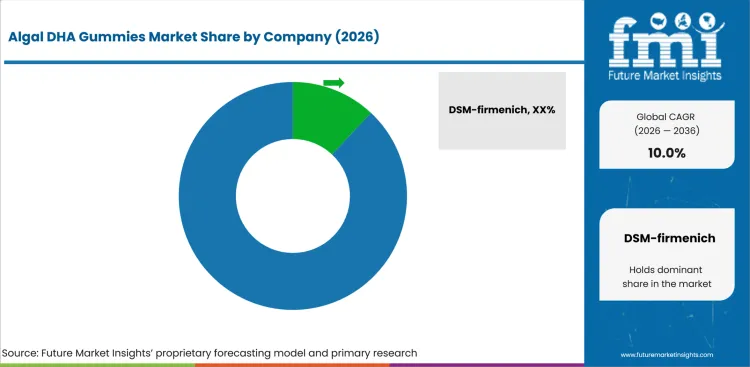
- Ingredient companies hold an advantage where algal DHA concentration and sensory masking are both needed.
- Gummy CMOs gain value by combining pectin matrix control with finished-pack service.
- Finished supplement brands compete through vegan positioning and direct consumer education.
- Retail-ready claims depend on serving dose, shelf-life data and clean source documentation.
Competition is shaped by dose delivery before brand visibility. dsm-firmenich and SCN BestCo created a high-load omega-3 gummy route in March 2024 using life’s OMEGA O33-P100.
Their work directly addresses a known limit in traditional gummies. The competitive edge is not only DHA sourcing but the ability to protect taste, texture and active recovery during scale-up.
CMOs can separate themselves when they help brands move from lab trials to launch quantities. SIRIO Pharma and TopGum Industries compete on dosage form know-how, while Corbion supports upstream algae lipid strength.
How do top algal DHA gummies companies compare?
| Company | Relevance to Market Title | DHA Source Control | Gummy Matrix Depth | Claim Documentation Support | Geographic Footprint |
|---|---|---|---|---|---|
| DSM-firmenich | Very High | Very Strong | Strong | Very Strong | Global |
| SCN BestCo | Very High | Medium | Very Strong | Strong | North America |
| Corbion | High | Very Strong | Low | Medium | Global |
| SIRIO Pharma | High | Medium | Very Strong | Strong | Global |
| TopGum Industries | High | Medium | Very Strong | Strong | Europe and North America |
| Amapharm | Moderate to High | Low | Strong | Medium | Europe |
| Santa Cruz Nutritionals | Moderate to High | Low | Strong | Medium | North America |
| Naturelo | Moderate to High | Low | Moderate | Strong | United States |
| Korea Eundan | Moderate | Low | Moderate | Medium | South Korea |
| BYHEALTH | Moderate | Low | Moderate | Medium | China |
Source: Future Market Insights competitive analysis, 2026.
Key Developments in Algal DHA Gummies Market
- In March 2024, dsm-firmenich partnered with SCN BestCo to develop high-load omega-3 gummies in the United States. The work used algal omega-3 powder for higher-dose gummy applications.
- In October 2024, dsm-firmenich expanded its life’sDHA portfolio with B54-0100 algal oil. The launch focused on sensory appeal and lower inclusion levels.
- In April 2026, Corbion announced a U.S. patent tied to DHA-rich algal biomass suspension. The development strengthens upstream algae lipid know-how.
- In April 2025, TopGum reported the Island Abbey acquisition as part of its 2025 expansion platform. The deal supports North American gummy supplement manufacturing capacity.
- In April 2026, SIRIO Europe launched Aeion for longevity supplement concepts. The platform shows how CMOs build branded formulation systems beyond standard gummies.
Key Players in the Algal DHA Gummies Market
Ingredient and Technology Leaders
- DSM-firmenich
- Corbion
Gummy CMOs
- SCN BestCo
- SIRIO Pharma
- TopGum Industries
- Amapharm
- Santa Cruz Nutritionals
Finished Brand Specialists
- Naturelo
- Korea Eundan
- BYHEALTH
Algal DHA Gummies Market - Report Scope
| Item | Value |
|---|---|
| Market size by 2036 | USD 690.6 million |
| Growth rate | 10.0% CAGR from 2026 to 2036 |
| Forecast period | 2026 to 2036 |
| Base year value (2025) | USD 240.0 million |
| By source format | DHA oil, EPA DHA oil, DHA powder, nutrient blends |
| By gummy base | Pectin, gelatin, starch, other bases |
| By consumer group | Children, adults, prenatal, seniors |
| By dosage strength | Low dose, standard dose, high dose |
| By sales channel | Online retail, pharmacies, wellness stores, supermarkets, practitioner sales |
| Regions covered | North America, Latin America, Europe, East Asia, South Asia and Pacific, Middle East and Africa |
| Countries covered | United States, United Kingdom, Germany, France, Japan, China, South Korea, India |
| Key companies profiled | DSM-firmenich, SCN BestCo, Corbion, SIRIO Pharma, TopGum Industries, Amapharm, Naturelo |
| Approach | Hybrid bottom-up and top-down methodology using gummy volumes, algal DHA inclusion costs, channel pricing and country adoption trends |
Source: Future Market Insights, 2026.
Algal DHA Gummies Market Breakdown by Source Format, Gummy Base, Consumer Group, Dosage Strength, Sales Channel and Region
Algal DHA Gummies Market Segmented by Source Format:
- DHA Oil
- EPA DHA Oil
- DHA Powder
- Nutrient Blends
Algal DHA Gummies Market Segmented by Gummy Base:
- Pectin
- Gelatin
- Starch
- Other Bases
Algal DHA Gummies Market Segmented by Consumer Group:
- Children
- Adults
- Prenatal
- Seniors
Algal DHA Gummies Market Segmented by Dosage Strength:
- Low Dose
- Standard Dose
- High Dose
Algal DHA Gummies Market Segmented by Sales Channel:
- Online Retail
- Pharmacies
- Wellness Stores
- Supermarkets
- Practitioner Sales
Algal DHA Gummies Market by Region:
- North America
- Latin America
- Europe
- East Asia
- South Asia and Pacific
- Middle East and Africa
This Report Answers
- What is the 2026 value and 2036 forecast for algal DHA gummies market?
- What source format is projected to hold the leading share during the forecast period?
- What gummy base is expected to account for the leading 2026 share?
- How do high-load algal DHA powders affect gummy product design?
- What companies compete in algal DHA gummies?
Research Sources and Bibliography
- USA Food and Drug Administration. (2024, September 24). Structure/function claims notification: Naturelo Vegan DHA. Department of Health and Human Services.
- USA Food and Drug Administration. (2024, September 6). New dietary ingredient notification of DHA MAG algal oil. Department of Health and Human Services.
- Department of Health and Social Care. (2025, June 11). National Diet and Nutrition Survey 2019 to 2023: Report. GOV.UK.
- German Federal Institute for Risk Assessment. (2026, April 30). Omega-3 fatty acids: Important but in moderation. BfR.
- French Agency for Food, Environmental and Occupational Health & Safety. (2024, December 24). Avis relatif à la mise à jour de l’arrêté du 26 septembre 2016. ANSES.
- French Agency for Food, Environmental and Occupational Health & Safety. (2025, March 13). Régimes végétariens: Effets sur la santé et repères alimentaires. ANSES.
- Ministry of Health, Labour and Welfare. (2024, October). Dietary Reference Intakes for Japanese, 2025. Government of Japan.
- U.S. Department of Agriculture Foreign Agricultural Service. (2026, April 6). Health functional food and supplements: Market brief for the Republic of Korea. Government of the United States.
- Food Safety and Standards Authority of India. (2024, January 4). Food Safety and Standards infant nutrition regulations compendium. Government of India.
- Food Safety and Standards Authority of India. (2025, May 2). List of product and ingredient applications approved under non-specified food regulations. Government of India.
- dsm-firmenich. (2024, March 4). dsm-firmenich partners with SCN BestCo to inspire a new era in omega-3 gummy innovation.
- dsm-firmenich. (2024, October 23). dsm-firmenich expands its advanced life’s portfolio with life’sDHA B54-0100.
- Corbion. (2026, April 20). Corbion advances algae innovation with new U.S. patent for omega-3 fatty acids derived from algae.
- Corbion. (2025, May 14). Annual Report 2024.
- TopGum Industries Ltd. (2026, March 26). 2025 annual report. Tel Aviv Stock Exchange.
- SIRIO Europe. (2026, April 14). Vitafoods Europe 2026: SIRIO Europe launches Aeion.
- dsm-firmenich. (2025, February 28). Accelerating a customer’s transition to algal omega-3.
- Centers for Disease Control and Prevention. (2025, April 23). U.S. births increase by 1% in 2024. National Center for Health Statistics.
- National Institutes of Health Office of Dietary Supplements. (2024). Omega-3 fatty acids: Fact sheet for health professionals.
- Office for National Statistics. (2025, July 1). Births in England and Wales: 2024.
- Food Standards Agency. (2024, April 10). Safety assessment change of conditions of use for the novel food Schizochytrium sp. oil rich in DHA and EPA.
- Department for Environment, Food & Rural Affairs. (2024, December 11). United Kingdom food security report 2024.
- Institut national de la statistique et des études économiques. (2025, January 14). In 2024, fertility continued to fall, life expectancy stabilised.
- French Agency for Food, Environmental and Occupational Health & Safety. (2024, December 24). Avis relatif à la mise à jour de l’arrêté du 26 septembre 2016.
- Federal Statistical Office of Germany. (2025, December 11). By 2035, one quarter of Germany’s population will be aged 67 or over.
- Federal Statistical Office of Germany. (2025, July 17). Decline in fertility rate slowed significantly in 2024.
- Ministry of Agriculture, Forestry and Fisheries. (2025). FY2024 White Paper on Fisheries summary.
- Consumer Affairs Agency. (2025). Foods with function claims evidence review information.
- National Bureau of Statistics of China. (2026, January 20). Total retail sales of consumer goods in December 2025.
- The State Council of the People’s Republic of China. (2025, January 17). China’s newborns rise in 2024, first time in years.
- Ministry of Commerce of the People’s Republic of China. (2024, March 28). China to boost imports of high-quality consumer goods.
- Statistics Korea. (2025, February 26). Preliminary results of birth and death statistics in 2024.
- Statistics Korea. (2023, December 13). Population projections for Korea 2022 to 2072.
- U.S. Department of Agriculture Foreign Agricultural Service. (2026, March 27). Food processing ingredients annual: India.
- Ministry of Statistics and Programme Implementation. (2026, May 12). CPI press release of April 2026.
- This bibliography is provided for reader reference and is not exhaustive. The full report contains the complete reference list and detailed citations.
Frequently Asked Questions
What is the algal DHA gummies market size in 2026?
The algal DHA gummies market size is anticipated to cross USD 265.4 million in 2026.
What is the algal DHA gummies market forecast for 2036?
The algal DHA gummies industry revenue is predicted to reach USD 690.6 million by 2036 as high-load formats expand.
What is the algal DHA gummies market CAGR?
The algal DHA gummies sector is projected to expand at 10.0% CAGR from 2026 to 2036.
What segment leads the algal DHA gummies market?
DHA oil is likely to capture 52.0% source format share in 2026 due to direct brain and eye support positioning.
What country grows fastest in the algal DHA gummies market?
China is set to record 12.4% CAGR by 2036, driven by health food filings and parent-led DHA demand.
Preview the report firsthand - request a free sample
Get SampleGet the brochure for pricing and purchase details.
Get PDFTable of Content
- Key Takeaways
- Market Size and CAGR
- Top Growth Driver
- Fastest Growing Segment
- Leading Region
- Key Companies
- Emerging Opportunities
- Executive Summary
- Global Market Outlook
- Demand-side Trends
- Supply-side Trends
- Technology Roadmap Analysis
- Analysis and Recommendations
- Analyst Perspective (What is happening? Why now? What should investors know?)
- Key Questions Answered
- How large is the market?
- What is the CAGR?
- What are key trends?
- Which region dominates?
- Who are the leaders?
- Market Overview
- Market Coverage / Taxonomy
- Market Definition / Scope / Limitations
- Research Methodology
- Chapter Orientation
- Analytical Lens and Working Hypotheses
- Market Structure, Signals, and Trend Drivers
- Benchmarking and Cross-market Comparability
- Market Sizing, Forecasting, and Opportunity Mapping
- Research Design and Evidence Framework
- Desk Research Programme (Secondary Evidence)
- Expert Input and Fieldwork (Primary Evidence)
- Tooling, Models, and Reference Databases
- Data Engineering and Model Build
- Quality Assurance and Audit Trail
- Market Background
- Market Dynamics (Drivers, Restraints, Opportunity, Trends)
- Scenario Forecast (Optimistic, Likely, Conservative)
- Impact Analysis
- AI Impact
- Sustainability Impact
- Regulatory Impact
- Technology Impact
- Consumer / Buyer Analysis
- Purchase Drivers
- Adoption Barriers
- Buyer Journey
- Opportunity Map Analysis
- Product Life Cycle Analysis
- Supply Chain Analysis
- Investment Feasibility Matrix
- Value Chain Analysis
- PESTLE and Porter's Analysis
- Regulatory Landscape
- Regional Parent Market Outlook
- Production and Consumption Statistics
- Import and Export Statistics
- Global Market Analysis and Forecast, 2021 to 2036
- Historical Market Size Value (USD Billion) & Volume (Unit) Analysis, 2021 to 2025
- Current and Future Market Size Value (USD Billion) & Volume (Unit) Projections, 2026 to 2036
- Y-o-Y Growth Trend Analysis
- Absolute $ Opportunity Analysis
- Global Market Pricing Analysis, 2021 to 2036
- Global Market Analysis and Forecast, By Source Format, 2021 to 2036
- Introduction / Key Findings
- Historical Market Size Value (USD Billion) & Volume (Unit) Analysis By Source Format, 2021 to 2025
- Current and Future Market Size Value (USD Billion) & Volume (Unit) Analysis and Forecast By Source Format, 2026 to 2036
- DHA Oil
- EPA DHA Oil
- DHA Powder
- Nutrient Blends
- DHA Oil
- Y-o-Y Growth Trend Analysis By Source Format, 2021 to 2025
- Absolute $ Opportunity Analysis By Source Format, 2026 to 2036
- Global Market Analysis and Forecast, By Gummy Base, 2021 to 2036
- Introduction / Key Findings
- Historical Market Size Value (USD Billion) & Volume (Unit) Analysis By Gummy Base, 2021 to 2025
- Current and Future Market Size Value (USD Billion) & Volume (Unit) Analysis and Forecast By Gummy Base, 2026 to 2036
- Pectin
- Gelatin
- Starch
- Other Bases
- Pectin
- Y-o-Y Growth Trend Analysis By Gummy Base, 2021 to 2025
- Absolute $ Opportunity Analysis By Gummy Base, 2026 to 2036
- Global Market Analysis and Forecast, By Consumer Group, 2021 to 2036
- Introduction / Key Findings
- Historical Market Size Value (USD Billion) & Volume (Unit) Analysis By Consumer Group, 2021 to 2025
- Current and Future Market Size Value (USD Billion) & Volume (Unit) Analysis and Forecast By Consumer Group, 2026 to 2036
- Children
- Adults
- Prenatal
- Seniors
- Children
- Y-o-Y Growth Trend Analysis By Consumer Group, 2021 to 2025
- Absolute $ Opportunity Analysis By Consumer Group, 2026 to 2036
- Global Market Analysis and Forecast, By Dosage Strength, 2021 to 2036
- Introduction / Key Findings
- Historical Market Size Value (USD Billion) & Volume (Unit) Analysis By Dosage Strength, 2021 to 2025
- Current and Future Market Size Value (USD Billion) & Volume (Unit) Analysis and Forecast By Dosage Strength, 2026 to 2036
- Low Dose
- Standard Dose
- High Dose
- Low Dose
- Y-o-Y Growth Trend Analysis By Dosage Strength, 2021 to 2025
- Absolute $ Opportunity Analysis By Dosage Strength, 2026 to 2036
- Global Market Analysis and Forecast, By Sales Channel, 2021 to 2036
- Introduction / Key Findings
- Historical Market Size Value (USD Billion) & Volume (Unit) Analysis By Sales Channel, 2021 to 2025
- Current and Future Market Size Value (USD Billion) & Volume (Unit) Analysis and Forecast By Sales Channel, 2026 to 2036
- Online Retail
- Pharmacies
- Wellness Stores
- Supermarkets
- Practitioner Sales
- Online Retail
- Y-o-Y Growth Trend Analysis By Sales Channel, 2021 to 2025
- Absolute $ Opportunity Analysis By Sales Channel, 2026 to 2036
- Global Market Analysis and Forecast, By Region, 2021 to 2036
- Introduction
- Historical Market Size Value (USD Billion) & Volume (Unit) Analysis By Region, 2021 to 2025
- Current Market Size Value (USD Billion) & Volume (Unit) Analysis and Forecast By Region, 2026 to 2036
- North America
- Latin America
- Western Europe
- Eastern Europe
- East Asia
- South Asia and Pacific
- Middle East & Africa
- Market Attractiveness Analysis By Region
- North America Market Analysis and Forecast, By Country, 2021 to 2036
- Historical Market Size Value (USD Billion) & Volume (Unit) Trend Analysis By Market Taxonomy, 2021 to 2025
- Market Size Value (USD Billion) & Volume (Unit) Forecast By Market Taxonomy, 2026 to 2036
- By Country
- USA
- Canada
- Mexico
- By Source Format
- By Gummy Base
- By Consumer Group
- By Dosage Strength
- By Sales Channel
- By Country
- Market Attractiveness Analysis
- By Country
- By Source Format
- By Gummy Base
- By Consumer Group
- By Dosage Strength
- By Sales Channel
- Key Takeaways
- Latin America Market Analysis and Forecast, By Country
- Historical Market Size Value (USD Billion) & Volume (Unit) Trend Analysis By Market Taxonomy, 2021 to 2025
- Market Size Value (USD Billion) & Volume (Unit) Forecast By Market Taxonomy, 2026 to 2036
- By Country
- Brazil
- Chile
- Rest of Latin America
- By Source Format
- By Gummy Base
- By Consumer Group
- By Dosage Strength
- By Sales Channel
- By Country
- Market Attractiveness Analysis
- By Country
- By Source Format
- By Gummy Base
- By Consumer Group
- By Dosage Strength
- By Sales Channel
- Key Takeaways
- Western Europe Market Analysis and Forecast, By Country
- Historical Market Size Value (USD Billion) & Volume (Unit) Trend Analysis By Market Taxonomy, 2021 to 2025
- Market Size Value (USD Billion) & Volume (Unit) Forecast By Market Taxonomy, 2026 to 2036
- By Country
- Germany
- UK
- Italy
- Spain
- France
- Nordic
- BENELUX
- Rest of Western Europe
- By Source Format
- By Gummy Base
- By Consumer Group
- By Dosage Strength
- By Sales Channel
- By Country
- Market Attractiveness Analysis
- By Country
- By Source Format
- By Gummy Base
- By Consumer Group
- By Dosage Strength
- By Sales Channel
- Key Takeaways
- Eastern Europe Market Analysis and Forecast, By Country
- Historical Market Size Value (USD Billion) & Volume (Unit) Trend Analysis By Market Taxonomy, 2021 to 2025
- Market Size Value (USD Billion) & Volume (Unit) Forecast By Market Taxonomy, 2026 to 2036
- By Country
- Russia
- Poland
- Hungary
- Balkan & Baltic
- Rest of Eastern Europe
- By Source Format
- By Gummy Base
- By Consumer Group
- By Dosage Strength
- By Sales Channel
- By Country
- Market Attractiveness Analysis
- By Country
- By Source Format
- By Gummy Base
- By Consumer Group
- By Dosage Strength
- By Sales Channel
- Key Takeaways
- East Asia Market Analysis and Forecast, By Country
- Historical Market Size Value (USD Billion) & Volume (Unit) Trend Analysis By Market Taxonomy, 2021 to 2025
- Market Size Value (USD Billion) & Volume (Unit) Forecast By Market Taxonomy, 2026 to 2036
- By Country
- China
- Japan
- South Korea
- By Source Format
- By Gummy Base
- By Consumer Group
- By Dosage Strength
- By Sales Channel
- By Country
- Market Attractiveness Analysis
- By Country
- By Source Format
- By Gummy Base
- By Consumer Group
- By Dosage Strength
- By Sales Channel
- Key Takeaways
- South Asia and Pacific Market Analysis and Forecast, By Country
- Historical Market Size Value (USD Billion) & Volume (Unit) Trend Analysis By Market Taxonomy, 2021 to 2025
- Market Size Value (USD Billion) & Volume (Unit) Forecast By Market Taxonomy, 2026 to 2036
- By Country
- India
- ASEAN
- Australia & New Zealand
- Rest of South Asia and Pacific
- By Source Format
- By Gummy Base
- By Consumer Group
- By Dosage Strength
- By Sales Channel
- By Country
- Market Attractiveness Analysis
- By Country
- By Source Format
- By Gummy Base
- By Consumer Group
- By Dosage Strength
- By Sales Channel
- Key Takeaways
- Middle East & Africa Market Analysis and Forecast, By Country
- Historical Market Size Value (USD Billion) & Volume (Unit) Trend Analysis By Market Taxonomy, 2021 to 2025
- Market Size Value (USD Billion) & Volume (Unit) Forecast By Market Taxonomy, 2026 to 2036
- By Country
- Kingdom of Saudi Arabia
- Other GCC Countries
- Türkiye
- South Africa
- Other African Union
- Rest of Middle East & Africa
- By Source Format
- By Gummy Base
- By Consumer Group
- By Dosage Strength
- By Sales Channel
- By Country
- Market Attractiveness Analysis
- By Country
- By Source Format
- By Gummy Base
- By Consumer Group
- By Dosage Strength
- By Sales Channel
- Key Takeaways
- Key Countries Market Analysis
- USA
- Pricing Analysis
- Market Share Analysis, 2025
- By Source Format
- By Gummy Base
- By Consumer Group
- By Dosage Strength
- By Sales Channel
- Canada
- Pricing Analysis
- Market Share Analysis, 2025
- By Source Format
- By Gummy Base
- By Consumer Group
- By Dosage Strength
- By Sales Channel
- Mexico
- Pricing Analysis
- Market Share Analysis, 2025
- By Source Format
- By Gummy Base
- By Consumer Group
- By Dosage Strength
- By Sales Channel
- Brazil
- Pricing Analysis
- Market Share Analysis, 2025
- By Source Format
- By Gummy Base
- By Consumer Group
- By Dosage Strength
- By Sales Channel
- Chile
- Pricing Analysis
- Market Share Analysis, 2025
- By Source Format
- By Gummy Base
- By Consumer Group
- By Dosage Strength
- By Sales Channel
- Germany
- Pricing Analysis
- Market Share Analysis, 2025
- By Source Format
- By Gummy Base
- By Consumer Group
- By Dosage Strength
- By Sales Channel
- UK
- Pricing Analysis
- Market Share Analysis, 2025
- By Source Format
- By Gummy Base
- By Consumer Group
- By Dosage Strength
- By Sales Channel
- Italy
- Pricing Analysis
- Market Share Analysis, 2025
- By Source Format
- By Gummy Base
- By Consumer Group
- By Dosage Strength
- By Sales Channel
- Spain
- Pricing Analysis
- Market Share Analysis, 2025
- By Source Format
- By Gummy Base
- By Consumer Group
- By Dosage Strength
- By Sales Channel
- France
- Pricing Analysis
- Market Share Analysis, 2025
- By Source Format
- By Gummy Base
- By Consumer Group
- By Dosage Strength
- By Sales Channel
- India
- Pricing Analysis
- Market Share Analysis, 2025
- By Source Format
- By Gummy Base
- By Consumer Group
- By Dosage Strength
- By Sales Channel
- ASEAN
- Pricing Analysis
- Market Share Analysis, 2025
- By Source Format
- By Gummy Base
- By Consumer Group
- By Dosage Strength
- By Sales Channel
- Australia & New Zealand
- Pricing Analysis
- Market Share Analysis, 2025
- By Source Format
- By Gummy Base
- By Consumer Group
- By Dosage Strength
- By Sales Channel
- China
- Pricing Analysis
- Market Share Analysis, 2025
- By Source Format
- By Gummy Base
- By Consumer Group
- By Dosage Strength
- By Sales Channel
- Japan
- Pricing Analysis
- Market Share Analysis, 2025
- By Source Format
- By Gummy Base
- By Consumer Group
- By Dosage Strength
- By Sales Channel
- South Korea
- Pricing Analysis
- Market Share Analysis, 2025
- By Source Format
- By Gummy Base
- By Consumer Group
- By Dosage Strength
- By Sales Channel
- Russia
- Pricing Analysis
- Market Share Analysis, 2025
- By Source Format
- By Gummy Base
- By Consumer Group
- By Dosage Strength
- By Sales Channel
- Poland
- Pricing Analysis
- Market Share Analysis, 2025
- By Source Format
- By Gummy Base
- By Consumer Group
- By Dosage Strength
- By Sales Channel
- Hungary
- Pricing Analysis
- Market Share Analysis, 2025
- By Source Format
- By Gummy Base
- By Consumer Group
- By Dosage Strength
- By Sales Channel
- Kingdom of Saudi Arabia
- Pricing Analysis
- Market Share Analysis, 2025
- By Source Format
- By Gummy Base
- By Consumer Group
- By Dosage Strength
- By Sales Channel
- Türkiye
- Pricing Analysis
- Market Share Analysis, 2025
- By Source Format
- By Gummy Base
- By Consumer Group
- By Dosage Strength
- By Sales Channel
- South Africa
- Pricing Analysis
- Market Share Analysis, 2025
- By Source Format
- By Gummy Base
- By Consumer Group
- By Dosage Strength
- By Sales Channel
- USA
- Market Structure Analysis
- Competition Dashboard
- Competition Benchmarking
- Market Share Analysis of Top Players
- By Regional
- By Source Format
- By Gummy Base
- By Consumer Group
- By Dosage Strength
- By Sales Channel
- Emerging Startups
- Innovation Benchmarking
- Competition Analysis
- Competition Deep Dive
- DSM-firmenich
- Overview
- Product Portfolio
- Profitability by Market Segments (Product/Region/Sales Channel)
- Sales Footprint
- Strategy Overview
- Marketing Strategy
- Product Strategy
- Channel Strategy
- Corbion
- SCN BestCo
- SIRIO Pharma
- TopGum Industries
- Amapharm
- Santa Cruz Nutritionals
- Naturelo
- Korea Eundan
- BYHEALTH
- DSM-firmenich
- Case Studies
- Success Stories
- Recent Developments
- Competition Deep Dive
- Assumptions & Acronyms Used


