

- Industry Size (2026)
- USD 491.6 Mn
- Forecast (2036)
- USD 1174.5 Mn
- CAGR (2026 to 2036)
- 9.1%
Anti-Fouling Chemicals for Membrane Bioreactors Market Forecast and Outlook 2026 to 2036
The anti-fouling chemicals for membrane bioreactors market is projected to grow from USD 491.6 million in 2026 to USD 1,174.5 million by 2036, reflecting a compound annual growth rate (CAGR) of 9.1%. Procurement priorities will be influenced by the need for reliability and long-term operational efficiency, with buyers seeking solutions that reduce downtime and maintenance costs. Risk aversion will lead many to favor established vendors whose products have proven track records in reducing membrane fouling. Vendor lock-in is likely to increase, as switching suppliers can lead to performance uncertainties and require significant process recalibration.
Switching costs are also a key consideration, as changing anti-fouling chemicals may involve re-certification, training, and equipment adjustments, adding to operational complexities. Consequently, buyers may opt for long-term relationships with trusted vendors to mitigate these risks. The market will thus see stable demand from committed customers, while new entrants will face challenges in overcoming these barriers to market penetration.
Quick Stats of the Anti-Fouling Chemicals for Membrane Bioreactors Market
- Anti-Fouling Chemicals for Membrane Bioreactors Market Value (2026): USD 491.6 million
- Anti-Fouling Chemicals for Membrane Bioreactors Market Forecast Value (2036): USD 1,174.5 million
- Anti-Fouling Chemicals for Membrane Bioreactors Market Global Forecast CAGR (2026-2036): 9.1%
- Anti-Fouling Chemicals for Membrane Bioreactors Market Leading Segment: Application Area (Municipal Wastewater Treatment) 38%
- Key Growth Regions in Anti-Fouling Chemicals for Membrane Bioreactors Market: India
- Top Players in Anti-Fouling Chemicals for Membrane Bioreactors Market: Veolia Water Technologies, Kemira, Kurita Water Industries, Ecolab, Solenis
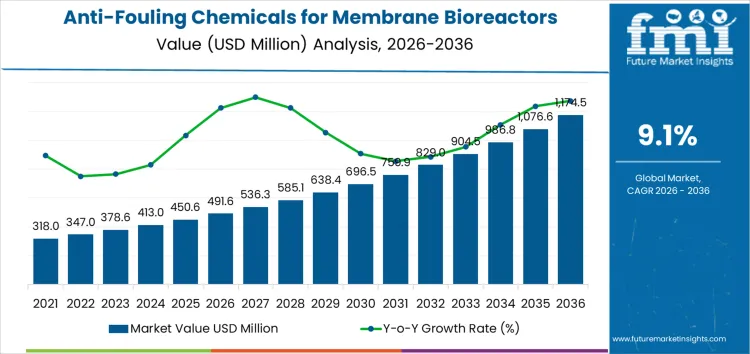
What is the Growth Forecast for the Anti-Fouling Chemicals for Membrane Bioreactors Market through 2036?
The half-decade weighted growth for the anti-fouling chemicals for membrane bioreactors market reveals a consistent and steady increase in market value, with the first five years (2026-2031) experiencing the bulk of the growth. Starting at USD 491.6 million in 2026, the market will increase to USD 536.8 million in 2027, reflecting an initial growth of USD 45.2 million. This growth will accelerate over the next few years as the adoption of membrane bioreactors increases and the need for anti-fouling chemicals to maintain system efficiency becomes more pronounced.
By 2028, the market value will rise to USD 586.7 million, adding USD 49.9 million, followed by USD 642.2 million in 2029, reflecting an increase of USD 55.5 million. The total market growth between 2026 and 2029 will amount to USD 150.6 million, marking a significant early surge driven by higher demand for effective anti-fouling chemicals to ensure membrane bioreactor efficiency.
In the second half of the forecast period (2031-2036), the market will continue to experience growth, but the rate will moderate as the technology matures. From USD 704 million in 2029, the market will increase to USD 773.6 million in 2030, with a growth of USD 69.6 million, followed by USD 852.1 million in 2031. The later years, from 2032 to 2036, will see gradual growth, with the market reaching USD 1,174.5 million by 2036, representing a steady rise of USD 320 million over the decade. This half-decade weighted growth highlights a peak in early adoption, followed by sustained, steady demand as anti-fouling chemicals for membrane bioreactors become integral to water treatment systems.
Anti-Fouling Chemicals for Membrane Bioreactors Market Key Takeaways
| Metric | Value |
|---|---|
| Industry Sales Value (2026) | USD 491.6 million |
| Industry Forecast Value (2036) | USD 1,174.5 million |
| Industry Forecast CAGR (2026-2036) | 9.1% |
What Is Driving the Demand for the Anti Fouling Chemicals for Membrane Bioreactors Market Globally?
The global demand for anti fouling chemicals for membrane bioreactors (MBRs) is being driven by the rapid expansion of advanced wastewater treatment technologies and the need to maintain system performance and longevity. MBRs combine membrane filtration with biological treatment to produce high quality effluent suitable for reuse or stringent discharge standards. However, membranes are prone to fouling by organic matter, biofilms, scaling, and particulate buildup, which reduces permeability, increases energy consumption, and raises operational costs due to frequent cleaning or membrane replacement.
Anti fouling chemicals, including specialized cleaners, dispersants, and conditioning agents, are used to slow fouling onset, facilitate easier cleaning, and restore membrane flux. As municipalities and industries face stricter effluent regulations, MBR adoption has grown in regions such as Europe, North America, and Asia Pacific. Operators are seeking solutions that stabilise performance, reduce downtime, and lower total cost of ownership, reinforcing the value of effective anti fouling chemistries.
Future demand for anti fouling chemicals for membrane bioreactors is expected to grow as wastewater reuse, water scarcity, and sustainability priorities continue shaping water infrastructure investments worldwide. Advances in chemical formulations are enhancing fouling resistance and cleaning efficacy while minimizing impact on membrane materials and downstream treatment processes. Integration of these chemistries with real time monitoring and process control systems helps operators optimise dosing, improve cleaning regimes, and extend membrane service intervals.
Expansion of industrial applications-such as food and beverage processing, pharmaceuticals, and petrochemicals-will support broader uptake because these sectors produce complex waste streams that accelerate fouling. Regulatory frameworks that mandate tighter effluent quality and encourage water reuse will further reinforce the need for reliable membrane performance. As utilities and industrial facilities prioritise resilient, cost effective treatment solutions and seek to reduce energy and waste, anti fouling chemicals that deliver measurable improvements in membrane operation are expected to see steady global market growth.
What are the Leading Segments in the Global Anti-Fouling Chemicals for Membrane Bioreactors Market?
The global anti-fouling chemicals for membrane bioreactors (MBRs) market is segmented by membrane type and application area. Among membrane types, hollow fiber membranes lead the market, capturing 34% of the share, followed by flat sheet membranes, tubular membranes, multi-layer composite membranes, and others. Hollow fiber membranes are widely used due to their compact design and high filtration efficiency. On the application area side, municipal wastewater treatment dominates the market, holding 38% of the share, followed by industrial effluent treatment, decentralized & on-site MBR systems, commercial & institutional facilities, and sludge & biogas treatment plants. Municipal wastewater treatment is the largest segment, as MBRs are increasingly used in urban water treatment due to their high efficiency and compact size.
What Drives the Growth of Hollow Fiber Membranes in the Anti-Fouling Chemicals for Membrane Bioreactors Market?
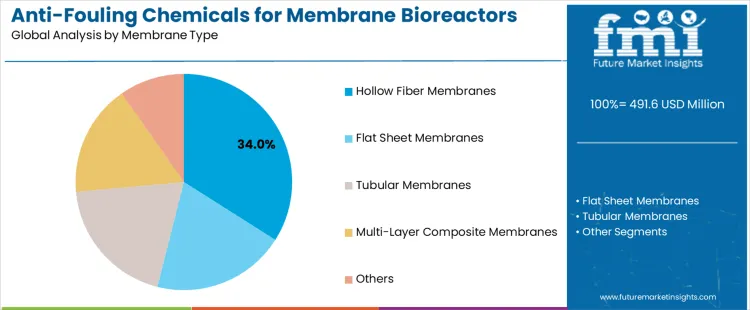
Hollow fiber membranes are the leading membrane type in the anti-fouling chemicals for membrane bioreactors market, holding 34% of the share. These membranes are favored for their high surface area and efficiency in filtration, making them particularly suitable for municipal wastewater treatment and other large-scale applications. The compact design of hollow fiber membranes allows for higher filtration capacity within a smaller footprint, making them ideal for urban and industrial water treatment facilities where space and efficiency are critical. Additionally, hollow fiber membranes are highly effective in membrane bioreactor systems, where anti-fouling chemicals play a key role in preventing the buildup of contaminants that could reduce membrane performance and lifespan. As the demand for efficient, compact, and sustainable water treatment technologies grows, hollow fiber membranes are expected to maintain their dominant position in the market, particularly in municipal wastewater treatment and industrial effluent management.
What is Driving the Demand for Municipal Wastewater Treatment in the Anti-Fouling Chemicals for Membrane Bioreactors Market?
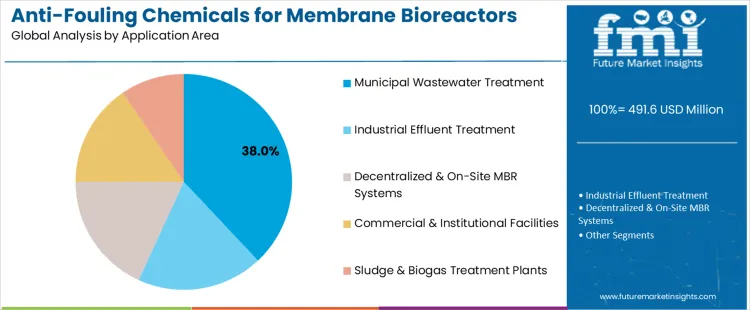
Municipal wastewater treatment is the leading application area in the anti-fouling chemicals for membrane bioreactors market, capturing 38% of the share. This demand is primarily driven by the increasing urbanization and the growing need for efficient wastewater treatment systems in cities. Municipal wastewater treatment facilities are adopting membrane bioreactor (MBR) technology due to its high efficiency in removing organic pollutants, suspended solids, and microorganisms from wastewater. MBRs, particularly with hollow fiber membranes, offer a compact and effective solution for treating large volumes of wastewater, making them ideal for urban and municipal applications. As municipalities face stricter environmental regulations and the need to address water scarcity, the demand for advanced and efficient wastewater treatment technologies, such as MBRs, continues to rise. Anti-fouling chemicals are crucial in maintaining the performance and longevity of these systems by preventing membrane fouling, thus driving the continued growth of the market in municipal wastewater treatment.
What are the Key Dynamics in the Global Anti Fouling Chemicals for Membrane Bioreactors Market?
The global anti fouling chemicals for membrane bioreactors (MBRs) market is expanding as wastewater treatment facilities and industrial processors adopt advanced solutions to reduce membrane fouling and maintain high flux, permeability and treated water quality. Anti fouling chemicals are used to prevent or mitigate buildup of organic, inorganic and biological foulants on membrane surfaces, extending membrane life and lowering operational costs. Growth reflects increasing deployment of MBR technology in municipal wastewater plants, industrial effluent recycling, and water scarce regions where stringent discharge standards and reuse goals drive adoption. Integration of anti fouling strategies supports efficiency, sustainability and compliance in complex treatment environments worldwide.
What are the Key Drivers for the Anti Fouling Chemicals for Membrane Bioreactors Market?
A primary driver is rising demand for high performance wastewater treatment and water reuse in urban and industrial settings. Membrane bioreactors offer compact footprints and superior effluent quality, but fouling remains a key operational challenge that reduces throughput and increases energy use. Anti fouling chemicals such as dispersants, cleaning agents and surface active additives help maintain membrane performance and reduce frequency of chemical clean in place cycles. Stricter environmental regulations on effluent quality and nutrient removal boost MBR use, incentivizing investment in effective anti fouling solutions. Expansion of industrial water recycling projects and scarcity driven water reuse initiatives also support market growth.
What are the Restraints for the Anti Fouling Chemicals for Membrane Bioreactors Market?
One restraint is the technical complexity of selecting and dosing anti fouling chemicals to match diverse wastewater characteristics and membrane types. Variability in organic load, suspended solids, scaling potential and biological activity across treatment plants requires site specific optimization, which can increase operational planning and chemical costs. Some facilities may be cautious about long term impacts of aggressive chemicals on membrane integrity or downstream processes, prompting reliance on physical cleaning or process adjustments. Budget constraints for smaller or resource limited treatment systems may delay adoption of advanced anti fouling chemistries without clear cost benefit demonstration.
What are the Key Trends in the Anti Fouling Chemicals for Membrane Bioreactors Market?
A key trend is development of environmentally benign anti fouling chemicals that deliver effective fouling control with reduced toxicity and lower impact on biological treatment processes. Bio based dispersants and tailored surfactant systems are gaining interest as facilities balance performance with sustainability goals and regulatory pressure on chemical use. Formulation advances target specific foulant types, such as proteins, colloids and inorganic scales, to enhance selectivity and reduce cleaning severity. Combined strategies that integrate anti fouling chemistry with real time monitoring and automated dosing improve operational efficiency. Collaboration between membrane manufacturers, chemical suppliers and treatment plant operators supports best practice protocols and optimized cleaning regimens that extend membrane life and lower lifecycle costs.
What is the Country-Wise Analysis of the Anti-Fouling Chemicals for Membrane Bioreactors Market?
The anti-fouling chemicals for membrane bioreactors market is expected to grow steadily, driven by the increasing demand for water and wastewater treatment solutions in both industrial and municipal sectors. Membrane bioreactors (MBRs) are widely used for treating wastewater, and anti-fouling chemicals are essential for maintaining the efficiency of these systems by preventing the buildup of fouling materials, which can impair membrane performance. High-growth markets like India and China are seeing significant demand due to their expanding industrial sectors, urbanization, and the growing need for effective water treatment solutions. Developed markets such as the United States, Germany, and South Korea are also experiencing steady growth, supported by stringent environmental regulations, advancements in wastewater treatment technologies, and a focus on sustainable water management.
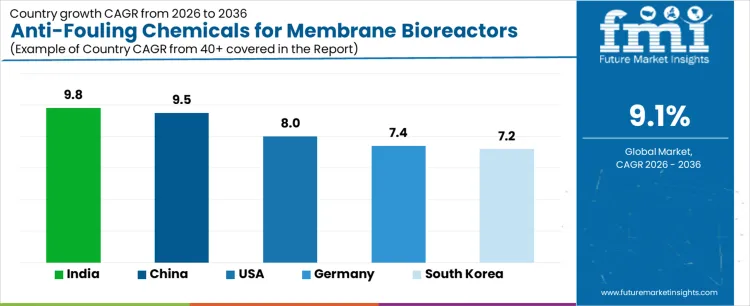
| Country | CAGR (2026-2036) |
|---|---|
| India | 9.8% |
| China | 9.5% |
| USA | 8% |
| Germany | 7.4% |
| South Korea | 7.2% |
What is the Growth Outlook for the Anti-Fouling Chemicals for Membrane Bioreactors Market in India?
The anti-fouling chemicals for membrane bioreactors market in India is expected to grow at the highest rate, with a projected CAGR of 9.8%. India’s rapidly expanding industrial base, urbanization, and increasing water pollution are driving the demand for efficient water treatment technologies, including membrane bioreactors. As the country faces challenges related to water scarcity and wastewater management, the adoption of advanced water treatment solutions like MBRs, coupled with anti-fouling chemicals, is becoming increasingly essential. The Indian government’s focus on improving water infrastructure, promoting sustainable water management, and reducing water contamination is expected to further support the market's growth. With a growing emphasis on sustainable development, India’s market for anti-fouling chemicals is set for strong growth.
What is the Market Outlook for the Anti-Fouling Chemicals for Membrane Bioreactors Market in China?
The anti-fouling chemicals for membrane bioreactors market in China is projected to grow steadily, with a projected CAGR of 9.5%. China’s significant industrial growth, rapid urbanization, and increasing water pollution are major drivers of demand for advanced water and wastewater treatment technologies. As the country works to address environmental challenges and improve water quality, the adoption of membrane bioreactors and anti-fouling chemicals is increasing. China’s government is actively investing in infrastructure projects to address water treatment and wastewater management, further boosting the market for these chemicals. With growing environmental regulations and an emphasis on sustainable practices, the demand for anti-fouling chemicals in membrane bioreactors is expected to continue rising steadily in China.
What is the Growth Forecast for the Anti-Fouling Chemicals for Membrane Bioreactors Market in the United States?
The anti-fouling chemicals for membrane bioreactors market in the United States is expected to grow steadily, with a projected CAGR of 8%. The U.S. market is driven by the growing need for effective and efficient water treatment technologies, especially in light of increasing water contamination and wastewater treatment challenges. The adoption of membrane bioreactors in municipal and industrial applications, coupled with the need to maintain system efficiency, is fueling the demand for anti-fouling chemicals. Stringent environmental regulations and government initiatives aimed at improving water quality and managing wastewater further contribute to the growth of the market. As sustainability and efficient resource management become more critical, the demand for anti-fouling chemicals in the U.S. is expected to grow steadily.
What is the Market Outlook for the Anti-Fouling Chemicals for Membrane Bioreactors Market in Germany?
The anti-fouling chemicals for membrane bioreactors market in Germany is projected to grow at a steady pace, with a projected CAGR of 7.4%. Germany’s commitment to sustainability and its strong regulatory framework aimed at improving water quality and wastewater management are key drivers of the market. As industries and municipalities in Germany seek to adopt more sustainable water treatment solutions, the use of membrane bioreactors and anti-fouling chemicals is becoming increasingly popular. The German government’s focus on green technologies and investments in advanced water treatment infrastructure further contribute to the market's growth. As demand for cleaner water management technologies increases, Germany’s market for anti-fouling chemicals in membrane bioreactors is expected to continue expanding.
What are the Growth Prospects for the Anti-Fouling Chemicals for Membrane Bioreactors Market in South Korea?
The anti-fouling chemicals for membrane bioreactors market in South Korea is expected to grow steadily, with a projected CAGR of 7.2%. South Korea’s strong focus on water conservation, environmental sustainability, and advanced wastewater treatment technologies is driving the adoption of membrane bioreactors in the country. As urbanization continues and industrialization grows, the need for efficient and sustainable wastewater management solutions is increasing. South Korea’s government is investing in advanced water treatment infrastructure and encouraging the use of green technologies to address water pollution. As part of these efforts, the demand for anti-fouling chemicals for membrane bioreactors is expected to grow steadily, supported by both industrial and government investments in environmental sustainability.
What is the Competitive Landscape for the Anti-Fouling Chemicals for Membrane Bioreactors Market?
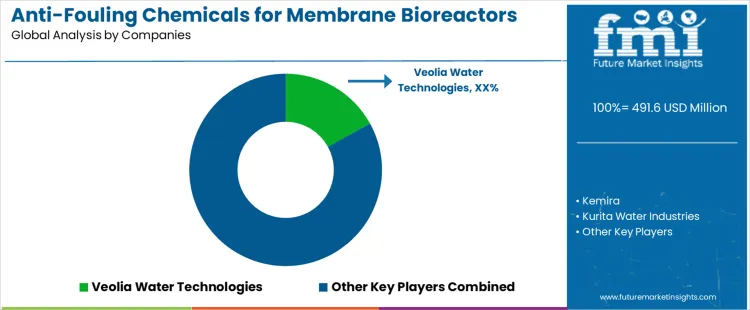
The anti-fouling chemicals for membrane bioreactors market is growing as industries and municipalities focus on improving the efficiency and longevity of membrane bioreactors used in wastewater treatment and other filtration processes. Veolia Water Technologies leads the market with its advanced anti-fouling chemicals, offering solutions that prevent biofouling and scaling in membrane bioreactors, ensuring optimal performance and extended membrane lifespan. Their strong emphasis on product innovation, sustainability, and performance has positioned them as a dominant player. Kemira, Kurita Water Industries, and Ecolab are key competitors, each offering specialized chemicals designed to enhance membrane bioreactor performance. Kemira and Kurita Water Industries provide high-quality anti-fouling agents that improve membrane efficiency, while Ecolab focuses on providing eco-friendly and effective solutions for industrial applications.
Solenis further contributes to the competitive landscape with its anti-fouling chemicals that are specifically designed for use in membrane bioreactor systems. Solenis focuses on delivering advanced chemical solutions that optimize membrane performance and reduce maintenance costs. These companies compete by focusing on product innovation, sustainability, and their ability to meet the growing demand for efficient, cost-effective solutions in water treatment applications. As the need for sustainable wastewater treatment and filtration technologies continues to rise, the market for anti-fouling chemicals for membrane bioreactors is expected to grow, fostering further innovation in the sector.
Key Players of the Anti-Fouling Chemicals for Membrane Bioreactors Market
- Veolia Water Technologies
- Kemira
- Kurita Water Industries
- Ecolab
- Solenis
Scope of the Report
| Items | Values |
|---|---|
| Quantitative Units (2026) | USD Million |
| Chemical Type | Biocide-Based Anti-Fouling Chemicals, Enzymatic & Bio-Based Anti-Foulants, Scale & Organic Fouling Inhibitors, Surfactant-Based Cleaning Agents, Other Specialty Anti-Fouling Chemicals |
| Membrane Type | Hollow Fiber Membranes, Flat Sheet Membranes, Tubular Membranes, Multi-Layer Composite Membranes, Others |
| Application Area | Municipal Wastewater Treatment, Industrial Effluent Treatment, Decentralized & On-Site MBR Systems, Commercial & Institutional Facilities, Sludge & Biogas Treatment Plants |
| Companies | Veolia Water Technologies, Kemira, Kurita Water Industries, Ecolab, Solenis |
| Regions Covered | North America, Latin America, Western Europe, Eastern Europe, South Asia and Pacific, East Asia, Middle East & Africa |
| Countries Covered | United States, Canada, Mexico, Brazil, Argentina, Germany, France, United Kingdom, Italy, Spain, Netherlands, China, India, Japan, South Korea, ANZ, GCC Countries, South Africa |
| Additional Attributes | Dollar by sales by chemical type, membrane type, application area, and region. Includes market trends in anti-fouling chemicals for membrane bioreactors, performance in various wastewater treatment and industrial applications, cost-effectiveness, sustainability practices, regulatory compliance, market share and competitive positioning of key companies, and the role of anti-fouling chemicals in enhancing membrane performance, reducing fouling, and improving the efficiency of MBR systems across sectors. |
Anti-Fouling Chemicals for Membrane Bioreactors Market Segmentation
Chemical Type
- Biocide-Based Anti-Fouling Chemicals
- Enzymatic & Bio-Based Anti-Foulants
- Scale & Organic Fouling Inhibitors
- Surfactant-Based Cleaning Agents
- Other Specialty Anti-Fouling Chemicals
Membrane Type
- Hollow Fiber Membranes
- Flat Sheet Membranes
- Tubular Membranes
- Multi-Layer Composite Membranes
- Others
Application Area
- Municipal Wastewater Treatment
- Industrial Effluent Treatment
- Decentralized & On-Site MBR Systems
- Commercial & Institutional Facilities
- Sludge & Biogas Treatment Plants
Region
- Asia Pacific
- China
- Japan
- South Korea
- India
- Australia & New Zealand
- ASEAN
- Rest of Asia Pacific
- Europe
- Germany
- United Kingdom
- France
- Italy
- Spain
- Nordic
- BENELUX
- Rest of Europe
- North America
- United States
- Canada
- Mexico
- Latin America
- Brazil
- Chile
- Rest of Latin America
- Middle East & Africa
- Kingdom of Saudi Arabia
- Other GCC Countries
- Turkey
- South Africa
- Other African Union
- Rest of Middle East & Africa
Bibliography
- Veolia Water Technologies. (n.d.). Advanced anti-fouling solutions for membrane bioreactors.
- Kemira. (n.d.). Sustainable solutions for membrane fouling prevention in water treatment.
Frequently Asked Questions
How big is the anti-fouling chemicals for membrane bioreactors market in 2026?
The global anti-fouling chemicals for membrane bioreactors market is estimated to be valued at USD 491.6 million in 2026.
What will be the size of anti-fouling chemicals for membrane bioreactors market in 2036?
The market size for the anti-fouling chemicals for membrane bioreactors market is projected to reach USD 1,174.5 million by 2036.
How much will be the anti-fouling chemicals for membrane bioreactors market growth between 2026 and 2036?
The anti-fouling chemicals for membrane bioreactors market is expected to grow at a 9.1% CAGR between 2026 and 2036.
What are the key product types in the anti-fouling chemicals for membrane bioreactors market?
The key product types in anti-fouling chemicals for membrane bioreactors market are biocide-based anti-fouling chemicals, enzymatic & bio-based anti-foulants, scale & organic fouling inhibitors, surfactant-based cleaning agents and other specialty anti-fouling chemicals.
Which membrane type segment to contribute significant share in the anti-fouling chemicals for membrane bioreactors market in 2026?
In terms of membrane type, hollow fiber membranes segment to command 34.0% share in the anti-fouling chemicals for membrane bioreactors market in 2026.
Preview the report firsthand - request a free sample
Get SampleGet the brochure for pricing and purchase details.
Get PDFTable of Content
- Executive Summary
- Global Market Outlook
- Demand-side Trends
- Supply-side Trends
- Technology Roadmap Analysis
- Analysis and Recommendations
- Market Overview
- Market Coverage / Taxonomy
- Market Definition / Scope / Limitations
- Market Background
- Market Dynamics
- Drivers
- Restraints
- Opportunity
- Trends
- Scenario Forecast
- Demand in Optimistic Scenario
- Demand in Likely Scenario
- Demand in Conservative Scenario
- Opportunity Map Analysis
- Product Life Cycle Analysis
- Supply Chain Analysis
- Investment Feasibility Matrix
- Value Chain Analysis
- PESTLE and Porter’s Analysis
- Regulatory Landscape
- Regional Parent Market Outlook
- Production and Consumption Statistics
- Import and Export Statistics
- Market Dynamics
- Global Market Analysis 2021 to 2025 and Forecast, 2026 to 2036
- Historical Market Size Value (USD Million) Analysis, 2021 to 2025
- Current and Future Market Size Value (USD Million) Projections, 2026 to 2036
- Y-o-Y Growth Trend Analysis
- Absolute $ Opportunity Analysis
- Global Market Pricing Analysis 2021 to 2025 and Forecast 2026 to 2036
- Global Market Analysis 2021 to 2025 and Forecast 2026 to 2036, By Chemical Type
- Introduction / Key Findings
- Historical Market Size Value (USD Million) Analysis By Chemical Type , 2021 to 2025
- Current and Future Market Size Value (USD Million) Analysis and Forecast By Chemical Type , 2026 to 2036
- Biocide-Based Anti-Fouling Chemicals
- Enzymatic & Bio-Based Anti-Foulants
- Scale & Organic Fouling Inhibitors
- Surfactant-Based Cleaning Agents
- Other Specialty Anti-Fouling Chemicals
- Biocide-Based Anti-Fouling Chemicals
- Y-o-Y Growth Trend Analysis By Chemical Type , 2021 to 2025
- Absolute $ Opportunity Analysis By Chemical Type , 2026 to 2036
- Global Market Analysis 2021 to 2025 and Forecast 2026 to 2036, By Membrane Type
- Introduction / Key Findings
- Historical Market Size Value (USD Million) Analysis By Membrane Type, 2021 to 2025
- Current and Future Market Size Value (USD Million) Analysis and Forecast By Membrane Type, 2026 to 2036
- Hollow Fiber Membranes
- Flat Sheet Membranes
- Tubular Membranes
- Multi-Layer Composite Membranes
- Others
- Hollow Fiber Membranes
- Y-o-Y Growth Trend Analysis By Membrane Type, 2021 to 2025
- Absolute $ Opportunity Analysis By Membrane Type, 2026 to 2036
- Global Market Analysis 2021 to 2025 and Forecast 2026 to 2036, By Application Area
- Introduction / Key Findings
- Historical Market Size Value (USD Million) Analysis By Application Area, 2021 to 2025
- Current and Future Market Size Value (USD Million) Analysis and Forecast By Application Area, 2026 to 2036
- Municipal Wastewater Treatment
- Industrial Effluent Treatment
- Decentralized & On-Site MBR Systems
- Commercial & Institutional Facilities
- Sludge & Biogas Treatment Plants
- Municipal Wastewater Treatment
- Y-o-Y Growth Trend Analysis By Application Area, 2021 to 2025
- Absolute $ Opportunity Analysis By Application Area, 2026 to 2036
- Global Market Analysis 2021 to 2025 and Forecast 2026 to 2036, By Region
- Introduction
- Historical Market Size Value (USD Million) Analysis By Region, 2021 to 2025
- Current Market Size Value (USD Million) Analysis and Forecast By Region, 2026 to 2036
- North America
- Latin America
- Western Europe
- Eastern Europe
- East Asia
- South Asia and Pacific
- Middle East & Africa
- Market Attractiveness Analysis By Region
- North America Market Analysis 2021 to 2025 and Forecast 2026 to 2036, By Country
- Historical Market Size Value (USD Million) Trend Analysis By Market Taxonomy, 2021 to 2025
- Market Size Value (USD Million) Forecast By Market Taxonomy, 2026 to 2036
- By Country
- USA
- Canada
- Mexico
- By Chemical Type
- By Membrane Type
- By Application Area
- By Country
- Market Attractiveness Analysis
- By Country
- By Chemical Type
- By Membrane Type
- By Application Area
- Key Takeaways
- Latin America Market Analysis 2021 to 2025 and Forecast 2026 to 2036, By Country
- Historical Market Size Value (USD Million) Trend Analysis By Market Taxonomy, 2021 to 2025
- Market Size Value (USD Million) Forecast By Market Taxonomy, 2026 to 2036
- By Country
- Brazil
- Chile
- Rest of Latin America
- By Chemical Type
- By Membrane Type
- By Application Area
- By Country
- Market Attractiveness Analysis
- By Country
- By Chemical Type
- By Membrane Type
- By Application Area
- Key Takeaways
- Western Europe Market Analysis 2021 to 2025 and Forecast 2026 to 2036, By Country
- Historical Market Size Value (USD Million) Trend Analysis By Market Taxonomy, 2021 to 2025
- Market Size Value (USD Million) Forecast By Market Taxonomy, 2026 to 2036
- By Country
- Germany
- UK
- Italy
- Spain
- France
- Nordic
- BENELUX
- Rest of Western Europe
- By Chemical Type
- By Membrane Type
- By Application Area
- By Country
- Market Attractiveness Analysis
- By Country
- By Chemical Type
- By Membrane Type
- By Application Area
- Key Takeaways
- Eastern Europe Market Analysis 2021 to 2025 and Forecast 2026 to 2036, By Country
- Historical Market Size Value (USD Million) Trend Analysis By Market Taxonomy, 2021 to 2025
- Market Size Value (USD Million) Forecast By Market Taxonomy, 2026 to 2036
- By Country
- Russia
- Poland
- Hungary
- Balkan & Baltic
- Rest of Eastern Europe
- By Chemical Type
- By Membrane Type
- By Application Area
- By Country
- Market Attractiveness Analysis
- By Country
- By Chemical Type
- By Membrane Type
- By Application Area
- Key Takeaways
- East Asia Market Analysis 2021 to 2025 and Forecast 2026 to 2036, By Country
- Historical Market Size Value (USD Million) Trend Analysis By Market Taxonomy, 2021 to 2025
- Market Size Value (USD Million) Forecast By Market Taxonomy, 2026 to 2036
- By Country
- China
- Japan
- South Korea
- By Chemical Type
- By Membrane Type
- By Application Area
- By Country
- Market Attractiveness Analysis
- By Country
- By Chemical Type
- By Membrane Type
- By Application Area
- Key Takeaways
- South Asia and Pacific Market Analysis 2021 to 2025 and Forecast 2026 to 2036, By Country
- Historical Market Size Value (USD Million) Trend Analysis By Market Taxonomy, 2021 to 2025
- Market Size Value (USD Million) Forecast By Market Taxonomy, 2026 to 2036
- By Country
- India
- ASEAN
- Australia & New Zealand
- Rest of South Asia and Pacific
- By Chemical Type
- By Membrane Type
- By Application Area
- By Country
- Market Attractiveness Analysis
- By Country
- By Chemical Type
- By Membrane Type
- By Application Area
- Key Takeaways
- Middle East & Africa Market Analysis 2021 to 2025 and Forecast 2026 to 2036, By Country
- Historical Market Size Value (USD Million) Trend Analysis By Market Taxonomy, 2021 to 2025
- Market Size Value (USD Million) Forecast By Market Taxonomy, 2026 to 2036
- By Country
- Kingdom of Saudi Arabia
- Other GCC Countries
- Turkiye
- South Africa
- Other African Union
- Rest of Middle East & Africa
- By Chemical Type
- By Membrane Type
- By Application Area
- By Country
- Market Attractiveness Analysis
- By Country
- By Chemical Type
- By Membrane Type
- By Application Area
- Key Takeaways
- Key Countries Market Analysis
- USA
- Pricing Analysis
- Market Share Analysis, 2025
- By Chemical Type
- By Membrane Type
- By Application Area
- Canada
- Pricing Analysis
- Market Share Analysis, 2025
- By Chemical Type
- By Membrane Type
- By Application Area
- Mexico
- Pricing Analysis
- Market Share Analysis, 2025
- By Chemical Type
- By Membrane Type
- By Application Area
- Brazil
- Pricing Analysis
- Market Share Analysis, 2025
- By Chemical Type
- By Membrane Type
- By Application Area
- Chile
- Pricing Analysis
- Market Share Analysis, 2025
- By Chemical Type
- By Membrane Type
- By Application Area
- Germany
- Pricing Analysis
- Market Share Analysis, 2025
- By Chemical Type
- By Membrane Type
- By Application Area
- UK
- Pricing Analysis
- Market Share Analysis, 2025
- By Chemical Type
- By Membrane Type
- By Application Area
- Italy
- Pricing Analysis
- Market Share Analysis, 2025
- By Chemical Type
- By Membrane Type
- By Application Area
- Spain
- Pricing Analysis
- Market Share Analysis, 2025
- By Chemical Type
- By Membrane Type
- By Application Area
- France
- Pricing Analysis
- Market Share Analysis, 2025
- By Chemical Type
- By Membrane Type
- By Application Area
- India
- Pricing Analysis
- Market Share Analysis, 2025
- By Chemical Type
- By Membrane Type
- By Application Area
- ASEAN
- Pricing Analysis
- Market Share Analysis, 2025
- By Chemical Type
- By Membrane Type
- By Application Area
- Australia & New Zealand
- Pricing Analysis
- Market Share Analysis, 2025
- By Chemical Type
- By Membrane Type
- By Application Area
- China
- Pricing Analysis
- Market Share Analysis, 2025
- By Chemical Type
- By Membrane Type
- By Application Area
- Japan
- Pricing Analysis
- Market Share Analysis, 2025
- By Chemical Type
- By Membrane Type
- By Application Area
- South Korea
- Pricing Analysis
- Market Share Analysis, 2025
- By Chemical Type
- By Membrane Type
- By Application Area
- Russia
- Pricing Analysis
- Market Share Analysis, 2025
- By Chemical Type
- By Membrane Type
- By Application Area
- Poland
- Pricing Analysis
- Market Share Analysis, 2025
- By Chemical Type
- By Membrane Type
- By Application Area
- Hungary
- Pricing Analysis
- Market Share Analysis, 2025
- By Chemical Type
- By Membrane Type
- By Application Area
- Kingdom of Saudi Arabia
- Pricing Analysis
- Market Share Analysis, 2025
- By Chemical Type
- By Membrane Type
- By Application Area
- Turkiye
- Pricing Analysis
- Market Share Analysis, 2025
- By Chemical Type
- By Membrane Type
- By Application Area
- South Africa
- Pricing Analysis
- Market Share Analysis, 2025
- By Chemical Type
- By Membrane Type
- By Application Area
- USA
- Market Structure Analysis
- Competition Dashboard
- Competition Benchmarking
- Market Share Analysis of Top Players
- By Regional
- By Chemical Type
- By Membrane Type
- By Application Area
- Competition Analysis
- Competition Deep Dive
- Veolia Water Technologies
- Overview
- Product Portfolio
- Profitability by Market Segments (Product/Age /Sales Channel/Region)
- Sales Footprint
- Strategy Overview
- Marketing Strategy
- Product Strategy
- Channel Strategy
- Kemira
- Kurita Water Industries
- Ecolab
- Solenis
- Veolia Water Technologies
- Competition Deep Dive
- Assumptions & Acronyms Used
- Research Methodology


