

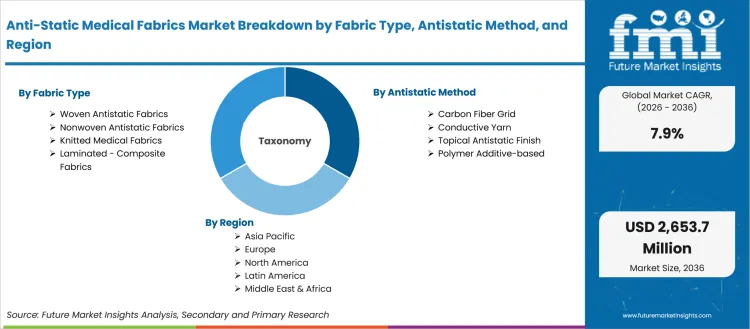
- Market Size (2026)
- USD 1240.6 Mn
- Forecast (2036)
- USD 2653.7 Mn
- CAGR (2026 to 2036)
- 7.9%
How big is the Anti-Static Medical Fabrics Market in 2026?
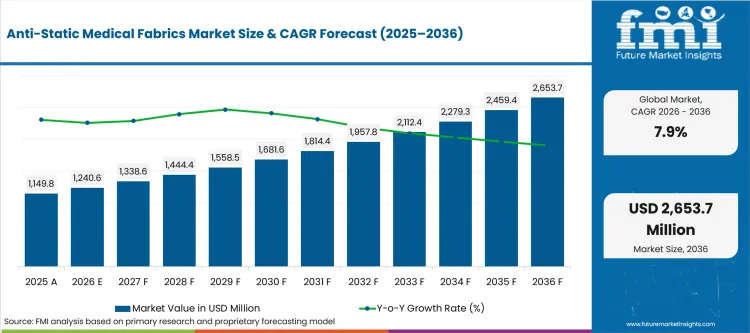
USD 1,240.6 million in 2026 and USD 2,653.7 million by 2036 at a 7.9% CAGR.
Demand for anti-static medical fabrics stood at USD 1,240.6 million in 2026, with the market climbing to USD 2,653.7 million by 2036 at a 7.9% CAGR. Growth is driven by hospital procurement teams, infection-control leads, and textile converters who treat static-control performance as a specification requirement rather than a nice-to-have, since fabric that generates static in operating rooms or sterile-processing areas can compromise sensitive equipment and contamination control. Medical-product suppliers building these fabrics into gowns, drapes, and covers have to hold that performance steady across every production run, because a single batch that drifts outside spec can force a hospital to reject supply mid-contract.
Adoption is slowed by the added cost and manufacturing complexity of embedding conductive or static-dissipative fibers without weakening barrier performance or comfort, and by the documentation burden hospitals now expect before they'll qualify a new supplier. Regulatory and standards references help set the outer boundary of what counts as compliant, but individual buyers still test and document a fabric's real-world performance before approval. The clearer opportunities lie in single-use disposable formats, reusable fabrics designed for repeat sterilization cycles, and suppliers who can prove traceable raw-material sourcing to shorten approval timelines. By fabric type, end-use application, and product form, cost and qualification requirements differ enough to warrant separate treatment. Regionally, manufacturing capacity concentrates where technical textile production is established, while hospital-driven demand for documented, specification-compliant fabrics skews toward markets with stricter infection-control regulation.
Key Takeaways of Anti-Static Medical Fabrics Market
- Demand for anti-static medical fabrics is driven by hospitals and infection-control teams prioritizing product safety, static-control performance, and reliable clinical supply, with quality documentation and technical support shaping supplier qualification.
- By sales channel, direct to converters is expected to lead with 54.4% share in 2026, supported by stronger service response and supplier accountability.
- Hospitals are the dominant end-user segment, projected to hold 45.3% share in 2026, driven by infection-control and patient safety requirements.
- Carbon fiber grid is estimated to lead the technology category with 38.0% share in 2026, backed by reliable static-control performance and technical compliance.
- Formulation consistency and operational proof remain critical to supplier evaluation, as healthcare organizations favor products that reduce buyer risk and supply-chain uncertainty before large-scale procurement.
- India and China are expected to form the higher-growth country tier, advancing at 10.13% and 9.13% CAGR respectively through 2036, supported by expanding healthcare manufacturing and production scale.
- Competition centers on Freudenberg Performance Materials, Berry Global, Ahlstrom, PFNonwovens, Kimberly-Clark Professional, Cardinal Health, Medline Industries, DuPont, Suominen, and Owens & Minor P&HS, with vendors differentiating through documentation quality, channel access, and post-sales technical support.
Analyst Perspective
"Demand for anti-static medical fabrics is being shaped by the need to maintain patient safety and dependable performance across clinical environments where electrostatic control is essential. Hospitals and medical device manufacturers are selecting materials that meet stringent regulatory standards, withstand repeated sterilization, and deliver consistent protective performance throughout their service life. Suppliers that offer validated quality systems, reliable manufacturing, and application expertise are expected to build lasting relationships with healthcare providers and OEMs."
- Anurag Sharma, Principal Consultant for Healthcare at Future Market Insights
How is the Anti-Static Medical Fabrics Market segmented?
The anti-static medical fabrics industry is segmented by Fabric Type, By Antistatic Method and By Application; End Use and By Sales Channel complete the forecast structure.
Fabric Type distinguishes the base construction the material is built on, since woven versus non-woven or knitted structures affect drape, durability, and how the fabric holds up through repeated sterilization cycles. Antistatic Method separates the technical approach used to dissipate static charge, because carbon fiber grids, conductive yarns, and coating-based methods each carry different cost and performance tradeoffs. Application identifies the specific medical product the fabric is converted into, since surgical gowns, drapes, and other items each impose different static-control thresholds. End Use shows which facility type consumes the finished product, because operating conditions and risk tolerance shift between hospital and non-hospital settings. Sales Channel captures the buying route the fabric moves through before reaching a converter or facility, each carrying different order and support expectations.
How does Direct to Converters influence buying within By Sales Channel?
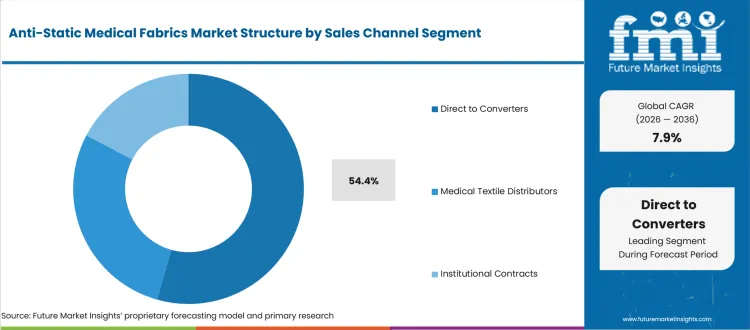
Fabric mills selling direct to converters skip the markup and lead-time layer a distributor would add, which matters for converters running continuous production lines that can't absorb delivery delays without idling equipment. Gown and drape converters are the primary buyers in this channel, and the deciding factor is whether the mill can hold order continuity steady across large-volume runs, since a supply gap here stalls finished-product output downstream.
- Direct to converters represents 54.4% of Sales Channel in 2026, equal to USD 674.9 million, rising from USD 625.5 million in 2025 to USD 1,443.6 million by 2036, reflecting how tightly converters depend on a direct relationship to keep continuous production lines running without distributor delays.
- Supplier accountability is the practical test converters apply, since a direct relationship removes the buffer a distributor might otherwise absorb when a batch falls short of spec. Mills demonstrating consistent order fulfillment and quick issue resolution retain converter accounts through repeat purchase cycles.
Where does Hospitals create value in the By End Use category?
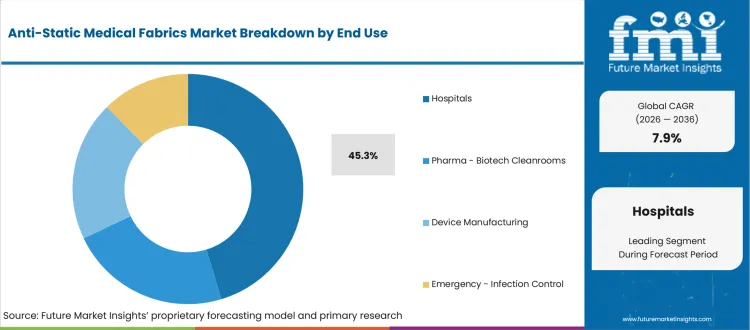
Hospitals operate under stricter static-control requirements than most other end-use settings, since electrostatic discharge near sensitive electronic equipment or flammable anesthetic environments carries direct patient-safety consequences. Hospital procurement and infection-control teams are the primary decision-makers, and the deciding factor is whether the fabric's antistatic performance holds up through the facility's sterilization and laundering cycle without degrading.
- Hospitals hold 45.3% share of End Use in 2026 at USD 562.0 million, growing from USD 520.8 million in 2025 to USD 1,202.1 million by 2036, reflecting the setting's stricter operating risk tolerance relative to outpatient or ambulatory facilities.
- Operating cost pressure shapes repeat orders here, since a fabric that loses antistatic performance after repeated sterilization cycles forces earlier replacement than the facility budgeted for. Suppliers demonstrating durability across wash cycles win renewal over lower-cost alternatives that underperform after repeated use.
What keeps Carbon Fiber Grid relevant within By Antistatic Method?
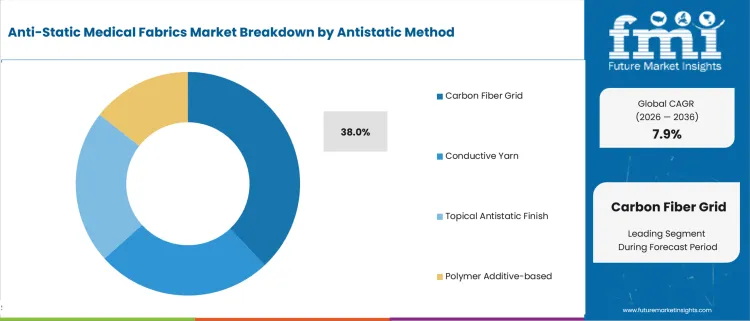
Carbon fiber grid construction earns its position by delivering durable static dissipation without relying on a surface coating that wears off after repeated laundering, a failure mode that shortens the usable life of coating-based alternatives. Fabric mills and converters serving reusable-textile hospital programs are the primary adopters, and the deciding factor is whether the grid's conductive performance holds steady through hundreds of wash-and-sterilize cycles.
- Carbon fiber grid contributes 38% of Antistatic Method share in 2026 at USD 471.4 million, growing from USD 436.9 million in 2025 to USD 1,008.4 million by 2036, reflecting its durability advantage over coating-based methods in reusable-fabric applications.
- Specification stability across production runs is what buyers verify before committing to volume orders, since inconsistent conductive-fiber density between batches creates uneven static performance across a single order. Mills documenting tight production tolerances convert trial orders into standing supply contracts.
How should buyers read Surgical Gowns demand within By Application?
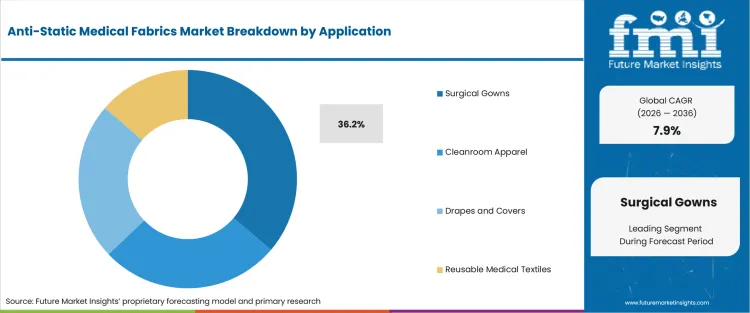
Surgical gowns carry the highest static-control stakes of any application in this category, since static discharge in an operating environment risks igniting flammable anesthetic agents or disrupting sensitive monitoring equipment nearby. Hospital sterile-processing departments and gown converters are the primary buyers, and the deciding factor is whether the finished gown's antistatic performance matches the facility's infection-control and safety protocol without added handling complexity.
- Surgical gowns account for 36.2% share of Application in 2026, rising from USD 416.2 million in 2025 to USD 449.1 million in 2026 and reaching USD 960.6 million by 2036, reflecting the application's direct link to operating-room safety protocols relative to lower-risk uses.
- Compliance documentation shapes repeat orders, since hospitals renewing gown contracts want verified antistatic test results on file rather than a manufacturer's unverified claim. Suppliers providing that documentation move from single-order trials into standing supply agreements.
Why is Woven Antistatic Fabrics still important in By Fabric Type?
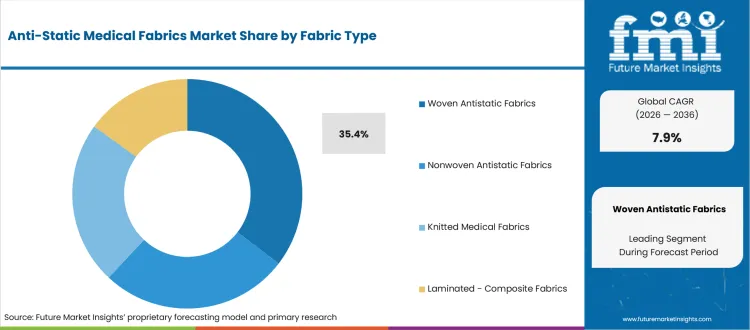
Woven construction holds its position because it delivers the tensile strength and dimensional stability hospital laundering programs need for a fabric expected to survive dozens of reuse cycles, an endurance level non-woven disposables aren't built for. Reusable-textile programs and gown converters are the primary users, and the deciding factor is whether the weave holds its antistatic fiber structure intact through repeated industrial washing.
- Woven antistatic fabrics stand at 35.4% share of Fabric Type in 2026, equal to USD 439.2 million, moving from USD 407.0 million in 2025 to USD 939.4 million by 2036, reflecting the format's durability edge for facilities running reusable-textile programs rather than single-use disposables.
- Buyer risk narrows to wash-cycle durability, since a woven fabric that loses conductive-fiber integrity after fewer washes than promised forces earlier-than-budgeted replacement. Mills demonstrating verified cycle-count performance retain hospital laundering contracts through renewal.
What factors shape the Anti-Static Medical Fabrics Market?
Anti-static medical fabrics market purchases are being shaped by uptime risk, compliance pressure, lifecycle cost; and integration burden.
- Driver: buyer risk, operating cost, and supplier accountability. Demand strengthens when buyers can connect the purchase to a measurable operating, formulation, compliance; or cost outcome in Anti-Static Medical Fabrics Market.
- Restraint: proof burden and implementation risk. Adoption slows when Anti-Static Medical Fabrics Market buyers cannot validate buyer risk, operating cost, and supplier accountability under their own operating conditions.
- Opportunity: supplier programs built around buyer risk, operating cost, and supplier accountability. The better opening is with vendors that make approval easier through field support, clear proof, and repeatable execution.
Anti-Static Medical Fabrics Market demand is strongest where the product reduces an operating risk that buyers can measure. Engineering and procurement teams need proof that the system improves uptime, compliance, inspection; data accuracy; or service cost before it becomes a standard purchase.
The Anti-Static Medical Fabrics Market buying process puts more weight on who owns support after approval. Evidence quality and distributor responsibility shape wider adoption.
Anti-Static Medical Fabrics Market procurement can stall when support continuity is not clear. Suppliers that protect buyer risk, operating cost, and supplier accountability after approval have a stronger route to repeat demand.
Which country CAGRs are profiled in the Anti-Static Medical Fabrics Market?
| Country | CAGR |
|---|---|
| United States | 6.73% |
| China | 9.13% |
| India | 10.13% |
| Germany | 6.13% |
| United Kingdom | 6.53% |
| Japan | 5.93% |
| South Korea | 7.33% |
| Rest of World | 8.53% |
How do country-level CAGRs compare in the Anti-Static Medical Fabrics Market?
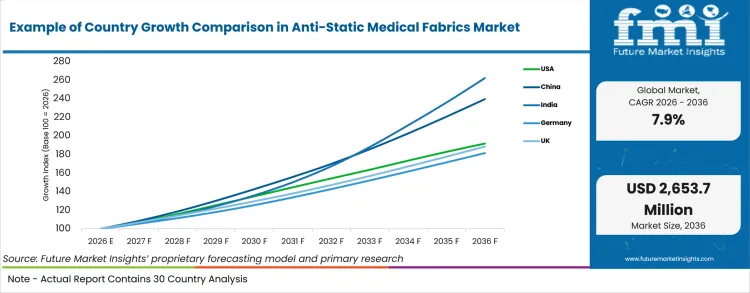
The growth spread extends across 4.2 percentage points, creating four recognizable performance bands in the anti-static medical fabrics market. India and China occupy the upper end with just a 1.0-point gap. Rest of World and South Korea establish the next cluster, separated by 1.2 percentage points. The United States and the United Kingdom remain almost identical, while Germany and Japan complete the comparison with the narrowest difference of only 0.2 percentage points. Variations across these markets reflect differences in medical textile production, healthcare manufacturing standards and adoption of electrostatic-safe clinical materials.
- At 10.13%, India ranks first in the comparison. Expansion of domestic medical textile manufacturing, broader hospital capacity additions and increasing production of protective healthcare garments are encouraging wider use of anti-static fabrics in clinical and cleanroom environments.
- China follows at 9.13%, only 1.0 percentage point below India. Its position reflects the country's large healthcare supply chain, extensive medical apparel production and continued emphasis on functional textile materials for medical applications.
- Rest of World reaches a CAGR of 8.53%, placing it 0.6 percentage points behind China. The combined outlook represents gradual adoption of higher-performance healthcare textiles across developing healthcare systems where investment in modern medical supplies continues to increase.
- A CAGR of 7.33% places South Korea 1.2 percentage points below Rest of World. Strong capabilities in technical textiles and advanced healthcare manufacturing contribute to demand for fabrics designed to minimize electrostatic discharge in sensitive medical settings.
- The United States records 6.73%, trailing South Korea by 0.6 percentage points. Healthcare providers and medical apparel manufacturers continue incorporating anti-static fabrics into protective clothing and specialized healthcare products where material performance and user safety remain important considerations.
- Only 0.2 percentage points separate the United Kingdom from the United States, with the market reaching 6.53%. Interest in durable, reusable medical textiles and compliance with healthcare quality standards continues to support demand for anti-static fabric solutions.
- Germany posts 6.13%, while Japan follows closely at 5.93%, leaving just a 0.2-point difference between the two markets. Germany benefits from its established technical textile sector, whereas Japan's demand is linked to advanced healthcare manufacturing and the use of functional fabrics in medical and cleanroom applications.
Similar CAGRs do not necessarily translate into identical commercial opportunities. Healthcare regulations, manufacturing capabilities, product qualification requirements and clinical textile specifications all shape supplier positioning and adoption patterns. The full report provides country-level CAGR analysis across North America, Latin America, Europe, East Asia, South Asia, Oceania and the Middle East and Africa.
Country-wise Analysis
Anti-Static Medical Fabrics Market country growth differs by infrastructure maturity, regulatory pressure, installed-base age; and service capability. Mature markets place more weight on specification control and lifecycle cost. Faster-growth markets still need local partners and reliable implementation support.
- United States rises from USD 264.4 million in 2025 to USD 285.3 million in 2026. By 2036, it is projected at USD 547.2 million at a 6.73% CAGR. United States buyers treat Anti-Static Medical Fabrics Market as a buyer risk, operating cost, and supplier accountability decision. Approval usually needs measurable operating proof before volume moves from existing suppliers.
- For Anti-Static Medical Fabrics Market, China moves from USD 207.0 million in 2025 to USD 223.3 million in 2026. The 2036 value is USD 534.9 million, supported by an 9.13% CAGR. China's buying condition is scale plus execution discipline in Anti-Static Medical Fabrics Market. Suppliers need availability, channel control, and proof that buyer risk; operating cost; and supplier accountability can hold across fast-ramping accounts.
- For Anti-Static Medical Fabrics Market, India is estimated at USD 91.98 million in 2025 and USD 99.25 million in 2026. It is projected at USD 260.5 million by 2036, with a 10.13% CAGR. India demand is tied to formal procurement and wider production activity in Anti-Static Medical Fabrics Market. Cost remains a hard filter, so suppliers need a price case that still supports buyer risk, operating cost; and supplier accountability.
- By 2036, the industry value in Germany is projected at USD 179.9 million at a 6.13% CAGR. Germany is qualification-led for Anti-Static Medical Fabrics Market. Technical review focuses on whether buyer risk, operating cost, and supplier accountability can be proven before commercial negotiation.
- United Kingdom rises from USD 57.49 million in 2025 to USD 62.03 million in 2026. By 2036, it is projected at USD 116.7 million at a 6.53% CAGR. United Kingdom buyers in Anti-Static Medical Fabrics Market place more weight on vendor accountability and delivery reliability. Switching costs rise when buyer risk, operating cost, and supplier accountability is not supported after purchase.
- Japan moves from USD 80.48 million in 2025 to USD 86.84 million in 2026. The 2036 value is USD 154.5 million, supported by an 5.93% CAGR. Japan's approval cycle for Anti-Static Medical Fabrics Market favors suppliers that reduce inspection work and keep buyer risk, operating cost, and supplier accountability consistent across repeat orders.
- South Korea is estimated at USD 45.99 million in 2025 and USD 49.62 million in 2026. It is projected at USD 100.7 million by 2036, with a 7.33% CAGR. South Korea's compact supply chains make Anti-Static Medical Fabrics Market feedback fast. Suppliers need responsive support because weak execution on buyer risk, operating cost, and supplier accountability can affect production schedules.
- Rest of World stands at USD 310.4 million in 2025 and USD 335.0 million in 2026. By 2036, the value is projected at USD 759.3 million at a 8.53% CAGR. Rest of World demand for Anti-Static Medical Fabrics Market is uneven. Local service access and import reliability matter where buyers need help proving buyer risk, operating cost, and supplier accountability without mature support networks.
Who are the notable companies in the Anti-Static Medical Fabrics Market?
Freudenberg Performance Materials; Berry Global; Ahlstrom; PFNonwovens; Kimberly-Clark Professional; Cardinal Health; Medline Industries; DuPont; Suominen and Owens & Minor P&HS are the notable companies assessed in this market.
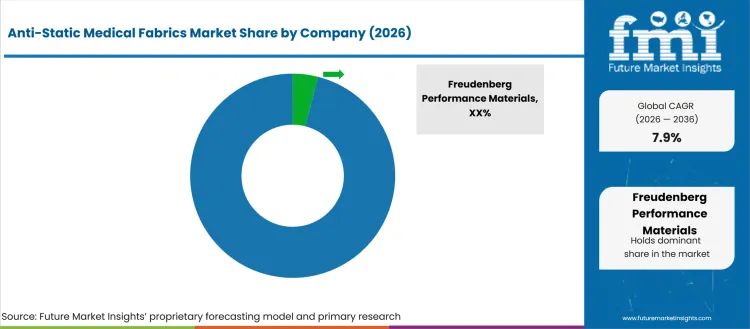
Anti-Static Medical Fabrics Market competition is strongest where suppliers can connect technical performance with operating accountability. Buyers compare who can reduce downtime, compliance exposure, inspection burden; or integration risk after purchase.
- Medical nonwoven suppliers such as Freudenberg Performance Materials, Berry Global, Ahlstrom and PFNonwovens matter when buyers compare supplier fit against the approval burden. Their value depends on evidence quality and service response after selection.
- Healthcare product suppliers such as Kimberly-Clark Professional, Cardinal Health and Medline Industries are useful where procurement needs a supplier role that is clear before volume expands. Buyers check whether the group can support the use case after approval.
- Technical fabric suppliers such as DuPont, Suominen and Owens & Minor P&HS matter where the buyer needs deeper application guidance or specification fit. Their advantage is narrower expertise that can shorten review after a trial.
Competitive Benchmarking: Anti-Static Medical Fabrics Market
| Company | Material Fit | Compliance Support | Supply Reliability | Geographic Footprint |
|---|---|---|---|---|
| Freudenberg Performance Materials | High | High | Strong | Global |
| Berry Global | High | Medium | Strong | Global |
| Ahlstrom | Strong | High | Medium | Global or regional |
| PFNonwovens | Medium | High | Medium | Regional |
| Kimberly-Clark Professional | Strong | Medium | Medium | Regional or global |
| Cardinal Health | High | High | Strong | Global |
| Medline Industries | High | Medium | Strong | Global |
| DuPont | Strong | High | Medium | Global or regional |
| Suominen | Medium | High | Medium | Regional |
| Owens & Minor P&HS | Strong | Medium | Medium | Regional or global |
Source: Future Market Insights competitive analysis, 2026. Ratings for Anti-Static Medical Fabrics Market reflect specification fit, implementation support, lifecycle service capability; channel reach; and relevance to operating-risk reduction.
Key Players in the Anti-Static Medical Fabrics Market
Medical nonwoven suppliers
- Freudenberg Performance Materials
- Berry Global
- Ahlstrom
- PFNonwovens
Healthcare product suppliers
- Kimberly-Clark Professional
- Cardinal Health
- Medline Industries
Technical fabric suppliers
- DuPont
- Suominen
- Owens & Minor P&HS
Anti-Static Medical Fabrics Market - Report Scope
| Coverage field | Report scope |
|---|---|
| Market breakdown | Anti-Static Medical Fabrics Market Breakdown By By Fabric Type, By Antistatic Method and By Application; End Use and By Sales Channel |
| Market Definition | Commercial demand for products; services covered under Anti-Static Medical Fabrics Market; including country demand; segment demand; and supplier-selection context |
| Regions Covered | North America; Latin America; Europe; East Asia; South Asia and Pacific; Middle East and Africa |
| Countries Covered | United States; United Kingdom; Germany; France; Japan; China; South Korea; India; and 30+ countries |
| Key Companies Profiled | Freudenberg Performance Materials; Berry Global; Ahlstrom; PFNonwovens; Kimberly-Clark Professional; Cardinal Health; Medline Industries; DuPont; Suominen; and Owens & Minor P&HS |
| Forecast Period | 2026 to 2036 |
| Approach | Anti-Static Medical Fabrics Market: Installed-base demand, project and replacement cycles, country infrastructure context; segment shares; and supplier relevance were used to build the sizing approach. |
Anti-Static Medical Fabrics Market - Research Methodology
| Method | Approach |
|---|---|
| Primary Research | FMI analysts gathered input from manufacturers, service providers, technology developers, distributors, end users, procurement teams, and subject-matter experts. Interviews examined purchasing decisions, product or service evaluation, adoption barriers, approval requirements, pricing considerations, and expectations for technical or commercial support. Respondents were also asked what evidence is required before a trial, pilot, or initial order develops into regular purchasing. |
| Desk Research | Desk research covered government statistics, regulatory publications, trade data, industry associations, technical literature, standards, company filings, product information, and official corporate announcements. Sources were reviewed for relevance, publication date, geographic coverage, and consistency with the defined market scope. Claims relating to performance, applications, approvals, capacity, investment, and commercial activity were retained only when supported by credible public evidence. |
| Market Sizing and Forecasting | The market model combined the baseline value with historical performance, segment structure, pricing and volume indicators, adoption levels, company participation, and country-level demand conditions. Forecast assumptions considered economic activity, investment trends, regulatory developments, technology adoption, purchasing cycles, supply availability, and barriers to wider market use. Segment and regional estimates were reconciled before the final market total was calculated. |
| Data Validation | Estimates were checked against multiple independent indicators, including public data, company activity, trade patterns, industry developments, and findings from primary interviews. Validation also tested whether products, services, applications, and company revenues fell within the defined market boundaries. Adjacent categories, unsupported claims, overlapping revenues, and activities without direct market relevance were excluded to reduce double counting and maintain consistency across segments and countries. |
Anti-Static Medical Fabrics Market by Segments
Anti-Static Medical Fabrics Market segmented by Fabric Type:
- Woven Antistatic Fabrics
- Nonwoven Antistatic Fabrics
- Knitted Medical Fabrics
- Laminated / Composite Fabrics
Anti-Static Medical Fabrics Market segmented by Antistatic Method:
- Carbon Fiber Grid
- Conductive Yarn
- Topical Antistatic Finish
- Polymer Additive-based
Anti-Static Medical Fabrics Market segmented by Application:
- Surgical Gowns
- Cleanroom Apparel
- Drapes and Covers
- Reusable Medical Textiles
Anti-Static Medical Fabrics Market segmented by End Use:
- Hospitals
- Pharma / Biotech Cleanrooms
- Device Manufacturing
- Emergency / Infection Control
Anti-Static Medical Fabrics Market segmented by Sales Channel:
- Direct to Converters
- Medical Textile Distributors
- Institutional Contracts
Research Sources and Bibliography
Secondary validation for Anti-Static Medical Fabrics Market uses healthcare safety, occupational exposure, textile compliance and trade sources together. FDA, CDC/NIOSH, OSHA and WHO references define why static control and medical textile performance matter. Trade data tests sourcing exposure.
- 1. FDA Medical Devices. https://www.fda.gov/medical-devices. Medical-device and healthcare product oversight used to frame compliance boundaries.
- 2. CDC NIOSH Personal Protective Equipment. https://www.cdc.gov/niosh/npptl/. Worker and protective-equipment context used to ground hospital and safety use cases.
- 3. OSHA Healthcare. https://www.osha.gov/healthcare. Workplace safety context used to test procurement and compliance pressure.
- 4. WHO Infection Prevention and Control. https://www.who.int/teams/integrated-health-services/infection-prevention-control. Healthcare safety context used to avoid overclaiming hospital demand.
- 5. ECHA. https://echa.europa.eu/. Chemical and material safety context used for textile and antistatic treatment scrutiny.
- 6. UN Comtrade. https://comtradeplus.un.org/. Trade flows used to test textile and medical-fabric sourcing exposure.
- 7. Freudenberg Performance Materials. https://www.freudenberg-pm.com/. Official company and product portfolio information used for competitive context.
- 8. Berry Global. https://www.berryglobal.com/. Official company and product portfolio information used for competitive context.
- 9. Ahlstrom. https://www.ahlstrom.com/. Official company and product portfolio information used for competitive context.
- 10. PFNonwovens. https://www.pfnonwovens.com/. Official company and product portfolio information used for competitive context.
- 11. Kimberly-Clark Professional. https://www.kcprofessional.com/. Official company and product portfolio information used for competitive context.
- 12. Cardinal Health. https://www.cardinalhealth.com/. Official company and product portfolio information used for competitive context.
- 13. Medline Industries. https://www.medline.com/. Official company and product portfolio information used for competitive context.
This Report Answers
- What value is forecast for the Anti-Static Medical Fabrics Market in 2026 and by 2036?
- What CAGR is forecast for the Anti-Static Medical Fabrics Market during the 2026 to 2036 period?
- Which segment groups are used to assess demand across Anti-Static Medical Fabrics Market?
- Which buyer problems are creating procurement interest in Anti-Static Medical Fabrics Market?
- How do the main segment shares shape Anti-Static Medical Fabrics Market decisions in the 2026 base?
- Which countries are profiled in the Anti-Static Medical Fabrics Market forecast and how do their CAGRs differ?
- Which companies are assessed in this market?
- What should Anti-Static Medical Fabrics Market buyers evaluate before changing suppliers?
- How does FMI size and validate Anti-Static Medical Fabrics Market country and segment demand?
- What risks could delay Anti-Static Medical Fabrics Market adoption, qualification, or repeat purchasing?
Frequently Asked Questions
Why should executives track the Anti-Static Medical Fabrics Market?
Executives should track Anti-Static Medical Fabrics Market because buyer risk, operating cost, and supplier accountability affects procurement risk and operating performance. The value is in knowing where the purchase can reduce cost, avoid disruption, or improve buyer confidence.
What business problem does the Anti-Static Medical Fabrics Market address?
The market addresses product safety, documentation, static-control performance; and clinical supply reliability. Buyers use the category when routine procurement is no longer enough to manage performance and documentation. Service and continuity expectations also shape the decision.
What should Anti-Static Medical Fabrics Market procurement leaders evaluate before selecting suppliers?
Anti-Static Medical Fabrics Market procurement leaders should test specification fit, installation burden, service coverage; lifecycle cost; and integration risk. A lower unit price is weak if downtime, commissioning, or maintenance cost rises after purchase.
What can limit return on investment for buyers?
Anti-Static Medical Fabrics Market payback depends on whether the product lowers downtime, inspection effort, compliance exposure; rework; or lifecycle cost. Buyers reduce risk by setting acceptance tests and service responsibilities before rollout.
How can suppliers build executive confidence?
Anti-Static Medical Fabrics Market suppliers build confidence when they can support specification review, installation, commissioning; and service response after approval. Buyers value partners that keep the system usable in the field.
Preview the report firsthand - request a free sample
Get SampleGet the brochure for pricing and purchase details.
Get PDFTable of Content
- Key Takeaways
- Market Size and CAGR
- Top Growth Driver
- Fastest Growing Segment
- Leading Region
- Key Companies
- Emerging Opportunities
- Executive Summary
- Global Market Outlook
- Demand-side Trends
- Supply-side Trends
- Technology Roadmap Analysis
- Analysis and Recommendations
- Analyst Perspective (What is happening? Why now? What should investors know?)
- Key Questions Answered
- How large is the market?
- What is the CAGR?
- What are key trends?
- Which region dominates?
- Who are the leaders?
- Market Overview
- Market Coverage / Taxonomy
- Market Definition / Scope / Limitations
- Research Methodology
- Chapter Orientation
- Analytical Lens and Working Hypotheses
- Market Structure, Signals, and Trend Drivers
- Benchmarking and Cross-market Comparability
- Market Sizing, Forecasting, and Opportunity Mapping
- Research Design and Evidence Framework
- Desk Research Programme (Secondary Evidence)
- Expert Input and Fieldwork (Primary Evidence)
- Tooling, Models, and Reference Databases
- Data Engineering and Model Build
- Quality Assurance and Audit Trail
- Market Background
- Market Dynamics (Drivers, Restraints, Opportunity, Trends)
- Scenario Forecast (Optimistic, Likely, Conservative)
- Impact Analysis
- AI Impact
- Sustainability Impact
- Regulatory Impact
- Technology Impact
- Consumer / Buyer Analysis
- Purchase Drivers
- Adoption Barriers
- Buyer Journey
- Opportunity Map Analysis
- Product Life Cycle Analysis
- Supply Chain Analysis
- Investment Feasibility Matrix
- Value Chain Analysis
- PESTLE and Porter's Analysis
- Regulatory Landscape
- Regional Parent Market Outlook
- Production and Consumption Statistics
- Import and Export Statistics
- Global Market Analysis and Forecast, 2021 to 2036
- Historical Market Size Value (USD Million) Analysis, 2021 to 2025
- Current and Future Market Size Value (USD Million) Projections, 2026 to 2036
- Y-o-Y Growth Trend Analysis
- Absolute $ Opportunity Analysis
- Global Market Pricing Analysis, 2021 to 2036
- Global Market Analysis and Forecast, By Fabric Type, 2021 to 2036
- Introduction / Key Findings
- Historical Market Size Value (USD Million) Analysis By Fabric Type, 2021 to 2025
- Current and Future Market Size Value (USD Million) Analysis and Forecast By Fabric Type, 2026 to 2036
- Woven Antistatic Fabrics
- Nonwoven Antistatic Fabrics
- Knitted Medical Fabrics
- Laminated - Composite Fabrics
- Woven Antistatic Fabrics
- Y-o-Y Growth Trend Analysis By Fabric Type, 2021 to 2025
- Absolute $ Opportunity Analysis By Fabric Type, 2026 to 2036
- Global Market Analysis and Forecast, By Antistatic Method, 2021 to 2036
- Introduction / Key Findings
- Historical Market Size Value (USD Million) Analysis By Antistatic Method, 2021 to 2025
- Current and Future Market Size Value (USD Million) Analysis and Forecast By Antistatic Method, 2026 to 2036
- Carbon Fiber Grid
- Conductive Yarn
- Topical Antistatic Finish
- Polymer Additive-based
- Carbon Fiber Grid
- Y-o-Y Growth Trend Analysis By Antistatic Method, 2021 to 2025
- Absolute $ Opportunity Analysis By Antistatic Method, 2026 to 2036
- Global Market Analysis and Forecast, By Application, 2021 to 2036
- Introduction / Key Findings
- Historical Market Size Value (USD Million) Analysis By Application, 2021 to 2025
- Current and Future Market Size Value (USD Million) Analysis and Forecast By Application, 2026 to 2036
- Surgical Gowns
- Cleanroom Apparel
- Drapes and Covers
- Reusable Medical Textiles
- Surgical Gowns
- Y-o-Y Growth Trend Analysis By Application, 2021 to 2025
- Absolute $ Opportunity Analysis By Application, 2026 to 2036
- Global Market Analysis and Forecast, By End Use, 2021 to 2036
- Introduction / Key Findings
- Historical Market Size Value (USD Million) Analysis By End Use, 2021 to 2025
- Current and Future Market Size Value (USD Million) Analysis and Forecast By End Use, 2026 to 2036
- Hospitals
- Pharma - Biotech Cleanrooms
- Device Manufacturing
- Emergency - Infection Control
- Hospitals
- Y-o-Y Growth Trend Analysis By End Use, 2021 to 2025
- Absolute $ Opportunity Analysis By End Use, 2026 to 2036
- Global Market Analysis and Forecast, By Sales Channel, 2021 to 2036
- Introduction / Key Findings
- Historical Market Size Value (USD Million) Analysis By Sales Channel, 2021 to 2025
- Current and Future Market Size Value (USD Million) Analysis and Forecast By Sales Channel, 2026 to 2036
- Direct to Converters
- Medical Textile Distributors
- Institutional Contracts
- Direct to Converters
- Y-o-Y Growth Trend Analysis By Sales Channel, 2021 to 2025
- Absolute $ Opportunity Analysis By Sales Channel, 2026 to 2036
- Global Market Analysis and Forecast, By Region, 2021 to 2036
- Introduction
- Historical Market Size Value (USD Million) Analysis By Region, 2021 to 2025
- Current Market Size Value (USD Million) Analysis and Forecast By Region, 2026 to 2036
- North America
- Latin America
- Western Europe
- Eastern Europe
- East Asia
- South Asia and Pacific
- Middle East & Africa
- Market Attractiveness Analysis By Region
- North America Market Analysis and Forecast, By Country, 2021 to 2036
- Historical Market Size Value (USD Million) Trend Analysis By Market Taxonomy, 2021 to 2025
- Market Size Value (USD Million) Forecast By Market Taxonomy, 2026 to 2036
- By Country
- USA
- Canada
- By Fabric Type
- By Antistatic Method
- By Application
- By End Use
- By Sales Channel
- By Country
- Market Attractiveness Analysis
- By Country
- By Fabric Type
- By Antistatic Method
- By Application
- By End Use
- By Sales Channel
- Key Takeaways
- Latin America Market Analysis and Forecast, By Country
- Historical Market Size Value (USD Million) Trend Analysis By Market Taxonomy, 2021 to 2025
- Market Size Value (USD Million) Forecast By Market Taxonomy, 2026 to 2036
- By Country
- Brazil
- Mexico
- Chile
- Rest of Latin America
- By Fabric Type
- By Antistatic Method
- By Application
- By End Use
- By Sales Channel
- By Country
- Market Attractiveness Analysis
- By Country
- By Fabric Type
- By Antistatic Method
- By Application
- By End Use
- By Sales Channel
- Key Takeaways
- Western Europe Market Analysis and Forecast, By Country
- Historical Market Size Value (USD Million) Trend Analysis By Market Taxonomy, 2021 to 2025
- Market Size Value (USD Million) Forecast By Market Taxonomy, 2026 to 2036
- By Country
- Germany
- UK
- Italy
- Spain
- France
- Nordic
- BENELUX
- Rest of Western Europe
- By Fabric Type
- By Antistatic Method
- By Application
- By End Use
- By Sales Channel
- By Country
- Market Attractiveness Analysis
- By Country
- By Fabric Type
- By Antistatic Method
- By Application
- By End Use
- By Sales Channel
- Key Takeaways
- Eastern Europe Market Analysis and Forecast, By Country
- Historical Market Size Value (USD Million) Trend Analysis By Market Taxonomy, 2021 to 2025
- Market Size Value (USD Million) Forecast By Market Taxonomy, 2026 to 2036
- By Country
- Russia
- Poland
- Hungary
- Balkan & Baltic
- Rest of Eastern Europe
- By Fabric Type
- By Antistatic Method
- By Application
- By End Use
- By Sales Channel
- By Country
- Market Attractiveness Analysis
- By Country
- By Fabric Type
- By Antistatic Method
- By Application
- By End Use
- By Sales Channel
- Key Takeaways
- East Asia Market Analysis and Forecast, By Country
- Historical Market Size Value (USD Million) Trend Analysis By Market Taxonomy, 2021 to 2025
- Market Size Value (USD Million) Forecast By Market Taxonomy, 2026 to 2036
- By Country
- China
- Japan
- South Korea
- By Fabric Type
- By Antistatic Method
- By Application
- By End Use
- By Sales Channel
- By Country
- Market Attractiveness Analysis
- By Country
- By Fabric Type
- By Antistatic Method
- By Application
- By End Use
- By Sales Channel
- Key Takeaways
- South Asia and Pacific Market Analysis and Forecast, By Country
- Historical Market Size Value (USD Million) Trend Analysis By Market Taxonomy, 2021 to 2025
- Market Size Value (USD Million) Forecast By Market Taxonomy, 2026 to 2036
- By Country
- India
- ASEAN
- Australia & New Zealand
- Rest of South Asia and Pacific
- By Fabric Type
- By Antistatic Method
- By Application
- By End Use
- By Sales Channel
- By Country
- Market Attractiveness Analysis
- By Country
- By Fabric Type
- By Antistatic Method
- By Application
- By End Use
- By Sales Channel
- Key Takeaways
- Middle East & Africa Market Analysis and Forecast, By Country
- Historical Market Size Value (USD Million) Trend Analysis By Market Taxonomy, 2021 to 2025
- Market Size Value (USD Million) Forecast By Market Taxonomy, 2026 to 2036
- By Country
- Kingdom of Saudi Arabia
- Other GCC Countries
- Türkiye
- South Africa
- Other African Union
- Rest of Middle East & Africa
- By Fabric Type
- By Antistatic Method
- By Application
- By End Use
- By Sales Channel
- By Country
- Market Attractiveness Analysis
- By Country
- By Fabric Type
- By Antistatic Method
- By Application
- By End Use
- By Sales Channel
- Key Takeaways
- Key Countries Market Analysis
- USA
- Pricing Analysis
- Market Share Analysis, 2025
- By Fabric Type
- By Antistatic Method
- By Application
- By End Use
- By Sales Channel
- Canada
- Pricing Analysis
- Market Share Analysis, 2025
- By Fabric Type
- By Antistatic Method
- By Application
- By End Use
- By Sales Channel
- Mexico
- Pricing Analysis
- Market Share Analysis, 2025
- By Fabric Type
- By Antistatic Method
- By Application
- By End Use
- By Sales Channel
- Brazil
- Pricing Analysis
- Market Share Analysis, 2025
- By Fabric Type
- By Antistatic Method
- By Application
- By End Use
- By Sales Channel
- Chile
- Pricing Analysis
- Market Share Analysis, 2025
- By Fabric Type
- By Antistatic Method
- By Application
- By End Use
- By Sales Channel
- Germany
- Pricing Analysis
- Market Share Analysis, 2025
- By Fabric Type
- By Antistatic Method
- By Application
- By End Use
- By Sales Channel
- UK
- Pricing Analysis
- Market Share Analysis, 2025
- By Fabric Type
- By Antistatic Method
- By Application
- By End Use
- By Sales Channel
- Italy
- Pricing Analysis
- Market Share Analysis, 2025
- By Fabric Type
- By Antistatic Method
- By Application
- By End Use
- By Sales Channel
- Spain
- Pricing Analysis
- Market Share Analysis, 2025
- By Fabric Type
- By Antistatic Method
- By Application
- By End Use
- By Sales Channel
- France
- Pricing Analysis
- Market Share Analysis, 2025
- By Fabric Type
- By Antistatic Method
- By Application
- By End Use
- By Sales Channel
- India
- Pricing Analysis
- Market Share Analysis, 2025
- By Fabric Type
- By Antistatic Method
- By Application
- By End Use
- By Sales Channel
- ASEAN
- Pricing Analysis
- Market Share Analysis, 2025
- By Fabric Type
- By Antistatic Method
- By Application
- By End Use
- By Sales Channel
- Australia & New Zealand
- Pricing Analysis
- Market Share Analysis, 2025
- By Fabric Type
- By Antistatic Method
- By Application
- By End Use
- By Sales Channel
- China
- Pricing Analysis
- Market Share Analysis, 2025
- By Fabric Type
- By Antistatic Method
- By Application
- By End Use
- By Sales Channel
- Japan
- Pricing Analysis
- Market Share Analysis, 2025
- By Fabric Type
- By Antistatic Method
- By Application
- By End Use
- By Sales Channel
- South Korea
- Pricing Analysis
- Market Share Analysis, 2025
- By Fabric Type
- By Antistatic Method
- By Application
- By End Use
- By Sales Channel
- Russia
- Pricing Analysis
- Market Share Analysis, 2025
- By Fabric Type
- By Antistatic Method
- By Application
- By End Use
- By Sales Channel
- Poland
- Pricing Analysis
- Market Share Analysis, 2025
- By Fabric Type
- By Antistatic Method
- By Application
- By End Use
- By Sales Channel
- Hungary
- Pricing Analysis
- Market Share Analysis, 2025
- By Fabric Type
- By Antistatic Method
- By Application
- By End Use
- By Sales Channel
- Kingdom of Saudi Arabia
- Pricing Analysis
- Market Share Analysis, 2025
- By Fabric Type
- By Antistatic Method
- By Application
- By End Use
- By Sales Channel
- Türkiye
- Pricing Analysis
- Market Share Analysis, 2025
- By Fabric Type
- By Antistatic Method
- By Application
- By End Use
- By Sales Channel
- South Africa
- Pricing Analysis
- Market Share Analysis, 2025
- By Fabric Type
- By Antistatic Method
- By Application
- By End Use
- By Sales Channel
- USA
- Market Structure Analysis
- Competition Dashboard
- Competition Benchmarking
- Market Share Analysis of Top Players
- By Regional
- By Fabric Type
- By Antistatic Method
- By Application
- By End Use
- By Sales Channel
- Emerging Startups
- Innovation Benchmarking
- Competition Analysis
- Competition Deep Dive
- Freudenberg Performance Materials
- Overview
- Product Portfolio
- Profitability by Market Segments
- Sales Footprint
- Strategy Overview
- Marketing Strategy
- Product Strategy
- Channel Strategy
- Berry Global
- Ahlstrom
- PFNonwovens
- Kimberly-Clark Professional
- Cardinal Health
- Medline Industries
- DuPont
- Suominen
- Owens & Minor P&HS
- Freudenberg Performance Materials
- Case Studies
- Success Stories
- Recent Developments
- Competition Deep Dive
- Assumptions & Acronyms Used


