

- Market Size (2026)
- USD 3.2 Bn
- Forecast (2036)
- USD 7.5 Bn
- CAGR (2026 to 2036)
- 8.8%
How big is the Automated Probe Cards Market in 2026?
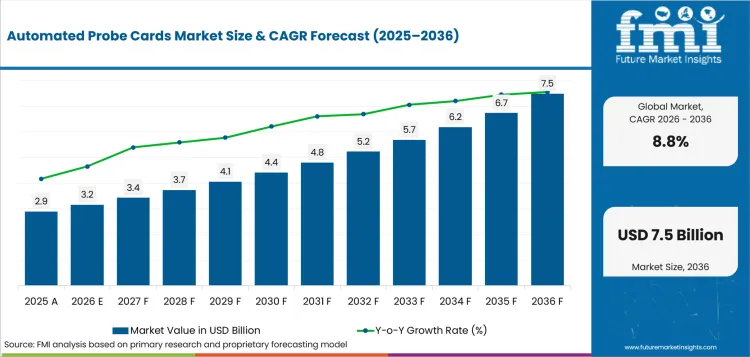
USD 3.2 billion in 2026 and USD 7.5 billion by 2036 at an 8.8% CAGR.
The automated probe card industry value is predicted to rise from USD 2.9 billion in 2025 to USD 7.5 billion by 2036 at 8.8% CAGR, guided by wafer-level test needs across memory and advanced packaging programs. Direct sales are expected to hold 84.0% share in 2026, supported by confidential layout work and direct engineering reviews. 300 mm wafers are projected to secure 67.0% share in 2026, influenced by high-volume memory and foundry production lines.
| Metric | Value |
|---|---|
| 2026 Market Size | USD 3.2 billion |
| 2036 Market Size | USD 7.5 billion |
| Forecast CAGR | 8.8% from 2026 to 2036 |
| Leading Sales Channel | Direct Sales |
| Direct Sales Share in 2026 | 84.0% |
| Leading Wafer Size | 300 mm |
| 300 mm Share in 2026 | 67.0% |
| Prominent Country in CAGR | South Korea |
| South Korea CAGR | 10.4% by 2036 |
Summary of the Automated Probe Cards Market
| Market Signal | Commercial Impact |
|---|---|
| Demand and Growth Drivers | Automated probe card demand is increasing with advanced memory testing and known-good-die screening requirements.
|
| Product and Segment View | Direct sales, 300 mm wafers, and MEMS probe cards dominate the market.
|
| Geography and Growth Outlook | South Korea and Japan are expected to remain key growth markets.
|
| Competitive Landscape | Competition is centered on advanced probe technologies and application-specific engineering support.
|
| Analyst Perspective | Automated probe cards have become a critical yield-control component in semiconductor manufacturing.
- Sudip Saha, Principal Consultant, Technology, Future Market Insights |
Semiconductor assembly and testing services intensity is rising as chip complexity and advanced packaging flows push more screening into wafer sort. Global semiconductor sales reached USD 791.7 billion in 2025, up 25.6% from 2024, while logic products totaled USD 301.9 billion and memory products reached USD 223.1 billion.
Semiconductor test equipment sales are projected to rise 48.1% to USD 11.2 billion in 2025, showing higher spending on electrical verification before packaging. United States CHIPS programs include USD 39 billion for incentives tied to facilities and equipment, creating a larger domestic manufacturing base needing probe card qualification and repair support.
Which factors support expansion in the Automated Probe Cards Market?
Finished probe card assemblies and service-led qualification programs support market value across semiconductor wafer sort.
- Market value rises as HBM and processor wafers need stable electrical contact across dense pads.
- 300 mm fab activity enlarges replacement demand as production lines need repeat probe card qualification across device families.
- Advanced packaging raises wafer sort value as buyers seek known-good-die screening before costly assembly steps.
- Direct engineering engagement supports supplier selection as layouts and current limits stay customer-specific.
Why is the Automated Probe Cards Market growing?
Wafer-level electrical screening is expanding as semiconductor devices require higher contact density before packaging.
Probe card buyers are spending more on dense contact architectures as memory and logic devices move into higher-value wafer sort. SEMI reported, semiconductor test equipment sales are projected to surge 48.1% to USD 11.2 billion in 2025, indicating stronger back-end verification spending tied to AI chips and advanced device architectures. Probe cards benefit from this test spending as fabs need stable interfaces between wafers and testers. Suppliers able to prove contact consistency and repair turnaround gain stronger positions in memory and processor qualification cycles.
How is the Automated Probe Cards Market segmented?
Automated probe cards market is segmented by probe type, application, wafer size, end use, and sales channel.
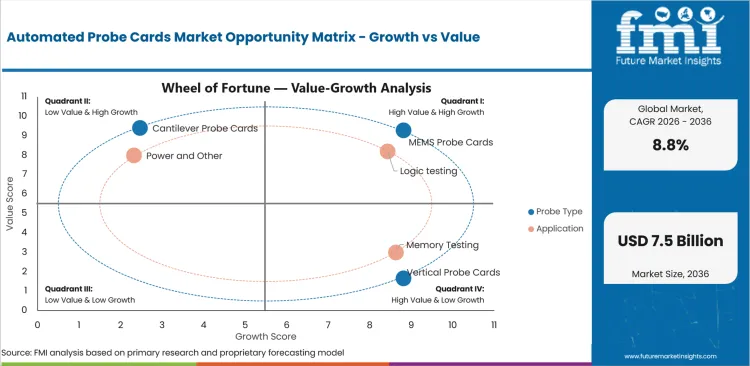
- MEMS probe cards are projected to account for 38.5% share in 2026, influenced by fine-pitch pad layouts and repeatable spring behavior in dense devices.
- Logic testing is expected to hold 36.0% share in 2026, shaped by processor and accelerator programs needing wider wafer-level electrical screening.
- 300 mm wafers are anticipated to account for 67.0% share in 2026, led by high-volume memory and foundry manufacturing.
- IDMs are projected to hold 30.0% share in 2026, guided by internal test roadmaps and recurring card qualification.
- Direct sales are expected to represent 84.0% share in 2026, supported by confidentiality needs and fab-level support.
Why do MEMS Probe Cards dominate the Automated Probe Cards Market by probe type?
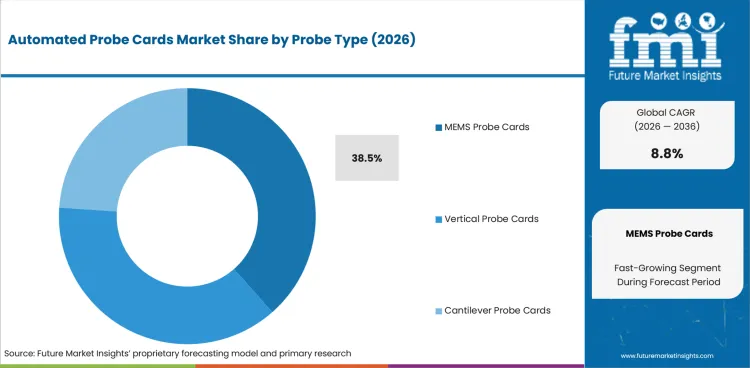
- MEMS probe cards are projected to account for 38.5% share in 2026, driven by long touchdown life and stable spring behavior.
- Vertical probe cards gain demand in high-current and high-parallelism test programs requiring reliable contact across tighter device layouts.
Which application leads the Automated Probe Cards Market?
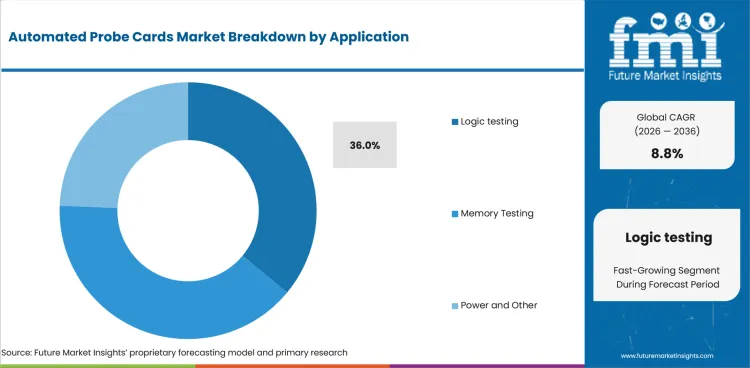
- Logic Testing is expected to hold 36.0% share in 2026, shaped by processors and wider wafer-level electrical screening before packaging.
- Memory Testing gains use as HBM and DRAM programs need dense, stable probe contact before stack-level assembly.
Which wafer size leads the Automated Probe Cards Market?
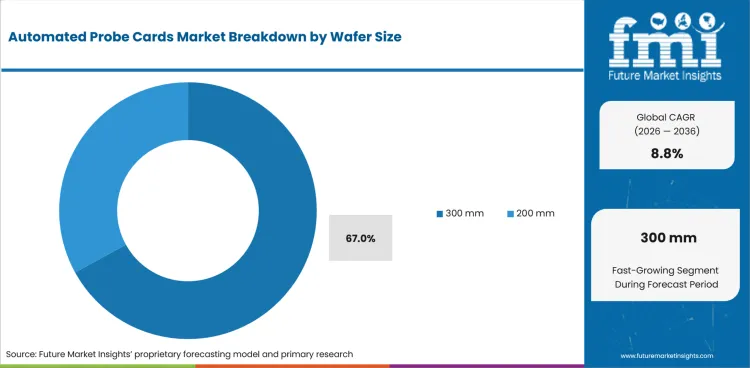
- 300 mm wafers are expected to hold 67.0% share in 2026, led by high-volume fabs standardizing around larger wafer formats.
- 200 mm wafers remain active in power and mature-node applications needing steady replacement demand.
Which end use leads the Automated Probe Cards Market?
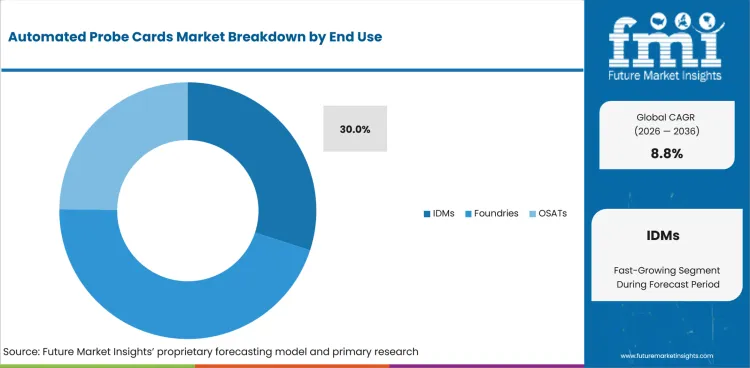
- IDMs are anticipated to account for 30.0% share in 2026, influenced by memory producers managing internal test roadmaps and recurring card replacement.
- Foundries create added demand as customer device diversity requires frequent probe card engineering changes.
Which sales channel leads the Automated Probe Cards Market?
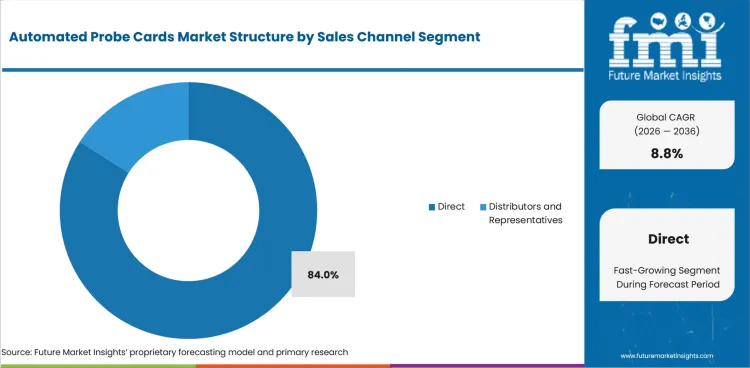
- Direct sales are expected to represent 84.0% share in 2026, guided by buyer preference for confidential layout work and direct engineering support.
- Distributors and representatives remain active in established card sales and laboratory orders with lower customization needs.
What are the drivers, restraints, and opportunities in the Automated Probe Cards Market?
Semiconductor wafer sort and service-linked qualification programs are shaping automated probe card buying decisions.
- Driver: HBM wafer sort intensity requires dense memory probe cards with stable contact behavior across many touchdowns.
- Restraint: Long qualification cycles can slow supplier switches as fabs protect yield data integrity and layout confidentiality.
- Opportunity: Advanced packaging and chiplet flows increase demand for probe cards supporting known-good-die screening before assembly.
HBM and AI Device Testing Strengthens Probe Card Demand
AI-linked memory and processor demand is raising wafer sort intensity before packaging. Semiconductor Industry Association data showed memory sales reached USD 223.1 billion in 2025, after rising 34.8% from 2024. HBM and DRAM programs need probe cards that can maintain contact resistance across dense pad arrays. Suppliers with MEMS depth and substrate capability gain stronger positions as retest reduction and uptime carry greater commercial value.
Qualification Burden Slows Supplier Switching
Probe cards require detailed customer approval before production use as contact behavior can affect yield interpretation. United States export control rules issued in December 2024 added controls on 24 types of semiconductor manufacturing equipment, 3 software tool types along with high-bandwidth memory, and 140 Entity List additions. Compliance checks can slow China-facing support and customer qualification work. Suppliers are required to maintain documentation and compliant support models to protect renewal decisions.
Advanced Packaging Creates Known-Good-Die Opportunity
Advanced packaging raises the value of wafer sort as failed die become more expensive after assembly. SEMI projected assembly and packaging equipment sales to rise 19.6% to USD 6.0 billion in 2025, with further expansion expected after that point. Probe card suppliers can benefit as chiplet and package-level flows increase demand for early screening. Engineering support around dense pads and signal integrity can turn probe cards into a higher-value production control tool.
Which countries are growing in the Automated Probe Cards Market?
South Korea 10.4% CAGR, Japan 9.6% CAGR, China 9.3% CAGR, United States 8.7% CAGR, India 8.1% CAGR, Germany 7.6% CAGR, France 7.2% CAGR, and United Kingdom 6.4% CAGR through 2036.
.webp "Top Country Growth Comparison Automated Probe Cards Market Cagr (2026 2036)")
| Country | CAGR |
|---|---|
| South Korea | 10.4% |
| Japan | 9.6% |
| China | 9.3% |
| United States | 8.7% |
| India | 8.1% |
| Germany | 7.6% |
| France | 7.2% |
| United Kingdom | 6.4% |
Source: Future Market Insights, 2026.
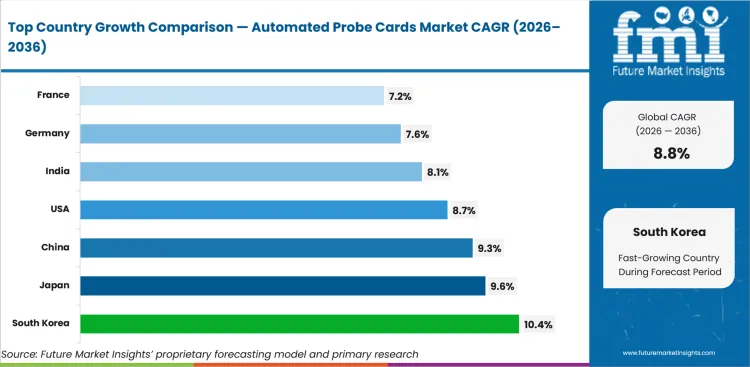
How do country-level CAGRs compare in the Automated Probe Cards Market?
South Korea leads country expansion while United Kingdom records the most cautious pace among profiled markets.
- South Korea is forecast to record 10.4% CAGR by 2036, driven by HBM and DRAM wafer sort intensity.
- Japan is expected to expand at 9.6% CAGR from 2026 to 2036, led by domestic probe card suppliers and semiconductor policy support.
- China is projected to grow at 9.3% CAGR through 2036, guided by domestic fab activity and localization pressure.
- United States is estimated to rise at 8.7% CAGR by 2036, reflected by CHIPS-backed manufacturing and high-value logic test programs.
- India is expected to advance at 8.1% CAGR over the forecast period as early fab and OSAT projects create future probe card needs.
- Germany is forecast to grow at 7.6% CAGR by 2036, backed by automotive and industrial semiconductor corridors.
- France is projected to post 7.2% CAGR by 2036, influenced by specialty electronics and European chip investment.
- United Kingdom is expected to record 6.4% CAGR by 2036, driven by compound semiconductor, photonics, and design-led programs.
How fast is the Automated Probe Cards Market growing in South Korea?
A 10.4% CAGR through 2036 reflects HBM and DRAM wafer sort intensity.
Country Market Snapshot Table
| Parameter | Value |
|---|---|
| Market Size in 2025 (Value) | USD 543.5 million |
| Market Size in 2026 (Value) | USD 600.0 million |
| Market Forecast in 2036 (Value) | USD 1,613.8 million |
| CAGR (2026 to 2036) | 10.4% |
| Years Considered | 2021 to 2036 |
| Base Year | 2025 |
| Forecast Period | 2026 to 2036 |
| Units Considered | Value (USD million) |
| Leading Sub-Region | Gyeonggi and Yongin memory manufacturing corridor |
South Korea Automated Probe Cards Market Outlook
- South Korea automated probe card industry draws momentum from HBM and high-density memory manufacturing. Memory producers need dense contact architectures that support high-throughput wafer sort without yield-data distortion.
- Buyers are expected to favor suppliers offering local repair access and proven memory qualification experience. Domestic suppliers and global probe card vendors gain value as fabs protect uptime during high-density device ramps.
Key Growth Drivers
- Memory fab expansion creates fresh demand for dense probe card programs, shown by Korea’s semiconductor ecosystem fund expansion to KRW 1.1 trillion by 2027.
- National technology priorities improve advanced device testing capability, reflected in a 2025 major R&D budget of KRW 24.8 trillion.
- HBM and DRAM programs need stable contact resistance as higher pin counts make retest losses more costly.
- Local suppliers gain scope as Korean fabs require fast service visits and production-card replacement.
Key Restraints
- Customer qualification cycles can slow adoption as memory fabs avoid supplier changes during active device ramps.
- Export-control exposure can complicate support for China-linked customer programs and regional service planning.
- Near-term equipment timing can face macro caution, signaled by a projected 0.9% economic expansion in 2025.
What makes South Korea unique
Memory production scale and fab-adjacent service expectations make South Korea a high-control probe card market.
Key Companies
- TSE
- Korea Instrument
- Will Technology
- T Plus
- Soulbrain MEMSYS
- Microfriend
Sales & Marketing Channels
- Direct technical sales to memory fabs
- Engineering qualification programs
- Local repair and refurbishment support
- Global supplier account teams
- Device-specific layout collaboration
- Multi-year service agreements
Country Segment Breakdown Table
| Segment | Sub-Segments |
|---|---|
| By Probe Type | MEMS Probe Cards · Vertical Probe Cards · Cantilever Probe Cards · Packaging Probe Cards |
| By Application | Logic Testing · Memory Testing · RF and Mixed Signal · Power and Other |
| By Wafer Size | 200 mm · 300 mm · Other |
| By End Use | IDMs · Foundries · OSATs · Fabless and Labs |
| By Sales Channel | Direct · Distributors and Representatives |
| Key Sub-Regions Covered, Semiconductor Corridors | Gyeonggi · Yongin · Icheon · Cheongju · Hwaseong · Pyeongtaek |
Frequently Asked Questions
How fast is South Korea Automated Probe Cards Market growing?
South Korea is projected to rise at 10.4% CAGR from 2026 to 2036, supported by dense memory wafer sort and HBM test intensity.
Who leads South Korea Automated Probe Cards Market?
TSE, Korea Instrument, PROTEC MEMS Technology, Will Technology, LEENO Industrial, and Soulbrain SLD lead based on domestic semiconductor test-interface supply and memory-linked wafer testing support.
What is driving adoption in South Korea Automated Probe Cards Market?
HBM wafer sort and repair-speed expectations are moving buyers toward dense probe card architectures.
What is the Automated Probe Cards Market outlook in Japan?
A 9.6% CAGR through 2036 reflects supplier depth and domestic semiconductor policy support.
Country Market Snapshot Table
| Parameter | Value |
|---|---|
| Market Size in 2025 (Value) | USD 438.0 million |
| Market Size in 2026 (Value) | USD 480.0 million |
| Market Forecast in 2036 (Value) | USD 1,200.5 million |
| CAGR (2026 to 2036) | 9.6% |
| Years Considered | 2021 to 2036 |
| Base Year | 2025 |
| Forecast Period | 2026 to 2036 |
| Units Considered | Value (USD million) |
| Leading Sub-Region | Kyushu and Hokkaido semiconductor corridors |
Japan Automated Probe Cards Market Outlook
- Japan automated probe card sales are linked to semiconductor manufacturing equipment relationships and advanced manufacturing programs. Buyers value long qualification records and supplier continuity.
- Probe card vendors with Japanese engineering support can benefit as fabs add advanced memory and specialty semiconductor capacity. Local supplier credibility remains important as device revisions need fast application engineering.
Key Growth Drivers
- Advanced domestic semiconductor programs increase probe card qualification needs, demonstrated by METI’s JPY 100 billion allocation from the 2025 initial budget to Rapidus.
- Revenue targets keep long-term supplier planning active, reflected in Japan’s ambition to lift domestic semiconductor company revenue to JPY 15 trillion by 2030.
- Domestic probe card suppliers provide credibility for memory and equipment-linked programs.
- Engineering-led buyer culture favors suppliers with stable qualification records and long-term service teams.
Key Restraints
- Supplier qualification can take longer as Japanese buyers emphasize reliability records and production history.
- Advanced node programs require higher engineering effort before production-card approval.
- Near-term regional softness can affect card ordering, shown by Japan semiconductor sales declining 4.7% in 2025 within global reporting.
What makes Japan unique
Domestic probe card suppliers and equipment relationships separate Japan from other profiled markets.
Key Companies
- Micronics Japan
- Japan Electronic Materials
- Yamaichi Electronics
- TOHO Electronics
- Nidec Advance Technology
- FormFactor Japan
Sales & Marketing Channels
- Direct engagement with IDMs and foundries
- Local engineering qualification teams
- Equipment supplier relationships
- Long-term repair agreements
- Regional technical service centers
- Production-card renewal programs
Country Segment Breakdown Table
| Segment | Sub-Segments |
|---|---|
| By Probe Type | MEMS Probe Cards · Vertical Probe Cards · Cantilever Probe Cards · Packaging Probe Cards |
| By Application | Logic Testing · Memory Testing · RF and Mixed Signal · Power and Other |
| By Wafer Size | 200 mm · 300 mm · Other |
| By End Use | IDMs · Foundries · OSATs · Fabless and Labs |
| By Sales Channel | Direct · Distributors and Representatives |
| Key Sub-Regions Covered, Semiconductor Corridors | Kyushu · Hokkaido · Tohoku · Kansai · Chubu · Kanto |
Frequently Asked Questions
How fast is Japan Automated Probe Cards Market growing?
Japan is projected to rise at 9.6% CAGR from 2026 to 2036, guided by domestic supplier depth and advanced semiconductor investment.
Who leads Japan Automated Probe Cards Market?
Micronics Japan, Japan Electronic Materials, NHK Spring, Seiken, Yokowo, and TOHO Electronics lead through MEMS contact technologies and wafer-test equipment support.
What is driving adoption in Japan Automated Probe Cards Market?
Domestic fab programs and supplier continuity are supporting probe card adoption across memory and specialty devices.
What is the Automated Probe Cards Market outlook in China?
A 9.3% CAGR through 2036 reflects localization pressure and domestic fab expansion.
Country Market Snapshot Table
| Parameter | Value |
|---|---|
| Market Size in 2025 (Value) | USD 512.4 million |
| Market Size in 2026 (Value) | USD 560.0 million |
| Market Forecast in 2036 (Value) | USD 1,362.7 million |
| CAGR (2026 to 2036) | 9.3% |
| Years Considered | 2021 to 2036 |
| Base Year | 2025 |
| Forecast Period | 2026 to 2036 |
| Units Considered | Value (USD million) |
| Leading Sub-Region | Yangtze River Delta and Greater Bay Area semiconductor corridors |
China Automated Probe Cards Market Outlook
- China automated probe card adoption is led by domestic fab activity and localization priorities. Buyers need local service access and supplier redundancy as export-control pressure affects equipment and support routes.
- Probe card suppliers must balance opportunity with compliance and partnership complexity. Local distribution and qualified domestic support can influence buyer acceptance across memory and power devices.
Key Growth Drivers
- Large IC production base strengthens wafer sort demand, measured by integrated circuit output of 484.3 billion units in 2025, up 10.9% year on year.
- Electronics manufacturing scale improves the serviceable customer base, evidenced through revenue of CNY 17.4 trillion in 2025 after 7.4% annual expansion.
- Localization goals push fabs to qualify alternative probe card suppliers and service providers.
- Mature-node and specialty device production supports repeat demand for vertical and cantilever cards.
Key Restraints
- Export-control restrictions can limit advanced probe card service routes and imported technology access.
- Local qualification processes can slow supplier entry as fabs protect device layouts and test recipes.
- Profit pressure can delay premium card programs, indicated by electronic equipment manufacturing profit contraction of 3.4% in 2025.
What makes China unique
Manufacturing scale and service partnerships define China’s distinct probe card demand profile.
Key Companies
- Suzhou UIGreen Micro&Nano Technologies
- MaxOne Semiconductor / MexOneSemi
- Shanghai Zenfocus Semiconductor
- Nidec SV Probe Suzhou
- STAr Technologies China
- Shanghai Testrong Technologies
Sales & Marketing Channels
- Direct sales through local entities
- Exclusive distribution partnerships
- Fab service and repair networks
- Domestic customer qualification programs
- Equipment supplier relationships
- Regional technical account management
Country Segment Breakdown Table
| Segment | Sub-Segments |
|---|---|
| By Probe Type | MEMS Probe Cards · Vertical Probe Cards · Cantilever Probe Cards · Packaging Probe Cards |
| By Application | Logic Testing · Memory Testing · RF and Mixed Signal · Power and Other |
| By Wafer Size | 200 mm · 300 mm · Other |
| By End Use | IDMs · Foundries · OSATs · Fabless and Labs |
| By Sales Channel | Direct · Distributors and Representatives |
| Key Sub-Regions Covered, Semiconductor Corridors | Shanghai · Jiangsu · Guangdong · Beijing · Hubei · Fujian |
Frequently Asked Questions
How fast is China Automated Probe Cards Market growing?
China is projected to rise at 9.3% CAGR from 2026 to 2036, guided by domestic fab expansion and localization-led qualification.
Who leads China Automated Probe Cards Market?
Suzhou UIGreen Micro&Nano Technologies, MaxOne Semiconductor, Shenzhen DGT Technology, Suzhou Silicon Test System, Shanghai Zenfocus Semiconductor, and Shenzhen Sestos Technology lead across local probe card supply and wafer-test interface capability.
What is driving adoption in China Automated Probe Cards Market?
Domestic IC output and buyer preference for local support are strengthening probe card qualification.
How fast is the Automated Probe Cards Market growing in the United States?
An 8.7% CAGR through 2036 reflects CHIPS-backed manufacturing and high-value logic test demand.
Country Market Snapshot Table
| Parameter | Value |
|---|---|
| Market Size in 2025 (Value) | USD 598.0 million |
| Market Size in 2026 (Value) | USD 650.0 million |
| Market Forecast in 2036 (Value) | USD 1,497.0 million |
| CAGR (2026 to 2036) | 8.7% |
| Years Considered | 2021 to 2036 |
| Base Year | 2025 |
| Forecast Period | 2026 to 2036 |
| Units Considered | Value (USD million) |
| Leading Sub-Region | Arizona, Texas, California, and New York semiconductor corridors |
United States Automated Probe Cards Market Outlook
- United States automated probe card spending is connected to AI accelerator work and domestic manufacturing incentives. Buyers need secure handling of die layouts and close supplier engagement during test program development.
- Direct technical relationships remain important as fabs and R&D teams require confidential engineering support. Domestic supplier presence can improve response speed for qualification and early production ramps.
Key Growth Drivers
- Domestic manufacturing incentives support new fab demand, backed by CHIPS programs directing USD 39 billion toward facilities and equipment investment.
- Private semiconductor supply-chain announcements expand the long-term base for wafer sort replacement, recorded at more than USD 640 billion by 2026.
- AI accelerator and processor programs need wider wafer-level screening before advanced packaging.
- Local R&D teams support engineering probe card demand across prototype and qualification work.
Key Restraints
- Export-control compliance raises documentation needs and can reshape China-facing service models.
- Layout confidentiality extends negotiation and technical review cycles before supplier approval.
- Advanced semiconductor controls increased support complexity, documented by 140 Entity List additions in 2024.
What makes United States unique
R&D intensity and secure layout handling set United States apart in probe card qualification.
Key Companies
- FormFactor
- Wentworth Laboratories
- GGB Industries
- Celadon Systems
- Tektronix Component Solutions
- ProbeLogic
Sales & Marketing Channels
- Direct technical sales to fabs
- R&D laboratory engagement
- Secure layout review programs
- Field service contracts
- Engineering probe system relationships
- Strategic customer account teams
Country Segment Breakdown Table
| Segment | Sub-Segments |
|---|---|
| By Probe Type | MEMS Probe Cards · Vertical Probe Cards · Cantilever Probe Cards · Packaging Probe Cards |
| By Application | Logic Testing · Memory Testing · RF and Mixed Signal · Power and Other |
| By Wafer Size | 200 mm · 300 mm · Other |
| By End Use | IDMs · Foundries · OSATs · Fabless and Labs |
| By Sales Channel | Direct · Distributors and Representatives |
| Key Sub-Regions Covered, Semiconductor Corridors | Arizona · Texas · California · New York · Oregon · Idaho |
Frequently Asked Questions
How fast is United States Automated Probe Cards Market growing?
United States is projected to rise at 8.7% CAGR from 2026 to 2036, supported by logic test programs and domestic fab investment.
Who leads United States Automated Probe Cards Market?
FormFactor, GGB Industries, Celadon Systems, Translarity, Signatone, and The Micromanipulator Company lead depending on domestic probe card and semiconductor test-interface capabilities.
What is driving adoption in United States Automated Probe Cards Market?
CHIPS-backed fabs and secure layout review needs are increasing direct probe card engagement.
What is the Automated Probe Cards Market outlook in India?
An 8.1% CAGR through 2036 reflects early fab, OSAT, and semiconductor design expansion.
Country Market Snapshot Table
| Parameter | Value |
|---|---|
| Market Size in 2025 (Value) | USD 115.6 million |
| Market Size in 2026 (Value) | USD 125.0 million |
| Market Forecast in 2036 (Value) | USD 272.4 million |
| CAGR (2026 to 2036) | 8.1% |
| Years Considered | 2021 to 2036 |
| Base Year | 2025 |
| Forecast Period | 2026 to 2036 |
| Units Considered | Value (USD million) |
| Leading Sub-Region | Gujarat, Assam, Karnataka, and Uttar Pradesh semiconductor corridors |
India Automated Probe Cards Market Outlook
- India automated probe card use remains early stage, guided by fab and chip design programs. Buyers will need imported or partnered probe card support before domestic wafer output reaches scale.
- Supplier opportunity depends on local service access and alignment with OSAT and fab ramp schedules. Direct sales will gain importance as projects move from policy approval to engineering qualification.
Key Growth Drivers
- Domestic project approvals support future test-interface demand, shown by 10 semiconductor projects involving INR 1.60 lakh crore approved across 6 states by December 2025.
- India’s mission framework reduces early capital pressure, offering fiscal support up to 50% for compound semiconductor facilities and chip design.
- OSAT and ATMP buildout creates future demand for known-good-die screening and probe card qualification.
- Domestic design centers increase engineering validation needs before larger production volumes arrive.
Key Restraints
- Early-stage fabs can delay production-card demand until wafer output stabilizes.
- Skilled service capability must develop as probe card repair and layout work require trained engineers.
- Advanced node capability remains a longer-term goal, evidenced by a roadmap targeting 3 nm and 2 nm technology nodes under the next mission phase.
What makes India unique
Early fab formation and OSAT buildout distinguish India as an emerging probe card market.
Key Companies
- Tessolve Semiconductor
- Kaynes Semicon
- Tata Electronics
- CG Semi
- SPEL Semiconductor
- Sahasra Semiconductors
Sales & Marketing Channels
- Direct sales to fab and OSAT projects
- Representative-led technical support
- Equipment supplier partnerships
- Training-led qualification programs
- Design laboratory engagement
- Imported service and repair coordination
Country Segment Breakdown Table
| Segment | Sub-Segments |
|---|---|
| By Probe Type | MEMS Probe Cards · Vertical Probe Cards · Cantilever Probe Cards · Packaging Probe Cards |
| By Application | Logic Testing · Memory Testing · RF and Mixed Signal · Power and Other |
| By Wafer Size | 200 mm · 300 mm · Other |
| By End Use | IDMs · Foundries · OSATs · Fabless and Labs |
| By Sales Channel | Direct · Distributors and Representatives |
| Key Sub-Regions Covered, Semiconductor Corridors | Gujarat · Assam · Karnataka · Uttar Pradesh · Tamil Nadu · Telangana |
Frequently Asked Questions
How fast is India Automated Probe Cards Market growing?
India is projected to rise at 8.1% CAGR from 2026 to 2036, supported by fab approvals and OSAT buildout.
Who leads India Automated Probe Cards Market?
Tessolve Semiconductor, Kaynes Semicon, Tata Electronics, CG Semi, SPEL Semiconductor, and Sahasra Semiconductors lead due to local post-silicon hardware and semiconductor assembly support.
What is driving adoption in India Automated Probe Cards Market?
Approved semiconductor projects and ATMP activity are creating future wafer sort interface needs.
What is the Automated Probe Cards Market outlook in Germany?
A 7.6% CAGR through 2036 reflects automotive and European microelectronics activity.
Country Market Snapshot Table
| Parameter | Value |
|---|---|
| Market Size in 2025 (Value) | USD 176.6 million |
| Market Size in 2026 (Value) | USD 190.0 million |
| Market Forecast in 2036 (Value) | USD 395.3 million |
| CAGR (2026 to 2036) | 7.6% |
| Years Considered | 2021 to 2036 |
| Base Year | 2025 |
| Forecast Period | 2026 to 2036 |
| Units Considered | Value (USD million) |
| Leading Sub-Region | Saxony and Bavaria microelectronics corridors |
Germany Automated Probe Cards Market Outlook
- Germany automated probe card requirements are aligned to industrial and specialty semiconductor corridors. Buyers value reliability and engineering support as automotive qualification requires stable test data.
- European service access remains important as local fabs and device makers prefer faster repair planning and shorter response cycles. Suppliers able to serve Dresden and wider European hubs gain stronger buyer access.
Key Growth Drivers
- German microelectronics capability supports probe card demand, quantified by Germany holding around 30% of European wafer capacity.
- Federal Chips Act-related measures strengthen production and research support, evidenced through more than EUR 20 billion earmarked for Germany.
- Automotive semiconductor needs increase demand for stable wafer-level test interfaces.
- European service teams improve supplier acceptance as repair timing affects fab schedules.
Key Restraints
- Automotive-grade qualification can extend approval cycles for new probe card suppliers.
- Energy and operating-cost pressure can make buyers cautious on expensive new card programs.
- Expansion timing can affect probe card order conversion, shown by a EUR 1.1 billion Dresden investment targeting more than 1 million wafers per year by 2028.
What makes Germany unique
Automotive device qualification and Saxony fab activity make Germany a specialized European demand center.
Key Companies
- FEINMETALL
- HTT Probecards
- Probe-Card-Service GmbH
- Jenoptik
- INGUN
- RoodMicrotec
Sales & Marketing Channels
- Direct sales to fabs and device makers
- Automotive electronics qualification programs
- European field service teams
- Equipment supplier partnerships
- Engineering repair contracts
- Distributor support for mature applications
Country Segment Breakdown Table
| Segment | Sub-Segments |
|---|---|
| By Probe Type | MEMS Probe Cards · Vertical Probe Cards · Cantilever Probe Cards · Packaging Probe Cards |
| By Application | Logic Testing · Memory Testing · RF and Mixed Signal · Power and Other |
| By Wafer Size | 200 mm · 300 mm · Other |
| By End Use | IDMs · Foundries · OSATs · Fabless and Labs |
| By Sales Channel | Direct · Distributors and Representatives |
| Key Sub-Regions Covered, Semiconductor Corridors | Saxony · Bavaria · Baden-Wurttemberg · North Rhine-Westphalia · Hesse · Berlin-Brandenburg |
Frequently Asked Questions
How fast is Germany Automated Probe Cards Market growing?
Germany is projected to rise at 7.6% CAGR from 2026 to 2036, supported by automotive semiconductor and microelectronics programs.
Who leads Germany Automated Probe Cards Market?
FEINMETALL, HTT Probecards, Probe-Card-Service GmbH, Jenoptik, INGUN, and RoodMicrotec lead through opto-electronic probe card technology and wafer-test support.
What is driving adoption in Germany Automated Probe Cards Market?
Automotive reliability requirements and industrial electronics testing are supporting probe card qualification.
What is the Automated Probe Cards Market outlook in France?
A 7.2% CAGR through 2036 reflects specialty electronics and European chip investment.
Country Market Snapshot Table
| Parameter | Value |
|---|---|
| Market Size in 2025 (Value) | USD 135.3 million |
| Market Size in 2026 (Value) | USD 145.0 million |
| Market Forecast in 2036 (Value) | USD 290.6 million |
| CAGR (2026 to 2036) | 7.2% |
| Years Considered | 2021 to 2036 |
| Base Year | 2025 |
| Forecast Period | 2026 to 2036 |
| Units Considered | Value (USD million) |
| Leading Sub-Region | Crolles and Grenoble semiconductor corridor |
France Automated Probe Cards Market Outlook
- France automated probe card buying reflects FD-SOI programs and European semiconductor investment. Buyers need probe card support being able to handle process changes and repair planning without long delays.
- Demand remains smaller than East Asian memory markets, yet France supports European service coverage and specialty semiconductor qualification. Suppliers with power and advanced logic test capability can secure selective programs.
Key Growth Drivers
- French semiconductor investment supports wafer sort needs, demonstrated by a Crolles project carrying nearly EUR 7.5 billion in total investment.
- National support strengthens specialty device capacity, reflected in up to EUR 2.9 billion from France 2030 tied to semiconductor development.
- Power and specialty device programs require stable test interfaces for automotive and industrial applications.
- FD-SOI and sensor activity supports engineering probe card demand across prototype and production steps.
Key Restraints
- Smaller domestic scale than East Asia limits large recurring memory probe card fleets.
- Specialist programs can require customized probe card designs and longer validation work.
- Capacity timing can slow order conversion, measured against a target of around 620,000 additional wafers per year by 2028.
What makes France unique
FD-SOI along with power electronics, and Crolles-linked activity give France a selective test-interface base.
Key Companies
Hprobe
Presto Engineering
SERMA Microelectronics
SERMA Technologies
Dolphin Design
CEA-Leti
Sales & Marketing Channels
- Direct technical sales to device makers
- European account teams
- Engineering laboratory engagement
- Specialty application distributors
- Equipment and testing partnerships
- Repair and refurbishment support
Country Segment Breakdown Table
| Segment | Sub-Segments |
|---|---|
| By Probe Type | MEMS Probe Cards · Vertical Probe Cards · Cantilever Probe Cards · Packaging Probe Cards |
| By Application | Logic Testing · Memory Testing · RF and Mixed Signal · Power and Other |
| By Wafer Size | 200 mm · 300 mm · Other |
| By End Use | IDMs · Foundries · OSATs · Fabless and Labs |
| By Sales Channel | Direct · Distributors and Representatives |
| Key Sub-Regions Covered, Semiconductor Corridors | Crolles · Grenoble · Tours · Provence-Alpes-Cote d’Azur · Occitanie · Ile-de-France |
Frequently Asked Questions
How fast is France Automated Probe Cards Market growing?
France is projected to rise at 7.2% CAGR from 2026 to 2036, guided by specialty electronics and chip investment.
Who leads France Automated Probe Cards Market?
Hprobe, Presto Engineering, SERMA Microelectronics, CEA-Leti, Dolphin Design, and STMicroelectronics Crolles lead through microelectronics production and test-development capability.
What is driving adoption in France Automated Probe Cards Market?
Power device testing and Crolles-linked expansion are supporting selective probe card demand.
What is the Automated Probe Cards Market outlook in the United Kingdom?
A 6.4% CAGR through 2036 reflects compound semiconductor and design-led demand.
Country Market Snapshot Table
| Parameter | Value |
|---|---|
| Market Size in 2025 (Value) | USD 94.0 million |
| Market Size in 2026 (Value) | USD 100.0 million |
| Market Forecast in 2036 (Value) | USD 186.0 million |
| CAGR (2026 to 2036) | 6.4% |
| Years Considered | 2021 to 2036 |
| Base Year | 2025 |
| Forecast Period | 2026 to 2036 |
| Units Considered | Value (USD million) |
| Leading Sub-Region | South Wales, Cambridge, Bristol, and Scotland semiconductor corridors |
United Kingdom Automated Probe Cards Market Outlook
- United Kingdom automated probe card activity centers on photonics and engineering validation programs. Buyer needs are more selective than high-volume memory countries, yet test-interface requirements remain important for R&D and specialty devices.
- Local capability supports laboratories and smaller production programs. Suppliers gain by supporting wafer probe stations and early validation work.
Key Growth Drivers
- Dedicated semiconductor companies create a specialist customer base, shown by GBP 10.6 billion in revenue and GBP 7.5 billion in GVA in 2025.
- Public support improves test and skills capacity, documented through up to GBP 19 million for a Semiconductor Centre, GBP 25 million for Innovation and Knowledge Centres, and GBP 35 million for skills.
- Compound semiconductor and photonics programs require specialized wafer-level test interfaces.
- Local design and laboratory activity supports engineering probe cards before production scale-up.
Key Restraints
- Smaller manufacturing scale limits large recurring probe card orders compared with East Asia.
- Workforce constraints can affect specialist test support and engineering availability.
- Skills pressure can limit future service depth, evidenced by 27,245 semiconductor workers and 39% expected to retire within 15 years.
What makes the United Kingdom unique
Compound semiconductor clusters and photonics work make United Kingdom a specialist probe card market.
Key Companies
- Wentworth Laboratories
- Probe Test Solutions
- Smiths Interconnect
- Oxford Instruments Plasma Technology
- Clas-SiC Wafer Fab
- Compound Semiconductor Applications Catapult
Sales & Marketing Channels
- Direct sales to laboratories and device makers
- University and R&D center engagement
- Specialist distributor support
- Wafer probe station partnerships
- Engineering validation programs
- Regional service support
Country Segment Breakdown Table
| Segment | Sub-Segments |
|---|---|
| By Probe Type | MEMS Probe Cards · Vertical Probe Cards · Cantilever Probe Cards · Packaging Probe Cards |
| By Application | Logic Testing · Memory Testing · RF and Mixed Signal · Power and Other |
| By Wafer Size | 200 mm · 300 mm · Other |
| By End Use | IDMs · Foundries · OSATs · Fabless and Labs |
| By Sales Channel | Direct · Distributors and Representatives |
| Key Sub-Regions Covered, Semiconductor Corridors | South Wales · Cambridge · Bristol · Scotland · North East · Southampton |
Frequently Asked Questions
How fast is United Kingdom Automated Probe Cards Market growing?
United Kingdom is projected to rise at 6.4% CAGR from 2026 to 2036, supported by compound semiconductor and design-led validation programs.
Who leads United Kingdom Automated Probe Cards Market?
Wentworth Laboratories, Probe Test Solutions, Smiths Interconnect, Oxford Instruments Plasma Technology, Clas-SiC Wafer Fab, and Compound Semiconductor Applications Catapult lead led by compound semiconductor support and wafer-level testing capability.
What is driving adoption in United Kingdom Automated Probe Cards Market?
Compound semiconductor testing and photonics development are creating selective probe card demand.
Who are the leading companies in the Automated Probe Cards Market?
FormFactor, Technoprobe, Micronics Japan, Japan Electronic Materials, and MPI Corporation.
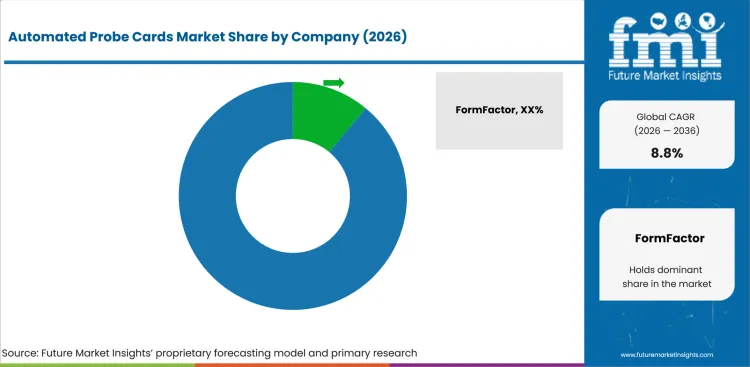
- Established probe card suppliers hold an advantage led by customer qualification records and fine-pitch contact depth.
- Memory-linked vendors gain stronger acceptance by supporting dense pad layouts and recurring production-card replacement.
- Regional suppliers win in country markets by offering fast repair support and fab-adjacent engineering access.
- Service-ready suppliers improve renewal chances through lifecycle cost proof and contact stability records.
FormFactor competes through MEMS probe cards and advanced wafer probe knowledge. Technoprobe has strengthened its device interface position after acquiring DIS capabilities and expanding support across high-performance semiconductor testing. Micronics Japan and Japan Electronic Materials retain strong positions in Japan and Asian memory programs.
Manufacturing depth and engineering response have become stronger competitive separators as logic processors and advanced packaging raise test complexity. MPI Corporation, Korea Instrument, Nidec SV Probe, and TSE compete based on regional access and test application coverage. Buyers compare suppliers through contact resistance control and engineering change response.
Specialist and regional suppliers can win through targeted device coverage and local service speed. FEINMETALL supports vertical probe card and contacting technologies, while Wentworth Laboratories serves specialty wafer probing and engineering applications. Companies able to prove card stability during production ramps should gain stronger renewal positions.
How do top Automated Probe Cards companies compare?
FormFactor and Technoprobe score on fine-pitch contact depth, while Micronics Japan and Japan Electronic Materials remain strong in Japan-led programs.
| Company | Market Title Match | Probe Card Portfolio Depth | Memory Test Strength | Fab Service Support | Channel Reach | Geographic Footprint |
|---|---|---|---|---|---|---|
| FormFactor | Very High | Very Strong | Very Strong | Very Strong | Very Strong | Global |
| Technoprobe | Very High | Very Strong | Strong | Very Strong | Very Strong | Global |
| Micronics Japan | Very High | Very Strong | Very Strong | Strong | Strong | Japan and Asia |
| Japan Electronic Materials | High | Strong | Strong | Medium | Strong | Japan and Asia |
| MPI Corporation | High | Strong | Medium | Strong | Strong | Asia and global |
| Korea Instrument | High | Medium | Very Strong | Strong | Medium | South Korea and Asia |
| Nidec SV Probe | High | Strong | Medium | Strong | Strong | Global |
| FEINMETALL | Moderate to High | Medium | Medium | Medium | Medium | Europe and global |
| Wentworth Laboratories | Moderate to High | Medium | Low | Medium | Medium | United Kingdom and United States |
| TSE | High | Medium | Strong | Medium | Medium | South Korea and Asia |
Source: Future Market Insights competitive analysis, 2026.
Who are the key players in the Automated Probe Cards Market?
FormFactor, Technoprobe, and Micronics Japan are listed with Japan Electronic Materials and MPI Corporation among other suppliers.
Key global companies leading the Automated Probe Cards Market include:
- FormFactor
- Technoprobe
- Micronics Japan
- Japan Electronic Materials
- MPI Corporation
- Korea Instrument
- Nidec SV Probe
- FEINMETALL
- Wentworth Laboratories
- TSE
Key Developments in Automated Probe Cards Market
- In May 2024, Technoprobe finalized acquisition of Teradyne’s Device Interface Solutions business, expanding device interface board and high-performance interface capability.
- In November 2024, FormFactor received the SK hynix Best Partner Award, reflecting probe card contribution to advanced package and memory testing programs.
- In January 2025, Technoprobe made the DIS Tech Italia merger deed available after completion of merger steps concluded in December 2024.
Key Players in the Automated Probe Cards Market
Global Probe Card Technology Leaders
- FormFactor
- Technoprobe
- Micronics Japan
- Japan Electronic Materials
Memory and Regional Test Specialists
- Korea Instrument
- TSE
- MPI Corporation
- Nidec SV Probe
Vertical, RF, and Specialty Contacting Suppliers
- FEINMETALL
- Wentworth Laboratories
- Local probe card suppliers
Device Interface and Engineering Support Companies
- DIS Tech Italia
- Regional repair partners
- Semiconductor test service providers
Automated Probe Cards Market - Scope & Definition
| Attribute | Detail |
|---|---|
| Market Definition | Wafer-level electrical test interface assemblies used with automatic probers and semiconductor testers to contact die pads before packaging |
| Functions Covered | Electrical contact, signal transfer, contact resistance control, touchdown repeatability, high-frequency test support, power device contact, and wafer sort interface stability |
| Applications Covered | Logic testing, memory testing, RF and mixed signal testing, power device testing, and other wafer-level semiconductor test applications |
| End-Use Industries | Integrated device manufacturers, foundries, outsourced semiconductor assembly and test companies, fabless test teams, laboratories, and semiconductor research centers |
| Grades Covered | Production probe cards, engineering probe cards, MEMS probe cards, vertical probe cards, cantilever probe cards, packaging probe cards, and application-specific customized cards |
| Inclusions | Commercially traded automated probe card assemblies across probe type, application, wafer size, end use, sales channel, and country-level semiconductor test use |
| Exclusions | Automatic wafer probers, semiconductor tester mainframes, packaged-device handlers, final test sockets, burn-in sockets, generic printed circuit boards, manual laboratory probes, and general semiconductor equipment not sold as probe card assemblies |
Automated Probe Cards Market - Research Methodology
| Method | Description |
|---|---|
| Primary Research | FMI analyst interviews with probe card engineers, wafer sort managers, semiconductor test teams, fab service teams, distributor networks, and regional sales representatives across selected markets |
| Desk Research | Review of semiconductor equipment data, official semiconductor policy releases, company disclosures, probe card product portfolios, fab investment material, and public semiconductor manufacturing evidence |
| Market Sizing & Forecasting | Bottom-up probe card demand approach using wafer sort volume, card replacement cycles, device test intensity, wafer size mix, application shifts, and country-level fab exposure |
| Data Validation | Cross-verification using company portfolios, official semiconductor data, regional manufacturing activity, device test trends, and supplier service footprints |
Automated Probe Cards Market - Report Scope
| Parameter | Details |
|---|---|
| Forecast period | 2026 to 2036 |
| Historical period | 2021 to 2025 |
| Quantitative unit | Revenue in USD million |
| By probe type | MEMS Probe Cards, Vertical Probe Cards, Cantilever Probe Cards, Packaging Probe Cards |
| By application | Logic Testing, Memory Testing, RF and Mixed Signal, Power and Other |
| By wafer size | 200 mm, 300 mm, Other |
| By end use | IDMs, Foundries, OSATs, Fabless and Labs |
| By sales channel | Direct, Distributors and Representatives |
| Regions covered | North America, Latin America, Europe, East Asia, South Asia and Pacific, Middle East and Africa |
| Countries covered | South Korea, Japan, China, United States, India, Germany, France, United Kingdom |
| Key companies profiled | FormFactor, Technoprobe, Micronics Japan, Japan Electronic Materials, MPI Corporation, Korea Instrument, Nidec SV Probe, FEINMETALL, Wentworth Laboratories, TSE |
| Approach | Bottom-up probe card demand approach using wafer sort volume, test intensity, card replacement cycles, application mix, fab activity, and country-level semiconductor manufacturing exposure |
Source: Future Market Insights competitive analysis, 2026.
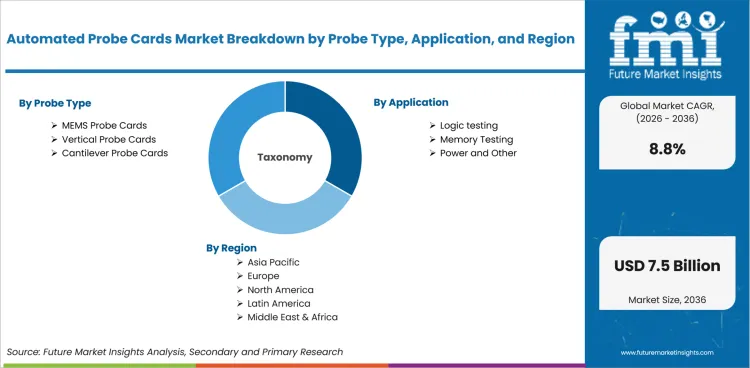
Automated Probe Cards Market Breakdown by Probe Type, Application, Wafer Size, End Use, Sales Channel, and Region
Automated Probe Cards Market Segmented by Probe Type
- MEMS Probe Cards
- Vertical Probe Cards
- Cantilever Probe Cards
- Packaging Probe Cards
Automated Probe Cards Market Segmented by Application
- Logic Testing
- Memory Testing
- RF and Mixed Signal
- Power and Other
Automated Probe Cards Market Segmented by Wafer Size
- 200 mm
- 300 mm
- Other
Automated Probe Cards Market Segmented by End Use
- IDMs
- Foundries
- OSATs
- Fabless and Labs
Automated Probe Cards Market Segmented by Sales Channel
- Direct
- Distributors and Representatives
Automated Probe Cards Market by Region
- North America
- Latin America
- Europe
- East Asia
- South Asia and Pacific
- Middle East and Africa
Research Sources and Bibliography
- Semiconductor Industry Association. (2026, February 6). Global annual semiconductor sales increase 25.6% to USD 791.7 billion in 2025.
- SEMI. (2025, December 16). Global semiconductor equipment sales projected to reach a record of USD 156 billion in 2027.
- National Institute of Standards and Technology. (2026, June 17). Department of Commerce announces definitive agreement with SandboxAQ for a USD 500 million CHIPS R&D award to accelerate AI-driven semiconductor materials discovery.
- National Institute of Standards and Technology. (2026). CHIPS for America program material.
- Bureau of Industry and Security. (2024, December 2). Commerce strengthens export controls to restrict China’s capability to produce advanced semiconductors for military applications.
- Press Information Bureau. (2026, February 7). India Semiconductor Mission 2.0.
- Press Information Bureau. (2025, August 15). Powering the future: Semiconductor and AI revolution.
- China State Council. (2026, January 30). China’s electronic information manufacturing sector posts rapid growth in 2025.
- National Bureau of Statistics of China. (2026, February 28). Statistical communiqué of the People’s Republic of China on the 2025 national economic and social development.
- Ministry of Economy, Trade and Industry. (2025, November 21). Press conference by Minister Akazawa.
- Japan External Trade Organization. (2025). Semiconductors and microelectronics attractive markets.
- Ministry of Economy and Finance, Republic of Korea. (2024, June 26). Semiconductor ecosystem support package.
- Korea.net. (2024, November 28). KRW 1.4 trillion policy fund in 2025 to support semiconductor industry.
- German Federal Government. (2025, October 15). Federal Government microelectronics strategy adopted.
- Germany Trade & Invest. (2026). Semiconductor industry in Germany.
- French Ministry of Economy, Finance and Industrial and Digital Sovereignty. (2025, January). Thema No. 27: Semiconductors, a globalized market and European dependence.
- Department for Science, Innovation and Technology. (2026, June 8). UK semiconductor sectoral analysis.
- Department for Science, Innovation and Technology. (2026, April 23). Frontier technologies: Powering the United Kingdom’s digital innovation.
- Department for Science, Innovation and Technology. (2025, April). UK semiconductor workforce study.
- Technoprobe. (2024, May 27). Technoprobe acquired Device Interface Solutions.
- Technoprobe. (2025, January 2). Merger deed by incorporation of DIS Tech Italia into Technoprobe.
- FormFactor. (2024, November 18). FormFactor receives SK hynix Best Partner Award.
- GlobalFoundries. (2025, October 28). GlobalFoundries plans billion-euro investment to expand chip manufacturing in Germany.
This bibliography is provided for reader reference and is not exhaustive. The full report contains the complete reference list and detailed citations.
This Report Answers
- Market size estimates for 2026 and forecasts through 2036 for the Automated Probe Cards Market.
- Insights across regional and country-level semiconductor wafer sort markets.
- Analysis of demand drivers and purchasing behavior.
- Evaluation of probe types, applications, wafer sizes, end uses, and sales channels.
- Assessment of semiconductor policy and wafer-level test intensity impacts.
- Identification of opportunities across MEMS cards and service-led qualification programs.
- Evaluation of direct sales models and technical service channels.
- Country-level analysis covering South Korea, Japan, China, United States, India, Germany, France, and United Kingdom.
- Assessment of competition, including leading probe card suppliers and device interface companies.
- Analysis of plant-level decision drivers and renewal criteria.
- Regional outlooks across North America, Europe, East Asia, South Asia and Pacific, Latin America, and Middle East and Africa.
- Delivery of market data, forecasts, and supporting analysis in report-ready format.
Frequently Asked Questions
What is the growth prospect for automated probe cards?
Demand for automated probe cards is expected to rise at a strong pace as memory and advanced packaging programs push more electrical screening into wafer sort.
Which companies are expected to shape the automated probe cards market?
FormFactor, Technoprobe, Micronics Japan, Japan Electronic Materials, MPI Corporation, and Korea Instrument are expected to shape competition through probe card portfolios and fab qualification depth.
Why are semiconductor test suppliers investing in automated probe cards?
Semiconductor test suppliers are investing in automated probe cards to support stable contact resistance and high-throughput wafer sort programs.
Why are direct sales channels important in the automated probe cards market?
Direct sales channels support confidential layout reviews and custom probe card qualification.
Which probe card formats are gaining attention in automated probe cards?
MEMS and vertical probe cards are gaining attention as high-density memory and power devices require stronger contact stability.
How do semiconductor policies influence automated probe card demand?
Semiconductor policies influence demand through domestic manufacturing support, and stronger need for qualified wafer sort interfaces.
Why is 300 mm wafer production important for automated probe cards?
300 mm wafer production is important as high-volume memory and foundry lines require larger installed bases of production and replacement probe cards.
What role does direct engineering support play in automated probe card adoption?
Direct engineering support helps buyers manage pad layout changes and lifecycle cost proof.
Preview the report firsthand - request a free sample
Get SampleGet the brochure for pricing and purchase details.
Get PDFTable of Content
- Key Takeaways
- Market Size and CAGR
- Top Growth Driver
- Fastest Growing Segment
- Leading Region
- Key Companies
- Emerging Opportunities
- Executive Summary
- Global Market Outlook
- Demand-side Trends
- Supply-side Trends
- Technology Roadmap Analysis
- Analysis and Recommendations
- Analyst Perspective (What is happening? Why now? What should investors know?)
- Key Questions Answered
- How large is the market?
- What is the CAGR?
- What are key trends?
- Which region dominates?
- Who are the leaders?
- Market Overview
- Market Coverage / Taxonomy
- Market Definition / Scope / Limitations
- Research Methodology
- Chapter Orientation
- Analytical Lens and Working Hypotheses
- Market Structure, Signals, and Trend Drivers
- Benchmarking and Cross-market Comparability
- Market Sizing, Forecasting, and Opportunity Mapping
- Research Design and Evidence Framework
- Desk Research Programme (Secondary Evidence)
- Expert Input and Fieldwork (Primary Evidence)
- Tooling, Models, and Reference Databases
- Data Engineering and Model Build
- Quality Assurance and Audit Trail
- Market Background
- Market Dynamics (Drivers, Restraints, Opportunity, Trends)
- Scenario Forecast (Optimistic, Likely, Conservative)
- Impact Analysis
- AI Impact
- Sustainability Impact
- Regulatory Impact
- Technology Impact
- Consumer / Buyer Analysis
- Purchase Drivers
- Adoption Barriers
- Buyer Journey
- Opportunity Map Analysis
- Product Life Cycle Analysis
- Supply Chain Analysis
- Investment Feasibility Matrix
- Value Chain Analysis
- PESTLE and Porter's Analysis
- Regulatory Landscape
- Regional Parent Market Outlook
- Production and Consumption Statistics
- Import and Export Statistics
- Global Market Analysis and Forecast, 2021 to 2036
- Historical Market Size Value (USD Million) Analysis, 2021 to 2025
- Current and Future Market Size Value (USD Million) Projections, 2026 to 2036
- Y-o-Y Growth Trend Analysis
- Absolute $ Opportunity Analysis
- Global Market Pricing Analysis, 2021 to 2036
- Global Market Analysis and Forecast, By Probe Type, 2021 to 2036
- Introduction / Key Findings
- Historical Market Size Value (USD Million) Analysis By Probe Type, 2021 to 2025
- Current and Future Market Size Value (USD Million) Analysis and Forecast By Probe Type, 2026 to 2036
- MEMS Probe Cards
- Vertical Probe Cards
- Cantilever Probe Cards
- MEMS Probe Cards
- Y-o-Y Growth Trend Analysis By Probe Type, 2021 to 2025
- Absolute $ Opportunity Analysis By Probe Type, 2026 to 2036
- Global Market Analysis and Forecast, By Application, 2021 to 2036
- Introduction / Key Findings
- Historical Market Size Value (USD Million) Analysis By Application, 2021 to 2025
- Current and Future Market Size Value (USD Million) Analysis and Forecast By Application, 2026 to 2036
- Logic testing
- Memory Testing
- Power and Other
- Logic testing
- Y-o-Y Growth Trend Analysis By Application, 2021 to 2025
- Absolute $ Opportunity Analysis By Application, 2026 to 2036
- Global Market Analysis and Forecast, By Wafer Size, 2021 to 2036
- Introduction / Key Findings
- Historical Market Size Value (USD Million) Analysis By Wafer Size, 2021 to 2025
- Current and Future Market Size Value (USD Million) Analysis and Forecast By Wafer Size, 2026 to 2036
- 300 mm
- 200 mm
- 300 mm
- Y-o-Y Growth Trend Analysis By Wafer Size, 2021 to 2025
- Absolute $ Opportunity Analysis By Wafer Size, 2026 to 2036
- Global Market Analysis and Forecast, By End Use, 2021 to 2036
- Introduction / Key Findings
- Historical Market Size Value (USD Million) Analysis By End Use, 2021 to 2025
- Current and Future Market Size Value (USD Million) Analysis and Forecast By End Use, 2026 to 2036
- IDMs
- Foundries
- OSATs
- IDMs
- Y-o-Y Growth Trend Analysis By End Use, 2021 to 2025
- Absolute $ Opportunity Analysis By End Use, 2026 to 2036
- Global Market Analysis and Forecast, By Sales Channel, 2021 to 2036
- Introduction / Key Findings
- Historical Market Size Value (USD Million) Analysis By Sales Channel, 2021 to 2025
- Current and Future Market Size Value (USD Million) Analysis and Forecast By Sales Channel, 2026 to 2036
- Direct
- Distributors and Representatives
- Direct
- Y-o-Y Growth Trend Analysis By Sales Channel, 2021 to 2025
- Absolute $ Opportunity Analysis By Sales Channel, 2026 to 2036
- Global Market Analysis and Forecast, By Region, 2021 to 2036
- Introduction
- Historical Market Size Value (USD Million) Analysis By Region, 2021 to 2025
- Current Market Size Value (USD Million) Analysis and Forecast By Region, 2026 to 2036
- North America
- Latin America
- Western Europe
- Eastern Europe
- East Asia
- South Asia and Pacific
- Middle East & Africa
- Market Attractiveness Analysis By Region
- North America Market Analysis and Forecast, By Country, 2021 to 2036
- Historical Market Size Value (USD Million) Trend Analysis By Market Taxonomy, 2021 to 2025
- Market Size Value (USD Million) Forecast By Market Taxonomy, 2026 to 2036
- By Country
- USA
- Canada
- Mexico
- By Probe Type
- By Application
- By Wafer Size
- By End Use
- By Sales Channel
- By Country
- Market Attractiveness Analysis
- By Country
- By Probe Type
- By Application
- By Wafer Size
- By End Use
- By Sales Channel
- Key Takeaways
- Latin America Market Analysis and Forecast, By Country
- Historical Market Size Value (USD Million) Trend Analysis By Market Taxonomy, 2021 to 2025
- Market Size Value (USD Million) Forecast By Market Taxonomy, 2026 to 2036
- By Country
- Brazil
- Chile
- Rest of Latin America
- By Probe Type
- By Application
- By Wafer Size
- By End Use
- By Sales Channel
- By Country
- Market Attractiveness Analysis
- By Country
- By Probe Type
- By Application
- By Wafer Size
- By End Use
- By Sales Channel
- Key Takeaways
- Western Europe Market Analysis and Forecast, By Country
- Historical Market Size Value (USD Million) Trend Analysis By Market Taxonomy, 2021 to 2025
- Market Size Value (USD Million) Forecast By Market Taxonomy, 2026 to 2036
- By Country
- Germany
- UK
- Italy
- Spain
- France
- Nordic
- BENELUX
- Rest of Western Europe
- By Probe Type
- By Application
- By Wafer Size
- By End Use
- By Sales Channel
- By Country
- Market Attractiveness Analysis
- By Country
- By Probe Type
- By Application
- By Wafer Size
- By End Use
- By Sales Channel
- Key Takeaways
- Eastern Europe Market Analysis and Forecast, By Country
- Historical Market Size Value (USD Million) Trend Analysis By Market Taxonomy, 2021 to 2025
- Market Size Value (USD Million) Forecast By Market Taxonomy, 2026 to 2036
- By Country
- Russia
- Poland
- Hungary
- Balkan & Baltic
- Rest of Eastern Europe
- By Probe Type
- By Application
- By Wafer Size
- By End Use
- By Sales Channel
- By Country
- Market Attractiveness Analysis
- By Country
- By Probe Type
- By Application
- By Wafer Size
- By End Use
- By Sales Channel
- Key Takeaways
- East Asia Market Analysis and Forecast, By Country
- Historical Market Size Value (USD Million) Trend Analysis By Market Taxonomy, 2021 to 2025
- Market Size Value (USD Million) Forecast By Market Taxonomy, 2026 to 2036
- By Country
- China
- Japan
- South Korea
- By Probe Type
- By Application
- By Wafer Size
- By End Use
- By Sales Channel
- By Country
- Market Attractiveness Analysis
- By Country
- By Probe Type
- By Application
- By Wafer Size
- By End Use
- By Sales Channel
- Key Takeaways
- South Asia and Pacific Market Analysis and Forecast, By Country
- Historical Market Size Value (USD Million) Trend Analysis By Market Taxonomy, 2021 to 2025
- Market Size Value (USD Million) Forecast By Market Taxonomy, 2026 to 2036
- By Country
- India
- ASEAN
- Australia & New Zealand
- Rest of South Asia and Pacific
- By Probe Type
- By Application
- By Wafer Size
- By End Use
- By Sales Channel
- By Country
- Market Attractiveness Analysis
- By Country
- By Probe Type
- By Application
- By Wafer Size
- By End Use
- By Sales Channel
- Key Takeaways
- Middle East & Africa Market Analysis and Forecast, By Country
- Historical Market Size Value (USD Million) Trend Analysis By Market Taxonomy, 2021 to 2025
- Market Size Value (USD Million) Forecast By Market Taxonomy, 2026 to 2036
- By Country
- Kingdom of Saudi Arabia
- Other GCC Countries
- Türkiye
- South Africa
- Other African Union
- Rest of Middle East & Africa
- By Probe Type
- By Application
- By Wafer Size
- By End Use
- By Sales Channel
- By Country
- Market Attractiveness Analysis
- By Country
- By Probe Type
- By Application
- By Wafer Size
- By End Use
- By Sales Channel
- Key Takeaways
- Key Countries Market Analysis
- USA
- Pricing Analysis
- Market Share Analysis, 2025
- By Probe Type
- By Application
- By Wafer Size
- By End Use
- By Sales Channel
- Canada
- Pricing Analysis
- Market Share Analysis, 2025
- By Probe Type
- By Application
- By Wafer Size
- By End Use
- By Sales Channel
- Mexico
- Pricing Analysis
- Market Share Analysis, 2025
- By Probe Type
- By Application
- By Wafer Size
- By End Use
- By Sales Channel
- Brazil
- Pricing Analysis
- Market Share Analysis, 2025
- By Probe Type
- By Application
- By Wafer Size
- By End Use
- By Sales Channel
- Chile
- Pricing Analysis
- Market Share Analysis, 2025
- By Probe Type
- By Application
- By Wafer Size
- By End Use
- By Sales Channel
- Germany
- Pricing Analysis
- Market Share Analysis, 2025
- By Probe Type
- By Application
- By Wafer Size
- By End Use
- By Sales Channel
- UK
- Pricing Analysis
- Market Share Analysis, 2025
- By Probe Type
- By Application
- By Wafer Size
- By End Use
- By Sales Channel
- Italy
- Pricing Analysis
- Market Share Analysis, 2025
- By Probe Type
- By Application
- By Wafer Size
- By End Use
- By Sales Channel
- Spain
- Pricing Analysis
- Market Share Analysis, 2025
- By Probe Type
- By Application
- By Wafer Size
- By End Use
- By Sales Channel
- France
- Pricing Analysis
- Market Share Analysis, 2025
- By Probe Type
- By Application
- By Wafer Size
- By End Use
- By Sales Channel
- India
- Pricing Analysis
- Market Share Analysis, 2025
- By Probe Type
- By Application
- By Wafer Size
- By End Use
- By Sales Channel
- ASEAN
- Pricing Analysis
- Market Share Analysis, 2025
- By Probe Type
- By Application
- By Wafer Size
- By End Use
- By Sales Channel
- Australia & New Zealand
- Pricing Analysis
- Market Share Analysis, 2025
- By Probe Type
- By Application
- By Wafer Size
- By End Use
- By Sales Channel
- China
- Pricing Analysis
- Market Share Analysis, 2025
- By Probe Type
- By Application
- By Wafer Size
- By End Use
- By Sales Channel
- Japan
- Pricing Analysis
- Market Share Analysis, 2025
- By Probe Type
- By Application
- By Wafer Size
- By End Use
- By Sales Channel
- South Korea
- Pricing Analysis
- Market Share Analysis, 2025
- By Probe Type
- By Application
- By Wafer Size
- By End Use
- By Sales Channel
- Russia
- Pricing Analysis
- Market Share Analysis, 2025
- By Probe Type
- By Application
- By Wafer Size
- By End Use
- By Sales Channel
- Poland
- Pricing Analysis
- Market Share Analysis, 2025
- By Probe Type
- By Application
- By Wafer Size
- By End Use
- By Sales Channel
- Hungary
- Pricing Analysis
- Market Share Analysis, 2025
- By Probe Type
- By Application
- By Wafer Size
- By End Use
- By Sales Channel
- Kingdom of Saudi Arabia
- Pricing Analysis
- Market Share Analysis, 2025
- By Probe Type
- By Application
- By Wafer Size
- By End Use
- By Sales Channel
- Türkiye
- Pricing Analysis
- Market Share Analysis, 2025
- By Probe Type
- By Application
- By Wafer Size
- By End Use
- By Sales Channel
- South Africa
- Pricing Analysis
- Market Share Analysis, 2025
- By Probe Type
- By Application
- By Wafer Size
- By End Use
- By Sales Channel
- USA
- Market Structure Analysis
- Competition Dashboard
- Competition Benchmarking
- Market Share Analysis of Top Players
- By Regional
- By Probe Type
- By Application
- By Wafer Size
- By End Use
- By Sales Channel
- Emerging Startups
- Innovation Benchmarking
- Competition Analysis
- Competition Deep Dive
- FormFactor
- Overview
- Product Portfolio
- Profitability by Market Segments (Product/Region/Sales Channel)
- Sales Footprint
- Strategy Overview
- Marketing Strategy
- Product Strategy
- Channel Strategy
- Technoprobe
- Micronics Japan
- Japan Electronic Materials
- MPI Corporation
- Korea Instrument
- Nidec SV Probe
- FormFactor
- Case Studies
- Success Stories
- Recent Developments
- Competition Deep Dive
- Assumptions & Acronyms Used


