- Market Size (2026)
- USD 285.0 Mn
- Forecast (2036)
- USD 505.6 Mn
- CAGR (2026 to 2036)
- 5.9%
How Big Is the Automatic Track Warning Systems Market in 2026?
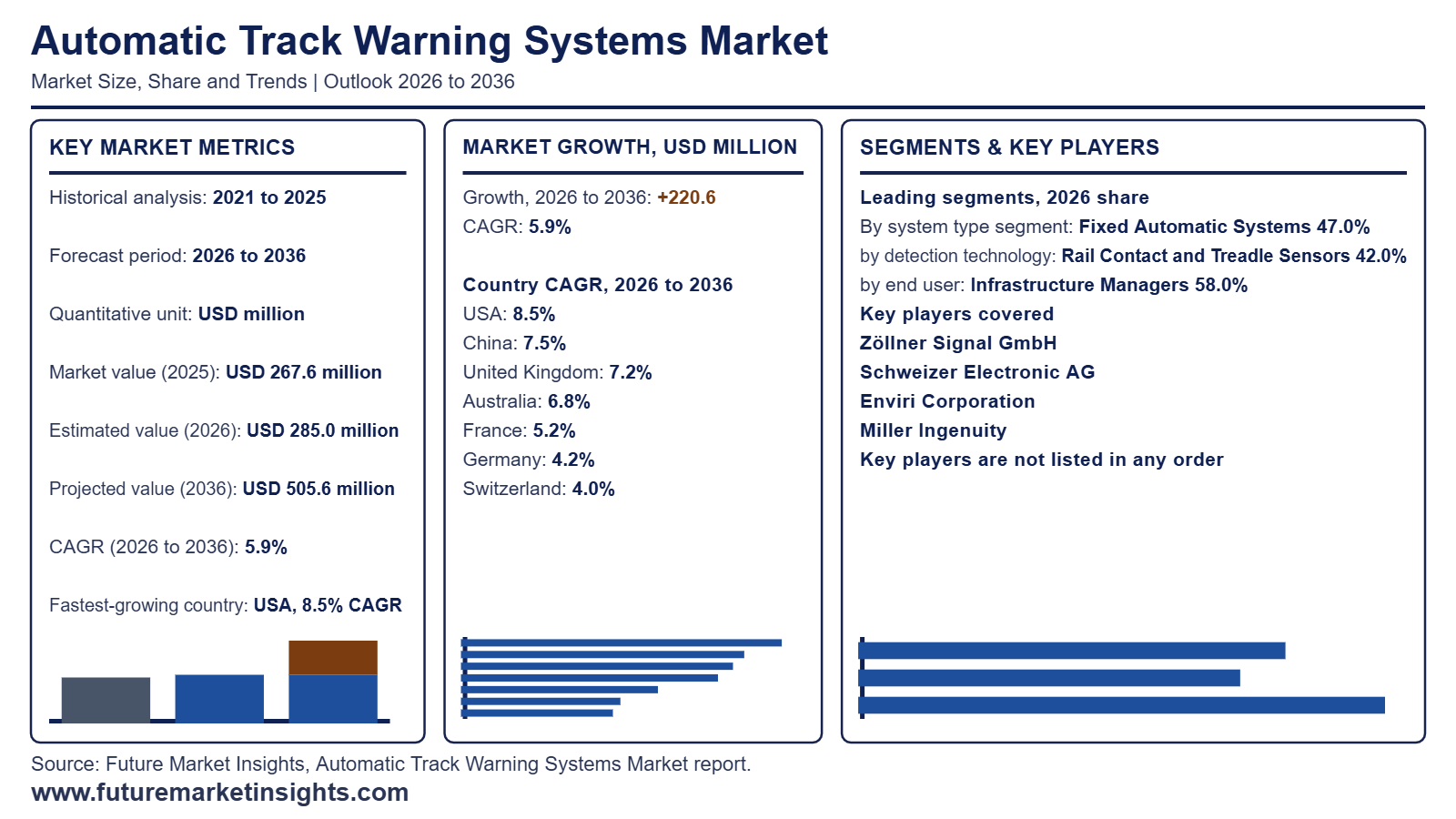
The global automatic track warning systems market is valued at USD 285.0 million in 2026, up from USD 267.6 million in 2025, and is projected by Future Market Insights (FMI) to reach USD 505.6 million by 2036, expanding at a 5.9% CAGR from 2026 to 2036 and generating USD 220.6 million in incremental revenue over the 10-year forecast period.
| Market Metric | Valuation / Share / Forecast Benchmark |
|---|---|
| 2025 Market Size (Historical) | USD 267.6 million |
| 2026 Market Size (Estimated) | USD 285.0 million |
| 2036 Market Size (Projected) | USD 505.6 million |
| Compound Annual Growth Rate (2026 to 2036) | 5.9% CAGR |
| Incremental Dollar Opportunity (2026 to 2036) | USD 220.6 million |
| Dominant System Type Segment (2026 to 2036 Share) | Fixed Automatic Systems (47.0% in 2026, easing to 44.5% by 2036) |
| Leading & Fastest-Growing Segments by Detection Technology | Rail Contact and Treadle Sensors (42.0% share in 2026, 4.8% CAGR) │ Radar, Lidar and Camera (6.7% CAGR) |
| Leading & Fastest-Growing Segments by End User | Infrastructure Managers (58.0% share in 2026, 5.5% CAGR) │ Track Maintenance Contractors (6.4% CAGR) |
| Largest Country Markets (2026 Global Share) | Germany (17.5%), United States (11.0%), United Kingdom (10.4%) |
| Fastest-Growing Country Markets (2026 to 2036) | United States (8.5% CAGR), China (7.5% CAGR), United Kingdom (7.2% CAGR) |
| Leading Tier-1 Companies | Zöllner Signal GmbH, Schweizer Electronic AG, Enviri Corporation, Miller Ingenuity |
Source: Future Market Insights analysis of the automatic track warning systems market, 2026.
Executive Market Overview
Demand for automatic track warning systems is largely driven by railway rules that restrict human lookouts along with renewal work carried out beside open lines. Infrastructure managers make most purchases, and one such manager, Network Rail (October 2025), stated that unassisted lookout working above 25 mph has been eliminated. Demand is concentrated in Europe, and Zöllner Signal (September 2026) reported SNCF approval of the F500 train detector for high-speed lines in France. FMI expects the United States and Australia to add buyers faster than Germany and Switzerland through 2036.
Railway infrastructure managers and maintenance contractors purchase or rent warning sets that detect an approaching train and alert the work gang, because rail authorities are restricting protection by human lookouts. Makers are adding inductive train detectors and remote worksite protection devices, and Schweizer Electronic is setting up a subsidiary outside Europe. The Wearable Personal Warning Devices segment is projected to expand at a 6.8% CAGR, the Radar, Lidar and Camera segment at 6.7% and the United States at 8.5%, all faster than the 5.9% overall market CAGR. Market sizing covers the sale and rental of fixed and portable systems, along with wearable devices, that warn rail workers of approaching trains. Train protection and cab signaling systems are excluded, as are level crossing warning installations and lookout labor services.
Analyst Perspective
"Railways are moving from simple lookout-operated sets to certified automatic systems that sell at higher prices, so revenue per worksite rises and market value grows faster than unit volume. One commercial risk for sellers of warning sets is a move by networks toward more maintenance in full line closures, which reduces the number of worksites that need a train warning at all."
- Nikhil Kaitwade, Principal Consultant, Future Market Insights (FMI)
Major Market Trends and Insights
French approvals extend radio warning to more worksites: SNCF Réseau authorized the Zöllner mobile radio warning system for mobile worksites in France, according to Zöllner Signal (April 2026). Zöllner Signal (September 2026) reported that SNCF approved the F500 train detector, which detects trains running at up to 300 km/h, for high-speed lines. In FMI's assessment, each approval adds a class of worksite that can replace human lookouts with equipment.
British maintenance is moving away from lookout protection: Network Rail (October 2025) told line managers and contractors that unassisted lookout working above 25 mph has been eliminated. The Office of Rail and Road (2025) reported that semi-automatic warning equipment is available at Network Rail and that adoption has been slower than expected. The Rail Accident Investigation Branch (June 2026) said that the move away from unassisted lookout protection has made trackside work statistically safer.
Makers are adding subsidiaries and partners in new countries: Schweizer Electronic (December 2025) announced a subsidiary in Toronto that will serve customers in Canada and the United States. In the Netherlands, Schweizer Electronic (February 2026) announced a partnership with DHW Track B.V. for the Dutch rail sector. Zöllner Signal (September 2025) stated that the Zöllner radio warning sets are deployed on thousands of worksites across Europe and Australia.
What Are the Main Drivers, Restraints, and Opportunities?
Rules that limit human lookouts are lifting equipment demand and North American transit agencies form a new group of buyers, though the shift of maintenance into closed lines holds demand back.
Driver: Railway rules that restrict human lookouts
In Great Britain, the end of unassisted lookout working above 25 mph was confirmed by Network Rail (October 2025). In France, small mobile teams gained SNCF Réseau permission to work under radio warning, according to Zöllner Signal (April 2026). The Federal Transit Administration (December 2025) posted a presentation on the roadway worker protection final rule and on technologies to comply. FMI expects these rules and approvals to move buyers from lookout labor to certified equipment.
Restraint: More maintenance is done on lines closed to trains
The Office of Rail and Road (2025) reported that more Network Rail work is being carried out under line blockages and night-time possessions. Yearly near misses involving trackside workers fell from 65 to 16, according to the Office of Rail and Road (2025). The Rail Accident Investigation Branch (June 2026) said that safety now relies on every worker knowing which lines are blocked. In FMI's assessment, work inside a full closure needs no train warning, which limits equipment demand on networks that close lines for maintenance.
Opportunity: Transit and freight railways in North America
Miller Ingenuity (2026) states that the ZoneGuard system will satisfy the redundant protection requirement of the Federal Transit Administration final rule, 49 CFR Part 671. The Federal Railroad Administration (2026) compliance manual covers train approach warning by watchmen and lookouts under section 214.329. A new Toronto subsidiary for customers in Canada and the United States was announced by Schweizer Electronic (December 2025). FMI expects transit agencies to be early buyers of electronic warning sets in this region.
How Is the Automatic Track Warning Systems Market Segmented?
The global automatic track warning systems market is segmented by system type and detection technology, along with end user and region.
| Segmentation Axis | Sub-Segments Covered | 2026 Leading Segment & Share | Main Growth Benchmark (2026 to 2036) |
|---|---|---|---|
| System Type | Fixed Automatic Systems, Portable and Semi-Automatic Systems, Wearable Personal Warning Devices | Fixed Automatic Systems (47.0% share) | Wearable Personal Warning Devices leads growth at 6.8% CAGR, against 5.3% for Fixed Automatic Systems |
| Detection Technology | Rail Contact and Treadle Sensors, Radio and Signalling-Linked, Radar, Lidar and Camera | Rail Contact and Treadle Sensors (42.0% share) | Radar, Lidar and Camera leads growth at 6.7% CAGR, against 4.8% for Rail Contact and Treadle Sensors |
| End User | Infrastructure Managers, Track Maintenance Contractors | Infrastructure Managers (58.0% share) | Track Maintenance Contractors leads growth at 6.4% CAGR, against 5.5% for Infrastructure Managers |
| Region | North America, Latin America, Western Europe, Eastern Europe, East Asia, South Asia and Pacific, Middle East and Africa | Germany (17.5% global share) | United States leads national growth at 8.5% CAGR |
Source: Future Market Insights analysis of the automatic track warning systems market, 2026.
Why Does the Fixed Automatic Systems Segment Lead by System Type?
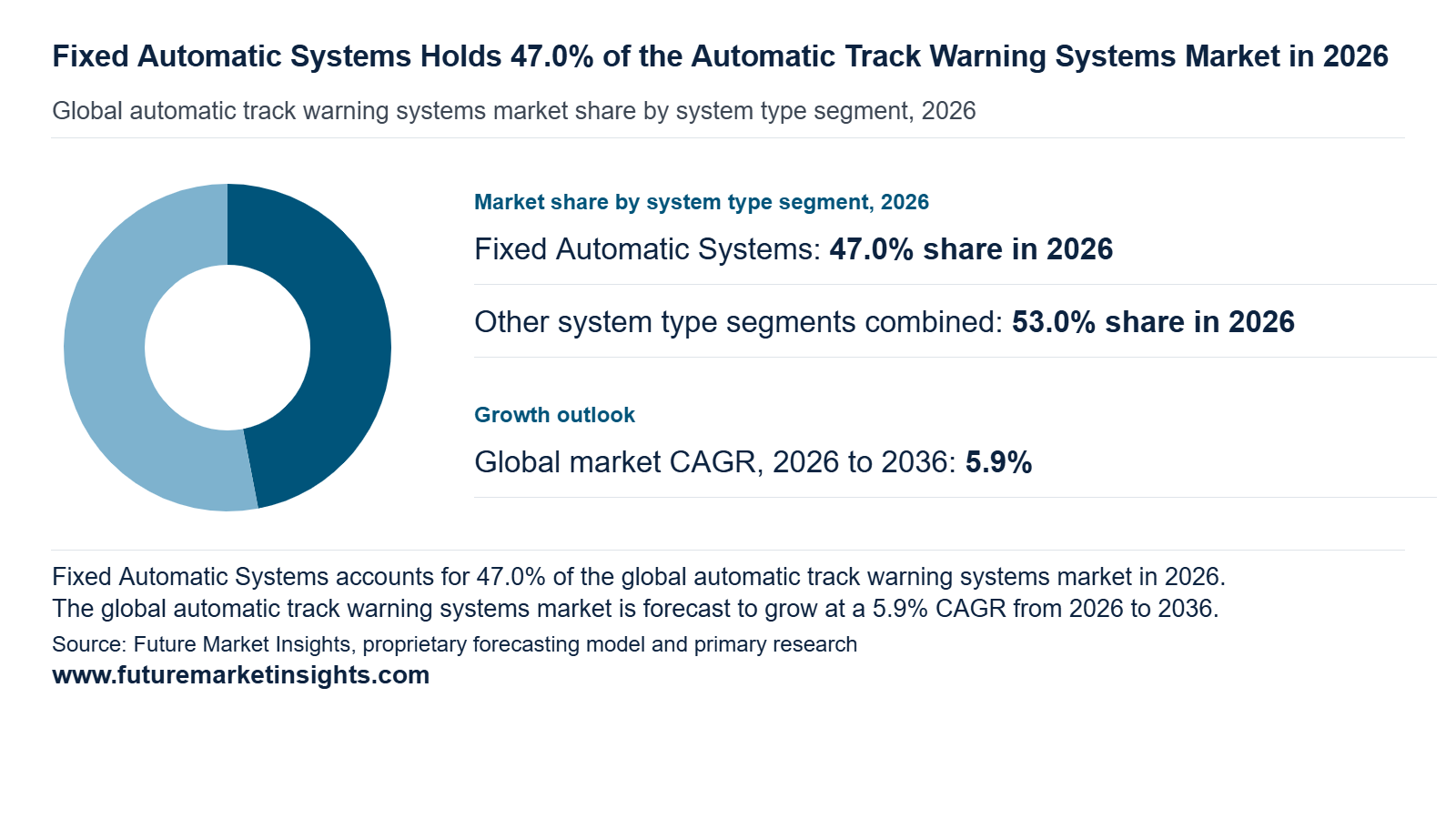
Fixed Automatic Systems hold 47.0% of 2026 sales because long renewal sites keep detectors and horns in place for weeks. Zöllner Signal (September 2025) described permanent installations that leave inductive train detectors on the rails for weeks or months at junctions and tunnels. Rail Live (2026) listed the Overwatch product of Schweizer Electronic as a permanent warning solution for complex junctions. FMI projects Fixed Automatic Systems at 44.5% of sales by 2036, as Portable and Semi-Automatic Systems expand by 6.2% per year on short worksites.
Why Does the Rail Contact and Treadle Sensors Segment Lead by Detection Technology?
Rail Contact and Treadle Sensors hold 42.0% of 2026 sales because, in FMI's assessment, a sensor fixed to the rail is the long-established way to detect a train at a worksite. Zöllner Signal (September 2025) stated that train detection can use a rail sensor or a lookout, as well as a signal from the interlocking. The inductive F500 detector, which detects trains at up to 300 km/h, gained SNCF approval for high-speed lines, according to Zöllner Signal (September 2026). In FMI's assessment, signal-linked warning draws on equipment sold in the railway signaling system market. FMI projects yearly growth of 6.7% for Radar, Lidar and Camera detection against 4.8% for Rail Contact and Treadle Sensors.
Why Does the Infrastructure Managers Segment Lead by End User?
Infrastructure Managers hold 58.0% of 2026 sales because the network owner sets the protection rules and approves each warning product. In France, the decision to allow radio warning sets on mobile worksites was taken by SNCF Réseau, according to Zöllner Signal (April 2026). Dual Inventive (October 2026) reported that the certified RCS 3000 signal was developed with ProRail and Strukton Rail, along with VolkerRail. In FMI's assessment, contractors that buy in the railway maintenance machinery market often rent warning sets for the same jobs. FMI projects sales to Track Maintenance Contractors to rise by 6.4% per year and to reach 44.0% of sales by 2036.
Automatic Track Warning Systems Market by Region and Country (2026 to 2036)
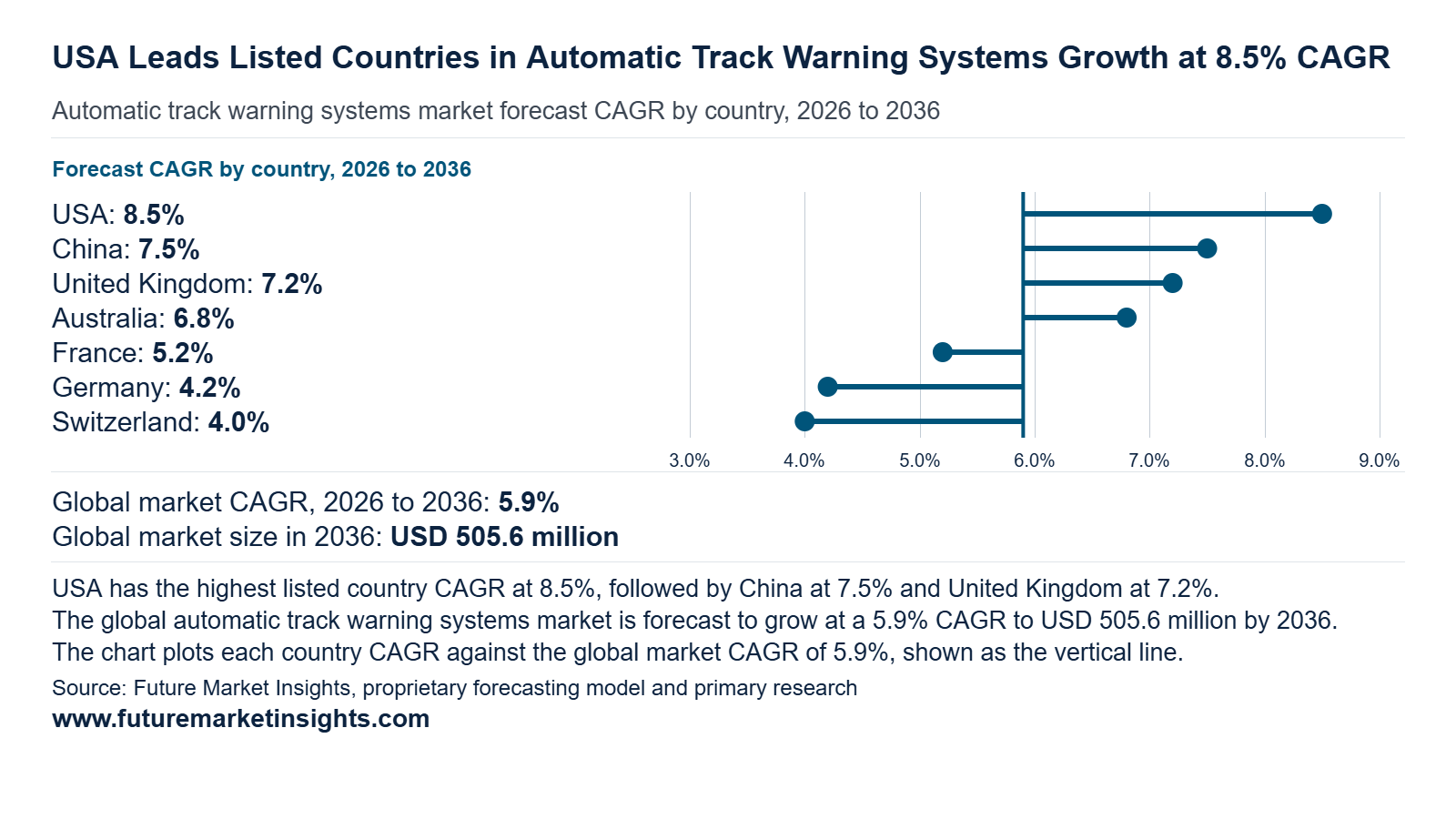
Europe holds the largest share of demand, and Germany is the largest market among the countries covered at 17.5% of global sales in 2026. Growth in the United States is forecast at 8.5% per year, a faster rate than China at 7.5% and the United Kingdom at 7.2%. FMI projects Germany and Switzerland below the global rate of 5.9% because both networks adopted technical warning early.
| Country | 2026 Revenue | 2036 Revenue | 10-Year Addition | 2026 to 2036 CAGR | Global Share (2026 → 2036) |
|---|---|---|---|---|---|
| United States | USD 31.4 million | USD 70.9 million | +USD 39.5 million | 8.5% | 11.0% → 14.0% |
| China | USD 25.6 million | USD 52.9 million | +USD 27.3 million | 7.5% | 9.0% → 10.5% |
| United Kingdom | USD 29.6 million | USD 59.4 million | +USD 29.8 million | 7.2% | 10.4% → 11.7% |
| Australia | USD 11.4 million | USD 22.0 million | +USD 10.6 million | 6.8% | 4.0% → 4.4% |
| France | USD 19.4 million | USD 32.2 million | +USD 12.8 million | 5.2% | 6.8% → 6.4% |
| Germany | USD 49.9 million | USD 75.3 million | +USD 25.4 million | 4.2% | 17.5% → 14.9% |
| Switzerland | USD 16.0 million | USD 23.6 million | +USD 7.6 million | 4.0% | 5.6% → 4.7% |
Source: Future Market Insights analysis of the automatic track warning systems market, 2026.
Germany
Germany is the largest market in this report at USD 49.9 million in 2026, with USD 75.3 million projected for 2036 at a CAGR of 4.2%. Zöllner Signal (October 2026), based in Kiel, reported that 2026 marks 80 years of the company. Deutsche Bahn was among the infrastructure operators with which the company exchanged ideas at InnoTrans, according to Zöllner Signal (October 2026). In FMI's assessment, the German network converted to technical warning early, so growth stays below the global rate.
United States
Sales in the United States are projected at USD 31.4 million for 2026 and USD 70.9 million for 2036, a CAGR of 8.5%. The Federal Transit Administration (December 2025) published an update from the agency's chief safety officer on implementation of the roadway worker protection rule. Miller Ingenuity (2026), based in Winona, Minnesota, describes the ZoneGuard system as a secondary warning device for freight and transit railways. In FMI's assessment, demand starts from a low base because watchmen and lookouts remain a permitted warning method under federal rules.
United Kingdom
The United Kingdom market is forecast to rise from USD 29.6 million in 2026 to USD 59.4 million by 2036, which equals a CAGR of 7.2%. Network Rail has semi-automatic warning equipment available, though adoption is slower than expected, according to the Office of Rail and Road (2025). Rail Forum (April 2025) reported a partnership between Dual Inventive and K2C Rail to introduce products such as the ZKL 3000 RC to the wider rail supply chain in the United Kingdom. Rail Live (2026) listed Schweizer Electronic as an exhibitor with the Minimel Lynx warning system at the June 2026 show.
China
China is forecast to grow at a CAGR of 7.5%, from USD 25.6 million in 2026 to USD 52.9 million by 2036. In FMI's assessment, the size of the Chinese network and the volume of yearly maintenance work support growth above the global rate. FMI expects purchases of warning equipment in China to start from a lower base than in Europe.
France
France accounts for USD 19.4 million in 2026, a figure FMI expects to rise to USD 32.2 million by 2036 at a CAGR of 5.2%. Zöllner Signal (April 2026) reported that SNCF Réseau approved radio warning for mobile worksites, a change that suits small teams such as surveying teams. A further SNCF approval covered the F500 train detector on high-speed lines, according to Zöllner Signal (September 2026). FMI expects the two approvals to bring forward purchases by French maintenance contractors.
Switzerland
Switzerland, the home country of Schweizer Electronic AG, is projected to move from USD 16.0 million in 2026 to USD 23.6 million by 2036 at a CAGR of 4.0%. Schweizer Electronic (February 2026) gives Reiden as the company seat. Zöllner Signal (October 2026) named SBB, the Swiss federal railway, among the operators met for an exchange of ideas at InnoTrans. In FMI's assessment, Swiss worksites already rely on technical warning, which holds the Swiss growth rate under the global figure.
Australia
Australia is expected to reach USD 22.0 million by 2036 from USD 11.4 million in 2026, a CAGR of 6.8%. Thousands of worksites in Europe and Australia are equipped with the Zöllner radio warning product, according to Zöllner Signal (September 2025). FMI expects Australian rail operators to add warning equipment from a lower base than European networks.
Competitive Environment and Notable Companies
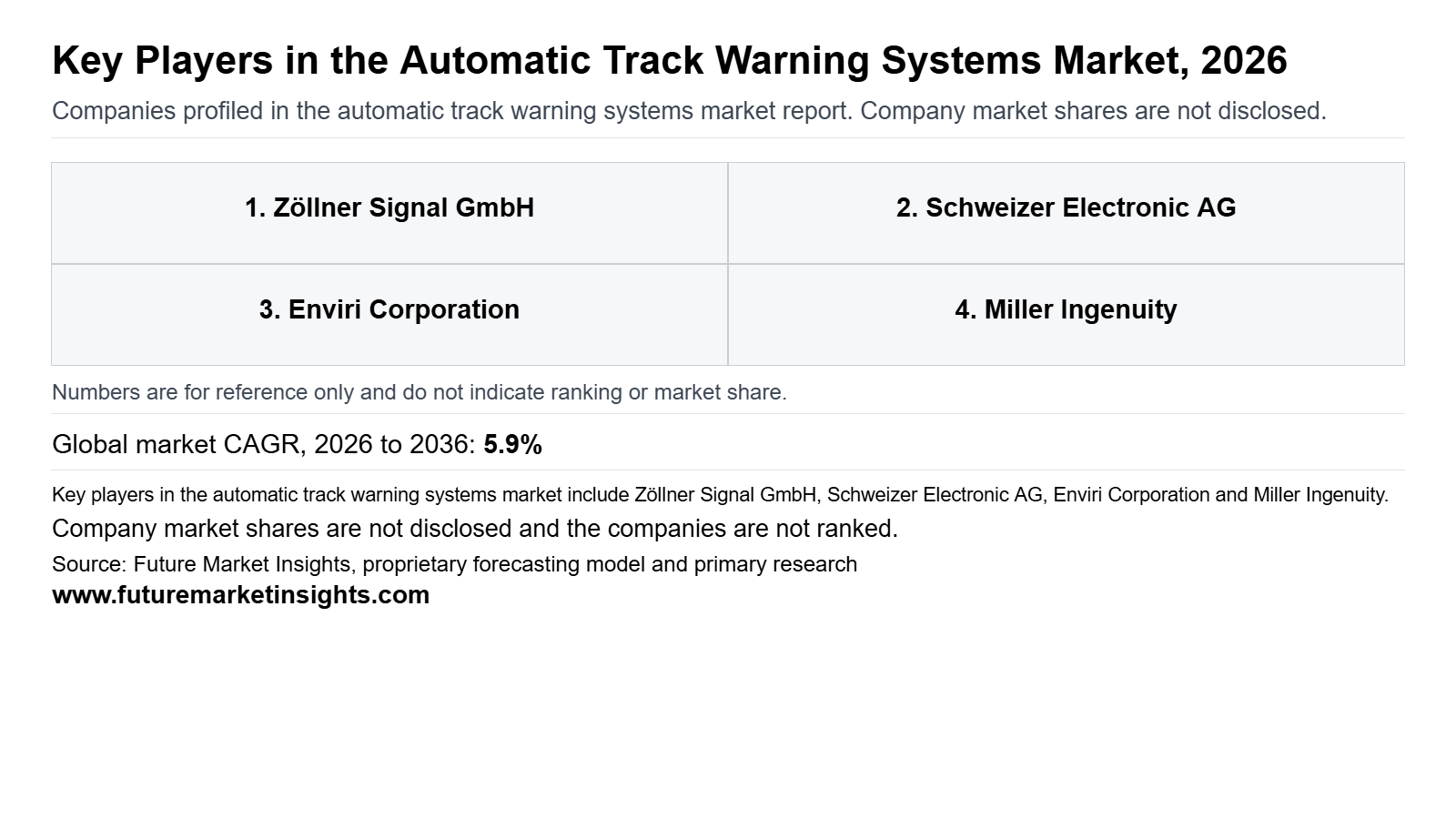
Competition is concentrated among a small group of specialist makers. Zöllner Signal GmbH and Schweizer Electronic AG sell certified warning systems to European networks. Miller Ingenuity sells to North American railways, as does Enviri Corporation through the Harsco Rail business. Dual Inventive sells remote worksite protection in the Netherlands and the United Kingdom. Schweizer Electronic AG is also active in the level crossing systems market.
How Are Companies Positioned in the Automatic Track Warning Systems Market?
Zöllner Signal GmbH is positioned on radio and cable warning systems for large renewal sites, and Zöllner Signal (October 2026) showed modular warning systems alongside personal warning devices at InnoTrans 2026. Schweizer Electronic AG is positioned on the Minimel Lynx family, which Rail Live (2026) described as scalable from lookout-operated to automatic warning with the same central controller. Dual Inventive is positioned on remote protection of line closures through a cloud platform, according to Dual Inventive (October 2026). MyChesCo (June 2026) reported that Enviri completed the separation of Harsco Environmental and Harsco Rail into a standalone public company. Harsco Rail (2026) states that the business is owned by Enviri Corporation and links to Protran Technology on the company website.
What Matters When a Buyer Selects an Automatic Track Warning Systems Supplier?
In FMI's assessment, buyers select a warning system first on approval by the network owner, because unapproved equipment cannot be used on the line. Safety certification is the second test, and Zöllner Signal (September 2025) lists SIL 4 certification for the company's radio warning product. Dual Inventive (October 2026) reported that DEKRA Rail validated the RCS 3000 at SIL 4. Rental availability and training support matter to contractors that take equipment for single jobs.
Which Capabilities Distinguish Product Offers?
Detection options and remote monitoring separate offers. Zöllner Signal (September 2026) reported that a single F500 sensor can provide train detection at SIL 4. Miller Ingenuity (2026) states that ZoneGuard combines several sensor technologies to detect rail vehicles and to avoid false alerts. Zöllner Signal (September 2025) described a web platform that shows device location and battery level.
How Does Geographic Reach Affect Competition?
Reach beyond the home country is growing in importance. Schweizer Electronic (December 2025) announced a subsidiary in Toronto for North American customers. A Dutch partner, DHW Track B.V., was announced by Schweizer Electronic (February 2026). FMI expects European makers to seek North American approvals as transit agencies adopt electronic warning.
| Verified Company Evidence (2026) | Commercial Effect | Buyer Action |
|---|---|---|
| 6 February 2026: Schweizer Electronic AG announced a partnership with DHW Track B.V. for the Dutch rail sector (Schweizer Electronic, February 2026). | The Swiss maker gains a local partner in the Netherlands. | Dutch buyers can compare the offer with existing worksite protection products. |
| 1 September 2026: Zöllner Signal GmbH reported that SNCF approved the F500 train detector for the mobile radio warning system on high-speed lines in France (Zöllner Signal, September 2026). | Radio warning sets can now be deployed on French high-speed lines with the approved inductive detector. | French maintenance contractors can plan equipment purchases for high-speed worksites. |
| 28 October 2026: Dual Inventive reported that Stichting RailAlert certified the RCS 3000 remote-controlled signal as a worksite protection device in June 2026 (Dual Inventive, October 2026). | Dutch contractors gain a certified mobile signal that marks the limit of a worksite by remote control. | Contractors in the Netherlands can review the device against current closure board practice. |
Source: Verified corporate disclosures and Future Market Insights analysis, 2026.
| Company | Core Positioning | Verified Activity & Source Attribution |
|---|---|---|
| Zöllner Signal GmbH | Maker of radio and cable warning systems for rail worksites, based in Kiel, Germany. | Reported that SNCF Réseau authorized the mobile radio warning system for mobile worksites in France (Zöllner Signal, April 2026). |
| Schweizer Electronic AG | Swiss maker of the Minimel warning systems and of level crossing systems, based in Reiden. | Announced a new subsidiary in Toronto for customers in Canada and the United States (Schweizer Electronic, December 2025). |
| Enviri Corporation | Owner of Harsco Rail, whose website links to Protran Technology. | Completed the separation of Harsco Environmental and Harsco Rail into a standalone public company (MyChesCo, June 2026). |
| Miller Ingenuity | Maker of the ZoneGuard electronic roadway worker protection system, based in Winona, Minnesota. | Listed a ZoneGuard demonstration at the TTC Conference in Pueblo, Colorado for 8 October 2025 (Miller Ingenuity, 2026). |
| Dual Inventive | Provider of remotely switched worksite protection devices run through a cloud platform. | Entered a partnership with K2C Rail to introduce products such as the ZKL 3000 RC to the wider rail supply chain in the United Kingdom (Rail Forum, April 2025). |
Source: Verified corporate disclosures and Future Market Insights analysis, 2026.
Automatic Track Warning Systems Market Report Scope and Research Methodology
FMI measures the automatic track warning systems market as the value of warning equipment sold or rented to railway buyers in each country in a calendar year. The number of systems placed with each buyer group is combined with average selling prices and rental rates to give value. FMI books each sale to the country in which the equipment is deployed. Each system is assigned to a single system type and detection technology, as well as a single end user group, so the segments of each axis add to the market total. Forecasts build on published maintenance and renewal plans of railway operators and on the dates at which lookout restrictions take effect.
| Coverage Field | Report Scope |
|---|---|
| Market definition | Equipment that detects approaching trains and warns people working on or near the line, sold or rented as fixed and portable systems or as wearable devices. |
| System Type | Fixed Automatic Systems, Portable and Semi-Automatic Systems, Wearable Personal Warning Devices |
| Detection Technology | Rail Contact and Treadle Sensors, Radio and Signalling-Linked, Radar, Lidar and Camera |
| End User | Infrastructure Managers, Track Maintenance Contractors |
| End users | Rail infrastructure managers and maintenance contractors, including transit agencies. |
| Inclusions | Train detectors, central units, warning horns and lamps, personal warning devices, monitoring software and equipment rental. |
| Exclusions | Train protection and cab signaling, level crossing warning installations and lookout labor services. |
| Quantitative units | USD million for value. |
| Value basis | Maker selling prices and rental income in USD, recorded in the country of deployment. |
| Base year and history | 2025 base year, with history from 2021 to 2025. |
| Forecast period | 2026 to 2036. |
| Regions covered | North America, Latin America, Western Europe, Eastern Europe, East Asia, South Asia and Pacific, Middle East and Africa. |
| National coverage | Germany, United States, United Kingdom, China, France, Switzerland, Australia. |
| Companies covered | Zöllner Signal GmbH, Schweizer Electronic AG, Enviri Corporation, Miller Ingenuity, Dual Inventive. |
Source: Future Market Insights analysis of the automatic track warning systems market, 2026.
Research Sources and Bibliography
- Dual Inventive. (2026, October 28). Dual Inventive's RCS 3000 Remote-Controlled Signal Certified for Worksite Protection.
- Federal Railroad Administration. (2026, accessed November 20, 2026). Track and Structures Compliance Manual, Volume III, Chapter 3: Roadway Worker Protection.
- Federal Transit Administration. (2025, December 12). Roadway Worker Protection: FTA Final Rule and Technologies to Comply.
- Harsco Rail. (2026, accessed November 20, 2026). Homepage - Harsco Rail | Railway Equipment Company.
- Miller Ingenuity. (2026, accessed November 20, 2026). Roadway Worker Protection System - ZoneGuard | Miller Ingenuity.
- MyChesCo. (2026, June 4). Enviri Completes Breakup, Spins Off Industrial Businesses. https://www.mychesco.com/a/news/regional/enviri-completes-breakup-spins-off-industrial-businesses/
- Network Rail. (2025, October 10). Safety Alert NRX25-01: Track Workers Safety - Reducing Near Misses. https://safety.networkrail.co.uk/safety-alert-nrx25-01-track-workers-safety-reducing-near-misses
- Office of Rail and Road. (2025, accessed November 20, 2026). Track and Train: Network Rail and train operators (Annual report of health and safety on Britain's railways 2024 to 2025). https://www.orr.gov.uk/annual-report-health-and-safety-britains-railways-2024-2025/track-and-train-network-rail-and-train
- Rail Accident Investigation Branch. (2026, June 15). Report 07/2026: Near miss with track workers at Bookham Tunnel. https://www.gov.uk/government/news/report-072026-near-miss-with-track-workers-at-bookham-tunnel
- Rail Forum. (2025, April 6). Dual Inventive Ltd and K2C Rail Ltd announce Strategic Partnership to transform rail safety. https://www.railforum.uk/2025/04/dual-inventive-ltd-and-k2c-rail-ltd-announce-strategic-partnership-to-transform-rail-safety/
- Rail Live. (2026, accessed November 20, 2026). Schweizer Electronic - Rail LIVE - the UK's largest rail exhibition. https://raillive.org.uk/exhibitor/schweizer-electronic
- Schweizer Electronic. (2025, December 11). Neue Tochtergesellschaft in Toronto, Kanada. https://schweizer-electronic.com/de/news/detail/neue-tochtergesellschaft-in-toronto-kanada
- Schweizer Electronic. (2026, February 6). Neue Partnerschaft in den Niederlanden. https://schweizer-electronic.com/de/news/detail/neue-partnerschaft-in-den-niederlanden
- Zöllner Signal. (2025, September 1). Safety Solutions for Track Worksites. https://railway-news.com/safety-solutions-for-track-worksites/
- Zöllner Signal. (2026, April 1). Good News from France: Mobile Worksites Now Authorised to Use MRWS!. https://railway-news.com/good-news-from-france-mobile-worksites-now-authorised-to-use-mrws/
- Zöllner Signal. (2026, September 1). SNCF Approval of the F500 Opens New Opportunities for MRWS Users in France. https://railway-news.com/zollner-sncf-approval-of-the-f500-opens-new-opportunities-for-mrws-users-in-france/
- Zöllner Signal. (2026, October 8). InnoTrans 2026: Connecting, Learning, and Shaping the Future of Rail. https://railway-news.com/zollner-innotrans-2026-connecting-learning-and-shaping-the-future-of-rail/
Table of Content
- Key Takeaways
- Market Size and CAGR
- Top Growth Driver
- Fastest Growing Segment
- Leading Region
- Key Companies
- Emerging Opportunities
- Executive Summary
- Global Market Outlook
- Demand-side Trends
- Supply-side Trends
- Technology Roadmap Analysis
- Analysis and Recommendations
- Analyst Perspective (What is happening? Why now? What should investors know?)
Read More...
- Key Questions Answered
- How large is the market?
- What is the CAGR?
- What are key trends?
- Which region dominates?
- Who are the leaders?
- Market Overview
- Market Coverage / Taxonomy
- Market Definition / Scope / Limitations
- Research Methodology
- Chapter Orientation
- Analytical Lens and Working Hypotheses
- Market Structure, Signals, and Trend Drivers
- Benchmarking and Cross-market Comparability
- Market Sizing, Forecasting, and Opportunity Mapping
- Research Design and Evidence Framework
- Desk Research Program (Secondary Evidence)
- Expert Input and Fieldwork (Primary Evidence)
- Tooling, Models, and Reference Databases
- Data Engineering and Model Build
- Quality Assurance and Audit Trail
- Market Background
- Market Dynamics (Drivers, Restraints, Opportunity, Trends)
- Scenario Forecast (Optimistic, Likely, Conservative)
- Impact Analysis
- AI Impact
- Sustainability Impact
- Regulatory Impact
- Technology Impact
- Consumer / Buyer Analysis
- Purchase Drivers
- Adoption Barriers
- Buyer Journey
- Opportunity Map Analysis
- Product Life Cycle Analysis
- Supply Chain Analysis
- Investment Feasibility Matrix
- Value Chain Analysis
- PESTLE and Porter's Analysis
- Regulatory Landscape
- Regional Parent Market Outlook
- Production and Consumption Statistics
- Import and Export Statistics
- Global Market Analysis and Forecast, 2021 to 2036
- Historical Market Size Value (USD Million) Analysis, 2021 to 2025
- Current and Future Market Size Value (USD Million) Projections, 2026 to 2036
- Y-o-Y Growth Trend Analysis
- Absolute $ Opportunity Analysis
- Global Market Pricing Analysis, 2021 to 2036
- Global Market Analysis and Forecast, By System Type, 2021 to 2036
- Introduction / Key Findings
- Historical Market Size Value (USD Million) Analysis By System Type, 2021 to 2025
- Current and Future Market Size Value (USD Million) Analysis and Forecast By System Type, 2026 to 2036
- Fixed Automatic Systems
- Portable and Semi-Automatic Systems
- Wearable Personal Warning Devices
- Y-o-Y Growth Trend Analysis By System Type, 2021 to 2025
- Absolute $ Opportunity Analysis By System Type, 2026 to 2036
- Global Market Analysis and Forecast, By Detection Technology, 2021 to 2036
- Introduction / Key Findings
- Historical Market Size Value (USD Million) Analysis By Detection Technology, 2021 to 2025
- Current and Future Market Size Value (USD Million) Analysis and Forecast By Detection Technology, 2026 to 2036
- Rail Contact and Treadle Sensors
- Radio and Signalling-Linked
- Radar, Lidar and Camera
- Y-o-Y Growth Trend Analysis By Detection Technology, 2021 to 2025
- Absolute $ Opportunity Analysis By Detection Technology, 2026 to 2036
- Global Market Analysis and Forecast, By End User, 2021 to 2036
- Introduction / Key Findings
- Historical Market Size Value (USD Million) Analysis By End User, 2021 to 2025
- Current and Future Market Size Value (USD Million) Analysis and Forecast By End User, 2026 to 2036
- Infrastructure Managers
- Track Maintenance Contractors
- Y-o-Y Growth Trend Analysis By End User, 2021 to 2025
- Absolute $ Opportunity Analysis By End User, 2026 to 2036
- Global Market Analysis and Forecast, By Region, 2021 to 2036
- Introduction
- Historical Market Size Value (USD Million) Analysis By Region, 2021 to 2025
- Current Market Size Value (USD Million) Analysis and Forecast By Region, 2026 to 2036
- North America
- Western Europe
- East Asia
- South Asia and Pacific
- Market Attractiveness Analysis By Region
- North America Market Analysis and Forecast, By Country, 2021 to 2036
- Historical Market Size Value (USD Million) Trend Analysis By Market Taxonomy, 2021 to 2025
- Market Size Value (USD Million) Forecast By Market Taxonomy, 2026 to 2036
- By Country
- United States
- Rest of North America
- By System Type
- By Detection Technology
- By End User
- By Country
- Market Attractiveness Analysis
- By Country
- By System Type
- By Detection Technology
- By End User
- Key Takeaways
- Western Europe Market Analysis and Forecast, By Country, 2021 to 2036
- Historical Market Size Value (USD Million) Trend Analysis By Market Taxonomy, 2021 to 2025
- Market Size Value (USD Million) Forecast By Market Taxonomy, 2026 to 2036
- By Country
- Germany
- United Kingdom
- France
- Switzerland
- Rest of Western Europe
- By System Type
- By Detection Technology
- By End User
- By Country
- Market Attractiveness Analysis
- By Country
- By System Type
- By Detection Technology
- By End User
- Key Takeaways
- East Asia Market Analysis and Forecast, By Country, 2021 to 2036
- Historical Market Size Value (USD Million) Trend Analysis By Market Taxonomy, 2021 to 2025
- Market Size Value (USD Million) Forecast By Market Taxonomy, 2026 to 2036
- By Country
- China
- Rest of East Asia
- By System Type
- By Detection Technology
- By End User
- By Country
- Market Attractiveness Analysis
- By Country
- By System Type
- By Detection Technology
- By End User
- Key Takeaways
- South Asia and Pacific Market Analysis and Forecast, By Country, 2021 to 2036
- Historical Market Size Value (USD Million) Trend Analysis By Market Taxonomy, 2021 to 2025
- Market Size Value (USD Million) Forecast By Market Taxonomy, 2026 to 2036
- By Country
- Australia
- Rest of South Asia and Pacific
- By System Type
- By Detection Technology
- By End User
- By Country
- Market Attractiveness Analysis
- By Country
- By System Type
- By Detection Technology
- By End User
- Key Takeaways
- Key Countries Market Analysis
- Germany
- Pricing Analysis
- Market Share Analysis, 2025
- By System Type
- By Detection Technology
- By End User
- United Kingdom
- Pricing Analysis
- Market Share Analysis, 2025
- By System Type
- By Detection Technology
- By End User
- United States
- Pricing Analysis
- Market Share Analysis, 2025
- By System Type
- By Detection Technology
- By End User
- China
- Pricing Analysis
- Market Share Analysis, 2025
- By System Type
- By Detection Technology
- By End User
- France
- Pricing Analysis
- Market Share Analysis, 2025
- By System Type
- By Detection Technology
- By End User
- Switzerland
- Pricing Analysis
- Market Share Analysis, 2025
- By System Type
- By Detection Technology
- By End User
- Australia
- Pricing Analysis
- Market Share Analysis, 2025
- By System Type
- By Detection Technology
- By End User
- Germany
- Market Structure Analysis
- Competition Dashboard
- Competition Benchmarking
- Market Share Analysis of Top Players
- By Regional
- By System Type
- By Detection Technology
- By End User
- Emerging Startups
- Innovation Benchmarking
- Competition Analysis
- Competition Deep Dive
- Zöllner Signal GmbH
- Overview
- Product Portfolio
- Profitability by Market Segments
- Sales Footprint
- Strategy Overview
- Marketing Strategy
- Product Strategy
- Channel Strategy
- Schweizer Electronic AG
- Enviri Corporation
- Miller Ingenuity
- Dual Inventive
- Zöllner Signal GmbH
- Competition Deep Dive
- Case Studies
- Success Stories
- Recent Developments
- Assumptions & Acronyms Used
List of Tables
- Table 1: Global Market Value (USD Million) Forecast by Region, 2021 to 2036
- Table 2: Global Market Value (USD Million) Forecast by System Type, 2021 to 2036
- Table 3: Global Market Value (USD Million) Forecast by Detection Technology, 2021 to 2036
- Table 4: Global Market Value (USD Million) Forecast by End User, 2021 to 2036
- Table 5: North America Market Value (USD Million) Forecast by Country, 2021 to 2036
- Table 6: North America Market Value (USD Million) Forecast by System Type, 2021 to 2036
- Table 7: North America Market Value (USD Million) Forecast by Detection Technology, 2021 to 2036
- Table 8: North America Market Value (USD Million) Forecast by End User, 2021 to 2036
- Table 9: Western Europe Market Value (USD Million) Forecast by Country, 2021 to 2036
- Table 10: Western Europe Market Value (USD Million) Forecast by System Type, 2021 to 2036
- Table 11: Western Europe Market Value (USD Million) Forecast by Detection Technology, 2021 to 2036
- Table 12: Western Europe Market Value (USD Million) Forecast by End User, 2021 to 2036
- Table 13: East Asia Market Value (USD Million) Forecast by Country, 2021 to 2036
- Table 14: East Asia Market Value (USD Million) Forecast by System Type, 2021 to 2036
- Table 15: East Asia Market Value (USD Million) Forecast by Detection Technology, 2021 to 2036
- Table 16: East Asia Market Value (USD Million) Forecast by End User, 2021 to 2036
- Table 17: South Asia and Pacific Market Value (USD Million) Forecast by Country, 2021 to 2036
- Table 18: South Asia and Pacific Market Value (USD Million) Forecast by System Type, 2021 to 2036
- Table 19: South Asia and Pacific Market Value (USD Million) Forecast by Detection Technology, 2021 to 2036
- Table 20: South Asia and Pacific Market Value (USD Million) Forecast by End User, 2021 to 2036
List of Figures
- Figure 1: Global Market Pricing Analysis
- Figure 2: Global Market Value (USD Million) Forecast 2021-2036
- Figure 3: Global Market Value Share and BPS Analysis by System Type, 2026 and 2036
- Figure 4: Global Market Y-o-Y Growth Comparison by System Type, 2026-2036
- Figure 5: Global Market Attractiveness Analysis by System Type
- Figure 6: Global Market Value Share and BPS Analysis by Detection Technology, 2026 and 2036
- Figure 7: Global Market Y-o-Y Growth Comparison by Detection Technology, 2026-2036
- Figure 8: Global Market Attractiveness Analysis by Detection Technology
- Figure 9: Global Market Value Share and BPS Analysis by End User, 2026 and 2036
- Figure 10: Global Market Y-o-Y Growth Comparison by End User, 2026-2036
- Figure 11: Global Market Attractiveness Analysis by End User
- Figure 12: Global Market Value (USD Million) Share and BPS Analysis by Region, 2026 and 2036
- Figure 13: Global Market Y-o-Y Growth Comparison by Region, 2026-2036
- Figure 14: Global Market Attractiveness Analysis by Region
- Figure 15: North America Market Incremental Dollar Opportunity, 2026-2036
- Figure 16: Western Europe Market Incremental Dollar Opportunity, 2026-2036
- Figure 17: East Asia Market Incremental Dollar Opportunity, 2026-2036
- Figure 18: South Asia and Pacific Market Incremental Dollar Opportunity, 2026-2036
- Figure 19: North America Market Value Share and BPS Analysis by Country, 2026 and 2036
- Figure 20: North America Market Value Share and BPS Analysis by System Type, 2026 and 2036
- Figure 21: North America Market Y-o-Y Growth Comparison by System Type, 2026-2036
- Figure 22: North America Market Attractiveness Analysis by System Type
- Figure 23: North America Market Value Share and BPS Analysis by Detection Technology, 2026 and 2036
- Figure 24: North America Market Y-o-Y Growth Comparison by Detection Technology, 2026-2036
- Figure 25: North America Market Attractiveness Analysis by Detection Technology
- Figure 26: North America Market Value Share and BPS Analysis by End User, 2026 and 2036
- Figure 27: North America Market Y-o-Y Growth Comparison by End User, 2026-2036
- Figure 28: North America Market Attractiveness Analysis by End User
- Figure 29: Western Europe Market Value Share and BPS Analysis by Country, 2026 and 2036
- Figure 30: Western Europe Market Value Share and BPS Analysis by System Type, 2026 and 2036
- Figure 31: Western Europe Market Y-o-Y Growth Comparison by System Type, 2026-2036
- Figure 32: Western Europe Market Attractiveness Analysis by System Type
- Figure 33: Western Europe Market Value Share and BPS Analysis by Detection Technology, 2026 and 2036
- Figure 34: Western Europe Market Y-o-Y Growth Comparison by Detection Technology, 2026-2036
- Figure 35: Western Europe Market Attractiveness Analysis by Detection Technology
- Figure 36: Western Europe Market Value Share and BPS Analysis by End User, 2026 and 2036
- Figure 37: Western Europe Market Y-o-Y Growth Comparison by End User, 2026-2036
- Figure 38: Western Europe Market Attractiveness Analysis by End User
- Figure 39: East Asia Market Value Share and BPS Analysis by Country, 2026 and 2036
- Figure 40: East Asia Market Value Share and BPS Analysis by System Type, 2026 and 2036
- Figure 41: East Asia Market Y-o-Y Growth Comparison by System Type, 2026-2036
- Figure 42: East Asia Market Attractiveness Analysis by System Type
- Figure 43: East Asia Market Value Share and BPS Analysis by Detection Technology, 2026 and 2036
- Figure 44: East Asia Market Y-o-Y Growth Comparison by Detection Technology, 2026-2036
- Figure 45: East Asia Market Attractiveness Analysis by Detection Technology
- Figure 46: East Asia Market Value Share and BPS Analysis by End User, 2026 and 2036
- Figure 47: East Asia Market Y-o-Y Growth Comparison by End User, 2026-2036
- Figure 48: East Asia Market Attractiveness Analysis by End User
- Figure 49: South Asia and Pacific Market Value Share and BPS Analysis by Country, 2026 and 2036
- Figure 50: South Asia and Pacific Market Value Share and BPS Analysis by System Type, 2026 and 2036
- Figure 51: South Asia and Pacific Market Y-o-Y Growth Comparison by System Type, 2026-2036
- Figure 52: South Asia and Pacific Market Attractiveness Analysis by System Type
- Figure 53: South Asia and Pacific Market Value Share and BPS Analysis by Detection Technology, 2026 and 2036
- Figure 54: South Asia and Pacific Market Y-o-Y Growth Comparison by Detection Technology, 2026-2036
- Figure 55: South Asia and Pacific Market Attractiveness Analysis by Detection Technology
- Figure 56: South Asia and Pacific Market Value Share and BPS Analysis by End User, 2026 and 2036
- Figure 57: South Asia and Pacific Market Y-o-Y Growth Comparison by End User, 2026-2036
- Figure 58: South Asia and Pacific Market Attractiveness Analysis by End User
- Figure 59: Global Market - Tier Structure Analysis
- Figure 60: Global Market - Company Share Analysis
Frequently Asked Questions
How big is the automatic track warning systems market in 2026?
Future Market Insights estimates the global automatic track warning systems market at USD 285.0 million in 2026, up from USD 267.6 million in 2025.
How fast is the automatic track warning systems market expected to grow through 2036?
FMI projects a 5.9% CAGR from 2026 to 2036, taking the global automatic track warning systems market to USD 505.6 million by 2036 and generating USD 220.6 million in incremental revenue.
Which system type leads the automatic track warning systems market?
The Fixed Automatic Systems segment leads the automatic track warning systems market by system type with 47.0% of 2026 revenue, and the Wearable Personal Warning Devices segment is projected to grow fastest at a 6.8% CAGR from 2026 to 2036.
Which detection technology leads the automatic track warning systems market?
The Rail Contact and Treadle Sensors segment leads the automatic track warning systems market by detection technology with 42.0% of 2026 revenue, and the Radar, Lidar and Camera segment is projected to grow fastest at a 6.7% CAGR from 2026 to 2036.
Which end user leads the automatic track warning systems market?
The Infrastructure Managers segment leads the automatic track warning systems market by end user with 58.0% of 2026 revenue, and the Track Maintenance Contractors segment is projected to grow fastest at a 6.4% CAGR from 2026 to 2036.
Which country is the largest automatic track warning systems market?
Among the countries covered, Germany is the largest automatic track warning systems market with 17.5% of global revenue in 2026 (USD 49.9 million), followed by the United States at 11.0% (USD 31.4 million) and the United Kingdom at 10.4% (USD 29.6 million).
Which countries are expected to grow fastest in the automatic track warning systems market?
The United States is projected to grow fastest in the automatic track warning systems market among the countries covered, at an 8.5% CAGR from 2026 to 2036, followed by China at 7.5% and the United Kingdom at 7.2%.
What drives demand for automatic track warning systems?
Demand for automatic track warning systems comes from railway rules that restrict human lookouts and from the volume of maintenance carried out beside lines open to trains.
Preview the report firsthand - request a free sample
Get SampleGet the brochure for pricing and purchase details.
Get PDF