

- Market Size (2026)
- USD 1925.0 Mn
- Forecast (2036)
- USD 2687.0 Mn
- CAGR (2026 to 2036)
- 3.4%
How big is Automotive Door Check Arms Market in 2026?
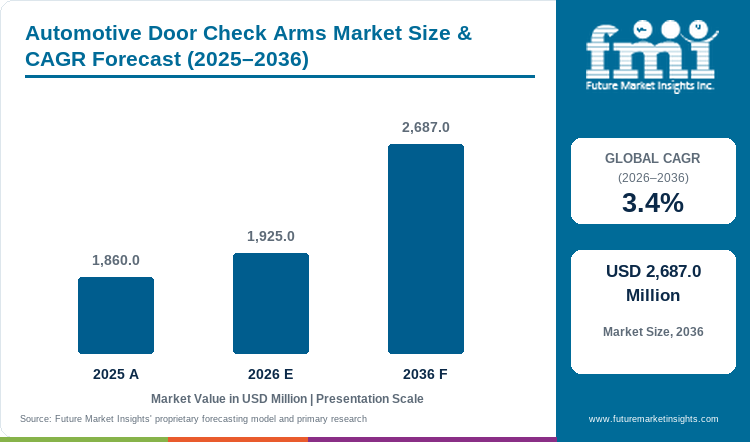
USD 1,925.0 million in 2026 and USD 2,687.0 million by 2036 at a 3.4% CAGR.
The market was valued at USD 1,860.0 million in 2025. Demand is estimated at USD 1,925.0 million in 2026 and is projected to reach USD 2,687.0 million by 2036 at 3.4% CAGR. The estimate covers mechanical, hydraulic and electromechanical door-check assemblies that regulate and retain the opening angle of hinged vehicle doors. OEM fitment and service replacement are included. Door hinges, latches, gas springs and complete power-door systems are excluded unless the check function is supplied within the assembly.
Demand develops beside the automotive door hinges market, because both products are specified within the side-door kinematic system. Check-arm revenue follows vehicle output, door count, system content and replacement of worn or noisy assemblies.
Key Takeaways
- The market is valued at USD 1,925.0 million in 2026 and is projected to create USD 762.0 million in additional value by 2036.
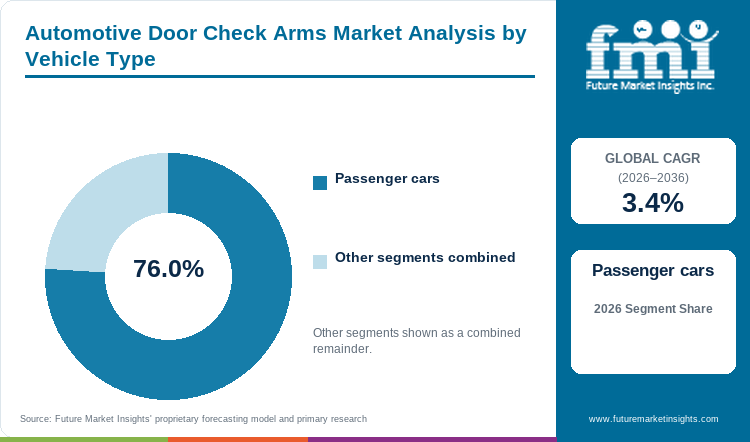
- Passenger cars is projected to hold 76.0% of Vehicle Type demand in 2026 because passenger-car output creates the broadest four-door fitment pool.
- Front side doors is projected to hold 52.0% of Door Position demand in 2026 because front doors are universal across conventional cabin layouts.
- Steel core with polymer overmold is projected to hold 58.0% of Material and Construction demand in 2026 because it combines structural strength with molded detent geometry.
- Integrated hinge checks and complete power-door actuators can remove a conventional arm from premium or space-constrained door architectures.
- Some of the key players in this market include Edscha, AISIN, Stabilus, Dorman Products, Aditya Auto Products & Engineering, Magna, Brose, AISIN Shiroki, ITW Motion, Kiekert.
Analyst Perspective
"A door check is judged in a few seconds by the driver, but it must repeat the same motion across years of temperature cycles, contamination and door slams."
- Nikhil Kaitwade, Principal Consultant, Future Market Insights
How is the automotive door check arms market segmented?
The automotive door check arms market is segmented by vehicle type, door position, material and construction, mechanism, sales channel and region.
Vehicle type sets the production pool. Door position changes fitment frequency and load. Material and mechanism define cost, detent behavior and durability, while sales channel separates platform installation from service replacement.
Why do passenger cars lead vehicle-type demand?
Passenger cars combine high production volume with repeated fitment per vehicle. Conventional four-door models may use a check assembly on every side door, so component demand rises faster than vehicle count alone suggests. Platform proliferation adds another layer: door mass, hinge geometry and opening angle differ by body style, which keeps check-arm specifications tied to individual programs rather than a single universal design. Global motor-vehicle production reached 96.4 million units in 2025, providing a broad production base for door-control hardware.
- Passenger cars account for 76.0% of vehicle-type demand in 2026.
- OICA reported 96.4 million motor vehicles produced globally in 2025, while passenger-car production remained a major source of multi-door check-arm fitment.
Why do front side doors lead door-position demand?
Front doors are present across sedans, hatchbacks, SUVs, pickups and most vans, even where rear-door configuration varies. They also see frequent use and often carry mirrors, speakers, wiring and trim that add mass to the door assembly. The check therefore has to control opening speed, hold the door at intermediate positions and resist loads near the end of travel. AISIN defines the door check around these same functions: regulating and retaining door opening while assisting closing.
- Front side doors represent 52.0% of door-position demand in 2026.
- Dorman maintains distinct front-left, front-right and front-left-or-right replacement check assemblies across Honda, Toyota, Ford and GM applications, illustrating how front-door fitment remains both common and position-specific.
Why does steel core with polymer overmold lead construction demand?
The check arm has to carry tensile and bending loads while producing smooth, repeatable holding effort as the door moves through its travel. Steel provides the structural backbone. Polymer at the contact surface can shape the working profile, reduce noise and control sliding behavior without requiring a fully machined metal arm. Current replacement assemblies show this mixed-material approach in practice: Dorman lists door checks made from steel and plastic for several Toyota applications.
- Steel core with polymer overmold makes up 58.0% of construction demand in 2026.
- Dorman specifies steel-and-plastic construction on application-specific door checks for Toyota Prius and Corolla platforms, supporting the use of combined structural and low-friction materials within conventional assemblies.
Why do roller and slider detent mechanisms lead?
The mechanism has to create recognizable hold-open positions without occupying much space inside the door cavity. A profiled arm moving against spring-loaded contact elements does this mechanically: changes in profile height alter resistance, while pockets or detents create defined stopping positions. CA2998496A1 describes a check arm with a variable-force profile and spaced pockets corresponding to discrete door positions, with a bearing member sliding against that profile. The holding characteristic can therefore be tuned through geometry rather than electronics.
- Roller and slider detent mechanisms hold 70.0% of mechanism demand in 2026.
- Patent literature documents profiled check arms, spring-loaded contact elements and discrete holding positions, confirming the established mechanical basis of this architecture.
Why does OEM supply lead the sales channel?
A door check is validated as part of the complete door system. Holding effort has to suit door mass, hinge geometry, seal resistance and the available package inside the door cavity. End-stop behavior also matters because loads are transferred into the door and body structure at full opening. This makes the component difficult to standardize across unrelated vehicles. The aftermarket exists mainly to reproduce the geometry and function of an original assembly after wear or failure.
- OEM supply captures 86.0% of sales-channel demand in 2026.
- Dorman describes its replacement checks as specific-fit parts designed to match the function of the original assembly, with separate applications and OE cross-references for individual vehicle programs.
What are the drivers, restraints and opportunities in the Automotive Door Check Arms Market?
Vehicle output sustains high-volume fitment, integrated door systems can displace the conventional arm, and aging vehicle fleets expand replacement demand.
- Driver: Global production and widespread four-door body styles create recurring OEM demand for several check assemblies per vehicle.
- Restraint: Integrated hinges and powered door-control systems can substitute for a standalone mechanical check arm.
- Opportunity: Low-noise composite profiles, continuous-position holding and service parts for older vehicles can raise value per application.
The automotive door latch and hinges market provides a direct demand proxy because door checks are fitted during body and door assembly. OICA reported 96.4 million vehicles produced in 2025, so small changes in average door content materially affect unit demand.
A conventional check arm competes for space with wiring, speakers, window regulators and side-impact structures. Premium power doors may combine motion, holding and obstacle detection in one actuator, while integrated hinge checks can reduce component count. Suppliers must therefore prove that a separate arm still offers the preferred cost and feel.
The automotive door latch market expands opportunities for refined motion as door modules add sensors and electronic functions. Continuous-position holding and better damping can capture value where automakers want a controlled opening experience without a complete powered-door package.
Which country CAGRs are profiled in the Automotive Door Check Arms Market?
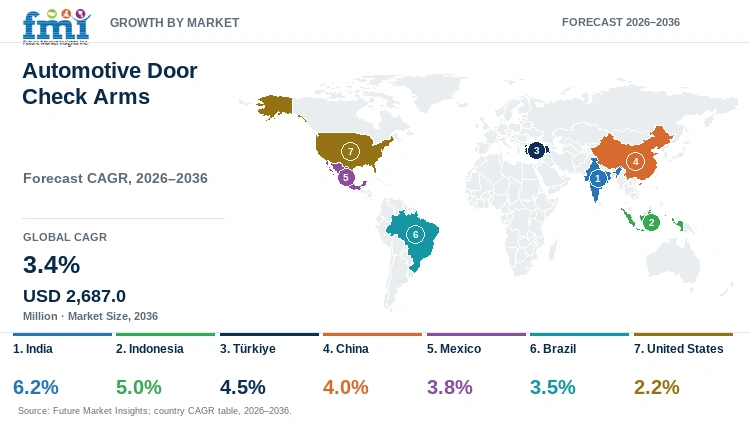
| Country | CAGR |
|---|---|
| India | 6.2% |
| Indonesia | 5.0% |
| Türkiye | 4.5% |
| China | 4.0% |
| Mexico | 3.8% |
| Brazil | 3.5% |
| United States | 2.2% |
How do country-level CAGRs compare in the Automotive Door Check Arms Market?
Door check-arm demand follows vehicle output, door count per platform, local sourcing requirements and the rate at which conventional mechanical checks give way to more advanced door-control systems. India has a broadening passenger-vehicle base and a deepening supplier network around stamped and molded body hardware. Indonesia remains more dependent on conventional, cost-controlled vehicle architectures. Türkiye and Mexico benefit from export-oriented assembly, while Brazil combines new-vehicle production with a sizeable replacement market. China brings scale but also faster adoption of higher-content door systems. The United States remains heavily influenced by the service life of its installed fleet.
- India: Passenger-vehicle production reached 5.38 million units in calendar 2025, giving door-check suppliers a substantial OEM fitment base before replacement demand is considered. Platform localization also favors suppliers that can combine formed steel parts, polymer interfaces and vehicle-specific validation.
- Indonesia: Conventional mechanical checks remain well suited to price-sensitive passenger vehicles and MPVs, where low part count and familiar manufacturing processes carry more weight than powered or continuously controlled door motion.
- Türkiye: Local assembly serves both domestic and export programs, so door-check suppliers have to manage several platform specifications while meeting corrosion, endurance and delivery requirements associated with European vehicle programs.
- China: Vehicle production exceeded 34.5 million units in 2025, providing a very large component base. At the same time, new-energy vehicles accounted for 16.6 million units of production, increasing exposure to richer door-system content on selected platforms.
- Mexico: Light-vehicle production reached 3.95 million units in 2025, with light trucks representing 77.2% of output. That mix keeps front-door check systems relevant across pickups and utility vehicles assembled for North American markets.
- Brazil: Production rose to 2.64 million vehicles in 2025. OEM demand therefore has a growing production base, while older vehicles continue to generate replacement purchases when check arms develop noise, excessive free movement or weak hold-open performance.
- United States: The opportunity is less about rapid fitment expansion and more about the size of the vehicle parc. Replacement demand remains meaningful where heavily used front-door checks wear at the detent, roller or pivot interfaces.
Across the key countries in this market, these rates measure revenue within the defined product boundary and do not represent growth of the wider automotive components industry.
Country-wise Analysis
- India: 6.2% CAGR through 2036. More passenger-vehicle programs create repeated sourcing opportunities because each platform requires its own combination of check effort, opening angle and package geometry. Calendar-year 2025 passenger-vehicle production reached 5.38 million units. The installed fleet adds a second route through replacement parts once door checks begin to loosen, click or lose holding force.
- Indonesia: 5.0% CAGR through 2036. Mechanical door checks fit the economics of locally assembled, value-focused vehicles. Steel-core and polymer-contact architectures can be produced regionally without introducing motors, sensors or complex electronics, keeping the component attractive where manufacturers are still prioritizing straightforward door hardware.
- Türkiye: 4.5% CAGR through 2036. Export assembly creates a supplier environment where consistency matters as much as part cost. Check arms have to meet vehicle-specific opening effort, corrosion protection and endurance targets across programs destined for several markets, which favors suppliers able to support platform validation rather than only produce stamped hardware.
- China: 4.0% CAGR through 2036. Production scale continues to generate large unit demand for conventional checks, but the content mix is changing. More than 16.6 million new-energy vehicles were produced in 2025, and selected higher-content models increasingly use powered doors, soft-close functions or more sophisticated motion-control hardware. Conventional check arms therefore retain volume while losing some share at the upper end of the market.
- Mexico: 3.8% CAGR through 2036. Local plants produced 3.95 million light vehicles in 2025, and more than three-quarters were light trucks. That production structure supports substantial front-door hardware demand, but sourcing remains tightly linked to North American platform schedules, localization targets and quality performance at body-assembly plants.
- Brazil: 3.5% CAGR through 2036. Vehicle output increased 3.5% in 2025 to 2.64 million units, strengthening original-fitment demand. The service side is different: long vehicle ownership periods and repeated door use create replacement opportunities for worn check assemblies even when new-vehicle growth slows.
- United States: 2.2% CAGR through 2036. New-platform demand remains substantial, but the more durable source of incremental revenue sits in replacement. Front-door checks experience frequent cycling, and failure is noticeable to the driver through clicking, reduced detent force or uncontrolled door movement. That creates a steady service market even without rapid growth in new mechanical-check fitment.
Who are the notable companies in the Automotive Door Check Arms Market?
Edscha, AISIN, Stabilus, Dorman Products, Aditya Auto Products & Engineering, Magna, Brose, AISIN Shiroki, ITW Motion, Kiekert are the notable companies profiled in this market.
Direct evidence is strongest for Edscha, AISIN, Stabilus and Dorman. Integrated door and closure suppliers influence the same platform decision but remain Unscored where a current standalone check-arm product is not publicly confirmed.
- Direct Door-Check Suppliers: Edscha, AISIN, Stabilus, Dorman Products.
- Regional and Body-Component Platforms: Aditya Auto Products & Engineering, AISIN Shiroki.
- Adjacent Door-System Specialists: Magna, Brose, ITW Motion, Kiekert.
Competitive Benchmarking: Automotive Door Check Arms Market
| Company | Direct Check Evidence | Motion-Control Breadth | OEM or Service Reach | Geographic Reach |
|---|---|---|---|---|
| Edscha | High | High | High | Global |
| AISIN | High | High | High | Global |
| Stabilus | High | High | High | Global |
| Dorman Products | High | Medium | High | North America, export |
| Aditya Auto Products & Engineering | Medium | Medium | High | India |
| Magna | Unscored | High | High | Global |
| Brose | Unscored | High | High | Global |
| AISIN Shiroki | Unscored | Medium | High | Asia, global programs |
| ITW Motion | Unscored | High | Medium | Global |
| Kiekert | Unscored | High | High | Global |
High direct evidence requires a named automotive door-check product. Medium reflects documented participation through a direct venture or closely related component. Unscored identifies adjacent door-system capability without sufficient public proof of a current standalone check arm.
Key Developments in the Automotive Door Check Arms Market
- In April 2026, Edscha announced that its new Hefei site would develop and manufacture door hinges, door checks and tailgate hinges, with China capacity expected to more than triple.
- In July 2026, Magna described software-defined motion profiles for its production SmartAccess power-door platform, reinforcing the shift from passive checks toward controlled door movement.
- In April 2025, Stabilus disclosed an order exceeding 400,000 electromechanical door-drive systems per year from a Chinese automaker, with production scheduled from 2026.
Key Players in the Automotive Door Check Arms Market
Direct Door-Check Suppliers
- Edscha
- AISIN
- Stabilus
- Dorman Products
Regional and Body-Component Platforms
- Aditya Auto Products & Engineering
- AISIN Shiroki
Adjacent Door-System Specialists
- Magna
- Brose
- ITW Motion
- Kiekert
Automotive Door Check Arms Market - Report Scope
| Coverage field | Report scope |
|---|---|
| Market Size | USD 1,925.0 million in 2026 and USD 2,687.0 million by 2036 at 3.4% CAGR. |
| Market Definition | Mechanical, hydraulic or electromechanical assemblies that limit, retain or damp the opening movement of a hinged vehicle door. |
| Segmentation | Vehicle type, door position, material and construction, mechanism, sales channel and region. |
| Regional Coverage | North America, Latin America, Western Europe, Eastern Europe, East Asia, South Asia and Pacific, and Middle East and Africa. |
| Countries Covered | India, Indonesia, Türkiye, China, Mexico, Brazil, United States and more than 20 countries included in the full report. |
| Key Companies Profiled | Edscha, AISIN, Stabilus, Dorman Products, Aditya Auto Products & Engineering, Magna, Brose, AISIN Shiroki, ITW Motion, Kiekert. |
| Forecast Period | 2026 to 2036. |
| Approach | Bottom-up model using vehicle production, average check assemblies per vehicle, OEM pricing, vehicle parc, replacement incidence and aftermarket pricing. |
Automotive Door Check Arms Market - Research Methodology
| Method | Approach |
|---|---|
| Primary Research | Direct-source research reviewed official production statistics, patent records, manufacturer product pages and corporate announcements. Evidence was checked against the defined check-arm function and the stated sales channel. |
| Desk Research | Desk research covered government statistics, standards, industry associations, technical literature, patents, official product information and corporate announcements. Evidence was screened for scope, date and direct relevance. |
| Market Sizing and Forecasting | Bottom-up model using vehicle production, average check assemblies per vehicle, OEM pricing, vehicle parc, replacement incidence and aftermarket pricing. |
| Data Validation | Estimates were checked against parent-market activity, installed-base indicators, product specifications and supplier participation. Adjacent products without the defined function were excluded. |
Automotive Door Check Arms Market by Segments
Automotive Door Check Arms Market segmented by Vehicle Type:
- Passenger cars
- Light commercial vehicles
- Medium and heavy trucks
- Buses and coaches
Automotive Door Check Arms Market segmented by Door Position:
- Front side doors
- Rear side doors
- Other hinged access doors
Automotive Door Check Arms Market segmented by Material and Construction:
- Steel core with polymer overmold
- Stamped steel
- Fiber-reinforced composite
- Other constructions
Automotive Door Check Arms Market segmented by Mechanism:
- Roller and slider detent
- Friction slider
- Active and electromechanical
- Integrated hinge check
Automotive Door Check Arms Market segmented by Sales Channel:
- OEM supply
- Aftermarket
Automotive Door Check Arms Market by Region:
- North America
- United States
- Canada
- Latin America
- Brazil
- Mexico
- Argentina
- Chile
- Western Europe
- Germany
- France
- United Kingdom
- Italy
- Spain
- Benelux
- Nordics
- Eastern Europe
- Poland
- Czech Republic
- Romania
- Hungary
- East Asia
- China
- Japan
- South Korea
- South Asia and Pacific
- India
- ASEAN
- Australia and New Zealand
- Middle East and Africa
- GCC Countries
- South Africa
- Türkiye
- Israel
Research Sources and Bibliography
- International Organization of Motor Vehicle Manufacturers. (2026). Global motor-vehicle production reached 96.4 million units in 2025.
- German Association of the Automotive Industry. (2026). International automobile production tables.
- Canadian Intellectual Property Office. (2017). CA2998496A1, vehicle door checker.
- United States Patent and Trademark Office. (2017). US9617774B2, composite check arm.
- European Patent Office. (2021). EP3103945B1, active door check.
- European Automobile Manufacturers' Association. (2026). Vehicles on European Roads 2026.
- European Environment Agency. (2026). Evolution of average passenger-car age in the European Union.
- Edscha. (2026, April 14). Edscha strengthens its presence in Hefei with a state-of-the-art site.
- Stabilus. (2025, April 8). Electromechanical door control systems and major tenders.
- AISIN. (n.d.; accessed September 24, 2026). Doors and Roofs: Door Check.
- Dorman Products. (n.d.; accessed September 24, 2026). Door Check assemblies.
- Future Market Insights. (2026). Automotive Door Hinges Market.
This bibliography is provided for reader reference and is not exhaustive. The full report contains the complete reference list and detailed citations.
This Report Answers
- How large is the automotive door check arms market in 2026 and 2036?
- Which product specification leads demand in 2026?
- What operating condition converts technical need into a purchase?
- Which constraint can delay qualification or replacement?
- How do country growth rates compare across the profiled markets?
- Which companies provide direct or adjacent market capability?
Frequently Asked Questions
How big is the automotive door check arms market in 2026?
The automotive door check arms market is valued at USD 1,925.0 million in 2026 and is projected to reach USD 2,687.0 million by 2036. The estimate covers revenue within the stated market definition and excludes adjacent equipment or chemicals sold without the required function.
What is the CAGR of the automotive door check arms market from 2026 to 2036?
The market is projected to grow at 3.4% CAGR between 2026 and 2036. Expansion depends on end-market output together with the rate at which plants adopt higher-specification products.
Which vehicle type leads the automotive door check arms market?
Passenger cars is expected to hold 76.0% share in 2026 because passenger-car output creates the broadest four-door fitment pool. Commercial vehicles add durable assemblies but remain smaller in unit volume.
Which countries are projected to record higher growth?
India is projected at 6.2% CAGR, followed by Indonesia at 5.0% and Türkiye at 4.5% through 2036. The comparison reflects local production investment and the timing of replacement or qualification cycles.
Which companies are active in the automotive door check arms market?
The profiled group includes Edscha, AISIN, Stabilus, Dorman Products, Aditya Auto Products & Engineering, Magna, Brose, AISIN Shiroki, ITW Motion, Kiekert. Capability differs by product range and application evidence.
Preview the report firsthand - request a free sample
Get SampleGet the brochure for pricing and purchase details.
Get PDFTable of Content
- Key Takeaways
- Market Size and CAGR
- Top Growth Driver
- Fastest Growing Segment
- Leading Region
- Key Companies
- Emerging Opportunities
- Executive Summary
- Global Market Outlook
- Demand-side Trends
- Supply-side Trends
- Technology Roadmap Analysis
- Analysis and Recommendations
- Analyst Perspective (What is happening? Why now? What should investors know?)
- Key Questions Answered
- How large is the market?
- What is the CAGR?
- What are key trends?
- Which region dominates?
- Who are the leaders?
- Market Overview
- Market Coverage / Taxonomy
- Market Definition / Scope / Limitations
- Research Methodology
- Chapter Orientation
- Analytical Lens and Working Hypotheses
- Market Structure, Signals, and Trend Drivers
- Benchmarking and Cross-market Comparability
- Market Sizing, Forecasting, and Opportunity Mapping
- Research Design and Evidence Framework
- Desk Research Programme (Secondary Evidence)
- Expert Input and Fieldwork (Primary Evidence)
- Tooling, Models, and Reference Databases
- Data Engineering and Model Build
- Quality Assurance and Audit Trail
- Market Background
- Market Dynamics (Drivers, Restraints, Opportunity, Trends)
- Scenario Forecast (Optimistic, Likely, Conservative)
- Impact Analysis
- AI Impact
- Sustainability Impact
- Regulatory Impact
- Technology Impact
- Consumer / Buyer Analysis
- Purchase Drivers
- Adoption Barriers
- Buyer Journey
- Opportunity Map Analysis
- Product Life Cycle Analysis
- Supply Chain Analysis
- Investment Feasibility Matrix
- Value Chain Analysis
- PESTLE and Porter's Analysis
- Regulatory Landscape
- Regional Parent Market Outlook
- Production and Consumption Statistics
- Import and Export Statistics
- Global Market Analysis and Forecast, 2021 to 2036
- Historical Market Size Value (USD Million) Analysis, 2021 to 2025
- Current and Future Market Size Value (USD Million) Projections, 2026 to 2036
- Y-o-Y Growth Trend Analysis
- Absolute $ Opportunity Analysis
- Global Market Pricing Analysis, 2021 to 2036
- Global Market Analysis and Forecast, By Vehicle Type, 2021 to 2036
- Introduction / Key Findings
- Historical Market Size Value (USD Million) Analysis By Vehicle Type, 2021 to 2025
- Current and Future Market Size Value (USD Million) Analysis and Forecast By Vehicle Type, 2026 to 2036
- Passenger cars
- Light commercial vehicles
- Medium and heavy trucks
- Buses and coaches
- Y-o-Y Growth Trend Analysis By Vehicle Type, 2021 to 2025
- Absolute $ Opportunity Analysis By Vehicle Type, 2026 to 2036
- Global Market Analysis and Forecast, By Door Position, 2021 to 2036
- Introduction / Key Findings
- Historical Market Size Value (USD Million) Analysis By Door Position, 2021 to 2025
- Current and Future Market Size Value (USD Million) Analysis and Forecast By Door Position, 2026 to 2036
- Front side doors
- Rear side doors
- Other hinged access doors
- Y-o-Y Growth Trend Analysis By Door Position, 2021 to 2025
- Absolute $ Opportunity Analysis By Door Position, 2026 to 2036
- Global Market Analysis and Forecast, By Material and Construction, 2021 to 2036
- Introduction / Key Findings
- Historical Market Size Value (USD Million) Analysis By Material and Construction, 2021 to 2025
- Current and Future Market Size Value (USD Million) Analysis and Forecast By Material and Construction, 2026 to 2036
- Steel core with polymer overmold
- Stamped steel
- Fiber-reinforced composite
- Other constructions
- Y-o-Y Growth Trend Analysis By Material and Construction, 2021 to 2025
- Absolute $ Opportunity Analysis By Material and Construction, 2026 to 2036
- Global Market Analysis and Forecast, By Mechanism, 2021 to 2036
- Introduction / Key Findings
- Historical Market Size Value (USD Million) Analysis By Mechanism, 2021 to 2025
- Current and Future Market Size Value (USD Million) Analysis and Forecast By Mechanism, 2026 to 2036
- Roller and slider detent
- Friction slider
- Active and electromechanical
- Integrated hinge check
- Y-o-Y Growth Trend Analysis By Mechanism, 2021 to 2025
- Absolute $ Opportunity Analysis By Mechanism, 2026 to 2036
- Global Market Analysis and Forecast, By Sales Channel, 2021 to 2036
- Introduction / Key Findings
- Historical Market Size Value (USD Million) Analysis By Sales Channel, 2021 to 2025
- Current and Future Market Size Value (USD Million) Analysis and Forecast By Sales Channel, 2026 to 2036
- OEM supply
- Aftermarket
- Y-o-Y Growth Trend Analysis By Sales Channel, 2021 to 2025
- Absolute $ Opportunity Analysis By Sales Channel, 2026 to 2036
- Global Market Analysis and Forecast, By Region, 2021 to 2036
- Introduction
- Historical Market Size Value (USD Million) Analysis By Region, 2021 to 2025
- Current Market Size Value (USD Million) Analysis and Forecast By Region, 2026 to 2036
- North America
- Latin America
- Western Europe
- Eastern Europe
- East Asia
- South Asia and Pacific
- Middle East and Africa
- Market Attractiveness Analysis By Region
- North America Market Analysis and Forecast, By Country, 2021 to 2036
- Historical Market Size Value (USD Million) Trend Analysis By Market Taxonomy, 2021 to 2025
- Market Size Value (USD Million) Forecast By Market Taxonomy, 2026 to 2036
- By Country
- United States
- Canada
- By Vehicle Type
- By Door Position
- By Material and Construction
- By Mechanism
- By Sales Channel
- By Country
- Market Attractiveness Analysis
- By Country
- By Vehicle Type
- By Door Position
- By Material and Construction
- By Mechanism
- By Sales Channel
- Key Takeaways
- Latin America Market Analysis and Forecast, By Country
- Historical Market Size Value (USD Million) Trend Analysis By Market Taxonomy, 2021 to 2025
- Market Size Value (USD Million) Forecast By Market Taxonomy, 2026 to 2036
- By Country
- Brazil
- Mexico
- Argentina
- Chile
- By Vehicle Type
- By Door Position
- By Material and Construction
- By Mechanism
- By Sales Channel
- By Country
- Market Attractiveness Analysis
- By Country
- By Vehicle Type
- By Door Position
- By Material and Construction
- By Mechanism
- By Sales Channel
- Key Takeaways
- Western Europe Market Analysis and Forecast, By Country
- Historical Market Size Value (USD Million) Trend Analysis By Market Taxonomy, 2021 to 2025
- Market Size Value (USD Million) Forecast By Market Taxonomy, 2026 to 2036
- By Country
- Germany
- France
- United Kingdom
- Italy
- Spain
- Benelux
- Nordics
- By Vehicle Type
- By Door Position
- By Material and Construction
- By Mechanism
- By Sales Channel
- By Country
- Market Attractiveness Analysis
- By Country
- By Vehicle Type
- By Door Position
- By Material and Construction
- By Mechanism
- By Sales Channel
- Key Takeaways
- Eastern Europe Market Analysis and Forecast, By Country
- Historical Market Size Value (USD Million) Trend Analysis By Market Taxonomy, 2021 to 2025
- Market Size Value (USD Million) Forecast By Market Taxonomy, 2026 to 2036
- By Country
- Poland
- Czech Republic
- Romania
- Hungary
- By Vehicle Type
- By Door Position
- By Material and Construction
- By Mechanism
- By Sales Channel
- By Country
- Market Attractiveness Analysis
- By Country
- By Vehicle Type
- By Door Position
- By Material and Construction
- By Mechanism
- By Sales Channel
- Key Takeaways
- East Asia Market Analysis and Forecast, By Country
- Historical Market Size Value (USD Million) Trend Analysis By Market Taxonomy, 2021 to 2025
- Market Size Value (USD Million) Forecast By Market Taxonomy, 2026 to 2036
- By Country
- China
- Japan
- South Korea
- By Vehicle Type
- By Door Position
- By Material and Construction
- By Mechanism
- By Sales Channel
- By Country
- Market Attractiveness Analysis
- By Country
- By Vehicle Type
- By Door Position
- By Material and Construction
- By Mechanism
- By Sales Channel
- Key Takeaways
- South Asia and Pacific Market Analysis and Forecast, By Country
- Historical Market Size Value (USD Million) Trend Analysis By Market Taxonomy, 2021 to 2025
- Market Size Value (USD Million) Forecast By Market Taxonomy, 2026 to 2036
- By Country
- India
- ASEAN
- Australia and New Zealand
- By Vehicle Type
- By Door Position
- By Material and Construction
- By Mechanism
- By Sales Channel
- By Country
- Market Attractiveness Analysis
- By Country
- By Vehicle Type
- By Door Position
- By Material and Construction
- By Mechanism
- By Sales Channel
- Key Takeaways
- Middle East and Africa Market Analysis and Forecast, By Country
- Historical Market Size Value (USD Million) Trend Analysis By Market Taxonomy, 2021 to 2025
- Market Size Value (USD Million) Forecast By Market Taxonomy, 2026 to 2036
- By Country
- GCC Countries
- South Africa
- Türkiye
- Israel
- By Vehicle Type
- By Door Position
- By Material and Construction
- By Mechanism
- By Sales Channel
- By Country
- Market Attractiveness Analysis
- By Country
- By Vehicle Type
- By Door Position
- By Material and Construction
- By Mechanism
- By Sales Channel
- Key Takeaways
- Key Countries Market Analysis
- United States
- Pricing Analysis
- Market Share Analysis, 2025
- By Vehicle Type
- By Door Position
- By Material and Construction
- By Mechanism
- By Sales Channel
- Canada
- Pricing Analysis
- Market Share Analysis, 2025
- By Vehicle Type
- By Door Position
- By Material and Construction
- By Mechanism
- By Sales Channel
- Mexico
- Pricing Analysis
- Market Share Analysis, 2025
- By Vehicle Type
- By Door Position
- By Material and Construction
- By Mechanism
- By Sales Channel
- Brazil
- Pricing Analysis
- Market Share Analysis, 2025
- By Vehicle Type
- By Door Position
- By Material and Construction
- By Mechanism
- By Sales Channel
- Chile
- Pricing Analysis
- Market Share Analysis, 2025
- By Vehicle Type
- By Door Position
- By Material and Construction
- By Mechanism
- By Sales Channel
- Germany
- Pricing Analysis
- Market Share Analysis, 2025
- By Vehicle Type
- By Door Position
- By Material and Construction
- By Mechanism
- By Sales Channel
- United Kingdom
- Pricing Analysis
- Market Share Analysis, 2025
- By Vehicle Type
- By Door Position
- By Material and Construction
- By Mechanism
- By Sales Channel
- Italy
- Pricing Analysis
- Market Share Analysis, 2025
- By Vehicle Type
- By Door Position
- By Material and Construction
- By Mechanism
- By Sales Channel
- Spain
- Pricing Analysis
- Market Share Analysis, 2025
- By Vehicle Type
- By Door Position
- By Material and Construction
- By Mechanism
- By Sales Channel
- France
- Pricing Analysis
- Market Share Analysis, 2025
- By Vehicle Type
- By Door Position
- By Material and Construction
- By Mechanism
- By Sales Channel
- India
- Pricing Analysis
- Market Share Analysis, 2025
- By Vehicle Type
- By Door Position
- By Material and Construction
- By Mechanism
- By Sales Channel
- ASEAN
- Pricing Analysis
- Market Share Analysis, 2025
- By Vehicle Type
- By Door Position
- By Material and Construction
- By Mechanism
- By Sales Channel
- Australia and New Zealand
- Pricing Analysis
- Market Share Analysis, 2025
- By Vehicle Type
- By Door Position
- By Material and Construction
- By Mechanism
- By Sales Channel
- China
- Pricing Analysis
- Market Share Analysis, 2025
- By Vehicle Type
- By Door Position
- By Material and Construction
- By Mechanism
- By Sales Channel
- Japan
- Pricing Analysis
- Market Share Analysis, 2025
- By Vehicle Type
- By Door Position
- By Material and Construction
- By Mechanism
- By Sales Channel
- South Korea
- Pricing Analysis
- Market Share Analysis, 2025
- By Vehicle Type
- By Door Position
- By Material and Construction
- By Mechanism
- By Sales Channel
- Poland
- Pricing Analysis
- Market Share Analysis, 2025
- By Vehicle Type
- By Door Position
- By Material and Construction
- By Mechanism
- By Sales Channel
- Hungary
- Pricing Analysis
- Market Share Analysis, 2025
- By Vehicle Type
- By Door Position
- By Material and Construction
- By Mechanism
- By Sales Channel
- Türkiye
- Pricing Analysis
- Market Share Analysis, 2025
- By Vehicle Type
- By Door Position
- By Material and Construction
- By Mechanism
- By Sales Channel
- South Africa
- Pricing Analysis
- Market Share Analysis, 2025
- By Vehicle Type
- By Door Position
- By Material and Construction
- By Mechanism
- By Sales Channel
- Indonesia
- Pricing Analysis
- Market Share Analysis, 2025
- By Vehicle Type
- By Door Position
- By Material and Construction
- By Mechanism
- By Sales Channel
- United States
- Market Structure Analysis
- Competition Dashboard
- Competition Benchmarking
- Market Share Analysis of Top Players
- By Regional
- By Vehicle Type
- By Door Position
- By Material and Construction
- By Mechanism
- By Sales Channel
- Emerging Startups
- Innovation Benchmarking
- Competition Analysis
- Competition Deep Dive
- Edscha
- Overview
- Product Portfolio
- Profitability by Market Segments
- Sales Footprint
- Strategy Overview
- Marketing Strategy
- Product Strategy
- Channel Strategy
- AISIN
- Stabilus
- Dorman Products
- Aditya Auto Products & Engineering
- Magna
- Brose
- AISIN Shiroki
- ITW Motion
- Kiekert
- Edscha
- Case Studies
- Success Stories
- Recent Developments
- Competition Deep Dive
- Assumptions & Acronyms Used


