

- Market Size (2026)
- USD 3.4 Bn
- Forecast (2036)
- USD 5.6 Bn
- CAGR (2026 to 2036)
- 5.1%
How big is Automotive Cam Phasers Market in 2026?
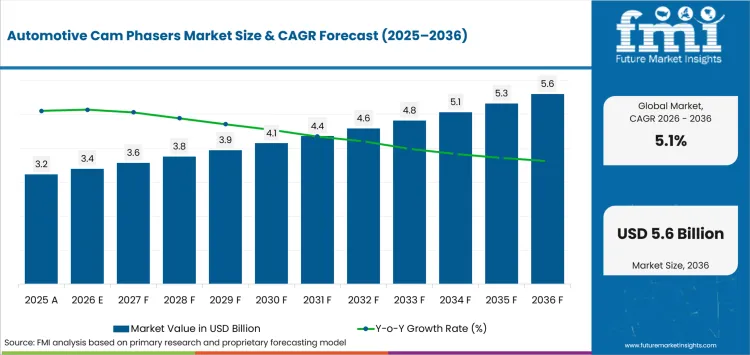
USD 3.4 billion in 2026 and USD 5.6 billion by 2036 at a 5.1% CAGR.
Demand for automotive cam phasers is projected to expand at 5.1% CAGR between 2026 and 2036, increasing valuation from USD 3.4 billion in 2026 to USD 5.6 billion by 2036. Revenue follows engine programs that retain controllable intake or exhaust timing for efficiency and hybrid restart quality. Schaeffler's April 2026 hybrid-powertrain release describes electromechanical camshaft phasing units with integrated motors, controls and software. Pressure-independent response gives phaser manufacturers a higher-value route into hybrid engines without requiring a broader cylinder-head redesign.
Regional demand differs because each vehicle mix leaves a different share of engines with camshafts and variable timing hardware. ACEA's July 2026 first-half data put hybrid-electric cars at 37.3% of EU registrations and battery-electric cars at 20.7%, with petrol and diesel together at 29.7%. Europe therefore retains meaningful combustion content inside hybrids, although battery-electric substitution steadily removes phaser fitment. Country revenue will depend on hybrid program duration, replacement intensity and the pace of powertrain change.
Key Takeaways
- Cam phaser demand follows combustion and hybrid engine programs that use adjustable valve timing to manage efficiency, restart quality and load response.
- By phaser type, hydraulic cam phasers are estimated to hold 38.0% in 2026 owing to oil-fed architectures that fit mature timing hardware and manufacturing routes.
- In 2026, inline engines are expected to lead engine type with 31.0% share because high-volume four-cylinder layouts accept modular phaser interfaces.
- Passenger cars are set to lead the vehicle type category with 42.0% share in 2026 due to gasoline and hybrid programs retaining variable valve control.
- Faster battery-electric adoption reduces new combustion-engine fitment and raises the commercial cost of qualifying a phaser for shrinking platform volumes.
- Some of the key players in this market include BorgWarner Inc., Schaeffler AG, AISIN CORPORATION, Astemo, Ltd., Mikuni Corporation, and Melling Tool Company.
Analyst Perspective
"Cam phaser value is shifting toward engines that need fast phase response during hybrid restarts without larger cylinder-head changes. Suppliers that prove response, oil-demand control and engine-specific durability can protect content as battery-electric growth reduces the number of new combustion programs."
- Nikhil Kaitwade, Principal Consultant, Future Market Insights
How is the automotive cam phasers market segmented?
The automotive cam phasers market is segmented by phaser type, engine type, vehicle type, sales channel and application.
Phaser type covers hydraulic, vane-type, electric, sprocket-type and cam torque actuated designs. Engine type includes inline, hybrid ICE, turbocharged engines, V engines and performance engines. Vehicle type covers passenger cars, SUVs/crossovers, light commercial vehicles and performance vehicles. Sales channels comprise OEM direct, engine system suppliers, aftermarket replacement and remanufacturing. Applications include intake control, dual VVT, exhaust control and cylinder-deactivation support in engine programs.
What drives intake cam control in the application category?
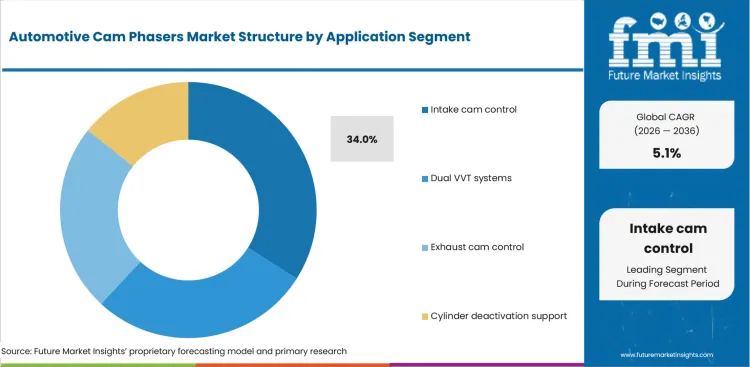
Intake cam timing changes when fresh charge is trapped, giving calibration teams direct control over pumping work and effective compression. The same authority can improve restart behavior without adding a second valve-control architecture.
- Intake cam control is set to lead the application category with 34.0% share in 2026 due to intake timing directly changing charge filling, pumping work and restart calibration.
- EPA's February 2026 Automotive Trends Report put variable valve timing at 89.4% of preliminary model-year 2025 gasoline-vehicle production. That penetration shows how deeply valve-event control is embedded in current gasoline platforms and calibration practice.
What makes hydraulic cam phasers central to the phaser type category?
Hydraulic cam phasers use engine oil pressure to move the camshaft against the timing drive at a cost familiar to established engine programs. Their fit with mature cylinder-head layouts keeps them closely tied to variable valve timing architectures without forcing major redesign.
- Based on phaser type, hydraulic cam phasers are projected to account for 38.0% in 2026 because oil-fed vane systems fit established control hardware and proven manufacturing routes.
- Astemo listed valve timing control among the engine-management products for its November 2025 Automechanika Shanghai display. That event keeps VTC visible in current service programs, where oil condition and actuator diagnosis influence replacement decisions.
Why do inline engines lead the engine type category?
Inline engines concentrate camshafts inside compact cylinder heads used widely in four-cylinder passenger vehicles. A modular phaser interface lets engineers adjust timing authority without rebuilding the complete drive for every displacement.
- By engine type, inline engines are estimated to hold 31.0% in 2026 owing to compact four-cylinder layouts that suit modular phaser packaging and repeatable control strategies.
- EPA's February 2026 Automotive Trends Report placed four-cylinder gasoline engines at 60% of USA model-year 2024 production. That concentration sustains a large architecture base, but each engine family still needs its own durability and calibration work.
How do passenger cars lead the vehicle type category?
Passenger-car programs expose cam phasers to low-speed operation, stop-start events and noise targets that make timing quality visible during normal driving. Hybrid models add repeated engine restarts, raising the value of controlled phase response.
- In 2026, passenger cars are expected to lead vehicle type with 42.0% share because gasoline and hybrid platforms retain valve-timing control for efficiency and drivability calibration.
- ACEA reported in January 2026 that hybrid-electric vehicles represented 34.5% of EU new-car registrations during 2025. That volume preserves substantial combustion hardware, even as battery-electric registrations reduce future phaser fitment.
What supports OEM direct leadership in the sales channel category?
Cam phasers enter an engine bill of material before launch because the camshaft interface and control strategy are program-specific. OEM approval ties design responsibility to one source for the engine program.
- By sales channel, OEM direct is forecast to represent 57.0% in 2026 because calibration, durability and launch approval sit inside the vehicle manufacturer's powertrain sourcing process.
- BorgWarner announced in February 2025 that an East Asian OEM selected its VCT for hybrid and gasoline engines. Production was scheduled for the first quarter of 2026, showing how phaser revenue follows engine-program awards instead of open-channel purchasing.
What are the drivers, restraints and opportunities in the Automotive Cam Phasers Market?
Efficiency calibration sustains demand, electrification reduces the addressable engine pool and faster low-oil-pressure actuation offers room for differentiated phaser content.
- Driver: Vehicle manufacturers retain controllable cam timing where combustion and hybrid engines must meet fuel-use, performance and regulated emissions requirements.
- Restraint: Battery-electric growth removes camshafts from new powertrains and can leave fewer units over which a new phaser qualification program recovers its cost.
- Opportunity: Electric or torque-assisted phasing can win higher-value hybrid programs that need fast response before conventional oil pressure stabilizes.
European fleet rules keep efficiency work inside remaining combustion and hybrid programs because CO2 performance is still measured against manufacturer targets. Regulation (EU) 2025/1214, adopted in June 2025, lets manufacturers average 2025-2027 compliance over three years. Cam phasers earn program content only if calibrated valve timing contributes enough efficiency to justify engine-specific validation.
Battery-electric vehicles remove the camshaft and variable valve timing system, so electrification directly reduces new phaser fitment. The IEA's May 2026 Global EV Outlook recorded more than 20 million electric-car sales in 2025, equal to one quarter of global new-car sales. Hybrid and replacement demand can cushion the decline, but they cannot fully offset lost battery-electric platform content.
Hybrid restarts increase the value of phasing that responds before conventional oil pressure stabilizes. BorgWarner announced in May 2026 that a Japanese OEM selected its torsional-assist VCT for a next-generation hybrid engine with production planned for 2028. Faster response and lower oil demand support higher-value awards, provided the design passes cost and durability validation.
Which country CAGRs are profiled in the Automotive Cam Phasers Market?
| Country | CAGR |
|---|---|
| Mexico | 6.6% |
| South Korea | 6.3% |
| Brazil | 5.9% |
| Japan | 5.6% |
| USA | 5.2% |
| France | 4.9% |
| Germany | 4.5% |
How do country-level CAGRs compare in the Automotive Cam Phasers Market?
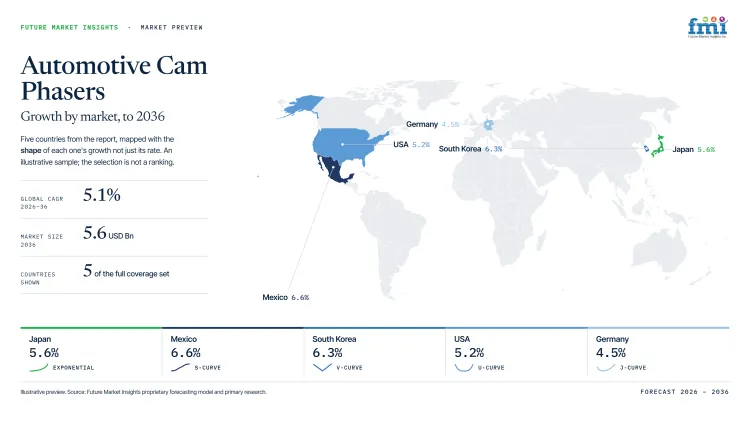
The countries span 2.1 percentage points from Mexico at 6.6% CAGR to Germany at 4.5%. Mexico and South Korea form the upper group, with Brazil and Japan next. USA and France follow before Germany at 4.5%. The spacing reflects engine-program renewal and powertrain mix rather than revenue scale.
- Mexico links export assembly with North American engine sourcing.
- South Korea centers phaser access on domestic OEM programs.
- Brazil's flex-fuel parc widens calibration-sensitive applications.
- Japan prioritizes compact packaging and quiet timing control.
- USA combines model-specific programs with a deep replacement channel.
- France retains hybrid content as gasoline-only registrations contract.
- Germany balances slower new-engine growth with serviceable fleet depth.
Comparable CAGRs can produce different revenue because vehicle production and installed fleets vary materially by country. The full report provides country-level CAGR analysis across North America, Latin America, Western Europe, Eastern Europe, East Asia, South Asia and Pacific, and Middle East and Africa.
Country-wise Analysis
- Mexico’s cam phaser outlook is anchored in export assembly rather than only local parc expansion. With North American gasoline and hybrid platforms still flowing through Mexican plants, suppliers gain leverage when launch support, pricing discipline and cross-border delivery performance are available near assembly operations. Demand is forecast to rise at 6.6% CAGR through 2036, and INEGI’s June 2026 vehicle production and export data underline the scale that can support localized sourcing. The strongest upside comes from a smaller number of high-volume engine awards instead of broad, fragmented replacement demand.
- South Korea’s demand profile is shaped by engineering proximity to domestic OEM programs, making timing of platform nominations especially important. KAMA’s first-half 2026 registration mix shows electrified models gaining share, but pure internal-combustion vehicles still accounted for a meaningful base. Cam phaser demand is expected to advance at 6.3% CAGR through 2036 as hybrid refreshes continue to need precise restart response. Battery-electric growth limits the future engine pool, so the advantage shifts to suppliers able to validate quickly with Hyundai and Kia engineering teams.
- Brazil presents a different demand route because flex-fuel calibration keeps combustion control commercially relevant across long service lives. Automotive cam phaser demand in Brazil is expected to register 5.9% CAGR through 2036, aided by continuing flex-fuel and hybrid development that preserves both OEM and replacement routes. Inmetro's August 2026 PBE Veicular update covered 959 models and versions from 43 brands, including 298 flex-fuel and 110 hybrid entries. That breadth gives phaser makers many application targets, although price sensitivity and uneven workshop diagnosis make accurate engine-specific coverage more important beyond the highest-volume platforms.
- Japan’s opportunity is shaped by compact packaging, quiet timing control and repeated hybrid-engine restarts in dense urban driving. JAMA stated in April 2026 that household passenger-car ownership reached 71.9% and multi-car ownership reached 30.5%, reinforcing a deep installed base. Japan is projected to record 5.6% CAGR through 2036 propelled by continuing hybrid vehicles programs. New bids must match domestic control logic and noise expectations, while replacement revenue should move toward long-running hybrid engine families that remain in service for extended ownership cycles.
- The United States combines a large installed combustion fleet with model-specific OEM programs, giving cam phasers both replacement demand and continuing exposure to gasoline trucks, SUVs and hybrids. Automotive cam phaser sales in the USA are expected to maintain 5.2% CAGR through 2036, tied to application-specific service demand and engine programs that retain variable timing. EPA's February 2026 final rule rescinded federal motor-vehicle greenhouse-gas standards while leaving traditional pollutant requirements in place, which may extend some combustion investment. At the same time, battery electric vehicle growth keeps platform planning fluid, so suppliers need current fitment data, durability evidence and service coverage as vehicle makers revise powertrain plans.
- France is not simply a shrinking thermal market; its hybrid-heavy registration mix still leaves meaningful cam phaser content inside electrified combustion powertrains. SDES reported in February 2026 that non-plug gasoline hybrids represented 42.5% of 2025 registrations, conventional thermal cars 26.7% and battery-electric cars 19.9%, while France is forecast to post 4.9% CAGR through 2036 because hybrids retain adjustable valve timing. Commercial wins depend on compact hybrid fitment, supplier support for aging gasoline vehicles and the ability to serve service channels without assuming broad pure-combustion platform volume will return to earlier levels.
- Germany’s slower CAGR reflects mature production economics rather than the absence of demand. Destatis reported in July 2026 that 49.5 million passenger cars were registered on January 1, 2026, up from 49.3 million a year earlier. Automotive cam phaser demand is projected to progress at 4.5% CAGR through 2036. The country’s engineering base still supports high-specification engine programs and service demand, but new architecture bids face fewer engine families. Suppliers must prove response, durability and hybrid duty-cycle performance before engineering teams accept additional validation work for lower lifetime combustion volumes.
Who are the notable companies in the Automotive Cam Phasers Market?
BorgWarner Inc., Schaeffler AG, AISIN CORPORATION, Astemo, Ltd., Mikuni Corporation, and Melling Tool Company are notable companies serving this market.
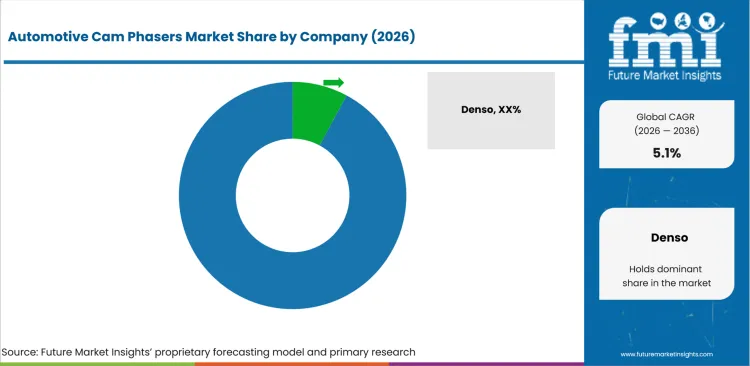
Competition turns on cam-phasing architecture, OEM program access and service coverage for production engine families. BorgWarner and Schaeffler document assisted or electromechanical routes, while AISIN, Astemo and Mikuni retain direct valve-timing positions. Melling concentrates on application-specific replacement phasers, where durability evidence and exact fitment raise the entry barrier.
- Broad cam-phasing platforms: BorgWarner Inc. and Schaeffler AG cover hydraulic, assisted or electromechanical routes for combustion and hybrid programs.
- OEM valve-timing manufacturers: AISIN CORPORATION, Astemo, Ltd. and Mikuni Corporation supply VVT or VTC products tied to regional engine programs.
- Aftermarket replacement specialist: Melling Tool Company publishes engine-specific VVT sprocket releases for North American service applications.
Competitive Benchmarking: Automotive Cam Phasers Market
| Company | Cam-Phasing Architecture Breadth | Electric / Low-Oil-Pressure Actuation | Lifecycle Channel Coverage | Geographic Reach |
|---|---|---|---|---|
| BorgWarner Inc. | High | High | Medium | Global |
| Schaeffler AG | Medium | High | Medium | Global |
| AISIN CORPORATION | Medium | Medium | Medium | Japan, North America, Europe, China and ASEAN |
| Astemo, Ltd. | Medium | Medium | High | Global aftermarket and Asian OEM base |
| Mikuni Corporation | Medium | Low | Medium | Japan, India and ASEAN |
| Melling Tool Company | Low | Low | Medium | North American aftermarket |
Scoring basis: High architecture breadth requires at least two documented phasing routes, Medium one direct VVT or VTC family and Low a narrow replacement line. High actuation depth requires current electric or pressure-independent phasing, Medium conventional VVT evidence and Low replacement-only actuation evidence. High lifecycle coverage requires broad service evidence, Medium one primary route with wider support and Low narrow channel coverage.
Key Developments in the Automotive Cam Phasers Market
- In August 2026, BorgWarner Inc. secured VCT awards for a European V6 hybrid and gasoline family plus a Chinese 1.5-liter turbo engine, with Chinese production starting in September 2026.
- In May 2026, Melling Tool Company released the VCTA-1021E VVT sprocket for 2018-2020 Ford 5.0L DOHC F-150 and Lobo applications, expanding model-specific replacement coverage.
- In June 2025, AISIN CORPORATION filed its annual securities report listing variable valve timing systems among its powertrain products and documenting manufacturing or sales operations in Japan, North America, Europe, China, ASEAN and India.
Key Players in the Automotive Cam Phasers Market
Integrated OEM Cam-Phasing Platforms
- BorgWarner Inc.
- Schaeffler AG
- AISIN CORPORATION
- Astemo, Ltd.
- Mikuni Corporation
Aftermarket Replacement Specialists
- Melling Tool Company
Automotive Cam Phasers Market - Report Scope
| Coverage field | Report scope |
|---|---|
| Market breakdown | By phaser type, engine type, vehicle type, sales channel, application and region. |
| Quantitative Units | USD billion. |
| Market Definition | Revenue includes automotive cam phaser assemblies and actuating mechanisms that change camshaft phase within gasoline, flex-fuel and hybrid combustion engines. |
| Regions Covered | North America, Latin America, Western Europe, Eastern Europe, East Asia, South Asia and Pacific, and Middle East and Africa. |
| Countries Covered | Mexico, South Korea, Brazil, Japan, USA, France, Germany, and 20+ countries included in the full report. |
| Key Companies Profiled | BorgWarner Inc., Schaeffler AG, AISIN CORPORATION, Astemo, Ltd., Mikuni Corporation, and Melling Tool Company. |
| Forecast Period | 2026 to 2036. |
| Approach | Primary and secondary research with market triangulation. |
Automotive Cam Phasers Market - Research Methodology
| Method | Approach |
|---|---|
| Primary Research | FMI analysts gathered input from manufacturers, service providers, technology developers, distributors, end users, procurement teams, and subject-matter experts. Interviews examined purchasing decisions, product or service evaluation, adoption barriers, approval requirements, pricing considerations, and expectations for technical or commercial support. Respondents were also asked what evidence is required before a trial, pilot, or initial order develops into regular purchasing. |
| Desk Research | Desk research covered government statistics, regulatory publications, trade data, industry associations, technical literature, standards, company filings, product information, and official corporate announcements. Sources were reviewed for relevance, publication date, geographic coverage, and consistency with the defined market scope. Claims relating to performance, applications, approvals, capacity, investment, and commercial activity were retained only when supported by credible public evidence. |
| Market Sizing and Forecasting | The market model combined the baseline value with historical performance, segment structure, pricing and volume indicators, adoption levels, company participation, and country-level demand conditions. Forecast assumptions considered economic activity, investment trends, regulatory developments, technology adoption, purchasing cycles, supply availability, and barriers to wider market use. Segment and regional estimates were reconciled before the final market total was calculated. |
| Data Validation | Estimates were checked against multiple independent indicators, including public data, company activity, trade patterns, industry developments, and findings from primary interviews. Validation also tested whether products, services, applications, and company revenues fell within the defined market boundaries. Adjacent categories, unsupported claims, overlapping revenues, and activities without direct market relevance were excluded to reduce double counting and maintain consistency across segments and countries. |
Automotive Cam Phasers Market by Segments
Automotive Cam Phasers Market segmented by Phaser Type:
- Hydraulic cam phasers
- Vane-type phasers
- Electric cam phasers
- Sprocket-type phasers
- Cam torque actuated phasers
Automotive Cam Phasers Market segmented by Engine Type:
- Inline engines
- Hybrid ICE engines
- Turbocharged engines
- V engines
- Performance engines
Automotive Cam Phasers Market segmented by Vehicle Type:
- Passenger cars
- SUVs/crossovers
- Light commercial vehicles
- Performance vehicles
Automotive Cam Phasers Market segmented by Sales Channel:
- OEM direct
- Engine system suppliers
- Aftermarket replacement
- Remanufacturing channel
Automotive Cam Phasers Market segmented by Application:
- Intake cam control
- Dual VVT systems
- Exhaust cam control
- Cylinder deactivation support
Automotive Cam Phasers Market by Region:
- North America
- United States
- Canada
- Latin America
- Brazil
- Mexico
- Argentina
- Chile
- Rest of Latin America
- Western Europe
- Germany
- France
- United Kingdom
- Italy
- Spain
- Benelux
- Nordics
- Rest of Western Europe
- Eastern Europe
- Poland
- Czech Republic
- Romania
- Hungary
- Rest of Eastern Europe
- East Asia
- China
- Japan
- South Korea
- South Asia and Pacific
- India
- ASEAN
- Australia and New Zealand
- Rest of South Asia and Pacific
- Middle East and Africa
- GCC Countries
- South Africa
- Türkiye
- Israel
- Rest of Middle East and Africa
Research Sources and Bibliography
- Schaeffler AG. (2026, April 27). Not just a bridging technology: Schaeffler offers extensive range from components to systems for all hybrid powertrains.
- European Automobile Manufacturers’ Association. (2026, July 23). New car registrations: +5.7% in H1 2026; battery-electric 20.7% market share.
- Astemo, Ltd. (2025, November 21). Astemo to Showcase Again at Automechanika Shanghai 2025.
- USA Environmental Protection Agency. (2026, February). The 2025 EPA Automotive Trends Report: Fuel Economy, and Technology since 1975.
- European Automobile Manufacturers’ Association. (2026, January 27). New car registrations: +1.8% in 2025; battery-electric 17.4% market share.
- Mikuni Corporation. (2025, October 7).
- BorgWarner Inc. (2025, February 6). BorgWarner Supplies Variable Cam Timing Technology for Major East Asian OEM's Hybrid and Gasoline Engines.
- European Parliament and Council of the European Union. (2025, June 19). Regulation (EU) 2025/1214 of the European Parliament and of the Council of 17 June 2025 amending Regulation (EU) 2019/631 to include an additional flexibility as regards the calculation of manufacturers’ compliance with CO2 emission performance standards for new passenger cars and new light commercial vehicles for the calendar years 2025 to 2027.
- International Energy Agency. (2026, May 20). Global EV Outlook 2026.
- BorgWarner Inc. (2026, May 6). BorgWarner Wins Two Conquest Awards in Asia for Combustion and Hybrid Powertrain Programs.
- Instituto Nacional de Estadística y Geografía. (2026, August 7). Venta, producción y exportación de vehículos ligeros.
- Korea Automobile & Mobility Association. (2026, August 5).
- Instituto Nacional de Metrologia, Qualidade e Tecnologia. (2026, August 14). Tabela PBE Veicular 2026 é atualizada com novos modelos e versões.
- Japan Automobile Manufacturers Association. (2026, April 14).
- USA Environmental Protection Agency. (2026, February 12). Final Rule: Rescission of the Greenhouse Gas Endangerment Finding and Motor Vehicle Greenhouse Gas Emission Standards Under the Clean Air Act.
- Service des données et études statistiques. (2026, February 11). Immatriculations de voitures en 2025 : le marché du neuf baisse, celui de l’occasion résiste.
- Statistisches Bundesamt. (2026, July 22). Pkw-Dichte 2026 erneut gestiegen.
- BorgWarner Inc. (2026, August 5). BorgWarner Secures New Variable Cam Timing Program Awards in Europe and China.
- AISIN CORPORATION. (2025, June 16). Annual Securities Report for the 102nd Fiscal Year.
- Melling Tool Company. (2026, May 1). Variable Valve Timing VVT Sprocket for Ford 5.0L DOHC - # VCTA-1021E.
- BorgWarner Inc. (2025, October 30). BorgWarner Reports Strong Third Quarter 2025 Results, Returned $136 million to Stockholders During Third Quarter, Announces Increased 2025 Guidance.
- Melling Tool Company. (2026, August 30). Product Releases.
- Schaeffler AG. (2025, September 3). Schaeffler at IAA MOBILITY 2025 in Hall B3, Booth B40: Shaping the future of mobility with electric axle drives, hybrid solutions, steer-by-wire technologies, and software.
- Melling Tool Company. (2026, June 17). Timing Kit for Ford & Lincoln 3.5L DOHC - # 3-1049SJVVT.
- USA Securities and Exchange Commission. (2026, February 11). BorgWarner Inc. Form 10-K for the fiscal year ended December 31, 2025.
- Schaeffler AG. (2026, March 3). FY 2025 Schaeffler AG earnings.
- AISIN CORPORATION. (2026, June 12). Annual Securities Report for the 103rd Fiscal Year.
- Astemo, Ltd. (2025, April 16). Astemo Achieves Automotive Parts Association Distinguished OE Partner Award.
- Melling Tool Company. (2026, August 27). Timing Kit for Ford 5.0L DOHC - # 3-1069SAVVT.
This bibliography is provided for reader reference and is not exhaustive. The full report contains the complete reference list and detailed citations.
This Report Answers
- What are the 2026 and 2036 market values?
- Which engine conditions sustain cam phaser demand?
- Why do hydraulic cam phasers hold 38.0% in 2026?
- How do inline engines shape phaser qualification?
- Why does OEM direct hold 57.0% in 2026?
- How do growth rates differ among profiled countries?
- Which companies supply OEM or replacement phasers?
- Which conditions limit cam phaser revenue?
Frequently Asked Questions
How big is the Automotive Cam Phasers Market in 2026?
The automotive cam phasers market is valued at USD 3.4 billion in 2026 and is projected to reach USD 5.6 billion by 2036. Combustion and hybrid programs retain adjustable valve timing for efficiency and restart control.
What is the CAGR of the Automotive Cam Phasers Market from 2026 to 2036?
The automotive cam phasers market is projected to grow at a CAGR of 5.1% between 2026 and 2036. Hybrid programs and replacement demand preserve revenue as battery-electric platforms remove new cam phaser fitment.
Which phaser type leads the Automotive Cam Phasers Market?
The hydraulic cam phasers segment is expected to hold 38.0% of the automotive cam phasers market in 2026, attributable to mature oil-control hardware and familiar engine packaging. Assisted designs become more relevant where low oil pressure delays conventional response.
Which vehicle type leads the Automotive Cam Phasers Market?
The passenger cars segment is expected to hold 42.0% of the automotive cam phasers market in 2026, supported by gasoline and hybrid engine volumes. Frequent low-speed operation and hybrid restarts keep cam timing quality visible in normal driving.
Which countries are projected to record the highest growth in the Automotive Cam Phasers Market?
Mexico is projected to grow at 6.6% CAGR, followed by South Korea at 6.3% and Brazil at 5.9% through 2036. Manufacturing depth, hybrid programs and flex-fuel calibration give the three countries different routes to faster growth.
Which companies are active in the Automotive Cam Phasers Market?
Key companies operating in the automotive cam phasers market include BorgWarner Inc., Schaeffler AG, AISIN CORPORATION, Astemo, Ltd., Mikuni Corporation, and Melling Tool Company. Competition centers on OEM program access, phasing architecture and application-specific replacement coverage.
Preview the report firsthand - request a free sample
Get SampleGet the brochure for pricing and purchase details.
Get PDFTable of Content
- Key Takeaways
- Market Size and CAGR
- Top Growth Driver
- Fastest Growing Segment
- Leading Region
- Key Companies
- Emerging Opportunities
- Executive Summary
- Global Market Outlook
- Demand-side Trends
- Supply-side Trends
- Technology Roadmap Analysis
- Analysis and Recommendations
- Analyst Perspective (What is happening? Why now? What should investors know?)
- Key Questions Answered
- How large is the market?
- What is the CAGR?
- What are key trends?
- Which region dominates?
- Who are the leaders?
- Market Overview
- Market Coverage / Taxonomy
- Market Definition / Scope / Limitations
- Research Methodology
- Chapter Orientation
- Analytical Lens and Working Hypotheses
- Market Structure, Signals, and Trend Drivers
- Benchmarking and Cross-market Comparability
- Market Sizing, Forecasting, and Opportunity Mapping
- Research Design and Evidence Framework
- Desk Research Programme (Secondary Evidence)
- Expert Input and Fieldwork (Primary Evidence)
- Tooling, Models, and Reference Databases
- Data Engineering and Model Build
- Quality Assurance and Audit Trail
- Market Background
- Market Dynamics (Drivers, Restraints, Opportunity, Trends)
- Scenario Forecast (Optimistic, Likely, Conservative)
- Impact Analysis
- AI Impact
- Sustainability Impact
- Regulatory Impact
- Technology Impact
- Consumer / Buyer Analysis
- Purchase Drivers
- Adoption Barriers
- Buyer Journey
- Opportunity Map Analysis
- Product Life Cycle Analysis
- Supply Chain Analysis
- Investment Feasibility Matrix
- Value Chain Analysis
- PESTLE and Porter's Analysis
- Regulatory Landscape
- Regional Parent Market Outlook
- Production and Consumption Statistics
- Import and Export Statistics
- Global Market Analysis and Forecast, 2021 to 2036
- Historical Market Size Value (USD Billion) Analysis, 2021 to 2025
- Current and Future Market Size Value (USD Billion) Projections, 2026 to 2036
- Y-o-Y Growth Trend Analysis
- Absolute $ Opportunity Analysis
- Global Market Pricing Analysis, 2021 to 2036
- Global Market Analysis and Forecast, By Phaser Type, 2021 to 2036
- Introduction / Key Findings
- Historical Market Size Value (USD Billion) Analysis By Phaser Type, 2021 to 2025
- Current and Future Market Size Value (USD Billion) Analysis and Forecast By Phaser Type, 2026 to 2036
- Hydraulic cam phasers
- Vane-type phasers
- Electric cam phasers
- Sprocket-type phasers
- Cam torque actuated phasers
- Hydraulic cam phasers
- Y-o-Y Growth Trend Analysis By Phaser Type, 2021 to 2025
- Absolute $ Opportunity Analysis By Phaser Type, 2026 to 2036
- Global Market Analysis and Forecast, By Engine Type, 2021 to 2036
- Introduction / Key Findings
- Historical Market Size Value (USD Billion) Analysis By Engine Type, 2021 to 2025
- Current and Future Market Size Value (USD Billion) Analysis and Forecast By Engine Type, 2026 to 2036
- Inline engines
- Hybrid ICE engines
- Turbocharged engines
- V engines
- Performance engines
- Inline engines
- Y-o-Y Growth Trend Analysis By Engine Type, 2021 to 2025
- Absolute $ Opportunity Analysis By Engine Type, 2026 to 2036
- Global Market Analysis and Forecast, By Vehicle Type, 2021 to 2036
- Introduction / Key Findings
- Historical Market Size Value (USD Billion) Analysis By Vehicle Type, 2021 to 2025
- Current and Future Market Size Value (USD Billion) Analysis and Forecast By Vehicle Type, 2026 to 2036
- Passenger cars
- SUVs/crossovers
- Light commercial vehicles
- Performance vehicles
- Passenger cars
- Y-o-Y Growth Trend Analysis By Vehicle Type, 2021 to 2025
- Absolute $ Opportunity Analysis By Vehicle Type, 2026 to 2036
- Global Market Analysis and Forecast, By Sales Channel, 2021 to 2036
- Introduction / Key Findings
- Historical Market Size Value (USD Billion) Analysis By Sales Channel, 2021 to 2025
- Current and Future Market Size Value (USD Billion) Analysis and Forecast By Sales Channel, 2026 to 2036
- OEM direct
- Engine system suppliers
- Aftermarket replacement
- Remanufacturing channel
- OEM direct
- Y-o-Y Growth Trend Analysis By Sales Channel, 2021 to 2025
- Absolute $ Opportunity Analysis By Sales Channel, 2026 to 2036
- Global Market Analysis and Forecast, By Application, 2021 to 2036
- Introduction / Key Findings
- Historical Market Size Value (USD Billion) Analysis By Application, 2021 to 2025
- Current and Future Market Size Value (USD Billion) Analysis and Forecast By Application, 2026 to 2036
- Intake cam control
- Dual VVT systems
- Exhaust cam control
- Cylinder deactivation support
- Intake cam control
- Y-o-Y Growth Trend Analysis By Application, 2021 to 2025
- Absolute $ Opportunity Analysis By Application, 2026 to 2036
- Global Market Analysis and Forecast, By Region, 2021 to 2036
- Introduction
- Historical Market Size Value (USD Billion) Analysis By Region, 2021 to 2025
- Current Market Size Value (USD Billion) Analysis and Forecast By Region, 2026 to 2036
- North America
- Latin America
- Western Europe
- Eastern Europe
- East Asia
- South Asia and Pacific
- Middle East & Africa
- Market Attractiveness Analysis By Region
- North America Market Analysis and Forecast, By Country, 2021 to 2036
- Historical Market Size Value (USD Billion) Trend Analysis By Market Taxonomy, 2021 to 2025
- Market Size Value (USD Billion) Forecast By Market Taxonomy, 2026 to 2036
- By Country
- USA
- Canada
- By Phaser Type
- By Engine Type
- By Vehicle Type
- By Sales Channel
- By Application
- By Country
- Market Attractiveness Analysis
- By Country
- By Phaser Type
- By Engine Type
- By Vehicle Type
- By Sales Channel
- By Application
- Key Takeaways
- Latin America Market Analysis and Forecast, By Country
- Historical Market Size Value (USD Billion) Trend Analysis By Market Taxonomy, 2021 to 2025
- Market Size Value (USD Billion) Forecast By Market Taxonomy, 2026 to 2036
- By Country
- Brazil
- Mexico
- Chile
- Rest of Latin America
- By Phaser Type
- By Engine Type
- By Vehicle Type
- By Sales Channel
- By Application
- By Country
- Market Attractiveness Analysis
- By Country
- By Phaser Type
- By Engine Type
- By Vehicle Type
- By Sales Channel
- By Application
- Key Takeaways
- Western Europe Market Analysis and Forecast, By Country
- Historical Market Size Value (USD Billion) Trend Analysis By Market Taxonomy, 2021 to 2025
- Market Size Value (USD Billion) Forecast By Market Taxonomy, 2026 to 2036
- By Country
- Germany
- UK
- Italy
- Spain
- France
- Nordic
- BENELUX
- Rest of Western Europe
- By Phaser Type
- By Engine Type
- By Vehicle Type
- By Sales Channel
- By Application
- By Country
- Market Attractiveness Analysis
- By Country
- By Phaser Type
- By Engine Type
- By Vehicle Type
- By Sales Channel
- By Application
- Key Takeaways
- Eastern Europe Market Analysis and Forecast, By Country
- Historical Market Size Value (USD Billion) Trend Analysis By Market Taxonomy, 2021 to 2025
- Market Size Value (USD Billion) Forecast By Market Taxonomy, 2026 to 2036
- By Country
- Russia
- Poland
- Hungary
- Balkan & Baltic
- Rest of Eastern Europe
- By Phaser Type
- By Engine Type
- By Vehicle Type
- By Sales Channel
- By Application
- By Country
- Market Attractiveness Analysis
- By Country
- By Phaser Type
- By Engine Type
- By Vehicle Type
- By Sales Channel
- By Application
- Key Takeaways
- East Asia Market Analysis and Forecast, By Country
- Historical Market Size Value (USD Billion) Trend Analysis By Market Taxonomy, 2021 to 2025
- Market Size Value (USD Billion) Forecast By Market Taxonomy, 2026 to 2036
- By Country
- China
- Japan
- South Korea
- By Phaser Type
- By Engine Type
- By Vehicle Type
- By Sales Channel
- By Application
- By Country
- Market Attractiveness Analysis
- By Country
- By Phaser Type
- By Engine Type
- By Vehicle Type
- By Sales Channel
- By Application
- Key Takeaways
- South Asia and Pacific Market Analysis and Forecast, By Country
- Historical Market Size Value (USD Billion) Trend Analysis By Market Taxonomy, 2021 to 2025
- Market Size Value (USD Billion) Forecast By Market Taxonomy, 2026 to 2036
- By Country
- India
- ASEAN
- Australia & New Zealand
- Rest of South Asia and Pacific
- By Phaser Type
- By Engine Type
- By Vehicle Type
- By Sales Channel
- By Application
- By Country
- Market Attractiveness Analysis
- By Country
- By Phaser Type
- By Engine Type
- By Vehicle Type
- By Sales Channel
- By Application
- Key Takeaways
- Middle East & Africa Market Analysis and Forecast, By Country
- Historical Market Size Value (USD Billion) Trend Analysis By Market Taxonomy, 2021 to 2025
- Market Size Value (USD Billion) Forecast By Market Taxonomy, 2026 to 2036
- By Country
- Kingdom of Saudi Arabia
- Other GCC Countries
- Türkiye
- South Africa
- Other African Union
- Rest of Middle East & Africa
- By Phaser Type
- By Engine Type
- By Vehicle Type
- By Sales Channel
- By Application
- By Country
- Market Attractiveness Analysis
- By Country
- By Phaser Type
- By Engine Type
- By Vehicle Type
- By Sales Channel
- By Application
- Key Takeaways
- Key Countries Market Analysis
- USA
- Pricing Analysis
- Market Share Analysis, 2025
- By Phaser Type
- By Engine Type
- By Vehicle Type
- By Sales Channel
- By Application
- Canada
- Pricing Analysis
- Market Share Analysis, 2025
- By Phaser Type
- By Engine Type
- By Vehicle Type
- By Sales Channel
- By Application
- Mexico
- Pricing Analysis
- Market Share Analysis, 2025
- By Phaser Type
- By Engine Type
- By Vehicle Type
- By Sales Channel
- By Application
- Brazil
- Pricing Analysis
- Market Share Analysis, 2025
- By Phaser Type
- By Engine Type
- By Vehicle Type
- By Sales Channel
- By Application
- Chile
- Pricing Analysis
- Market Share Analysis, 2025
- By Phaser Type
- By Engine Type
- By Vehicle Type
- By Sales Channel
- By Application
- Germany
- Pricing Analysis
- Market Share Analysis, 2025
- By Phaser Type
- By Engine Type
- By Vehicle Type
- By Sales Channel
- By Application
- UK
- Pricing Analysis
- Market Share Analysis, 2025
- By Phaser Type
- By Engine Type
- By Vehicle Type
- By Sales Channel
- By Application
- Italy
- Pricing Analysis
- Market Share Analysis, 2025
- By Phaser Type
- By Engine Type
- By Vehicle Type
- By Sales Channel
- By Application
- Spain
- Pricing Analysis
- Market Share Analysis, 2025
- By Phaser Type
- By Engine Type
- By Vehicle Type
- By Sales Channel
- By Application
- France
- Pricing Analysis
- Market Share Analysis, 2025
- By Phaser Type
- By Engine Type
- By Vehicle Type
- By Sales Channel
- By Application
- India
- Pricing Analysis
- Market Share Analysis, 2025
- By Phaser Type
- By Engine Type
- By Vehicle Type
- By Sales Channel
- By Application
- ASEAN
- Pricing Analysis
- Market Share Analysis, 2025
- By Phaser Type
- By Engine Type
- By Vehicle Type
- By Sales Channel
- By Application
- Australia & New Zealand
- Pricing Analysis
- Market Share Analysis, 2025
- By Phaser Type
- By Engine Type
- By Vehicle Type
- By Sales Channel
- By Application
- China
- Pricing Analysis
- Market Share Analysis, 2025
- By Phaser Type
- By Engine Type
- By Vehicle Type
- By Sales Channel
- By Application
- Japan
- Pricing Analysis
- Market Share Analysis, 2025
- By Phaser Type
- By Engine Type
- By Vehicle Type
- By Sales Channel
- By Application
- South Korea
- Pricing Analysis
- Market Share Analysis, 2025
- By Phaser Type
- By Engine Type
- By Vehicle Type
- By Sales Channel
- By Application
- Russia
- Pricing Analysis
- Market Share Analysis, 2025
- By Phaser Type
- By Engine Type
- By Vehicle Type
- By Sales Channel
- By Application
- Poland
- Pricing Analysis
- Market Share Analysis, 2025
- By Phaser Type
- By Engine Type
- By Vehicle Type
- By Sales Channel
- By Application
- Hungary
- Pricing Analysis
- Market Share Analysis, 2025
- By Phaser Type
- By Engine Type
- By Vehicle Type
- By Sales Channel
- By Application
- Kingdom of Saudi Arabia
- Pricing Analysis
- Market Share Analysis, 2025
- By Phaser Type
- By Engine Type
- By Vehicle Type
- By Sales Channel
- By Application
- Türkiye
- Pricing Analysis
- Market Share Analysis, 2025
- By Phaser Type
- By Engine Type
- By Vehicle Type
- By Sales Channel
- By Application
- South Africa
- Pricing Analysis
- Market Share Analysis, 2025
- By Phaser Type
- By Engine Type
- By Vehicle Type
- By Sales Channel
- By Application
- USA
- Market Structure Analysis
- Competition Dashboard
- Competition Benchmarking
- Market Share Analysis of Top Players
- By Regional
- By Phaser Type
- By Engine Type
- By Vehicle Type
- By Sales Channel
- By Application
- Emerging Startups
- Innovation Benchmarking
- Competition Analysis
- Competition Deep Dive
- Denso
- Overview
- Product Portfolio
- Profitability by Market Segments
- Sales Footprint
- Strategy Overview
- Marketing Strategy
- Product Strategy
- Channel Strategy
- BorgWarner
- Schaeffler
- Aisin
- Hitachi Astemo
- Mikuni
- Delphi Technologies / BorgWarner
- Eaton
- Mahle
- Melling
- Denso
- Case Studies
- Success Stories
- Recent Developments
- Competition Deep Dive
- Assumptions & Acronyms Used


