

- Market Size (2026)
- USD 920.7 Mn
- Forecast (2036)
- USD 1587.7 Mn
- CAGR (2026 to 2036)
- 5.6%
How big is Automotive Battery Isolators Market in 2026?
USD 920.7 million in 2026 and USD 1,587.7 million by 2036 at a 5.6% CAGR.
Automotive battery isolator demand is projected to rise at 5.6% CAGR between 2026 and 2036 as secondary batteries power refrigeration and work equipment without risking engine starting. The RV Industry Association forecast 328,800 to 367,000 wholesale RV shipments for 2026 in March 2026, sustaining a large production base for dual-battery specification. The production range keeps isolator demand relevant even as high-content builds shift toward controlled charging.
Mexico's factory-linked channel differs from Australia's service-led aftermarket because INEGI reported about 3.95 million Mexican light vehicles produced during 2025 in January 2026. That production scale gives Mexican body builders repeatable platform specifications, whereas Australian demand depends more heavily on specialist distributor stock and installer access.
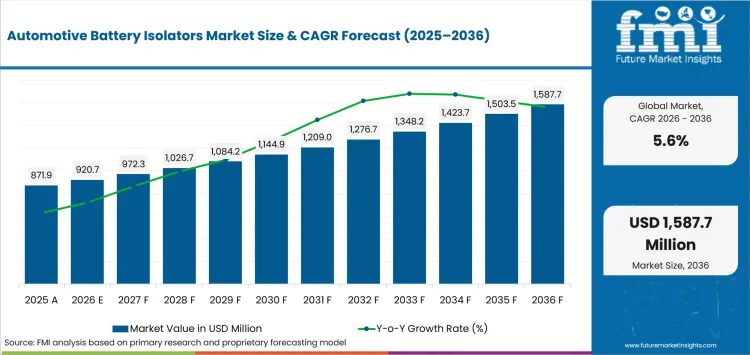
Key Takeaways
- Auxiliary batteries protect starter capacity and supply refrigerators, telematics, tools and other loads that continue drawing power after the engine stops.
- By isolator type, voltage-sensitive relays are estimated to hold 29.0% in 2026 owing to automatic voltage-triggered switching that preserves starter capacity.
- By voltage, 12 V systems are forecast to represent 47.0% in 2026 due to direct fit with common starter batteries and accessory circuits.
- Recreational vehicles are projected to hold 26.0% share in 2026 attributable to house loads that require starter-battery protection during stationary use.
- Variable alternator output and lithium charge profiles can make a simple relay unsuitable when installations require current limiting or controlled multi-stage charging.
- Some of the key players in this market include REDARC Electronics, Victron Energy, Blue Sea Systems, Littelfuse, Cole Hersee, Mastervolt, Enerdrive, and Samlex America.
Analyst Perspective
"Current rating alone does not decide whether an isolator belongs in a repeat vehicle build. Installers now compare switching thresholds with alternator behavior and battery chemistry before they approve the same architecture for multiple vehicles."
- Nikhil Kaitwade, Principal Consultant, Future Market Insights
How is the Automotive Battery Isolators Market segmented?
The automotive battery isolators market is segmented by isolator type, voltage, vehicle type, application and sales channel.
Isolator type covers voltage-sensitive relays, solenoid isolators, diode isolators, MOSFET isolators and smart battery isolators. Voltage includes 12 V, 24 V, 48 V and multi-voltage systems. Vehicle types cover recreational vehicles, commercial vans, pickup trucks, marine or utility vehicles and emergency vehicles. Applications include auxiliary battery charging, dual battery management, fleet telematics power and off-grid systems. Sales channels include aftermarket distributors, OEM upfitters, e-commerce catalogs and fleet installers.
What supports Auxiliary battery charging in the Application category?
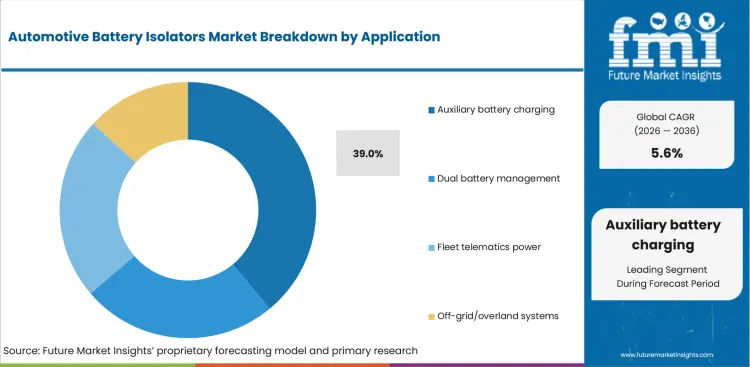
Auxiliary battery charging routes alternator output to a second bank and protects the battery needed to restart the vehicle. Installers compare isolators with automotive DC-DC converters if battery chemistry or alternator behavior requires active charge control. In June 2025, REDARC released its Trailer Power Kit with a 12 A DC-DC charger and current-limited vehicle input.
- By application, auxiliary battery charging is forecast to represent 39.0% in 2026 driven by the direct need for protected secondary-bank charging.
- Protected secondary-bank charging also depends on cable sizing and current limits that keep vehicle wiring within rated operating conditions.
What makes Voltage-sensitive relays central to the Isolator type category?
Voltage-sensitive relays suit dual-battery layouts built around conventional starter batteries that need automatic separation without a separate charging controller. Their role overlaps the wider battery management systems field as installers compare relay switching with active charging before choosing an architecture for higher-current auxiliary loads.
- By isolator type, voltage-sensitive relays are estimated to hold 29.0% in 2026 owing to automatic connect-and-isolate behavior that preserves starter capacity with limited wiring complexity.
- In February 2026, RVIA reported 3,069 January motorhome shipments with volume up 12.7% from a year earlier. The shipment increase sustains automatic dual-battery switching for builders serving accessory-heavy mobile platforms.
Why do 12 V systems lead the Voltage category?
Twelve-volt circuits are the common reference for starter batteries and automotive wiring harnesses in RVs, vans and pickups. In February 2025, REDARC launched its 50 A BCDC Alpha R for alternator-fed auxiliary batteries. The launch shows how common 12 V layouts increasingly use active charge control without abandoning the installed wiring base.
- In 2026, 12 V systems are expected to lead the voltage category with 47.0% share because installers can match common battery banks and accessory circuits without voltage conversion.
- Installers can retain familiar 12 V cabling and choose relay or controlled-charging architectures that match alternator behavior and battery chemistry.
How do Recreational vehicles shape the Vehicle type category?
Inside recreational vehicles, refrigeration and communications loads continue operating with the engine stopped. Larger auxiliary banks and monitored equipment are increasing electrical content as vehicle electrification reaches RV and van builders that need higher current capacity plus serviceable protection for extended off-grid operation.
- Recreational vehicles are projected to hold 26.0% share in 2026 given persistent house loads that make starter-battery protection and secondary-bank charging routine design requirements.
- In April 2025, REDARC introduced REDWORKS QuickFit Power Panels for RV and van manufacturers. The pre-wired format shows builders placing more weight on repeatable electrical installation and tested component integration.
What are the drivers, restraints and opportunities in the Automotive Battery Isolators Market?
Auxiliary electrical loads expand fitment demand. Variable alternators and lithium batteries narrow the safe use of simple relays, leaving room for low-loss and controlled isolation architectures.
- Driver: More onboard electrical equipment increases the need to preserve engine-starting capacity as a separate battery supplies stationary or intermittent loads.
- Restraint: Smart alternators and lithium batteries can require current control that a basic voltage-sensitive relay or diode isolator does not provide.
- Opportunity: Low-loss switching and better current control can extend isolator use into higher-load mobile systems that need documented electrical compatibility.
Battery separation becomes necessary once mobile equipment draws meaningful power from the starter circuit, which also needs automotive relays and fuses for downstream protection. RVIA recorded 4,084 truck-camper shipments in 2025 with volume 25.2% above 2024. More accessory-ready vehicle formats give installers additional points for dual-battery fitment and replacement work.
Variable-voltage alternators and lithium batteries expose simple isolation limits because voltage sensing alone cannot manage a battery-specific charge profile. REDARC launched the 100 A BCDC Alpha100 R in June 2025 with controlled auxiliary charging and start-battery recovery. The 100 A charger raises the comparison bar for automotive connectors and simple relays in installations that need current control.
Some installations need lower voltage drop and safer automatic control without stepping up to a full charger. Victron Energy released Venus OS 3.60 in June 2025 and allowed Orion XS hardware to operate as a standard DC-DC converter. Configurable control makes the boundary between electric vehicle relays and active charging more explicit during product selection.
Which country CAGRs are profiled in the Automotive Battery Isolators Market?
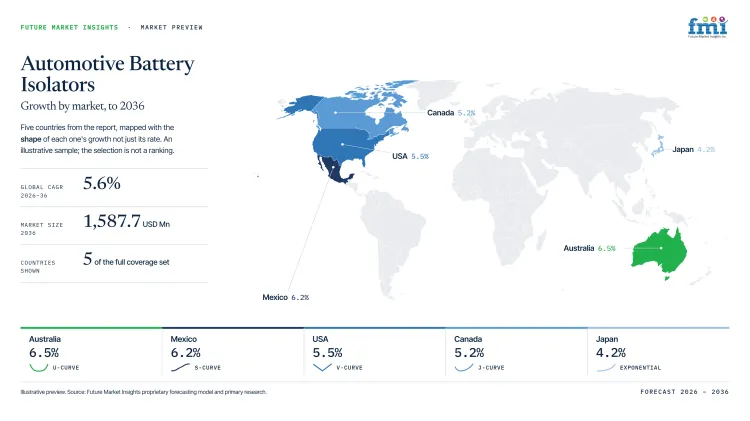
| Country | CAGR |
|---|---|
| Australia | 6.5% |
| Mexico | 6.2% |
| USA | 5.5% |
| Canada | 5.2% |
| Japan | 4.2% |
How do country-level CAGRs compare in the Automotive Battery Isolators Market?
The five country forecasts span 2.3 percentage points from Australia at 6.5% to Canada at 4.2%. Australia and Mexico form the upper pair. USA holds the middle position. The Japan and Canada form the lower pair. The narrow range means channel conditions can outweigh small CAGR differences during market entry.
- Australia's touring fleets place sustained loads on auxiliary batteries during long off-grid trips.
- Mexico's commercial vehicle mix gives isolator makers exposure to repeatable upfitter specifications.
- US installers face wider alternator and battery-chemistry variation in recreational and commercial platforms.
- Canadian winter operating conditions increase attention to current ratings and enclosure protection.
- Japan’s humid and rainy conditions drive demand for moisture-resistant, well-protected battery isolators.
Comparable CAGRs produce different order patterns as vehicle mix and installation channels differ. The full report provides country-level CAGR analysis across North America, Latin America, Europe, East Asia, South Asia, Oceania and the Middle East and Africa.
Country-wise Analysis
- Australian RV owners routinely travel long distances between service centers, so field-replaceable isolators and clear fault guidance carry more value than complex installations requiring specialist diagnostics or factory intervention. Australia is projected to grow at 6.5% CAGR through 2036 because its large recreational fleet sustains aftermarket upgrades and the Caravan Industry Association of Australia reported about 937,000 registered RVs in June 2026 following 4% annual fleet growth. Remote service distance still raises downtime and freight cost, which favors manufacturers maintaining regional stock plus simple 12 V or multi-voltage fitment guidance that installers can apply without factory engineering during replacement work.
- Mexico gives isolator manufacturers a high-volume platform base through commercial and pickup production, with body builders repeatedly specifying auxiliary electrical systems for fleet and specialty vehicle programs including utility fleets and emergency conversions. INEGI recorded about 3.95 million light vehicles produced during 2025 and light trucks represented 77.2% of output, giving component makers a large base for repeatable harness and current-rating specifications. The Mexican automotive battery isolators sector is projected to record 6.2% CAGR during the assessment period given this production depth, although OEM qualification and model variation favor companies maintaining verified specifications plus stable local inventory for replacement programs.
- US demand spans RV production and commercial upfitting plus owner-led upgrades, with specialist installers integrating isolators beside automotive data connectors and other electrical components in high-content vans and motorhomes in service. RVIA reported in May 2026 that April motorhome shipments rose 13.0% even as total RV shipments declined 17.4%, exposing cyclical inventory risk for distributors carrying several current ratings and electrical architectures. The USA is estimated to post 5.5% CAGR over the forecast period helped by its mixed installed base and continuing auxiliary-power work, leaving channel breadth and rework control more decisive than the small growth-rate gap separating it from Brazil or Canada.
- Canadian fleet and RV installers cover long service distances under cold-weather duty cycles, so cable sizing and enclosure protection receive more attention during replacement decisions than in milder operating conditions throughout the year. Automotive battery isolator sales in Canada are forecast to expand at 5.2% CAGR by 2036 tied to continued van demand that Statistics Canada measured in June 2026 as first-quarter van registrations rising 4.5% year over year. Vehicle-mix volatility complicates distributor stocking, and seasonal demand swings are expected to keep flexible inventories plus cold-weather documentation important for serving recreational and commercial fitments without concentrating too much stock in one vehicle class.
- Japan’s fleet and recreational vehicle installers operate across varied climates and long service intervals, increasing attention to cable sizing, current ratings, and enclosure protection when replacing automotive battery isolators. Automotive battery isolator sales in Japan are forecast to expand at 4.2% CAGR by 2036, supported by steady demand for commercial vans, light-duty vehicles, and recreational applications. Vehicle-mix variation can complicate distributor stocking, making flexible inventories and fitment-specific documentation important for serving diverse vehicle platforms without overstocking one class.
Who are the notable companies in the Automotive Battery Isolators Market?
REDARC Electronics, Victron Energy, Blue Sea Systems, Littelfuse, Cole Hersee, Mastervolt, Enerdrive, and Samlex America are the notable companies profiled in this market.
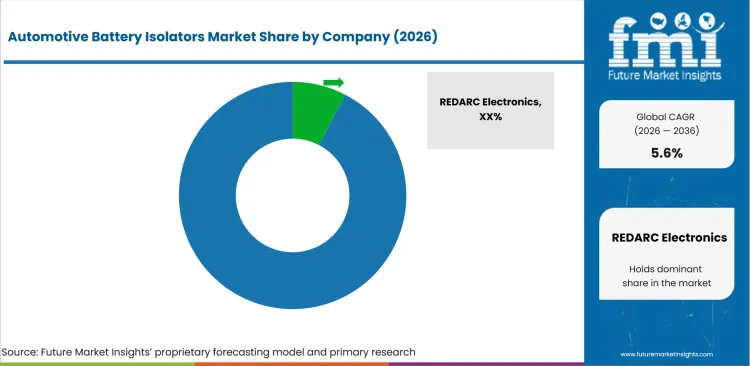
The field is fragmented between dedicated mobile-power brands and broader electrical-component manufacturers. Entry depends on verified current handling, multi-voltage coverage and installer documentation rather than corporate scale alone. Adjacent automotive fuse blocks influence specification because isolators operate inside protected battery circuits that technicians must service safely. Broader automotive power distribution modules also shape upfitter expectations for low-voltage protection and serviceable switching.
- REDARC Electronics, Enerdrive and Samlex America concentrate on automatic battery separation and auxiliary-power equipment for mobile or recreational installations.
- Victron Energy, Blue Sea Systems and Mastervolt span several charging or battery-management architectures that give installers alternatives to a standalone isolator.
- Littelfuse and Cole Hersee compete through vehicle-grade switching and circuit-protection portfolios with distribution into commercial and specialty vehicle channels.
Competitive Benchmarking: Automotive Battery Isolators Market
| Company | Isolation Architecture Breadth | Multi-Voltage Coverage | Vehicle & Installer Fitment | Geographic Reach |
|---|---|---|---|---|
| REDARC Electronics | Medium | Medium | High | Australia, North America and selected global channels |
| Victron Energy | High | High | High | Europe, North America, Asia-Pacific and global dealers |
| Blue Sea Systems | Medium | Medium | High | North America and international marine or RV channels |
| Littelfuse | High | Medium | High | North America, Europe and Asia-Pacific |
| Cole Hersee | Medium | Medium | High | North America with wider Littelfuse distribution |
| Mastervolt | High | Medium | High | Europe, North America and international mobile channels |
| Enerdrive | Medium | Medium | High | Australia, New Zealand and mobile-power distributors |
| Samlex America | Medium | Medium | Medium | North America and international distributor channels |
Scoring basis: High architecture breadth requires at least three documented isolation or battery-management routes. Medium requires two routes and Low identifies one documented route. High multi-voltage coverage requires documented 12 V, 24 V and higher or mixed-voltage support. High fitment depth requires multiple vehicle-oriented ratings plus installation guidance. Medium denotes narrower documented coverage and Low denotes a verified limitation.
Key Developments in the Automotive Battery Isolators Market
- In June 2026, Enerdrive began its full transition to the Dometic master brand and kept existing products plus technical support channels. The change consolidates mobile-power distribution under Dometic Power Solutions APAC.
- In November 2025, Victron Energy announced the Orion XS 12/12-70A battery-to-battery charger for second-quarter 2026 availability. Its 12 V architecture and 70 A rating broaden controlled-charging alternatives beside conventional isolation.
- In February 2026, Littelfuse filed its 2025 Form 10-K and documented switches plus relays serving commercial and recreational vehicle end markets. The filing confirms continued vehicle power-control activity relevant to battery-isolation specifications.
Key Players in the Automotive Battery Isolators Market
Automatic Relay and Mobile-Power Specialists
- REDARC Electronics
- Blue Sea Systems
- Enerdrive
- Samlex America
Multi-Architecture Battery Management Suppliers
- Victron Energy
- Mastervolt
Vehicle Switching and Protection Suppliers
- Littelfuse
- Cole Hersee
Automotive Battery Isolators Market - Report Scope
| Coverage field | Report scope |
|---|---|
| Market breakdown | By isolator type, voltage, vehicle type, application, sales channel and region. |
| Quantitative Units | USD Million. |
| Market Definition | Commercial battery isolation devices that separate starter and auxiliary battery banks in vehicle and mobile-power systems. The scope includes voltage-sensitive relays, solenoid and diode isolators, MOSFET isolators and smart battery isolators. Complete batteries, alternators, standalone DC-DC chargers, installation labor and high-voltage traction-battery disconnect devices above 48 V are excluded. |
| Regions Covered | North America, Latin America, Europe, East Asia, South Asia and Pacific, and Middle East and Africa. |
| Countries Covered | Australia, Mexico, Brazil, USA, Canada, and 20+ countries included in the full report. |
| Key Companies Profiled | REDARC Electronics; Victron Energy; Blue Sea Systems; Littelfuse; Cole Hersee; Mastervolt; Enerdrive; Samlex America. |
| Forecast Period | 2026 to 2036. |
| Approach | Primary and secondary research with market triangulation. |
Automotive Battery Isolators Market - Research Methodology
| Method | Approach |
|---|---|
| Primary Research | FMI analysts gathered input from manufacturers, service providers, technology developers, distributors, end users, procurement teams, and subject-matter experts. Interviews examined purchasing decisions, product or service evaluation, adoption barriers, approval requirements, pricing considerations, and expectations for technical or commercial support. Respondents were also asked what evidence is required before a trial, pilot, or initial order develops into regular purchasing. |
| Desk Research | Desk research covered government statistics, regulatory publications, trade data, industry associations, technical literature, standards, company filings, product information, and official corporate announcements. Sources were reviewed for relevance, publication date, geographic coverage, and consistency with the defined market scope. Claims relating to performance, applications, approvals, capacity, investment, and commercial activity were retained only when supported by credible public evidence. |
| Market Sizing and Forecasting | The market model combined the baseline value with historical performance, segment structure, pricing and volume indicators, adoption levels, company participation, and country-level demand conditions. Forecast assumptions considered economic activity, investment trends, regulatory developments, technology adoption, purchasing cycles, supply availability, and barriers to wider market use. Segment and regional estimates were reconciled before the final market total was calculated. |
| Data Validation | Estimates were checked against multiple independent indicators, including public data, company activity, trade patterns, industry developments, and findings from primary interviews. Validation also tested whether products, services, applications, and company revenues fell within the defined market boundaries. Adjacent categories, unsupported claims, overlapping revenues, and activities without direct market relevance were excluded to reduce double counting and maintain consistency across segments and countries. |
Automotive Battery Isolators Market by Segments
Automotive Battery Isolators Market segmented by isolator type:
- Voltage-sensitive relays
- Solenoid isolators
- Diode isolators
- MOSFET isolators
- Smart battery isolators
Automotive Battery Isolators Market segmented by voltage:
- 12 V systems
- 24 V systems
- 48 V systems
- Multi-voltage systems
Automotive Battery Isolators Market segmented by vehicle type:
- Recreational vehicles
- Commercial vans
- Pickup trucks
- Marine/utility vehicles
- Emergency vehicles
Automotive Battery Isolators Market segmented by application:
- Auxiliary battery charging
- Dual battery management
- Fleet telematics power
- Off-grid/overland systems
Automotive Battery Isolators Market segmented by sales channel:
- Aftermarket distributors
- OEM upfitters
- E-commerce/catalog
- Fleet installers
Automotive Battery Isolators Market by Region:
- North America
- United States
- Canada
- Latin America
- Brazil
- Mexico
- Argentina
- Chile
- Western Europe
- Germany
- France
- United Kingdom
- Italy
- Spain
- Benelux
- Nordics
- Eastern Europe
- Poland
- Czech Republic
- Romania
- Hungary
- East Asia
- China
- Japan
- South Korea
- South Asia and Pacific
- India
- ASEAN
- Australia and New Zealand
- Middle East and Africa
- GCC Countries
- South Africa
- Türkiye
- Israel
Research Sources and Bibliography
- RV Industry Association. (2026, March 3). 2026 RV wholesale shipments to rise modestly.
- RV Industry Association. (2026, January 25). RV shipments end 2025 with 342,220 units, modest 2.5% growth over 2024.
- RV Industry Association. (2026, February 24). RV shipments top 24,000 in January.
- RV Industry Association. (2026, May 22). April RV shipments hit 29,000; motorhomes up 13%.
- Caravan Industry Association of Australia. (2026, June 14). State of the Industry 2026: Resilience in a changing market.
- Statistics Canada. (2026, June 11). New motor vehicle registrations, first quarter 2026.
- INEGI. (2026, January 9). Registro Administrativo de la Industria Automotriz de Vehículos Ligeros, December 2025 results.
- FENABRAVE. (2025, July 3). Balanço de emplacamentos de veículos fecha 1º semestre em alta, mas juros preocupam.
- REDARC Electronics. (2025, February 4). REDARC releases BCDC Alpha R, expanding the BCDC series with advanced features.
- REDARC Electronics. (2025, April 1). REDARC REDWORKS Power Panels: The plug-and-play solution for RV and van manufacturers.
- REDARC Electronics. (2025, June 11). REDARC launches BCDC Alpha100 R.
- REDARC Electronics. (2025, June 18). REDARC introduces the Trailer Power Kit.
- REDARC Electronics. (2025, November 4). REDARC unveils Tow-Pro Link and REDWorks Power Panels at SEMA 2025.
- Victron Energy. (2025, November 14). Victron Energy at Metstrade 2025.
- Dometic Power Solutions. (2026, June 2). Enerdrive is transitioning to Dometic.
- Dometic Power Solutions. (2026, May 29). Gold Class Caravans raises the stakes with all new 4.5t ATM flagship model.
- Eaton. (2025, May 27). Eaton’s Mobility Group begins power connections production in Europe.
- TE Connectivity. (2025, October 2). TE Connectivity launches new product portfolio for automotive ECUs.
- CTEK. (2025, November 11). CTEK’s new NXT Series: next level battery charging.
- Littelfuse. (2026, January 28). Littelfuse reports fourth quarter and full year 2025 results.
- Blue Sea Systems. (Accessed 2026, August 26). CE Certificates.
- Mastervolt. (Accessed 2026, August 26). Mac Plus Series E-Mark Certificate.
- Victron Energy. (2025, June 10). Introducing Venus OS 3.60.
- FORVIA HELLA. (2025, August 6). FORVIA HELLA achieves world’s first series production of its 12V Lithium Battery Management System in China.
- Littelfuse. (Accessed 2026, August 26). Cole Hersee.
- Samlex America. (2025, November). ACR-300 automatic charge separator.
- Littelfuse, Inc. (2026, February 19). Annual Report (Form 10-K).
This bibliography is provided for reader reference and is not exhaustive. The full report contains the complete reference list and detailed citations.
This Report Answers
- What is the automotive battery isolators market size in 2026 and what value is projected for 2036?
- What operating conditions increase demand for automotive battery isolators?
- Why do voltage-sensitive relays hold the largest isolator type share in 2026?
- Why do 12 V systems hold the largest voltage share in 2026?
- How do recreational vehicles influence battery isolator demand?
- Why is auxiliary battery charging the leading application?
- How do country growth rates differ among Australia, Mexico, Brazil, USA and Canada?
- Which companies supply automotive battery isolation and adjacent mobile-power systems?
- How do smart alternators and lithium batteries change isolator selection?
- Which capabilities separate stronger automotive battery isolator suppliers from narrower participants?
Frequently Asked Questions
How big is the automotive battery isolators market in 2026?
The automotive battery isolators market is valued at USD 920.7 million in 2026 and is projected to reach USD 1,587.7 million by 2036. Growth comes from auxiliary batteries supporting onboard electrical loads without draining the starter battery.
What is the CAGR of the automotive battery isolators market from 2026 to 2036?
The automotive battery isolators market is projected to grow at a CAGR of 5.6% between 2026 and 2036. Expansion is supported by RV electrical content, commercial vehicle upfitting and demand for protected secondary-battery charging.
Which isolator type leads the automotive battery isolators market?
The voltage-sensitive relays segment is expected to hold 29.0% of the automotive battery isolators market in 2026, driven by automatic connection and separation with limited wiring complexity. Their fit is strongest in compatible alternator and battery configurations.
Which voltage segment leads the automotive battery isolators market?
The 12 V systems segment is expected to hold 47.0% of the automotive battery isolators market in 2026, attributable to the large installed base of 12 V starter and accessory circuits. Multi-voltage products gain relevance on platforms carrying mixed electrical loads.
Which companies are active in the automotive battery isolators market?
Key companies operating in the market include REDARC Electronics, Victron Energy, Blue Sea Systems, Littelfuse, Cole Hersee, Mastervolt, Enerdrive, and Samlex America. These companies compete through switching architecture, voltage coverage, vehicle fitment documentation and mobile-power distribution.
Preview the report firsthand - request a free sample
Get SampleGet the brochure for pricing and purchase details.
Get PDFTable of Content
- Key Takeaways
- Market Size and CAGR
- Top Growth Driver
- Fastest Growing Segment
- Leading Region
- Key Companies
- Emerging Opportunities
- Executive Summary
- Global Market Outlook
- Demand-side Trends
- Supply-side Trends
- Technology Roadmap Analysis
- Analysis and Recommendations
- Analyst Perspective (What is happening? Why now? What should investors know?)
- Key Questions Answered
- How large is the market?
- What is the CAGR?
- What are key trends?
- Which region dominates?
- Who are the leaders?
- Market Overview
- Market Coverage / Taxonomy
- Market Definition / Scope / Limitations
- Research Methodology
- Chapter Orientation
- Analytical Lens and Working Hypotheses
- Market Structure, Signals, and Trend Drivers
- Benchmarking and Cross-market Comparability
- Market Sizing, Forecasting, and Opportunity Mapping
- Research Design and Evidence Framework
- Desk Research Programme (Secondary Evidence)
- Expert Input and Fieldwork (Primary Evidence)
- Tooling, Models, and Reference Databases
- Data Engineering and Model Build
- Quality Assurance and Audit Trail
- Market Background
- Market Dynamics (Drivers, Restraints, Opportunity, Trends)
- Scenario Forecast (Optimistic, Likely, Conservative)
- Impact Analysis
- AI Impact
- Sustainability Impact
- Regulatory Impact
- Technology Impact
- Consumer / Buyer Analysis
- Purchase Drivers
- Adoption Barriers
- Buyer Journey
- Opportunity Map Analysis
- Product Life Cycle Analysis
- Supply Chain Analysis
- Investment Feasibility Matrix
- Value Chain Analysis
- PESTLE and Porter's Analysis
- Regulatory Landscape
- Regional Parent Market Outlook
- Production and Consumption Statistics
- Import and Export Statistics
- Global Market Analysis and Forecast, 2021 to 2036
- Historical Market Size Value (USD Million) Analysis, 2021 to 2025
- Current and Future Market Size Value (USD Million) Projections, 2026 to 2036
- Y-o-Y Growth Trend Analysis
- Absolute $ Opportunity Analysis
- Global Market Pricing Analysis, 2021 to 2036
- Global Market Analysis and Forecast, By Isolator Type, 2021 to 2036
- Introduction / Key Findings
- Historical Market Size Value (USD Million) Analysis By Isolator Type, 2021 to 2025
- Current and Future Market Size Value (USD Million) Analysis and Forecast By Isolator Type, 2026 to 2036
- Voltage-sensitive relays
- Solenoid isolators
- Diode isolators
- MOSFET isolators
- Smart battery isolators
- Voltage-sensitive relays
- Y-o-Y Growth Trend Analysis By Isolator Type, 2021 to 2025
- Absolute $ Opportunity Analysis By Isolator Type, 2026 to 2036
- Global Market Analysis and Forecast, By Voltage, 2021 to 2036
- Introduction / Key Findings
- Historical Market Size Value (USD Million) Analysis By Voltage, 2021 to 2025
- Current and Future Market Size Value (USD Million) Analysis and Forecast By Voltage, 2026 to 2036
- 12 V systems
- 24 V systems
- 48 V systems
- Multi-voltage systems
- 12 V systems
- Y-o-Y Growth Trend Analysis By Voltage, 2021 to 2025
- Absolute $ Opportunity Analysis By Voltage, 2026 to 2036
- Global Market Analysis and Forecast, By Vehicle Type, 2021 to 2036
- Introduction / Key Findings
- Historical Market Size Value (USD Million) Analysis By Vehicle Type, 2021 to 2025
- Current and Future Market Size Value (USD Million) Analysis and Forecast By Vehicle Type, 2026 to 2036
- Recreational vehicles
- Commercial vans
- Pickup trucks
- Marine/utility vehicles
- Emergency vehicles
- Recreational vehicles
- Y-o-Y Growth Trend Analysis By Vehicle Type, 2021 to 2025
- Absolute $ Opportunity Analysis By Vehicle Type, 2026 to 2036
- Global Market Analysis and Forecast, By Application, 2021 to 2036
- Introduction / Key Findings
- Historical Market Size Value (USD Million) Analysis By Application, 2021 to 2025
- Current and Future Market Size Value (USD Million) Analysis and Forecast By Application, 2026 to 2036
- Auxiliary battery charging
- Dual battery management
- Fleet telematics power
- Off-grid/overland systems
- Auxiliary battery charging
- Y-o-Y Growth Trend Analysis By Application, 2021 to 2025
- Absolute $ Opportunity Analysis By Application, 2026 to 2036
- Global Market Analysis and Forecast, By Sales Channel, 2021 to 2036
- Introduction / Key Findings
- Historical Market Size Value (USD Million) Analysis By Sales Channel, 2021 to 2025
- Current and Future Market Size Value (USD Million) Analysis and Forecast By Sales Channel, 2026 to 2036
- Aftermarket distributors
- OEM upfitters
- E-commerce/catalog
- Fleet installers
- Aftermarket distributors
- Y-o-Y Growth Trend Analysis By Sales Channel, 2021 to 2025
- Absolute $ Opportunity Analysis By Sales Channel, 2026 to 2036
- Global Market Analysis and Forecast, By Region, 2021 to 2036
- Introduction
- Historical Market Size Value (USD Million) Analysis By Region, 2021 to 2025
- Current Market Size Value (USD Million) Analysis and Forecast By Region, 2026 to 2036
- North America
- Latin America
- Western Europe
- Eastern Europe
- East Asia
- South Asia and Pacific
- Middle East & Africa
- Market Attractiveness Analysis By Region
- North America Market Analysis and Forecast, By Country, 2021 to 2036
- Historical Market Size Value (USD Million) Trend Analysis By Market Taxonomy, 2021 to 2025
- Market Size Value (USD Million) Forecast By Market Taxonomy, 2026 to 2036
- By Country
- USA
- Canada
- By Isolator Type
- By Voltage
- By Vehicle Type
- By Application
- By Sales Channel
- By Country
- Market Attractiveness Analysis
- By Country
- By Isolator Type
- By Voltage
- By Vehicle Type
- By Application
- By Sales Channel
- Key Takeaways
- Latin America Market Analysis and Forecast, By Country
- Historical Market Size Value (USD Million) Trend Analysis By Market Taxonomy, 2021 to 2025
- Market Size Value (USD Million) Forecast By Market Taxonomy, 2026 to 2036
- By Country
- Brazil
- Mexico
- Chile
- Rest of Latin America
- By Isolator Type
- By Voltage
- By Vehicle Type
- By Application
- By Sales Channel
- By Country
- Market Attractiveness Analysis
- By Country
- By Isolator Type
- By Voltage
- By Vehicle Type
- By Application
- By Sales Channel
- Key Takeaways
- Western Europe Market Analysis and Forecast, By Country
- Historical Market Size Value (USD Million) Trend Analysis By Market Taxonomy, 2021 to 2025
- Market Size Value (USD Million) Forecast By Market Taxonomy, 2026 to 2036
- By Country
- Germany
- UK
- Italy
- Spain
- France
- Nordic
- BENELUX
- Rest of Western Europe
- By Isolator Type
- By Voltage
- By Vehicle Type
- By Application
- By Sales Channel
- By Country
- Market Attractiveness Analysis
- By Country
- By Isolator Type
- By Voltage
- By Vehicle Type
- By Application
- By Sales Channel
- Key Takeaways
- Eastern Europe Market Analysis and Forecast, By Country
- Historical Market Size Value (USD Million) Trend Analysis By Market Taxonomy, 2021 to 2025
- Market Size Value (USD Million) Forecast By Market Taxonomy, 2026 to 2036
- By Country
- Russia
- Poland
- Hungary
- Balkan & Baltic
- Rest of Eastern Europe
- By Isolator Type
- By Voltage
- By Vehicle Type
- By Application
- By Sales Channel
- By Country
- Market Attractiveness Analysis
- By Country
- By Isolator Type
- By Voltage
- By Vehicle Type
- By Application
- By Sales Channel
- Key Takeaways
- East Asia Market Analysis and Forecast, By Country
- Historical Market Size Value (USD Million) Trend Analysis By Market Taxonomy, 2021 to 2025
- Market Size Value (USD Million) Forecast By Market Taxonomy, 2026 to 2036
- By Country
- China
- Japan
- South Korea
- By Isolator Type
- By Voltage
- By Vehicle Type
- By Application
- By Sales Channel
- By Country
- Market Attractiveness Analysis
- By Country
- By Isolator Type
- By Voltage
- By Vehicle Type
- By Application
- By Sales Channel
- Key Takeaways
- South Asia and Pacific Market Analysis and Forecast, By Country
- Historical Market Size Value (USD Million) Trend Analysis By Market Taxonomy, 2021 to 2025
- Market Size Value (USD Million) Forecast By Market Taxonomy, 2026 to 2036
- By Country
- India
- ASEAN
- Australia & New Zealand
- Rest of South Asia and Pacific
- By Isolator Type
- By Voltage
- By Vehicle Type
- By Application
- By Sales Channel
- By Country
- Market Attractiveness Analysis
- By Country
- By Isolator Type
- By Voltage
- By Vehicle Type
- By Application
- By Sales Channel
- Key Takeaways
- Middle East & Africa Market Analysis and Forecast, By Country
- Historical Market Size Value (USD Million) Trend Analysis By Market Taxonomy, 2021 to 2025
- Market Size Value (USD Million) Forecast By Market Taxonomy, 2026 to 2036
- By Country
- Kingdom of Saudi Arabia
- Other GCC Countries
- Türkiye
- South Africa
- Other African Union
- Rest of Middle East & Africa
- By Isolator Type
- By Voltage
- By Vehicle Type
- By Application
- By Sales Channel
- By Country
- Market Attractiveness Analysis
- By Country
- By Isolator Type
- By Voltage
- By Vehicle Type
- By Application
- By Sales Channel
- Key Takeaways
- Key Countries Market Analysis
- USA
- Pricing Analysis
- Market Share Analysis, 2025
- By Isolator Type
- By Voltage
- By Vehicle Type
- By Application
- By Sales Channel
- Canada
- Pricing Analysis
- Market Share Analysis, 2025
- By Isolator Type
- By Voltage
- By Vehicle Type
- By Application
- By Sales Channel
- Mexico
- Pricing Analysis
- Market Share Analysis, 2025
- By Isolator Type
- By Voltage
- By Vehicle Type
- By Application
- By Sales Channel
- Brazil
- Pricing Analysis
- Market Share Analysis, 2025
- By Isolator Type
- By Voltage
- By Vehicle Type
- By Application
- By Sales Channel
- Chile
- Pricing Analysis
- Market Share Analysis, 2025
- By Isolator Type
- By Voltage
- By Vehicle Type
- By Application
- By Sales Channel
- Germany
- Pricing Analysis
- Market Share Analysis, 2025
- By Isolator Type
- By Voltage
- By Vehicle Type
- By Application
- By Sales Channel
- UK
- Pricing Analysis
- Market Share Analysis, 2025
- By Isolator Type
- By Voltage
- By Vehicle Type
- By Application
- By Sales Channel
- Italy
- Pricing Analysis
- Market Share Analysis, 2025
- By Isolator Type
- By Voltage
- By Vehicle Type
- By Application
- By Sales Channel
- Spain
- Pricing Analysis
- Market Share Analysis, 2025
- By Isolator Type
- By Voltage
- By Vehicle Type
- By Application
- By Sales Channel
- France
- Pricing Analysis
- Market Share Analysis, 2025
- By Isolator Type
- By Voltage
- By Vehicle Type
- By Application
- By Sales Channel
- India
- Pricing Analysis
- Market Share Analysis, 2025
- By Isolator Type
- By Voltage
- By Vehicle Type
- By Application
- By Sales Channel
- ASEAN
- Pricing Analysis
- Market Share Analysis, 2025
- By Isolator Type
- By Voltage
- By Vehicle Type
- By Application
- By Sales Channel
- Australia & New Zealand
- Pricing Analysis
- Market Share Analysis, 2025
- By Isolator Type
- By Voltage
- By Vehicle Type
- By Application
- By Sales Channel
- China
- Pricing Analysis
- Market Share Analysis, 2025
- By Isolator Type
- By Voltage
- By Vehicle Type
- By Application
- By Sales Channel
- Japan
- Pricing Analysis
- Market Share Analysis, 2025
- By Isolator Type
- By Voltage
- By Vehicle Type
- By Application
- By Sales Channel
- South Korea
- Pricing Analysis
- Market Share Analysis, 2025
- By Isolator Type
- By Voltage
- By Vehicle Type
- By Application
- By Sales Channel
- Russia
- Pricing Analysis
- Market Share Analysis, 2025
- By Isolator Type
- By Voltage
- By Vehicle Type
- By Application
- By Sales Channel
- Poland
- Pricing Analysis
- Market Share Analysis, 2025
- By Isolator Type
- By Voltage
- By Vehicle Type
- By Application
- By Sales Channel
- Hungary
- Pricing Analysis
- Market Share Analysis, 2025
- By Isolator Type
- By Voltage
- By Vehicle Type
- By Application
- By Sales Channel
- Kingdom of Saudi Arabia
- Pricing Analysis
- Market Share Analysis, 2025
- By Isolator Type
- By Voltage
- By Vehicle Type
- By Application
- By Sales Channel
- Türkiye
- Pricing Analysis
- Market Share Analysis, 2025
- By Isolator Type
- By Voltage
- By Vehicle Type
- By Application
- By Sales Channel
- South Africa
- Pricing Analysis
- Market Share Analysis, 2025
- By Isolator Type
- By Voltage
- By Vehicle Type
- By Application
- By Sales Channel
- USA
- Market Structure Analysis
- Competition Dashboard
- Competition Benchmarking
- Market Share Analysis of Top Players
- By Regional
- By Isolator Type
- By Voltage
- By Vehicle Type
- By Application
- By Sales Channel
- Emerging Startups
- Innovation Benchmarking
- Competition Analysis
- Competition Deep Dive
- REDARC Electronics
- Overview
- Product Portfolio
- Profitability by Market Segments
- Sales Footprint
- Strategy Overview
- Marketing Strategy
- Product Strategy
- Channel Strategy
- Victron Energy
- Blue Sea Systems
- Littelfuse
- Eaton
- Cole Hersee
- Mastervolt
- Enerdrive
- NOCO
- Samlex America
- REDARC Electronics
- Case Studies
- Success Stories
- Recent Developments
- Competition Deep Dive
- Assumptions & Acronyms Used


