

- Market Size (2026)
- USD 5.0 Bn
- Forecast (2036)
- USD 8.3 Bn
- CAGR (2026 to 2036)
- 5.3%
How big is Automotive Axle Carriers Market in 2026?
USD 5.0 billion in 2026 and USD 8.3 billion by 2036 at a 5.3% CAGR
Demand for automotive axle carriers is projected to expand at 5.3% CAGR between 2026 and 2036, increasing valuation from USD 5.0 billion in 2026 to USD 8.3 billion by 2036. Axle-carrier spending follows vehicle-platform awards because housing geometry fixes differential location, bearing support and mounting interfaces during pre-production engineering. Schaeffler documented a successful ramp-up of its fourth-generation e-axle for Hyundai Motor Group in May 2025. Scaling that e-axle program increases the value of automotive axle systems whose carrier interfaces can absorb powertrain changes without reopening the complete axle package.
Localization also changes which foundries and machining lines can win long-running axle programs from OEMs. In January 2025, the Government of Canada said Linamar would expand EV-parts work at four Ontario facilities and expected the project to create about 2,000 full-time jobs. Local machining capacity gives OEMs another route for automotive differential housings and related structural parts. Each platform still requires fatigue, bore and assembly validation before sourcing can shift.
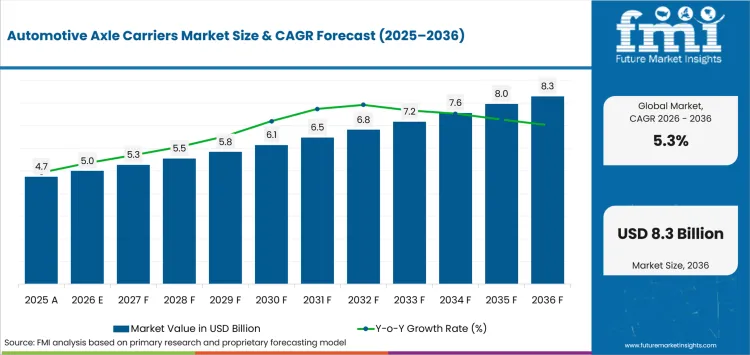
Key Takeaways
- Vehicle-platform renewal underpins demand: each new rear-drive, AWD/4WD, hybrid or electric axle program can require fresh carrier geometry and production validation.
- Rear axle carriers are set to lead the carrier type category with 32.0% share in 2026 due to rear-drive and multi-axle drivetrain packaging.
- The cast iron segment is likely to capture 40.0% share in 2026 attributable to mature casting routes and predictable load-bearing behavior.
- By sales channel, OEM direct is forecast to represent 55.0% in 2026 driven by vehicle-maker control of platform packaging and qualification timing.
- Validation cost is the main restraint since material, machining or attachment changes can force new durability work once program geometry has been frozen.
- Some of the key players in this market include Dana Incorporated, Dauch Corporation, Magna International, Linamar Corporation, JTEKT Corporation, AISIN Corporation, Schaeffler AG, and ZF Friedrichshafen AG.
Analyst Perspective
"Platform engineering sets axle-carrier economics by fixing differential bore location, bearing seats and suspension interfaces ahead of series tooling. Manufacturers with flexible casting and machining assets can follow conventional, AWD/4WD and eAxle programs without surrendering dimensional control at launch volume."
- Nikhil Kaitwade, Principal Consultant, Future Market Insights
How is the automotive axle carriers market segmented?
Carrier type, material, vehicle type, sales channel, drivetrain, and region define the market segmentation.
Carrier type covers rear axle carriers, front axle carriers, AWD axle carriers, EV e-axle carriers, and heavy-duty axle carriers. Material includes cast iron, aluminum, ductile iron, forged steel, and lightweight alloy. Vehicle type covers passenger cars, SUVs/crossovers, pickup trucks, light commercial vehicles, and electric vehicles. Sales channel includes OEM direct, driveline Tier-1s, aftermarket replacement, and precision foundry supply. Drivetrain covers AWD/4WD, RWD, FWD, and e-axle configurations used in the defined market taxonomy.
Why do rear axle carriers lead demand within the carrier type category?
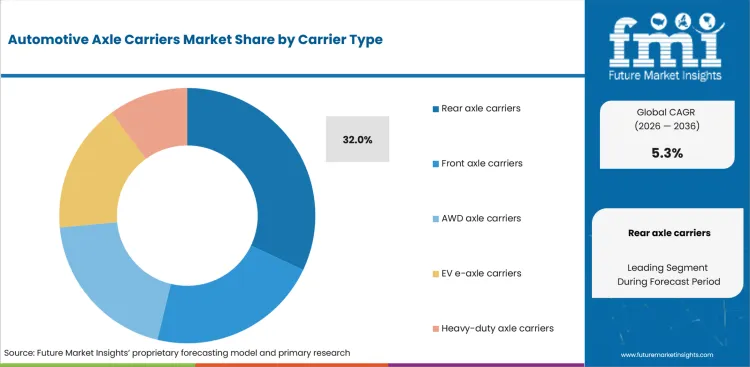
Rear carriers locate the differential in rear-drive and many AWD layouts, so bore alignment and mounting stiffness affect gear contact and wheel bearing requirements. The housing also fixes suspension and half-shaft geometry ahead of final-drive centerline release for tooling.
- Based on carrier type, rear axle carriers are projected to account for 32.0% in 2026 due to dedicated rear final-drive housings remaining necessary despite propulsion changes.
- In June 2025, AAM announced a Scout Motors award covering front electric drive units and rear e-Beam axles. The program keeps the carrier structurally central after the motor and reduction gear enter the axle assembly.
Why does cast iron lead demand within the material category?
Cast iron suits carriers that prioritize stiffness, damping and machining familiarity over mass savings. Foundry automotive casting process windows can hold bore location and flange geometry at volume. Weight-sensitive lightweight automotive materials require different tooling and a distinct validation route.
- By material, cast iron is estimated to hold 40.0% in 2026 owing to mature casting and machining routes that control load-bearing geometry at volume.
- Linamar completed its Aludyne North America asset acquisition in November 2025 and gained aluminum casting plus precision-machining capacity for axle housings. The transaction gives OEMs another route for weight-focused designs without treating that activity as proof of the authorised cast-iron share.
Why does OEM direct lead demand within the sales channel category?
Early carrier geometry fixes differential position, bearing seats and attachment points for the complete axle. OEM engineers control drawings and durability gates even if a Tier-1 assembles the axle, which keeps launch changes under vehicle-maker approval.
- In 2026, OEM direct is expected to lead sales channel with 55.0% share because vehicle makers control packaging and durability approval before production release.
- AISIN said in January 2025 that its jointly developed eAxle was adopted for Suzuki e VITARA production. The program shows how axle and propeller shaft content is awarded against a vehicle-specific package instead of a catalog part.
Why does AWD/4WD lead demand within the drivetrain category?
AWD/4WD layouts send torque to more than one driven axle, increasing the importance of differential location and mounting stiffness at each driven end. Electrification changes the torque source without removing the need for aligned carrier support in all-wheel drive architectures.
- By drivetrain, AWD/4WD is forecast to represent 36.0% in 2026 driven by added driven-axle hardware and the qualification work tied to it.
- In August 2025, AISIN said the Isuzu D-MAX EV adopted front and rear eAxles for full-time 4WD. The application preserves axle-side structural and differential duties in a battery-electric pickup with towing and rough-road requirements.
What are the drivers, restraints and opportunities in the Automotive Axle Carriers Market?
Platform renewal expands carrier engineering work, validation limits late sourcing changes, and integrated electric axles increase the number of housing interfaces that need fresh qualification.
- Driver: New AWD/4WD, commercial-vehicle, hybrid and electric axle programs require carrier designs matched to changing torque paths and packaging envelopes.
- Restraint: Carrier-to-differential joints and precision bores leave little tolerance for process drift, so a late material or sourcing change can reopen validation.
- Opportunity: Integrated electric drives let axle manufacturers redesign housings for motors, reduction gears and oil flow instead of preserving legacy layouts.
Commercial-vehicle electrification is returning carrier design to active platform work instead of treating the axle housing as a carryover part. In April 2025, ZF secured a multi-year Indian order for several thousand AxTrax 2 electric axles for intercity buses. Orders of that scale make electric vehicle e-axles a direct source of new carrier machining, mounting, and structural-validation work.
Carrier validation is difficult to bypass as differential attachment and bearing geometry carry load directly in the torque path. A January 2025 NHTSA filing for Mercedes-Benz recall 24V-862 documented three vehicles in which the rear differential might not meet the specified bolted connection to the carrier. Only three vehicles were covered, but the failure mode explains why assembly control and joint verification can delay a process switch after launch.
Integrated eAxles give engineers more freedom to reduce loss and packaging mass inside a carrier-like housing, provided the revised structure still controls gears and bearings under torque. AISIN said in October 2025 that its new bZ4X eAxle improved transmission efficiency by using higher gear precision and a casing shape that reduced oil agitation. The revised casing gives advanced automotive materials and precision casting programs a measurable qualification target instead of a generic weight-reduction brief.
Which country CAGRs are profiled in the Automotive Axle Carriers Market?
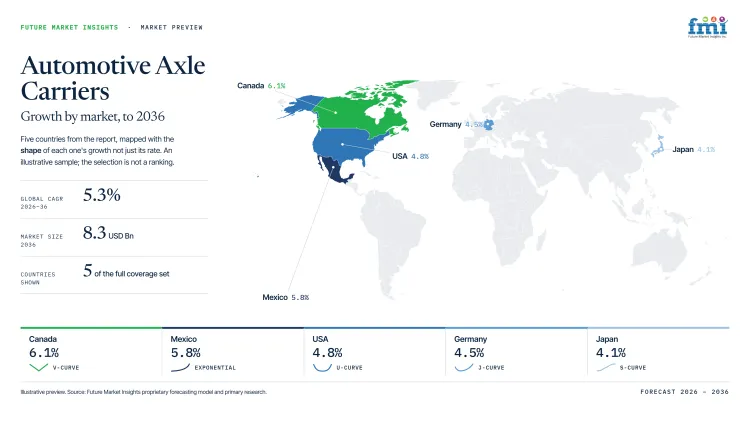
| Country | CAGR |
|---|---|
| Canada | 6.1% |
| Mexico | 5.8% |
| Brazil | 5.5% |
| South Korea | 5.1% |
| USA | 4.8% |
| Germany | 4.5% |
| Japan | 4.1% |
How do country-level CAGRs compare in the Automotive Axle Carriers Market?
The profiled markets span 2.0 percentage points from Canada at 6.1% to Japan at 4.1%. Canada and Mexico form the faster North American pair. Brazil and South Korea occupy the middle of the range. The USA, Germany, and Japan grow more slowly from larger or more mature manufacturing bases.
- Canada converts smaller production gains into faster percentage growth.
- Mexico concentrates carrier volume near high-output assembly hubs.
- Brazil depends more on domestic localization economics.
- South Korea channels sourcing within integrated OEM groups.
- USA relies more on mature-platform replacement cycles.
- Germany retains specification influence despite moderate unit growth.
- Japan's incumbent relationships slow switching between qualified suppliers.
Comparable CAGRs therefore mask different sourcing paths, investment hurdles, and program-access risks for axle-carrier manufacturers. The full report provides country-level CAGR analysis across North America, Latin America, Europe, East Asia, South Asia, Oceania and the Middle East and Africa.
Country-wise Analysis
- Canada's axle-carrier programs depend heavily on USA-bound light vehicles, so Ontario plants need machining lines that can follow current cross-border model allocations without stranding dedicated tooling. Canada's automotive axle carriers outlook is anticipated to advance at 6.1% CAGR through 2036, aided by casting and machining investment close to shared North American vehicle programs. In February 2026, the Government of Canada said more than 90% of Canadian-made vehicles are exported to the United States. Tariff changes or model transfers can redirect volume quickly, which favors manufacturers with North American program access and tooling that can switch between conventional and electrified drivetrains.
- Mexico's carrier opportunity is concentrated in high-volume light-truck and utility-vehicle plants that run to North American platform schedules and tightly timed model changes. INEGI data published in June 2026 show light trucks represented 80.0% of Mexican light-vehicle production during the first five months, which keeps rear-drive and AWD hardware commercially important. Automotive axle carrier demand in Mexico is forecast to rise at 5.8% CAGR over the assessment period, attributable to that vehicle mix and deep local casting capacity. Trade-policy changes remain the main friction: one engineering revision can affect tooling, launch timing and sourcing decisions on both sides of the USA-Mexico border.
- Brazilian axle-carrier programs increasingly have to fit local efficiency and recyclability requirements and preserve low machining cost for domestic vehicle production today. The automotive axle carriers sector is projected to record 5.5% CAGR during the assessment period, supported by local production and engineering work on more efficient drivetrains. Federal Decree No. 12,435 of April 2025 made MOVER requirements effective from June 1, 2025 and placed those requirements inside new-vehicle commercialization. The rule does not prescribe a carrier material, so local foundries still need repeatable bore control and durability evidence for lighter designs to displace established castings on price-sensitive programs.
- South Korea's axle-carrier base serves export programs with compact packaging and frequent model changes, which puts machining accuracy under pressure during compressed launches. The Ministry of Trade, Industry and Energy said in January 2026 that domestic vehicle production reached 4.1 million units in 2025, giving local driveline plants a large launch base. In South Korea, automotive axle carrier demand is predicted to advance at 5.1% CAGR through 2036, tied to export production and electric drivetrain programs. Close access to Hyundai and Kia engineering is an advantage, but new entrants still need proven bore control and NVH performance to make price a meaningful sourcing factor.
- USA axle-carrier sourcing spans high-volume pickup, SUV and commercial-vehicle programs, so machining assets must cover conventional and electrified drivetrains without locking capacity to one propulsion route during repeated model changes. The USA is estimated to post 4.8% CAGR over the forecast period, driven by repeated platform renewal from a large installed manufacturing base today. In February 2026, the EPA finalized repeal of federal highway-vehicle greenhouse-gas standards and changed one federal signal used in electrification planning. State policy and OEM product commitments still differ, which gives flexible casting and machining lines an advantage over plants dedicated to a single drivetrain architecture.
- Germany's axle-carrier work is shaped by premium AWD programs and engineering specifications that are often carried into export platforms during early series sourcing. In July 2026, the Federal Government confirmed motor-vehicle tax relief for qualifying new battery-electric registrations through 2030, maintaining an incentive for electric model launches. Adoption of automotive axle carriers in Germany is estimated to expand at 4.5% CAGR through 2036, helped by electric-model investment despite high domestic production costs. Engineering proximity is the local advantage, but stand-alone capacity is harder to defend without participation during housing qualification for the target vehicle program and its export derivatives at volume.
- Japan's axle-carrier market operates within tightly integrated supplier relationships and long validation cycles, which make switching difficult once a housing enters a multi-year vehicle program. Automotive axle carrier sales in Japan are forecast to expand at 4.1% CAGR by 2036, given steady hybrid and electric platform renewal instead of a rapid capacity build. METI's June 2025 Mobility DX strategy set a 30% global unit-sales target for Japanese software-defined vehicles in both 2030 and 2035 and called for stronger domestic production infrastructure. Digital traceability raises interface expectations for carrier production records, and incumbent quality history means new suppliers need domestic process proof to challenge established program positions.
Who are the notable companies in the Automotive Axle Carriers Market?
Dana Incorporated, Dauch Corporation, Magna International, Linamar Corporation, JTEKT Corporation, AISIN Corporation, Schaeffler AG, ZF Friedrichshafen AG
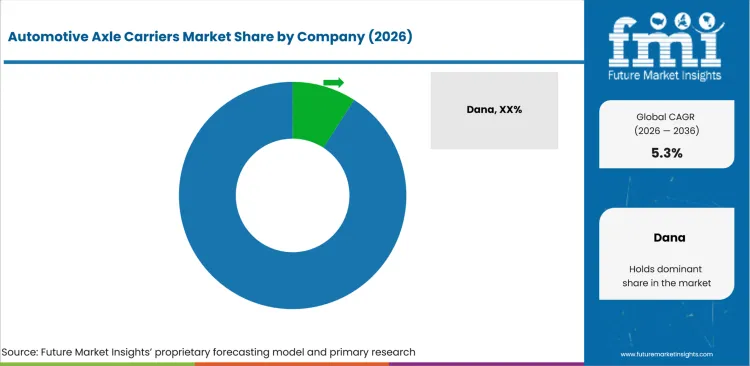
Competition centers on companies that can hold axle geometry during casting and machining until serial launch. Dana and Dauch carry broad axle responsibility alongside Linamar's precision manufacturing and complete eAxle routes. Magna, AISIN, Schaeffler and ZF supply integrated electrified-drivetrain content, whereas JTEKT centers on differentials and torque control for multi-axle programs. vehicle electrification changes torque delivery but leaves final-drive geometry inside OEM qualification.
- Broad axle integrators: Dana Incorporated, Dauch Corporation, Linamar Corporation, and ZF Friedrichshafen AG take complete-axle responsibility.
- Electrified drivetrain integrators: Magna International, AISIN Corporation, and Schaeffler AG compete where electric-drive modules alter carrier packaging.
- Driveline specialist: JTEKT Corporation supplies differential carrier assemblies, Torsen differentials, and AWD couplings for torque-management programs.
Competitive Benchmarking: Automotive Axle Carriers Market
| Company | Complete Axle Integration | Electrified Axle Integration | AWD / Torque Management | Geographic Reach |
|---|---|---|---|---|
| Dana Incorporated | High | High | High | Global |
| Dauch Corporation | High | High | High | Global |
| Magna International | Medium | High | High | North America, Europe, Asia |
| Linamar Corporation | High | High | Medium | North America, Europe, Asia |
| JTEKT Corporation | Medium | Medium | High | Asia, North America, Europe |
| AISIN Corporation | Medium | High | High | Asia, North America, Europe |
| Schaeffler AG | Medium | High | Medium | Europe, North America, Asia |
| ZF Friedrichshafen AG | High | High | High | Global |
Scoring basis: High complete axle integration requires documented responsibility for complete axle systems on multiple vehicle programs. Medium covers one integrated axle route and Low identifies narrower component participation. High electrified axle integration requires serial or awarded eAxle or eDrive systems. Medium applies to related modules and Low to no documented electrified route. High AWD/torque management requires direct differential or torque-distribution systems documented in current vehicle or axle programs. Medium covers adjacent driveline modules and Low indicates no documented active torque-control role. Geographic reach follows operating or customer regions documented in official company reports and regulatory filings.
Key Developments in the Automotive Axle Carriers Market
- In April 2026, ZF Friedrichshafen AG introduced the A134 rear driven axle for buses and coaches with higher weight and torque capacity.
- In February 2026, Dauch Corporation completed its acquisition of Dowlais and brought GKN Automotive and GKN Powder Metallurgy into the combined company.
- In February 2025, Magna International expanded its Mercedes-Benz partnership to engineer and produce an electric off-roader using the eDS Duo drive system.
Key Players in the Automotive Axle Carriers Market
Complete Axle Integrators
- Dana Incorporated
- Dauch Corporation
Electric-Drive and Precision Manufacturing
- Magna International
- Linamar Corporation
Differential and Torque-Control Specialist
- JTEKT Corporation
Electrified Powertrain Integrators
- AISIN Corporation
- Schaeffler AG
- ZF Friedrichshafen AG
Automotive Axle Carriers Market - Report Scope
| Coverage field | Report scope |
|---|---|
| Market breakdown | By carrier type, material, vehicle type, sales channel, drivetrain and region |
| Quantitative Units | USD billion. |
| Market Definition | Automotive axle carrier housings and structural carrier assemblies that locate and support differential or integrated axle-drive functions within vehicle axle systems |
| Regions Covered | North America, Latin America, Western Europe, Eastern Europe, East Asia, South Asia and Pacific, and Middle East and Africa. |
| Countries Covered | Canada, Mexico, Brazil, South Korea, USA, Germany, Japan, and 20+ countries included in the full report. |
| Key Companies Profiled | Dana Incorporated, Dauch Corporation, Magna International, Linamar Corporation, JTEKT Corporation, AISIN Corporation, Schaeffler AG, ZF Friedrichshafen AG |
| Forecast Period | 2026 to 2036. |
| Approach | Primary and secondary research with market triangulation. |
Automotive Axle Carriers Market - Research Methodology
| Method | Approach |
|---|---|
| Primary Research | FMI analysts gathered input from manufacturers, service providers, technology developers, distributors, end users, procurement teams, and subject-matter experts. Interviews examined purchasing decisions, product or service evaluation, adoption barriers, approval requirements, pricing considerations, and expectations for technical or commercial support. Respondents were also asked what evidence is required before a trial, pilot, or initial order develops into regular purchasing. |
| Desk Research | Desk research covered government statistics, regulatory publications, trade data, industry associations, technical literature, standards, company filings, product information, and official corporate announcements. Sources were reviewed for relevance, publication date, geographic coverage, and consistency with the defined market scope. Claims relating to performance, applications, approvals, capacity, investment, and commercial activity were retained only when supported by credible public evidence. |
| Market Sizing and Forecasting | The market model combined the baseline value with historical performance, segment structure, pricing and volume indicators, adoption levels, company participation, and country-level demand conditions. Forecast assumptions considered economic activity, investment trends, regulatory developments, technology adoption, purchasing cycles, supply availability, and barriers to wider market use. Segment and regional estimates were reconciled before the final market total was calculated. |
| Data Validation | Estimates were checked against multiple independent indicators, including public data, company activity, trade patterns, industry developments, and findings from primary interviews. Validation also tested whether products, services, applications, and company revenues fell within the defined market boundaries. Adjacent categories, unsupported claims, overlapping revenues, and activities without direct market relevance were excluded to reduce double counting and maintain consistency across segments and countries. |
Automotive Axle Carriers Market by Segments
Automotive Axle Carriers Market segmented by Carrier Type:
- Rear axle carriers
- Front axle carriers
- AWD axle carriers
- EV e-axle carriers
- Heavy-duty axle carriers
Automotive Axle Carriers Market segmented by Material:
- Cast iron
- Aluminum
- Ductile iron
- Forged steel
- Lightweight alloy
Automotive Axle Carriers Market segmented by Vehicle Type:
- Passenger cars
- SUVs/crossovers
- Pickup trucks
- Light commercial vehicles
- Electric vehicles
Automotive Axle Carriers Market segmented by Sales Channel:
- OEM direct
- Driveline Tier-1s
- Aftermarket replacement
- Precision foundry supply
Automotive Axle Carriers Market segmented by Drivetrain:
- AWD/4WD
- RWD
- FWD
- E-axle
Automotive Axle Carriers Market by Region:
- North America
- United States
- Canada
- Latin America
- Brazil
- Mexico
- Argentina
- Chile
- Western Europe
- Germany
- France
- United Kingdom
- Italy
- Spain
- Benelux
- Nordics
- Eastern Europe
- Poland
- Czech Republic
- Romania
- Hungary
- East Asia
- China
- Japan
- South Korea
- South Asia and Pacific
- India
- ASEAN
- Australia and New Zealand
- Middle East and Africa
- GCC Countries
- South Africa
- Türkiye
- Israel
Research Sources and Bibliography
- Schaeffler AG (2025, May 7). Q1 2025 Schaeffler AG earnings.
- Innovation, Science and Economic Development Canada (2025, January 28). Government of Canada further strengthening the electric vehicle manufacturing sector.
- American Axle & Manufacturing Holdings, Inc. (2025, June 11). AAM Secures New Business to Support Scout Motors' Iconic SUV and Truck Launch.
- Linamar Corporation (2025, November 14). Linamar Completes Acquisition of Aludyne North America Assets.
- AISIN Corporation (2025, January 20). Suzuki's First BEV "e VITARA" Adopts eAxle.
- AISIN Corporation (2025, August 1). Isuzu's first battery-electric pickup "D-MAX EV" adopts eAxle.
- ZF Friedrichshafen AG (2025, April 16). India Business Win: ZF secures significant order for AxTrax 2 Electric Axle for commercial vehicles.
- National Highway Traffic Safety Administration (2025, January 3). Part 573 Safety Recall Report - 24V-862.
- AISIN Corporation (2025, October 10). Newly developed eAxle adopted for TOYOTA's new "bZ4X".
- Employment and Social Development Canada (2026, February 18). Government of Canada's new Auto Strategy.
- Instituto Nacional de Estadística y Geografía (2026, June 8). Registro administrativo de la industria automotriz de vehículos ligeros. Mayo de 2026.
- Presidência da República, Brazil (2025, April 15). Decreto nº 12.435, de 15 de abril de 2025.
- Ministry of Trade, Industry and Energy, Republic of Korea (2026, January 15). Automobile Exports Hit Record High of $72 Billion in 2025.
- USA Environmental Protection Agency (2026, February 12). Final Rule: Rescission of the Greenhouse Gas Endangerment Finding and Motor Vehicle Greenhouse Gas Emission Standards Under the Clean Air Act.
- German Federal Government (2026, July 6). E-Autos von Kfz-Steuer befreit.
- Ministry of Economy, Trade and Industry of Japan (2025, June 9). Mobility Digital Transformation (DX) Strategy Updated.
- Dana Incorporated (2026). Annual Report on Form 10-K for the year ended December 31, 2025.
- Dauch Corporation (2026). Annual Report on Form 10-K for the year ended December 31, 2025.
- Magna International Inc. (2026). 2025 Annual Report to Shareholders.
- Linamar Corporation (2025, March 25). 2024 Annual Information Form.
- JTEKT Corporation (2025). JTEKT Report 2025.
- AISIN Corporation (2025). Integrated Report 2025.
- Schaeffler AG (2026). Annual Report 2025.
- ZF Friedrichshafen AG (2026). Annual Report 2025 ZF Group.
- ZF Friedrichshafen AG (2026, April 13). Driving Sustainable Mobility: ZF Presents Its Latest Technologies at Bus2Bus.
- Dauch Corporation (2026, February 3). Dauch Corporation (formerly AAM) and Dowlais Group (GKN) Combination Complete.
- Magna International Inc. (2025, February 11). Magna Expands Long-Term Innovation Partnership with Mercedes-Benz.
- Magna International Inc. (2026, July 28). Magna Secures 800V eDrive Program Award with Chery.
- Valeo (2026, March 30). Valeo Inaugurates New Electric Powertrain Manufacturing Line in Pune.
- Valeo (2026, June 17). Valeo Accelerates the Energy Transition with First 48V 2-Speed eAxle for Dacia Duster, Bigster & Striker.
- BorgWarner Inc. (2025, October 30). BorgWarner to Supply Leading Chinese OEM with 7-in-1 Integrated Drive Module.
- ZF Friedrichshafen AG (2025, June 3). SELECT platform gives car manufacturers a choice: ZF introduces more flexible concept for e-drives.
- Dana Incorporated (2026, January 2). Dana Incorporated Completes Sale of Off-Highway Business.
- Dauch Corporation (2026, January 26). American Axle & Manufacturing Holdings, Inc. to Become "Dauch Corporation" and Trade on NYSE Under New Ticker Symbol "DCH".
- Magna International Inc. (2025, November 19). Magna Deepens China Footprint to Meet Growing EV Demand.
- Linamar Corporation (2026, May 1). Linamar Corporation Completes Previously Announced Acquisition of WinningBLW's Remscheid and Penzberg Facilities.
- JTEKT Corporation (2026, May 12). eAxle向け超高速回転深溝ボールベアリングを開発.
- AISIN Corporation (2026, February 4). AISIN to Strengthen Production System to Expand Business in India - 32 Billion Yen to Be Invested to Expand the Existing Plant and Establish a New Plant for Local Production of AT and CVT -.
- Schaeffler AG (2025, September 3). Shaping the future of mobility with electric axle drives, hybrid solutions, steer-by-wire technologies, and software.
- ZF Friedrichshafen AG (2026, February 16). AxTrax 2 LF: ZF Secures Major India City Bus Order.
This bibliography is provided for reader reference and is not exhaustive. The full report contains the complete reference list and detailed citations
This Report Answers
- What is the automotive axle carriers market size in 2026 and 2036?
- Which platform changes require new axle-carrier engineering?
- Why do rear axle carriers lead carrier type?
- Why does cast iron lead material?
- Why does OEM direct lead sales channel?
- How do the seven profiled country CAGRs compare?
- Which companies provide complete-axle, eAxle, or torque-control capability?
- How do validation and machining requirements constrain supplier switching?
Frequently Asked Questions
How big is the automotive axle carriers market in 2026?
The automotive axle carriers market is valued at USD 5.0 billion in 2026 and is projected to reach USD 8.3 billion by 2036. Platform renewal requires fresh carrier geometry and qualification as drivetrain packages change.
What is the CAGR of the automotive axle carriers market from 2026 to 2036?
The automotive axle carriers market is projected to grow at a CAGR of 5.3% between 2026 and 2036. AWD/4WD and electric-drive programs require new housing interfaces and durability validation for production release.
Which carrier type leads the automotive axle carriers market?
The rear axle carriers segment is expected to hold 32.0% of the automotive axle carriers market in 2026, driven by rear final-drive and AWD packaging. Its housing fixes differential and bearing alignment during each rear-drive or multi-axle vehicle program.
Which material leads the automotive axle carriers market?
The cast iron segment is expected to hold 40.0% of the automotive axle carriers market in 2026, attributable to mature casting and machining routes. Aluminum competes where measurable mass savings justify different tooling and validation costs.
Which companies are active in the automotive axle carriers market?
Key companies include Dana Incorporated, Dauch Corporation, Magna International, Linamar Corporation, JTEKT Corporation, AISIN Corporation, Schaeffler AG, and ZF Friedrichshafen AG. They differ in axle responsibility, electric-drive integration, precision manufacturing, and torque-control depth.
Preview the report firsthand - request a free sample
Get SampleGet the brochure for pricing and purchase details.
Get PDFTable of Content
- Key Takeaways
- Market Size and CAGR
- Top Growth Driver
- Fastest Growing Segment
- Leading Region
- Key Companies
- Emerging Opportunities
- Executive Summary
- Global Market Outlook
- Demand-side Trends
- Supply-side Trends
- Technology Roadmap Analysis
- Analysis and Recommendations
- Analyst Perspective (What is happening? Why now? What should investors know?)
- Key Questions Answered
- How large is the market?
- What is the CAGR?
- What are key trends?
- Which region dominates?
- Who are the leaders?
- Market Overview
- Market Coverage / Taxonomy
- Market Definition / Scope / Limitations
- Research Methodology
- Chapter Orientation
- Analytical Lens and Working Hypotheses
- Market Structure, Signals, and Trend Drivers
- Benchmarking and Cross-market Comparability
- Market Sizing, Forecasting, and Opportunity Mapping
- Research Design and Evidence Framework
- Desk Research Programme (Secondary Evidence)
- Expert Input and Fieldwork (Primary Evidence)
- Tooling, Models, and Reference Databases
- Data Engineering and Model Build
- Quality Assurance and Audit Trail
- Market Background
- Market Dynamics (Drivers, Restraints, Opportunity, Trends)
- Scenario Forecast (Optimistic, Likely, Conservative)
- Impact Analysis
- AI Impact
- Sustainability Impact
- Regulatory Impact
- Technology Impact
- Consumer / Buyer Analysis
- Purchase Drivers
- Adoption Barriers
- Buyer Journey
- Opportunity Map Analysis
- Product Life Cycle Analysis
- Supply Chain Analysis
- Investment Feasibility Matrix
- Value Chain Analysis
- PESTLE and Porter's Analysis
- Regulatory Landscape
- Regional Parent Market Outlook
- Production and Consumption Statistics
- Import and Export Statistics
- Global Market Analysis and Forecast, 2021 to 2036
- Historical Market Size Value (USD Billion) Analysis, 2021 to 2025
- Current and Future Market Size Value (USD Billion) Projections, 2026 to 2036
- Y-o-Y Growth Trend Analysis
- Absolute $ Opportunity Analysis
- Global Market Pricing Analysis, 2021 to 2036
- Global Market Analysis and Forecast, By Carrier Type, 2021 to 2036
- Introduction / Key Findings
- Historical Market Size Value (USD Billion) Analysis By Carrier Type, 2021 to 2025
- Current and Future Market Size Value (USD Billion) Analysis and Forecast By Carrier Type, 2026 to 2036
- Rear axle carriers
- Front axle carriers
- AWD axle carriers
- EV e-axle carriers
- Heavy-duty axle carriers
- Rear axle carriers
- Y-o-Y Growth Trend Analysis By Carrier Type, 2021 to 2025
- Absolute $ Opportunity Analysis By Carrier Type, 2026 to 2036
- Global Market Analysis and Forecast, By Material, 2021 to 2036
- Introduction / Key Findings
- Historical Market Size Value (USD Billion) Analysis By Material, 2021 to 2025
- Current and Future Market Size Value (USD Billion) Analysis and Forecast By Material, 2026 to 2036
- Cast iron
- Aluminum
- Ductile iron
- Forged steel
- Lightweight alloy
- Cast iron
- Y-o-Y Growth Trend Analysis By Material, 2021 to 2025
- Absolute $ Opportunity Analysis By Material, 2026 to 2036
- Global Market Analysis and Forecast, By Vehicle Type, 2021 to 2036
- Introduction / Key Findings
- Historical Market Size Value (USD Billion) Analysis By Vehicle Type, 2021 to 2025
- Current and Future Market Size Value (USD Billion) Analysis and Forecast By Vehicle Type, 2026 to 2036
- Passenger cars
- SUVs/crossovers
- Pickup trucks
- Light commercial vehicles
- Electric vehicles
- Passenger cars
- Y-o-Y Growth Trend Analysis By Vehicle Type, 2021 to 2025
- Absolute $ Opportunity Analysis By Vehicle Type, 2026 to 2036
- Global Market Analysis and Forecast, By Sales Channel, 2021 to 2036
- Introduction / Key Findings
- Historical Market Size Value (USD Billion) Analysis By Sales Channel, 2021 to 2025
- Current and Future Market Size Value (USD Billion) Analysis and Forecast By Sales Channel, 2026 to 2036
- OEM direct
- Driveline Tier-1s
- Aftermarket replacement
- Precision foundry supply
- OEM direct
- Y-o-Y Growth Trend Analysis By Sales Channel, 2021 to 2025
- Absolute $ Opportunity Analysis By Sales Channel, 2026 to 2036
- Global Market Analysis and Forecast, By Drivetrain, 2021 to 2036
- Introduction / Key Findings
- Historical Market Size Value (USD Billion) Analysis By Drivetrain, 2021 to 2025
- Current and Future Market Size Value (USD Billion) Analysis and Forecast By Drivetrain, 2026 to 2036
- AWD/4WD
- RWD
- FWD
- E-axle
- AWD/4WD
- Y-o-Y Growth Trend Analysis By Drivetrain, 2021 to 2025
- Absolute $ Opportunity Analysis By Drivetrain, 2026 to 2036
- Global Market Analysis and Forecast, By Region, 2021 to 2036
- Introduction
- Historical Market Size Value (USD Billion) Analysis By Region, 2021 to 2025
- Current Market Size Value (USD Billion) Analysis and Forecast By Region, 2026 to 2036
- North America
- Latin America
- Western Europe
- Eastern Europe
- East Asia
- South Asia and Pacific
- Middle East & Africa
- Market Attractiveness Analysis By Region
- North America Market Analysis and Forecast, By Country, 2021 to 2036
- Historical Market Size Value (USD Billion) Trend Analysis By Market Taxonomy, 2021 to 2025
- Market Size Value (USD Billion) Forecast By Market Taxonomy, 2026 to 2036
- By Country
- USA
- Canada
- By Carrier Type
- By Material
- By Vehicle Type
- By Sales Channel
- By Drivetrain
- By Country
- Market Attractiveness Analysis
- By Country
- By Carrier Type
- By Material
- By Vehicle Type
- By Sales Channel
- By Drivetrain
- Key Takeaways
- Latin America Market Analysis and Forecast, By Country
- Historical Market Size Value (USD Billion) Trend Analysis By Market Taxonomy, 2021 to 2025
- Market Size Value (USD Billion) Forecast By Market Taxonomy, 2026 to 2036
- By Country
- Brazil
- Mexico
- Chile
- Rest of Latin America
- By Carrier Type
- By Material
- By Vehicle Type
- By Sales Channel
- By Drivetrain
- By Country
- Market Attractiveness Analysis
- By Country
- By Carrier Type
- By Material
- By Vehicle Type
- By Sales Channel
- By Drivetrain
- Key Takeaways
- Western Europe Market Analysis and Forecast, By Country
- Historical Market Size Value (USD Billion) Trend Analysis By Market Taxonomy, 2021 to 2025
- Market Size Value (USD Billion) Forecast By Market Taxonomy, 2026 to 2036
- By Country
- Germany
- UK
- Italy
- Spain
- France
- Nordic
- BENELUX
- Rest of Western Europe
- By Carrier Type
- By Material
- By Vehicle Type
- By Sales Channel
- By Drivetrain
- By Country
- Market Attractiveness Analysis
- By Country
- By Carrier Type
- By Material
- By Vehicle Type
- By Sales Channel
- By Drivetrain
- Key Takeaways
- Eastern Europe Market Analysis and Forecast, By Country
- Historical Market Size Value (USD Billion) Trend Analysis By Market Taxonomy, 2021 to 2025
- Market Size Value (USD Billion) Forecast By Market Taxonomy, 2026 to 2036
- By Country
- Russia
- Poland
- Hungary
- Balkan & Baltic
- Rest of Eastern Europe
- By Carrier Type
- By Material
- By Vehicle Type
- By Sales Channel
- By Drivetrain
- By Country
- Market Attractiveness Analysis
- By Country
- By Carrier Type
- By Material
- By Vehicle Type
- By Sales Channel
- By Drivetrain
- Key Takeaways
- East Asia Market Analysis and Forecast, By Country
- Historical Market Size Value (USD Billion) Trend Analysis By Market Taxonomy, 2021 to 2025
- Market Size Value (USD Billion) Forecast By Market Taxonomy, 2026 to 2036
- By Country
- China
- Japan
- South Korea
- By Carrier Type
- By Material
- By Vehicle Type
- By Sales Channel
- By Drivetrain
- By Country
- Market Attractiveness Analysis
- By Country
- By Carrier Type
- By Material
- By Vehicle Type
- By Sales Channel
- By Drivetrain
- Key Takeaways
- South Asia and Pacific Market Analysis and Forecast, By Country
- Historical Market Size Value (USD Billion) Trend Analysis By Market Taxonomy, 2021 to 2025
- Market Size Value (USD Billion) Forecast By Market Taxonomy, 2026 to 2036
- By Country
- India
- ASEAN
- Australia & New Zealand
- Rest of South Asia and Pacific
- By Carrier Type
- By Material
- By Vehicle Type
- By Sales Channel
- By Drivetrain
- By Country
- Market Attractiveness Analysis
- By Country
- By Carrier Type
- By Material
- By Vehicle Type
- By Sales Channel
- By Drivetrain
- Key Takeaways
- Middle East & Africa Market Analysis and Forecast, By Country
- Historical Market Size Value (USD Billion) Trend Analysis By Market Taxonomy, 2021 to 2025
- Market Size Value (USD Billion) Forecast By Market Taxonomy, 2026 to 2036
- By Country
- Kingdom of Saudi Arabia
- Other GCC Countries
- Türkiye
- South Africa
- Other African Union
- Rest of Middle East & Africa
- By Carrier Type
- By Material
- By Vehicle Type
- By Sales Channel
- By Drivetrain
- By Country
- Market Attractiveness Analysis
- By Country
- By Carrier Type
- By Material
- By Vehicle Type
- By Sales Channel
- By Drivetrain
- Key Takeaways
- Key Countries Market Analysis
- USA
- Pricing Analysis
- Market Share Analysis, 2025
- By Carrier Type
- By Material
- By Vehicle Type
- By Sales Channel
- By Drivetrain
- Canada
- Pricing Analysis
- Market Share Analysis, 2025
- By Carrier Type
- By Material
- By Vehicle Type
- By Sales Channel
- By Drivetrain
- Mexico
- Pricing Analysis
- Market Share Analysis, 2025
- By Carrier Type
- By Material
- By Vehicle Type
- By Sales Channel
- By Drivetrain
- Brazil
- Pricing Analysis
- Market Share Analysis, 2025
- By Carrier Type
- By Material
- By Vehicle Type
- By Sales Channel
- By Drivetrain
- Chile
- Pricing Analysis
- Market Share Analysis, 2025
- By Carrier Type
- By Material
- By Vehicle Type
- By Sales Channel
- By Drivetrain
- Germany
- Pricing Analysis
- Market Share Analysis, 2025
- By Carrier Type
- By Material
- By Vehicle Type
- By Sales Channel
- By Drivetrain
- UK
- Pricing Analysis
- Market Share Analysis, 2025
- By Carrier Type
- By Material
- By Vehicle Type
- By Sales Channel
- By Drivetrain
- Italy
- Pricing Analysis
- Market Share Analysis, 2025
- By Carrier Type
- By Material
- By Vehicle Type
- By Sales Channel
- By Drivetrain
- Spain
- Pricing Analysis
- Market Share Analysis, 2025
- By Carrier Type
- By Material
- By Vehicle Type
- By Sales Channel
- By Drivetrain
- France
- Pricing Analysis
- Market Share Analysis, 2025
- By Carrier Type
- By Material
- By Vehicle Type
- By Sales Channel
- By Drivetrain
- India
- Pricing Analysis
- Market Share Analysis, 2025
- By Carrier Type
- By Material
- By Vehicle Type
- By Sales Channel
- By Drivetrain
- ASEAN
- Pricing Analysis
- Market Share Analysis, 2025
- By Carrier Type
- By Material
- By Vehicle Type
- By Sales Channel
- By Drivetrain
- Australia & New Zealand
- Pricing Analysis
- Market Share Analysis, 2025
- By Carrier Type
- By Material
- By Vehicle Type
- By Sales Channel
- By Drivetrain
- China
- Pricing Analysis
- Market Share Analysis, 2025
- By Carrier Type
- By Material
- By Vehicle Type
- By Sales Channel
- By Drivetrain
- Japan
- Pricing Analysis
- Market Share Analysis, 2025
- By Carrier Type
- By Material
- By Vehicle Type
- By Sales Channel
- By Drivetrain
- South Korea
- Pricing Analysis
- Market Share Analysis, 2025
- By Carrier Type
- By Material
- By Vehicle Type
- By Sales Channel
- By Drivetrain
- Russia
- Pricing Analysis
- Market Share Analysis, 2025
- By Carrier Type
- By Material
- By Vehicle Type
- By Sales Channel
- By Drivetrain
- Poland
- Pricing Analysis
- Market Share Analysis, 2025
- By Carrier Type
- By Material
- By Vehicle Type
- By Sales Channel
- By Drivetrain
- Hungary
- Pricing Analysis
- Market Share Analysis, 2025
- By Carrier Type
- By Material
- By Vehicle Type
- By Sales Channel
- By Drivetrain
- Kingdom of Saudi Arabia
- Pricing Analysis
- Market Share Analysis, 2025
- By Carrier Type
- By Material
- By Vehicle Type
- By Sales Channel
- By Drivetrain
- Türkiye
- Pricing Analysis
- Market Share Analysis, 2025
- By Carrier Type
- By Material
- By Vehicle Type
- By Sales Channel
- By Drivetrain
- South Africa
- Pricing Analysis
- Market Share Analysis, 2025
- By Carrier Type
- By Material
- By Vehicle Type
- By Sales Channel
- By Drivetrain
- USA
- Market Structure Analysis
- Competition Dashboard
- Competition Benchmarking
- Market Share Analysis of Top Players
- By Regional
- By Carrier Type
- By Material
- By Vehicle Type
- By Sales Channel
- By Drivetrain
- Emerging Startups
- Innovation Benchmarking
- Competition Analysis
- Competition Deep Dive
- Dana
- Overview
- Product Portfolio
- Profitability by Market Segments
- Sales Footprint
- Strategy Overview
- Marketing Strategy
- Product Strategy
- Channel Strategy
- American Axle & Manufacturing
- Magna International
- GKN Automotive
- Linamar
- JTEKT
- Aisin
- Schaeffler
- ZF Friedrichshafen
- Meritor
- Dana
- Case Studies
- Success Stories
- Recent Developments
- Competition Deep Dive
- Assumptions & Acronyms Used


