

- Market Size (2026)
- USD 42.9 Bn
- Forecast (2036)
- USD 71.9 Bn
- CAGR (2026 to 2036)
- 5.3%
How big is All Wheel Drive Market in 2026?
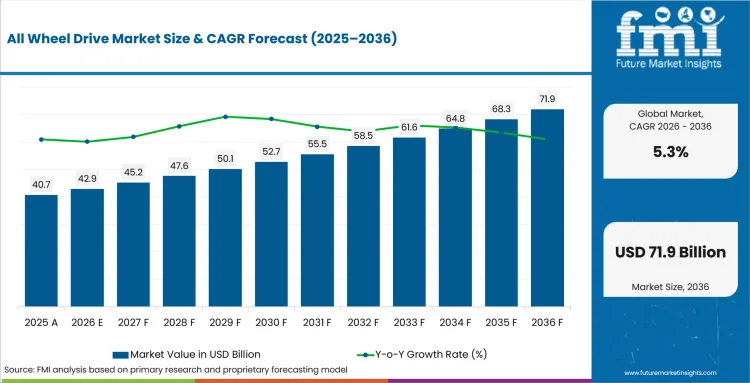
USD 42.9 billion in 2026 and USD 71.9 billion by 2036 at a 5.3% CAGR.
Demand in the all wheel drive market is projected to expand at 5.3% CAGR between 2026 and 2036, increasing valuation from USD 42.9 billion in 2026 to USD 71.9 billion by 2036. Increasing vehicle software integration is expanding the importance of cybersecurity validation alongside traditional drivetrain performance and reliability requirements. GKN Automotive reported in September 2025 that SGS TÜV awarded its automotive cybersecurity engineering processes ISO 21434 certification. The certification covers engineering, manufacturing, quality, information securityand supply-chain procedures across the product lifecycle. Software-controlled AWD programs require cybersecurity evidence beside mechanical durability during vehicle approvaland validated designs must support volume production across several models. Commercial performance depends on reusable packaging and dependable lifecycle controls across each awarded platform.
Electrified platforms can add secondary-axle traction without routing a mechanical prop shaft through the vehicle floor. Magna introduced the DHD REX hybrid drive in March 2026 for vehicles from the B through E segments and stated that the modular system supports AWD layouts including SUVs. Electric vehicle e-axles and hybrid secondary drives therefore give engineers more packaging freedom across shared underbodies and regional derivatives. Mechanical utility platforms place greater weight on towing loads and dealer serviceability across transfer cases and differentials. Vehicle teams must validate thermal control and diagnostics across every operating mode before the architecture enters production. A single platform award can support several regions and trim levels, but unresolved integration problems can delay the complete model family.
Key Takeaways
- SUV and crossover programs create repeat AWD demand through towing, launch tractionand stability requirements shared across several vehicle variants.
- Full-time AWD is projected to account for 35.0% by product type in 2026, supported by immediate torque availability across premium and utility models.
- Sport utility vehicles are anticipated to hold 46.0% in 2026, reflecting towing duties and varied road conditions across high-volume platforms.
- Passenger vehicle manufacturers are forecast to capture 48.0% share in 2026, underpinned by direct control over platform architecture and warranty decisions.
- Added driveline mass and continuous mechanical losses can reduce fuel economy or electric range despite measurable improvements in traction and launch stability.
- Competition includes Magna International, BorgWarner Inc., ZF Friedrichshafen AG, GKN Automotive, a Dauch Corporation company, JTEKT Corporation, Dana Incorporated, Hyundai WIAand Schaeffler AG. Each company must prove exact-market integration through active production programs and dependable regional engineering support coverage.
Analyst Perspective
“Driveline manufacturers no longer compete on traction alone across modern vehicle programs and electrified platform families. Automakers need systems that fit shared vehicle platforms and limit fuel or battery penalties during normal driving. Mechanical couplings remain practical for heavy utility models, while compact electric secondary drives widen packaging choices for electrified vehicles. Repeat platform awards are expected to favor manufacturers that prove durability and efficiency across several models without slowing validation or increasing warranty exposure.”
- Nikhil Kaitwade, Principal Analyst, Future Market Insights
How is the All Wheel Drive Market segmented?
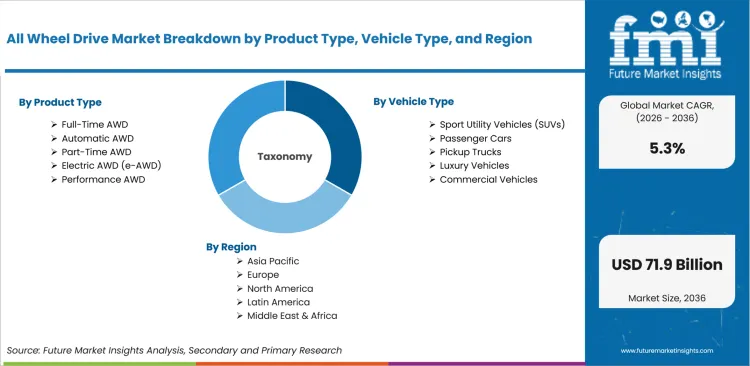
The all wheel drive market is assessed by product type, vehicle type, end user, distribution channel, componentand region.
Product type separates full-time, automatic, part-time, electricand performance AWD architectures according to torque delivery and engagement strategy. Vehicle type compares sport utility vehicles, passenger cars, pickups, luxury vehiclesand commercial vehicles across different traction and packaging requirements. End user distinguishes passenger and commercial vehicle manufacturers from fleets, defense agencies, government usersand aftermarket customers. Distribution channel separates factory-installed contracts from authorized dealers, aftermarket distributors, online channelsand automotive retailers. Component analysis follows transfer cases, differentials, electronic controls, drive shaftsand power take-off units across the torque path. Regional analysis compares vehicle production, engineering support, dealer coverage, service distanceand regulatory conditions across the stated country and regional scope.
Why does full-time AWD lead the product type category?
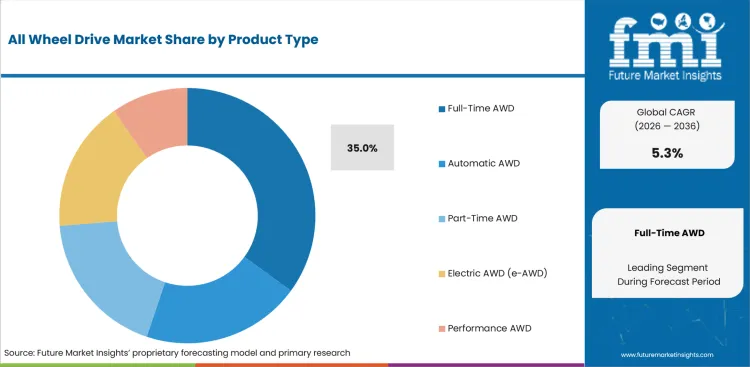
Full-time AWD keeps both axles available throughout the driving cycle and demands accurate calibration across changing grip levels. Mercedes-AMG reported in June 2026 that the new GLE 63 S and GLS 63 use permanent 4MATIC+ with fully variable torque distribution. The named production models show how automotive differential systems manage continuous torque under high engine output and changing grip. Vehicle engineers must balance immediate traction against driveline losses and warranty exposure during series approval.
- The product type category is forecast to be led by full-time AWD at 35.0% share in 2026 due to immediate torque availability across premium and utility platforms. Continuous axle engagement supports stable launch behavior across changing grip levels without waiting for a secondary drive request. Common calibration and proven durability also let automakers reuse the architecture across several related models and regions.
- Automakers choose full-time AWD for vehicles that require dependable traction across every driving phase and cannot rely on delayed axle engagement. Shared hardware can serve several engines and trim levels across one related platform family and regional production network. Continuous mechanical engagement adds friction and raises lifecycle energy use, which limits adoption across efficiency-sensitive models.
How do sport utility vehicles shape demand in the vehicle type category?
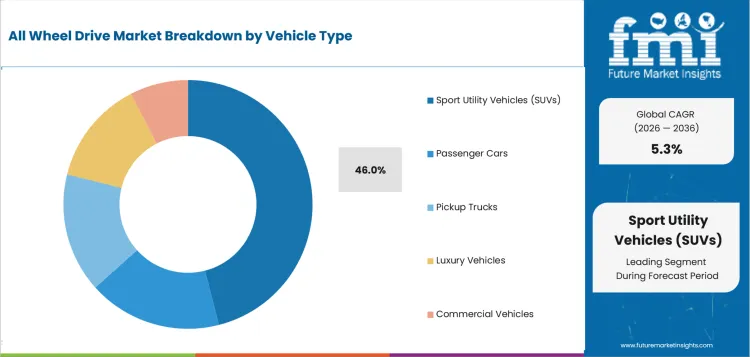
SUV programs combine higher curb weight with towing and rough-road requirements that increase the value of controlled secondary-axle traction. High-volume crossovers must also protect certified efficiency across ordinary driving and several regional certification cycles. BorgWarner announced in October 2025 that Chery selected its Gen VI XWD system for SUV models entering production in 2027. The selected system combines a coupling with an electronic limited-slip differential and active torque vectoring across changing road conditions.
- In 2026, sport utility vehicles are expected to lead the vehicle type category with 46.0% share because towing duties and varied road conditions reward secondary-axle traction. High production volume spreads calibration and tooling costs across more units than narrow vehicle categories. The position remains sensitive to purchase price and certified efficiency across ordinary driving and regional testing cycles.
- Manufacturers extend SUV-focused AWD through scalable couplings and electric rear drives that fit several wheelbases within one product family. Shared interfaces support regional derivatives without creating a separate driveline package for every body style. Entry models face slower adoption if added energy use weakens certified efficiency or raises prices beyond recognized customer value.
What keeps passenger vehicle manufacturers ahead within end user?
GKN Automotive reported in July 2025 that more than 2.5 million vehicles had received its e4WD systems since the 2002 launch. The installed history supports multi-motor e-axles through established integration across motors, transmissionsand controls during long passenger-vehicle programs. Vehicle manufacturers retain direct authority over platform architecture and warranty planning throughout long development cycles. Final approval depends on thermal performance and stable production quality across every derivative model and regional assembly plant.
- Based on end user, passenger vehicle manufacturers are projected to account for 48.0% in 2026 due to direct control over platform packaging and warranty targets. Long development cycles give automakers more influence than fleets or aftermarket channels over original AWD architecture. Their position also reflects the disruption created by replacing a driveline company late in vehicle validation.
- Passenger vehicle manufacturers favor partners that coordinate mechanical hardware with controls and thermal management throughout platform development. Repeat awards can extend across related sedans and crossovers once production quality remains stable across regional plants. Adoption weakens if engineering support cannot resolve software calibration and warranty issues across the complete model lifecycle within agreed response periods.
Which buying mechanism supports OEM sales in the distribution channel category?
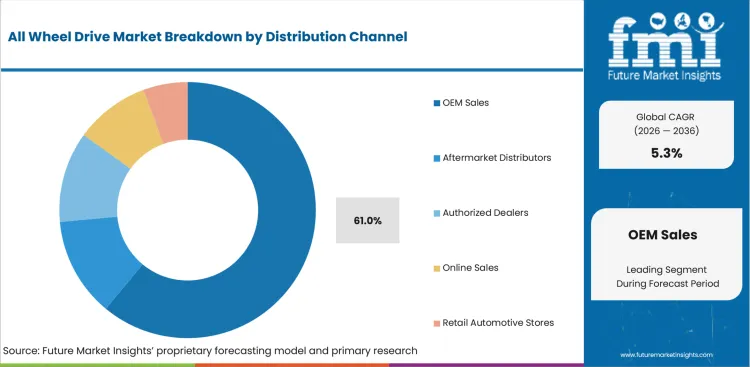
OEM sales concentrate revenue at the platform award through components matched to transmission layouts and vehicle software across production volumes. Series contracts let driveline companies recover qualification costs through automotive axle systems supplied across scheduled production rather than replacement demand. BorgWarner announced in July 2026 that a Chinese automaker selected its torque-on-demand transfer case for a new full-size SUV. Production is planned for the fourth quarter of 2026 through established local engineering and manufacturing operations. OEM channels favor driveline manufacturers that support regional assembly plants without repeating the validation program.
- OEM sales are likely to capture 61.0% share in 2026 attributable to factory installation and validation during vehicle development. Scheduled production contracts provide larger unit volumes than uncertain replacement demand and create clearer tooling recovery across the awarded platform. Common production controls also support derivative models without repeating every qualification step at related assembly plants.
- Automakers use OEM contracts to assign tooling ownership and production capacity across the complete vehicle lifecycle. Driveline companies can expand through derivative models and regional plants once the original design passes validation. Commercial risk rises if one vehicle program misses planned volume and leaves dedicated manufacturing assets below sustainable utilization for several years.
What supports the position of transfer cases within the component category?
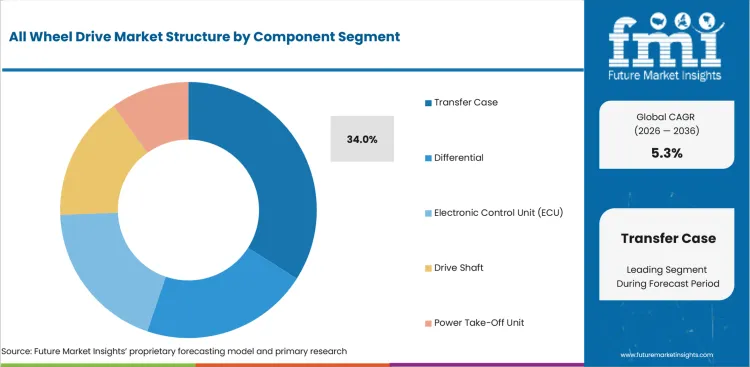
Transfer cases divide engine torque between axles across pickups and utility vehicles that retain mechanical AWD layouts. Hyundai WIA announced in April 2025 that its two-speed active transfer case entered mass production for Kia's Tasman pickup. The program links transfer-case gearing with differential housing designs built for towing loads and rough-road duty. Production awards require durable transmission interfaces across regional vehicle cycles and several assembly plants with different operating requirements.
- Transfer cases are set to lead the component category with 34.0% share in 2026 due to established mechanical layouts across utility vehicles and pickups. Existing transmission interfaces and dealer service procedures reduce integration risk across engine-based vehicle programs and production regions. Durable gearing and controlled engagement remain essential without creating excessive noise or continuous efficiency losses during normal road use.
- Vehicle manufacturers adopt transfer cases through proven transmission interfaces and established service procedures across dealer networks. Modular housings and electronic shift controls widen coverage across several utility platforms and vehicle derivatives. New electric architectures can replace the mechanical torque path with a secondary motor and remove the prop shaft from suitable vehicle layouts. The architectural shift reduces packaging complexity but requires different diagnostics and thermal support across the vehicle lifecycle.
What are the drivers, restraintsand opportunities in the All Wheel Drive Market?
SUV and crossover programs sustain AWD demand, while added energy use and warranty exposure create openings for disconnectable couplings and electric secondary drives.
- Driver: SUV and crossover programs create repeat AWD volume through towing, launch tractionand stability requirements shared across several vehicle variants.
- Restraint: Added driveline mass and mechanical losses can reduce fuel economy or electric range across vehicles with limited secondary-axle use.
- Opportunity: Disconnectable couplings and electric secondary drives can provide traction on demand without carrying continuous mechanical losses during normal driving.
SUV and crossover programs increase AWD volume through heavier curb weights, towing requirementsand broader road-use conditions. The EPA reported in February 2026 that four-wheel-drive systems represented 63% of model-year 2024 production and 86% within trucks. The recorded fitment rates confirm a large production base for couplings and transfer cases without proving equal returns for every company. Commercial value depends on platform reuse that spreads calibration and tooling costs across several models and regional plants.
Energy consumption creates a material restraint as secondary driveline parts add rotating mass and friction during ordinary driving. Germany's Environment Agency stated in September 2025 that European fleet targets required 2025 car emissions to fall 15% from the 2021 baseline. The tighter threshold raises the commercial value of efficient disconnect technology across mechanical AWD vehicle platforms. Automakers can reject a capable traction system if its energy penalty weakens certification results or creates expensive warranty exposure.
Disconnectable couplings and electric secondary drives create a practical opening for traction systems that avoid continuous mechanical losses. Schaeffler presented its modular EMR4 electric axle drive in September 2025 with configurable motor and transmission interfaces. Suitable electric drive axles let automakers add driven wheels without a mechanical prop shaft across defined vehicle platforms. Program teams must prove thermal stability and diagnostic coverage before simpler packaging can support repeat production revenue.
Which country CAGRs are profiled in the All Wheel Drive Market?
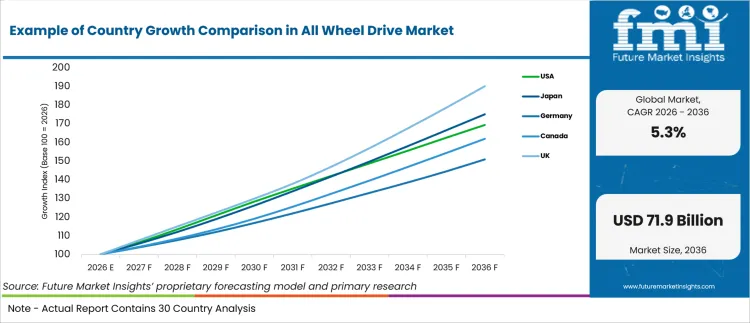
| Country | CAGR |
|---|---|
| UK | 6.6% |
| Japan | 5.8% |
| USA | 5.4% |
| Canada | 4.9% |
| South Korea | 4.6% |
| Germany | 4.2% |
| Australia | 3.9% |
How do country-level CAGRs compare in the All Wheel Drive Market?
The country forecasts show a gradual progression across the all wheel drive market, with growth rates declining in relatively consistent intervals rather than forming sharply separated tiers. The UK and Japan define the upper end of the comparison, reflecting continued demand for vehicles that combine traction, stability and performance across varied driving conditions. The USA and Canada create a middle band where adoption remains supported by established consumer preference for SUVs, pickup trucks and crossover vehicles. South Korea, Germany and Australia follow with more measured growth profiles, although the differences between these markets remain moderate rather than pronounced.
- The UK benefits from increasing demand for premium SUVs and performance-oriented vehicles, encouraging broader availability of all wheel drive configurations across multiple vehicle segments.
- Japan's outlook is supported by strong automotive engineering capabilities and continued adoption of AWD technologies in passenger vehicles designed for diverse terrain and weather conditions.
- The USA reflects sustained demand for SUVs, light trucks and utility vehicles where all wheel drive systems are increasingly offered as standard or premium features.
- Canada continues to support market expansion through consumer preference for enhanced traction and vehicle control in regions that experience challenging seasonal weather conditions.
- South Korea benefits from growing popularity of sport utility vehicles and increasing incorporation of advanced drivetrain technologies into domestic and export vehicle models.
- Germany's market development is influenced by demand for premium vehicles and the integration of AWD systems into both internal combustion and electrified vehicle platforms.
- Australia maintains steady momentum as demand for utility vehicles, off-road capable models and vehicles suited to long-distance driving conditions supports continued AWD adoption.
Similar CAGRs do not necessarily translate into identical commercial opportunities. Differences in vehicle ownership patterns, climate conditions, electrification strategies and consumer preferences can significantly influence AWD penetration across automotive segments. As a result, manufacturers may encounter distinct product positioning and technology adoption dynamics despite broadly comparable growth forecasts. The full report provides country-level CAGR analysis across North America, Latin America, Europe, East Asia, South Asia, Oceania and the Middle East and Africa.
Country-wise Analysis
- Company fleets account for most new zero-emission car registrations in the UK and create a direct route for dual-motor AWD models. Department for Transport data released in April 2026 showed that company keepers represented 78% of new zero-emission car registrations during 2025. All wheel drive demand in the UK is forecast to rise at 6.6% CAGR over the forecast period, reflecting premium crossover adoption and scheduled fleet replacement. National dealer networks provide software calibration and warranty administration across major population centers and regional vehicle fleets. Higher energy use and expensive collision repairs create material friction for complex driveline layouts across fleet operations. Fleet contracts therefore need residual-value assumptions that reflect battery consumption and repair costs across the complete replacement cycle.
- Japanese households maintain broad passenger-car ownership beyond major city centers and closely monitor purchase and inspection costs. Adoption of all wheel drive systems in Japan is estimated to expand at 5.8% CAGR through 2036, shaped by compact e-AWD layouts and hybrid platforms. The Japan Automobile Manufacturers Association reported in April 2026 that household passenger-car ownership reached 71.9% and multi-car ownership reached 30.5%. Domestic engineering networks provide precise calibration and dependable maintenance through manufacturer dealer systems across regional prefectures. Full-time mechanical layouts face resistance from fuel costs and limited workshop space across compact urban facilities. Modular e-axle designs therefore need clear repair procedures before packaging advantages translate into wider model coverage.
- Large pickup and SUV programs give the United States a broad production base for mechanical and electric AWD systems. BEA data published through the Federal Reserve in July 2026 recorded 906.634 thousand domestic light-truck sales during June, indicating a sizeable utility-vehicle base for transfer cases and electric secondary drives across national programs. The all wheel drive market in the United States is projected to grow at 5.4% CAGR by 2036, underpinned by utility platforms and premium electric models. Local engineering centers and production capacity support faster program changes across several vehicle plants and model families. Federal efficiency rules and warranty exposure remain material frictions for systems that add range loss without measurable traction gains.
- Canada's dispersed population and winter driving conditions increase the value of AWD systems with dependable regional service coverage. All wheel drive demand in Canada is set to advance at 4.9% CAGR through 2036, influenced by utility-vehicle fitment and cold-weather use. Statistics Canada reported in March 2026 that multipurpose vehicles represented 63.2% of 2025 registrations while zero-emission vehicles held 9.5%. Dealer networks support maintenance across major provinces through stocked parts and established diagnostic procedures for branded driveline systems. Long service distances and uneven electric adoption create material friction outside metropolitan areas and established parts hubs. Regional inventory agreements therefore remain necessary for specialized transfer-case and coupling components across dispersed service territories.
- South Korea combines dense vehicle production with short engineering distances around major automotive manufacturing clusters. The transport ministry reported in March 2025 that environmentally friendly vehicles represented 40% of all new registrations during 2024, reflecting conditions that favor electronically controlled driveline adoption. The all wheel drive sector in South Korea is projected to record 4.6% CAGR during the assessment period. Domestic testing capacity and established OEM programs support coupling and e-axle calibration near assembly plants. Concentrated customer power creates strict cost targets and demanding reference requirements for broader platform awards. New entrants need local launch support that resolves calibration changes without extending approval schedules, as remote engineering support rarely matches the response speed expected during an active production ramp-up and early warranty review.
- Germany combines premium vehicle platforms with rigorous European fleet-emission targets and formal technical inspection across major production programs. The federal economic ministry reported in January 2026 that battery-electric vehicles represented 19.1% of new registrations during 2025. Deep engineering and dealer networks support calibration and warranty resolution near major OEM production centers. The all wheel drive market in Germany is anticipated to advance at 4.2% CAGR over the assessment period, linked to premium e-AWD programs and stricter efficiency targets. Lifecycle cost scrutiny creates material friction for mechanical systems with continuous losses across ordinary driving. Vehicle companies need local engineering support that documents certified efficiency and resolves warranty issues without delaying derivative models.
- Australia's long travel distances and mixed road conditions favor durable AWD systems with broad dealer and maintenance coverage. All wheel drive sales in Australia are forecast to expand at 3.9% CAGR by 2036, reflecting utility-vehicle demand across dispersed population centers. The infrastructure department confirmed in February 2026 that electric vehicles represented about 12% of vehicles covered by the 2025 emissions standard. National dealer networks support mechanical AWD maintenance across regional cities while electric specialists serve newer secondary-drive layouts. Long parts routes and limited specialist coverage create material friction outside major metropolitan service corridors. Durable mechanical systems retain an advantage in locations that value repair access above compact electric packaging.
Who are the notable companies in the All Wheel Drive Market?
Magna International, BorgWarner Inc., ZF Friedrichshafen AG, GKN Automotive, a Dauch Corporation company, JTEKT Corporation, Dana Incorporated, Hyundai WIAand Schaeffler AG are the notable companies shaping this market.
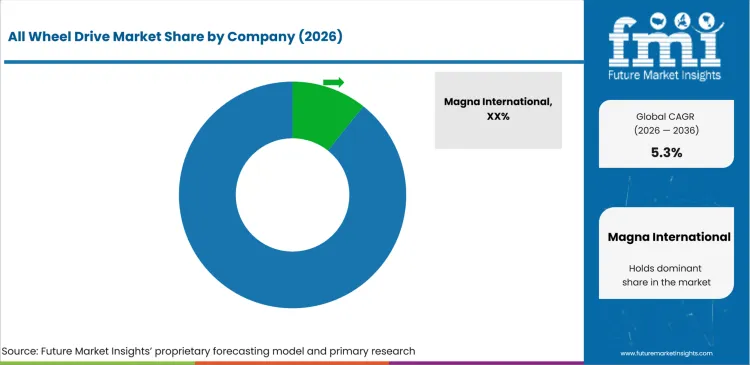
Competition combines global integrators with specialists in couplings, transfer cases, differentialsand electric secondary drives. Dauch Corporation completed its combination with Dowlais Group in February 2026 and retained GKN Automotive as a subsidiary within the enlarged driveline group. Magna and ZF cover mechanical integration beside complete electric-drive modules across global vehicle programs and production regions. BorgWarner and Dana focus on controlled torque transfer through couplings and disconnect systems for utility platforms. JTEKT and Hyundai WIA contribute bearings and transfer-case technology while Schaeffler provides modular electric axle systems. Electrified programs increasingly require e-axle remanufacturing services beyond the original warranty period and initial ownership cycle. Mechanical programs rely on separate axle remanufacturing programs because transfer cases and differentials follow different repair routes.
- Magna International, BorgWarner Inc.and ZF Friedrichshafen AG combine global engineering coverage with mechanical driveline or electric-drive integration across active vehicle programs. Their scale supports calibration and production across several regions without separating hardware from control software. Named program awards remain the decisive test because portfolio breadth alone cannot prove repeat vehicle integration.
- GKN Automotive, Dana Incorporatedand JTEKT Corporation compete through torque-transfer systems that include couplings, disconnect technology, bearingsand axle components for defined architectures. Their installed engineering bases support mechanical and electrified programs across several regions and vehicle platforms. Each company must show series-production fit and responsive warranty support before a technical capability can secure broader platform awards.
- Hyundai WIA and Schaeffler AG add focused transfer-case and electric-axle capabilities for regional programs or specialized platform requirements. Hyundai WIA has a named mass-production transfer-case application while Schaeffler offers a modular electric-drive platform. Both companies need repeat customer awards and service coverage across the intended production geography to widen their competitive position.
Competitive Benchmarking: All Wheel Drive Market
| Company | AWD System Breadth | Vehicle Integration Evidence | Electrified AWD Capability | Geographic Reach |
|---|---|---|---|---|
| Magna International | High | High | High | Global |
| BorgWarner Inc. | High | High | Medium | Global |
| ZF Friedrichshafen AG | High | High | High | Global |
| GKN Automotive | High | Medium | High | Global |
| JTEKT Corporation | Medium | Low | Low | Global |
| Dana Incorporated | High | Low | Low | Global |
| Hyundai WIA | Medium | High | Low | Multi-country |
| Schaeffler AG | Low | Low | Medium | Global |
Key Developments in the All Wheel Drive Market
- In February 2025, Magna expanded its Mercedes-Benz partnership through production of the eDS Duo for an electric off-road vehicle. The 240 kW system combines two motors with a two-speed transmission and independent wheel control inside one electric driveline. The named production program gives Magna direct evidence of premium e-AWD integration across a demanding utility-vehicle application. Series production proves the drive can meet packaging and durability requirements across an active vehicle program and defined manufacturing route.
- In June 2025, American Axle & Manufacturing secured Scout Motors business for front electric drive units and rear e-Beam axles. The agreement covers the Traveler SUV and Terra pickup with initial production targeted for 2027 in the United States. Hardware on both axles links revenue to complete electric and range-extended vehicle programs rather than an isolated component trial. Coordinated front and rear propulsion places integration responsibility across the complete vehicle architecture and production launch.
- In February 2026, BorgWarner secured its first 48V electric cross differential program with a Chinese original equipment manufacturer. The system controls wheel-to-wheel torque through the customer's 48V electrical architecture and real-time slip detection. The award extends active torque management into lower-voltage electrified vehicles without requiring a complete high-voltage secondary axle. Named customer integration gives BorgWarner a production route for this lower-voltage torque-management architecture within electrified vehicle programs.
- In December 2025, ZF received its first eRE+ customer order for a range-extender system with a switchable 200 kW front-axle drive. The architecture combines rear electric propulsion with an independently controlled front drive that can disengage during efficient cruising. The named order strengthens ZF's position in electrified AWD programs balancing traction with range and packaging limits. The switchable front drive gives vehicle engineers a direct method for reducing secondary-drive losses during cruising.
Key Players in the All Wheel Drive Market
Integrated Driveline and Platform Providers
- Magna International
- BorgWarner Inc.
- ZF Friedrichshafen AG
Torque Transfer and Axle Specialists
- GKN Automotive, a Dauch Corporation company
- JTEKT Corporation
- Dana Incorporated
- Hyundai WIA
Electric Drive and Motion Technology Specialists
- Schaeffler AG
All Wheel Drive Market - Report Scope
| Coverage field | Report scope |
|---|---|
| Market breakdown | Product type, vehicle type, end user, distribution channel, componentand region. |
| Quantitative Units | Revenue in USD Million, CAGR in %. |
| Market Definition | Mechanical and electronically controlled all-wheel-drive systems, transfer cases, couplings, differentials, control units, drive shaftsand related vehicle integration. |
| Regions Covered | North America, Latin America, Western Europe, Eastern Europe, East Asia, South Asia and Pacificand Middle East and Africa. |
| Countries Covered | UK, Japan, USA, Canada, South Korea, Germanyand Australia. |
| Key Companies Profiled | Magna International, BorgWarner Inc., ZF Friedrichshafen AG, GKN Automotive, a Dauch Corporation company, JTEKT Corporation, Dana Incorporated, Hyundai WIAand Schaeffler AG. |
| Forecast Period | 2026 to 2036. |
| Approach | Hybrid bottom-up and top-down market sizing supported by primary interviews and official desk research. |
All Wheel Drive Market - Research Methodology
| Method | Approach |
|---|---|
| Primary Research | FMI analysts gathered input from manufacturers, service providers, technology developers, distributors, end users, sourcing teams and subject-matter experts. Interviews examined purchasing decisions, product or service evaluation, adoption barriers, approval requirements, pricing considerationsand expectations for technical or commercial support. Respondents were also asked what evidence is required before a trial, pilot, or initial order develops into regular purchasing. |
| Desk Research | Desk research covered government statistics, regulatory publications, trade data, industry associations, technical literature, standards, company filings, product informationand official corporate announcements. Sources were reviewed for relevance, publication date, geographic coverageand consistency with the defined market scope. Claims relating to performance, applications, approvals, capacity, investmentand commercial activity were retained only when supported by credible public evidence. |
| Market Sizing and Forecasting | The market model combined the baseline value with historical performance, segment structure, pricing and volume indicators, adoption levels, company participationand country-level demand conditions. Forecast assumptions considered economic activity, investment trends, regulatory developments, technology adoption, purchasing cycles, supply availabilityand barriers to wider market use. Segment and regional estimates were reconciled before the final market total was calculated. |
| Data Validation | Estimates were checked against multiple independent indicators, including public data, company activity, trade patterns, industry developmentsand findings from primary interviews. Validation also tested whether products, services, applicationsand company revenues fell within the defined market boundaries. Adjacent categories, unsupported claims, overlapping revenuesand activities without direct market relevance were excluded to reduce double counting and maintain consistency across segments and countries. |
All Wheel Drive Market by Segments
All Wheel Drive Market segmented by Product Type:
- Full-Time AWD
- Mechanical Full-Time AWD
- Electronic Full-Time AWD
- Automatic AWD
- On-Demand AWD
- Intelligent AWD
- Part-Time AWD
- Selectable AWD
- Manual Transfer Case AWD
- Electric AWD (e-AWD)
- Dual Motor AWD
- Tri-Motor AWD
- Performance AWD
- Torque Vectoring AWD
- Sport AWD
All Wheel Drive Market segmented by Vehicle Type:
- Sport Utility Vehicles (SUVs)
- Compact SUVs
- Full-Size SUVs
- Passenger Cars
- Sedans
- Hatchbacks
- Pickup Trucks
- Light Duty Pickups
- Heavy Duty Pickups
- Luxury Vehicles
- Luxury Sedans
- Luxury SUVs
- Commercial Vehicles
- Light Commercial Vehicles
- Medium Commercial Vehicles
All Wheel Drive Market segmented by End User:
- Passenger Vehicle Manufacturers
- Mass Market OEMs
- Premium OEMs
- Commercial Vehicle Manufacturers
- Light Commercial OEMs
- Heavy Commercial OEMs
- Fleet Operators
- Rental Fleets
- Corporate Fleets
- Defense & Government
- Military Vehicles
- Public Safety Vehicles
- Aftermarket Customers
- Repair Workshops
- Individual Vehicle Owners
All Wheel Drive Market segmented by Distribution Channel:
- OEM Sales
- Vehicle Manufacturers
- Assembly Plants
- Aftermarket Distributors
- Authorized Distributors
- Independent Distributors
- Authorized Dealers
- OEM Dealerships
- Certified Service Centers
- Online Sales
- E-commerce Platforms
- OEM Online Stores
- Retail Automotive Stores
- Auto Parts Retailers
- Specialty Automotive Stores
All Wheel Drive Market segmented by Component:
- Transfer Case
- Chain Drive Transfer Case
- Gear Drive Transfer Case
- Differential
- Center Differential
- Limited Slip Differential
- Electronic Control Unit (ECU)
- Torque Control Module
- Drive Control Module
- Drive Shaft
- Front Drive Shaft
- Rear Drive Shaft
- Power Take-Off Unit
- Integrated PTO
- Modular PTO
All Wheel Drive Market by Region:
- North America
- United States
- Canada
- Latin America
- Brazil
- Mexico
- Argentina
- Chile
- Western Europe
- Germany
- France
- United Kingdom
- Italy
- Spain
- Benelux
- Nordics
- Eastern Europe
- Poland
- Czech Republic
- Romania
- Hungary
- East Asia
- China
- Japan
- South Korea
- South Asia and Pacific
- India
- ASEAN
- Australia and New Zealand
- Middle East and Africa
- GCC Countries
- South Africa
- Türkiye
- Israel
Research Sources and Bibliography
- USA Environmental Protection Agency. (2026, February). 2025 EPA Automotive Trends Report: Fuel Economyand Technology since 1975.
- GKN Automotive. (2025, September 8). GKN Automotive achieves ISO 21434 certification.
- Department for Transport. (2026, April 29). Vehicle licensing statistics, United Kingdom: 2025.
- Japan Automobile Manufacturers Association. (2026, April 14). 2025
- USA Bureau of Economic Analysis. (2026, July 3). Motor vehicle retail sales: Domestic light weight trucks [DLTRUCKSSA]. Federal Reserve Bank of St. Louis.
- Statistics Canada. (2026, March 12). New motor vehicle registrations, fourth quarter 2025.
- Ministry of Land, Infrastructure and Transport. (2025, March 11).
- Federal Ministry for Economic Affairs and Energy. (2026, January 27). Great prospects for electric mobility.
- Department of Infrastructure, Transport, Regional Development, Communications and the Arts. (2026, February 18). New vehicle emissions standard driving wider choice and competitive prices for Australians.
- German Environment Agency. (2025, September 26). Pkw und leichte Nutzfahrzeuge.
- Magna International. (2026, March 24). Magna unveils DHD REX hybrid drive for enhanced EV range.
- Mercedes-Benz Group AG. (2026, June 16). V8 power at its finest: The new Mercedes-AMG GLE 63 S 4MATIC+ and Mercedes-AMG GLS 63 4MATIC+.
- BorgWarner Inc. (2026, February 11). BorgWarner secures its first 48V electric cross differential program.
- GKN Automotive. (2025, July 28). Revolutionising all-wheel drive technology with GKN Automotive’s e4WD.
- BorgWarner Inc. (2026, July 27). BorgWarner secures new transfer case business in China, expanding all-wheel drive growth.
- Hyundai WIA. (2025, April 3). HYUNDAI WIA reveals nation’s first rear wheel drive based “2-speed 4WD system”.
- Schaeffler Automotive Buehl GmbH & Co. KG. (2025, September 3). Shaping the future of mobility with electric axle drives, hybrid solutions, steer-by-wire technologiesand software.
- Dauch Corporation. (2026, February 3). Dauch Corporation completes acquisition of Dowlais Group plc.
- Magna International. (2025, February 11). Magna expands long-term innovation partnership with Mercedes-Benz.
- American Axle & Manufacturing Holdings, Inc. (2025, June 11). AAM secures new business to support Scout Motors’ iconic SUV and truck launch.
- BorgWarner Inc. (2025, October 30). BorgWarner expands collaboration with Chery to supply advanced AWD products for global growth.
- ZF Friedrichshafen AG. (2025, December 9). Leapmotor relies on range extenders from ZF.
- Dana Incorporated. (2026, February 27). Annual report for the fiscal year ended December 31, 2025 (Form 10-K). USA Securities and Exchange Commission.
- Yamamoto, T. (2025). Technology development and outlook for automotive driveline system. JTEKT Engineering Journal, 1021E.
This bibliography is provided for reader reference and is not exhaustive. The full report contains the complete reference list and detailed citations
This Report Answers
- What investment case supports expansion from 2026 to 2036?
- Which platform conditions convert AWD engineering capability into repeat production revenue across passenger and light commercial vehicles?
- How do Full-Time AWD and electric secondary drives compare across traction performance and energy consumption?
- Which country conditions change entry economics across the UK, Japan, USA, Canada, South Korea, Germanyand Australia?
- How should automakers compare Magna, BorgWarner, ZF, GKN Automotive under Dauch Corporation, Dana, JTEKT, Hyundai WIAand Schaeffler?
- Which supplier capabilities support OEM awards across mechanical torque transfer and electrified secondary-drive architectures?
- What efficiency or warranty conditions could weaken the projected 5.3% CAGR through 2036?
- Which quarterly indicators reveal platform-award conversion and repeat demand across related vehicle models?
- How do disconnect technology and modular e-axles change packaging and lifecycle economics for future AWD platforms?
Frequently Asked Questions
How big is the All Wheel Drive Market in 2026?
The all wheel drive market is valued at USD 42.9 billion in 2026 and is forecast to reach USD 71.9 billion by 2036. Growth reflects increasing vehicle software integration expanding the importance of cybersecurity validation alongside traditional drivetrain performance and reliability requirements worldwide.
What is the CAGR of the All Wheel Drive Market from 2026 to 2036?
The all wheel drive market grows at a CAGR of 5.3% between 2026 and 2036, supported by SUV and crossover programs that create repeat AWD volume through towing, launch traction, and stability requirements shared across several vehicle variants.
Which distribution channel leads the All Wheel Drive Market?
OEM sales account for 61.0% of the all wheel drive market by distribution channel in 2026, attributable to factory installation and validation during vehicle development that provides larger unit volumes than uncertain replacement demand.
How much will the All Wheel Drive Market add between 2026 and 2036?
The all wheel drive market is set to add USD 29.0 billion between 2026 and 2036, growing from USD 42.9 billion to USD 71.9 billion as electrified secondary-drive architectures extend across a widening base of SUV and crossover vehicle platforms.
Who are the leading companies in the All Wheel Drive Market?
Five companies lead the all wheel drive market, including Magna International, BorgWarner, ZF Friedrichshafen, GKN Automotive, and JTEKT Corporation, competing through mechanical torque transfer systems, electronic controls, and electrified secondary-drive architectures across global vehicle programs.
Preview the report firsthand - request a free sample
Get SampleGet the brochure for pricing and purchase details.
Get PDFTable of Content
- Key Takeaways
- Market Size and CAGR
- Top Growth Driver
- Fastest Growing Segment
- Leading Region
- Key Companies
- Emerging Opportunities
- Executive Summary
- Global Market Outlook
- Demand-side Trends
- Supply-side Trends
- Technology Roadmap Analysis
- Analysis and Recommendations
- Analyst Perspective (What is happening? Why now? What should investors know?)
- Key Questions Answered
- How large is the market?
- What is the CAGR?
- What are key trends?
- Which region dominates?
- Who are the leaders?
- Market Overview
- Market Coverage / Taxonomy
- Market Definition / Scope / Limitations
- Research Methodology
- Chapter Orientation
- Analytical Lens and Working Hypotheses
- Market Structure, Signals, and Trend Drivers
- Benchmarking and Cross-market Comparability
- Market Sizing, Forecasting, and Opportunity Mapping
- Research Design and Evidence Framework
- Desk Research Programme (Secondary Evidence)
- Expert Input and Fieldwork (Primary Evidence)
- Tooling, Models, and Reference Databases
- Data Engineering and Model Build
- Quality Assurance and Audit Trail
- Market Background
- Market Dynamics (Drivers, Restraints, Opportunity, Trends)
- Scenario Forecast (Optimistic, Likely, Conservative)
- Impact Analysis
- AI Impact
- Sustainability Impact
- Regulatory Impact
- Technology Impact
- Consumer / Buyer Analysis
- Purchase Drivers
- Adoption Barriers
- Buyer Journey
- Opportunity Map Analysis
- Product Life Cycle Analysis
- Supply Chain Analysis
- Investment Feasibility Matrix
- Value Chain Analysis
- PESTLE and Porter's Analysis
- Regulatory Landscape
- Regional Parent Market Outlook
- Production and Consumption Statistics
- Import and Export Statistics
- Global Market Analysis and Forecast, 2021 to 2036
- Historical Market Size Value (USD Billion) Analysis, 2021 to 2025
- Current and Future Market Size Value (USD Billion) Projections, 2026 to 2036
- Y-o-Y Growth Trend Analysis
- Absolute $ Opportunity Analysis
- Global Market Pricing Analysis, 2021 to 2036
- Global Market Analysis and Forecast, By Product Type, 2021 to 2036
- Introduction / Key Findings
- Historical Market Size Value (USD Billion) Analysis By Product Type, 2021 to 2025
- Current and Future Market Size Value (USD Billion) Analysis and Forecast By Product Type, 2026 to 2036
- Full-Time AWD
- Mechanical Full-Time AWD
- Electronic Full-Time AWD
- Automatic AWD
- On-Demand AWD
- Intelligent AWD
- Part-Time AWD
- Selectable AWD
- Manual Transfer Case AWD
- Electric AWD (e-AWD)
- Dual Motor AWD
- Tri-Motor AWD
- Performance AWD
- Torque Vectoring AWD
- Sport AWD
- Full-Time AWD
- Y-o-Y Growth Trend Analysis By Product Type, 2021 to 2025
- Absolute $ Opportunity Analysis By Product Type, 2026 to 2036
- Global Market Analysis and Forecast, By Vehicle Type, 2021 to 2036
- Introduction / Key Findings
- Historical Market Size Value (USD Billion) Analysis By Vehicle Type, 2021 to 2025
- Current and Future Market Size Value (USD Billion) Analysis and Forecast By Vehicle Type, 2026 to 2036
- Sport Utility Vehicles (SUVs)
- Compact SUVs
- Full-Size SUVs
- Passenger Cars
- Sedans
- Hatchbacks
- Pickup Trucks
- Light Duty Pickups
- Heavy Duty Pickups
- Luxury Vehicles
- Luxury Sedans
- Luxury SUVs
- Commercial Vehicles
- Light Commercial Vehicles
- Medium Commercial Vehicles
- Sport Utility Vehicles (SUVs)
- Y-o-Y Growth Trend Analysis By Vehicle Type, 2021 to 2025
- Absolute $ Opportunity Analysis By Vehicle Type, 2026 to 2036
- Global Market Analysis and Forecast, By End User, 2021 to 2036
- Introduction / Key Findings
- Historical Market Size Value (USD Billion) Analysis By End User, 2021 to 2025
- Current and Future Market Size Value (USD Billion) Analysis and Forecast By End User, 2026 to 2036
- Passenger Vehicle Manufacturers
- Mass Market OEMs
- Premium OEMs
- Commercial Vehicle Manufacturers
- Light Commercial OEMs
- Heavy Commercial OEMs
- Fleet Operators
- Rental Fleets
- Corporate Fleets
- Defense & Government
- Military Vehicles
- Public Safety Vehicles
- Aftermarket Customers
- Repair Workshops
- Individual Vehicle Owners
- Passenger Vehicle Manufacturers
- Y-o-Y Growth Trend Analysis By End User, 2021 to 2025
- Absolute $ Opportunity Analysis By End User, 2026 to 2036
- Global Market Analysis and Forecast, By Distribution Channel, 2021 to 2036
- Introduction / Key Findings
- Historical Market Size Value (USD Billion) Analysis By Distribution Channel, 2021 to 2025
- Current and Future Market Size Value (USD Billion) Analysis and Forecast By Distribution Channel, 2026 to 2036
- OEM Sales
- Vehicle Manufacturers
- Assembly Plants
- Aftermarket Distributors
- Authorized Distributors
- Independent Distributors
- Authorized Dealers
- OEM Dealerships
- Certified Service Centers
- Online Sales
- E-commerce Platforms
- OEM Online Stores
- Retail Automotive Stores
- Auto Parts Retailers
- Specialty Automotive Stores
- OEM Sales
- Y-o-Y Growth Trend Analysis By Distribution Channel, 2021 to 2025
- Absolute $ Opportunity Analysis By Distribution Channel, 2026 to 2036
- Global Market Analysis and Forecast, By Component, 2021 to 2036
- Introduction / Key Findings
- Historical Market Size Value (USD Billion) Analysis By Component, 2021 to 2025
- Current and Future Market Size Value (USD Billion) Analysis and Forecast By Component, 2026 to 2036
- Transfer Case
- Chain Drive Transfer Case
- Gear Drive Transfer Case
- Differential
- Center Differential
- Limited Slip Differential
- Electronic Control Value (USD Billion) (ECU)
- Torque Control Module
- Drive Control Module
- Drive Shaft
- Front Drive Shaft
- Rear Drive Shaft
- Power Take-Off Unit
- Integrated PTO
- Modular PTO
- Transfer Case
- Y-o-Y Growth Trend Analysis By Component, 2021 to 2025
- Absolute $ Opportunity Analysis By Component, 2026 to 2036
- Global Market Analysis and Forecast, By Region, 2021 to 2036
- Introduction
- Historical Market Size Value (USD Billion) Analysis By Region, 2021 to 2025
- Current Market Size Value (USD Billion) Analysis and Forecast By Region, 2026 to 2036
- North America
- Latin America
- Western Europe
- Eastern Europe
- East Asia
- South Asia and Pacific
- Middle East & Africa
- Market Attractiveness Analysis By Region
- North America Market Analysis and Forecast, By Country, 2021 to 2036
- Historical Market Size Value (USD Billion) Trend Analysis By Market Taxonomy, 2021 to 2025
- Market Size Value (USD Billion) Forecast By Market Taxonomy, 2026 to 2036
- By Country
- USA
- Canada
- By Product Type
- By Vehicle Type
- By End User
- By Distribution Channel
- By Component
- By Country
- Market Attractiveness Analysis
- By Country
- By Product Type
- By Vehicle Type
- By End User
- By Distribution Channel
- By Component
- Key Takeaways
- Latin America Market Analysis and Forecast, By Country
- Historical Market Size Value (USD Billion) Trend Analysis By Market Taxonomy, 2021 to 2025
- Market Size Value (USD Billion) Forecast By Market Taxonomy, 2026 to 2036
- By Country
- Brazil
- Mexico
- Chile
- Rest of Latin America
- By Product Type
- By Vehicle Type
- By End User
- By Distribution Channel
- By Component
- By Country
- Market Attractiveness Analysis
- By Country
- By Product Type
- By Vehicle Type
- By End User
- By Distribution Channel
- By Component
- Key Takeaways
- Western Europe Market Analysis and Forecast, By Country
- Historical Market Size Value (USD Billion) Trend Analysis By Market Taxonomy, 2021 to 2025
- Market Size Value (USD Billion) Forecast By Market Taxonomy, 2026 to 2036
- By Country
- Germany
- UK
- Italy
- Spain
- France
- Nordic
- BENELUX
- Rest of Western Europe
- By Product Type
- By Vehicle Type
- By End User
- By Distribution Channel
- By Component
- By Country
- Market Attractiveness Analysis
- By Country
- By Product Type
- By Vehicle Type
- By End User
- By Distribution Channel
- By Component
- Key Takeaways
- Eastern Europe Market Analysis and Forecast, By Country
- Historical Market Size Value (USD Billion) Trend Analysis By Market Taxonomy, 2021 to 2025
- Market Size Value (USD Billion) Forecast By Market Taxonomy, 2026 to 2036
- By Country
- Russia
- Poland
- Hungary
- Balkan & Baltic
- Rest of Eastern Europe
- By Product Type
- By Vehicle Type
- By End User
- By Distribution Channel
- By Component
- By Country
- Market Attractiveness Analysis
- By Country
- By Product Type
- By Vehicle Type
- By End User
- By Distribution Channel
- By Component
- Key Takeaways
- East Asia Market Analysis and Forecast, By Country
- Historical Market Size Value (USD Billion) Trend Analysis By Market Taxonomy, 2021 to 2025
- Market Size Value (USD Billion) Forecast By Market Taxonomy, 2026 to 2036
- By Country
- China
- Japan
- South Korea
- By Product Type
- By Vehicle Type
- By End User
- By Distribution Channel
- By Component
- By Country
- Market Attractiveness Analysis
- By Country
- By Product Type
- By Vehicle Type
- By End User
- By Distribution Channel
- By Component
- Key Takeaways
- South Asia and Pacific Market Analysis and Forecast, By Country
- Historical Market Size Value (USD Billion) Trend Analysis By Market Taxonomy, 2021 to 2025
- Market Size Value (USD Billion) Forecast By Market Taxonomy, 2026 to 2036
- By Country
- India
- ASEAN
- Australia & New Zealand
- Rest of South Asia and Pacific
- By Product Type
- By Vehicle Type
- By End User
- By Distribution Channel
- By Component
- By Country
- Market Attractiveness Analysis
- By Country
- By Product Type
- By Vehicle Type
- By End User
- By Distribution Channel
- By Component
- Key Takeaways
- Middle East & Africa Market Analysis and Forecast, By Country
- Historical Market Size Value (USD Billion) Trend Analysis By Market Taxonomy, 2021 to 2025
- Market Size Value (USD Billion) Forecast By Market Taxonomy, 2026 to 2036
- By Country
- Kingdom of Saudi Arabia
- Other GCC Countries
- Türkiye
- South Africa
- Other African Union
- Rest of Middle East & Africa
- By Product Type
- By Vehicle Type
- By End User
- By Distribution Channel
- By Component
- By Country
- Market Attractiveness Analysis
- By Country
- By Product Type
- By Vehicle Type
- By End User
- By Distribution Channel
- By Component
- Key Takeaways
- Key Countries Market Analysis
- USA
- Pricing Analysis
- Market Share Analysis, 2025
- By Product Type
- By Vehicle Type
- By End User
- By Distribution Channel
- By Component
- Canada
- Pricing Analysis
- Market Share Analysis, 2025
- By Product Type
- By Vehicle Type
- By End User
- By Distribution Channel
- By Component
- Mexico
- Pricing Analysis
- Market Share Analysis, 2025
- By Product Type
- By Vehicle Type
- By End User
- By Distribution Channel
- By Component
- Brazil
- Pricing Analysis
- Market Share Analysis, 2025
- By Product Type
- By Vehicle Type
- By End User
- By Distribution Channel
- By Component
- Chile
- Pricing Analysis
- Market Share Analysis, 2025
- By Product Type
- By Vehicle Type
- By End User
- By Distribution Channel
- By Component
- Germany
- Pricing Analysis
- Market Share Analysis, 2025
- By Product Type
- By Vehicle Type
- By End User
- By Distribution Channel
- By Component
- UK
- Pricing Analysis
- Market Share Analysis, 2025
- By Product Type
- By Vehicle Type
- By End User
- By Distribution Channel
- By Component
- Italy
- Pricing Analysis
- Market Share Analysis, 2025
- By Product Type
- By Vehicle Type
- By End User
- By Distribution Channel
- By Component
- Spain
- Pricing Analysis
- Market Share Analysis, 2025
- By Product Type
- By Vehicle Type
- By End User
- By Distribution Channel
- By Component
- France
- Pricing Analysis
- Market Share Analysis, 2025
- By Product Type
- By Vehicle Type
- By End User
- By Distribution Channel
- By Component
- India
- Pricing Analysis
- Market Share Analysis, 2025
- By Product Type
- By Vehicle Type
- By End User
- By Distribution Channel
- By Component
- ASEAN
- Pricing Analysis
- Market Share Analysis, 2025
- By Product Type
- By Vehicle Type
- By End User
- By Distribution Channel
- By Component
- Australia & New Zealand
- Pricing Analysis
- Market Share Analysis, 2025
- By Product Type
- By Vehicle Type
- By End User
- By Distribution Channel
- By Component
- China
- Pricing Analysis
- Market Share Analysis, 2025
- By Product Type
- By Vehicle Type
- By End User
- By Distribution Channel
- By Component
- Japan
- Pricing Analysis
- Market Share Analysis, 2025
- By Product Type
- By Vehicle Type
- By End User
- By Distribution Channel
- By Component
- South Korea
- Pricing Analysis
- Market Share Analysis, 2025
- By Product Type
- By Vehicle Type
- By End User
- By Distribution Channel
- By Component
- Russia
- Pricing Analysis
- Market Share Analysis, 2025
- By Product Type
- By Vehicle Type
- By End User
- By Distribution Channel
- By Component
- Poland
- Pricing Analysis
- Market Share Analysis, 2025
- By Product Type
- By Vehicle Type
- By End User
- By Distribution Channel
- By Component
- Hungary
- Pricing Analysis
- Market Share Analysis, 2025
- By Product Type
- By Vehicle Type
- By End User
- By Distribution Channel
- By Component
- Kingdom of Saudi Arabia
- Pricing Analysis
- Market Share Analysis, 2025
- By Product Type
- By Vehicle Type
- By End User
- By Distribution Channel
- By Component
- Türkiye
- Pricing Analysis
- Market Share Analysis, 2025
- By Product Type
- By Vehicle Type
- By End User
- By Distribution Channel
- By Component
- South Africa
- Pricing Analysis
- Market Share Analysis, 2025
- By Product Type
- By Vehicle Type
- By End User
- By Distribution Channel
- By Component
- USA
- Market Structure Analysis
- Competition Dashboard
- Competition Benchmarking
- Market Share Analysis of Top Players
- By Regional
- By Product Type
- By Vehicle Type
- By End User
- By Distribution Channel
- By Component
- Emerging Startups
- Innovation Benchmarking
- Competition Analysis
- Competition Deep Dive
- Magna International
- Overview
- Product Portfolio
- Profitability by Market Segments
- Sales Footprint
- Strategy Overview
- Marketing Strategy
- Product Strategy
- Channel Strategy
- BorgWarner Inc.
- ZF Friedrichshafen AG
- GKN Automotive
- JTEKT Corporation
- Dana Incorporated
- American Axle & Manufacturing Holdings
- Schaeffler AG
- Hyundai WIA
- Eaton Corporation
- Magna International
- Case Studies
- Success Stories
- Recent Developments
- Competition Deep Dive
- Assumptions & Acronyms Used


