

- Market Size (2026)
- USD 272.4 Mn
- Forecast (2036)
- USD 602.6 Mn
- CAGR (2026 to 2036)
- 6.2%
All-Terrain Vehicle Performance Brake Kits Market Outlook for 2026 to 2036
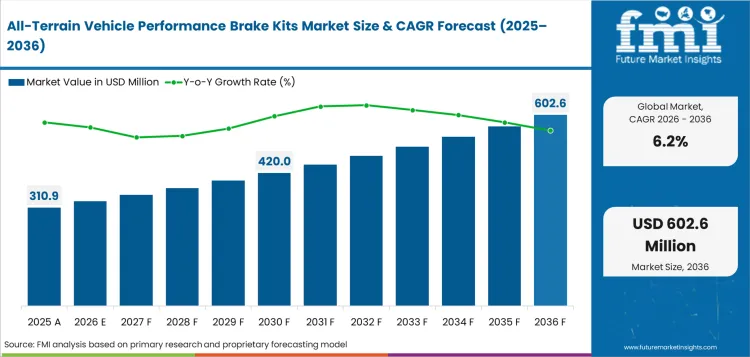
The all-terrain vehicle performance brake kits market was valued at USD 310.9 million in 2025. Industry revenue is projected to cross USD 330.2 million in 2026 and scale to USD 602.6 million by 2036 at 6.2% CAGR. Sintered metal is projected to secure 55.3% share of friction material in 2026. Front axle kits are forecast to hold 52.4% share of kit configuration in 2026.
Brake heat and pedal feel are becoming important commercial tests for all-terrain vehicle performance brake kits. In September 2025, Wilwood UTV Division released big brake kits for the 2024 Can-Am Maverick R. The kits use Narrow Dynapro Radial Mount four piston calipers with Lug-Drive dynamically mounted floating 11.60 × 0.25 inch steel rotors.
In January 2024, CPSC issued a final rule updating the mandatory ATV standard under 16 CFR part 1420 to reference ANSI/SVIA 1-2023. The rule became effective in January 2025. CPSC guidance states that the standard covers service and parking brake performance. This regulation adds value for brake kit suppliers because factory and aftermarket systems must align with stricter brake performance expectations. Aftermarket sourcing will favor complete caliper and rotor packages because high power side by sides need stronger stopping feel on rough terrain.
Summary of the All-Terrain Vehicle Performance Brake Kits Market
- Demand and Growth Drivers
- Safety scrutiny is raising attention on brake response led by ATV injury data keeping off-road braking performance visible.
- Trail and mud riders are replacing stock pads sooner as heat and water shorten brake component life.
- Electric ATV launches are creating new fitment work since vehicle weight and torque profiles alter braking loads.
- Product and Segment View
- Sintered metal is projected to account for 55.3% share in 2026 due to riders preferring heat-tolerant pad compounds.
- Front axle kits are forecast to represent 52.4% share in 2026 since most stopping work concentrates on the front end.
- Online aftermarket is projected to hold 48.6% share in 2026 with model-specific search guiding orders.
- Geography and Competitive Outlook
- India is projected to record 7.1% CAGR by 2036, driven by the consistent advance of powersports parts e-commerce and local vehicle output.
- China is expected to expand at 6.8% CAGR by 2036 due to export scale and local component supply depth.
- Companies such as EBC Brakes, Moto-Master and DP Brakes offers premium friction supply. SuperATV, Race-Driven and QuadBoss widen online access.
- Analyst Opinion
- Nikhil Kaitwade, Principal Consultant for Industrial Automation at FMI, observes, “The ATV brake kit market has evolved from reactive replacements to planned performance upgrades. Riders now compare compound life and rotor cooling before buying. Suppliers with verified fitment data and strong friction material depth will gain more repeat orders across sport and utility ATV use."
- All-Terrain Vehicle Performance Brake Kits Market Value Analysis
- Revenue growth is moving from single replacement parts toward bundled kits with rotors and fitment hardware.
- Riders are spending on heat-tolerant brake packages as trail speeds and loaded utility rides raise stopping loads.
- Supplier differentiation now depends on vehicle coverage tables and compound clarity during online selection.
- Performance kit demand is supported by service workshops needing fewer returns and fewer mismatched parts.
Key Takeaways, Market Size, and Forecast
- The all-terrain vehicle performance brake kits market size stood at USD 310.9 million in 2025.
- The all-terrain vehicle performance brake kits industry value is expected to rise to USD 602.6 million by 2036.
- The sector is anticipated to expand at 6.2% CAGR from 2026 to 2036.
- Industry revenue is forecast to create an incremental opportunity of USD 272.4 million from 2026 to 2036.
- Sintered metal is projected to account for 55.3% share of friction material in 2026.
- Front axle kits are set to represent 52.4% share of kit configuration in 2026.
- India is predicted to record a stronger country pace at 7.1% CAGR, followed by China at 6.8% CAGR by 2036.
All-Terrain Vehicle Performance Brake Kits Market Definition
All-terrain vehicle performance brake kits include aftermarket and accessory brake packages sold for ATVs to improve stopping response, heat resistance or service life. Scope covers brake pads and rotors. Calipers, brake lines and axle-specific conversion kits are included. Kits sold for sport, utility and electric ATVs are included. Finished vehicles are outside scope unless revenue relates to brake kit supply.
All-Terrain Vehicle Performance Brake Kits Market Inclusions
Scope includes performance brake pads and brake rotors. Rotor and pad bundles are included with caliper kits and upgraded brake line kits. Products sold through online aftermarket and specialty dealers are included. Workshop retail and OEM accessory channels are included. Sintered metal and semi-metallic friction materials are included. Ceramic and organic grades are included with low copper grades if sold as ATV brake kit inputs.
All-Terrain Vehicle Performance Brake Kits Market Exclusions
Scope excludes standard factory brake systems installed on new vehicles. General motorcycle brake kits are excluded unless fitted to ATV models. UTV and side-by-side kits are excluded unless cataloged for ATV cross-fitment. Brake fluids and tools are outside scope. Apparel and unrelated powersports accessories are outside scope.
All-Terrain Vehicle Performance Brake Kits Market Research Methodology
- Primary Research: FMI analysts reviewed ATV braking needs across aftermarket sellers, repair workshops and component distributors.
- Desk Research: Official safety data, vehicle launch records and supplier product catalogs supported market sizing.
- Market Sizing and Forecasting: Forecast values used replacement frequency, kit pricing and fitment coverage checks.
- Data Validation: Checks compared 2025 value with 2026 value. Segment share balance was reviewed against rider use and supplier catalog depth.
Why is the All-Terrain Vehicle Performance Brake Kits Market Growing?
- Riders are upgrading brake packages as sport and utility ATV use places more heat stress on pads and rotors.
- Mud and trail conditions are making sintered pad life and rotor cleaning design central to kit selection.
- Model-specific online listings are turning older utility ATV repairs into direct brake kit replacement orders.
Brake kit demand is shifting toward fitment specific repair because ATV braking issues are now connected to safety compliance and vehicle control. In April 2025, CPSC recalled about 1,300 E-Bully youth ATVs after the parking brakes failed to hold and the units violated the federal mandatory ATV safety standard. In May 2025, CPSC warned consumers to stop using Pulse Performance Products electric quad youth ATVs because the vehicles were missing parking brakes and required safety reflectors. These actions show why brake kit suppliers need clear fitment and installation guidance before sale. Repair shops can gain value when replacement kits restore braking performance for a specific ATV model instead of serving as generic accessories.
Market Segmentation Analysis
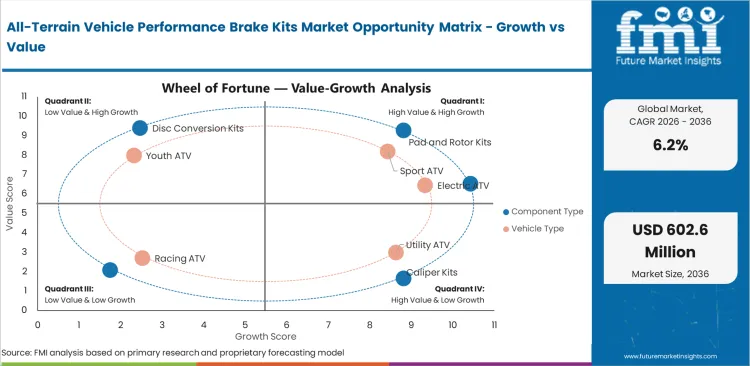
- Pad and rotor kits are projected to capture 46.5% share in 2026, driven by bundled purchase lowering fitment errors during brake service.
- Sport ATV is expected to account for 39.4% share in 2026 as high-speed trail riding creates greater heat stress.
- Front axle kits are forecast to represent 52.4% share in 2026 since front brakes handle most stopping load during deceleration.
- Online aftermarket is projected to hold 48.6% share in 2026 due to vehicle-filtered catalogs guiding buyers toward matched kits.
- Trail riding is expected to secure 42.7% share in 2026 given frequent brake cycling on mixed terrain.
- Sintered metal is forecast to garner 55.3% share in 2026, reflecting heat resistance and wet-surface durability.
Market segmentation is divided into six parent groups based on how riders and workshops specify ATV brake upgrades. Component type separates pad bundles from caliper and line packages. Vehicle type captures sport and utility fitment differences. Kit configuration shows axle-level buying behavior. Sales channel and performance use explain how part choice changes between trail, mud and racing conditions.
Insights into All-Terrain Vehicle Performance Brake Kits Market by Component Type
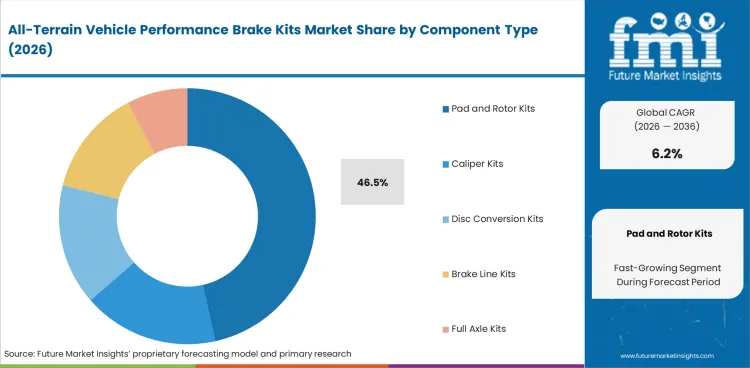
- Pad and rotor kits are projected to secure 46.5% share in 2026 due to riders often replacing friction surfaces together to restore stopping feel and reduce uneven wear.
- Disc conversion kits keep a clear upgrade role for older utility ATVs led by drum hardware limiting heat control during wet trail and farm use.
Insights into All-Terrain Vehicle Performance Brake Kits Market by Vehicle Type
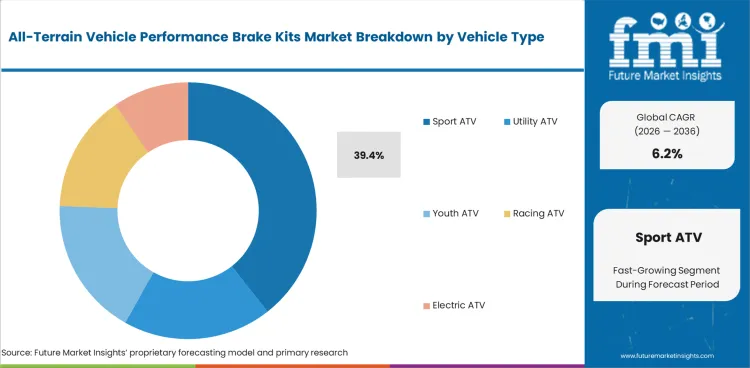
- Sport ATV is expected to account for 39.4% share in 2026, led by faster trail riding and modified tires increasing demand for stronger braking response.
- Utility ATV use keeps steady replacement need influenced by towing and farm work creating repeated low-speed braking under heavier loads.
Insights into All-Terrain Vehicle Performance Brake Kits Market by Kit Configuration
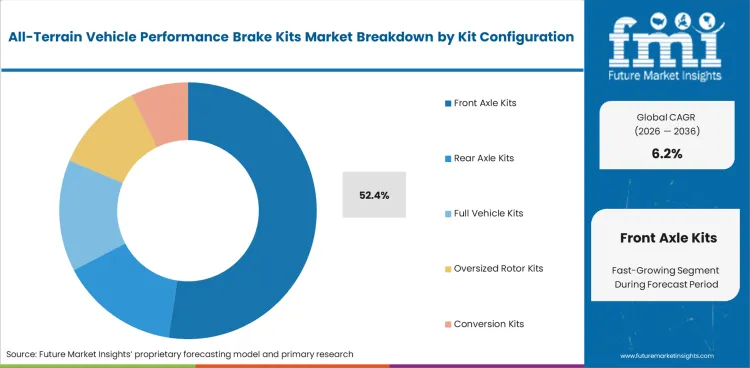
- Front axle kits are forecast to represent 52.4% share in 2026, reflecting front brake load being more visible during speed reduction and hill descents.
- Full vehicle kits gain attention among riders rebuilding older machines since one order can refresh pad and hardware coverage together.
Insights into All-Terrain Vehicle Performance Brake Kits Market by Sales Channel
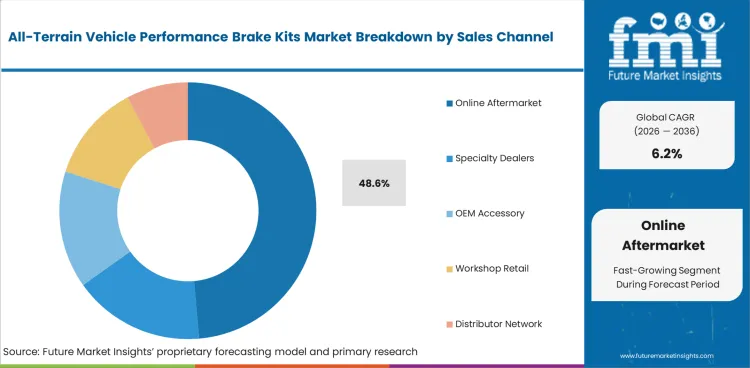
- Online aftermarket is projected to hold 48.6% share in 2026, driven by model filters providing riders with match pads and rotors without dealer visits.
- Specialty dealers protect a service role for complex kits as caliper and line changes need fitment checks before installation begins.
Insights into All-Terrain Vehicle Performance Brake Kits Market by Performance Use
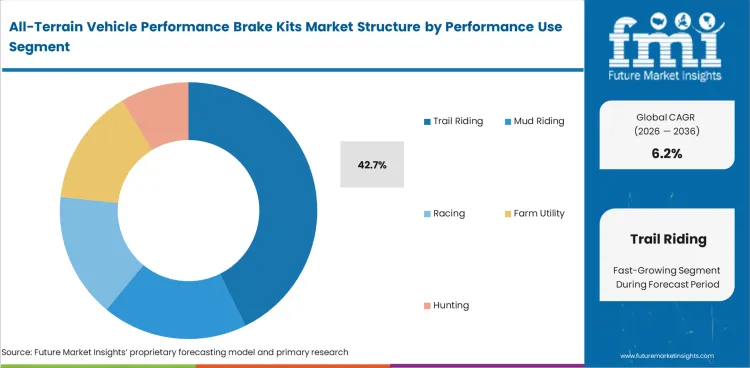
- Trail riding is expected to secure 42.7% share in 2026 through repeated braking on rough surfaces raising heat and wear across stock parts.
- Mud riding supports premium pad demand since water and long low-speed pulls shorten brake life across many recreational ATVs.
Insights into All-Terrain Vehicle Performance Brake Kits Market by Friction Material
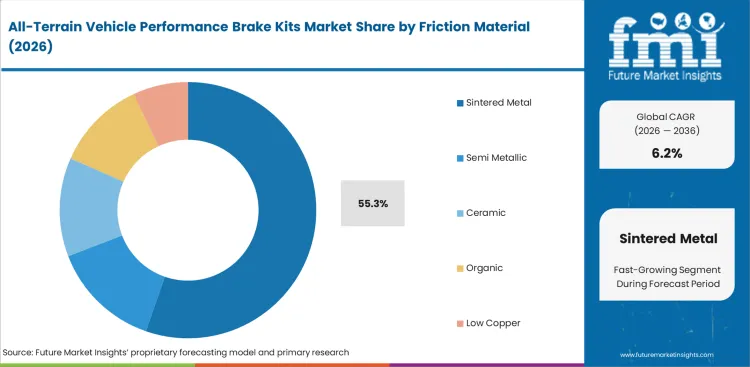
- Sintered metal is forecast to garner 55.3% share in 2026 as riders value heat tolerance and longer wear during wet riding.
- Low copper pads are gaining notice due to brake material rules in road vehicles making cleaner friction claims more familiar to buyers.
All-Terrain Vehicle Performance Brake Kits Market Drivers, Restraints and Opportunities
- Heavy trail use is pushing brake kit selection toward wear control, led by riders tracking pad life and disc condition more closely.
- Compliance and fitment complexity can slow adoption as ATV suppliers need clearer installation records and vehicle-level compatibility checks.
- Electric utility ATV rollout is opening testing opportunities due to charging cycles and towing work creating new brake-service expectations.
Brake kit growth is expected to move toward service-backed replacement and documented fitment. Polaris stated in its 2025 Sportsman 850 and XP 1000 owner’s manual, brake pads must be replaced at 0.030 inch or 0.762 mm of remaining friction material. Same manual advises more frequent checks when brakes face heavy use. Such wear limits give dealers and online sellers a practical trigger for pad and rotor kit replacement instead of broad upgrade claims.
Compliance is also predicted to shape supplier selection as NIST recorded in January 2024, CPSC final rule 2024-01309 amended the mandatory ATV standard under 16 CFR 1420 to reference ANSI/SVIA 1-2023. Suppliers with clearer fitment files and installation guidance will reduce return risk across older ATV platforms. Electric utility models add the next opportunity since BRP’s August 2025 Outlander Electric release states charging from 20% to 80% in 50 minutes, up to 50 miles of range and 1,830 lbs. of towing capacity. Such operating conditions will push brake suppliers to test compounds and hardware against heavier work cycles.
Production Capacity and Supplier Footprint Analysis
Production strength is expected to favor brake suppliers with broad engineering depth and aftermarket reach. Brembo reported €3,702.7 million in 2025 revenue and €440.7 million in net investments during 2025. Motorbike applications declined 10.6% in 2025, however aftermarket performance partly offset weakness in original equipment demand. ATV performance brake kit suppliers can read this as a shift toward replacement depth and service-ready parts coverage. Manufacturers with pad, rotor and hydraulic component capabilities will be better placed as riders seek proven friction parts across mixed off-road use.
Import Dependence and Trade Flow Analysis
Cross-border brake kit movement is expected to depend more on correct product classification and export filing discipline. USA Census Bureau stated in February 2026, Schedule B and HTS tables were updated to accept February 1, 2026 code changes. AES allowed outdated codes only for a 30-day grace period beyond January 31, 2026. Using an outdated code results in a fatal error. Brake kit sellers using overseas rotors or hose assemblies will need cleaner classification work before shipping. Distributors with correct Schedule B and HTS mapping can reduce customs delays and protect online delivery promises.
Analysis of All-Terrain Vehicle Performance Brake Kits Market by Key Countries
.webp "Top Country Growth Comparison All Terrain Vehicle Performance Brake Kits Market Cagr (2026 2036)")
| Country | CAGR |
|---|---|
| India | 7.1% |
| China | 6.8% |
| Brazil | 6.3% |
| United States | 5.8% |
| Australia | 5.5% |
| Canada | 5.4% |
| Germany | 4.7% |
Source: Future Market Insights, 2026.
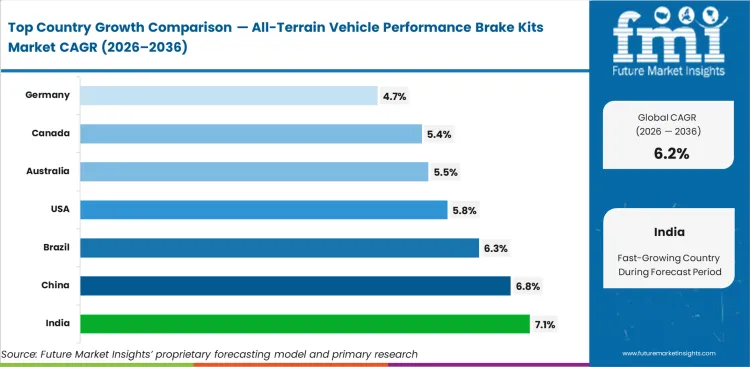
All-Terrain Vehicle Performance Brake Kits Market CAGR Analysis by Country
- India is projected to record 7.1% CAGR by 2036 due to vehicle output and online parts access propelling faster replacement activity.
- China is expected to expand at 6.8% CAGR by 2036, reflecting component manufacturing scale supporting regional supply depth.
- Brazil is forecast to grow at 6.3% CAGR by 2036, led by rural utility riding and repair demand broadening kit adoption.
- United States is expected to advance at 5.8% CAGR by 2036, driven by trail recreation keeping aftermarket brake upgrades visible.
- Australia is projected to rise at 5.5% CAGR by 2036 as quad bike safety attention sustains service and replacement demand.
- Canada is forecast at 5.4% CAGR by 2036 since powersports use benefits from broad recreational vehicle ownership.
- Germany is expected to post 4.7% CAGR by 2036 with mature vehicle service channels keeping growth measured.
Country performance differs by riding culture, rural use and aftermarket access. India and China track above the global line as vehicle output and parts supply depth support quicker kit availability. Germany falls below the global pace as mature service behavior and cautious modification habits keep upgrade demand more selective.
Demand Outlook for All-Terrain Vehicle Performance Brake Kits in India
Demand in India is projected to record 7.1% CAGR by 2036, influenced by parts access improving with wider digital retail. India produced 34.7 million vehicles in fiscal 2025 to 2026 according to national automotive industry data released in 2026. Motorcycle and small vehicle service networks give aftermarket brake suppliers a practical route into powersports parts. ATV kit demand stays consistent with local cataloging and distributor coverage speeding replacement access.
- Local component supply can reduce lead times for pads and hoses used in repair-focused ATV channels.
- Digital parts sellers can educate buyers by matching kit numbers to vehicle make and axle position.
- Sport and farm utility riders create separate needs, so sellers must separate trail braking from load-oriented service kits.
Growth Outlook for All-Terrain Vehicle Performance Brake Kits in China
The market in China is expected to expand at 6.8% CAGR by 2036 due to component scale supporting lower-cost kit supply. China recorded 31.4 million vehicle sales in 2024 according to national automotive industry data released in January 2025. Broad component manufacturing gives brake kit suppliers access to rotors and friction inputs. Export-focused sellers can serve global ATV owners through online channels tied to model compatibility.
- Domestic metalworking capacity supports stainless rotor supply across value and performance grades.
- Export sellers can widen coverage for older Yamaha, Honda and Polaris fitments sold globally.
- Quality claims will matter as buyers compare low-cost parts against branded sintered pad kits.
Demand Analysis of All-Terrain Vehicle Performance Brake Kits in Brazil
Industry in Brazil is forecast to grow at 6.3% CAGR by 2036, driven by rural work and off-road recreation support replacement cycles. Local off-road use often exposes brakes to mud and heat over long service intervals. Aftermarket channels can gain from affordable pad and rotor bundles suited to utility ATVs. Supplier success will depend on distributor reach and proof of wear life under wet use.
- Farm and ranch ATV users need brake kits tolerating wet ground and repeated low-speed braking.
- Retailers can build demand by offering kit bundles instead of single pads for older working machines.
- Imported performance kits will need clear value claims to overcome freight cost and price sensitivity.
Opportunity Analysis of All-Terrain Vehicle Performance Brake Kits in the United States
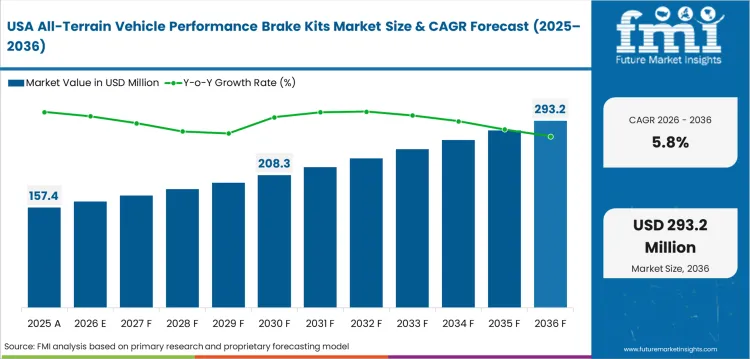
The market in United States is expected to advance at 5.8% CAGR by 2036 through recreational riding sustaining a deep aftermarket. Consumer safety officials reported 94,700 off-highway vehicle emergency department injuries in 2022 in a CPSC report released in May 2025. ATV-coded products accounted for about 90.0% of OHV injury estimates from 2019 to 2023 by original NEISS product code. Safety data keeps attention on vehicle control, supporting upgrades focused on stopping response and brake fade reduction.
- Trail riders compare pad material and rotor design before ordering model-specific kits.
- Dealer and online channels both remain important since many riders install pads themselves after checking fitment tables.
- Performance claims need testing language instead of vague stopping power copy to reduce buyer doubt.
Future Outlook for All-Terrain Vehicle Performance Brake Kits in Australia
Sector in Australia is projected to rise at 5.5% CAGR by 2036 as safety regulation keeps quad bike maintenance visible. Safe Work Australia stated in April 2026 that around 245 people had died in quad bike incidents since 2011. Farm use and remote riding make brake condition a practical service issue. Suppliers can gain by offering kits suited to dust and loaded utility use.
- Agricultural riders need brake parts withstanding long replacement intervals and rough ground.
- Workplace safety attention can push service checks toward pads and brake line condition.
- Regional workshops remain important since many quad bikes operate far from major city service networks.
Sales Analysis of All-Terrain Vehicle Performance Brake Kits in Canada
Sales in Canada is forecast at 5.4% CAGR by 2036 since broad vehicle ownership supports recreational parts demand. Statistics Canada reported 26.8 million road motor vehicles registered in 2024 in data released during November 2025. Large recreational geography provides ATV sellers with a wide service audience outside of prominent urban centers. Winter storage cycles can also concentrate maintenance orders before riding seasons begin.
- Rural and trail users need corrosion-resistant braking parts suited to wet and cold storage conditions.
- Online channels can serve remote buyers once vehicle fitment and return policies are clear.
- Specialty dealers can keep value by bundling brake inspections with tire and suspension service.
Demand Outlook for All-Terrain Vehicle Performance Brake Kits in Germany
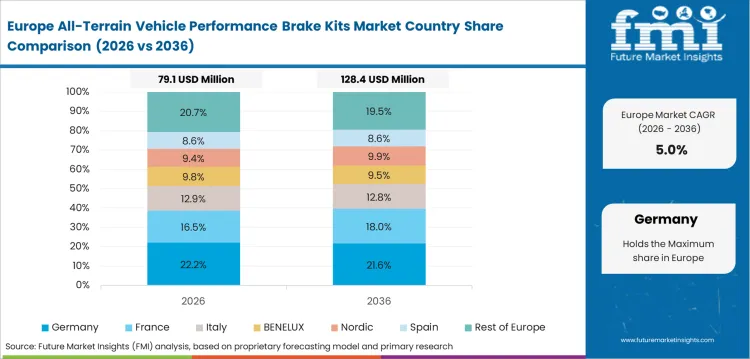
Demand in Germany is expected to post 4.7% CAGR by 2036 reflecting the aftermarket growing from a mature service core. National transport data reported 162.0 thousand motorcycle registrations in 2025, down from 251.2 thousand in 2024. ATV demand is smaller than motorcycle demand, so kit suppliers face tighter volume pools. Premium fitment quality and compliance-friendly material claims will carry more weight than broad catalog claims.
- Specialty shops will favor reputable pad brands with clear compound and fitment information.
- Brake material claims need to align with European expectations on low dust and reliable service life.
- Growth stays measured as buyers are selective about modifications beyond normal maintenance.
Competitive Landscape and Strategic Positioning
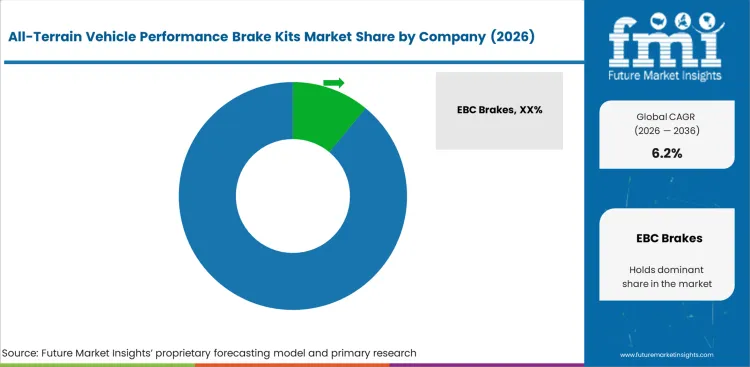
- Friction specialists gain an advantage when riders and workshops compare pad compound depth with rotor material proof.
- Online aftermarket sellers compete through fitment accuracy and vehicle-specific bundle coverage across older and newer ATV platforms.
- OEM accessory channels shape expectations as new ATV launches create wider brake loads and more fitment variation.
Competition in the all-terrain vehicle performance brake kits market is divided between friction material specialists and powersports aftermarket sellers. Companies such as EBC Brakes, Moto-Master and DP Brakes compete on pad compounds and rotor engineering. Galfer adds brake pad and rotor coverage across powersports channels. SuperATV, Demon Powersports and Race-Driven compete through model-mapped online catalogs and kit bundles.
Fitment depth is becoming as important as friction quality. High Lifter lists brake re-build kits and brake line extensions in its ATV brake catalog. Its catalog includes a Honda front disc brake conversion kit. QuadBoss offers caliper rebuild kits, brake line kits and performance brake pads. Suppliers with clear part matching across online powersports channels can reduce returns and support repeat orders.
Premium competition is expected to focus on heat control and material clarity. Moto-Master uses nitro and sinter pro racing lines for UTV and side-by-side brake pads. DP Brakes states sintered pads are used by a broad share of new motorcycle and ATV platforms. EBC lists ATV and UTV rotors built from heat-treated stainless steel. Companies with proven compound depth and accurate fitment data are well placed to maintain competitive edge.
Key Companies in the All-Terrain Vehicle Performance Brake Kits Market
Competitive structure is better understood by grouping companies around friction material depth, online fitment coverage and off-road accessory reach.
- Friction and Rotor Specialists: EBC Brakes and Moto-Master compete based on pad compound range. DP Brakes and Galfer add rotor engineering depth.
- Online Kit Sellers: SuperATV and Demon Powersports gain visibility through vehicle-specific listings. Race-Driven and QuadBoss add bundled brake parts.
- Accessory Channel Anchors: High Lifter Products and Pro Armor influence kit expectations through off-road accessory breadth and workshop reach.
Competitive Benchmarking: All-Terrain Vehicle Performance Brake Kits Market
| Company | ATV Fitment Coverage | Friction Material Depth | Online Kit Clarity | Geographic Footprint |
|---|---|---|---|---|
| EBC Brakes | High | High | Medium | Global aftermarket |
| Moto-Master | Medium | High | Medium | Europe and global dealers |
| DP Brakes | Medium | High | Medium | North America and Europe |
| Galfer | Medium | Medium | Medium | Global powersports |
| SuperATV | High | Medium | High | United States online |
| Demon Powersports | Medium | Medium | High | North America online |
| Race-Driven | High | Medium | High | United States online |
| QuadBoss | High | Medium | High | North America dealers |
| High Lifter Products | Medium | Medium | High | United States specialty |
| Pro Armor | Medium | Medium | Medium | OEM accessory channel |
Source: Future Market Insights competitive analysis, 2026. Ratings reflect relative positioning based on ATV fitment coverage, friction material depth and online kit clarity.
Key Developments in All-Terrain Vehicle Performance Brake Kits Market
- In January 2025, Polaris released 6 new 2025 purpose-built ATV models, including 850 and XP 1000 Mud Edition, Scrambler 850, and Scrambler XP 1000 S.
- In August 2025, BRP introduced the 2026 Can-Am Outlander Electric with 47.0 hp and 53.0 lb-ft of torque.
- In August 2025, BRP launched the 2026 Can-Am Defender with 262.0 mm front rotors and 32.0 mm hydraulic twin-piston calipers.
Key Players in the All-Terrain Vehicle Performance Brake Kits Market
Major Global and Regional Players:
- EBC Brakes
- Moto-Master
- DP Brakes
- Galfer
- SuperATV
Specialist and Online Aftermarket Players:
- Race-Driven
- QuadBoss
- High Lifter Products
- Demon Powersports
Market Scope and Coverage
| Parameter | Details |
|---|---|
| Quantitative Units | USD 310.9 million to USD 602.6 million, at 6.2% CAGR |
| Market Definition | Aftermarket and accessory performance brake kits for all-terrain vehicles |
| Component Type | Pad and rotor kits, caliper kits, disc conversion kits, brake line kits, full axle kits |
| Vehicle Type | Sport ATV, utility ATV, youth ATV, racing ATV, electric ATV |
| Kit Configuration | Front axle kits, rear axle kits, full vehicle kits, oversized rotor kits, conversion kits |
| Sales Channel | Online aftermarket, specialty dealers, OEM accessory, workshop retail, distributor network |
| Performance Use | Trail riding, mud riding, racing, farm utility, hunting |
| Friction Material | Sintered metal, semi-metallic, ceramic, organic, low copper |
| Regions Covered | North America, Latin America, Europe, East Asia, South Asia and Pacific, Middle East and Africa |
| Countries Covered | India, China, Brazil, United States, Australia, Canada, Germany and 30+ countries |
| Key Companies Profiled | EBC Brakes, Moto-Master, DP Brakes, Galfer, SuperATV, Demon Powersports, Race-Driven, QuadBoss, High Lifter Products, Pro Armor |
| Forecast Period | 2026 to 2036 |
| Approach | Replacement volume checks, kit pricing review, fitment coverage checks, official safety data review and segment share estimates |
Source: Future Market Insights, 2026.
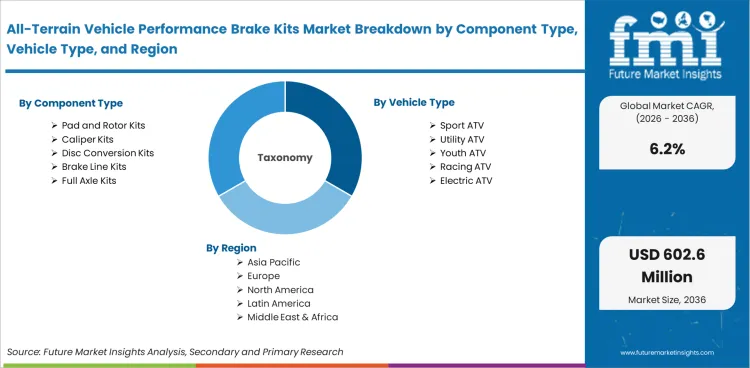
All-Terrain Vehicle Performance Brake Kits Market Breakdown by Component Type, Vehicle Type, Kit Configuration, Sales Channel, Performance Use, Friction Material and Region
By Component Type:
- Pad and Rotor Kits
- Caliper Kits
- Disc Conversion Kits
- Brake Line Kits
- Full Axle Kits
By Vehicle Type:
- Sport ATV
- Utility ATV
- Youth ATV
- Racing ATV
- Electric ATV
By Kit Configuration:
- Front Axle Kits
- Rear Axle Kits
- Full Vehicle Kits
- Oversized Rotor Kits
- Conversion Kits
By Sales Channel:
- Online Aftermarket
- Specialty Dealers
- OEM Accessory
- Workshop Retail
- Distributor Network
By Performance Use:
- Trail Riding
- Mud Riding
- Racing
- Farm Utility
- Hunting
By Friction Material:
- Sintered Metal
- Semi Metallic
- Ceramic
- Organic
- Low Copper
By Region:
- North America
- Latin America
- Europe
- East Asia
- South Asia and Pacific
- Middle East and Africa
Research Sources and Bibliography
- BRP Inc. (2025, August 17). Can-Am breaks new ground: Introducing the Outlander Electric, Outlander MAX 6x6, Maverick R X rc, and the first ATV with semi-active suspension. BRP Inc.
- BRP Inc. (2025, August 17). Can-Am launches new generation Defender side-by-side, engineered to outperform. BRP Inc.
- Brembo N.V. (2026, March 18). FY 2025 results. Brembo.
- China Association of Automobile Manufacturers. (2025, January 14). China’s auto output, sales both reach new heights in 2024. State Council of the People’s Republic of China.
- Federal Statistical Office of Germany. (2026, January). Transport equipment and motor vehicle registrations. Destatis.
- National Institute of Standards and Technology. (2024, January 23). Standard for all-terrain vehicles: ANSI/SVIA 1-2023. Standards Incorporated by Reference Database.
- Polaris Inc. (2025). 2025 Sportsman 850 and XP 1000 owner’s manual. Polaris Online Publication Portal.
- Polaris Inc. (2025, January 14). Polaris releases new purpose-built additions to the 2025 ATV lineup. Polaris Investor Relations.
- Safe Work Australia. (2026, April 20). Have your say on options to improve quad bike safety in the workplace. Safe Work Australia.
- Society of Indian Automobile Manufacturers. (2026, April 14). Auto industry performance of Q4 (Jan-March 2026) and FY 2025-26. Society of Indian Automobile Manufacturers.
- Statistics Canada. (2025, October 17). Vehicle registrations, 2024. Statistics Canada.
- USA Census Bureau. (2026, February 5). Schedule B and Harmonized Tariff Schedule (HTS) updated in the Automated Export System (AES). USA Census Bureau.
- USA Consumer Product Safety Commission. (2025, May 20). 2024 report of deaths and injuries involving off-highway vehicles with more than two wheels. USAConsumer Product Safety Commission.
- Can-Am. (2026). 2026 Can-Am Maverick: Powerful side-by-side vehicle. BRP.
- SuperATV. (2026). Honda utility ATV rear disc brake kit. SuperATV.
Bibliography uses government sources, official company evidence and non-commercial trade data relevant to market demand signals.
This Report Answers
- Which kit type is projected to hold a strong share in all-terrain vehicle performance brake kits?
- How much revenue can the all-terrain vehicle performance brake kits sector create from 2026 to 2036?
- Which countries show stronger readiness for ATV performance brake kit suppliers?
- How do sintered metal pads shape performance brake kit selection?
- Which companies compete across friction materials, kit bundles and online fitment coverage?
- How do safety data and electric ATV launch influence future brake kit needs?
Frequently Asked Questions
What is the all-terrain vehicle performance brake kits market size in 2026?
The all-terrain vehicle performance brake kits industry is projected to reach USD 330.2 million in 2026, supported by replacement and upgrade demand.
What CAGR is forecast for the all-terrain vehicle performance brake kits market?
The sector is forecast to expand at 6.2% CAGR from 2026 to 2036 as riders upgrade pads and brake lines.
Which friction material leads the all-terrain vehicle performance brake kits market?
Sintered metal is projected to account for 55.3% share in 2026 due to heat resistance and wet riding durability.
Which kit configuration has wider adoption in all-terrain vehicle performance brake kits?
Front axle kits are forecast to represent 52.4% share in 2026 as front brakes handle most stopping load during riding.
Which country records stronger pace in all-terrain vehicle performance brake kits?
India is projected to record 7.1% CAGR by 2036 as parts access and vehicle service channels continue expanding.
Who are key players in the all-terrain vehicle performance brake kits market?
EBC Brakes and Moto-Master are key suppliers. DP Brakes and Galfer add friction depth. SuperATV and Race-Driven are active kit sellers.
Preview the report firsthand - request a free sample
Get SampleGet the brochure for pricing and purchase details.
Get PDFTable of Content
- Executive Summary
- Global Market Outlook
- Demand-side Trends
- Supply-side Trends
- Technology Roadmap Analysis
- Analysis and Recommendations
- Market Overview
- Market Coverage / Taxonomy
- Market Definition / Scope / Limitations
- Research Methodology
- Chapter Orientation
- Analytical Lens and Working Hypotheses
- Market Structure, Signals, and Trend Drivers
- Benchmarking and Cross-market Comparability
- Market Sizing, Forecasting, and Opportunity Mapping
- Research Design and Evidence Framework
- Desk Research Programme (Secondary Evidence)
- Company Annual and Sustainability Reports
- Peer-reviewed Journals and Academic Literature
- Corporate Websites, Product Literature, and Technical Notes
- Earnings Decks and Investor Briefings
- Statutory Filings and Regulatory Disclosures
- Technical White Papers and Standards Notes
- Trade Journals, Industry Magazines, and Analyst Briefs
- Conference Proceedings, Webinars, and Seminar Materials
- Government Statistics Portals and Public Data Releases
- Press Releases and Reputable Media Coverage
- Specialist Newsletters and Curated Briefings
- Sector Databases and Reference Repositories
- FMI Internal Proprietary Databases and Historical Market Datasets
- Subscription Datasets and Paid Sources
- Social Channels, Communities, and Digital Listening Inputs
- Additional Desk Sources
- Expert Input and Fieldwork (Primary Evidence)
- Primary Modes
- Qualitative Interviews and Expert Elicitation
- Quantitative Surveys and Structured Data Capture
- Blended Approach
- Why Primary Evidence is Used
- Field Techniques
- Interviews
- Surveys
- Focus Groups
- Observational and In-context Research
- Social and Community Interactions
- Stakeholder Universe Engaged
- C-suite Leaders
- Board Members
- Presidents and Vice Presidents
- R&D and Innovation Heads
- Technical Specialists
- Domain Subject-matter Experts
- Scientists
- Physicians and Other Healthcare Professionals
- Governance, Ethics, and Data Stewardship
- Research Ethics
- Data Integrity and Handling
- Primary Modes
- Tooling, Models, and Reference Databases
- Desk Research Programme (Secondary Evidence)
- Data Engineering and Model Build
- Data Acquisition and Ingestion
- Cleaning, Normalisation, and Verification
- Synthesis, Triangulation, and Analysis
- Quality Assurance and Audit Trail
- Market Background
- Market Dynamics
- Drivers
- Restraints
- Opportunity
- Trends
- Scenario Forecast
- Demand in Optimistic Scenario
- Demand in Likely Scenario
- Demand in Conservative Scenario
- Opportunity Map Analysis
- Product Life Cycle Analysis
- Supply Chain Analysis
- Investment Feasibility Matrix
- Value Chain Analysis
- PESTLE and Porter’s Analysis
- Regulatory Landscape
- Regional Parent Market Outlook
- Production and Consumption Statistics
- Import and Export Statistics
- Market Dynamics
- Global Market Analysis 2021 to 2025 and Forecast, 2026 to 2036
- Historical Market Size Value (USD Million) Analysis, 2021 to 2025
- Current and Future Market Size Value (USD Million) Projections, 2026 to 2036
- Y-o-Y Growth Trend Analysis
- Absolute $ Opportunity Analysis
- Global Market Pricing Analysis 2021 to 2025 and Forecast 2026 to 2036
- Global Market Analysis 2021 to 2025 and Forecast 2026 to 2036, By Component Type
- Introduction / Key Findings
- Historical Market Size Value (USD Million) Analysis By Component Type , 2021 to 2025
- Current and Future Market Size Value (USD Million) Analysis and Forecast By Component Type , 2026 to 2036
- Pad and Rotor Kits
- Caliper Kits
- Disc Conversion Kits
- Brake Line Kits
- Full Axle Kits
- Pad and Rotor Kits
- Y-o-Y Growth Trend Analysis By Component Type , 2021 to 2025
- Absolute $ Opportunity Analysis By Component Type , 2026 to 2036
- Global Market Analysis 2021 to 2025 and Forecast 2026 to 2036, By Vehicle Type
- Introduction / Key Findings
- Historical Market Size Value (USD Million) Analysis By Vehicle Type, 2021 to 2025
- Current and Future Market Size Value (USD Million) Analysis and Forecast By Vehicle Type, 2026 to 2036
- Sport ATV
- Utility ATV
- Youth ATV
- Racing ATV
- Electric ATV
- Sport ATV
- Y-o-Y Growth Trend Analysis By Vehicle Type, 2021 to 2025
- Absolute $ Opportunity Analysis By Vehicle Type, 2026 to 2036
- Global Market Analysis 2021 to 2025 and Forecast 2026 to 2036, By Kit Configuration
- Introduction / Key Findings
- Historical Market Size Value (USD Million) Analysis By Kit Configuration, 2021 to 2025
- Current and Future Market Size Value (USD Million) Analysis and Forecast By Kit Configuration, 2026 to 2036
- Front Axle Kits
- Rear Axle Kits
- Full Vehicle Kits
- Oversized Rotor Kits
- Conversion Kits
- Front Axle Kits
- Y-o-Y Growth Trend Analysis By Kit Configuration, 2021 to 2025
- Absolute $ Opportunity Analysis By Kit Configuration, 2026 to 2036
- Global Market Analysis 2021 to 2025 and Forecast 2026 to 2036, By Sales Channel
- Introduction / Key Findings
- Historical Market Size Value (USD Million) Analysis By Sales Channel, 2021 to 2025
- Current and Future Market Size Value (USD Million) Analysis and Forecast By Sales Channel, 2026 to 2036
- Online Aftermarket
- Specialty Dealers
- OEM Accessory
- Workshop Retail
- Distributor Network
- Online Aftermarket
- Y-o-Y Growth Trend Analysis By Sales Channel, 2021 to 2025
- Absolute $ Opportunity Analysis By Sales Channel, 2026 to 2036
- Global Market Analysis 2021 to 2025 and Forecast 2026 to 2036, By Performance Use
- Introduction / Key Findings
- Historical Market Size Value (USD Million) Analysis By Performance Use, 2021 to 2025
- Current and Future Market Size Value (USD Million) Analysis and Forecast By Performance Use, 2026 to 2036
- Trail Riding
- Mud Riding
- Racing
- Farm Utility
- Hunting
- Trail Riding
- Y-o-Y Growth Trend Analysis By Performance Use, 2021 to 2025
- Absolute $ Opportunity Analysis By Performance Use, 2026 to 2036
- Global Market Analysis 2021 to 2025 and Forecast 2026 to 2036, By Friction Material
- Introduction / Key Findings
- Historical Market Size Value (USD Million) Analysis By Friction Material, 2021 to 2025
- Current and Future Market Size Value (USD Million) Analysis and Forecast By Friction Material, 2026 to 2036
- Sintered Metal
- Semi Metallic
- Ceramic
- Organic
- Low Copper
- Sintered Metal
- Y-o-Y Growth Trend Analysis By Friction Material, 2021 to 2025
- Absolute $ Opportunity Analysis By Friction Material, 2026 to 2036
- Global Market Analysis 2021 to 2025 and Forecast 2026 to 2036, By Region
- Introduction
- Historical Market Size Value (USD Million) Analysis By Region, 2021 to 2025
- Current Market Size Value (USD Million) Analysis and Forecast By Region, 2026 to 2036
- North America
- Latin America
- Western Europe
- Eastern Europe
- East Asia
- South Asia and Pacific
- Middle East & Africa
- Market Attractiveness Analysis By Region
- North America Market Analysis 2021 to 2025 and Forecast 2026 to 2036, By Country
- Historical Market Size Value (USD Million) Trend Analysis By Market Taxonomy, 2021 to 2025
- Market Size Value (USD Million) Forecast By Market Taxonomy, 2026 to 2036
- By Country
- USA
- Canada
- Mexico
- By Component Type
- By Vehicle Type
- By Kit Configuration
- By Sales Channel
- By Performance Use
- By Friction Material
- By Country
- Market Attractiveness Analysis
- By Country
- By Component Type
- By Vehicle Type
- By Kit Configuration
- By Sales Channel
- By Performance Use
- By Friction Material
- Key Takeaways
- Latin America Market Analysis 2021 to 2025 and Forecast 2026 to 2036, By Country
- Historical Market Size Value (USD Million) Trend Analysis By Market Taxonomy, 2021 to 2025
- Market Size Value (USD Million) Forecast By Market Taxonomy, 2026 to 2036
- By Country
- Brazil
- Chile
- Rest of Latin America
- By Component Type
- By Vehicle Type
- By Kit Configuration
- By Sales Channel
- By Performance Use
- By Friction Material
- By Country
- Market Attractiveness Analysis
- By Country
- By Component Type
- By Vehicle Type
- By Kit Configuration
- By Sales Channel
- By Performance Use
- By Friction Material
- Key Takeaways
- Western Europe Market Analysis 2021 to 2025 and Forecast 2026 to 2036, By Country
- Historical Market Size Value (USD Million) Trend Analysis By Market Taxonomy, 2021 to 2025
- Market Size Value (USD Million) Forecast By Market Taxonomy, 2026 to 2036
- By Country
- Germany
- UK
- Italy
- Spain
- France
- Nordic
- BENELUX
- Rest of Western Europe
- By Component Type
- By Vehicle Type
- By Kit Configuration
- By Sales Channel
- By Performance Use
- By Friction Material
- By Country
- Market Attractiveness Analysis
- By Country
- By Component Type
- By Vehicle Type
- By Kit Configuration
- By Sales Channel
- By Performance Use
- By Friction Material
- Key Takeaways
- Eastern Europe Market Analysis 2021 to 2025 and Forecast 2026 to 2036, By Country
- Historical Market Size Value (USD Million) Trend Analysis By Market Taxonomy, 2021 to 2025
- Market Size Value (USD Million) Forecast By Market Taxonomy, 2026 to 2036
- By Country
- Russia
- Poland
- Hungary
- Balkan & Baltic
- Rest of Eastern Europe
- By Component Type
- By Vehicle Type
- By Kit Configuration
- By Sales Channel
- By Performance Use
- By Friction Material
- By Country
- Market Attractiveness Analysis
- By Country
- By Component Type
- By Vehicle Type
- By Kit Configuration
- By Sales Channel
- By Performance Use
- By Friction Material
- Key Takeaways
- East Asia Market Analysis 2021 to 2025 and Forecast 2026 to 2036, By Country
- Historical Market Size Value (USD Million) Trend Analysis By Market Taxonomy, 2021 to 2025
- Market Size Value (USD Million) Forecast By Market Taxonomy, 2026 to 2036
- By Country
- China
- Japan
- South Korea
- By Component Type
- By Vehicle Type
- By Kit Configuration
- By Sales Channel
- By Performance Use
- By Friction Material
- By Country
- Market Attractiveness Analysis
- By Country
- By Component Type
- By Vehicle Type
- By Kit Configuration
- By Sales Channel
- By Performance Use
- By Friction Material
- Key Takeaways
- South Asia and Pacific Market Analysis 2021 to 2025 and Forecast 2026 to 2036, By Country
- Historical Market Size Value (USD Million) Trend Analysis By Market Taxonomy, 2021 to 2025
- Market Size Value (USD Million) Forecast By Market Taxonomy, 2026 to 2036
- By Country
- India
- ASEAN
- Australia & New Zealand
- Rest of South Asia and Pacific
- By Component Type
- By Vehicle Type
- By Kit Configuration
- By Sales Channel
- By Performance Use
- By Friction Material
- By Country
- Market Attractiveness Analysis
- By Country
- By Component Type
- By Vehicle Type
- By Kit Configuration
- By Sales Channel
- By Performance Use
- By Friction Material
- Key Takeaways
- Middle East & Africa Market Analysis 2021 to 2025 and Forecast 2026 to 2036, By Country
- Historical Market Size Value (USD Million) Trend Analysis By Market Taxonomy, 2021 to 2025
- Market Size Value (USD Million) Forecast By Market Taxonomy, 2026 to 2036
- By Country
- Kingdom of Saudi Arabia
- Other GCC Countries
- Turkiye
- South Africa
- Other African Union
- Rest of Middle East & Africa
- By Component Type
- By Vehicle Type
- By Kit Configuration
- By Sales Channel
- By Performance Use
- By Friction Material
- By Country
- Market Attractiveness Analysis
- By Country
- By Component Type
- By Vehicle Type
- By Kit Configuration
- By Sales Channel
- By Performance Use
- By Friction Material
- Key Takeaways
- Key Countries Market Analysis
- USA
- Pricing Analysis
- Market Share Analysis, 2025
- By Component Type
- By Vehicle Type
- By Kit Configuration
- By Sales Channel
- By Performance Use
- By Friction Material
- Canada
- Pricing Analysis
- Market Share Analysis, 2025
- By Component Type
- By Vehicle Type
- By Kit Configuration
- By Sales Channel
- By Performance Use
- By Friction Material
- Mexico
- Pricing Analysis
- Market Share Analysis, 2025
- By Component Type
- By Vehicle Type
- By Kit Configuration
- By Sales Channel
- By Performance Use
- By Friction Material
- Brazil
- Pricing Analysis
- Market Share Analysis, 2025
- By Component Type
- By Vehicle Type
- By Kit Configuration
- By Sales Channel
- By Performance Use
- By Friction Material
- Chile
- Pricing Analysis
- Market Share Analysis, 2025
- By Component Type
- By Vehicle Type
- By Kit Configuration
- By Sales Channel
- By Performance Use
- By Friction Material
- Germany
- Pricing Analysis
- Market Share Analysis, 2025
- By Component Type
- By Vehicle Type
- By Kit Configuration
- By Sales Channel
- By Performance Use
- By Friction Material
- UK
- Pricing Analysis
- Market Share Analysis, 2025
- By Component Type
- By Vehicle Type
- By Kit Configuration
- By Sales Channel
- By Performance Use
- By Friction Material
- Italy
- Pricing Analysis
- Market Share Analysis, 2025
- By Component Type
- By Vehicle Type
- By Kit Configuration
- By Sales Channel
- By Performance Use
- By Friction Material
- Spain
- Pricing Analysis
- Market Share Analysis, 2025
- By Component Type
- By Vehicle Type
- By Kit Configuration
- By Sales Channel
- By Performance Use
- By Friction Material
- France
- Pricing Analysis
- Market Share Analysis, 2025
- By Component Type
- By Vehicle Type
- By Kit Configuration
- By Sales Channel
- By Performance Use
- By Friction Material
- India
- Pricing Analysis
- Market Share Analysis, 2025
- By Component Type
- By Vehicle Type
- By Kit Configuration
- By Sales Channel
- By Performance Use
- By Friction Material
- ASEAN
- Pricing Analysis
- Market Share Analysis, 2025
- By Component Type
- By Vehicle Type
- By Kit Configuration
- By Sales Channel
- By Performance Use
- By Friction Material
- Australia & New Zealand
- Pricing Analysis
- Market Share Analysis, 2025
- By Component Type
- By Vehicle Type
- By Kit Configuration
- By Sales Channel
- By Performance Use
- By Friction Material
- China
- Pricing Analysis
- Market Share Analysis, 2025
- By Component Type
- By Vehicle Type
- By Kit Configuration
- By Sales Channel
- By Performance Use
- By Friction Material
- Japan
- Pricing Analysis
- Market Share Analysis, 2025
- By Component Type
- By Vehicle Type
- By Kit Configuration
- By Sales Channel
- By Performance Use
- By Friction Material
- South Korea
- Pricing Analysis
- Market Share Analysis, 2025
- By Component Type
- By Vehicle Type
- By Kit Configuration
- By Sales Channel
- By Performance Use
- By Friction Material
- Russia
- Pricing Analysis
- Market Share Analysis, 2025
- By Component Type
- By Vehicle Type
- By Kit Configuration
- By Sales Channel
- By Performance Use
- By Friction Material
- Poland
- Pricing Analysis
- Market Share Analysis, 2025
- By Component Type
- By Vehicle Type
- By Kit Configuration
- By Sales Channel
- By Performance Use
- By Friction Material
- Hungary
- Pricing Analysis
- Market Share Analysis, 2025
- By Component Type
- By Vehicle Type
- By Kit Configuration
- By Sales Channel
- By Performance Use
- By Friction Material
- Kingdom of Saudi Arabia
- Pricing Analysis
- Market Share Analysis, 2025
- By Component Type
- By Vehicle Type
- By Kit Configuration
- By Sales Channel
- By Performance Use
- By Friction Material
- Turkiye
- Pricing Analysis
- Market Share Analysis, 2025
- By Component Type
- By Vehicle Type
- By Kit Configuration
- By Sales Channel
- By Performance Use
- By Friction Material
- South Africa
- Pricing Analysis
- Market Share Analysis, 2025
- By Component Type
- By Vehicle Type
- By Kit Configuration
- By Sales Channel
- By Performance Use
- By Friction Material
- USA
- Market Structure Analysis
- Competition Dashboard
- Competition Benchmarking
- Market Share Analysis of Top Players
- By Regional
- By Component Type
- By Vehicle Type
- By Kit Configuration
- By Sales Channel
- By Performance Use
- By Friction Material
- Competition Analysis
- Competition Deep Dive
- EBC Brakes
- Overview
- Product Portfolio
- Profitability by Market Segments (Product/Age /Sales Channel/Region)
- Sales Footprint
- Strategy Overview
- Marketing Strategy
- Product Strategy
- Channel Strategy
- Moto-Master
- DP Brakes
- Galfer
- SuperATV
- Demon Powersports
- Race-Driven
- QuadBoss
- High Lifter Products
- Pro Armor
- EBC Brakes
- Competition Deep Dive
- Assumptions & Acronyms Used


