

- Market Size (2026)
- USD 1.8 Bn
- Forecast (2036)
- USD 5.9 Bn
- CAGR (2026 to 2036)
- 12.6%
Multi-Motor E-Axle Torque Vectoring Systems Market Size, Market Forecast and Outlook By FMI
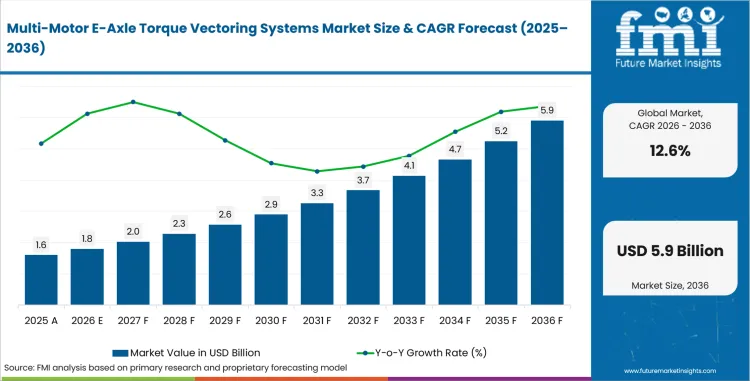
Multi-motor e-axle torque vectoring systems market was valued at USD 1.6 billion in 2025 and is expected to reach USD 1.8 billion in 2026. Demand is forecast to reach USD 5.9 billion by 2036 at 12.6% CAGR during the forecast period. OEM fitment is anticipated to account for 86.0% of sales channel demand in 2026. Passenger EVs are forecast to account for 68.0% of vehicle type demand in 2026.
Key Takeaways, Market Size, and Forecast
- Multi-motor e-axle torque vectoring systems market stood at USD 1.6 billion in 2025.
- By 2036, industry revenue is forecast to reach USD 5.9 billion.
- Demand is expected to rise at 12.6% CAGR during the forecast period.
- Market expansion is predicted to add USD 4.1 billion in incremental opportunity over 2026 to 2036.
- OEM fitment is anticipated to represent 86.0% of sales channel demand in 2026.
- Passenger EVs are expected to hold 68.0% of vehicle type demand in 2026.
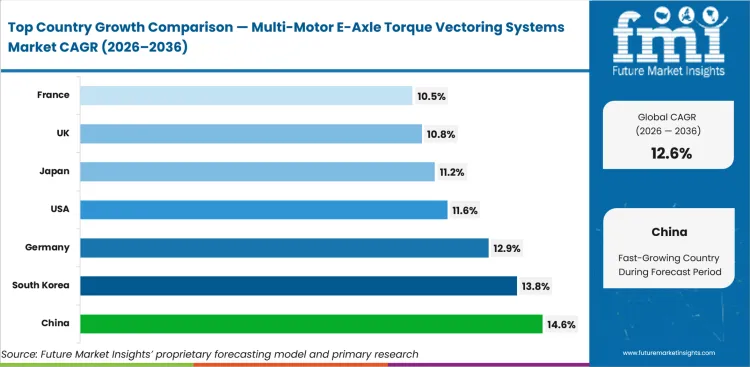
- China at 14.6% CAGR and South Korea at 13.8% CAGR are expected to lead country-level expansion during the forecast period.
Summary of the Multi-Motor E-Axle Torque Vectoring Systems Market
- Demand and Growth Drivers
- EV makers are using multi-motor e-axles to control power more smoothly across electric vehicle platforms.
- Premium electric SUVs need faster torque correction because heavier vehicles need better grip during turns.
- Central vehicle motion software is making torque control part of the main EV design plan.
- Product and Segment View
- Dual motor layouts give automakers a practical balance between system cost and road control.
- Software torque control is becoming more important as motor response must work smoothly with steering and braking.
- OEM fitment stays the main route because torque vectoring needs tuning before a vehicle enters production.
- Geography and Competitive Outlook
- China has a clear role because large EV output gives suppliers more platform opportunities.
- Germany and South Korea support demand through electric drivetrain engineering and premium EV development.
- Suppliers with compact motor packaging and tested control software are better placed for future vehicle programs.
- Analyst Opinion
- Nikhil Kaitwade Principal Consultant at FMI says “Multi-motor e-axle torque vectoring has moved beyond a performance feature. Automakers use it to control traction and stability across electric platforms. Suppliers pairing compact axle packaging with fast software calibration will be preferred in premium EVs and electric SUVs.”
- Multi-Motor E-Axle Torque Vectoring Systems Market Value Analysis
- The multi-motor e-axle torque vectoring systems market is moving from a premium EV feature into a core drivetrain design choice.
- Value is rising as automakers use front and rear electric drive units to improve road grip and launch control.
- Market value is supported by premium electric SUVs because heavier vehicles need faster torque correction during turns.
- Software control adds more value as motor response must work smoothly with braking systems.
- Suppliers with compact e-axle packaging can support automakers that want better performance without adding complex mechanical parts.
Brake dust pressure and high EV weight are making torque-vectoring e-axles more valuable in premium electric platforms. In January 2024, the European Parliament’s Euro 7 provisional agreement set brake particle limits at 3 mg/km for pure electric M1 and N1 vehicles and 7 mg/km for most other powertrains. This gives OEMs a clearer reason to reduce brake-based stability control through motor-side torque control. In May 2024, BorgWarner supplied its eTVD for the Polestar 3 with a 3-in-1 system that replaces the differential and adds torque vectoring with on-demand disconnect. The setup helps suppliers sell handling and brake-wear reduction through one rear-axle module. In February 2024, Magna won a specialized rear eDrive program using an 800V eDS Duo variant rated at 726 kW and 8,000 Nm. High-output integration gives OEMs a shorter route to performance EV differentiation without adding separate motor and inverter packages.
Multi-Motor E-Axle Torque Vectoring Systems Market Definition
The multi-motor e-axle torque vectoring systems market covers electric drive systems that use two or more motors to control how power moves across an EV platform. These systems help each wheel or axle receive the right torque based on road grip and driving conditions. Automakers use them to improve launch control and cornering stability in premium electric vehicles. The market is closely tied to electric SUVs and performance EVs because heavier vehicles need faster torque response. Supplier value comes from compact motor packaging and control software that can work smoothly with braking systems.
Multi-Motor E-Axle Torque Vectoring Systems Market Inclusions
Market scope covers multi-motor e-axle torque vectoring systems categorized by motor layout, including dual motor and tri-motor systems. Quad motor and in-wheel pairs are included for EV platforms that need wheel-side torque control. Vehicle type covers passenger EVs and performance SUVs. Electric trucks and luxury sedans are included where multi-motor drive systems support traction and handling needs. Control type covers software torque and e-differential systems. Brake blending and yaw control are included when motor torque is coordinated with braking response. Voltage class covers 800V systems and 400V systems. Hybrid voltage systems are included where automakers use mixed architecture across shared EV platforms. Sales channel includes OEM fitment and platform upgrades. Service replacement is included when certified axle modules or control units are replaced through approved service routes. Revenue scope covers 2026 to 2036. Key participants include e-axle suppliers and electric motor manufacturers. Automakers, tier-one drivetrain suppliers, inverter makers, control software developers, testing providers and EV platform integrators form the wider market ecosystem.
Multi-Motor E-Axle Torque Vectoring Systems Market Exclusions
Scope excludes single-motor e-axles without torque vectoring control. Conventional mechanical differentials are excluded unless paired with electric torque split control. Brake-only stability control is excluded unless it works with motor torque distribution. Battery packs and charging hardware are excluded unless supplied inside a complete axle control package.
Multi-Motor E-Axle Torque Vectoring Systems Market Research Methodology
- Primary Research: FMI analysts reviewed e-axle suppliers and torque management specialists across leading automotive countries.
- Desk Research: Public data from IEA and OICA supported EV production checks and supplier activity review.
- Market Sizing and Forecasting: Market size was estimated by checking EV output and multi-motor platform penetration.
- Data Validation: Forecast checks compared electric car sales and vehicle production with active supplier awards.
Why is the Multi-Motor E-Axle Torque Vectoring Systems Market Growing?
- EV platforms need more precise torque control as OEMs add front and rear electric drive units to premium models.
- Central vehicle motion software raises the value of motor torque commands as braking and powertrain actions must work together.
- Higher voltage e-axles raise system value since inverters and cooling hardware need tighter design.
EV platform design is moving toward drive units with fewer separate parts. Bosch says its eAxle covers 70.0 kW to 300.0 kW output and supports 400V and 800V systems. Demand for electric vehicle e-axle systems is expected to rise as automakers seek compact drive packages with lower packaging work. Multi-motor torque vectoring extends the same idea by using control software to vary torque between axles or wheels. Suppliers with motor design and software calibration can capture higher content per vehicle.
Vehicle motion control is becoming central to premium EV behavior. Bosch says Vehicle Motion Management controls vehicle movement across six degrees of freedom and brings braking with powertrain actions into one motion domain. Demand for automotive electric drivetrain components is expected to expand as torque commands must work with braking and steering inputs. Such control depth gives suppliers a clearer route into vehicle programs. It makes torque vectoring a platform feature instead of a performance add-on.
Market Segmentation Analysis
- Dual motor layouts are expected to hold 52.0% share in 2026.
- Passenger EVs are forecast to account for 68.0% of demand in 2026.
- Software torque control is anticipated to capture 61.0% share in 2026.
- Premium EV platforms are likely to hold 49.0% share in 2026.
- Torque vectoring needs vehicle-level validation before launch, so OEM fitment is forecast to account for 86.0% share in 2026.
The market is divided into five primary segment groups based on motor layout and vehicle type. Control type, voltage class and sales channel complete the structure. Motor layout covers dual motor and tri-motor systems. Quad motor and in-wheel pairs complete the layout scope. Vehicle type covers passenger EVs and performance SUVs. Electric trucks and luxury sedans complete the vehicle scope. Control type covers software torque and e-differential. Brake blending and yaw control complete the control scope. Voltage class covers 800V systems and 400V systems. Hybrid voltage systems complete the voltage scope. Sales channel covers OEM fitment and platform upgrades. Service replacement completes the channel scope.
Insights into Multi-Motor E-Axle Torque Vectoring Systems Market by Motor Layout
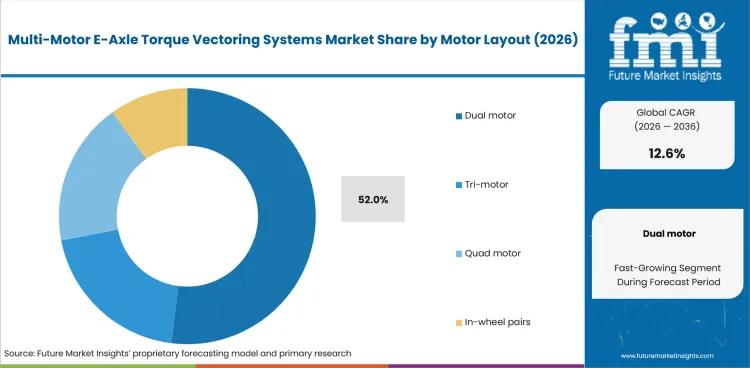
- Dual motor layouts are expected to hold 52.0% share in 2026 with front and rear e-axles giving stable torque control without the higher cost of quad motor systems.
- Tri-motor systems are expected to serve performance EVs in 2026 because rear axle bias improves launch feel and cornering response. Demand for electric vehicle e-axle systems supports wider use of compact drive layouts.
Insights into Multi-Motor E-Axle Torque Vectoring Systems Market by Vehicle Type
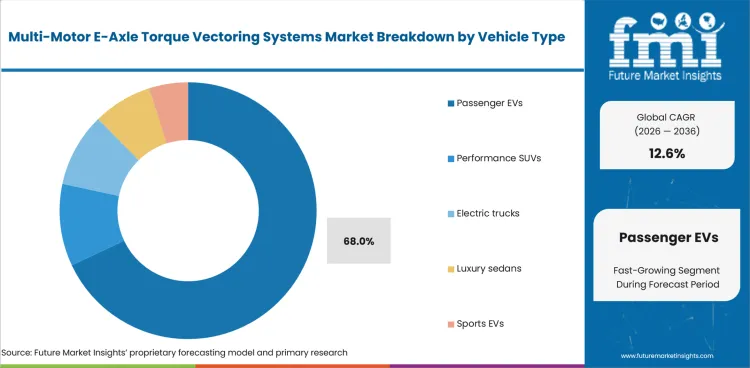
- Passenger EVs are forecast to account for 68.0% share in 2026 as premium sedans and SUVs need smoother grip control in city roads and highways.
- Performance SUVs are expected to support higher system content in 2026 because heavy vehicle weight needs fast torque correction. Demand for bev electric drive unit platforms supports this shift.
Insights into Multi-Motor E-Axle Torque Vectoring Systems Market by Control Type
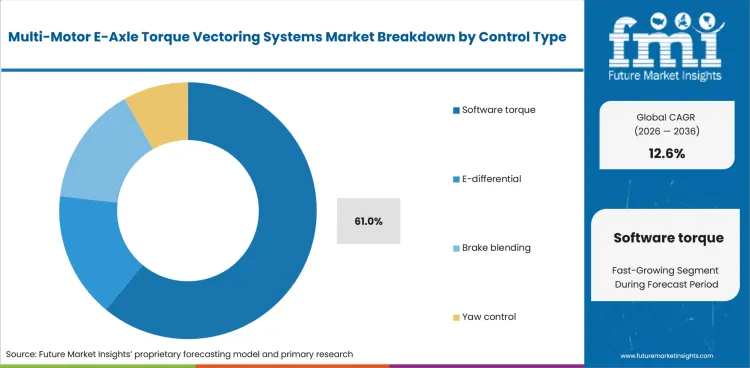
- Software torque control is anticipated to capture 61.0% share in 2026. OEMs move axle response into central vehicle motion software.
- E-differential control is expected to support wheel-side torque management in 2026 because it improves traction on low-grip roads. Demand for e-axle inverter and control unit systems supports this control shift.
Insights into Multi-Motor E-Axle Torque Vectoring Systems Market by Voltage Class
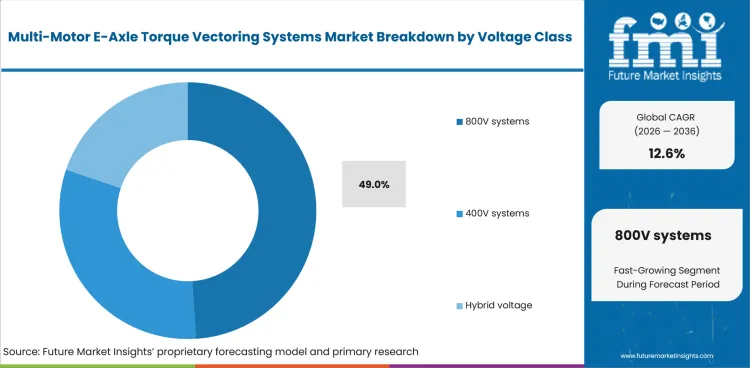
- 800V systems are forecast to hold 49.0% share in 2026 as premium EVs need faster power response and better heat control.
- 400V systems are expected to stay important in 2026 for cost-focused EVs with simpler drive layouts. Demand for e-axle cooling and lubrication parts rises as higher output systems need stable temperature control.
Insights into Multi-Motor E-Axle Torque Vectoring Systems Market by Sales Channel
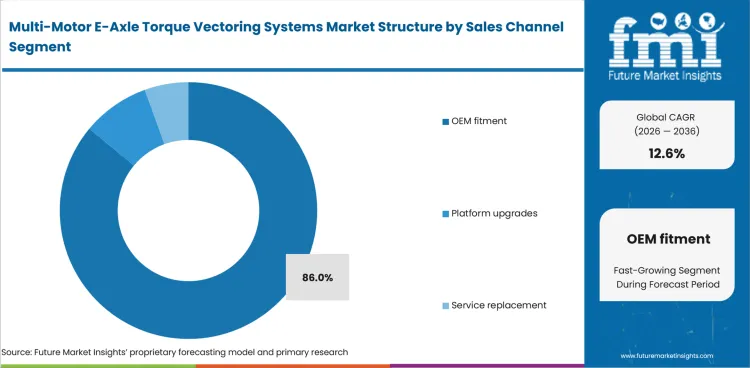
- OEM fitment is expected to account for 86.0% share in 2026 as torque vectoring software must be tuned before vehicle launch.
- Platform upgrades are expected to support limited demand in 2026 when automakers refresh premium EV trims. Demand for automotive e-axle disconnect actuator systems fits the same need for controlled torque transfer.
Multi-Motor E-Axle Torque Vectoring Systems Market Drivers, Restraints, and Opportunities
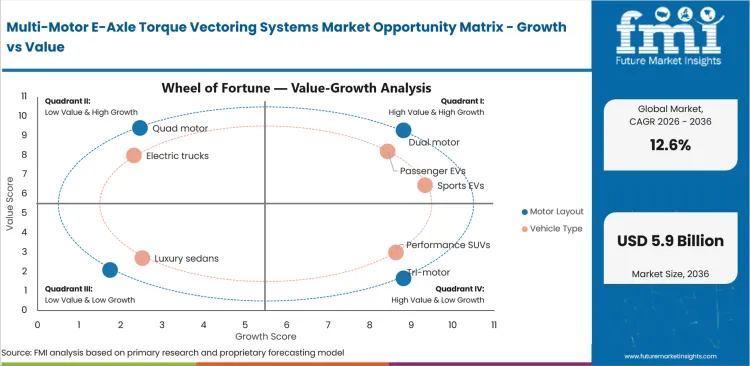
- EV platform reuse is raising demand for modular dual motor e-axles suited to sedans and SUVs.
- High software validation cost can slow adoption as torque split must meet safety and durability targets.
- 800V architectures create higher-value supply openings for integrated motors and SiC power modules.
EV Platform Reuse Raises E-Axle Demand
Automakers want electric drive modules suited to more than one vehicle body. Bosch says its eAxle combines power electronics and motor with transmission in one compact unit. The same platform offers 3-in-1 and 6-in-1 variants for different vehicle needs. Demand for BEV electric drive unit solutions is expected to rise as OEMs reduce separate drivetrain parts. Multi-motor torque vectoring benefits from the same design path. Each added motor needs matched software and clear packaging space.
Software Validation Cost Limits Small Programs
Torque vectoring software affects stability and steering feel. Each calibration needs road testing across low grip and high load use. Bosch Vehicle Motion Management shows why control is becoming cross-domain as braking and powertrain actions must work together. Testing demand supports e-axle and inverter efficiency platforms used before launch approval. Smaller EV programs may slow wheel-level torque control if validation cost is too high. The real barrier is not motor supply. The barrier is proving safe torque response under difficult driving conditions.
Cooling Need Raises System Value
Higher voltage drive systems raise the value of thermal design. Bosch lists fourth generation inverters for 400V and 800V use with up to 6.0% more range. Such power electronics need stable cooling during repeated acceleration and high-speed driving. Demand for e-axle cooling and lubrication components is expected to rise as premium EVs use higher output axle packages. Suppliers can add value by reducing heat stress and keeping torque response stable. Better thermal control helps OEMs protect range and driving feel.
Competitive Landscape and Strategic Positioning
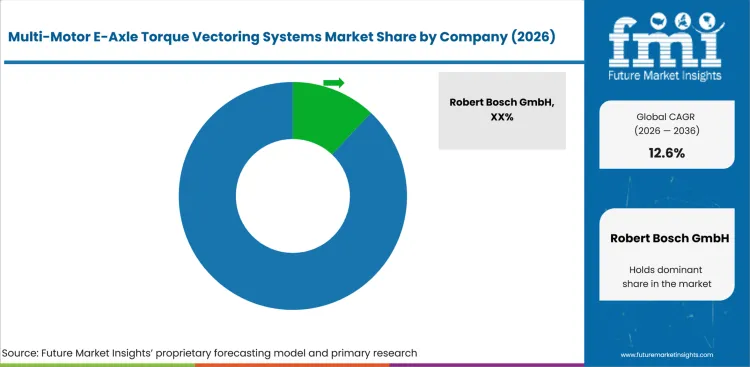
- OEMs compare suppliers based on how well the e-axle fits the vehicle platform and how smoothly the software controls torque.
- Bosch and ZF have an advantage because they can supply integrated drive units for global vehicle programs.
- BorgWarner and GKN Automotive are important suppliers because their torque management systems support wheel-side control in electric drivetrains.
- New suppliers face a difficult entry path since each system must pass safety validation and heat testing before automakers can use it.
Competitive positioning depends on the ability to supply e-axle hardware with control software. Bosch lists its eAxle with 70.0 kW to 300.0 kW output and 400V or 800V voltage options. Demand for e-axle inverter and control unit systems is expected to rise as OEMs prefer compact drive packages with fewer interfaces. Suppliers with tested software can move earlier into vehicle programs. Hardware scale alone is not enough for torque vectoring awards.
Torque management specialists are important because EVs need fast wheel-side control. GKN Automotive presents compact AWD active connect and torque vectoring modules for performance and efficiency needs. Demand for automotive e-axle disconnect actuator systems reflects the same need to manage traction and efficiency in dual motor EVs. BorgWarner supports electric torque management through differential and integrated drive module capability. OEMs need suppliers able to keep torque transfer smooth under low grip and heavy load.
Motor and module specialists add value when e-axles become more compact. Schaeffler and Nidec support electric drive module development through motor and integration capability. Demand for electric vehicle motor systems is expected to grow as multi-motor layouts raise the number of drive units per vehicle. Smaller suppliers can enter through one focused capability such as low noise or better heat control. Large suppliers keep an advantage through validation support and global manufacturing access.
Key Companies in the Multi-Motor E-Axle Torque Vectoring Systems Market
- Integrated E-Axle Suppliers: Robert Bosch GmbH and ZF Friedrichshafen AG hold positions through complete drive unit design and OEM integration depth.
- Torque Management Specialists: BorgWarner Inc. and GKN Automotive serve e-differential needs and torque control programs across electrified driveline systems.
- Motor and Module Suppliers: Schaeffler AG and Nidec Corporation support compact motor systems and integrated axle concepts.
Competitive Benchmarking: Multi-Motor E-Axle Torque Vectoring Systems Market
| Company | E-Axle Integration Depth | Torque Control Software | 800V Readiness | Geographic Footprint |
|---|---|---|---|---|
| Robert Bosch GmbH | High | High | High | Global with European strength |
| ZF Friedrichshafen AG | High | High | High | Global with Germany centered engineering |
| Magna International Inc. | High | Medium | High | North America and Europe centered |
| BorgWarner Inc. | Medium | High | Medium | Global with China program depth |
| GKN Automotive | Medium | High | Medium | Global with driveline strength |
| Schaeffler AG | Medium | Medium | Medium | Europe and Asia centered |
| Nidec Corporation | High | Medium | High | Japan and China focused |
Source: Future Market Insights competitive analysis, 2026.
Key Developments in Multi-Motor E-Axle Torque Vectoring Systems Market
- In July 2025, BorgWarner secured a new electric cross differential program with a leading Chinese OEM for electric vehicles in China. The eXD system controls power distribution between wheels and supports handling plus traction under changing road conditions.
- In February 2026, BorgWarner secured its first 48V electric cross differential program with a leading Chinese OEM. The eXD solution is integrated with the OEM’s 48V electrical and electronic architecture and is designed to control torque distribution between wheels.
Key Players in the Multi-Motor E-Axle Torque Vectoring Systems Market
Major Global Players
- Robert Bosch GmbH
- ZF Friedrichshafen AG
- Magna International Inc.
- BorgWarner Inc.
- GKN Automotive
System and Component Specialists
- Schaeffler AG
- Nidec Corporation
Analysis of Multi-Motor E-Axle Torque Vectoring Systems Market by Key Countries
.webp "Top Country Growth Comparison Multi Motor E Axle Torque Vectoring Systems Market Cagr (2026 2036)")
| Country | CAGR |
|---|---|
| China | 14.6% |
| South Korea | 13.8% |
| Germany | 12.9% |
| United States | 11.6% |
| Japan | 11.2% |
| United Kingdom | 10.8% |
| France | 10.5% |
Source: Future Market Insights, 2026.
Sales Analysis of Multi-Motor E-Axle Torque Vectoring Systems Market in China
Fastest-growing country market · 2026-2036
China Market Outlook
China is the fastest-growing country market with 14.6% CAGR during the forecast period. Market revenue is estimated at USD 450.0 million in 2026 and projected to reach USD 1,758.2 million by 2036. Incremental opportunity is estimated at USD 1,308.2 million.
China leads because local EV output gives e-axle suppliers access to large platform volumes. Passenger EVs account for 68.0% of vehicle type demand in 2026. OEM fitment accounts for 86.0% of sales channel demand because torque vectoring must be calibrated before launch.
Key Growth Drivers
- China State Council reported 16.626 million NEVs produced in 2025, giving local e-drive suppliers a large platform base.
- China State Council reported 16.49 million NEVs sold in 2025, which raises demand for electric motors and axle control software.
- OICA reported China produced 34.53 million vehicles in 2025, giving e-axle suppliers access to high-volume OEM programs.
- Domestic EV brands compete through range and performance features. This raises demand for software torque control in premium sedans and performance SUVs.
Key Restraints
- China’s official 2025 auto plan targeted 32.3 million vehicle sales and 15.5 million NEV sales, showing tighter control over market expansion.
- Price competition across local EV brands can reduce margins for higher-cost torque vectoring packages.
- Wider use outside premium trims is limited because low-cost EV platforms often prioritize battery range and base drivetrain cost.
What makes China unique
China has the deepest EV production base and a fast-moving domestic supplier network. Local brands can test dual motor and 800V systems across many price points. This shortens the path from platform approval to high-volume production.
Key Companies
- BYD
- Jing-Jin Electric Technologies
- Inovance Automotive
- HYCET E-Chuang
- Shanghai Edrive
Sales & Marketing Channels
- OEM platform nominations
- Tier-one supplier programs
- EV production clusters
- Automaker engineering centers
- Authorized service networks
Market Taxonomy & Sub-Regions Covered
| Segment | Sub-Segments |
|---|---|
| By Motor Layout | Dual Motor, Tri-Motor, Quad Motor, In-wheel Pairs |
| By Vehicle Type | Passenger EVs, Performance SUVs, Electric Trucks, Luxury Sedans, Sports EVs |
| By Control Type | Software Torque, E-Differential, Brake Blending, Yaw Control |
| By Voltage Class | 400V Systems, 800V Systems, Hybrid Voltage |
| By Sales Channel | OEM Fitment, Platform Upgrades, Service Replacement |
| Key Sub-Regions Covered | Guangdong, Jiangsu, Zhejiang, Shanghai, Beijing, Chongqing |
Frequently Asked Questions
How fast is China’s multi-motor e-axle torque vectoring systems market growing?
China is forecast to grow at 14.6% CAGR during the study period, ranking first among the covered countries.
What is China’s market value outlook?
China is estimated at USD 450.0 million in 2026 and projected to reach USD 1,758.2 million by 2036.
Which segment leads in China?
OEM fitment leads with 86.0% sales channel share in 2026 because torque vectoring must be factory-calibrated.
Sales Analysis of Multi-Motor E-Axle Torque Vectoring Systems Market in South Korea
Second-fastest country market · 2026-2036
South Korea Market Outlook
South Korea is forecast to expand at 13.8% CAGR through 2036. Market revenue is estimated at USD 120.0 million in 2026 and projected to reach USD 437.1 million by 2036. Incremental opportunity is estimated at USD 317.1 million.
South Korea matters because EV programs connect with export manufacturing and battery-led vehicle design. Passenger EVs lead demand with 68.0% vehicle type share in 2026. OEM fitment accounts for 86.0% sales channel share because export EV platforms need launch-stage validation.
Key Growth Drivers
- ITA reported South Korea produced 407,009 EVs in 2025, equal to 11.0% of total automobile production.
- MOTIR reported eco-friendly vehicle sales of 76,000 units in February 2026, with electric vehicles reaching 36,000 units.
- South Korea’s automotive exports reached a record USD 72.0 billion in 2025, giving local drivetrain suppliers access to global EV programs.
- Battery and motor engineering depth helps suppliers tune torque delivery around thermal limits and power availability.
Key Restraints
- ITA reported South Korea reduced its maximum EV purchase subsidy to USD 3,950 in 2025, which can limit higher-cost multi-motor adoption in price-sensitive trims.
- South Korea’s battery certification system became effective on February 17, 2025, raising compliance work for EV platform validation.
- Export-led production exposes local drivetrain suppliers to tariff changes and overseas demand shifts.
What makes South Korea unique
South Korea combines battery expertise with vehicle export scale. This gives drivetrain suppliers a clear route to calibrated e-axle modules for global EV models.
Key Companies
- Hyundai Mobis
- Hyundai Transys
- HL Mando
- SNT Motiv
- Kia
Sales & Marketing Channels
- Export platform awards
- OEM engineering programs
- Battery and drivetrain integration centers
- Vehicle validation routes
- Dealer service networks
Market Taxonomy & Sub-Regions Covered
| Segment | Sub-Segments |
|---|---|
| By Motor Layout | Dual Motor, Tri-Motor, Quad Motor, In-wheel Pairs |
| By Vehicle Type | Passenger EVs, Performance SUVs, Electric Trucks, Luxury Sedans, Sports EVs |
| By Control Type | Software Torque, E-Differential, Brake Blending, Yaw Control |
| By Voltage Class | 400V Systems, 800V Systems, Hybrid Voltage |
| By Sales Channel | OEM Fitment, Platform Upgrades, Service Replacement |
| Key Sub-Regions Covered | Ulsan, Gyeonggi, Seoul, Incheon, Chungnam, Busan |
Frequently Asked Questions
How fast is South Korea’s multi-motor e-axle torque vectoring systems market growing?
South Korea is forecast to expand at 13.8% CAGR through 2036.
What is South Korea’s market value outlook?
Revenue is estimated at USD 120.0 million in 2026 and projected to reach USD 437.1 million by 2036.
Which segment leads in South Korea?
OEM fitment leads with 86.0% share in 2026 because export EV platforms need factory validation.
Sales Analysis of Multi-Motor E-Axle Torque Vectoring Systems Market in Germany
Premium EV engineering market · 2026-2036
Germany Market Outlook
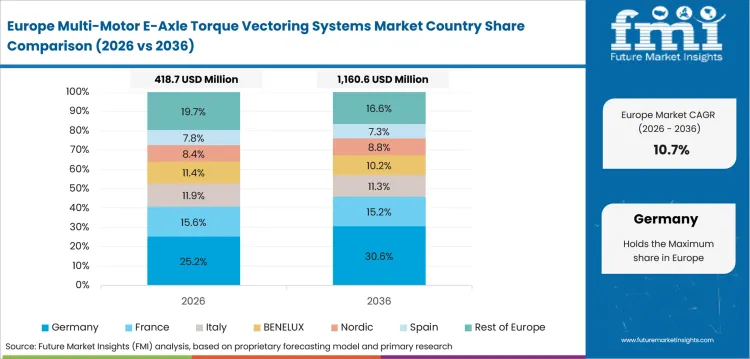
Germany is forecast to expand at 12.9% CAGR between 2026 and 2036. Market revenue is estimated at USD 175.0 million in 2026 and projected to reach USD 588.8 million by 2036. Incremental opportunity is estimated at USD 413.8 million.
Germany holds a major role because premium automakers use driving feel and traction control as product differentiators. Passenger EVs account for 68.0% of vehicle type demand in 2026. Dual motor layouts account for 52.0% of motor layout demand because they give front-rear torque control at lower system cost than quad motor layouts.
Key Growth Drivers
- EAFO reported 45,535 BEV registrations in Germany in April 2025, up 53.5% from April 2024.
- ACEA reported Germany’s BEV registrations rose 43.2% in 2025, which expands the base for factory-integrated torque control.
- Germany’s premium vehicle base favors software torque systems because handling response is part of model positioning.
- Local engineering centers give suppliers access to e-drive validation and chassis calibration work.
Key Restraints
- Destatis reported only 13.5% of newly registered passenger cars in Germany were electric in 2024, equal to 380,609 units.
- OICA reported Europe’s vehicle production slipped 0.8% to 17.2 million units in 2025, which limits supplier capacity expansion.
- Higher labor and validation costs can make German-developed systems harder to place in cost-sensitive EV trims.
What makes Germany unique
Germany has premium vehicle brands and deep e-drive engineering. Torque vectoring is valued because it improves traction and driving feel in high-output electric sedans and SUVs.
Key Companies
- Robert Bosch GmbH
- ZF Friedrichshafen AG
- Schaeffler AG
- Vitesco Technologies
- Porsche Engineering
Sales & Marketing Channels
- Premium OEM platform awards
- Tier-one e-drive contracts
- Engineering validation centers
- Chassis calibration programs
- Authorized service networks
Market Taxonomy & Sub-Regions Covered
| Segment | Sub-Segments |
|---|---|
| By Motor Layout | Dual Motor, Tri-Motor, Quad Motor, In-wheel Pairs |
| By Vehicle Type | Passenger EVs, Performance SUVs, Electric Trucks, Luxury Sedans, Sports EVs |
| By Control Type | Software Torque, E-Differential, Brake Blending, Yaw Control |
| By Voltage Class | 400V Systems, 800V Systems, Hybrid Voltage |
| By Sales Channel | OEM Fitment, Platform Upgrades, Service Replacement |
| Key Sub-Regions Covered | Bavaria, Baden-Württemberg, Lower Saxony, Saxony, Hesse, North Rhine-Westphalia |
Frequently Asked Questions
How fast is Germany’s multi-motor e-axle torque vectoring systems market growing?
Germany is forecast to expand at 12.9% CAGR by 2036.
What is Germany’s market value outlook?
Revenue is estimated at USD 175.0 million in 2026 and projected to reach USD 588.8 million by 2036.
Which segment leads in Germany?
OEM fitment leads with 86.0% sales channel share in 2026 because torque software must be calibrated before premium EV launch.
Sales Analysis of Multi-Motor E-Axle Torque Vectoring Systems Market in United States
Premium SUV and pickup EV market · 2026-2036
United States Market Outlook
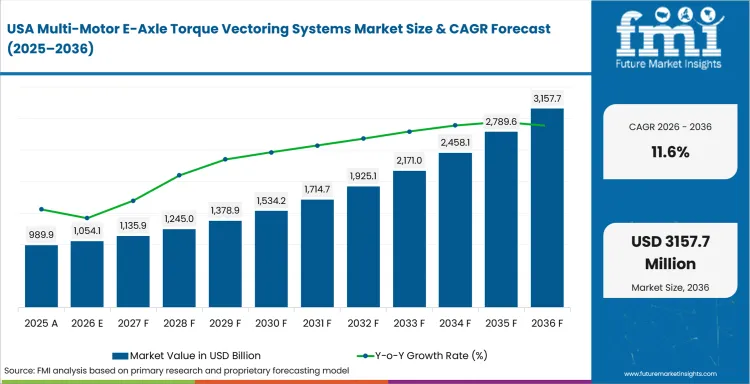
The United States is forecast to expand at 11.6% CAGR over the study period. Market revenue is estimated at USD 200.0 million in 2026 and projected to reach USD 599.3 million by 2036. Incremental opportunity is estimated at USD 399.3 million.
United States demand comes from premium electric SUVs and high-output pickups. Passenger EVs lead with 68.0% vehicle type share in 2026. Software torque accounts for 61.0% of control type demand because traction response must connect with braking and vehicle stability systems.
Key Growth Drivers
- OICA reported the United States produced 10.24 million vehicles in 2025, giving suppliers a large base for electrified platform awards.
- OICA reported United States vehicle sales of 16.7 million units in 2025, creating scale for premium EV trim planning.
- EPA finalized multi-pollutant standards for model year 2027 and later light-duty and medium-duty vehicles in March 2024, which pushes automakers to plan cleaner electric platforms and higher-efficiency drivetrain systems.
- Electric pickups and performance SUVs need torque control for launch response and towing stability.
Key Restraints
- Argonne reported plug-in electric vehicle sales fell 4.0% in 2025 compared with 2024, which can delay some platform upgrade plans.
- Argonne reported plug-in electric vehicles reached only 6.1% of monthly sales in March 2026, limiting wider multi-motor fitment.
- Policy changes around incentives can reduce private-market demand for expensive multi-motor options.
What makes the United States unique
The United States is a large market for electric SUVs and pickups. Multi-motor torque vectoring has a practical role because these vehicles need traction and load control.
Key Companies
- Rivian
- Lucid Motors
- Tesla
- American Axle & Manufacturing
- Dana Incorporated
Sales & Marketing Channels
- OEM platform contracts
- Direct automaker engineering programs
- Electric pickup launch programs
- Tier-one drivetrain supply
- Service replacement networks
Market Taxonomy & Sub-Regions Covered
| Segment | Sub-Segments |
|---|---|
| By Motor Layout | Dual Motor, Tri-Motor, Quad Motor, In-wheel Pairs |
| By Vehicle Type | Passenger EVs, Performance SUVs, Electric Trucks, Luxury Sedans, Sports EVs |
| By Control Type | Software Torque, E-Differential, Brake Blending, Yaw Control |
| By Voltage Class | 400V Systems, 800V Systems, Hybrid Voltage |
| By Sales Channel | OEM Fitment, Platform Upgrades, Service Replacement |
| Key Sub-Regions Covered | Michigan, California, Texas, Tennessee, Ohio, Georgia |
Frequently Asked Questions
How fast is the United States multi-motor e-axle torque vectoring systems market growing?
The United States is forecast to expand at 11.6% CAGR across the forecast period.
What is the United States market value outlook?
Revenue is estimated at USD 200.0 million in 2026 and projected to reach USD 599.3 million by 2036.
Which segment leads in the United States?
OEM fitment leads with 86.0% sales channel share in 2026 because factory calibration is required for towing and stability control.
Sales Analysis of Multi-Motor E-Axle Torque Vectoring Systems Market in Japan
Compact e-drive engineering market · 2026-2036
Japan Market Outlook
Japan is forecast to expand at 11.2% CAGR by 2036. Market revenue is estimated at USD 105.0 million in 2026 and projected to reach USD 303.6 million by 2036. Incremental opportunity is estimated at USD 198.6 million.
Japan’s role comes from motor design and precision manufacturing. Passenger EVs account for 68.0% of demand in 2026. OEM fitment leads with 86.0% share because Japanese suppliers often serve export platform programs that need launch-stage validation.
Key Growth Drivers
- OICA reported Japan produced 8.41 million vehicles in 2025, giving local suppliers a large engineering and export base.
- METI stated Japan targets 100% electrified new passenger vehicle sales by 2035, which keeps drivetrain electrification central to policy planning.
- METI reported the automobile sector accounts for about 16.0% of Japan’s total CO2 emissions, giving low-loss electric drive systems a policy role.
- Japanese suppliers have strength in compact motors and low-noise components, which suits premium passenger EVs and luxury sedans.
Key Restraints
- JAMA reported Japan’s motor vehicle production totaled 8.23 million units in 2024, below the 2023 level.
- Japan’s 2035 electrification target includes hybrids, which can slow BEV-only demand for quad motor and in-wheel pair layouts.
- Conservative vehicle launch cycles can stretch validation timelines for torque vectoring systems.
What makes Japan unique
Japan has deep capability in compact motors and precision components. Local suppliers can win export programs even when domestic BEV uptake moves at a cautious pace.
Key Companies
- Denso Corporation
- Aisin Corporation
- JTEKT Corporation
- Hitachi Astemo
- Toyota Motor Corporation
Sales & Marketing Channels
- Export platform nominations
- OEM supplier programs
- Motor and inverter integration routes
- Vehicle test centers
- Authorized repair networks
Market Taxonomy & Sub-Regions Covered
| Segment | Sub-Segments |
|---|---|
| By Motor Layout | Dual Motor, Tri-Motor, Quad Motor, In-wheel Pairs |
| By Vehicle Type | Passenger EVs, Performance SUVs, Electric Trucks, Luxury Sedans, Sports EVs |
| By Control Type | Software Torque, E-Differential, Brake Blending, Yaw Control |
| By Voltage Class | 400V Systems, 800V Systems, Hybrid Voltage |
| By Sales Channel | OEM Fitment, Platform Upgrades, Service Replacement |
| Key Sub-Regions Covered | Aichi, Kanagawa, Shizuoka, Tokyo, Saitama, Fukuoka |
Frequently Asked Questions
How fast is Japan’s multi-motor e-axle torque vectoring systems market growing?
Japan is forecast to expand at 11.2% CAGR by 2036.
What is Japan’s market value outlook?
Revenue is estimated at USD 105.0 million in 2026 and projected to reach USD 303.6 million by 2036.
Which segment leads in Japan?
OEM fitment leads with 86.0% share in 2026 because torque systems require vehicle-level validation.
Sales Analysis of Multi-Motor E-Axle Torque Vectoring Systems Market in United Kingdom
Premium EV validation market · 2026-2036
United Kingdom Market Outlook
The United Kingdom is forecast to expand at 10.8% CAGR across the forecast period. Market revenue is estimated at USD 85.0 million in 2026 and projected to reach USD 237.0 million by 2036. Incremental opportunity is estimated at USD 152.0 million.
United Kingdom demand is led by premium vehicle engineering and zero-emission vehicle rules. Passenger EVs lead with 68.0% vehicle type share in 2026. OEM fitment accounts for 86.0% of demand because torque vectoring must be integrated during vehicle development.
Key Growth Drivers
- House of Commons Library reported the ZEV mandate rises to 80.0% of carmaker sales by 2030 and 100.0% by 2035.
- DfT reported 2,012,000 licensed zero-emission vehicles at the end of December 2025, equal to 4.8% of all licensed vehicles.
- DfT reported 1,874,000 road-using zero-emission vehicles at the end of December 2025, creating a larger base for service planning.
- Premium EV engineering in the West Midlands creates demand for chassis calibration and torque control validation.
Key Restraints
- SMMT reported UK vehicle production fell 15.5% in 2025 to 764,715 cars and commercial vehicles.
- House of Commons Library reported April 2025 relaxations to some ZEV mandate rules, which can reduce near-term pressure for high-cost drivetrain content.
- Smaller domestic production scale limits local volume for e-axle manufacturing compared with China and Germany.
What makes the United Kingdom unique
The United Kingdom is smaller in production scale, yet it has high-value engineering depth. Demand is strongest in premium EV testing and factory-fit torque control systems.
Key Companies
- GKN Automotive
- Protean Electric
- Equipmake
- YASA
- McLaren Applied
Sales & Marketing Channels
- Premium OEM engineering programs
- Prototype and validation routes
- Tier-one driveline contracts
- Performance EV programs
- Specialist service networks
Market Taxonomy & Sub-Regions Covered
| Segment | Sub-Segments |
|---|---|
| By Motor Layout | Dual Motor, Tri-Motor, Quad Motor, In-wheel Pairs |
| By Vehicle Type | Passenger EVs, Performance SUVs, Electric Trucks, Luxury Sedans, Sports EVs |
| By Control Type | Software Torque, E-Differential, Brake Blending, Yaw Control |
| By Voltage Class | 400V Systems, 800V Systems, Hybrid Voltage |
| By Sales Channel | OEM Fitment, Platform Upgrades, Service Replacement |
| Key Sub-Regions Covered | West Midlands, Oxfordshire, Greater London, Warwickshire, Sunderland, Coventry |
Frequently Asked Questions
How fast is the United Kingdom multi-motor e-axle torque vectoring systems market growing?
The United Kingdom is forecast to expand at 10.8% CAGR by 2036.
What is the United Kingdom market value outlook?
Revenue is estimated at USD 85.0 million in 2026 and projected to reach USD 237.0 million by 2036.
Which segment leads in the United Kingdom?
OEM fitment leads with 86.0% sales channel share in 2026 because premium EV programs need factory-level calibration.
Sales Analysis of Multi-Motor E-Axle Torque Vectoring Systems Market in France
European compact EV platform market · 2026-2036
France Market Outlook
France is forecast to expand at 10.5% CAGR during the study period. Market revenue is estimated at USD 80.0 million in 2026 and projected to reach USD 217.1 million by 2036. Incremental opportunity is estimated at USD 137.1 million.
France has a clear role in European EV platform planning. Passenger EVs account for 68.0% of demand in 2026. OEM fitment leads with 86.0% share because e-axle torque control must be approved during vehicle validation.
Key Growth Drivers
- ACEA reported France’s BEV registrations rose 12.5% in 2025, giving automakers a larger base for electric drivetrain software.
- Service-Public.fr reported EV aid continued after July 1, 2025 through energy saving certificates, helping preserve demand for qualifying electric passenger cars.
- ICCT reported combined BEV and PHEV market share in Europe reached 25.0% year to date in 2025, keeping French platforms aligned with regional EV planning.
- French EV programs need efficient e-axle packages for compact models. Software torque control helps improve traction and range management.
Key Restraints
- Service-Public.fr reported the ecological bonus for new passenger cars was removed on July 1, 2025, creating a policy transition for EV demand.
- ICCT reported total passenger car registrations in France fell 12.0% in May 2025 compared with May 2024, which can slow platform volume planning.
- Compact EV programs face strict cost targets, which can limit quad motor and in-wheel pair adoption.
What makes France unique
France is important for compact EV programs and European platform sourcing. Demand is strongest in factory-fit systems that balance efficiency and stable driving performance.
Key Companies
- Valeo
- Ampere
- Stellantis
- Dumarey Powerglide
- Mersen
Sales & Marketing Channels
- European OEM platform awards
- Compact EV programs
- Tier-one supply routes
- Engineering validation centers
- Dealer service networks
Market Taxonomy & Sub-Regions Covered
| Segment | Sub-Segments |
|---|---|
| By Motor Layout | Dual Motor, Tri-Motor, Quad Motor, In-wheel Pairs |
| By Vehicle Type | Passenger EVs, Performance SUVs, Electric Trucks, Luxury Sedans, Sports EVs |
| By Control Type | Software Torque, E-Differential, Brake Blending, Yaw Control |
| By Voltage Class | 400V Systems, 800V Systems, Hybrid Voltage |
| By Sales Channel | OEM Fitment, Platform Upgrades, Service Replacement |
| Key Sub-Regions Covered | Île-de-France, Hauts-de-France, Grand Est, Auvergne-Rhône-Alpes, Normandy, Nouvelle-Aquitaine |
Frequently Asked Questions
How fast is France’s multi-motor e-axle torque vectoring systems market growing?
France is forecast to expand at 10.5% CAGR during the forecast period.
What is France’s market value outlook?
Revenue is estimated at USD 80.0 million in 2026 and projected to reach USD 217.1 million by 2036.
Which segment leads in France?
OEM fitment leads with 86.0% share in 2026 because e-axle torque control must be built into the vehicle platform.
Report Scope and Coverage
| Parameter | Details |
|---|---|
| Quantitative Units | USD 1.8 billion to USD 5.9 billion at 12.6% CAGR |
| Market Definition | Electric drive systems that use two or more motors to control torque across EV axles or wheels |
| Segments Covered | Motor layout, vehicle type, control type, voltage class, sales channel, and region |
| Motor Layout | Dual motor, tri-motor, quad motor, and in-wheel pairs |
| Vehicle Type | Passenger EVs, performance SUVs, electric trucks, luxury sedans, and sports EVs |
| Control Type | Software torque, e-differential, brake blending, and yaw control |
| Voltage Class | 800V systems, 400V systems, and hybrid voltage systems |
| Sales Channel | OEM fitment, platform upgrades, and service replacement |
| Regions Covered | North America, Latin America, Western Europe, Eastern Europe, East Asia, South Asia and Pacific, Middle East and Africa |
| Countries Covered | United States, China, South Korea, Germany, Japan, United Kingdom, France, and more than 30.0 countries |
| Key Companies Profiled | Robert Bosch GmbH, ZF Friedrichshafen AG, Magna International Inc., BorgWarner Inc., GKN Automotive, Schaeffler AG, and Nidec Corporation |
| Forecast Period | 2026 to 2036 |
| Approach | Hybrid bottom-up and top-down method using EV platform penetration, multi-motor fitment, e-axle pricing, control software content, and supplier program activity |
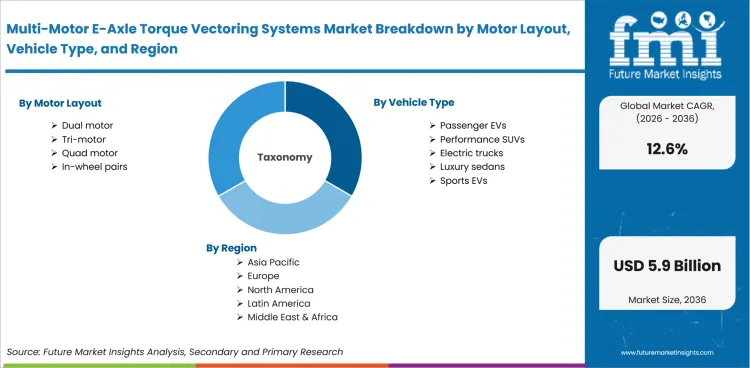
Multi-Motor E-Axle Torque Vectoring Systems Market Breakdown by Motor Layout and Vehicle Type with Control Type and Voltage Class. Sales Channel and Region
Multi-Motor E-Axle Torque Vectoring Systems Market Segmented by Motor Layout
- Dual motor
- Tri-motor
- Quad motor
- In-wheel pairs
Multi-Motor E-Axle Torque Vectoring Systems Market Segmented by Vehicle Type
- Passenger EVs
- Performance SUVs
- Electric trucks
- Luxury sedans
- Sports EVs
Multi-Motor E-Axle Torque Vectoring Systems Market Segmented by Control Type
- Software torque
- E-differential
- Brake blending
- Yaw control
Multi-Motor E-Axle Torque Vectoring Systems Market Segmented by Voltage Class
- 800V systems
- 400V systems
- Hybrid voltage
Multi-Motor E-Axle Torque Vectoring Systems Market Segmented by Sales Channel
- OEM fitment
- Platform upgrades
- Service replacement
Multi-Motor E-Axle Torque Vectoring Systems Market by Region
- North America
- Latin America
- Western Europe
- Eastern Europe
- East Asia
- South Asia and Pacific
- Middle East and Africa
Research Sources and Bibliography
- Council of the European Union. (2024, April 12). Euro 7: Council adopts new rules on emission limits for cars, vans and trucks.
- BorgWarner Inc. (2024, May 2). BorgWarner supplies Polestar BEV SUVs with electric torque vectoring and disconnect systems.
- Magna International Inc. (2024, February 6). Magna awarded specialized eDrive system business with North America-based OEM.
- Robert Bosch GmbH. (n.d.). eAxle systems. Bosch Mobility.
- Robert Bosch GmbH. (n.d.). Vehicle Motion Management. Bosch Mobility.
- Robert Bosch GmbH. (n.d.). Inverter generation 4. Bosch Mobility.
- BorgWarner Inc. (2025, July 31). BorgWarner secures new electric cross differential project for electric vehicles in China.
- BorgWarner Inc. (2026, February 11). BorgWarner secures its first 48V electric cross differential program.
- European Automobile Manufacturers’ Association. (2026, January 27). New car registrations: +1.8% in 2025; battery-electric 17.4% market share.
- Bureau of Transportation Statistics. (n.d.). Hybrid-electric, plug-in hybrid-electric and electric vehicle sales. USA Department of Transportation.
- USA Environmental Protection Agency. (2024, March 20). Final rule: Multi-pollutant emissions standards for model years 2027 and later light-duty and medium-duty vehicles.
- German Federal Statistical Office. (2025, September 8). Electric cars: Low number of new registrations. Destatis.
- European Alternative Fuels Observatory. (2025, May 8). Germany: BEV registrations surge by 54% in April 2025. European Commission.
- Hutton, G., Stewart, I., Benson, M., Webb, D., & Jozepa, I. (2025, June 20). Electric vehicles and infrastructure. House of Commons Library.
- Monteforte, M., & Diaz de Aguilar, S. (2025, June 25). European market monitor: Cars and vans, May 2025. International Council on Clean Transportation.
- International Organization of Motor Vehicle Manufacturers. (2026, April 23). Auto industry growth shifted east in 2025 amid global repositioning.
- International Trade Administration. (2025, July 21). South Korea electric vehicles EV market. USA Department of Commerce.
- Japan Automobile Manufacturers Association. (2025, September). The motor industry of Japan 2025.
- Ministry of Economy, Trade and Industry. (2024, June 24). Subsidies upgraded for the purchase of clean energy vehicles toward the realization of GX in the automobile sector. Agency for Natural Resources and Energy.
- Ministry of Trade, Industry and Resources. (2026, January 15). Automobile exports hit record high of $72 billion in 2025.
- Ministry of Trade, Industry and Resources. (2026, March 19). February 2026 automobile exports reach $4.8 billion.
- Directorate of Legal and Administrative Information. (2025, July 3). What is the follow-up to the ecological bonus? Service-Public.fr.
- Directorate of Legal and Administrative Information. (2025, September 10). New €1,000 premium for the purchase of an electric vehicle produced in Europe. Service-Public.fr.
- Society of Motor Manufacturers and Traders. (2026, January 29). Tough year for auto but new models and industrial strategy can deliver growth.
- Department for Transport. (2026, April 29). Vehicle licensing statistics, United Kingdom: 2025. GOV.UK.
This Report Answers
- What is the current size of the multi-motor e-axle torque vectoring systems market?
- What will be the multi-motor e-axle torque vectoring systems market value by 2036?
- What CAGR is expected during the forecast period for multi-motor e-axle torque vectoring systems market?
- Which sales channel holds the leading share in the market?
- Which vehicle type leads demand in multi-motor e-axle torque vectoring systems market?
- Which countries expand faster in the multi-motor e-axle torque vectoring systems market?
- Which suppliers are important for multi-motor e-axle torque vectoring systems market?
- What decides supplier selection for the multi-motor e-axle torque vectoring systems market?
Frequently Asked Questions
What is multi-motor e-axle torque vectoring?
Multi-motor e-axle torque vectoring uses two or more electric motors to vary torque across axles or wheels. The system improves traction and handling in electric vehicles.
How large is the market in 2026?
Market revenue is expected to reach USD 1.8 billion in 2026 based on EV production and multi-motor platform penetration.
What is the 2036 revenue outlook?
Revenue is forecast to reach USD 5.9 billion by 2036 as premium EVs and electric SUVs add calibrated torque split systems.
What CAGR is expected for 2026 to 2036?
Demand is expected to rise at 12.6% CAGR from 2026 to 2036 as multi-motor fitment expands in EV platforms.
Which segment leads by sales channel?
OEM fitment leads sales channel demand with an anticipated 86.0% share in 2026 due to vehicle-level validation needs.
Which vehicle type drives demand?
Passenger EVs drive demand with a forecast 68.0% share in 2026 as premium models use multi-motor systems for traction and control.
Why do automakers use torque vectoring in EVs?
Automakers use torque vectoring to improve grip and launch control without adding extra mechanical driveline complexity.
Which country grows fastest?
China is expected to record 14.6% CAGR through 2036 as EV production scale supports faster adoption of multi-motor systems.
Which companies are active in this market?
Bosch and ZF are active suppliers. Magna and BorgWarner support e-axle hardware and torque control software.
What is the main adoption barrier?
Main adoption barrier is software validation cost since torque commands must stay safe during braking and low-grip driving events.
Preview the report firsthand - request a free sample
Get SampleGet the brochure for pricing and purchase details.
Get PDFTable of Content
- Executive Summary
- Global Market Outlook
- Demand-side Trends
- Supply-side Trends
- Technology Roadmap Analysis
- Analysis and Recommendations
- Market Overview
- Market Coverage / Taxonomy
- Market Definition / Scope / Limitations
- Research Methodology
- Chapter Orientation
- Analytical Lens and Working Hypotheses
- Market Structure, Signals, and Trend Drivers
- Benchmarking and Cross-market Comparability
- Market Sizing, Forecasting, and Opportunity Mapping
- Research Design and Evidence Framework
- Desk Research Programme (Secondary Evidence)
- Company Annual and Sustainability Reports
- Peer-reviewed Journals and Academic Literature
- Corporate Websites, Product Literature, and Technical Notes
- Earnings Decks and Investor Briefings
- Statutory Filings and Regulatory Disclosures
- Technical White Papers and Standards Notes
- Trade Journals, Industry Magazines, and Analyst Briefs
- Conference Proceedings, Webinars, and Seminar Materials
- Government Statistics Portals and Public Data Releases
- Press Releases and Reputable Media Coverage
- Specialist Newsletters and Curated Briefings
- Sector Databases and Reference Repositories
- FMI Internal Proprietary Databases and Historical Market Datasets
- Subscription Datasets and Paid Sources
- Social Channels, Communities, and Digital Listening Inputs
- Additional Desk Sources
- Expert Input and Fieldwork (Primary Evidence)
- Primary Modes
- Qualitative Interviews and Expert Elicitation
- Quantitative Surveys and Structured Data Capture
- Blended Approach
- Why Primary Evidence is Used
- Field Techniques
- Interviews
- Surveys
- Focus Groups
- Observational and In-context Research
- Social and Community Interactions
- Stakeholder Universe Engaged
- C-suite Leaders
- Board Members
- Presidents and Vice Presidents
- R&D and Innovation Heads
- Technical Specialists
- Domain Subject-matter Experts
- Scientists
- Physicians and Other Healthcare Professionals
- Governance, Ethics, and Data Stewardship
- Research Ethics
- Data Integrity and Handling
- Primary Modes
- Tooling, Models, and Reference Databases
- Desk Research Programme (Secondary Evidence)
- Data Engineering and Model Build
- Data Acquisition and Ingestion
- Cleaning, Normalisation, and Verification
- Synthesis, Triangulation, and Analysis
- Quality Assurance and Audit Trail
- Market Background
- Market Dynamics
- Drivers
- Restraints
- Opportunity
- Trends
- Scenario Forecast
- Demand in Optimistic Scenario
- Demand in Likely Scenario
- Demand in Conservative Scenario
- Opportunity Map Analysis
- Product Life Cycle Analysis
- Supply Chain Analysis
- Investment Feasibility Matrix
- Value Chain Analysis
- PESTLE and Porter’s Analysis
- Regulatory Landscape
- Regional Parent Market Outlook
- Production and Consumption Statistics
- Import and Export Statistics
- Market Dynamics
- Global Market Analysis 2021 to 2025 and Forecast, 2026 to 2036
- Historical Market Size Value (USD Million) Analysis, 2021 to 2025
- Current and Future Market Size Value (USD Million) Projections, 2026 to 2036
- Y-o-Y Growth Trend Analysis
- Absolute $ Opportunity Analysis
- Global Market Pricing Analysis 2021 to 2025 and Forecast 2026 to 2036
- Global Market Analysis 2021 to 2025 and Forecast 2026 to 2036, By Product Type
- Introduction / Key Findings
- Historical Market Size Value (USD Million) Analysis By Product Type , 2021 to 2025
- Current and Future Market Size Value (USD Million) Analysis and Forecast By Product Type , 2026 to 2036
- Soy Protein
- Wheat Protein
- Pea Protein
- Soy Protein
- Y-o-Y Growth Trend Analysis By Product Type , 2021 to 2025
- Absolute $ Opportunity Analysis By Product Type , 2026 to 2036
- Global Market Analysis 2021 to 2025 and Forecast 2026 to 2036, By Form
- Introduction / Key Findings
- Historical Market Size Value (USD Million) Analysis By Form, 2021 to 2025
- Current and Future Market Size Value (USD Million) Analysis and Forecast By Form, 2026 to 2036
- Granules
- Chunks
- Slices
- Granules
- Y-o-Y Growth Trend Analysis By Form, 2021 to 2025
- Absolute $ Opportunity Analysis By Form, 2026 to 2036
- Global Market Analysis 2021 to 2025 and Forecast 2026 to 2036, By End Use
- Introduction / Key Findings
- Historical Market Size Value (USD Million) Analysis By End Use, 2021 to 2025
- Current and Future Market Size Value (USD Million) Analysis and Forecast By End Use, 2026 to 2036
- Industrial
- Household
- Commercial
- Industrial
- Y-o-Y Growth Trend Analysis By End Use, 2021 to 2025
- Absolute $ Opportunity Analysis By End Use, 2026 to 2036
- Global Market Analysis 2021 to 2025 and Forecast 2026 to 2036, By Application
- Introduction / Key Findings
- Historical Market Size Value (USD Million) Analysis By Application, 2021 to 2025
- Current and Future Market Size Value (USD Million) Analysis and Forecast By Application, 2026 to 2036
- Meat Extenders
- Meat Alternatives
- Snacks
- Meat Extenders
- Y-o-Y Growth Trend Analysis By Application, 2021 to 2025
- Absolute $ Opportunity Analysis By Application, 2026 to 2036
- Global Market Analysis 2021 to 2025 and Forecast 2026 to 2036, By Nature
- Introduction / Key Findings
- Historical Market Size Value (USD Million) Analysis By Nature, 2021 to 2025
- Current and Future Market Size Value (USD Million) Analysis and Forecast By Nature, 2026 to 2036
- Conventional
- Organic
- Conventional
- Y-o-Y Growth Trend Analysis By Nature, 2021 to 2025
- Absolute $ Opportunity Analysis By Nature, 2026 to 2036
- Global Market Analysis 2021 to 2025 and Forecast 2026 to 2036, By Region
- Introduction
- Historical Market Size Value (USD Million) Analysis By Region, 2021 to 2025
- Current Market Size Value (USD Million) Analysis and Forecast By Region, 2026 to 2036
- North America
- Latin America
- Western Europe
- Eastern Europe
- East Asia
- South Asia and Pacific
- Middle East & Africa
- Market Attractiveness Analysis By Region
- North America Market Analysis 2021 to 2025 and Forecast 2026 to 2036, By Country
- Historical Market Size Value (USD Million) Trend Analysis By Market Taxonomy, 2021 to 2025
- Market Size Value (USD Million) Forecast By Market Taxonomy, 2026 to 2036
- By Country
- USA
- Canada
- Mexico
- By Product Type
- By Form
- By End Use
- By Application
- By Nature
- By Country
- Market Attractiveness Analysis
- By Country
- By Product Type
- By Form
- By End Use
- By Application
- By Nature
- Key Takeaways
- Latin America Market Analysis 2021 to 2025 and Forecast 2026 to 2036, By Country
- Historical Market Size Value (USD Million) Trend Analysis By Market Taxonomy, 2021 to 2025
- Market Size Value (USD Million) Forecast By Market Taxonomy, 2026 to 2036
- By Country
- Brazil
- Chile
- Rest of Latin America
- By Product Type
- By Form
- By End Use
- By Application
- By Nature
- By Country
- Market Attractiveness Analysis
- By Country
- By Product Type
- By Form
- By End Use
- By Application
- By Nature
- Key Takeaways
- Western Europe Market Analysis 2021 to 2025 and Forecast 2026 to 2036, By Country
- Historical Market Size Value (USD Million) Trend Analysis By Market Taxonomy, 2021 to 2025
- Market Size Value (USD Million) Forecast By Market Taxonomy, 2026 to 2036
- By Country
- Germany
- UK
- Italy
- Spain
- France
- Nordic
- BENELUX
- Rest of Western Europe
- By Product Type
- By Form
- By End Use
- By Application
- By Nature
- By Country
- Market Attractiveness Analysis
- By Country
- By Product Type
- By Form
- By End Use
- By Application
- By Nature
- Key Takeaways
- Eastern Europe Market Analysis 2021 to 2025 and Forecast 2026 to 2036, By Country
- Historical Market Size Value (USD Million) Trend Analysis By Market Taxonomy, 2021 to 2025
- Market Size Value (USD Million) Forecast By Market Taxonomy, 2026 to 2036
- By Country
- Russia
- Poland
- Hungary
- Balkan & Baltic
- Rest of Eastern Europe
- By Product Type
- By Form
- By End Use
- By Application
- By Nature
- By Country
- Market Attractiveness Analysis
- By Country
- By Product Type
- By Form
- By End Use
- By Application
- By Nature
- Key Takeaways
- East Asia Market Analysis 2021 to 2025 and Forecast 2026 to 2036, By Country
- Historical Market Size Value (USD Million) Trend Analysis By Market Taxonomy, 2021 to 2025
- Market Size Value (USD Million) Forecast By Market Taxonomy, 2026 to 2036
- By Country
- China
- Japan
- South Korea
- By Product Type
- By Form
- By End Use
- By Application
- By Nature
- By Country
- Market Attractiveness Analysis
- By Country
- By Product Type
- By Form
- By End Use
- By Application
- By Nature
- Key Takeaways
- South Asia and Pacific Market Analysis 2021 to 2025 and Forecast 2026 to 2036, By Country
- Historical Market Size Value (USD Million) Trend Analysis By Market Taxonomy, 2021 to 2025
- Market Size Value (USD Million) Forecast By Market Taxonomy, 2026 to 2036
- By Country
- India
- ASEAN
- Australia & New Zealand
- Rest of South Asia and Pacific
- By Product Type
- By Form
- By End Use
- By Application
- By Nature
- By Country
- Market Attractiveness Analysis
- By Country
- By Product Type
- By Form
- By End Use
- By Application
- By Nature
- Key Takeaways
- Middle East & Africa Market Analysis 2021 to 2025 and Forecast 2026 to 2036, By Country
- Historical Market Size Value (USD Million) Trend Analysis By Market Taxonomy, 2021 to 2025
- Market Size Value (USD Million) Forecast By Market Taxonomy, 2026 to 2036
- By Country
- Kingdom of Saudi Arabia
- Other GCC Countries
- Turkiye
- South Africa
- Other African Union
- Rest of Middle East & Africa
- By Product Type
- By Form
- By End Use
- By Application
- By Nature
- By Country
- Market Attractiveness Analysis
- By Country
- By Product Type
- By Form
- By End Use
- By Application
- By Nature
- Key Takeaways
- Key Countries Market Analysis
- USA
- Pricing Analysis
- Market Share Analysis, 2025
- By Product Type
- By Form
- By End Use
- By Application
- By Nature
- Canada
- Pricing Analysis
- Market Share Analysis, 2025
- By Product Type
- By Form
- By End Use
- By Application
- By Nature
- Mexico
- Pricing Analysis
- Market Share Analysis, 2025
- By Product Type
- By Form
- By End Use
- By Application
- By Nature
- Brazil
- Pricing Analysis
- Market Share Analysis, 2025
- By Product Type
- By Form
- By End Use
- By Application
- By Nature
- Chile
- Pricing Analysis
- Market Share Analysis, 2025
- By Product Type
- By Form
- By End Use
- By Application
- By Nature
- Germany
- Pricing Analysis
- Market Share Analysis, 2025
- By Product Type
- By Form
- By End Use
- By Application
- By Nature
- UK
- Pricing Analysis
- Market Share Analysis, 2025
- By Product Type
- By Form
- By End Use
- By Application
- By Nature
- Italy
- Pricing Analysis
- Market Share Analysis, 2025
- By Product Type
- By Form
- By End Use
- By Application
- By Nature
- Spain
- Pricing Analysis
- Market Share Analysis, 2025
- By Product Type
- By Form
- By End Use
- By Application
- By Nature
- France
- Pricing Analysis
- Market Share Analysis, 2025
- By Product Type
- By Form
- By End Use
- By Application
- By Nature
- India
- Pricing Analysis
- Market Share Analysis, 2025
- By Product Type
- By Form
- By End Use
- By Application
- By Nature
- ASEAN
- Pricing Analysis
- Market Share Analysis, 2025
- By Product Type
- By Form
- By End Use
- By Application
- By Nature
- Australia & New Zealand
- Pricing Analysis
- Market Share Analysis, 2025
- By Product Type
- By Form
- By End Use
- By Application
- By Nature
- China
- Pricing Analysis
- Market Share Analysis, 2025
- By Product Type
- By Form
- By End Use
- By Application
- By Nature
- Japan
- Pricing Analysis
- Market Share Analysis, 2025
- By Product Type
- By Form
- By End Use
- By Application
- By Nature
- South Korea
- Pricing Analysis
- Market Share Analysis, 2025
- By Product Type
- By Form
- By End Use
- By Application
- By Nature
- Russia
- Pricing Analysis
- Market Share Analysis, 2025
- By Product Type
- By Form
- By End Use
- By Application
- By Nature
- Poland
- Pricing Analysis
- Market Share Analysis, 2025
- By Product Type
- By Form
- By End Use
- By Application
- By Nature
- Hungary
- Pricing Analysis
- Market Share Analysis, 2025
- By Product Type
- By Form
- By End Use
- By Application
- By Nature
- Kingdom of Saudi Arabia
- Pricing Analysis
- Market Share Analysis, 2025
- By Product Type
- By Form
- By End Use
- By Application
- By Nature
- Turkiye
- Pricing Analysis
- Market Share Analysis, 2025
- By Product Type
- By Form
- By End Use
- By Application
- By Nature
- South Africa
- Pricing Analysis
- Market Share Analysis, 2025
- By Product Type
- By Form
- By End Use
- By Application
- By Nature
- USA
- Market Structure Analysis
- Competition Dashboard
- Competition Benchmarking
- Market Share Analysis of Top Players
- By Regional
- By Product Type
- By Form
- By End Use
- By Application
- By Nature
- Competition Analysis
- Competition Deep Dive
- Cargill
- Overview
- Product Portfolio
- Profitability by Market Segments (Product/Age /Sales Channel/Region)
- Sales Footprint
- Strategy Overview
- Marketing Strategy
- Product Strategy
- Channel Strategy
- ADM
- Sonic Biochem
- Roquette Frères
- IFF
- Cargill
- Competition Deep Dive
- Assumptions & Acronyms Used


